國立交通大學
英語教學研究所碩士論文
A Master Thesis Presented to Institute of TESOL, National Chiao Tung University In Partial Fulfillment of the Requirements
for the Degree of Master of Arts
圖像中的萬語千言: 美式英語母語者與台灣英語學習者對
於行銷圖像隱喻的解讀
A Picture Says a Thousand Words:
The Interpretations of Advertising Pictorial Metaphors by
Native Speakers of American English and Taiwanese
Learners of English
研究生:石耘臺
Graduate: Yun-Tai Shih
指導教授:鄭維容
Advisor: Dr. Stephanie W. Cheng
中華民國九十八年六月
i
ii ABSTRACT
The studies of metaphor endure a great history of research. Metaphors are not
only a form of figure of speech in human communication, but also a sales pitch often
employed by advertisers. There has already been a plethora of studies on advertising
metaphors in consumer research; however, little research has explored advertising
metaphors in pictorial form. Meanwhile, there is only a small body of research done
to ascertain how second language learners perceive advertising metaphors.
This study, therefore, aims to explore how native and non-native English
speakers interpret advertising pictorial metaphors. I intend to answer three research
questions: (1) How do the native and non-native speakers of English interpret
advertising pictorial metaphors? (2) What factors that determine the success of
pictorial metaphor interpretations? and (3) How do the native and non-native speakers
of English perceive the advertisements with and without considering advertiser’s
intention? I follow the research design and adopt the coding scheme of pictorial
metaphors from Forceville (1996). A questionnaire containing four advertisements
and question items is administered to collect data in American and Taiwan. In this
study, a research assistant who is an American is invited to provide assistance in
selecting advertisements, contacting American participants, collecting data in the
United States, and being a second rater. The non-native data is collected from 20
TESOL graduate students enrolled in three different universities in Taiwan, and the
native data is gleaned from another 20 TESOL graduates at the University of Texas in
San Antonio, U. S. A.
Based on the results, the English native speakers from the United States have
more success in identifying pictorial metaphors than their counterparts. In other words,
the American participants seemed to be more attuned to the pictorial metaphors in the
iii
performances in interpreting metaphors by seeking possible factors. By considering
contextual, societal, and individual factors, we re-examine the four advertisements
and the metaphor interpretation process. As for participants’ views towards the
advertisements, in some advertisements, the participants hold similar perspectives
despite they belong to disparate cultural backgrounds. Moreover, even for participants
who belong to the same group, their viewpoints can differ tremendously. Some
pedagogical implications towards teaching English in EFL context and suggestions to
iv
ACKNOWLEDGEMENTS
Completing a thesis has never been easy. As my study at graduate school is approaching the finish line, I would like to express my heartfelt gratitude to those who have showcased their generosity to me on the way.
First and foremost, I want to thank my advisor Professor Stephanie Cheng, who sacrificed tons of her private time reading and revising my problem-strewn drafts. Although my writing skills have a long way to achieve virtuosity, your efforts and advisory have brought it to the next level. Without you and your guidance,
improvement was not even possible.
For those who assisted me in collecting data, their contributions also need to be accredited. For my dear aunt, along with her two children Brandon and Melinda in San Antonio, Texas, thank you all for your help and guidance in collecting data; For Bernie, my co-worker and director at David’s English Center, many thanks to you for pulling strings for my pilot study; Finally, Lilian, Ian, Ying, Greg, Johan, Margaret, Vicky, Fenny, Gal, and many others who participated in my study, thank you so much for spending your precious time on the questionnaires.
Next, I would like to thank my parents who have supported me right from the beginning, especially during the time where profound disorientation and despair occurred. Every time I was home, you opened your arms and listened to my
complaints and joy. The thanks also went to my grandparents who have high hopes and never lose their faith in me. I am glad that I did it and I love you two so much. Because of the caring from my family, I was able to accomplish this assiduous task lying before me.
Last but not least, there are four other important persons whose dedication cannot be ignored. For Professor Chih-Hua Kuo and Professor Ching-Fen Chang, how fortune I was to have you two as committee members. Your devotedness towards my paper is much appreciated. As for Professor Marisol Velasco-Sacristán in Spain, thank you for your directions on using Wonderbra advertisement. The final thank you goes to Professor Charles Forceville from University of Amsterdam whose work is the source of my inspiration. Without your book, I might have never had interest in pictorial metaphors.
v TABLE OF CONTENTS ……….……i ABSTRACT……….……..ii ACKNOWLEDGEMENT………..…..iv TABLE OF CONTENTS……….………..v List of Tables………..….…viii List of Figures………...…ix
CHAPTER ONE: INTRODUCTION………...1
Overview………...1
Metaphor in Advertising……….1
Early Research on Metaphor………...………...2
Metaphor in Revolution: Semantics and Pragmatics….………...3
Importance of the Study….………..………..4
Purpose of the Study….………...………..6
Organization of the Thesis………..………6
CHAPTER TWO: LITERATURE REVIEW...……….….8
Overview………..………...8
Lakoff and Johnson: Metaphor We Live By (1980)...8
Human Conceptual System……….………...…………...9
Metaphorical Categorization and Cultural Coherence………..……...…10
Personification and Metonymy……….………...……….12
Rachel Giora: The Graded Salience Hypothesis (1997)………..12
Relevance-Perspectives for Advertising Communication…………...…..……...15
The Origin of Relevance………..…..………...15
The Nature of Human Communication………...16
Contextualization……….………….…...17
Relevance Theory and Human Communication………….…...……….…..18
Strong Communication versus Weak Communication……...…..…...…...21
Relevance Theory and Advertising Language……….….22
Covert Communication in Advertising……….…25
Max Black (1972): The Interaction Theory of Metaphor……….…27
Model of Pictorial Metaphor……….…………...…28
Types of Pictorial Metaphor………...…..29
vi
CHAPTER THREE: METHODOLOGY...………..……….38
Overview……….………...………….……….38
Participants………...………….………...39
Instrument……….40
Consent Form……….………..…40
Demographic Information Survey………40
Instructional Page……….………...……40
Advertisements……….40
Pilot Study………43
Question Items……….….45
Data Collection Procedure…….………...………….……...46
Data Analyses………...…47
Stage One: Analysis of Participants’ Metaphor Interpretation Performance……….………47
Stage Two: Factors behind Metaphor Interpretations….…….………....50
Stage Three: Analysis of Personal Perspectives towards the Advertisements……….51
Personal associations towards the advertisements………..…51
Personal perspectives towards advertiser’s intention in Advertisements……….………53
CHAPTER FOUR: RESULTS AND DISCUSSIONS….………...………….55
Overview…………...……….………..…55
RQ1: How Do the Native and Non-Native Speakers of English Interpret Advertising Pictorial Metaphors?...55
Better Metaphor Interpreters………...56
RQ2: What Factors That Determine the Success of Pictorial Metaphor Interpretations?...58
Problem Analysis I: Issue of Primary and Secondary Subject……….58
MP1A: Folgers Coffee………...……….……….59
MP1B: Bic Razor...61
MP2A: IWC Watch………..….63
MP2B: Wonderbra………67
Problem analysis II: Issue of Mutual Features………...……….68
Possible Factors behind Interpreting Pictorial Metaphors……….…69
Awareness of context………70
vii
RQ3: How Do the Native and Non-Native Speakers of English Perceive the
Advertisements With and Without Considering Advertiser’s Intention?...73
Personal Associations towards the Advertisements………...……..73
MP1 A: Folgers Coffee………...73
MP1B: Bic Razor………...……..75
MP2 A: IWC Watch………..77
MP2B: Wonderbra………....80
Personal Perspectives towards Advertiser’s Intention in Advertisements…81 Folgers Coffee is manhole cover………..…82
Bic Razor is lawn mower………..……84
IWC Watch is bus strap………....86
Wonderbra is woman………...……….88
CHAPTER FIVE: CONCLUSION……..……….………...92
Overview……….………...………..92
Research Summary………...92
Research Limitations and Future Research Suggestions………….…...………..93
Pedagogical Implications……….……95
Lexical competence and vocabulary learning………..95
Pragmatic competence and cultural learning………..…96
Advertisements as valuable classroom materials……….……97
Conclusion………....99
REFERENCES………...………...……….100
APPENDICES…..………..106
Appendix A: Consent Form and Invitation Letter……….…….106
Appendix B: The Questionnaire……….…………109
viii List of Tables
Table 1. The Selection of Mappable Features in a Verbal Metaphor……….………..28
Table 2. Possible Mapping Features in Folgers Coffee Advertisement…….………...32
Table 3. Demographic Information of the Participants………...….……39
Table 4. Primary Subject, Secondary Subject, and Mutual Features in MP1 Advertisements………...49
Table 5. Primary Subject, Secondary Subject, and Mutual Features in MP2 Advertisements………...49
Table 6. Taiwanese Participants’ Personal Associations towards IWC Watch Advertisement………...…….52
Table 7. Strong/Weak Implicatures in Wonderbra Advertisement………...53
Table 8. Numbers of Successful Metaphor Interpreters in American and Taiwanese Group………..…56
Table 9. Better Metaphor Interpreters in Four Advertisements………...….57
Table 10. Numbers of Nouns Used for Secondary Subject in the Four Advertisements……….59
Table 11. Variety of Secondary Subject Names for the Folgers Coffee Advertisement….….………60
Table 12. Variety of Secondary Subject Names for the Bic Razor Advertisement………..61
Table 13. Variety of Secondary Subject Names for the IWC Big Pilot Watch Advertisement………..64
Table 14. Variety of Secondary Subject Names for the Wonderbra Advertisement………...……...68
Table 15. Numbers of Participants Who Failed to Provide Mutual Features……...68
Table 16. Personal Associations towards the Folgers Coffee Advertisement...74
Table 17. Personal Associations towards the Bic Razor Advertisement …………...76
Table 18. Personal Associations towards the IWC Watch Advertisement…………...78
Table 19. Personal Associations towards the Wonderbra Advertisement……….80
Table 20. Strong/Weak implicatures in Folgers Coffee Advertisement………...82
Table 21. Strong/Weak Implicatures in Bic Razor Advertisement………...…84
Table 22. Strong/Weak Implicatures in IWC Watch Advertisement…………...…….87
ix
List of Figures
Figure 1. ZM magazine cover……….……….………11
Figure 2. Y Plus Yoga Center……….………..14
Figure 3. Folgers Coffee with the doctored version…….…....………....30
Figure 4. Interactive elements in advertisements……….………33
Figure 5. IWC Big Pilot’s Watch……….……….34
Figure 6. Bic Razor…..………..…….….41
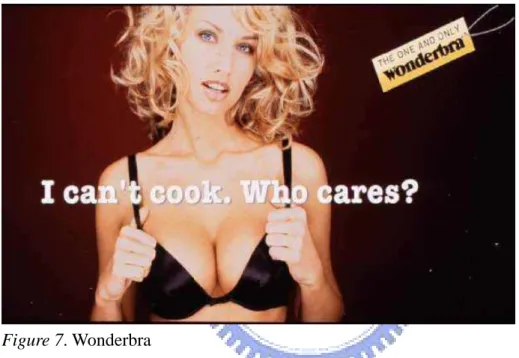
Figure 7. Wonderbra………...……..42
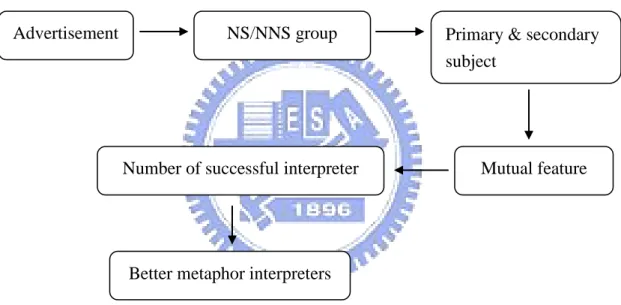
Figure 8. Diagram of analytical procedure for research question one………...….….50
Figure 9. Diagram of analytical procedure for research question two……….……....51
Figure 10. Weeder………...…………...62
Figure 11. Lawn mower……….………..62
Figure 12. Loop watch………...………..66
Figure 13. Hanger watch……….……….66
Figure 14. Ring watch……….…….67
CHAPTER ONE
INTRODUCTION
Overview
This chapter is divided into five sections. To begin with, I would discuss the
common visual rhetoric, metaphor, in advertising. Next, I would introduce the
foremost researchers in metaphors, J. Lakoff and M. Johnson, who approached
metaphor from human cognition. Their contributions towards establishing the earliest
theory of metaphor are still highly praised until today. Followed by Lakoff and Johnson‘s work, an overview of metaphor research in the fields of semantics and pragmatics would be presented. Some crucial works relevant to the present study
would be introduced, as well as their development towards advertising metaphors.
Finally, the importance and the purpose of the present study would be presented,
followed by the organization of the thesis.
Metaphor in Advertising
Human eyes can hardly dodge myriads of different advertisements in everyday
life. Advertisements are seen on flyers, leaflets, brochures, newspaper advertisement
sections, magazine cover pages, and so on. Although their appearances are physically
diverse, their central purposes are identical: To promote a target product with a
specific sales pitch, and to tout potential buyers. In order to outdo other competitors in
the same business, advertisers often have to think hard to produce alluring figurative
languages to elongate the attention span of viewers. Metaphor is one of the most
ubiquitous figurative languages employed by advertisers, and it is often observed in
the verbal texts of advertisements, namely slogans. However, with the medium of
technology like computer drafting (a type of Computer-Aided Design, CAD, which
makes use of computer technology to produce high-definition or three-dimensional
the concomitant effects with pictures. As a result, compared to the advertisements a
decade ago, there is a propensity for advertisements nowadays that the number of
visual-aided advertisements has been increasing. This trend has foretold a message to
both the general public and the researchers in the field of metaphor. That is,
understanding and researching metaphor in advertising need to be re-defined, with a
consideration regarding possible effects of visual elements which have become an
integral part in nearly every piece of modern advertisement.
Early Research on Metaphor
The early studies on metaphor received a tremendous boost with the rise of
cognitive linguistics, as witnessed in Johnson (1992), Lakoff and Johnson (1980), and
MacCormac (1985). Among these cognitive linguists, George Lakoff and Mark
Johnson are regarded as pioneers in identifying and defining metaphor.
Unprecedentedly, the first three types of metaphor were identified, including ―structural metaphors,‖ ―orientational metaphors,‖ and ―ontological metaphors.‖ Theses early works by Lakoff and Johnson had proffered a starting research platform
for later scholars interested in metaphor. What is more groundbreaking is the claim in
their influential work Metaphor We Live By (1980), in which they stated that the human thinking process is ―fundamental metaphorical in nature‖ (Lakoff & Johnson, 1980, p. 12). They asserted that metaphor is deeply rooted in human thought and
action:
―Metaphor is for most people device of the poetic imagination and the rhetorical flourish--a matter of extraordinary rather than ordinary language. Moreover, metaphor is typically viewed as characteristic of language alone, a matter of words rather than thought or action. For this reason, most people think they can get along perfectly well without metaphor. We have found, on the contrary, that metaphor is pervasive in everyday life, not just in language but in thought and
action.‖
Lakoff and Johnson further indicated that though metaphor is grounded in the
human conceptual systems, some of these systems are universal while others are
dependent on languages and cultures. Their insightful comments paved a way for the
development of advertising metaphor regarding cognitive aspects in both semantics
and pragmatics.
Metaphor in Revolution: Semantics and Pragmatics
Scholars in semantics adopt a cognitive-semantic approach towards metaphorical
expressions, and deal with the issue of how metaphor is processed in human cognition.
There has been a large amount of studies addressing the operational procedure of
metaphor, such as Cohen (1993), Giora (1997, 1999), and Levin (1979). Among them, Giora (1997) proposed ―the graded salience principle‖ (p. 193), arguing that there exists at least two conventional or salient meanings, the literal and the metaphorical,
in every metaphor. She asserted that these two meanings will be activated at the
moment when the metaphor is being processed in contexts, and contextual factors
later come into play. Contextual factors are metaphor-specific, and interpreters often
have to take socio-cultural factors into account, which links the issue to the field of
pragmatics.
Different from semanticists, pragmaticists approach metaphor with careful
scrutiny of language and its users‘ socio-cultural backgrounds. For instance, Bouton
(1988) conducted a cross-cultural study to examine native and non-native speakers of
English on their abilities of understanding conversational implicatures. He found that
different cultural backgrounds of the participants had the different interpretations on
implicatures made by NNS and NS. Most importantly, over the last two decades,
numerous researchers have contended that metaphors are best analyzed in the domain
of pragmatics (Blakemore, 1987; Grice, 1975; Levinson, 1983; Sperber & Wilson, 1986, 1987). This movement originated from Sperber and Wilson‘s (1986, 1987)
relevance theory, as evidenced in works such as Tanaka (1994) and Forceville (1996).
Sperber and Wilson (1986) truncated Grice‘s famous theory Maxims of Conversation
into a single principle Relevance, holding a relevance-oriented view towards
implicatures and how they act in human communication. Since the birth of the
relevance theory, it has been widely applied to elucidate communications in various
disciplines, largely in verbal discourses (e.g., conversational joking by Norrick, 2003)
and verbal-visual (media) discourses. Verbal-visual discourse can be further divided
into two specific areas: The discourse of advertising (e.g., punning, by Tanaka, 1992,
1994) and comics (e.g., Yus, 1997, 1998a). The present study attempted to explore the
area of advertising discourse, with a focus on non-native speakers‘ perceptions.
Importance of the Study
Although metaphor comes from a long line of research, there are two areas where little research has been conducted: Learners‘ perceptions and advertising pictorial metaphor.
First of all, only a small number of metaphor studies accentuate the issue of comparing learners‘ perceptions with those of native speakers. Perhaps the only study that discussed both native and non-native speakers‘ perceptions is Bouton (1988)
where the author conducted a cross-cultural study on examining English learners‘
abilities of interpreting conversational implicatures. Bouton stated that culture-related
factors might be decisive for non-native speakers to interpret implicatures.
The other area that deserves more exploration is the research of advertising
pictorial metaphors. In the domain of advertising research, though metaphor is often
the rhetoric which researchers investigate in advertisements, only a small body of
studies center on pictorial (or visual) metaphor. Tanaka (1994) investigated a number
of British and Japanese advertisements, and she found culture-specific values were
number of female and male participants in responding to a set of cell phone service
advertisements with female and male models in them, and they found striking
gender-related responses from both groups. Lundmark (2005) collected a number of
advertisements in British magazines and analyzed how textual features interacted with
pictorial components. Obviously, there is still much space left for pictorial metaphor
research.
The only study pertinent to the present research is Forceville‘s (1995) where he probed the perceptions of 18 participants from two non-English speaking countries,
Holland and Belgium (Dutch, German, and French are all official languages in
Belgium, while Dutch is the only official language in Holland), on three correlated
IBM advertisements. Forceville discussed some responses relevant to . For example,
in those three billboards, one of them is a tuning fork with the imprinted IBM logo.
While most of the participants from Amsterdam gave some aesthetic appraisal, those
in Belgium expressed no special feelings. Following are the responses from two
Amsterdam participants:
A12: ―The combination of technique on a high level and art on a high level; for great human achievements technique is required: tuning is necessary to accomplish coherence.‖
A1: ―Musicality; elegance.‖
(Forceville, 1995, p. 186)
Another example is cited from a Belgium participant:
G11: ―This picture does not really have much impact for me…….‖ (p. 186)
Forceville (1995) indicated that it might be the fact that participants from
Amsterdam were actually a group of Art majors in university, which was reflected in
their art-related comments. As for the participants from Belgium, they were audience
comments towards the IBM tuning fork advertisement diverge. However, the
backgrounds of participants were not strictly controlled in Forceville (1995).
Therefore, this factor was included in the present study.
Purpose of the Study
The purpose of the present study is to continue advertising research and explore learners‘ and native speakers‘ interpretations of advertising pictorial metaphors. This study aimed to answer the following research questions: (1) How do the native and
non-native speakers of English interpret advertising pictorial metaphors? (2) What
factors that determine the success of pictorial metaphor interpretations? (3) How do
the native and non-native speakers of English perceive the advertisements with and
without considering advertiser‘s intention?
It is hoped that this study will make two contributions. First of all, this study
would continue advertising research by exploring pictorial metaphors. Since the
model of pictorial metaphors proposed by Forceville (1996) is relatively new, this
study attempted to apply his model to interpret data and motivate futures studies to
make the theory of pictorial metaphor more complete. As for the other contribution, it
is expected that the results of the present study could provide insights regarding the
factors that might affect the comprehension of metaphors.
Organization of the Thesis
In chapter 2, literature of advertising pictorial metaphors, from the domain of
linguistics to advertising research, would be reviewed firstly. Relevant studies of
advertising pictorial metaphors would be also discussed. In chapter 3, I would
introduce the methodology of the present research, such as the participants, the
instrument utilized to glean and interpret data, and the process of data collection. In
chapter 4, the results and discussions of the study would be presented and discussed.
findings, limitations of the present study, suggestions for future research, and some
CHAPTER TWO
LITERATURE REVIEW
Overview
In this chapter, we would be first led by an early yet pivotal work, Metaphors we
live by (Lakoff & Johnson, 1980), to enter the realm of metaphor. George Lakoff and
Mark Johnson have long been recognized as pioneers who explained metaphor by
human cognition. Their contributions will give us a general picture about the human conceptual system and formations of metaphor. What follows is Giora‘s (1997) the
graded salience hypothesis which approached the issue of processing literal and
non-literal language in human mind. It proffers us a microscopic view of how
information recipients tackle metaphoric messages psychologically. In the next two
parts, I would introduce the relevance theory by Sperber and Wilson (1986, 1987),
and the interaction theory by Black (1962, 1972, 1979a, 1979b). These two theories
serve as foundations of the theory of advertising pictorial metaphor. I would
demonstrate how and why the relevance theory relates to the discourse of advertising,
and how and why the interaction theory can help identify pictorial metaphor. Finally,
two studies on advertising pictorial metaphors (Mick & Politi, 1989 & Forceville,
1995) would be discussed.
Lakoff and Johnson: Metaphor We Live By (1980)
Lakoff & Johnson‘s publication Metaphors we live by has long been recognized as the very first book explaining the concepts of metaphor in human conceptual
system from the cognitive and cultural perspectives. Looking back at the references in
metaphor research in the past two decades, their work often has its place. Not only
because the book introduces metaphors in a systematic way, but also because the
theories proposed pave ways for successive researchers who have been constantly
Regarding the contents of the book, Lakoff and Johnson explain and tackle
concepts of metaphor by human cognition, with a special attention to cultural
coherence. Some concepts which directly link with the present study are discussed in
the following sections, including human conceptual system, metaphorical
categorization, cultural coherence, and the notions of metonymy and personification.
Human Conceptual System
When people encounter the term ―metaphor,‖ poetry and rhetoric are the domains that often come to their minds. Indeed, metaphor is a form of figurative
language; however, it is not only seen in rhetorical speeches or writings but in everyday life. Lakoff and Johnson (1980) indicated that, ―Our ordinary conceptual system, in terms of which we both think and act, is fundamentally metaphorical in nature‖ (p. 3). It is the ―thought and action‖ (p. 4) that enables us to identify the metaphorical linguistic behaviors of the human beings. In the case of the present study
which focuses on the perception of pictorial metaphors in advertisements, Lakoff and Johnson‘s standpoints still hold water. As known to the general public, the main purpose of advertising is to persuade viewers to make purchases. In order to arouse buyers‘ motivation, metaphors often serve as a riddle-like role making viewers ponder the fascinations hidden inside advertisements.
Lakoff and Johnson (1980) then present the formula of the ―conceptual
metaphor‖ by using the now classic example ―ARGUMENT IS WAR‖ (the formula is ―NOUN IS NOUN‖, which is the first step to identify a metaphor). Here are two examples of this conceptual metaphor:
I‘ve never won an argument with him. He shot down all of my arguments.
The verbs associated with the action of arguing, as in the above sentences, are
commonly used by speakers of English. Nevertheless, speakers may not be aware of
the mechanism behind metaphors. In this case, it is the concept of war that transfers the rhetorical power to the verb ―argue‖, because, it is in war that we fire up missiles to shoot down our nemeses, use weapons to defend our fortress, and finally win the
battle. Therefore, the fundamentals of metaphor, as commented by Lakoff and Johnson is, ―…. understanding and experiencing one kind of thing in terms of another‖ (p. 5).
Metaphorical Categorization and Cultural Coherence
By using the classical instance ARGUMENT IS WAR, Lakoff and Johnson show
us the concept of structural metaphors, where a concept is metaphorically structured
in terms of another. Followed by conceptual metaphor, they introduced ―orientational metaphor‖ in which two ideas of the opposite are placed, like the relation of up-down, in-out, front-back, etc. They illustrated this by using the English adjective ―happy.‖ In
English, if a person says ―I‘m feeling up today,‖ it means he is in high spirits or happy. On the contrary, when a person utters a sentence like ―I‘m feeling down‖ or ―I‘m down,‖ he is probably having a bad day. The point that Lakoff and Johnson tried to make is: Words or phrases that are spatially related to each other can implicate a
certain condition of the subject.
However, a concern surges: How do we know concept like HAPPY is UP instead of DOWN? Lakoff and Johnson (1980) added that it is determined by individual‘s ―physical and cultural experience‖:
Such metaphorical orientations are not arbitrary. They have a basis in our physical and cultural experience. Though the polar oppositions up-down, in-out, etc., are physical in nature, the orientational metaphors based on them can vary from culture to culture.
Indeed, the bodily-physical experiences we have are obtained from cultures. In
other words, different values and philosophies are molded by disparate cultures. For
instance, gender ideology, or more specifically, gender stereotype, plays an important
role in sculpturing the way of thinking in every culture. One of the pictorial
metaphors discussed in Velasco-Sacristán and Fuertes-Olivera (2006) (see Figure 1),
is a typical example of orientational metaphor in Lakoff and Johnson‘s term (see note
1).
Figure 1. ZM magazine cover
Copyright image courtesy of Marisol Velasco-Sacristán([email protected])
In the advertisement, there is a man standing in the front with a smile while a
woman sitting in the far back with a glum face. The spatial relation, namely
front-behind, implies that male is dominant in terms of certain issue, in this case
men, the man-front-woman-back might be reversed. This is what Lakoff and Johnson (1980) called ―cultural coherence‖:
―The most fundamental values in a culture will be coherent with the metaphorical structure of the most fundamental concepts in the culture.‖
(p. 22)
Personification and Metonymy
These concepts of personification and metonymy are not new to metaphor researchers, because they are often a part of metaphor. Consider the sentence, ―The wind whispers.‖ In this case, the wind is personified because only human beings are able to perform the act of whispering. In addition, depersonification happens in life, too. For example, the metaphor ―That gal is a beast‖ implies that the girl is as ugly as a beast.
Now consider a sentence of metonymy, ―We need more strong bodies to finish this task.‖ Clearly, ―strong bodies‖ stands for ―strong people‖, as the concept of metonymy is understood as THE PART FOR THE WHOLE.
Metonymy and (de)personification often take place in advertising. When
advertisers intend to put an emphasis on a certain part of the promoted product, metonymy comes into play (e.g., ―comfortable upholstery‖ for ―car‖). When the advertised product, like a women‘s bra, should outshine other features of a woman, de-personification starts to work. Lakoff and Johnson‘s phenomenal and insightful
probe into human conceptual system and metaphorical concepts indeed provide a
staunch foundation for future research on metaphor.
Rachel Giora: The Graded Salience Hypothesis (1997)
The studies of literal language and figurative language come from a long line of
have been unabated, and they became more intense with the rise of pragmatics. Pragmatics brought in the concept of ―contextual effects‖ which plays either a
decisive role or not in the previous research, as in The standard pragmatic model (see
Fodor, 1983; Grice, 1975; Searle, 1979) and The direct access view (see Gibbs, 1994;
Sperber & Wilson, 1986). Interestingly, Giora (1997), as a cognitive-semanticist,
proposed the graded salience hypothesis, explaining the conflicts from former models
and stressed the saliency of meanings (to view a comprehensive introduction and
comments, see Giora, 2002). Also, Giora (1997) applied the hypothesis on how to
approach different figurative languages, with metaphor being one of them.
Instead of re-joining the forums held in the previous two models, Giora (1997) presented the concept ―salient meanings.‖ To be salient, ―meanings of words, phrases,
or sentences (e.g., the conventional interpretations of idioms or proverbs) have to be
coded in the mental lexicon and, in addition, enjoy prominence due to their
conventionality, frequency, familiarity, or prototypicality‖ (Giora, 2002, p. 491). In
other words, a word or phrase is very likely to be interpreted in a different way by
language users. Giora used the polysemous word ―bank‖ as an example to illustrate
salient and less-salient meaning. For the people live in metropolitan areas, the word
bank meaning ―an institution which provides banking service‖ is more salient, while
the meaning ―riverside‖ is less-salient.
Giora (2002) then predicted that contextual information would inhibit less-salient
meaning after salient meaning is processed. For the case of metaphor, she found that
both salient and less-salient meanings will be evoked initially in both metaphoric and literal biasing contexts based on the measurement of participants‘ reading times and lexical decisions. Though Giora approached metaphor from a pure cognitive stance,
her graded salience hypothesis can still lend support to the present study in terms of
possible pictorial metaphor in the first phase, like Plate 2, contextual information will
be conducive to the decision of the real advertised product. In this advertisement, what comes to the eyes are a straw and a woman‘s miniature image perfectly matched with the curve of the straw. But what is the advertised target? Is the conceptual
metaphor ―WOMAN IS STRAW‖ or ―STRAW IS WOMAN‖? Both choices are possible until the contextual information comes into play – the texts on the straw which read ―Y +YOGA CENTER.‖
Figure 2. Y Plus Yoga Center
Image fromhttp://inventorspot.com/inventive_marketing_yoga_center_straw
______________
Note 1. The authors called this type of gender metaphor ―universal gender metaphor‖
Relevance-Perspectives for Advertising Communication
In this section, we turn to look at the most influential theory about human
communication in the past two decades, the relevance theory by Sperber and Wilson (1986, 1987). The relevance theory, along with Black‘s interaction theory (Black, 1962), serve as the two major theoretical foundations of advertising pictorial
metaphors. In the domain of advertising language, the relevance theory is conducive
to the explanations of how the advertiser (the speaker) interact with the viewer (the
hearer), and vice versa. I will first introduce a brief history of the relevance theory,
and then relate some tenets of the relevance theory to the present study.
The Origin of Relevance
Paul Grice (1975) proposed four maxims of conversation, that is, maxims of
quantity, quality, relevance, and manner. His claims received a tremendous challenge
by Wilson and Sperber (1981). Wilson and Sperber (1981) suggested revisions
regarding the definition of implicature and the maxim-centered explanation of figurative language. They dubbed their theory ―Relevance Theory‖ (henceforth RT) which has become one of the most influential theoretical construct in contemporary
pragmatic research. The fundamental difference between RT and Grice‘s maxims lies in the recognition of communicative norms: In Grice‘s sense, interlocutors have to know the maxims (communicative norms) beforehand in order to communicate, and
these maxims are not violable. However, RT says that communicators do not know
these norms but search for them during the course of interaction instead. They can
also violate the norms if they want to. From another angle, RT is able to explain
figurative language like metaphor because in order to grasp the non-literal meaning, interlocutors often have to ―go beyond the words or sentences‖, thus disobeying the Gricean maxims.
The Nature of Human Communication
According to Sperber and Wilson (1986), the general objective of RT is ―to identify underlying mechanisms, rooted in human psychology, which explain how humans communicate with one another‖ (p. 32). RT stands from a cognitive point to tackle views from previous models (e.g., Grice‘s Cooperative Principle, and the traditional ―code model‖ which regards the human brain as a decoding device), injecting the concept of relevance in the dynamic cognitive environment where
speakers and listeners interact.
First of all, let us take in two important concepts, informative intention and
communicative intention. These two concepts are pivotal for understanding the
speaker‘s incentives in communication:
(a) Informative intention: The intention to make manifest or more manifest to the audience a certain set of assumptions.
(b) Communicative intention: The intention to make mutually manifest to audience and communicator the communicator‘s informative intention.
(Sperber & Wilson, 1987, p. 700)
Informative intention happens when the communicator attempts to deliver a
message, while communicative intention is achieved while the addressee understands the intended message (in Sperber and Wilson‘s term, mutual manifestness). Forceville (1996) further points out that, these two intentions are difficult to distinguish in verbal
communication (p. 105). If these two intentions are both in force, this type of
communication is called ―ostensive-inferential communication‖ (p. 85). Specifically, ostensive communication and the notion of inference will be dissected for further
elaborations.
Based on the definition in Sperber and Wilson (1986), ―ostensive communication‖ has to meet three requirements (pp. 153-154): (a) attract the
addressee‘s attention; (b) direct this attention towards the addressee‘s intentions; and (c) reveal the addresser‘s intentions. Notice that not every communication is ostensive. There are times where exists only informative intention without communicative
intention (explicit non-ostensive communication), and where none of these two take
place. On the other hand, communication not only engages participants in delivering or receiving messages, but also the process of ―inferring.‖ Sperber and Wilson (1986) define inference as ―the process by which an assumption is accepted as true or
probably true on the strength of the truth or probable truth of other assumptions‖ (p.
68). Put simply, inferring means proving the authenticity of a piece of evidence by
searching in the prior experience.
Indeed, when ads readers are exerting mental power processing potential
metaphorical meanings, simultaneously they are searching schemas in their minds. Those relevant past experiences will spark permutations in altering the addressee‘s cognitive environment.
So far, I have discussed two principles of human communication from a
relevance point of view, intention and inference. To summarize, the addresser
dispatches her message with a desire for communication success (intention). Then, the
addressee processes mentally to break down the true meaning in the message. The
crucial point of reaching the communication success is the establishment of mutual
knowledge which the addresser and the addressee are incessantly exchanging in
bilateral directions.
Contextualization
No other scholars or researchers before Sperber and Wilson (1987) regard the
concept of context as a fluid network, but ―as a monolithic entity that is accessible to interlocutors beforehand during interaction‖ (Yus, 1998b, p. 86). In Sperber and Wilson‘s (1987) perspectives, a context is fluid because it is interactive. It is
interactive since when the speaker selects a certain context in communication, the context sets a certain assumptions to the speaker‘s utterances.
While the addressee begins to solve the code in the message, she is not only
dealing with one context. Instead, a number of contexts from different genres might
come to her mind. At the same time, all the possible contexts are dynamic. They are
not static entities passively to be chosen, but as fluid and dynamic extensions aiming for ―optimal relevance.‖ By optimal relevance, Sperber and Wilson (1987) means the addressee searches the most relevant and plausible interpretation of the message that matches the addresser‘s original intention. The practical meaning of optimal relevance will be elaborated in the next session.
Sperber and Wilson (1987) noted that context is of dynamism. Contexts are not
only an array of possible situations, but also as extended contextual variations actively
constructed by communicators in order to obtain more contextual implications. In the
next part, relevance theory and human communication will be fully combined to
move us closer towards the discourse of advertising.
Relevance Theory and Human Communication
In previous introductions of the underpinnings of RT, some breakthroughs in the
study of human communication were presented. In this phase, RT will make an
official rendezvous with human communication. As mentioned, the momentum of
proposing RT is to re-define the nature of communication along with the essential
opponents inside. There are four basic assumptions described by Wilson (1994) that
serve as the rudiments for RT:
(a) Every utterance has a variety of possible interpretations, all compatible with the information that is linguistically encoded.
(b) Not all these interpretations occur to the hearer simultaneously; some of them take more effort to think up.
(c) Hearers are equipped with a single, general criterion for evaluating interpretations. (d) This criterion is powerful enough to exclude all but at most a single interpretation, so that
having found an interpretation that fits the criterion, the hearer looks no further.
(p. 44)
It is conspicuous that these four assumptions are sequentially related to each
other. These four assumptions make it clear that human communication involves not
merely a sender-stimulus-hearer affair, but an intricate and cognitive-demanding
network in which the addresser deliver stimuli with degrees of more or less logical
interpretations to the addressee who is poised to choose the correct interpretation in a
certain context. In other words, addressee is seeking what Berg‘s (1991) phrase, the
most relevant relevance, which is the one produced by the addresser‘s stimulus that
best guides addressees to the intended interpretation or, the ―usefulness with regard to the conversational goals or objectives of the conversants‖ (p. 412).
However, it seems that it costs a great amount of cognitive efforts before the
addressee gets the right message. In fact, the addresser also needs to work in her
cognitive frame to produce the most effective processing message. By most effective
processing, it means the one that costs no excessive effort. It is true that addresses are
not willing to spend too much time inferring the message, and so does the addresser,
who is afraid that the elongated time might lead to conversation breakdown.
Therefore, the course of interaction is not a one-sided cognitive work, but an
intersubjective web: the lesser efforts are involved, the more relevant the discourse.
Nevertheless, what makes the discourse relevant to the addressee? Namely, how
to trigger the formation of mutual knowledge between the addresser and addressee?
The linchpin is contextual effects which have a direct relationship to the degree of
relevance. According to Wilson (1994), contextual effects can be related to context in
assumption; and (c) combining to a previous assumption to yield further contextual
effects. In (c), relevance is manifested because contextual implications are generated.
The following examples illustrate the three disparate contextual effects:
(a) It will rain in Paris tomorrow:
Previous context: The hearer is going to Paris tomorrow and he is almost sure that it will rain. Contextual effect: The utterance strengthens a previous assumption.
(b) It will rain in Paris tomorrow.
Previous context: The hearer is going to Paris tomorrow, but he had not expected that it might rain.
Contextual effect: The utterance contradicts (and suppresses) a previous assumption. (c) It will rain in Paris tomorrow.
Previous context: The hearer is going to Paris tomorrow and has thought about packing an overcoat just in case.
Contextual effect: The utterance is combined with previous assumptions to yield the contextual implication that it is necessary to pack that overcoat.
(Wilson, 1994, p. 45)
However, Wilson and Sperber (1986) reminded us that assumptions do not work
every time when: (a) the assumption supplies new information but this information is
not related to the information already present in the context; (b) the assumption is
already present in the context and its strength is not altered in any way by the new
information; and (c) the assumption is too weak to alter the context and is therefore
eliminated (pp. 120-121). Therefore, ―an assumption is relevant in a context if and only if it has some contextual effect in that context‖ (p. 122).
Although context is important for relevance, it is not always given beforehand. In
other words, the addressee has to construct contexts and search for relevance during
the process. More importantly, when there is an optimal selection for context, a
maximal amount of contextual effects, and little processing effort, relevance is
RT had been edited and re-edited after its debut. Although there are a number of
critics like Levinson (1989) who attacked RT for its negligent perspective on
semantics, the contribution of RT towards a more complete theory on human
communication cannot be denied. Before relating RT to the discourse of advertising,
let us deal with the last issue about the force of communication.
Strong Communication versus Weak Communication
Another monumental contribution made by Sperber and Wilson (1986) is that
they distinguished strong and weak communication. Strong communication is the
form of communication where assumptions are explicitly communicated between the
addresser and addressee. The assumptions are processed by the addressee who
searches for relevance in the utterance. On the other hand, when assumptions are not
explicitly manifest to the addressee, a number of possible implications will be
triggered and the so-called ―weak communication‖ will take place. While most
researchers maintained that there was a tendency in considering all communication
are strong communication, Sperber and Wilson (1986) asserted that much
communication carries vague, suggestive assumptions. To best exemplify the
distinction of these two types of communication, consider the following conversation:
Peter: Would you drive a Mercedes?
Mary: I wouldn‘t drive ANY expensive car.
(Sperber & Wilson, 1986, p. 194)
Here, two explicit and instant implications are harnessed from Peter‘s judgment based on Mary‘s response. First, Mary regards Mercedes as an expensive car, which is an implicated premise; moreover, Mary would never drive a Mercedes, which is an
implicated conclusion (noted in Forceville, 1996). Though these two implications are
implications might also derive from her reply. For example, Peter might supply the
premise that Cadillacs and Alfa Romeos are also luxurious automobiles which Mary
would not drive either. This implication is weaker than the two strong implications mentioned above since it is only a speculation from Mary‘s reply.
Sperber and Wilson (1986) concluded that ―the more strongly an assumption is communicated, the more the communicator takes responsibility for having it derived
by the addressee; the weaker an assumption is communicated, the more the addressee
takes responsibility for deriving it. Certain utterances aim at triggering weak rather than strong implicatures‖ (p. 194).
Relevance Theory and Advertising Language
RT is indeed an unprecedented professional view in light of human
communication. As mentioned, it has been applied to diverse fields of study. The
study of advertising and its language is one of the areas where RT has been effectively
executed to account for the advertiser/receiver communication. However, there is a
fine line that demarcates the human communication and advertising language, since
the latter belongs to the form of mass communication. As reported in Forceville
(1996), there are at least four important aspects that differentiate the communication
of advertising from human communication. These four aspects are temporal
difference, number of participants, multi-media character, and textual ambiguity.
The very first difference lies in the temporal difference, or simply time. The participants in Sperber and Wilson‘s (1986) communication are engaged in a face-to-face and co-present communication network, but those in the milieu of
advertising are not simultaneously present. That also means that there is no immediate
―In oral discourse, the problem is ultimately resolved by the ostensive function of discourse; in other words, reference is determined by the ability to point to a reality common to the
interlocutors. If we cannot point to the thing about which we speak, at least we can situate it in relation to the unique spatio-temporal network which is shared by the interlocutors. It is the ―here‖ and ―now‖, determined by the situation of discourse, which provides the ultimate reference of all discourse. With writing, things already begin to change. For there is no longer a situation common to the writer and the reader, and the concrete conditions of the act of pointing no longer exist.‖
(p. 141) Ricoeur‘s (1981) observation lucidly informs us that communication breakdown can be solved in face-to-face ostensive communication, but not in the case of
advertising. What implies the communication process of advertising is that, as
remarked by Forceville (1996), ―this means that the advertiser must think twice before sending her message: an unfortunate stimulus cannot be easily revoked and adapted (p.
100).
The next difference deals with the number of participants in the communication.
In the course of face-to-face interaction, there are only two interlocutors; however, in
advertising which is a form of mass communication, it is often the case of an
advertiser (or a group of advertisers) versus a large number of ads readers. At this
stage, a problem has emerged: How does an advertiser do to guarantee she has sent a
proper message? Namely, how can she direct the ads readers towards the desired
implications during the search for relevance? It is necessary for the advertiser to make
an assessment of the cognitive environment of the target groups. In other words, the advertiser has to give a second thought on ―the general public‘s taste‖ before
transmitting the advertisement. Knowing the ups and downs in a certain advertising
field is crucial to every advertiser who looks forwards to success.
The third component is the multi-media character of advertisements.
visual features. Here, verbal and visual features refer to the texts and the pictures,
which together produce concomitant effects which alter the readers‘ cognitive
environment. Barthes (1986) argued that in advertising verbal information ―anchors‖
visual information: The former not only helps identify elements in the latter, but also
restricts the number of interpretations it might give rise to. Recalling Figure 2, if the text ―Y+ Yoga Center‖ did not appear on the flex straw or anywhere in the
advertisement, the readers would have no clues of which interpretations to choose.
Furthermore, Forceville (1996) reminded us that, ―Even though Barthes‘s view has to be qualified in that particularly in modern advertising pictures may ―anchor‖ text as well as the other way round, text is still a vital element in making sense of an
advertisement. The less verbal anchoring is present, we may deduce, the greater the range of interpretations that is possible‖ (p. 102).
The last issue is textual ambiguity. It is necessary to combine the previous three
differences to understand the nature of text. As we know, ambiguities occur in the
course of conversation frequently. As a result, the interlocutor often gets involved in
the activity of disambiguation. In the case of advertising, the task of disambiguation
falls totally on ads readers, for there is neither instant communicators on the spot nor
feedback exchanged. This fact echoes what I have mentioned earlier, the weak
communication, which can be argued to be the fundamental mode of communication
for advertising. To be more accurate, the verbal (textual) features in advertising,
compared to those in face-to-face interaction, are ―powerful but indeterminate‖ (Cook, 1992, p. 45), aiming for the readers to do what Pateman (1983) dubbed ―strategic exploitation‖ (p. 200).
From the elucidations above, it is evident that the communication in face-to-face
interaction and that in advertising are truly distinctive by nature. These disparities will also lead the researcher to focus on the missing aspects found in Sperber and Wilson‘s
theory of communication.
Covert Communication in Advertising
Keiko Tanaka, like Charles Forceville, holds a relevance-oriented view towards the language of advertising. In her book ―Advertising language: A pragmatic approach to advertisements in Britain and Japan,‖ Tanaka (1992) reviewed the previous former schools of thoughts on human communication, analyzed two common rhetorical figures in advertisements (puns and metaphor), and above all, she proposed ―covert communication‖ is an advantageous form of selling products often employed by advertisers. Bencherif and Tanaka (1987) summarized the difference between
ostensive and covert communication by using the notion of covert information
transmission as a basis, as follows:
Ostensive communication: an overt form of communication where there is, on the part of the
speaker, an intention to alter the mutual cognitive environment of the speaker and the hearer.
Covert communication: a case of communication where the intention of the speaker is to alter the
cognitive environment of the hearer, i.e. to make a set of assumptions more manifest to her, without making this intention mutually manifest.
(p. 67)
The purposes of utilizing covert communication in the setting of advertising,
according to Tanaka (1992), are of two concerns. The foremost concern derives from the advertiser‘s intention to focus readers‘ attention on the content of product, making her oblivious of the fact that someone is trying to sell her something. Myers (1983)
reported his interview with a real estate agent. According to the agent, by making their
house advertisements akin to a magazine cover can become more appealing,
especially to the younger audience.
The second purpose is ―to avoid taking responsibility for the social consequences of certain implications arising from advertisements‖ (Tanaka, 1994, p .44). For
instance, since quite a lot of advertisements contain sexual implications, advertisers
have to be meticulous when promoting the product. By resorting to covert
communication, advertisers are able to promulgate the product without making the
intentions overt. Thus, in covert communication, communicators shoulder no
responsibilities for causing any social consequences, not only because they are not
having face-to-face communication with ads readers, but also because the
interpretation task depends totally on the readers.
Taking one step further, is Tanaka‘s covert communication consistent with Sperber and Wilson‘s weak communication? Forceville (1996) vetoed the equality, stating that ―Covert communication necessarily makes ample use of the possibilities of weak communication, but not all weak communication is covert communication‖ (p. 107).‖ His stance is that adverts who engage readers in covert communication do not take responsibilities of harboring certain implications, because those implications
are not made mutually manifest.
Unlike Forceville, Guy Cook, a giant neo-researcher in advertising communication holds a relatively radical perspective for Tanaka‘s covert communication. Crook (2004) commented that Forceville‘s (1996) distinction remained vague; moreover, he questioned the qualification of covert communication towards the valid communication in Sperber and Wilson‘s sense. He then proposed that irrelevance is a pre-requisite for covert communication, and suggested that
advertising communication should be approached by a combination of relevance
theory and covert communication.
Although Tanaka‘s covert communication has received constant criticism from her fellow researchers, its contribution is highly laudable, as Crook (2004)
commented, ―In short, the notion of covert communication describes a theoretical subpart of communicative behavior and is helpful in elucidating the role of intentions
in utterance interpretation across a range of domains‖ (p. 737).
Max Black (1972): The Interaction Theory of Metaphor
Among all the research and studies on metaphor, Max Black‘s interaction theory
of metaphor (Black, 1962, 1972, 1979a, 1979b) has been regarded as the central
foundation to which many writers are explicitly or implicitly committed (Forceville,
1996; Hausman, 1989; Indurkhya, 1991, 1992; Kjargaard, 1986; Kittay, 1987;
MacCormac, 1985; Ricoeur, 1977; Verbrugge, 1980). Not only for the lucid
elucidations of the intricate cognitive process of metaphor, Black‘s theory paved the road for the development of pictorial metaphor. In addition, his interaction theory also
manifests an awareness of treating metaphor in pragmatics, which can be best realized in his own quote: ―Metaphorical meaning cannot be adequately discussed without resorting to metaphorical use‖ (Black, 1972, p. 34). The marrow of the interaction theory can be summarized as follows:
(a) A metaphor is divided into the primary subject and the secondary subject.
(b) The primary subject is the one which is being metaphorized by the secondary subject. (c) During the metaphorizing process, properties of the secondary subject are projected (or
mapped) onto the primary subject.
(d) Hearers (metaphor recipients) decide which properties should be mapped onto the primary subject based on contextual clues and personal experience.
(Black, 1972, p. 35)
The stance of interactive metaphor indeed opened a door and let the sunlight
slant in for those who had strived to unravel and unveil the mystery of metaphor. I
will use the example in Black (1979a) to illustrate projection process mentioned
earlier. Table 1 shows that for a man to be metaphorized as a wolf, there should be
some common attributes. Among the attributes, some of them are mappable (like ―living creature‖ and ―being aggressive‖) while some are not (―having for legs).
Above all, the mapping process is depended totally on oneself, who selects and
decides transferrable features based on personal experience.
Table 1
The Selection of Mappable Features in a Verbal Metaphor (Forceville, 1996, p. 11)
_____________________________________________________________________
Primary subject Secondary subject
_____________________________________________________________________ MAN IS WOLF
Living creature _________Living creature _________ …
_________Being aggressive, cruel, bloodthirsty x_________Having 4 legs… _____________________________________________________________________
As the name of the theory ―interactive‖ suggested, Black (1972) demonstrated that metaphor is able to engage communicators in an interactive and reciprocal ―take it or not‖ process of cognition. This is to say that in order to understand the metaphor posed by the communicator, the recipient needs to go through the mental labyrinth,
make a decision by activating schematic knowledge, and finally. The elevation from
word-level to discourse is definitely insightful and pioneering. However, Black‘s also received criticism. One of the major critical commentators on Black‘s theory is Kittay (1987). Based on the extension of the primary and secondary subject concept, she argued that both should be seen as part of ―semantic fields.‖ For detailed information on Kittay‘s (1987) criticism towards Black (1972), please refer to Forceville (1996).
Model of Pictorial Metaphor
Although Black‘s theory explained the internal works of metaphor, no elements of non-verbal metaphors were discussed. Charles Forceville, who inherited Black‘s
interaction theory, is the first researcher who attempted to establish a theory for
pictorial metaphor. In his revolutionary book Pictorial metaphor in advertising,
Forceville (1996) mentioned that in order to verify any purported pictorial metaphor,
three essential questions are to be asked:
(1) What are the two terms of the metaphor, and how do we know?
(2) Which of the two terms is the primary subject and which is its secondary subject, and how do we know?
(3) Which features are projected from the secondary subject upon the domain of the primary subject, and how do we decide on these features?
(p. 108)
According to Forceville (1996), this model (the three above questions) is a
combination of the interaction theory and the relevance theory. On one hand, the
interaction theory contributes the taxonomy of the primary and secondary subject to
pictorial metaphor. On the other hand, the relevance theory proffers a microscopic
view into the nature of advertiser-recipient communication. By asking these three
questions, we are able to measure how much recipients understand a target pictorial
metaphor. I will demonstrate this in the next section with one of the advertisements
used in the present study.
Types of Pictorial Metaphor
There are a number of pictorial metaphor types identified in Forceville (1996), but
I only explore two of them in my research. The first type of pictorial metaphor was dubbed ―Metaphors with one pictorially present term‖ or MP1. In this sort, usually the secondary subject has to be retrieved to decide which features then can be mapped
onto the primary subject (the advertised product). Consider the following
Figure 3. Folgers Coffee with the doctored version
Image fromhttp://adsoftheworld.com/media/ambient/folgers_coffee_manhole
In this picture which was shot on a street in New York, the manhole cover was
replaced by a coffee cup which contained steaming hot coffee. Let us examine this
particular metaphor with Forceville‘s model. The first question asked us what the two
terms of metaphor are and how we know. From the doctored version of this
advertisement, it is obvious that the two terms are a coffee cup and a manhole cover.
However, the readers will not be able to see the doctored version but the original
advertisement. This means oftentimes readers are required to observe what similarities between the two objects, as what was said in Black‘s theory, ―The similarity between the two terms is not preexistent but – with the aid of this specific
context – created‖ (Black, 1979a, p. 82). It is in this specific context, where people are
substituted by the coffee cup. Then, here comes the second question: Which one is the primary subject and which is the second subject? If recalling the concept of ―verbal anchoring‖ in the previous section, the question is solved immediately with the help of the text appeared around the coffee cup ―Hey, City That Never Sleeps. Wake up. Folgers.‖ At this stage, we are assured that the metaphor is COFFEE CUP is MANHOLE COVER, instead of the reverse. Eventually, we have to decide the
mappable features in this case. Before we begin the final stage, Forceville (1996)
reminded us:
First, ―relevance is always relevance to an individual‖ (Sperber & Wilson, 1986, p. 142), and unless that individual happens to be oneself, one can never be completely clear about the
relevance of a message to a specific individual. Second, given a shared (sub)cultural background, a group of addressees confronting this advertisement are likely to agree on at least part of the interpretation. This part, which then constitutes the message‘s ―strong implicatures‖ can be complemented by more idiosyncratic ―weak implicatures‖ in the interpretation of specific individuals.‖
(pp. 112-113)
In short, every metaphorical interpretation consists of a set of strong implicatures
agreed by most people in a group of a particular cultural background, plus a cohort of
weak implicatures from individuals. Namely, the same metaphor may be deciphered differently due to the viewers‘ cultural backgrounds (like customs) or individual philosophy and ideology. Table 2 exhibits the possible mapping features between the
primary subject COFFEE CUP and the secondary subject MANHOLE COVER. Table 2 shows that while some of the features are mappable (like ―round shape‖), others fail to be projected onto the primary subject. Therefore, a possible strong
implicature of this advertisement may be something like ―Folgers provides hot and steamy coffee everyday‖ or ―Folgers coffee gives you vitality, just like the manhole cover which has the ―vitality of city‖ buried underneath it‖ (it refers to the myriad of
cords, wires, and lines underground). Interestingly, there might also be some
idiosyncratic explanations to a varying degree. For instance, some people might derive an implicature like ―Folgers offers quality but inexpensive coffee‖, for a manhole cover is usually made of cast iron which is not a costly material compared to
other metals, and takes pressure very well. While some viewers give positive
feedback to the coffee advertisement, others might have a not-so-positive impression.
By this I mean the image of manhole covers projected in different cultures. For those
who regard a manhole cover as being dirty and downtrodden, positive attributes of
coffee will be less likely to be associated.
Table 2
Possible Mapping Features in Folgers Coffee Advertisement
Primary subject: COFFEE CUP IS Secondary subject: MANHOLE COVER
- round shape - steamy - hot - vital - refreshing - addictive - round shape - steamy - hot - vital - heavy (x) - porous (x)
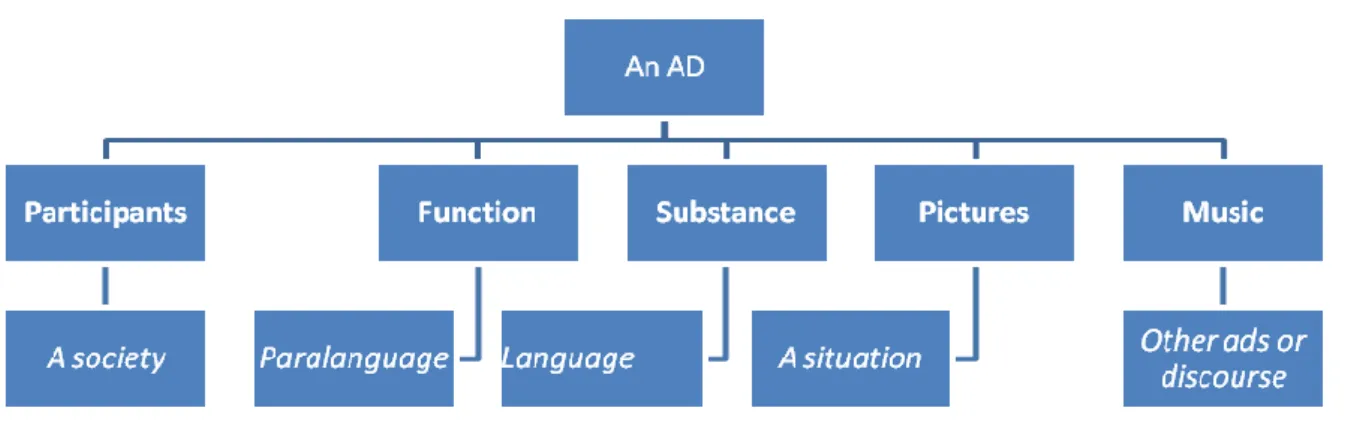
The factor of cultural variables is also echoed in Cook‘s (1992) study in which he listed a number of interactive elements embedded in an advertisement (Figure 4).
He underscored the relationship of each element and stated that the processing of any
advertisement should be treated and scrutinized with possible social