
國
立
交
通
大
學
多媒體工程研究所
碩
碩
碩
碩
士
士
士
士
論
論
論
論
文
文
文
文
基於俄羅斯方塊的馬賽克畫:一種新的藝術畫與
其在資訊隱藏上的應用
Tetromino-based Mosaics — A New Type of Art Image and Its
Applications in Information Hiding
研 究 生:張均培
指導教授:蔡文祥 教授
中
中
中
基於俄羅斯方塊的馬賽克畫
基於俄羅斯方塊的馬賽克畫
基於俄羅斯方塊的馬賽克畫
基於俄羅斯方塊的馬賽克畫:
:
:
:一種新的藝術畫
一種新的藝術畫
一種新的藝術畫
一種新的藝術畫
與其在資訊隱藏上的應用
與其在資訊隱藏上的應用
與其在資訊隱藏上的應用
與其在資訊隱藏上的應用
Tetromino-based Mosaics — A New Type of Art Image and Its
Applications in Information Hiding
研 究 生:張均培 Student: Chun-Pei Chang
指導教授:蔡文祥 Advisor: Prof. Wen-Hsiang Tsai
國 立 交 通 大 學
多 媒 體 工 程 研 究 所
碩 士 論 文
A Thesis
Submitted to Institute of Multimedia Engineering College of Computer Science
National Chiao Tung University in partial Fulfillment of the Requirements
for the Degree of Master
in
Computer Science
June 2009
Hsinchu, Taiwan, Republic of China
基於俄羅斯方塊的馬賽克畫
基於俄羅斯方塊的馬賽克畫
基於俄羅斯方塊的馬賽克畫
基於俄羅斯方塊的馬賽克畫:
:
:一種新的藝術畫
:
一種新的藝術畫
一種新的藝術畫與
一種新的藝術畫
與
與
與
其在資訊隱藏上的應用
其在資訊隱藏上的應用
其在資訊隱藏上的應用
其在資訊隱藏上的應用
研究生: 張均培
指導教授: 蔡文祥 博士
國立交通大學多媒體工程研究所
摘要
摘要
摘要
摘要
在本論文中,我們以俄羅斯方塊(Tetris)為基本元件,創造了一種新的藝術 畫,稱之為俄羅斯方塊馬賽克畫(tetromino-based mosaic images),並研究自動產 生這種影像與在其中做資訊隱藏的技術。在俄羅斯方塊馬賽克畫中,我們找到了 兩種可供隱藏資訊的特性,分別是俄羅斯方塊的排列組合和其顏色的變化。首 先,我們利用樹狀搜尋演算法來找出所有俄羅斯方塊的排列組合,藉由選擇不同 的組合,將秘密資訊或浮水印隱藏於俄羅斯方塊馬賽克畫之中。同時,利用偵測 邊界所得到的資訊,我們也提出了一種強化邊緣的方法來改善上述資訊隱藏技術 所造成的雜訊。另一方面,藉由調整鄰近俄羅斯方塊的顏色,我們可以將秘密資 訊隱藏於其中,達到秘密訊息傳輸與版權保護之目的。此外,我們也提出一種可 視浮水印技術來保護俄羅斯方塊馬賽克畫的版權,而且所嵌入的可視浮水印可以 無失真地移除之。基於這種浮水印技術,最後我們利用調色盤的對應關係,將秘 密影像隱藏於浮水印區域,來達到影像秘密傳輸之目的。透過良好的實驗結果, 我們證明了所提出方法的實用性。
Tetromino-based Mosaics — A New Type of Art Image and
Its Applications in Information Hiding
Student: Chun-Pei Chang Advisor: Prof. Wen-Hsiang Tsai, Ph. D.
Institute of Multimedia Engineering, College of Computer Science
National Chiao Tung University
ABSTRACT
A new type of art image is created in this study, namely, tetromino-based mosaic
image. Methods for automatic creation of images of this type and data hiding in them
are proposed. For the creation of tetromino-based mosaic images, we find all the
possible combinations of tetrominoes by a tree enumeration algorithm. A tetromino
database is constructed with different colors and tetromino combinations for image
creation. We also propose a border enhancement process for improving visual effects of
tetromino edges. For data hiding in tetromino-based mosaic images, we utilize two
types of features of mosaic images, tetromino combination and color, to embed data.
We can hide data by using distinct combinations of tetrominoes. An edge fitting
method is used to enhance edge effects byadjusting combinations of tetrominoes using
the information obtained by edge detection. In addition, the colors of tetrominoes are
also used to hide data by shifting color values of tetrominoes slightly. For
watermarking in tetromino-based mosaic images, we propose a removable lossless
watermarking method by replacing the colors according to a mapping between two
color palettes. Based on this invertible watermarking method, an image steganographic
method is also proposed by replacing the colors of the watermark area according to the
proposed mapping between the two color palettes. Experimental results show the
ACKNOWLEDGEMENTS
I am in hearty appreciation of the continuous guidance, discussions, support, and
encouragement received from my advisor, Dr. Wen-Hsiang Tsai, not only in the
development of this thesis, but also in every aspect of my personal growth.
Thanks are due to Mr. Tsung-Yuan Liu, Mr. Chih-Jen Wu, Mr. Che-Wei Lee,
Mr. Guo-Feng Yang, Mr. Jian-Yuan Wang, Mr. Yi-Chen Lai, Miss Mei-Fen Chen,
Miss Chin-Ting Yang, Miss Chiao-Chun Huang and Miss Shu-Hung Hung for their
valuable discussions, suggestions, and encouragement. Appreciation is also given to
the colleagues of the Computer Vision Laboratory in the Institute of Multimedia
Engineering at National Chiao Tung University for their suggestions and help during
my thesis study.
Finally, I also extend my profound thanks to my family for their lasting love,
CONTENTS
ABSTRACT (in Chinese) ... i
ABSTRACT (in English)... ii
ACKNOWLEDGEMENTS ... iii
CONTENTS... iv
LIST OF FIGURES ... vii
LIST OF TABLES... x
Chapter 1
Introduction ... 1
1.1 Motivation and Background ...1
1.1.1 Motivation of Study ...1
1.1.2 Introduction to Tetris and Tetrominoes ...2
1.1.3 Introduction to Mosaic Images ...3
1.2 Overview of Proposed Methods...4
1.2.1 Definitions of Terms ...5
1.2.2 Brief Description of Proposed Method for Creation of Tetromino-based Mosaic Images ...7
1.2.3 Brief Description of Proposed Method for Data Hiding in Tetromino-based Mosaic Images by Distinct Combinations of Tetrominoes...7
1.2.4 Brief Description of Proposed Method for Data Hiding in Tetromino-based Mosaic Images by Small Tetromino Color Shiftings ...9
1.2.5 Brief Description of Proposed Method for Removable Lossless Visible Watermarking in Tetromino-based Mosaic Images ...10
1.2.6 Brief Description of Proposed Method for Image Steganography by Watermarking in Tetromino-based Mosaic Images ...12
1.3 Contributions...12
1.4 Thesis Organization ...13
Chapter 2
Review of Related Works... 14
2.1 Previous Studies on Mosaic Images ...14
2.2 Previous Studies on Information Hiding Techniques ...17
2.3 Previous Studies on Information Hiding Techniques in Art Images...18
2.4 Previous Studies on Image Steganography ...21
3.1 Idea of Proposed Method ...24
3.2 Review of Traditional Mosaic Image Creation Process...25
3.2.1 Mosaic Image Creation Process...25
3.2.2 Tile Image Mosaic Database Construction ...27
3.2.3 Similarity Measure Computation...28
3.3 Proposed Tetromino-based Mosaic Image Creation Process ...29
3.3.1 Scheme of Creation Process...29
3.3.2 Tetromino Database Construction...30
3.3.3 Visual Effect Improvement by Border Enhancement ...33
3.4 Experimental Results ...34
3.5 Discussions and Summary ...34
Chapter 4
Data Hiding in Tetromino-based Mosaic Images by
Distinct Combinations of Tetrominoes... 42
4.1 Idea of Proposed Method ...42
4.2 Proposed Data Hiding Method by Distinct Combinations of Tetrominoes42 4.2.1 Scheme of Propose Method ...42
4.2.2 Data Embedding Process ...44
4.2.3 Data Extraction Process ...45
4.2.4 Experimental Results ...47
4.3 Proposed Edge Fitting Method by Adjusting Combinations of Tetrominoes Using Information Obtained by Edge Detection...49
4.3.1 Scheme of Propose Method ...49
4.3.2 Detailed Algorithms of Edge Fitting Method ...49
4.3.3 Experimental Results ...55
4.4 Discussions and Summary ...55
Chapter 5
Data Hiding in Tetromino-based Mosaic Images by Small
Tetromino Color Shiftings ... 58
5.1 Idea of Proposed Method ...58
5.2 Proposed Data Hiding by Small Tetromino Color Shifting ...58
5.2.1 Scheme of Propose Method ...59
5.2.2 Data Embedding Process ...59
5.2.3 Data Extraction Process ...62
5.3 Experimental Results ...64
5.4 Discussions and Summary ...65
Chapter 6
Removable Lossless Visible Watermarking in
Tetromino-based Mosaic Images ... 70
6.1 Idea of Proposed Method ...70 6.2 Review of A Removable Lossless Visible Watermarking Technique for
Palette images ...71
6.3 Proposed Method for Removable Lossless Visible Watermarking in Tetromino-based Mosaic Images ...77
6.3.1 Visible Watermark Embedding Process ...77
6.3.2 Lossless Recovery Process of Original Images by Removing Visible Watermark...78
6.4 Experimental Results ...80
6.5 Discussions and Summary ...88
Chapter 7
Image Steganography in Tetromino-based Mosaic Images
by Watermarking ... 90
7.1 Idea of Proposed Method ...90
7.2 Proposed Method for Image Steganography in Tetromino-based Mosaic Images by Watermarking ...91
7.2.1 Image Embedding Process...91
7.2.2 Image Extraction Process...94
7.3 Experimental Results ...95
7.4 Discussions and Summary ...96
Chapter 8
Conclusions and Suggestions for Future Works ... 101
8.1 Conclusions...101
8.2 Suggestions for Future Works...102
LIST OF FIGURES
Figure 1.1 Five basic tetrominoes...2
Figure 1.2 Close’s paintings. (a) “Keith III, State I,” 1975. (b) “Self-Portrait,” 1977...5
Figure 1.3 (a) “Lincoln Portrait” by Harmon. (b) “Lincoln in Dalivision” by Dali... .5
Figure 1.4 Creation process of tetromino-based mosaic images.... ...8
Figure 1.5 Embedding process of data hiding by distinct combinations of tetrominoes.... ...9
Figure 1.6 Embedding process of data hiding by small color shiftings... 11
Figure 1.7 Removable lossless watermarking process in tetromino-based mosaic images.... ... 11
Figure 2.1 Ancient mosaic images. (a) Detail from the mosaic floor signed Gnosis in the “House of the Abduction of Helen” at Pella, Greek, late 4th century BC, Pella, Archaeological Museum. (b) Roman mosaic of Ulysses at Carthage, Bardo Museum, Tunisia.... ...14
Figure 2.2 Mosaic images created by a number of authors. (a) By Haeberli. (b) By Hausner. (c) By Dobashi et al. (d) By Faustino and Figueiredo. (e) By Di Blasi and Gallo. (f) By Elber and Wolberg...16
Figure 2.3 Jigsaw image mosaic (JIM) created by Kim and Pellacini...17
Figure 2.4 Colored paper mosaic created by Gi et al...17
Figure 2.5 Image mosaics created by Lin and Tsai [21]. (a) A mosaic image of Lena. (b) A mosaic image of Albert Einstein...19
Figure 2.6 Art images created by Hung et al. [22]. (a) A tile mosaic image. (b) A stained glass image.... ...19
Figure 2.7 Art images created by Hsu and Tsai [23]. (a) A digital puzzle image. (b) A digital pointillistic image. (c) A digital circular-dotted image...20
Figure 2.8 Art images created by Wang and Tsai [24]. (a) An irregular hexagonal-tiled images. (b) A tile-overlapping mosaic images. (c) A variable-sized mosaic images.... ...22
Figure 3.1 The system architecture of an image mosaic creation system...26
Figure 3.2 An experimental result of image mosaic creation by Lin and Tsai [21]...27
Figure 3.3 Nineteen types of oriented tetrominoes.... ...31
Figure 3.4 Some illustrations of inputs in Algorithm 3.5. (a) A plane of 4×4 grids. (b) A tetromino combination in a plane of 4×4 grids.... ...31
Figure 3.5 An original image... ...35 Figure 3.6 Some of experimental results of the proposed tetromino-based mosaic
created from Figure 3.5. (b) A partial image of the red region in (a)... ...36 Figure 3.7 Some of experimental results of the proposed tetromino-based mosaic
creation. (a) A tetromino-based mosaic image with dark border effects created from Figure 3.5. (b) A partial image of the red region in (a)... ...37 Figure 3.8 Some of experimental results of the proposed tetromino-based mosaic
creation. (a) A tetromino-based mosaic image with lightening and
shading border effects created from Figure 3.5. (b) A partial image of the red region in (a)... ...38 Figure 3.9 Some of experimental results of the proposed tetromino-based mosaic
creation. (a) An image of Eiffel Tower. (b) A tetromino-based mosaic image created from (a)...39 Figure 3.10 Some of experimental results of the proposed tetromino-based mosaic
creation. (a) An self-portrait of van Gogh. (b) A tetromino-based mosaic image created from (a)... ...40 Figure 3.11 Some of experimental results of the proposed tetromino-based mosaic
creation. (a) An image of Jolin, a singer. (b) A tetromino-based mosaic image created from (a).... ...41 Figure 4.1 Fourteen edge types in a grid of 4×4 grids.. ...46 Figure 4.2 Some illustrations of tetromino combination recognition. (a) A tetromino
combination of 4×4 grids. (b) A corresponding edge type array of (a)... ...46 Figure 4.3 An experimental result. (a) A stego-tetromino-based mosaic image with
embedded data. (b) The message extracted from (a)... ...48 Figure 4.4 A comparison between two tetromino-based mosaic images. The blue and
green regions show the differences caused by noise. (a) An original image. (b) An image created from (a) by a mosaic creation in Chapter 3. (c) An image created from (a) by our data hiding method in Section 4.2... ... 52 Figure 4.5 A Gaussian filter matrix...54 Figure 4.6 3×3 Sobel masks...55 Figure 4.7 Some illustrations of tile images for different edge directions. (a) Vertical
direction. (b) Horizontal direction. (c) Two diagonal directions.... ...55 Figure 4.8 Some experimental results. The green regions show the noise
improvement achieved by an edge fitting method. (a) A
stego-tetromino-based mosaic image created from 4.4(a) with embedded data. (b) A stego-tetromino-based mosaic image created from 4.4(a) with embedded data by the proposed edge fitting method.... ...56 Figure 5.1 A comparison of four close colors in a block. (1) Color values of RGB
channel = (255, 0, 0). (2) Color values of RGB channel = (255, 2, 0). (3) Color values of RGB channel = (253, 0, 2). (4) Color values of RGB
channel = (253, 2, 2)... ...60 Figure 5.2 An illustration of nineteen tetromino types and their pivot grids. The
black spot of each tetromino depicts its pivot grid... ...60 Figure 5.3 An experimental result. (a) A tetromino-based mosaic image. (b) A
stego-tetromino-based mosaic image created from (a) with the watermark shown in (c) embedded. (c) The watermark. (d) A watermark extracted from (b) with a correct key. (e) A watermark extracted from (b) with a wrong key...66 Figure 5.4 Another experimental result. (a) A tetromino-based mosaic image. (b) A
stego-tetromino-based mosaic image created from (a) with the watermark shown in (c) embedded. (c) The watermark. (d) A watermark extracted from (b) with a correct key. (e) A watermark extracted from (b) with a wrong key...68 Figure 6.1 An experimental result of Chen and Tsai’s method [32]. (a) A binary
watermark image. (b) A color palette image. (c) A watermarked image created by embedding the visible watermark (a) into (b). (d) A lossless recovered image created by removing the visible watermark (a) from (c)... ...76 Figure 6.2 A binary watermark image of size 256×256...81 Figure 6.3 An experimental result. (a) A tetromino-based mosaic image. (b) A
watermarked image created from (a) with the watermark shown in Figure 6.2 embedded. (c) A recovered image created with a right key. (d) A
recovered image created with a wrong key...81 Figure 6.4 An experimental result. (a) A tetromino-based mosaic image. (b) A
watermarked image created from (a) with the watermark shown in Figure 6.2 embedded. (c) A recovered image created with a right key. (d) A
recovered image created with a wrong key...85 Figure 7.1 Input images for the proposed method. (a) A binary watermark. (b) A
secret image. (c) A secret image... ...96 Figure 7.2 An experimental result. (a) A tetromino-based mosaic image. (b) A
watermarked stego-image created from (a) with a secret image shown in Figure 7.1(b) embedded. (c) The secret image extracted with a right key. (d) The secret image extracted with a wrong key... ...97 Figure 7.3 Another experimental result. (a) A tetromino-based mosaic image. (b) A
watermarked stego-image created from (a) with a secret image shown in Figure 7.1(c) embedded. (c) The secret image extracted with a right key. (d) The secret image extracted with a wrong key... ...99
LIST OF TABLES
Chapter 1
Introduction
1.1
Motivation and Background
1.1.1
Motivation of Study
With the progress of computer networks, interpersonal communication is more
and more popular than before. Exchanges of digital files have become convenient and
fast through the Internet. For example, many people have the experience of sharing
their photographs of traveling with families and friends on instant messaging services
such as MSN Messenger and Skype. However, this trend brings many drawbacks in
communication security. For example, hackers on the Internet can easily duplicate or
tamper with the contents of digital files, causing many legal problems of privacy and
copyright. In addition, important information, such as bank account passwords or
intelligence data, is extremely secret and should be protected carefully. This demand
has generated wide interests in enhancing the security involved in digital file
transmission. Therefore, the study of covert communication and copyright protection
becomes an important issue.
Different from the traditional information hiding techniques, this study tries to
combine approaches to information hiding and art image creation. Using art images as
camouflages of secret data brings some benefits. Someone who intends to steal the
data may consider that these art images are only artistic productions and ignore them
can also be applied to enhance copyright protection and authentication for the art
image which we create. These properties assure that approaches to information hiding
in art images are safer than traditional ones.
Due to geometric characters, Tetris and tetrominoes, which will be introduced in
detail in the following section, are chosen as materials to create mosaic images for use
as the art image mentioned above. Tetrominoes can be used to fill a plane in certain
arrangement without overlapping. This property makes tetrominoes become good
components of a new type of mosaic image, called tetromino-based mosaic image in
this study. It is desired to propose a method for creation of tetromino-based mosaic
images and design new information hiding techniques for covert communication and
copyright protection applications by taking advantages of the characteristics of this
new type of mosaic image.
1.1.2
Introduction to Tetris and Tetrominoes
Tetris is a popular computer game invented by a Russian mathematician, named
Alexey Pajitnov, in 1985. He derived the game’s name from the Greek numerical
prefix "tetra-" and tennis, his favorite sport. "Tetra-" means that all of the game's
pieces, called tetrominoes, contain four segments. A tetromino is a geometric shape
composed of four squares, connected orthogonally. There are five basic tetrominoes
(shown in Figure 1.1), and nineteen oriented tetrominoes obtained by rotating and
reflecting the basic tetrominoes.
The game rule of Tetris is as follows: An initial game board, a rectangular grid
with all empty cells, is given. A random sequence of tetrominoes is generated, and the
player is allowed to rotate and horizontally move the falling piece before it lands on
filled cells. If an entire row of the game board is filled with tetrominoes, all cells of
this row are cleared and the game score is increased gradually. A player loses when a
new piece is blocked by filled cells and cannot enter the game board anymore.
Breukelaar et al. [1] showed that the problem of deciding whether a given Tetris
configuration can be cleared using a given sequence of pieces is NP-hard.
In this study, we will not only use tetrominoes as materials for creating a novel
type of mosaic image which is called tetromino-based mosaic image in this study, but
also develop information hiding techniques in tetromino-based mosaic images for
covert communication, copyright protection, and image steganography applications.
1.1.3
Introduction to Mosaic Images
Mosaic is the art of surface decorations composed of numerous small pieces of
colored glass, stone, or other materials. It is used for cultural or religious significance
in Greek and Roman times over 2000 years ago, and is still widely used today in
many ways, such as decorations of house interiors, commercials and church windows,
etc.
Creating different kinds of mosaic images by computing is a new research topic
in recent years. A traditional mosaic image is obtained by arranging a large number of
small images, called tile images, in a certain way so that each tile image presents a
small piece of the source image, named target image. The overall effect is that the
mosaic image seems like the source image when seen from a distance. This effect
only see the average color of a region even though the region is actually full of
different colors. As a result, the key point of mosaic image creation is to make the
average colors of tiles to be as similar to those of the target images as possible.
Battiato et al. [2] gave the mathematical problem definition of mosaic creation and
optimization issue as follows:
Given a rectangular region I2 in the plane R2, a tile dataset and a set of constraints, find N sites Pi(xi, yi) in I2 and place N tiles, one at each Pi , such that all tiles are disjoint, the area they cover is maximized and the
constraints are verified as much as possible.
In the 1970’s, American artist Close [3] began producing gridded paintings by
using some characteristics of the human visual system. Some of his paintings are
shown in Figure 1.2. Harmon [4]created the first result of mosaic images through the
computer and designed an automatic human-face recognition system for mosaic
creation in 1973. A resulting image of his method is revealed in Figure 1.3 (a). Dali [5]
imitated Harmon’s achievement to paint a famous portrait of Abraham Lincoln,
named “Lincoln in Dalivision” as seen in Figure 1.3 (b). He painted this masterpiece
by putting many small images together which include a picture of his wife.
In this research, we are not only inspired by Close’s and Dali’s paintings to raise
the idea of establishing a scheme for a new type of mosaic image creation, but also
paid attention to its applications in information hiding.
1.2
Overview of Proposed Methods
In this thesis study, we concentrate our attention on full-color images. First of all,
process are given. Then two data hiding techniques and applications of covert
communication and watermarking are proposed based on the above-mentioned
scheme. Furthermore, a removable lossless visual watermarking technique for
tetromino-based mosaic images is proposed. Finally, we propose an image
steganographic scheme for tetromino-based mosaic images based on the use of the
watermarking technique.
(a) (b)
Figure 1.2 Close’s paintings. (a) “Keith III, State I,” 1975. (b) “Self-Portrait,” 1977.
(a) (b)
Figure 1.3 (a) “Lincoln Portrait” by Harmon. (b) “Lincoln in Dalivision” by Dali.
Before describing the proposed methods, some definitions of terms are given to
facilitate the understanding of the remainder of this thesis.
1. Source image: A source image is an image chosen to produce a mosaic
image.
2. Tile image: A tile image is a small image, similar to a small specific block
of the source image.
3. Target image: A target image is a sub-image of the source image obtained
by dividing the source image into tiles. For each target image, there is a
corresponding tile image for substitution in the mosaic creation process.
4. Mosaic image: A mosaic image is obtained by arranging a large number
of tile images in a certain way, yielding an effect like the source image
when seen from a distance.
5. Cover image: A cover image is a medium to be embedded with a
watermark for copyright protection or some information for covert
communication.
6. Stego-image: A stego-image is produced by embedding a watermark or
some information into a cover image.
7. Creation process: A creation process generates a mosaic image from
source image.
8. Embedding process: An embedding process is a process to embed data in
an image.
9. Extraction process: An extraction process is a process to extract data
from an image.
10.Recovered image: a recovered image is an image that is produced by
removing an embedded visible watermark from a stego-image.
remove the embedded visible watermark from a stego-image and obtain
exactly the original cover image without distortion.
12.Image steganography: Image steganography is the scheme to embed
secret information into images for covert communication such that the
secret transmitted in the communication is imperceptible.
1.2.2
Brief Description of Proposed Method for
Creation of Tetromino-based Mosaic Images
The proposed creation process of tetromino-based mosaic images is depicted in
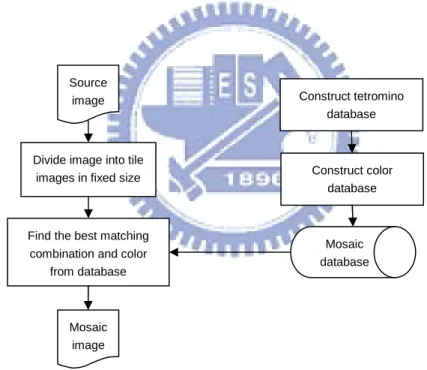
Figure 1.4. According to the flowchart, first of all, we construct a mosaic database
with tetromino combinations and colors. Then we divide a given image into many tile
images to find the best matching combination and colors of tetrominoes from the
mosaic database for each tile image. The tetromino-based mosaic image for the given
image is generated by composing all tile images in a certain arrangement. Moreover,
some related processes of such mosaic creation are proposed to improve the visual
effects of the generated tetromino-based mosaic image. The detailed creation process
will be described in Chapter 3.
1.2.3
Brief Description of Proposed Method for Data
Hiding in Tetromino-based Mosaic Images by
Distinct Combinations of Tetrominoes
Based on the scheme of above-mentioned tetromino-based mosaic image
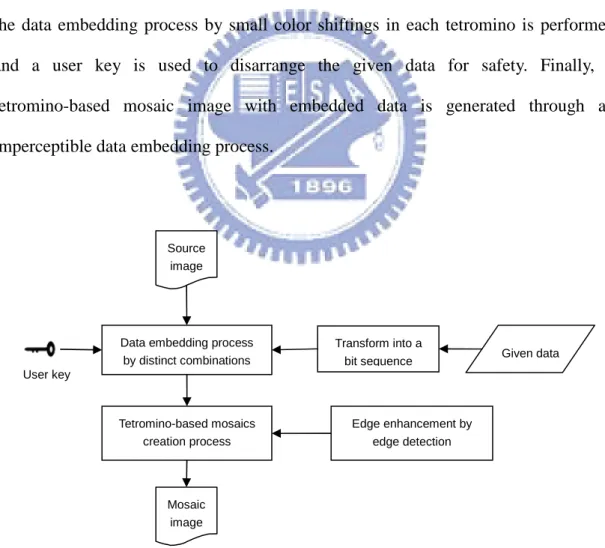
using distinct combinations of tetrominoes. The data embedding process of such data
hiding is illustrated in Figure 1.5. At the beginning, we transform given data which
will be hidden into a bit sequence. The given data might be a watermark, a piece of
secret message, or any digital data which you want to transmit by covert
communication. A user key is used to strengthen the security of data hiding by
disarranging the bit sequence of the given data. Second, an edge fitting process is
performed by edge detection thresholding before the data embedding process. Finally,
a tetromino-based mosaic image with embedded data is created by the data
embedding process using distinct combinations of tetrominoes. The detailed algorithm
of the embedding method will be described in Section 4.3.2.
Figure 1.4 Creation process of tetromino-based mosaic images.
The data extraction process is an inverse version of the above-mentioned data
embedding process. After the tetromino shape detection process, the extraction
process is performed to obtain the embedded data by recognizing the combinations of
tetrominoes. Then the user key is utilized to recover the given data in its original order.
The description of the extraction process will be described in detail in Section 4.3.3.
Mosaic image Source
image
Divide image into tile images in fixed size
Mosaic database Construct tetromino database Construct color database Find the best matching
combination and color from database
1.2.4
Brief Description of Proposed Method for Data
Hiding in Tetromino-based Mosaic Images by
Small Tetromino Color Shiftings
A tetromino is composed by four squares with the same color. However, human
visual system cannot be aware of small changes of colors. According to this property,
colors of each tetromino can be shifted in small amounts to embed data. The
embedding process of data hiding is illustrated in Figure 1.5. At first a tetromino
shape detection process is performed on an input tetromino-based mosaic image. Then,
the data embedding process by small color shiftings in each tetromino is performed
and a user key is used to disarrange the given data for safety. Finally, a
tetromino-based mosaic image with embedded data is generated through an
imperceptible data embedding process.
Figure 1.5 Embedding process of data hiding by distinct combinations of tetrominoes.
Source image Mosaic image Tetromino-based mosaics creation process Data embedding process
by distinct combinations Edge enhancement by edge detection thresholding Given data Transform into a bit sequence User key
The data extraction process is a reversed procedure of the data embedding
process. After the execution of a tetromino shape detection process, the extraction
process by tetromino color detection is performed to obtain the embedded data. The
detailed algorithm of the data embedding and extraction processes will be stated in
Section 5.2.2 and 5.2.3, respectively.
1.2.5
Brief Description of Proposed Method for
Removable Lossless Visible Watermarking in
Tetromino-based Mosaic Images
Tetromino-based mosaic images are composed by limited colors which integrally
are similar to a palette in concept. As a result, we can employ this characteristic to
apply some palette-like watermarking technique to tetromino-based mosaic images.
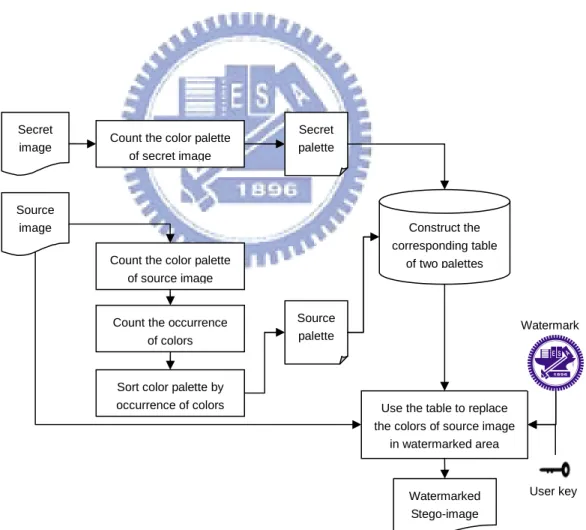
The proposed process of removable lossless watermarking in tetromino-based mosaic
images is illustrated in Figure 1.7. In the first place, two palettes called source palette
and secret palette are created by counting the colors of the source image and the
secret image respectively. Second, a corresponding table of these two palettes for
watermarking is constructed by the use of a measure of Euclidean distance. At last,
the colors of the source image in the watermarked area are replaced with the
corresponding colors in the table to form a watermarked stego-image. The watermark
removing process is an inverse process of the watermark embedding process. The
Figure 1.6 Embedding process of data hiding by small color shiftings
Figure 1.7 Removable lossless watermarking process in tetromino-based mosaic images.
Source image Secret image
Count the occurrence of colors Sort color palette by occurrence of colors Count the color palette
of secret image
Count the color palette of source image Source palette Secret palette Construct the corresponding table of two palettes Watermarked Stego-image Use the table to replace the colors of source image
in watermarked area Watermark User key Mosaic image Mosaic image Tetromino-based mosaic
image creation process Data embedding process
by small color shiftings Given data Transform into a
bit sequence User key
Tetrominoes shape detection process
1.2.6
Brief Description of Proposed Method for
Image Steganography by Watermarking in
Tetromino-based Mosaic Images
The proposed method for image steganography is achieved by the concept of the
removable watermarking technique. A watermarked tetromino-based mosaic image is
created as a cover image to embed a secret image by the palette-like watermarking
technique. In other words, the watermarked area is used to embed a secret image for
image steganography. The detailed algorithm will be described in Chapter 7.
1.3
Contributions
Some major contributions of this study are listed as follows.
1. A method to find all arrangements of tetrominoes to fill a plane and
construct a tetromino database for mosaic creation.
2. A method to create a new type of mosaic images composed of
tetrominoes is proposed.
3. A method to recognize the tetromino combinations in tetromino-based
mosaic images is proposed.
4. A method for data hiding in tetromino-based mosaic images by distinct
combinations of tetrominoes is proposed.
5. A method for data hiding in tetromino-based mosaic images by small
tetromino color shiftings is proposed.
6. A method to enhance the visual effects of edges by a border enhancement
images.
7. A method for removable lossless watermarking technique for
tetromino-based mosaic images is proposed.
8. A method for image steganography by watermarking in tetromino-based
mosaic images is proposed.
1.4
Thesis Organization
The remainder of this thesis is organized as follows. In Chapter 2, we review the
related works of this study. In Chapter 3, the proposed method for creation of
tetromino-based mosaic images is described. In Chapters 4, the data hiding method by
distinct combinations of tetrominoes in tetromino-based mosaic images is presented.
The edge fitting method by edge detection thresholding is also described. Then, the
proposed data hiding method by small tetromino color shiftings is described in
Chapter 5. We present the proposed removable lossless watermarking method for
tetromino-based mosaic images in Chapter 6. In Chapter 7, the proposed method for
image steganography by watermarking in tetromino-based mosaic images will be
presented. Conclusions of our works and discussions on future works are included in
Chapter 2
Review of Related Works
2.1
Previous Studies on Mosaic Images
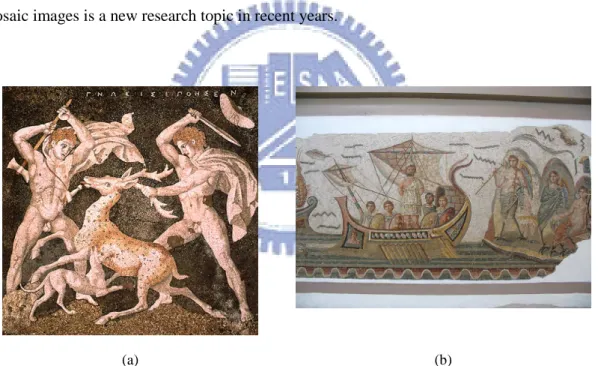
Mosaic image is a common type of decorations composed of numerous small tiles
arranged in a certain way. Tile mosaics appeared in Greek and Roman times over 2000 years
ago. Two examples are shown in Figure 2.1. They are still widely used today. Creation of
mosaic images is a new research topic in recent years.
(a) (b)
Figure 2.1 Ancient mosaic images. (a) Detail from the mosaic floor signed Gnosis in the “House of the Abduction of Helen” at Pella, Greek, late 4th century BC, Pella, Archaeological Museum. (b) Roman mosaic of Ulysses at Carthage, Bardo Museum, Tunisia.
Haeberli [6] used Voronoi diagramsto place the Voronoi sites at random and fill
each tile with a color which is sampled from the image. However, Haeberli’s method
does not attempt to follow the edge features of the image and the tiles all have
utilizing centroidal Voronoi diagrams. In Hausner’s method, the method proposed by
Hoff [8] was extended to draw a Voronoi diagram efficiently, and Lloyd’s algorithm
[9] was utilized to produce centroidal Voronoi diagrams by moving each seed to the
centroid of its Voronoi region.
Extending the original idea of Haeberli’s method, Dobashi et al. [10] optimized
Voronoi diagrams by using the sites and edges of the Voronoi diagrams to reduce the
error between the original image and the resulting image. Faustino and Figueiredo [11]
presented a technique similar to Dobashi’s method. The main difference is that
Faustino and Figueiredo created tiles whose sizes are adapted to the edge features of
the image. This method is achieved by using a centroidal Voronoi diagram with a
density function that emphasizes edge features. Di Blasi and Gallo [12] created
another type of mosaic images by emphasizing boundaries by placing tiles along edge
directions. Elber and Wolberg [13] proposed an advanced approach to rendering
traditional mosaic images by recovering free-form feature curves from the image and
laying rows of tiles along edge curves. Figure 2.2 shows some examples of the results
of the above-mentioned methods.
Photomosaics created by Silvers and Hawley [14] is a different kind of mosaic
where a collection of small images is arranged in a rectangular grid. When viewing
the mosaic composed by small images from a distance, the small images combine to
yield an impressive integrated painting. Kim and Pellacini [15] introduced a new kind
of mosaic, called jigsaw image mosaic (JIM), as shown in Figure 2.3, where image
tiles of arbitrary shape are used to compose the final picture. Gi et al. [16] proposed a
technique of generating and arranging fragmentary piece of colored tiles to simulate
(a) (b)
(c) (d)
(e) (f)
Figure 2.2 Mosaic images created by a number of authors. (a) By Haeberli. (b) By Hausner. (c) By Dobashi et al. (d) By Faustino and Figueiredo. (e) By Di Blasi and Gallo. (f) By Elber and Wolberg.
Figure 2.3 Jigsaw image mosaic (JIM) created by Kim and Pellacini.
Figure 2.4 Colored paper mosaic created by Gi et al..
2.2
Previous Studies on Information
Hiding Techniques
Many information hiding techniques have been proposed to embed data into
given media for various purposes, such as covert communication or copyright
the human visual system, for example, by changing the least significant bits of the
pixels of a cover image to embed information [17]. The information embedded in an
image can be used to protect the copyright of the image, verify the authenticity of the
image, convey a secret message, and so on.
Information hiding in images is a popular research topic in recent years.
Researches on this topic can be classified into three approaches, namely, the
spatial-domain approach, the frequency-domain approach, and the combination of
them [18]. Ni, et al. [19] presented a novel reversible data hiding algorithm in the
spatial domain by utilizing the zero or the minimum point of the histogram and
slightly modifying the pixel values to embed data. Cheng and Tsai [20] proposed a
DCT-based method for embedding an invisible watermark by adjusting the magnitude
relation of certain DCT coefficient pairs in the frequency domain. No matter what
domains they belong to, most of these researches are based on pixel-wise or
block-wise operations. Generally speaking, information hiding in the frequency
domain is more robust than that in the spatial domain, but produces more distortion
sometimes.
2.3
Previous Studies on Information
Hiding in Art Images
Lin and Tsai [21] proposed two methods to hide information in image mosaics.
One is to manipulate the four borders of tile images. The other is to modify the
histogram of tile images. Hung et al. [22] proposed two methods to hide information
in art images. One is to embed data in the tile mosaic image by modifying the
orientations, sizes, and textures of tile mosaic images. The other is to embed data in
Lin and Tsai [21] are shown in Figure 2.5. Two images generated by Hung et al. [22]
are shown in Figure 2.6.
(a) (b)
Figure 2.5 Image mosaics created by Lin and Tsai [21]. (a) A mosaic image of Lena. (b) A mosaic image of Albert Einstein.
(a) (b)
Figure 2.6 Art images created by Hung et al. [22]. (a) A tile mosaic image. (b) A stained glass image.
Hsu and Tsai [23] proposed three methods to hide information in art images. One
is to embed data in digital puzzle images by modifying the orientations, sizes, and
varying the RGB values of each color dot of the pointillistic image. The other is to
embed data in the circular-dotted image by modifying the drawing order of the
circular dots of the circular-dotted image. Some examples of the art images created by
Hsu and Tsai [23] are shown in Figure 2.7.
(a) (b) (c)
Figure 2.7 Art images created by Hsu and Tsai [23]. (a) A digital puzzle image. (b) A digital pointillistic image. (c) A digital circular-dotted image.
Wang and Tsai [24] proposed the creations of three types of art images and their
applications for information hiding. First, information is hidden in irregular
hexagonal-tiled images by adjusting the locations of the two specific vertices and
modifying the inner colors of hexagons. For tile-overlapping mosaic images, the
information hiding work was implemented by changing the overlapping degrees of
adjacent tile images. Last, an information hiding method in variable-sized mosaic
images was proposed by changing the sizes of them without creating holes and
overlapping areas in the resulting stego-image. Some examples of the art images
created by Wang and Tsai [24] are shown in Figure 2.8.
the combinations of mosaic image creation and information hiding techniques will be
proposed. We will focus on tetromino-based mosaic images, a novel type of mosaic
image. A method for automatic creation of tetromino-based mosaic images and two
data hiding methods for such images are proposed. Furthermore, we propose a
technique of removable lossless visible watermarking in tetromino-based mosaic
image. Using this watermarking technique, an image steganography method for
tetromino-based mosaic images is also proposed in this study.
2.4
Previous Studies on Image
Steganography
Steganography, which means “covered writing” in Greek, is the science of
communicating a message by embedding it into data files of certain forms. This
technique differs from cryptography in that communication is evident but the content
of the communication is camouflaged. Unlike data hiding and digital watermarking,
the main goal of steganography is to create complete imperceptibility. Many different
file formats can be used as cover media for data hiding, but digital image are the most
popular file type because they are used everywhere on the Internet.
Least significant bit (LSB) insertion is the most common approach to embedding
information in a cover image [17]. In this approach, the least significant bit of each
byte inside an image is changed to hide at least a bit of the secret message. Lee and
Chen [25] proposed an image steganographic model based on variable-sized LSB
insertion to maximize the embedding capacity while maintaining image fidelity.
images by using the compression properties of the frequency domain. Fridrich and Du
[27] presented a steganographic technique for palette images by hiding message bits
into the parity bits of colors which are close to one another.
Marvel et al. [28] presented a new type of digital image steganography, called
spread spectrum image steganography (SSIS). The SSIS system proposed by them
combines spread spectrum communication, error control coding, and image
processing to hide information in images. Fridrich and Goljan [29] presented a new
steganographic method for digital images in raster formats. Message bits are
embedded in the cover image by adding a weak noise signal with a specified but
arbitrary probabilistic distribution. A steganographic technique for embedding secret
messages into a gray-valued cover image was proposed by Wu and Tsai [30].
Information is embedded into a cover image by replacing the difference values of the
two-pixel blocks of the cover image with similar ones in which bits of embedded data
are included.
(a)
Figure 2.8 Art images created by Wang and Tsai [24]. (a) An irregular hexagonal-tiled images. (b) A tile-overlapping mosaic images. (c) A variable-sized mosaic images.
(b)
(c)
Figure 2.8 Art images created by Wang and Tsai [24]. (a) An irregular hexagonal-tiled images. (b) A tile-overlapping mosaic images. (c) A variable-sized mosaic images (continued).
Chapter 3
Creation of Tetromino-based Mosaic
Images
3.1
Idea of Proposed Method
Lin and Tsai [21] proposed a method to create an image mosaic by arranging a
large number of small tile images with each tile image resembling a similar-sized
block of a given image. The image mosaic composed of all the tile images looks
integrally like the source image when seen from a distance. The idea of the proposed
art image creation method in this study was inspired by Lin and Tsai’s method to
create a new type of mosaic images, called tetromino-based mosaic image, as
mentioned previously. The idea of tetromino-based mosaic image creation was
developed by two main concepts. The first is an integration of art and computer
technology. Users can create their own images which look more artistically with
special visual effects for decorations. The second concept is that a mosaic image can
be used as a fine medium for covert communication. As a result, the proposed method
also deals with the problem of copyright protection.
In geometry, tetrominoes can be repeated to fill a plane and combined closely to
one another to form a square lock. This is the reason why tetrominoes are also good
units for mosaic image creation as proposed in this study. However, tiling a plane
with tetrominoes is more difficult than traditional mosaic creation because
kinds of tetrominoes to create a variety of distinct mosaic image is a critical issue. In
addition, using tetrominoes as components to generate mosaic images can provide a
new style of visual effects for viewers. The tetromino-based mosaic image creation
and other related processes are stated in the following sections.
3.2
Review of Traditional Image Mosaic
Creation Process
3.2.1
Mosaic Image Creation Process
Two issues, mosaic database construction and similarity measure selection, play
important roles in mosaic image creation. The former is the first step of the mosaic
creation process to generate tiles images. Tile images are not only the basic
components of mosaic images but also the key components determining how mosaic
images look like. The latter issue is the design of a good measure for use in the
process of choosing the best matching tile image from a mosaic database. In Lin and
Tsai’s study [21], mosaic images were created according to the following procedures.
First, a mosaic database was constructed by selecting a set of tile images and then
extracting from their relevant features which depend on what types of tile images are
used as the input to the construction process. Next, the image mosaic creation process
starts with a source image as an input. The process divides the source image into
many small target images based on a given size. A similarity measure is then used to
search the best matching tile images of the given size from the mosaic database.
Finally, after putting the best-matching tile images together, a mosaic image is
Algorithm 3.1. Traditional mosaic creation process.
Input: a source image I, a tile image database DB, and a given tile size S. Output: a mosaic image I′.
Steps:
Step 1. Divide I into blocks of target images based on the given size S.
Step 2. Extract features from each target image.
Step 3. For each target image, search the best matching tile image from tile image
database DB according to a similarity measure.
Step 4. Compose all tile images to generate a mosaic image I′.
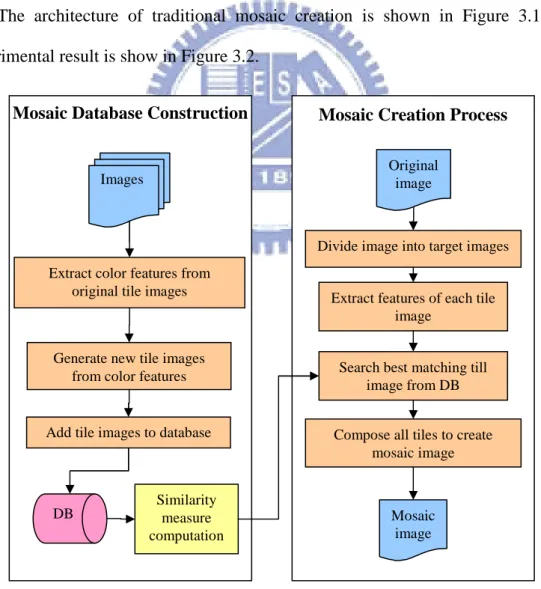
The architecture of traditional mosaic creation is shown in Figure 3.1. The
experimental result is show in Figure 3.2.
Figure 3.1 The system architecture of an image mosaic creation system. Divide image into target images
Extract features of each tile image
Search best matching till image from DB
Compose all tiles to create mosaic image
Mosaic image Extract color features from
original tile images
DB
Generate new tile images from color features
Mosaic Creation Process Original
image Images
Mosaic Database Construction
Similarity measure computation Add tile images to database
Figure 3.2 An experimental result of image mosaic creation by Lin and Tsai [21].
3.2.2
Tile Image Mosaic Database Construction
For mosaic image creation, we have to construct a database to accelerate the
computation of searching the best matching tile image. We accomplish tile image
database construction using the following algorithm.
Algorithm 3.2. Tile image database construction. Input: a set of original tile images, M = {I1, I2, …, In}.
Output: a set of new tile images, N = {T1, T2, .., Tn} and a set of feature vectors V =
Steps:
Step 1 Calculate the average color of each original tile image Ii in each of the RGB
channels.
Step 2 Represent the average colors as a one-dimension feature vector Vi with three
elements Ri, Gi, and Bi for Ii.
Step 3 Generate a new tile image Ti by resizing and cropping each original image Ii
to a predefined tile size.
Step 4 Add all Ti and associated Vi to DB.
3.2.3
Similarity Measure Computation
In Algorithm 3.1, computation of the similarity measure between a target image
and a tile image is mentioned. An input source image is first divided into blocks of
small target images and the feature vector of each target image is obtained by
calculating three average color values of the target image in the RGB channels. The
vector extracted from a target image is taken as an input to the similarity measure
computation with another input being the feature vector extracted from a tile image in
the mosaic database. A tile image from the mosaic database is considered to be similar
to the target image if the resulting value of the similarity measure, say a Euclidean
distance between the two feature vectors, is the smallest among all the tile images in
the database. The detailed algorithm of similarity measure computation is described as
follows.
Algorithm 3.3. Similarity measure computation.
Input: a target image T, and a tile image L from the database DB. Output: a similarity measure value D between T and L.
Steps:
Step 1. Divide T and L into N parts, where N is a predefined number.
Step 2. Extract color features from each part of T to form a vector VT with
N×3
elements.
Step 3. Extract color features from each part of L to form a vector VL with N×3
elements.
Step 4. Calculate the Euclidean distance between the color vectors VT and VL
according to the following similarity measure:
2
T L
D
=
=
=
=
V
−
−
−
−
V
.3.3
Proposed Tetromino-based Mosaic
Image Creation Process
3.3.1
Scheme of Creation Process
In this section, based on above-mentioned traditional mosaic image creation
process we show how to create a tetromino-based mosaic image as an algorithm as
follows.
Algorithm 3.4. Creation process of tetromino-based mosaic images.
Input: a source image I, a given size s of one square in a tetromino, and a tile image database DB.
Output: a tetromino-based mosaic image I′. Steps:
Step 1.Construct a tetromino database DB by generating numerous tile images with
Step 2.Divide the source image I into many target images with the given size s.
Step 3.For each target image T, perform the following operations.
3.1 Calculate the distance between T and each tile image L in the tetromino
database DB by Algorithm 3.3.
3.2 Choose the tile image Lo in DB with the smallest distance as the best
matching tile image for T.
3.3 Perform a border enhancement process to enhance the visual effect of
each tetromino in T.
Step 4.For each target image T in I, replace it with the best matching tile image to
create a tetromino-based mosaic image I′ as output.
In the above steps, a best matching tile image, which is the most similar to the
corresponding target image, is found by the similarity measure computation as stated
in Algorithm 3.3. The construction of the tetromino database DB mentioned in the
above algorithm is described in the next section.
3.3.2
Tetromino Database Construction
The tetromino database is used to find the best matching tile image for each
target image, as described in the previous algorithm. It is desired to control the
number of colors and combinations of the tetrominoes in the database. Before the
beginning of tetromino database construction, we have to design an algorithm to
enumerate all the possible tetromino combinations in a fixed-sized region. Nineteen
types of tetrominoes, as shown in Figure 3.3, are used as inputs for the tetromino
database construction algorithm. In this study, the fixed-sized region is a plane of 4×4
combinations in a 4×4 grid. The detail of the enumerating process of tetromino
combinations is described in Algorithm 3.4 below. The tetromino database is
constructed by Algorithm 3.5 below.
Figure 3.3 Nineteen types of oriented tetrominoes.
Figure 3.4 Some illustrations of inputs in Algorithm 3.5. (a) A plane of 4×4 grids. (b) A tetromino combination in a plane of 4×4 grids.
Algorithm 3.5. Process for enumerating tetromino combinations. Input: 19 types of tetrominoes E and a plane P of 4×4 grids.
Output: a set of all possible tetromino combinations T = {T1, T2, .., Tn} in P.
Steps:
Step 2.In first level, for each tetromino type X in E, perform the following operations.
2.1 For each position which can be used to place X, perform the following
operations.
2.1.1 Generate a child node Cr of root r.
2.1.2 If the filled tetromino crosses the boundary of P, delete Cr and go
back to 2.1.
2.1.3 Record the tetromino type X and the position of X in Ck
Step 3.For each node of level Li , where 2≧i≧4, perform the following operations.
3.1 For each node D in level i − 1, perform the following operations. 3.1.1 Choose one type from E and denote it by Y.
3.1.2 For each position which can be used to place Y, perform the
following operations.
3.1.2.1 Generate a child node Ck of node D.
3.1.2.2 If the filled tetromino Y crosses the boundary of P, delete
the child node Ck and go back to Step 3.1.2.
3.1.2.3 If the filled tetromino Y overlaps with any existing
tetromino, delete child node Ck and go back to Step 3.1.2.
3.1.2.4 If the filled tetromino combination Y already exists in the
tree, delete child node Ck and go back to Step 3.1.2.
3.1.2.5 Record the tetromino type and the position of Y in Ck.
Step 4. Through a tree traversal, search all paths from all leaves in level 4 to the
root.
Step 5. For each path Pi in the tree, form a tetromino combination Ti by extracting
data from each node of Pi.
Input: 19 types of tetrominoes, and a fixed number N of colors. Output: a tetromino database DB with all possible tile images. Steps:
Step 1. Generate a set of all possible tetromino combinations T = {T1, T2, .., Tn} in a
plane of 4×4 grids by Algorithm 3.5.
Step 2. Generate a set of N distinct colors, C = {C1, C2, .., CN}, in the RGB color
space uniformly.
Step 3. Create all possible tile images by generating all possible combinations of Ti
in T and Ci in C.
3.3.3
Visual Effect Improvement by Border
Enhancement
Through the above-proposed algorithms, a basic tetromino-based mosaic image
is created. However, a problem occurs in our creation process. If two tetrominoes
which are close to one another have the same or similar color, the edge between these
two tetrominoes may be hard for the viewers to recognize. It is desire to enhance the
boundary of tetrominoes in tetromino-based mosaic creation. Furthermore, we also
hope to make each piece of tetrominoes look more three-dimensional. As a result, two
visual effects, lightening and shading borders, are created as a post-processing step in
this study after the tetromino-based mosaic image creation process, which we call
border enhancement. An algorithm for this purpose is described as follows.
Algorithm 3.7. Border enhancement.
Input: a plane Y of 4×4 grids with a tetromino combination P. Output: Y with lightening and shading effects P′.
Steps:
Step 1. For each tetrominoes t in P, transform the color of the tetromino from the
RGB model to the HSL model
Step 2. For each tetrominoes t in P, check its edge type according to the follow
steps.
2.1 If it is a top or left edge in t, then lighten the edge by increasing the L
channel value of the color at the borders.
2.2 If it is a bottom or right edge in t, then shade the edge by decreasing
the L channel value of the color at the borders.
3.4
Experimental Results
Some tetromino-based mosaic images generated by the proposed creation
process (Algorithm 3.4) are shown in this section. All the tetromino-based mosaic
images in our experimental results were created by the use of a tetromino database
with 125 kinds of colors and 117 types of tetromino combinations constructed in this
study. Figures 3.6, 3.7 and 3.8 show the results of using different border
enhancements. Figures 3.9, 3.10 and 3.11 show some experimental results of using
different kinds of original images obtained from the proposed mosaic image creation
process.
3.5
Discussions and Summary
In this chapter, we reviewed a traditional mosaic image creation process and
proposed accordingly an idea of creating a novel type of mosaic image composed by
In addition, an algorithm has been proposed to generate a tetromino database with
different colors and tiling styles. Finally, we also proposed a border enhancement
process for improving edge effects in tetromino-based mosaic images. Some
experimental results are presented to show the effects of the proposed algorithms.
Colors and tetromino combination are the most important characteristics in
tetromino-based mosaic image creation. With these two features, we will propose two
data hiding methods in the two following chapters.
(a)
(b)
Figure 3.6 Some of experimental results of the proposed tetromino-based mosaic creation. (a) A tetromino-based mosaic image without border effects created from Figure 3.5. (b) A partial image of the red region in (a).
(a)
(b)
Figure 3.7 Some of experimental results of the proposed tetromino-based mosaic creation. (a) A tetromino-based mosaic image with dark border effects created from Figure 3.5. (b) A partial image of the red region in (a).
(a)
(b)
Figure 3.8 Some of experimental results of the proposed tetromino-based mosaic creation. (a) A tetromino-based mosaic image with lightening and shading border effects created from Figure 3.5. (b) A partial image of the red region in (a).
(a)
(b)
Figure 3.9 Some of experimental results of the proposed tetromino-based mosaic creation. (a) An image of Eiffel Tower. (b) A tetromino-based mosaic image created from (a)
(a)
(b)
Figure 3.10 Some of experimental results of the proposed tetromino-based mosaic creation. (a) An self-portrait of van Gogh. (b) A tetromino-based mosaic image created from (a).
(a)
(b)
Figure 3.11 Some of experimental results of the proposed tetromino-based mosaic creation. (a) An image of Jolin, a singer. (b) A tetromino-based mosaic image created from (a).
Chapter 4
Data Hiding in Tetromino-based
Mosaic Images by Distinct
Combinations of Tetrominoes
4.1
Idea of Proposed Method
As mentioned in Chapter 3, we create a new type of mosaic images in this study,
named tetromino-based mosaic images. This type of mosaic image is generated by the
use of distinct tetromino combinations. Combinations of tetrominoes can be encoded
to hide data. However, using this way to hide data may damage the tetromino-based
mosaic images which we create. Therefore, we propose to use edge fitting to maintain
visual qualities of tetromino-based mosaic images by sacrificing a portion of capacity
of data hiding. In this chapter, we will describe the proposed data hiding method using
distinct combinations of tetrominoes and an edge fitting technique based on edge
detection.
4.2
Proposed Data Hiding Method by
Distinct Combinations of
Tetrominoes
The main concept of the proposed method for data hiding using tetromino-based
mosaic images is to encode tetromino combinations during tetromino-based mosaic
image creation. The creation can be regarded as a two-level hierarchical operation.
The lower level of the operation is to fill four tetrominoes into a block of 4×4 grids
for tile image generation. And the upper level is to put all tile images together to
create a tetromino-based mosaic image. As a result, we can use the lower level of this
two-level hierarchical image creation to hide data. Through the tetromino database
construction described in Chapter 3, 117 kinds of tetromino combinations can be
found by an enumerating process, as mentioned previously. In theory, we can only
embed six bits in a block of 4×4 grids by fundamental binary encoding because the
largest power of 2 smaller than 117 is 26. To increase the capacity of our data hiding technique, a transformation process between a binary digit system and a decimal digit
one are proposed. At first, the given data are transformed into a binary digit sequence.
Subsequently, we transform the binary number sequence into a decimal digit sequence.
Then, we encode 100 tetromino combinations for every two digits of the decimal digit
sequence for data hiding. Because the capacity of the maximum integer data type in
C/C++ is 64 binary bits long, which equals 20 decimal digits, we can embed
64×(2/20)=6.4 bits in a block of 4×4 grids by the above-mentioned process. The detail of the process is described as algorithm below.
Algorithm 4.1. Data transformation from binary to decimal. Input: message data D and a secret key K.
Output: a randomized decimal digit sequence Sr to be used in the data hiding process.
Steps:
Step 1.Transform D into a binary digit sequence S = {S1, S2, ..., Sn}.

![Figure 2.5 Image mosaics created by Lin and Tsai [21]. (a) A mosaic image of Lena](https://thumb-ap.123doks.com/thumbv2/9libinfo/8389090.178620/31.892.143.747.228.947/figure-image-mosaics-created-tsai-mosaic-image-lena.webp)
![Figure 2.7 Art images created by Hsu and Tsai [23]. (a) A digital puzzle image. (b) A digital pointillistic image](https://thumb-ap.123doks.com/thumbv2/9libinfo/8389090.178620/32.892.122.769.321.749/figure-images-created-tsai-digital-puzzle-digital-pointillistic.webp)
![Figure 2.8 Art images created by Wang and Tsai [24]. (a) An irregular hexagonal-tiled images](https://thumb-ap.123doks.com/thumbv2/9libinfo/8389090.178620/34.892.130.769.490.1055/figure-images-created-wang-tsai-irregular-hexagonal-images.webp)
![Figure 3.2 An experimental result of image mosaic creation by Lin and Tsai [21].](https://thumb-ap.123doks.com/thumbv2/9libinfo/8389090.178620/39.892.152.744.104.711/figure-experimental-result-image-mosaic-creation-lin-tsai.webp)
