
出題學習策略與物理實驗教學:潛能探討與影響分析(1/2)
22
0
0
全文
(2) 行政院國家科學委員會補助專題研究計畫. □ 成 果 報 告 □期中進度報告. 出題學習策略與物理實驗教學:潛能探討與影響分析(1/2). 計畫類別: 個別型計畫 □ 整合型計畫 計畫編號:NSC 94-2511-S-006-002執行期間:94 年 08 月 01 日至 95 年 07 月 31 日 計畫主持人:于富雲 共同主持人:劉祐興 計畫參與人員:馬凱賢、王正傑、范惠琪、陳靖宜. 成果報告類型(依經費核定清單規定繳交):□精簡報告. □完整報告. 本成果報告包括以下應繳交之附件: □赴國外出差或研習心得報告一份 □赴大陸地區出差或研習心得報告一份 出席國際學術會議心得報告及發表之論文各一份 □國際合作研究計畫國外研究報告書一份. 處理方式:除產學合作研究計畫、提升產業技術及人才培育研究計畫、 列管計畫及下列情形者外,得立即公開查詢 □涉及專利或其他智慧財產權,□一年□二年後可公開查詢 執行單位:國立成功大學 教育研究所 中. 華. 民. 國 95 年 05 月 25 日.
(3) 出題學習策略與物理實驗教學:潛能探討與影響分析(1/2) Multiple-Choice Question-Generation Learning Strategy: Potential and Effects for University Physics Laboratory Classrooms(1/2) 計畫類別:個別型計劃 計畫編號:NSC 94-2511-S-006-002執行期限:94 年 8 月 1 日至 95 年 7 月 31 日 計劃主持人:于富雲 國立成功大學教育研究所 計劃共同主持人:劉祐興 國立暨南大學土木工程學系 計劃主持人電子郵件信箱:[email protected] 一、. 中文摘要. 有鑑於科學探究重在問題的擬定,故本研究第一年計畫主要鎖定「選擇題問題建構」 學習策略融入物理實驗課程的潛在價值分析。經由為期一學期的研究歷程與資料收集,從 問卷量化分析資料發現,參與學生對於此策略運用對學習之潛能與滿意度皆持顯著正面的 看法;此外,對於選擇題問題建構策略所連帶產生的作業要求與認知負擔,學生並無顯著 的負面焦慮感。進一歩質性資料分析指出,選擇題問題建構策略對學習實具有多重面向的 促成效果(包括:突破傳統實驗課程之常態回應性被動學習型態與保守看法、促進學生建 設性與具產能的研讀習慣、增加組內成員主動的溝通與互動、思考能力與相關學科能力的 養成等)。整體言之,本研究發現不僅對選擇題問題建構學習策略之運用有助學生對物理 學科知識的記憶與理解提供實證數據基礎,針對選擇題問題建構學習策略對促成學生的賦 權感與有利學習社群的實踐化皆提供豐富的質性資料,以增加研究的解釋力與讀者對研究 結果的外推性。 關鍵字:出題學習策略、高等教育、物理實驗教學. Abstract The potential value of a multiple-choice question-construction instructional strategy for the support of students’learning of physics experiments was examined in the study. 42 university freshmen participated in the study for a whole semester. A constant comparison method adopted to categorize students’qualitative data indicated that the influences of multiple-choice question-construction were evident in several significant ways (promoting constructive and productive studying habits; reflecting and previewing course related materials; increasing in-group communication and interaction; breaking passive learning style and habits, etc.), which worked together not only enhanced students’comprehension and retention of the obtained knowledge, but also helped distill a sense of empowerment and learning community within the participants. Analysis with one-group t-tests, using 3 as the expected mean, on quantitative data further f oundt ha ts t ude nt s ’s a t i s f a c t i ont owa r dpa s tl e a r ni nge xpe r i e nc e ,a ndpe r c e pt i onst owa r d this strategy’ s potentials for promoting learning were statistically significant at the 0.0005 level while learning anxiety was not statistically significant. Suggestions for incorporating question-generation activities within classroom and topics for future studies were rendered. Keywords: Higher education, Learning strategies, Physics labs, Student generated questions 二、. Introduction As far as instructional strategies per se, questioning is an essential educational tool for all disciplines in general and lies at the heart of scientific inquiry in particular (Chin and Kayalvizhi 2002). Student generated-questioning has been suggested as a promising instructional strategy to f a c i l i t a t es t ude nt s ’c ogni t i vee l a bor a t i onand as a valuable alternative to achieving meaningful 2.
(4) learning and reinforcing higher-order thinking skills (Balajthy 1984, Biddulph et al. 1986, Chang 1998, Chin and Kayalvizhi 2002, Commeyras 1995, Dori and Herscovitz 1999, English 1998, Leung and Wu 1999, Rakes and Scott 1983, Silver 1994, Wilen 1985). Evidence from past studies generally supported teaching and the inclusion of the element of student questioning in instructional process for the enhancement of student text processing and reading comprehension, motivation, question-generation ability, problem-solving ability, and attitudes toward the subject matter studied (Dori and Herscovitz 1999, Keil 1965, King 1992, Koch and Eckstein 1991, Perez 1985, Rosenshine et al. 1996, Shih 1999, Silver 1994, Wong 1985, Yang 2000, Yu et al. 2003). Even though several studies showed the beneficial effects of student generated questions, the focus and context of existing studies exclusively evolved around how self-questioning may i nf l ue nc es t u de nt s ’pr oc e s s i ng ofpr os eoror a li ns t r uc t i on.Asmor ea nd more classrooms emphasize student-directed hands-on learning activities, the potential of student generated que s t i oni ngf ort hes uppor tofs t ude nt s ’l e a r ni ng( c ont e ntdoma i nknowl e dg ea swe l la sg e ne r a l cognitive ability) in such learning environments would warrant further investigation. Besides, past studies supporting the efficacy of self-questioning primarily involved posing open-ended questions or story problems. Analytically, relative to open-ended question-posing, which comprised of constructing a question and its answer/solution, when faced with the tasks of constructing multiple-choice questions, students would have the added cognitive task of pondering three distractors that could effectively discriminate those who have learned and mastered the concepts, principles, or procedures from those who have not. Seeing that the potential of multiple-choice question-construction for the support of student-directed learning activity has yet been investigated, the main purpose of this study was to examine the potential values of its use in physics laboratory. Furthermore, there is evidence that students may show signs of hostility and resist changes in the classroom that requires them to handle more responsibilities (Silver 1994). As such, students’satisfaction and anxiety level associated with multiple-choice question-generation learning task would be an important aspect to be examined for future adoption and diffusion into the classroom. In summary, this study investigated students’perceived values of multiple-choice question-construction for physics experimentation learning as well as their satisfaction and anxiety associated with the learning experience. 三、 Methods Learning Context and Experimental Procedures A multiple-choice question-construction instructional strategy was incorporated into a ‘ La bor a t or yf orPhy s i c s ’c our s ef ora whol es e me s t e r .Students were informed that this pedagogical approach was designed to prompt them to think critically about the content of the lab activities and to elaborate on interacting physical phenomenon. 42 university freshmen from the department of Civil Engineering in one national university in Taiwan participated in this study. During the course of this study, each of the enrolled students was required to individually construct three multiple-choice questions while conducting a series of physics experiments with the other three randomly assigned group members. In total, ten laboratories related to thermodynamics, electricity, magnetism, dynamics, optics, wave transmission, centripetal force, and atomic physics were set up. These experiments were carried out in 12 3-hour instructional sessions. To guide students through the process of carrying out their experiments, a computer-assisted tutorial was developed in the form of VCD and made available to students for repetitive and flexible viewing both in- and out-of-class. As successful self-questioning instructional studies all appeared to involve either direct instruction or explicit written instruction on question generation (Wong, 1985), a training session was arranged at the first lab session. The main purpose of the training was to equip students with the basic skills and knowledge of generating higher-order thinking (HOT) multiple-choice questions around important experimental elements. Adopting King’ s definition (1992), HOT questions are “ those that cannot be answered by the factual materials in the texts or by teacher’ s lectures. They require students to think, rather than remember or look up.”Training was given 3.
(5) orally in large group settings and involved direct instruction, practice and feedback. Afterwards each student received a 3-page training booklet that summarized the following points conveyed during the training session: (a) the rationale for incorporating multiple-choice question-generation in the class; (b) most frequent encountered types of questions in the context of physical experimentation (observational, procedural or explanatory questions) with each type illustrated by 3-4 question examples related to physic experiments; (c) general guidelines on multiple-choice question construction (i.e., DOs and DON’ Ts). Students were advised to use the booklet as a reference guide for good question-generation practice throughout the rest of the lab sessions. As a routine, each of the participants was required to individually construct and hand in three multiple-choice questions before the end of each lab session while one copy of group lab report for each of the experiments was due at the beginning of next lab session. Bearing in mind that providing constructive feedback to questions that students constructed was important, yet time-consuming if given individually, the instructor gave student feedback as a whole group by purposively selecting students’work and used them as exemplars to accentuate important question-generation guidelines at least every two weeks. Besides, TAs used a grading system of plus (very good), check (good), and minus (you can do better) as individual feedback to students on the overall quality of their constructed questions. These codes were later translated as 90, 80, or 70, summed, and accounted for 15% of their final grade (whereas group lab reports account for 35%, final exam for 30% and attendance for 20%). Finally, students were made aware that 50% of the final test exam would be based on the questions students generated in this class if deemed appropriate and valid. At the last class session, a post-session self-report questionnaire was disseminated to participants to be completed individually to collect data on their perceptions and dispositions toward the adopted instructional approach. Measurement Instruments The questionnaire mainly consisted of three Likert-scales to collect quantitative data on students’perceptions towards the potential of question-construction instructional strategy for the support of their learning as well as their satisfaction and anxiety level associated with the activity. The adopted scales were originally developed by Hung (2000), who mainly drawn upon Kr a s he n’ s second language acquisition theory that focuses on the affective components that have a decisive impact on successful learning (Krashen 1987). The scales were adapted to make the items better fit current experimental tasks (Physics experimentation) and the target population involved (undergraduates). Each statement on the scales was rated on a five-part discrete scale with corresponding ve r ba lde s c r i pt i onsr a ng i ngf r om ‘ s t r ong l ydi s a gr e e ’t hr oug h‘ di s a gr e e , ’‘ no-opi ni on, ’‘ a g r e e , ’t o ‘ s t r ong l ya g r e e ’(each response received a weight of 1, 2, 3, 4, or 5, respectively). Both positive and negative statements were included in the instrument to counteract possible response-set tendencies. As such, scoring on the negative statements were reversed so that negative and positive responses could be summed and analysed with higher scores reflecting more positive attitudes; that is, more satisfied, more amiable perceptions, and less anxiety level associated with multiple-choice question-construction learning experience. Internal consistency reliability was calculated for each of the scales using the Cronbach's alpha method. The Cronbach's alpha values calculated after the study were 0.80, 0.82, and 0.80 f or‘ Students’Perceptions toward the Potential of Multiple-Choice Question-Construction Learning Strategy for the Support of Their Learning Scale, ’‘ Satisfaction towards Past Learning Experience Scale, ’a nd‘ Anxiety toward Participating in Multiple-Choice Question Construction Activity Scale, ’r e s pe c t i ve l y . In addition, one open-ended question (What do you think of question-construction in class? Specifically, in what aspects does question-construction affect your learning?) was included and intentionally inserted at the beginning of the questionnaire to gather more descriptive and possibly multiple perspectives from participants. Students were advised to provide at least 100 words for the open-ended question before moving on to other parts of the questionnaire. By presented the open-ended question first, it could avoid potential leads or hints students might pick up from the scales to inadvertently skew their perceptions and responses in any ways. 4.
(6) Data Analysis Quantitative data from each of the scales were analyzed with one-group t-tests, using 3 as the expected mean, first on the summed up data, and then separately on each of the statements. A .05 level of significance was adopted. Qualitative data from the open-ended question were analysed using a constant comparison method as proposed by Lincoln and Guba (1985) to help understand many of the thought processes provoked during multiple-choice question construction that stimulate changes in students’learning process and outcomes. 四、. Results The main purpose of this study was to understand multiple-choice question-construction’ s associated values as perceived by the learners as well as their satisfaction and anxiety toward this particular strategy. Results on each of these areas are presented separated in the following sections. Students’Perceptions towards the Potential of Multiple-Choice Question Construction for the Support of Their Learning A 10-item scale and one open-ended question were used to probe into students’perceptions toward the potential values of multiple-choice question construction for their learning. Overall, it was found that between 47.62% and 90.48% of the participants agreed or strongly agreed to the statements on the scale. For instance, 9 participants (21.43%) marked ‘ strongly agree’and 27 (64.29%) marked ‘ a g r e e ’to the statement, ‘ Constructing questions in class made me think more deeply and thoroughly’while 6 participants (14.29%) marked ‘ s t r ong l ya gr e e ’and 18 (42.86%) marked ‘ agree’to the statement, ‘ Constructing questions in class helped enhance my ability in the topics covered in this course.’ Analysis with one-group t-tests, using 3 as the expected mean, on summed up data gathered from the scale found that students’perceptions toward the potential of multiple-choice question-construction for their learning was statistically significant at the 0.0005 level (t =6.44). Separate t-tests done on each of the statements, using 3 as the expected mean, found that all statements were statistically significant at the at least 0.005 level. The quantitative data derived from the scale indicated that students regarded multiple-choice question construction as a promising approach for enhancing their performance and competency of physics experiment. Based on the constant comparison data analysis done on students’responses to the open-ended question, three prominent categories pertaining to the influences of multiple-choice question-construction on learning emerged. They are: studying behaviours, attitudes and learning outcomes. Each of the themes is described separately in the following sections. Studying behaviours Regarding studying behaviours, one of the most frequently pointed-out features associated with student generated multiple-choice question was that it helped students ‘ concentrate more on task-at-hand.’In total, 18 students mentioned in their written responses that being required to construct questions in class helped them to ‘ be more attentive to experiment-related materials and details.’They ‘ focused more’on ‘ procedural process’and ‘ different ways of handling apparatus’so as to have a better understanding of how multiple variables might interact with each other and affect the outcomes of the experiment. Getting into the habit of ‘ reflecting back on one’ s own thinking and learning’was another salient feature that stands out from students’descriptive responses. 20 students appreciated the fact that after being exposed to multiple-choice question-construction activity, they are now used to think back at certain points during the learning process to make sure that they understand and grasp the core concepts of the materials in this as well as other classes. The third prevailing dimension resulted from multiple-choice question construction activity was that it made students ‘ preview course materials’before heading to the lab. Previewing course materials before classes was not something undergraduates would normally do. However, as participating students were required to hand in three questions before leaving each physics lab 5.
(7) session, six students expressed plainly that they started previewing materials related to each week’ s designated experiment (VCD and lab manuals) before coming into the classroom so as to satisfactorily fulfill the assigned work. One final category related to studying habits was that multiple-choice question-construction helped ‘ increase inner-group discussion.’Five students pointed out in their written reply that group-members ‘ interacted more intensely’many times as a response to the questions group-members conceived during the process. Student constructed questions ‘ enhanced the breath and depth of group discussion’in class, as one student put it. One indicated that constructing questions in class helped ‘ build a sense of learning community among group members.’ On top, students felt ‘ more connected to the class and their group members’as a result of this shared experience. A more enthusiastic and positive attitude toward learning Many students openly admitted in writing that they, more or less, adopted a get-it-over-with attitude toward physics experiments. Ever since middle schools physics lab has been structured in a pretty predictable way—students assigned in groups, following prescribed procedures, collecting data, and reporting results in lab repots. Multiple-choice question-construction learning experience, as reflected in ten separate entries, essentially provided participants with a rare opportunity to ‘ think independently and creatively.’ One student ardently explained it in his response, ‘ Compared to traditional transmission-receptive mode of teaching, which does not value what students think, student question-construction helps attain the goal of what science and physics should ultimately be—cultivating investigatory and independent thinking individuals.’ Question-construction task indeed presented to students as a never-before challenge. Five students expressed their excitement and enthusiasm about the activity, writing about their eagerness to test out some of the alternatives (in terms of procedures, quantities of solutions, apparatus, etc. and its associated effects) that came to their mind during the multiple-choice question-construction process. This whole process and experience, as these students described it, made learning physics more ‘ interesting,’‘ exciting,’‘ inviting,’and ‘ empowering.’ Besides, as students needed to hand in three questions before the end of each lab session, on-the-spot processing of in-coming information was desirable and necessary. These attitudes and disposition contrasted significantly to the passive learning mode students used to hold. Finally, three students mentioned that in-class question-construction ‘ helped eliminate bandwagon effect frequently present in group situations,’‘ had a positive effect on getting each and every group member actively and cooperatively participating in the experiment.’ The whole process in a way helped connect group members and build a knowledge community. In short, the kind of inertia and passive learning attitudes toward physics experiment residing in students slightly moved toward a more active and enthusiastic one through multiple-choice question construction learning activity. Learning outcomes in terms of learning of physics, overall thinking capability, work efficiency Constructive studying habits and positive attitudes as described above combined in effect helped the learning of physics experiments, as more than half of the respondents perceived (24 to be exact as reflected in their written responses). As only one physics lab session was offered per year at the participating department, it disabled same year comparative study. To provide a preliminary base for evaluating the effect of the question construction on student learning, nevertheless, participants’academic achievement on the final exam was compared to those of the previous year. To control for test difficulty that may confound the analysis and bias the result, student academic performance was based on the same set of test items included in both this study and the previous year. According to independent two-group t-test, it was found that there was a significant difference between the two groups, t = 2.58, p < .05. Students exposed to the practice of multiple-choice question-construction for a whole semester (M = 70.76, SD = 6.87, n = 42) performed significantly better than their counterparts who followed the traditional way of conducting physics experiment the previous year (M = 66.00, SD = 9.56, n = 38). One of the reasons that may account for multiple-choice question-construction’ s cognitive 6.
(8) potentials sprung from the fact that ‘ You must understand the materials well to be able to come up with the questions,’as reflected in nine students’entries. Also, ‘ constructing multiple-choice questions kind of forced you to face what you still didn’ t quite comprehend. As a consequence, it enhanced one’ s own understanding of the investigated topic.’ Another reason that might explain why engaging in question-construction was facilitative to students’learning of physics experiments, as one student perceived it, was because ‘ engaging in multiple-choice question-construction task made you think thoroughly and interact more deeply with the materials.’Students needed to think more about the phenomenon they were observing and the experiment they were carrying out in order to come up with HOT questions. Other reasons students put forth in their responses to the open-ended question—in what aspects does question-construction affect your learning, included that it induced the learners to ‘ be sensitive to and focus on the important aspects of the experiments;’‘ zoom in on easily forgotten or frequently made mistakes;’‘ discuss more with their group members;’‘ constantly refer to and reflect back on course content,’etc. By such mediating processes multiple-choice question-construction increased awareness and enhanced comprehension, retention, and association, which in the end helped students’learning of physics experiments. The second spin-off out of student question-construction activity was students’overall thinking capability. By contemplating questions, the correct answer and three plausible alternatives to each posed question, students praised about its enlightening effects on their ‘ creative,’‘ reflective,’‘ flexible,’‘ independent,’‘ backward’thinking ability. Students came to the realization that constructing multiple-choice questions demanded them to ‘ adopt a different thinking approach.’Verbatim memorization or simply plugging-in equations and theorems that usually worked for solving teacher-provided questions would be inadequate and insufficient to meet the current needs. Instead, students stated that in order to construct plausible distractors, they tended to ‘ think the other way around’and ‘ conjure all possible conceptions related to a specific principle/theorem/rule’(alternative concept, misconceptions and myth). In addition to the above two learning outcomes, three students wrote that ‘ multiple-choice question-construction experience enhanced the efficiency of conducting physics experiment.’ This was due to the fact that ‘ almost all group-mates preview the materials beforehand so that everyone involved has a pretty good idea of what it is they need to find out and understand from the experiment.’ It was this kind of goal-directed behaviours that expedited students’lab work and made conducting physics experiment more efficient and organized. Satisfaction towards Past Learning Experience Generally, students rated favourably to statements on ‘ Satisfaction towards Past Learning Experience Scale.’Analysis with one-group t-tests, using 3 as the expected mean, on summed up data gathered from the scale f oundt ha ts t ude nt s ’s a t i s f a c t i ont owa r dpa s tl e a r ni nge xpe r i e nc ewas statistically significant at the 0.0005 level with t = 4.80. Follow-up separate t-tests done on each of the statements, using 3 as the expected mean, however, found that 2 items were not statistically significant. In other words, even though students as a whole were consonant with statements on the satisfaction scale like ‘ I t ’ se nj oy abl et obeabl et oconstruct questions in class,’‘ I like to learn through in-class question-construction learning task to facilitate my learning,’they responded conservatively to two statements—’ I hope that all courses can integrate this kind of instructional approach to let students have a chance to construct questions in class,’and ‘ I am satisfied with my performance in question-construction learning activity.’Particularly, less than 1/3 of the respondents agreed or strongly agreed to these two statements. Two reasons were proposed to account for the not-so-favourable ratings on these two statements. With regards to the first statement, different class structures and formats might let students to hold back on rendering their full support for over-the-board implementation of multiple-choice question construction in other classes. Explicitly, physics experiments largely consisted of student-directed hands-on learning activities in which students have more control over the structure and flow of their own learning whereas the majority of classes in higher education were instructor-led large class lecture. On the other hand, in respect of ‘ I am satisfied with my performance in question-construction learning activity,’more than 60% respondents 7.
(9) (61.90%) marked ‘ no opinion’to this statement. This might be due to the fact that no participants have been exposed to question-construction learning activity before. Limited experience might lend the majority of participants to render the more conservative, uncertain response concerning their satisfaction with their performance as compared to the more familiar in-class learning activities like exams. Anxiety toward Participating in Multiple-Choice Question Construction Activity Analysis with one-group t-tests, using 3 as the expected mean, on summed up data gathered from the scale found that students’a n xi e t ywa snots t a t i s t i c a l l ys i g ni f i c a nt ,t=1. 26 (p>.05). That is, overall multiple-choice question-construction task did not significantly heighten students’ anxiety toward the learning situation that might arise from the added cognitive tasks associated with the arrangement. Follow-up separate t-tests done on each of the statements, using 3 as the expected mean, further found that 3 items were not statistically significant, and 5 were statistically significant. Of the 5 statistically significant results, 3 were in fact significantly favourable of the measured construct. Expressly, students considerably agreed with statement like ‘ I was not worried that I need to construct questions in class,’and at the same time evidently disagreed with statements like ‘ Constructing questions in class frightened me,’‘ My heart sank knowing that I need to continue constructing questions in class.’ Combining the 3 significantly positive attitudes with the 3 non-significant, nevertheless, favourable disposition (‘ I felt pressure finding out that I need to construct questions in class;’‘ I was nervous about constructing questions in class;’‘ I felt a great sense of relief knowing that I don’ t need to construct questions in class anymore.’ ), altogether it indicated that students did not feel anxiety when faced with multiple-choice question construction task. In general, students did not associate multiple-choice question construction experience with negative emotional feelings (e.g., worry, frightened, pressure, nervous, etc.). Signs of opposition, hostility or resistance to changes that might arise in response to the added responsibility and work as suggested by Silver (1994) were not evident in this study. However, students conveyed their worry about ‘ not being able to come up with good questions’and ‘ not perform well on question-construction task.’ A closer look at those two significant results in the un-anticipated direction (more anxiety level) yielded that they were more performance-related. To promote smooth adoption and diffusion in their classrooms, teachers may need to deal with these aspects to further alleviate students’elevated anxiety. 五、. Discussion & Conclusions According to information processing theory and metacognition, when individuals process incoming information more extensively and engage in elaborative activities, they are better able to understand and retain that information as such personalized elaborations make the new information more meaningful to them and are more in consistent with their own experience and knowledge base (King 1992, Wong 1985). However, research has shown that learners often do not engage in elaboration without prompting (Pressley et al. 1990, Spires et al. 1990). Thus, an important question challenging instructors is—how to incorporate a strategy that can induce learners to spontaneously engage in the activation and use of elaborated learning? The current study focused on inspecting the potential values of multiple-choice question-construction for student learning of physics experimentation. Analysis on quantitative data gathered from the questionnaire f ound t ha ts t ude nt s ’s a t i s f a c t i on t owa r d pa s tl e a r ni ng experience, and perceptions toward the potentials of multiple-choice question-construction for the support of their learning were statistically significant. Student performance on the final exam as compared to that of the previous year further substantiated the pedagogical effects of student generated questioning strategy. Finally, learning anxiety was not statistically significant. The obtained results supported the efficacy of multiple-choice question-c ons t r uc t i onf ors t ud e nt s ’ learning without elevating anxiety that might arise from the added cognitive tasks. Inductive data analysis of students’responses further indicated that the influences of multiple-choice question-construction were evident in several significant ways (promoting constructive and productive studying habits; increasing in-group communication and interaction; reflecting and 8.
(10) previewing course related materials; breaking passive learning style and habits, etc.), which worked together not only enhanced students’comprehension and retention of the obtained knowledge, but also helped distill a sense of empowerment and learning community within the participants. A closer examination into the descriptions and explanations students provided for its cognitive gains on physics experiments in essence reflected many of the cognitive strategies and executive processes that information-processing theorists and metacognitivists stressed as facilitative of students’learning. For instance, ‘ focus on the important aspects of the learning task,’‘ constantly refer back to course content,’and ‘ zoom in on easily forgotten or frequently made mistakes’was indicative of what Cook and Mayer (1983) termed as attentional (the process of selective attention), organizational as well as rehearsal strategy whereas ‘ reflect back on course content’and ‘ face what you still didn’ t quite comprehend’was exemplars of checking, overseeing and monitoring strategy. In other words, by encouraging students to construct multiple-choice questions, different cognitive and metacognitive strategies were instantiated that mediated information processing and learning. In summary, multiple-choice question-construction approach helped make students monitor consciously and actively their own learning and induce them to plan, deploy, evaluate and modify various cognitive strategies during the course of learning. Based on the results yielded from past and the present study, it is suggested that multiple-choice question-construction is an instructional strategy with great potential that physics instructors might want to consider for incorporating in their labs. Before proceeding to suggestions for future research, a word of caution was offered to instructors. Though students in this study generally did not associate multiple-choice question construction with negative emotional feelings, nor did they show signs of opposition, hostility, or resistance to changes, students did express concerns about ‘ not being able to come up with good questions’and ‘ not perform well on question-construction task.’ To promote smooth adoption and diffusion in the classrooms, teachers may need to alleviate students’anxiety related to their performance on the task. Some possible ways like providing support and guidance during the process (e.g., providing mechanism to students to view others’work), distilling a learning goal orientation in the classroom and de-emphasizing a performance goal disposition (by providing individual feedback focusing on comments instead of scores), etc. might help in this area. Areas open for further investigations Past studies supported the beneficial effects of student-generated questions merely consisted of generating open-ended questions or essay questions. As different tasks may solicit different cognitive processing and behaviour responses, which in turn can lead to different levels of comprehension, researchers may be interested in empirically examining the comparative learning effects associated with multiple-choice and open-ended questioning strategy. A natural flow and profitable endeavor from this point will be to develop a psychometrically-sound scale, based on the respondents’perceived views toward multiple-choice question-construction strategy to assist quantifying future large-scale data collection on examining the effects of this specific strategy. Finally, students in the present study individually composed multiple-choice questions. Researchers having faith in cooperative learning instructional strategy may want to examine if there is an enhancing moderator effect under cooperative question-generation condition. The results will help instructors arrange optimal multiple-choice question-construction environments for their students. 六、 References Balajthy E. (1984). Using student-constructed questions to encourage active reading. Journal of Reading, 27(5), 408-411. Biddulph, F., Symington, D. and Os bor ne ,R.( 198 6) .Thepl a c eofc hi l dr e n’ sque s t i onsi npr i ma r y science education. Research in Science and Technological Education, 4(1), 77-88. Brown, A. L. (1987). Metacognition, executive control, self-regulation, and other more 9.
(11) mysterious mechanisms. In F. E. Weinert and R. H. Kluwe (eds.) Metacognition, Motivation, and Understanding (New Jersey: Lawrence Erlbaum Associates), 65-116. Chang S. C. (1998). The Study of the Application of Metacognition Strategy in Social Studies of Fifth Grade Students in Elementary School. Unpublished master thesis, National Tainan Teachers College, Tainan, Taiwan. Chin C. and Kayalvizhi G. (2002). Posing problems for open investigations: What questions do pupils ask? Research in Science and Technological Education, 20(2), 269-287. Comme y r a s ,M.( 1995) .Wha tc a nwel e a r nf r om s t ude nt s ’que s t i ons ?Theory into Practice, 34(2), 101-106. Cook, L. K. and Mayer, R. E. (1983). Reading strategies training for meaningful learning from prose. In M. Pressley and F. R. Levin (eds.) Cognition Strategy Research: Educational Applications (New York: Springer-Verlag), 87-131. Dori Y. J. and Herscovitz O. (1999) Question-posing capability as an alternative evaluation method: analysis of an environmental case study. Journal of Research in Science Teaching, 36(4), 411-430. Eng l i s h,L.D.( 1998) .Chi l dr e n’ spr ob l e m pos i ngwi t hi nf or ma la ndi nf or ma lc ont e xt .Journal for Research in Mathematics Education, 29(1), 83-106. Flavell J. H. (1979). Metacognition and cognitive monitoring: A new area of cognitive-development inquiry. American Psychology, 34, 906-911. Flavell J. H. (1987). Speculations about the nature and development of metacognition. In F. E. Weinert and R. H. Kluwe (eds.) Metacognition, Motivation, and Understanding (New Jersey: Lawrence Erlbaum Associates), 21-29. Gagne, R. M. (1985). The Conditions of Learning and Theory of Instruction (New York: Holt, Rinehart and Winston). Gagne, R. M., Briggs, L. J. and Wager, W. W. (1992). Principles of Instructional Design (Fort Worth, TX: Harcourt Brace Jovanovich College Publishers). Hung, M. (2000). The Effects of Captioned, Subtitled and Non-captioned Television Videotapes on Foreign Language Learning. Unpublished master thesis, National Cheng-Kung University, Tainan, Taiwan. Hung, T. C., Yu, F. Y. and Chan, T. W. (2002). Effects of question-posing via Internet on cognition and metacognition. Proceedings of 2002 Taiwan Area Network Conference (TANET), National Tsing-Hwa University, Hsin-Chu, Taiwan, 30 October-1 November 2002, pp. 421-426, (in Chinese). Keeley, S. M., Ali, R. and Gebing, T. (1998). Beyond the sponge model: Encouraging st ude nt s ’ questioning skills in abnormal psychology. Teaching of Psychology, 25(4), 270-274. Keil G.. E. (1965). Writing and Solving Original Problems as a Means of Improving Verbal Arithmetic Problem Solving Ability. Unpublished doctoral dissertation, Indianan University, IN, U.S.A. King, A. (1992). Facilitating elaborative learning through guided student-generated questioning. Educational Psychologist, 27(1), 111-126. Koch, A. and Echstein, S. G. (1991). Improvement of reading comprehension of physics texts by s t ude nt s ’que s t i onf or mul a t i on.International Journal of Science Education, 13, 473-485. Krashen, S. D. (1987). Principles and practice in second language acquisition (England: Prentice Hall Ltd). Leung, S. S. and Wu, R. X. (1999). Problem posing with middle grades mathematics: Two real classroom examples. Mathematics Teaching in the Middle School (Reston, VA: National Council of Teachers of Mathematics). Lincoln, Y. S. and Guba, E. G. (1985). Naturalistic inquiry (Beverly Hills, CA: Sage Publications). Livingston, J. A. (2003). Metacognition: Overview. ERIC Document No. ED 474 273. Perez J. A. (1985). Effects of Student-Generated Problems on Problem Solving Performance. Unpublished doctoral dissertation, Teachers College, Columbia University, NY, U.S.A. Pressley, M., Wood, E., and Woloshyn, V. (1990) Elaborative interrogation and facilitation of fact learning: Why having a knowledge base is one thing and using it quite another. In W. 10.
(12) Schneider and F. E. Weinert (eds) Interactions Among Aptitudes, Strategies, and Knowledge in Cognitive Performance (New York: Springer-Verlag). Rakes, T. A. and Scott, S. M. (1983). Using teacher/student generated questions. ERIC Document No. ED239233. Reigeluth C. M. (1983). Instructional-Design Theories and Models (Lawrence, NJ: Erlbaum Associates). Rosenshine, B. Meister, C. and Chapman, S. (1996). Teaching students to generate questions: A review of the intervention studies. Review of Educational Research, 66, 181-221. Shih T. C. (1999). The Effect of Comparative Tests Between Self-Questioning Strategy and Cooperative Learning on Junior High School St ude nt s ’Chinese Reading Comprehension. Unpublished master thesis, National Sun Yat-Sen University, Kaohsiung, Taiwan. Silver, E. A. (1994). On mathematical problem posing. For the Learning of Mathematics, 14(1), 19-28. Spires, H. A., Donley, J., and Penrose, A. M. (1990). Prior knowledge activation: inducing text engagement in reading to learn. Paper presented at the Annual Meeting of the American Educational Research Association, Boston, MA, 3 April –7 April, 1990. Weiner C. J. (1978). The effect of training in questioning and student question generation on reading achievement. Paper presented at the Annual Meeting of the American Educational Research Association. Toronto, Canada. ERIC Document No. ED158223 Wilen, W. W. (1985). Using st ude nt s ’questions to stimulate interest in political parties. Social Studies Journal, 14(1), 3-9. Wong, B. Y. L. (1985). Self-questioning instructional research: a review. Review of Educational Research, 55, 227-268. Yang H. J. (2000). The Study of the Problem Posing Activity Applies to Elementary School Student of Grade Three by Action Research. Unpublished master thesis, National Chia-Yi University, Chia-Yi, Taiwan. Yu F. Y., Liu Y. H., Hung C. C. and Chan T. W. (2003). Construction and evaluation of a web-based question-posing and peer assessment learning system. In B. Wasson, R. Baggetun, U. Hoppe and S. Ludvigsen (eds.) International Conference on Computer Support for Collaborative Learning CSCL20003: Community Events, Communication and Interaction, Bergen, Norway, 14 June –18 June 2003, 53-55. 七、. 計畫效用自評 整體言之,本研究發現不僅對選擇題問題建構學習策略之運用有助學生對物理學科知 識的記憶與理解提供實證數據基礎,針對選擇題問題建構學習策略對促成學生的賦權感與 有利學習社群的實踐化皆提供豐富的質性資料,也增加研究的解釋力與讀者對研究結果的 外推性。本研究發現結果,已被 International Journal of Science Education (SSCI)刊登。第二 年除了繼續收集、彙整相關理論與實證基礎,將針對出題學習策略整合於物理實驗教學上, 對學生學習成就表現、學習策略運用、對物理實驗與學習經驗的整體態度與觀感之影響分 析,以前、後測控制組準實驗設計法(pretest-posttest control-group experimental design) ,收 集相關數據資料。 本研究除了依循當初擬定之計畫,針對研究目的進行教室觀察、非結構性訪談、文件 分析等質性資料之收集工作與分析外,更於研究歷程中,根據觀察所得,進一步擬定問卷, 加入收集學習者可能引發之學習焦慮與整題學習滿意度等量化資料之收集。 第一年計畫已完成出題學習策略於物理實驗情境運用之相關教材設計,包含 12 個教學 單元物理實驗操作之教學光碟、學生物理實驗手冊、選擇題試題出題訓練手冊等。所發展 之教材,也提供其他系所單位(例如:化工系)於物理實驗課程中運用。. 11.
(13) 附件一:出席國際學術會議心得報告. 報告人姓名 時間 會議 地點. 服務機構. 于富雲. 國立成功大學教育研究所 教授. 及職稱 民國九十四年十一月二十八日 本會核定 國科會計畫(出題學習策略與物理實 補助文號 驗教學:潛能探討與影響分析 NSC 至十二月二日 94-2511-S-006-002)審核通過補助 南洋理工大學,新加坡 (Nanyang Technological University, Singapore). 會議. (中文) 第十三屆電腦於教育國際研討會. 名稱. (英文) 13th International Conference on Computer in Education. 發表 論文 題目. (中文) 線上出題教學策略對後設認知策略能力之發展 (英文) Promoting Metacognitive Strategy Development through Online Question-Generation Instructional Approach. 一、. 參加會議經過 一 年 一 度 的 電 腦 於 教 育 國 際 研 討 會 ( International Conference on Computer in Education,ICCE)是亞太地區內電腦科技融入教學中最具歷史的會議,由亞太地區電腦於 教育學會(Asian Pacific Society For Computers in Education,APSCE)督導,於 11 月 28 日 到 12 月 2 日在新加坡南洋理工大學舉辦。 本次大會在新加坡教育部與人力資源部長 Gan Kim Yong 發表演說後正式開啟,今年大 會主題為「藉由學習科學使教育創新得以長足發展與全面提升」(Towards Sustainable and Scalable Educational Innovations Informed by the Learning Sciences),次主題為「分享學術研 究、測試與改革創新的方法」(Sharing Good Practices of Research, Experimentation and Innovation)。今年共有來自世界各地 20 餘國家六百多位學者與教師共同參與,在緊密的 論文審查系統與制度下,僅有 75 篇(27%)被接受以長篇論文的形式發表,95 篇(35%) 以短篇論文形發表,堪稱為一審查嚴謹的國際學術研討會。 此次會議大會共安排四場專題演講,分別由領域內學術界頗負盛名的國際學者,包括: 來自美國密西根大學科學教育之 Joseph Krajcik 教授,講題為: Using learning technologies to support students in developing integrated understanding;史丹佛國際研究機構中心主任 (Director, Center for Technology in Learning SRI International)Jeremy Roschelle 教授講授: Scaling Up Innovative Technology-Based Middle School Mathematics to a Wide Variety of Teachers;擁有多個頭銜,包括:日本教育科技促進協會會長、運用能力鑑定協會主席以及 亞太數位學習網路促進委員會主席等之 Takashi Sakamoto 教授講授: Re-construction of Conceptual Framework on ICT in Education and e-Learning in the Networked Learning Community;以及 Computer Supported Intentional Learning Environment 概念的先驅者,目前 任教於 Ontario Institute for Studies in Education, University of Toronto 之 Marlene Scadamalia 主講:Collective Responsibility for Sustained Idea Improvement。 本此會議所發表的論文涵蓋電腦科技融入教學有關之理論性、實徵性、技術層面、社 12.
(14) 會層面等跨學科相關議題,主題綜跨:小組互動模式與分析(Analysis & Model of Group Interaction) 、數位學習(E-Learning) 、學習設計(Learning Design) 、無線與行動設施(Wireless & Mobile Device) 、問題導向學習與模擬(Problem-Based Learning & Simulation) 、學習社群 (Learning Communities)、互動與介面設計(Interface & Interaction Design)、後設認知 ( Metacognition )、 教 師 發 展 ( Teacher’ s professional Development )、 同 儕 教 學 ( Peer Tutoring ) 、電腦支援合作學習:分散回應系統(CSCL:Distributed Response Systems) 、評 估與測驗(Assessment & Testing) 、調整性教導與多代理人系統(Adaptive Tutoring Systems & multi-Agent Systems),遊戲與機器人( Games & Robots)、代理人與超媒體(Agents & Hypermedia)等等。會議成果分享除了長篇論文與短文形式外,也加入專家圓桌會談、工 作坊、教學實做課程、專題演講、邀請演講、博班生發表專場(doctoral student consortium)。 本人此次出席共計有四大任務。第一為發表論文,本人所發表的論文被接受以長篇論 文的形式發表,並被安排在第一場專題演講之後的第一場次第一位發表者,講題為:線上 出題教學策略對後設認知策略能力之發展 (Promoting Metacognitive Strategy Development through Online Question-Generation Instructional Approach)。此次會議之每篇長篇論文皆被至 少三位以上的審查者以匿名方式審查之。根據大會統計資料,本年度計有 271 篇投稿論文, 其中僅有 75 篇(27%接受率)被獲以長篇論文形式發表,堪稱為一品管嚴格的國際研討會; 此外,本篇論文發表後,更獲 Research and Practice in Technology Enhanced Learning 期刊 進一步邀約期刊論文發表。經由場內外不少學者的討論與互動,研究者更獲來自日本幾位學 者邀約,擬進一步針對明年籌組專家圓桌會談與研究合作可能,可謂收穫不少。 除了發表論文,本人第二任務為完成獲邀為 Doctoral Student Consortium 之 Advisor(當 年度同時受邀擔任指導教授者有此次會議之專題演講者之一 Joseph Krajcik, Gerry Stahl, Tsukasa Hirashima, Naomi Miyake 與 Michael Jacobson 等數位學習領域國際知名學者)。 第三任務為 Assessment & Testing 場次的主持人。最後,由於本人是 Asian Pacific Society For Computers in Education(APSCE)推選出之常務理監事(Executive Committee) ,本次會 議中也針對會務的推行與擴展進行商討,期提升資訊科技與網路學習科技在亞太地區更平 順的未來與發展。 二、. 與會心得 今年大會令人印象深刻處,除了具前瞻性的學術論文發表外,一系列由新加坡當地教 師分享課室應用科技的實際教學經驗與多樣主題,像是:Use of Data Loggers for Learning、 Strategies for Language Learning、Alternative Assessment in Learning、Use of Blogs、Resources Development for Teaching & Learning、Reflections on Outreach Strategies in IT Innovation、 Emerging Technologies in Matermatics Learning、Language & Science Learning、Mobile learning、Informing Formative Assessment、Learning with Video、Learning in ICT-Enabled Environment 、 Change Management and School ICT Culture 、 Deployment of ICT in Adminstration 等,除了以論文形式發表,並結合學生成品展示與學生親自帶領解說,讓研 究者感嘆台灣在這方面機會與訓練的欠缺。新加坡經由教師與學生的深入參與設計、運用 與推廣,不但允許個人創新與創意的展現,經由授權的歷程,也容易做收長遠與多元的融 入發展,這樣的經驗與模式台灣應可多加參考與學習。 最後,大會除了一般有的晚宴社交活動外,也特別設計一系列的 iCafe、iClassroom、 Iicce News 等,讓與會者有機會與任教於不同教育階段的教師與行政人員有互動的機會, 13.
(15) 掌握大會進行中衍生出的最新訊息,這樣多元的方式,的確增加大會的機動性與多樣化活 動。. 14.
(16) 附件二:出席國際學術會議發表之論文. Promoting Metacognitive Strategy Development through Online Question-Generation Instructional Approach Fu-Yun YU Graduate Institute of Education, National Cheng-Kung University, Taiwan [email protected]. Abstract. The study investigated the immediate and delayed effects of online multiple-choice question-generation instructional approach on students’metacognitive strategies development within. a. web-based. learning. environment.. A. 2. (question-generation. versus. non. question-generation) x 3 (measuring times) mixed-design experimental research method was used. 132 sixth-graders participated in the study for 4 consecutive weeks. A Web-based learning system that enabled students to construct, assess, view, and practice answering multiple-choice questions was used. Results indicated that students participated in the question-generation condition reported more frequent use of metacognitive strategies while learning science during the course of the study than their counterparts in the comparison group. Weeks after concluding the study, students in the question-generation group remained to activate metacognitive strategies more frequently than the comparison group without being prompted to do so. Suggestions for classroom instructors and future research topics are proposed.. Keywords: Instructional strategy, metacognition, web-based learning environment. 1. Introduction Seeing web’ s inviting features (e.g., multimedia and multi-tool integration, less time-, place-, and device-dependent, decentralized database structuring and management, etc.) and its potential for worldwide connectivity and collaboration, a Question-Posing and Peer Assessment learning system (QPPA) was devised to support varied and active learning opportunities. In general, QPPA allows online anonymous and simultaneous multiple-choice question-posing, peer-assessing, question-viewing and drill-and-practice learning activities for various subject matters for all levels of schooling. A series of evaluative studies supported QPPA’ s efficacy and usability for students’learning [1, 2]. Detailed examination of students’in-class behaviors and interaction revealed that question-generation in particular seemed to cultivate a learning culture that encouraged active and deep-processing of incoming information. Specifically, on-site observations in classrooms showed that students, when generating questions, were constantly engaging in activities like gazing through textbooks, comparing different sources of references about concepts, asking for clarifications for a specific term, inquiring about different ways to frame a question, arguing over options for plausibility with peers, etc. [1]. These kinds of engaging behaviors showed signs of active learning. 15.
(17) A review of studies on problem-posing is generally in support of the effects of training and including a problem-generation strategy for the promotion of students’cognitive and/or affective development [2-10]. For instance, Keil contrasted sixth-grade students who had experience writing and then solving their own mathematics problems with students who had comparable instruction but simply solved textbook story problems. The researchers found that students exposed to posing experience did better on tests of mathematics achievement than their contrasting group [3]. Perez’ s study with college students studying remedial mathematics similarly found that instructional arrangements which involved some writing and rewriting of story problems had a positive effect on students’attitudes toward mathematics [6]. Rosenshine, Meister & Chapman’ s review of intervention studies in which students were taught to generate questions as a means of improving their comprehension found that teaching students the cognitive strategy of generating questions resulted in gains in comprehension [7]. Despite past studies on question-posing supported the inclusion of a question-generation i ns t r uc t i ona ls t r a t e gyf orpr omot i ngs t ude nt s ’academic performance and/or attitudes, all involved posing open-ended questions or story problems learning tasks. Besides, none examined the long-term effect that may arise from question-generation experiences. Finally, self-questioning is commonly viewed as a metacognitive comprehension monitoring strategy [11]. However, the question regarding how effectively multiple-choice question-generation may help create a setting where students are actively involved in regulating their own learning has not yet been under serious scrutiny. Bearing these in mind, this study empirically investigated the effects of multiple-choice question-generation on the overall metacognitive strategy use. Both immediate and long-term effects associated with multiple-choice question generation were examined.. 2. Metacognition: Implications for Multiple-Choice Question-Generation Metacognition can be simply defined as “ thinking about thinking.”Briefly stated, metacognition refers to higher order thinking that involves active control over the cognitive processes engaged in learning, and emphasizes the role of executive processes in overseeing and controlling one’ s cognitive processes [11, 12]. The term “ metacognition”is most often associated with John Favell. According to Flavell, metacognition consists of metacognitive knowledge (person variables, task variables and strategy variables) and metacognitive experience (involving the use of metacognitive strategies) [13]. While cognitive strategies are used to help an individual achieve a particular goal, metacognitive strategies are the mediator processes that one uses to control cognitive activities to ensure that a cognitive goal has been met [14]. Executive processes involve planning, monitoring, and evaluating. Activities like planning how to approach a given learning task, monitoring comprehension, self-questioning, evaluating progress toward the completion of a task, assessing the outcomes of those cognitive endeavors, and modifying strategic plans based on current learning situations are metacognitive in nature [11]. When confronted with the cognitive task of generating multiple-choice questions, several sub-tasks are involved. Sub-tasks like zooming in on materials that are testable, phrasing question stems, finding plausible alternatives, providing the best answer for the posed question, etc. are among those involved in multiple-choice question generation. Completing these sub-tasks presumably would demand recurring use of a combination of metacognitive strategies. Briefly illustrated, to generate multiple-choice questions students need to make sure that they understand the materials. If that is not the case, they must determine what needs to be done to ensure that they meet the cognitive goal of understanding the text. In this instance, likely “ monitoring” comprehension is called in first, accompanied by “ evaluating”whether the cognitive goal of understanding has been met, which is then followed by “ planning”and “ revising”to bring out the planned outcomes. As can be seen, a mixture of metacognitive strategies, including “ monitoring,” “ evaluating”“ planning”and “ revising“are activated at different points during the process. Similarly, when faced with the tasks of providing correct answer to the posed questions, finding plausible alternatives, and the like, students would need to pull in various metacognitive strategies to attain the learning task at hand. 16.
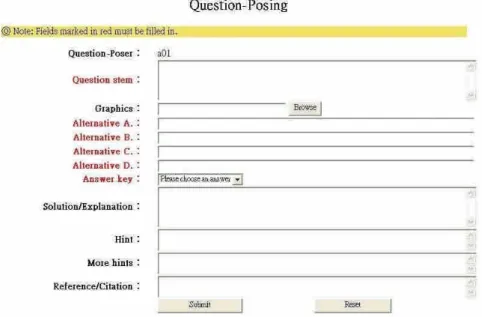
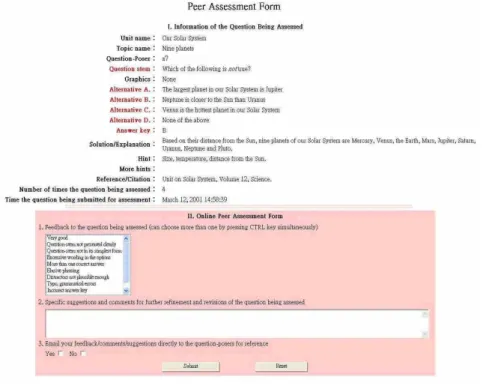
(18) 3. Methodology 3.1 Research Question and Participants In light of metacognition the researcher hypothesized that students exposed to the multiple-choice question-generation treatment condition would score higher on the immediate and prolonged assessment of metacognitive strategy use as compared to their counterparts in the no question-generation group while learning science. Four classes of six-grade students (N=132) from one primary school in Taiwan participated in the study in the school’ s computer lab. All participants were taking computer classes at the time of the study and possessed a fundamental knowledge of computer hardware and software operations.. 3.2 Learning System QPPA, a web-based domain-independent learning system, was used for the study. Mainly, QPPA is comprised of four functions that enable multiple-choice question-posing, peer-assessing, question-viewing, and drill-and-practice learning activities. As shown in Figure 1, for question-posing, composers need to provide a question-stem, four plausible alternatives and the correct answer for each posed question. In addition, composers can give hints, cues, and citations, etc. to be used as learning aids or feedback during drill-and-practice exercises. For peer-assessing, students would decide which item to assess from a peer-assessment window first and then give their feedback on an online assessment form. Some frequently made mistakes in multiple-choice test construction, such as question-stem not presented clearly, question-stem not in its simplest form, excessive wording in the options, more than one correct answer, elusive phrasing, distractors not plausible enough, etc., are provided through a pull-down menu (see Figure 2). In addition, students can type in detailed suggestions for further refinement of the examined item in the “ feedback type-in space.”In question-viewing function, students can observe questions composed by others and comments/suggestions given by assessors (Figure 3). Finally, for drill-and-practice exercises students can specify any numbers of questions they prefers for a given learning unit at their discretion. At completion, feedback as to the percentage of correct answers and a review button for the missed ones is provided for further review.. Figure 1: Question-posing function 17.
(19) Figure 2: Online assessment form. Figure 3: Question-viewing function. 3.3 Experimental Design and Treatment Conditions A 2 (instructional strategy) x 3 (measuring times: pretest, immediate test, delayed test) mixed-design experimental research method was adopted. Two treatment conditions were devised for the study, namely question-generation group (Treatment A) versus non question-generation group (Treatment B). Students assigned to Treatment A would have the opportunity to interact with all four main functions embedded in QPPA for the duration of the study. Basically, for each instructional session students were directed to construct multiple-choice questions first, and then assess questions posed by their peers, view questions and comments peers contributed, and finally practice answering questions. Students were advised to generate at least 1 multiple-choice question for a given learning unit within a 10-minute learning time block before they could move 18.
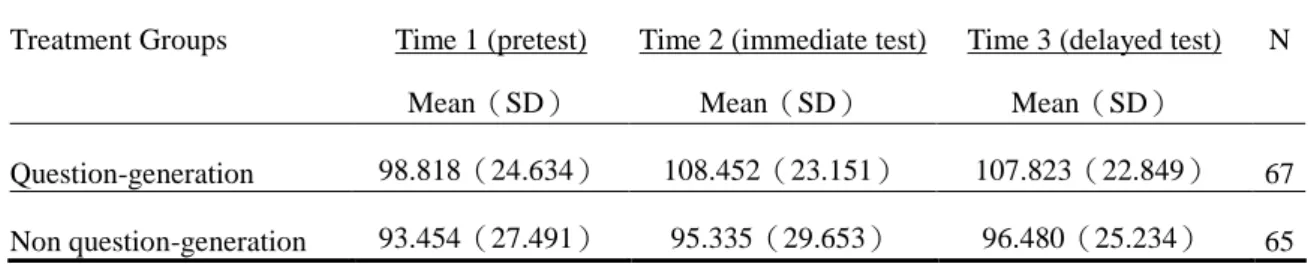
(20) on to assess questions that their peers generated for the next 10 minutes, followed by another 10 minutes of question-viewing and drill-and-practice learning activities. Students assigned to Treatment B would interact with all QPPA’ s main functions except question-generation for the duration of the study. As a routine, students were instructed to first assess questions that were constructed by other students, and then view questions and comments other students contributed, and finally practice answering questions. The questions that students in Treatment B assessed imported directly from the database of Treatment A. Learning time allocated for question-generation activities (10 minutes) was used for the peer assessment learning activity for Treatment B group (that is, 20 minutes in total). Prior to the commencement of the study, all participating students filled out a questionnaire individually that assessed their metacognitive strategy use at entry point (1st wave of data collection). The following week, QPPA was introduced as an extra-curricular learning activity supporting science learning. Students in the study used the system for four 40-minutes instructional sessions for four consecutive weeks. Before having students interact with QPPA, a training session on the features and operating procedures of the system was arranged for participating students in both treatment conditions. In addition, a training session on multiple-choice question-generation as well as sample questions was provided for Treatment A group. Following the conclusion of the study, students were asked to fill out the questionnaire to assess the immediate effect of question-generation on their metacognitive strategy use (2nd wave of data collection). Six weeks after, the same instrument was administered again to detect if any remaining effects existed (3rd wave of data collection).. 3.4 Measurement Instrument “ Metacognitive Strategy Use Scale,”a 24-item 6-point Likert scale questionnaire (1= no consistency, 6= complete consistency), was used to reveal students’activation of metacognitive strategies for cognition regulation (planning, monitoring, revising and evaluating) (Cronbach alpha = .97). Che r ng’ s “ Cognition”subscale from “ Middle School Students’Self-Regulatory Learning Scale”was adopted and adapted [15]. Sample statements include: while learning science, I would set goals to assist fulfilling different learning activities (planning); I would constantly check to see whether I understand the content of the materials while attending to lectures (monitoring); if having a hard time understanding the text while studying science, I would adjust my study strategy (revision); prior to a science exam, I would pose questions to help my review sessions (evaluation).. 4. Results & Discussion Data were analyzed with a repeated measures ANOVA method. Instructional strategy is the between-subject factor. The repeated measures factor is defined by three waves of measurement for students’metacognitive strategy use. Significant interaction effects were followed by simple main effect tests. Tuke y ’ sHSD post hoc tests would be conducted if simple main effect was detected for time effect. Table 1 displays the means and standard deviations for metacognitive strategy use at the three time points of data collection. Analysis indicated that there was a significant instructional strategy by time interaction effect, F=3.01,p<.05. Simple main effect test further found that students in two different groups started out similarly in terms of their levels of metacognitive strategy use before the intervention (F=1.45,p>.05), but differed significantly in the immediate test (F = 8.67,p<.05) and the delayed test (F = 6.49,p<.05). A separate simple main effect revealed a significant difference between the pretest, the immediate test and the delayed test for the question-generation group, F=10.75,p<.05, but no significant differences for the non 19.
(21) question-generation group were found, F=0.84,p>.05. Tuke y ’ sHSDpost hoc tests pointed out that significant differences between the pretest and immediate test, (F = -9.633, p<.05), and between the pretest and delayed test (F = -9.005, p<.05) for the question-generation group. That is, metacognitive strategy use for students in the question-generation group increased statistically from the pretest to the immediate test and remained stable 6 weeks after the conclusion of the study whereas levels of metacognitive strategy use for the non question-generation group was unchanged, statistically speaking, over the 3 waves of data collection. The obt a i ne dr e s ul t ss uppor t e dt he r e s e a r c he r s ’c ont e nt i on t ha ta multiple-choice question-ge ne r a t i ons t r a t e gyha saf a c i l i t a t i ngi mme di a t ea ndpr ol onge de f f e c tf ors t ude nt s ’ metacognitive strategy development. This study found that students in the multiple-choice question-generation group tended to engage more frequently in higher levels of thinking and initiated executive processes more often as compared to the non question-generation group. In order to accomplish each and every sub-task involved in question-generation like zooming in on materials that are testable, phrasing question stems, finding plausible alternatives, providing the best answer for the posed question, etc., monitoring, revising, evaluating and planning metacognitive strategies were employed more frequently during the process. Informal observations of the classrooms further provided evidence showing the positive effects of question-generation on metacognition development. Several noticeable changes in the classrooms during the course of the study were observed. Specifically, at the beginning stage of the study, the interaction and behaviors of both treatment conditions did not appear to differ from each other, with students devoted earnestly to re-examining the textbooks and interacting with computers. However, with the progression of the study, students in the question-generation group started to develop different coping strategies for the current task. It was noted that more and more students in the question-generation group brought in sheets of paper filled with pre-formulated questions they thought of in advance, referred to other sources of reference for sample questions which can be re-formulated or modeled after, marked on the margins of the textbook with examples and related concepts, etc. These actions are indicative of revision, planning, evaluation, and monitoring metacognitive strategies use. Table 1: Means and Standard Deviations for Metacognitive Strategy Use by Waves Treatment Groups. Time 1 (pretest). Time 2 (immediate test). Time 3 (delayed test). N. Mean(SD). Mean(SD). Mean(SD). Question-generation. 98.818(24.634). 108.452(23.151). 107.823(22.849). 67. Non question-generation. 93.454(27.491). 95.335(29.653). 96.480(25.234). 65. 5. Conclusions Instructional interventions that help nurture self-regulated learners where they become more aware of their learning processes and products while learning are usually viewed as a means for effective learning. Seeing that evidence supporting the incorporation of a problem-posing instructional approach mainly conducted under open-ended problem-posing situations in traditional classrooms, and that past studies mainly focused on its immediate effect on academic performance and/or attitudes, in the light of metacognition this study set out to empirically assess its immediate and prolonged effects on enhancing s t ude nt s ’me t a c og ni t i ves t r a t e gydevelopment. As hypothesized, after exposing to the question-generation instructional strategy students in the question-generation group increased in their use of metacognitive strategies while studying science as indexed in the immediate and delayed tests. The statistically significant results combined with observational data supported r e s e a r c he r s ’expectations that engaging in multiple-choice question generation task helps students to be more aware of their learning status 20.
(22) and become more self-regulated learners. Based on the current study and research evidence on problem-posing in the past, it is suggested that students should be given opportunities to pose problems in addition to responding to problems pre-formulated by teachers or textbooks. Some issues in need of further investigation are offered. First, students’metacognitive strategy use was assessed at 3 time points in this study (right before the commencement of the study, immediate after concluding the study, and six weeks after the conclusion of the study). With extended, longer experimental time, instruments administered at different time points during the intervention will enable observations of developmental trends for metacognitive strategy use. Finally, the researchers mainly adopted a positivist approach to quantitatively examine the effects of question-generation instructional intervention on students’metacognitive development. Researchers prone to post-positivist paradigm might examine the issue by document analysis combined with in-depth interview with a panel of students during the pedagogical intervention. Qualitative analysis of interview transcripts as well as student-generated questions will help shed some lights on the role, place and mechanism of question-generation in the classroom.. Acknowledgements The research study was funded by the Ministry of Education, R.O.C. Project title: A Synchronous Competitive Educational Game. Project no. 92-H-FA07-1-4. Special thanks to Chun-Chi Hung for data collection and analysis.. References [1] Yu. F. Y., Liu, Y. H. & Chan, T. W. (2004). A Networked question-posing and peer assessment learning system: A cognitive enhancing tool. Journal of Educational Technology Systems, 32 (2 & 3), 211-226 [2] Yu, F. Y., Liu, Y. H., Hung, C. C. & Chan, T. W. (in press) A Web-based learning system for question-posing and peer assessment. Innovations in Education and Teaching International. [3] Keil, G.. E. (1965). Writing and solving original problems as a means of improving verbal arithmetic problem solving ability. Unpublished doctoral dissertation, Indianan University. [4] Dori, Y. J. & Herscovitz, O. (1999) Question-posing capability as an alternative evaluation method: analysis of an environmental case study. Journal of Research in Science Teaching, 36 (4), 411-30. [5] Koch, A. & Echstein, S. G. (1991). Improvement of reading comprehension of physics texts by s t u de n t s ’qu e s t i on formulation. International Journal of Science Education, 13, 473-485. [6] Perez, J. A. (1985). Effects of student-generated problems on problem solving performance. Unpublished doctoral dissertation, Teachers College, Columbia University. [7] Rosenshine, B. Meister, C. & Chapman, S. (1996). Teaching students to generate questions: A review of the intervention studies. Review of Educational Research, 66, 181-221. [8] Shih, T. C. (1999). The effect of comparative tests between self-questioning strategy and cooperative learning on junior high school st ude nt s ’Chinese reading comprehension. Unpublished Master Thesis, National Sun Yat-Sen University. Kaohsiung, Taiwan. [9] Silver, E. A. (1994). On mathematical problem posing. For the Learning of Mathematics, 14, 1, 19-28. [10] Wong, B. Y. L. (1985). Self-questioning instructional research: a review. Review of Educational Research, 55, 227-268. [11] Livingston, J. A. (2003). Metacognition: Overview. ED 474 273. [12] Brown, A. L. (1987). Metacognition, executive control, self-regulation, and other more mysterious mechanisms. In F. E. Weinert & R. H. Kluwe (Eds), Metacognition, motivation, and understanding (pp. 65-116). Hillsdale, New Jersey: Lawrence Erlbaum Associates. [13] Flavell, J. H. (1979). Metacognition and cognitive monitoring: A new area of cognitive-development inquiry. American Psychology, 34, 906-911. [14] Flavell, J. H. (1987). Speculations about the nature and development of metacognition, In F. E. Weinert & R. H. Kluwe (Eds), Metacognition, motivation, and understanding (pp. 21-29). Hillsdale, New Jersey: Lawrence Erlbaum Associates. [15] Cherng, B. L. (2000). Studies of junior and senior high school students' self-regulated learning. Unpublished technical report. Taipei, Taiwan.. 21.
(23)
數據
相關文件
透過國語文學習,掌握 文本要旨、發展學習及 解決問題策略、初探邏 輯思維,並透過體驗與 實踐,處理日常生活問
思維策略簡報 教學系統 課文短片 快樂閱讀花園 閱讀策略短片 閱讀策略簡報 課文分析簡報
2-1 化學實驗操作程序的認識 探究能力-問題解決 計劃與執行 2-2 化學實驗數據的解釋 探究能力-問題解決 分析與發現 2-3 化學實驗結果的推論與分析
推理論證 批判思辨 探究能力-問題解決 分析與發現 4-3 分析文本、數據等資料以解決問題 探究能力-問題解決 分析與發現 4-4
• 4.1 學校尚需提升學與教 效能。學校仍需持續探討 不同的教學策略, 以助 教師促進課堂互動,及 提升學生的共通能力...
3) 日常逐步發展不同的學與教策略,尋求校內 ( 行政 ) 與校外 ( 資源 ) 支援,留意機會,以擴闊學生的學習 經驗. 4)
二、 學 與教: 第二語言學習理論、學習難點及學與教策略 三、 教材:. 運用第二語言學習架構的教學單元系列
Rebecca Oxford (1990) 將語言學習策略分為兩大類:直接性 學習策略 (directed language learning strategies) 及間接性學 習策略 (in-directed
