國立臺灣大學管理學院商學研究所 碩士論文
Department of Business Administration College of Management
National Taiwan University Master Thesis
品牌形象變化與消費者反應之間的非線性關係:
以韓國流行音樂偶像團體為例
The non-linear relationship between the brand image change and consumer reaction: The case of K-Pop idol
groups 林昱丞 Yu-Cheng Lin
指導教授:柯冠州 博士 Advisor: Kuan-Chou Ko, Ph.D.
中華民國 108 年 8 月 August, 2019
`丶
(中文)
(英文)
國立臺灣大學碩士學位論文
口試委員會審定書
品牌形象演化與消費者反應之間的非線性關係:以 韓國流行音樂偶像團盤為例
The non-linear relationship between the brand image evolution and consumer reaction: The case ofK-:-Pop idol groups
本論文係林昱丞君 (R06741044) 在國立臺灣大學甯學 妍究所完成之碩士學位論文,於民國 108 年 06 月 21 日承下
列考試委員審查通過及口試及格,特此證明 指導教授:
七\嶧三'
(簽名)二 霨[{') l)
口試委員:
讠 、 1v ?
系主任、所長 (簽名)
l ' •
謝辭
時光荏苒,兩年前我還只是剛進入商研所的懵懂新生,且當時的我 也從來沒有想過自己能夠整合自己所學,完成一份具有研究意涵的碩 士論文。在商研所的兩年,除了理論上的學習之外,實務上的應用,甚 至是與同儕相處的軟實力都成為我在離開學校之後的養分。
首先要先感謝柯冠州老師在去年找教授到快要萬念俱灰之際,願 意擔任我的指導教授,並且在論文的主題上給予我很大的空間發揮。尤 其在每次的 Meeting,老師都會給我一些建議使我的論文變得更完整,
也重建了我被自己摧毀的信心,在口試之前甚至還要麻煩老師再額外 幫助我修正我的論文,感激之情難以用三言兩語道盡。
再來要感謝 106 級商研所的同學們,在撰寫論文的過程中,當心 情感覺到有點低落的時候,謝謝曾經不經意地給我幾句鼓勵的話的同 學們,你們一句簡單的話都能夠讓我振作並重新整理好心情。尤其是與 我同門的昭安、亦昕跟鈺婷,感謝彼此互相鼓勵並一起渡過口試的難關,
你們都是促使我繼續完成論文的動力。
最後我要感謝我的家人,雖然這一年來大部分的時間都往學校跑,
常常早出晚歸,不過謝謝你們在我求學生涯中給予我最大的支持,讓我 在每次感到疲累之時,能夠有個避風港可以好好休息。
2019.07 林昱丞
摘要
品牌形象變化在進入到網路時代之後變得更加重要,由於網路的
發達,使得消費者每天接收大量的資訊,也導致消費者的需求快速的 變動。而為了滿足消費者的不斷產生的新需求,品牌商需要適時地改 變自己的品牌形象,進而增加消費者對於該品牌的評價。然而,以往 的研究只關心品牌是否需要變化,而沒有討論每次進行品牌形象改變 時,改變的程度該如何決定。
因此,本篇論文探討品牌形象變化的程度與消費者反應之間的關 係。本篇論文選擇韓國流行音樂的偶像團體作為論文的研究標的,以 不同時期回歸的專輯曲風轉換當作品牌的形象變化,透過分析曲風轉 換的程度以及使用韓國音樂節目排行榜的「觀眾偏好」項目分數作為 粉絲對於該次回歸的反應,以迴歸模型來分析品牌形象變化程度與消 費者反應之見是否存在關係。研究結果發現,適度的品牌形象變化有 利於增加市場喜愛程度,但如果形象變化的程度過於極端,可能因為 形象變化後的面貌與原先差距過大,反而會降低加市場喜愛程度。
關鍵字:品牌形象變化、產品變異度、品牌重塑、韓國流行音樂、
偶像團體、曲風轉換、死忠粉絲
ABSTRACT
Brand image change becomes more important nowadays because consumers receive much more information on Internet on a daily basis, so the new needs of consumers is formed rapidly. In order to fulfill the rapidly emerging needs, firms need to promptly change their brand images.
However, although the brand evolution and brand extension literature has revealed possible consequences of brand image change, scant studies have investigated whether high, median, and low levels brand image change will differently affect market reaction. Based on the brand incongruity theory, the current research posits that the relationship between brand image change and market reaction follows an inverted U shape.
This research studies the fan reaction toward the image change of Korean
pop music idol groups. According to the results of an ordinary linear
regression analysis, this research reveals an inverted U relationship between
brand image change and market reaction. Besides, this research captures the
extent of brand image change and gives the idol groups’ company a lesson
that the idol groups should not change their images extremely but gradually
change their images so that they can ensure their original fandoms.
Keywords: Brand image change, Brand evolution, Corporate rebranding,
Product incongruity, K-Pop, Idol groups, Music styles, Hardcore fans
CONTENT
謝辭 ... 1
摘要 ... 2
ABSTRACT ... 3
CONTENT ... 5
LIST OF FIGURES ... 7
LIST OF TABLES ... 8
1
Introduction ... 9
2
Literature Review ... 11
2.1
Brand Image Transfer ... 12
2.2
Brand Evolution ... 13
2.3
Brand Extension ... 18
2.4
Corporate Rebranding ... 20
2.5
Product Incongruity ... 24
2.6
Hypothesis ... 28
3
Research Method ... 32
3.1
Research Setting ... 32
3.2
Data Collection... 34
3.2.1
Dependent variable
...35
3.2.2
Independent variables
...36
3.2.3
Control variables
...38
3.3
Analysis ... 41
4
Result ... 41
4.1
Supplementary Analysis ... 45
5
Discussion ... 48
5.1
Theoretical Contribution ... 48
5.2
Managerial Contribution ... 49
5.3
Limitation and Future Research ... 49
6
Appendix ... 52
6.1
Appendix A: K-Pop Idol Groups’ Logos ... 52
6.2
Appendix B: Music Genres Categorization ... 52
7
Reference ... 53
LIST OF FIGURES
Figure 1. The relationship between each music styles. ... 37
LIST OF TABLES
Table 1. Different Dimensions of Brand Evolution ... 13
Table 2. Product Incongruity Findings ... 27
Table 3. Description Data and Correlation Table ... 42
Table 4. Variance Inflation Factor Table ... 43
Table 5. Ordinary Linear Regression Analysis ... 44
Table 6. Supplementary Analysis of Transformation ... 47
Introduction
Brand image change becomes important as the Internet evolves because the Internet offers consumers unparalleled access to a massive body of knowledge and information (Bakos, 1997), and the preferences of the consumers change rapidly because consumers can obtain the massive information easily through the Internet. Besides, Internet has fundamentally reshaped the way businesses and consumers communicate, interact and transact around the world (Laroche, 2010). Therefore, in the fast-paced world, brand image change becomes the hot issue no matter what the brand category is.
Brand image was defined as the perceptions about a brand as reflected by the brand associations held in memory (Keller, 1993). Riezebos, Riezebos, Kist, and Kootstra (2003) indicate that brand image change occurs when the associations valuable to consumers are carried over from one brand to another. In order to tailor the consumers’ preferences, the enterprise may use many methods to change the brand image, such as redesigning the brand logo to render the brand more appealing to new customers as well as to the existing customer base, those with strong commitment to the brand (Walsh, Winterich, & Mittal, 2011), developing the new market of the brand through the brand name into the language of specific region (Low & Blois, 2002), and building new brand image through the corporate action (e.g., mergers or acquisitions, sponsorship, strategic alliances, or
cobranding deals) or attempts by the firms to reposition themselves and their product offerings (Jaju, Joiner, & Reddy, 2006).
However, the recent studies seldom discuss the relationship between the extent as well as the quickness of brand image change and the market reaction. Research on brand extensions similarly finds that extensions that depart more radically from consumers’
notions of the parent brand (e.g., BMW camera) are evaluated less favorably than extensions that are less incongruent (e.g., BMW lawnmower) (See Maoz & Tybout, 2002).
Based on findings and rationale of the literature on new product incongruity and evaluation, this research argues that the different levels of brand image change might result in the different outcomes.
In sum, this research seeks to know which extent of the brand image change leads to the better result for the brands by examining the relationship between the extent of the brand image change and the preferences of the consumers. According to the extant research on brand image incongruity, this research hypothesizes that the relationship between the brand image change and the preferences of consumers is non-linear.
In the following sections, this thesis reviews the literatures related the brand image change, including studies on brand extension, rebranding, and brand image incongruity. The
findings of thesis reviews indicate that previous literatures regard brand image change only discuss the outcome of brand image change, yet few studies discuss the extent if brand image change. This research selects the Korean pop music (as known as K-Pop) to test the research hypothesis. I pick 30 K-Pop idol groups’ discographies as the sample of the research and analyze the data of the K-Pop idol groups’ profile and their discographies with the simple linear regression model. Through the analysis, the result reveals an inverted U relationship between the brand image change and the market reaction. The relationship can also give the idol groups’ company a lesson that the idol groups should not change their images extremely but gradually change their images so that they can ensure their original fandoms.
Literature Review
Before the research of brand image change, I start to review the literatures related to brand image change including brand image transfer, brand extension, and rebranding. The process of brand image change might involve in the brand image transfer, and the brand image can be changed through the methods of brand extension and rebranding. Hence, this research first begins to review the literatures about brand image transfer, brand extension, and rebranding.
Brand Image Transfer
Past research on the brand image transfer was usually associated with the sponsorship.
For example, Gwinner and Eaton (1999) examined the role of brand image transfer, through building up image associations between the sponsored entity to the sponsoring brand in the sporting event sponsorship (Gwinner, 1997). Smith (2004) further constructed a framework of the brand image transfer through sponsorship activities, and described how consumers would transfer the brand image from the sponsored property to the sponsor. and Carrillat, Solomon, & d'Astous (2015) indicate that the image transfer in concurrent sponsorship, several brands simultaneously sponsor the same event, is due to the stereotypic processing.
However, the literature on the brand image transfer paid particular attention to the issue of different kinds of sponsorship, and scant research focus on the other issues, such as extending brand to another product class, changing the brand personality, and promoting the brand together with other brands, to research the brand image transfer. Therefore, in order to deeply understand the theory of the brand image transfer, this research will review the related theories of the brand image transfer, including the theory of brand evolution, brand extension, and corporate rebranding.
Brand Evolution
Brand evolution is a term used to depict the evolving process of corporate brand images and meanings in ever-changing environments based on all the touch points among the consumers, the company, and its network over time (Rindell & Strandvik, 2010). Many extant studies have explored the issue of brand evolution with different perspectives to illustrate the process of brand evolution (See Table 1). Park, Jaworski, and MacInnis
(1986) used the brand concept, a firm-selected brand meaning derived from basic Table 1. Different Dimensions of Brand Evolution
Author Stage Antecedent
Park Jaworski and MacInnis (1986) Journal of Marketing
Introduction Stage
Elaboration Stage
Fortification Stage
Consumer needs
Fit with internal and external environment
Brand’s life cycle
McEnally and Chernatony (1999) Academy of Marketing Science Review
Stage 1: Unbranded
Stage 2: Brand as Reference
Stage 3: Brand as Personality
Stage 4: Brand as Icon
Stage 5: Brand as Company
Stage 6: Brand as Policy
Competitive pressure
Consumer interaction
Product life cycle
Merrilees (2005)
Journal of Advertising Research
Phase 1: Brand Vision
Phase 2: Brand Orientation
Phase 3: Brand Strategy Implementation
Demand side: Consumers’
needs, and the marketing positions.
Supply side: The creation, development, and ongoing management of the brand.
consumer needs, to describe the process of the brand evolution. Their research indicated that the motivation for an ongoing brand evolution should include the consumer needs and fit with the internal and external environments and the brand’s life cycle.
According to the research of Park, Jaworski, and MacInnis (1986), the process of brand evolution could be separated into three stages. The first stage is the introduction stage. In this stage, the brand designs a series of activities to establish the brand image and brand position. The plan of marketing mix in the introduction stage should aim to communicate the brand image and develop the brand into the easily extended brand image. The second stage is the elaboration stage. This stage focuses on enhancing the value of brand image and sustaining the competitive advantages in the market. Hence, the marketing mix at this stage is to strengthen links to the original brand concept. That is, the extension may not be too far from the brand concept. The final stage is the fortification stage. It aims to link the elaborated brand image to the image of another product classes, such as linking Ivory soap with Ivory Shampoo and Ivory Liquid. Therefore, the purpose of marketing mix in this stage is to enter to a new market or developing a new product category, so that the brand image can be expanded.
Goodyear (1996) states that the role of brand in classical branding has four stages, unbranded, brand as reference, brand as personality, and brand as icon. In unbranded stage,
consumers consider the role of brand only the commodity and the product. However, in the other stages, the meaning of brand appears and the brand name, brand personality, and symbolic meaning of the brand become the components of the brand respectively.
In McEnally and De Chernatony (1999), it extends the Goodyear (1996) model by relating each stage and valuing the consumers’ engagement of the processes. According to McEnally and De Chernatony (1999), in addition to the four stages of Goodyear (1996), the branding process adds the other two stages, brand as company, and brand as policy.
In the unbranded stage, consumers have not built the concept of brand when the product exists at the beginning, thus, information of the product is only limited as the product uses.
In the second stage (brand as reference), the goals of brand management are to position the brand as having unique functional benefits. Hence, in this stage, consumers are linking various brand nodes to the product category in memory and expanding the network associated with each brand (Cohen & Basu, 1987).
In the third stage (brand as personality), to differentiate with other brands, brands need to focus on adding the emotion values into the brands, and the brands construct their brand personalities, refers to the set of human characteristics associated with a brand (Aaker, 1997), in order to fit with consumers’ lifestyle and build the association with the
consumers. In the fourth stage (brand as icon), various brands have become so widely accepted that the brands can be used to stand for something beyond itself, that is, the brands have become a symbol. Also, in this stage, brands use the physical symbols to exhibit the brand image concretely and extend the consumers’ perceptions of the brands.
The first four stages describe the classical approach to brand marketing while the last two stages (brand as company and brand as policy) are in the genre of post-modernism (Brown, 2008). In the fifth stage, brand as company, the brand is no longer to be thought of only physical products, but be thought of products plus services. Like the physical products’
brand, when the service becomes the brand, it can also increase the ability for creating the value to the firms. The final stage, brand as policy, brand and company are closely identified with social, ethical and political issues (Goodyear, 1996). In this stage, the brand is designed in order to fulfill the higher consumers’ needs, such as self- actualization, the highest level of Maslow’s pyramid.
Besides, McEnally and De Chernatony (1999) indicates that the branding process may not reach every stage in all product categories and the brand can start evolving into each level. In fact, most of the brands end at second, third, or fourth stages (brand as reference, brand as personality, and brand as icon). Such the competitive pressure, the consumers’
interaction and the product life cycle become the antecedents of the brand’s evolution
into each stages.
The difference between Park, Jaworski, and MacInnis (1986) and McEnally and De Chernatony (1999) is that previous study focuses on the strategy design when the brands are into the different stages, and the strategy of launching the marketing mix and adjusting the brand image do not differ from the product category, yet McEnally and De Chernatony (1999) focuses on evolving nature of branding and the different product category may have different branding process.
Merrilees (2005) indicates that the brand evolves through rebranding and constructs the framework of brand evolution with three phases: brand vision, brand orientation, and brand strategy implementation. Brand vision, formulation of a brand, highlights distinctive features and values (both functional and emotional) and how the brand is positioned competitively (De Chernatony & Dall’Olmo Riley, 1998). Brand orientation means the approach where the processes of the organization revolve around the creation, development and protection of brand identity in an ongoing interaction with target customers with the aim of achieving lasting competitive advantages in the form of brands (Urde, 1999). Brand strategy implementation is the implementation of the brand strategy through the marketing mix, such as advertising, and the rationale of the brand strategy implementation was the repositioning of the company as the retailer to help customers
get started with a new season or life event.
In the framework of brand vision-orientation-strategy implementation, the drivers of brand evolution, in addition to the consumer aspects as McEnally and De Chernatony (1999) (like the consumers’ needs, and the marketing position), this framework also provides the supply side of brand evolution drivers, that is, the creation, development, and continuous management of the brand.
Brand Extension
Brand extension is a strategy that a firm attaches its existing brand name to a new product introduced in a different product category (Swaminathan, Fox, & Reddy, 2001). Brand extension is always seen as positive because brand extension reduces new product introduction cost and extending to another product category increases the chance to succeed (Kapferer, 2008).
Several studies (e.g., Aaker & Keller, 1990; Boush & Loken, 1991; Keller & Aaker, 1992) further indicated that product category similarity plays a critical role for the success of brand extension strategy. These studies posited that product category similarity can mediate positive affect transfer when brand specific associations are held constant (Broniarczyk & Alba, 1994), and may provide the most valid basis for evaluating an
extension when both affect and brand-specific associations are held constant (Broniarczyk & Alba, 1994). Therefore, when the image of a brand was clearly associated with the new product category it intended to extend to, this brand extension should be more preferred because of the carry-over affect generated from the original brand (Broniarczyk & Alba, 1994).
Brand extension can be conduct through many ways, and one of the brand extension method is called crossover, refers to when a product designed for one target segment meets with attraction and acceptance in another segment (Grier, Brumbaugh, & Thornton, 2006). The crossover method also has many different forms. For example, Hosany, Prayag, Martin, and Lee (2013) gave the example about Sanrio renew the brand image of Hello Kitty by changing the collaboration from fast-moving consumer goods to the high-class brands, like Anna Sui and EVA airways. The success of brand extensions can be attributed to the strong emotional connection between the character and consumers (Belson &
Bremner, 2004). Samu, Krishnan, and Smith (1999) used the joint advertising, or advertising alliance, to illustrate the crossover on the advertisement (e.g., Kellogg and Tropicana sponsor an advertisement showing their products used together at breakfast).
Advertising alliances are important for the new brands and established brands entering to the new market because the advertising alliances increase the brand awareness of new
brands as well as established brands through the exposure to their own clients (e.g., Park, Jaworski, & MacInnis, 1986).
Aguirre-Rodriguez, Bóveda-Lambie, and Montoya (2014) indicated another crossover strategy called ethnic crossover brand extension, which refers to how brands can associate themselves with an ethnic group (e.g., Pantene's Relaxed and Natural for Women of Color hair care line, McDonald's Café con leche, and Dulce de leche Cheerios). Ethnic crossover brand extensions usually imitated a combination of a parent brand and an extended product category, presenting mixed ethnic cues (e.g., Campbell's caldo gallego and Goya's New England clam chowder).
Corporate Rebranding
Corporate rebranding, refers to the disjunction or change between an initially formulated corporate brand and a new formulation (Merrilees & Miller, 2008). Many branding strategies including brand renewal, refreshment, makeover, reinvention, renaming and repositioning can be seen as facets of rebranding strategy (Merrilees & Miller, 2008). The main purposes of corporate rebranding for the brand are to enhance brand relevance and improve operational efficiency (Melewar, Gotsi, & Andriopoulos, 2012; Sonenshein, 2010; Vallaster & Lindgreen, 2011).
In order to enhance brand relevance, corporate rebranding may require not only meeting the needs of new market segments, but also retaining the core brand concept to a certain degree by building a bridge from the existing corporate brand to the revised corporate brand (Merrilees & Miller, 2008). In other words, without building a bridge between new brand image and the original brand position for the existing customers might result in unsuccessful rebranding. For instance, Gap launched a new logo on its website in 2010 and indicated that the target customer is the millennial, but changing new logo resulted in some critics from customers born in 1990s, who valued the old brand, which evoked their childhood memories (Tarnovskaya & Biedenbach, 2018).
Corporate rebranding can be carried out through many different ways and brand can make changes from the various facets, such as the physical appearance, the icon, the customers, and even the image. Hence, the research chooses three representative methods to illustrate the different kinds of corporate rebranding.
The first method is changing the brand logo. A logo is a visual representation of the brand, and the brand logo design can influence the consumers’ perceptions of the brand (Fajardo, Zhang, & Tsiros, 2016). Logos have the potential to not only express consumers’ brand- self associations, but also reinforce and strengthen them, thus enhancing customers' willingness to exert effort and invest resources towards sustaining their relationship with
the brand (Park, MacInnis, Priester, Eisingerich, & Iacobucci, 2010; Thomson, MacInnis,
& Park, 2005). For example, Henderson and Cote (1998) indicated that the rounded-shape logos, compared to angular logos, could lead to more positive consumer affect because round logos (compared with angular logos) were rated as being more harmonious and natural, and dimensions such as elaborateness, naturalness, and harmony impacted consumers’ affective responses.
The second method is to build the brand community. Brand community is defined as a specialized, non-geographically bound community, based on a structured set of social relationships among users of a brand (Muniz & O'guinn, 2001). The establishment of a brand community has been regarded as an effective method to develop a strong bond between brand and consumers (Quester & Fleck, 2010). For example, Harley-Davidson’s Harley Owners Group (HOG) is the prototypical example of a brand community cited in published studies (e.g., Schouten & McAlexander, 1995). The company who owns that brand usually actively nurtures its brand community (Algesheimer, Dholakia, &
Herrmann, 2005). In a brand community, all members (i.e., customers) share the information and essential resources that may be cognitive, emotional, or material in nature (McAlexander, Schouten, & Koenig, 2002), interact with other customers and construe himself or herself as the members of the community to get the sense of belongings in the
brand community (Algesheimer, Dholakia, & Herrmann, 2005). Brand community members usually maintain self-awareness of their membership within the community (e.g., “I see myself as part of the community”), emphasizing the perceived similarities with other community members and dissimilarities with nonmembers (Algesheimer, Dholakia, & Herrmann, 2005).
The last method is retro branding, the revival or relaunch of a product or service brand from a prior historical period, which is usually but not always updated to contemporary standards of performance, functioning, or taste (Brown, Kozinets, & Sherry, 2003). As the market changes rapidly, some old brands might be eliminated because of falling behind the market trends. However, many long-abandoned brands have recently been revived and successfully relaunched (Franklin, 2005; Wansink, 1997), so that marketers appear in the midst of a“retro revolution” in which revivals of old brands and their
images are a powerful management option (Brown, 2001). For the customers who had ever known and used the product of the old brands, retro branding puts the old brands’
element into new products, and the personal associations with the old brands will evoke the customers’ memories to attract the old brands’ existing customers.
Among brand associations endowing emotional connections, a recurring theme broadly used by practitioners in retro branding communication strategies called nostalgia which
is conceptualized as a sentimental or bitter-sweet yearning for a product from the past (Baker & Kennedy, 1994). When the customers feel nostalgic on the brand, even though customers experience the sadness in the emotion, they also experience the happiness of the nostalgia. That is, the strategy of nostalgia on the brand influences the customers’
feelings, and customers will have the emotional brand association during the experience.
Product Incongruity
When consumers evaluate a new product extended from a brand, they may compare the design and concept of the new product with the image of that brand in their minds. The difference between the new product concept and the brand’s original image is so-called the product incongruity (see Sheinin and Schmitt, 1994; Jhang, Grant, and Campbell, 2012). Product incongruity is defined as a function of the degree of match between a product and the activated product category (Mandler, 1982). Meyers-Levy and Tybout (1989) define moderate versus extreme incongruity in terms of levels within the product category hierarchy, and Jhang, Grant, and Campbell (2012) define the level of incongruity in terms of the type of associations the consumer must make to resolve the incongruity to understand a benefit of the new product.
Existing research suggests that the level of incongruity between an object and its
associated schema can influence a person’s evaluations of the object (Cohen & Basu, 1987; Meyers-Levy & Tybout, 1989; Srull, 1981; Sujan, 1985). More precisely, many studies suggest a positive effect of moderate incongruity. That is, consumers would evaluate moderately incongruent products more positively than congruent ones (e.g., Meyers-Levy & Tybout, 1989; Peracchio & Meyers-Levy, 1994). The reason why the moderate incongruity products is preferred is that congruent products just meet the original consumers’ expectations, resulting in mildly positive, familiarity-based evaluations, but congruent products do not bring the feeling of freshness. However, moderate incongruity is theorized to evoke arousal as the consumer elaborates in an attempt to resolve the incongruity (Jhang, Grant, & Campbell, 2012).
Even though moderate incongruity products can get more positive evaluation than the congruent ones, extreme incongruity can rather lead to negative affect because it requires individuals to develop an entirely new schema or dramatically alter an existing schema (Meyers-Levy and Tybout, 1989). For the extant consumers, they may easily get lost or even develop the feeling of betrayal when they encounter the extremely incongruent products, which are significantly away from the original brand position. Therefore, some studies indicated the relationship between the level of product schema incongruity and the product evaluation is an inverted U relationship. That is, moderate incongruity is
evaluated more positive than either congruity or extreme incongruity (e.g., Mandler, 1982;
Meyers-Levy & Tybout, 1989).
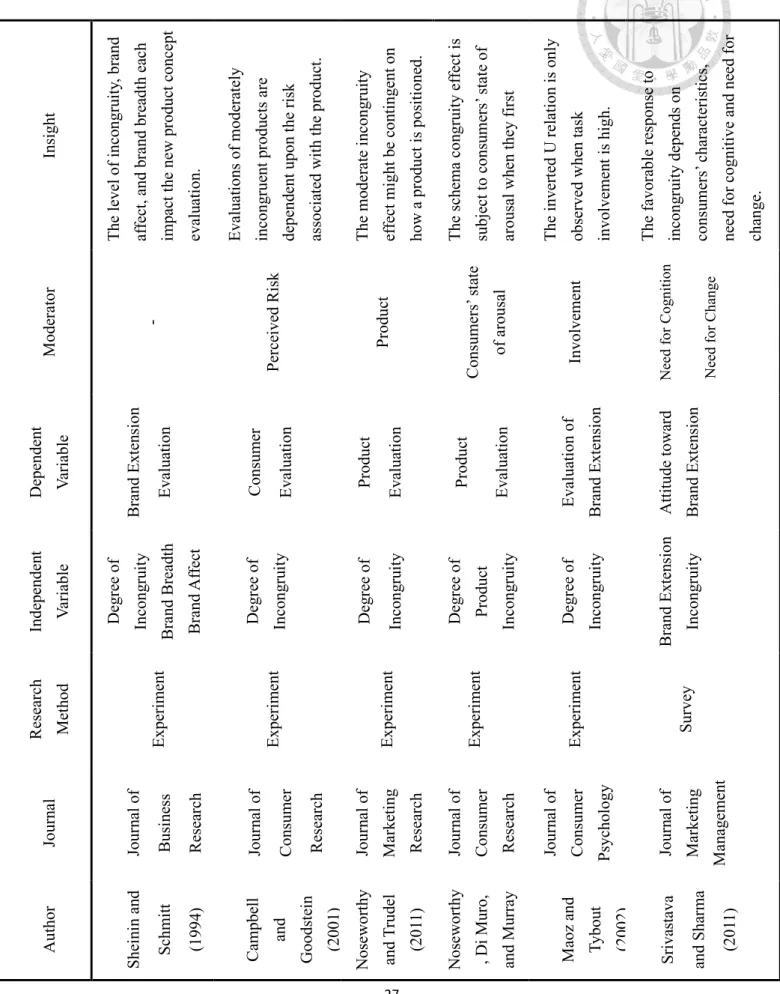
After discovering the relationship between the level of product incongruity and the product evaluation (Mandler, 1982), many experts, based on Mandler’s study, keep researching on the product incongruity issue (See Table 2). For example, Sheinin and Schmitt (1994) extend the Mandler (1982) and found that the level of incongruity, brand affect, and brand breadth impact the new product concept evaluation, and in different level of incongruity, the different extents of brand affect and brand breadth may result in different outcomes.
Some studies paid particular attention to what can interfere the inverted U relationship between the level of product incongruity and the product evaluation. For example, Campbell and Goodstein (2001) indicated that high perceived risk should lead to more conservative purchase decisions, so only when the perception of risk is low, consumers would enjoy the positive stimulation. Therefore, consumer evaluation of moderately incongruent products should depend upon the risk associated with the product. In addition, Noseworthy and Trudel (2011) demonstrated that the type of positioning (i.e., functional or experiential positioning) moderated how consumer evaluated new products with different levels of product-brand incongruity. They showed that when a product was
Table 2. Product Incongruity Findings
Insight The level of incongruity, brand affect, and brand breadth each impact the new product concept evaluation. Evaluations of moderately incongruent products are dependent upon the risk associated with the product. The moderate incongruity effect might be contingent on how a product is positioned. The schema congruity effect is subject to consumers’ state of arousal when they first encounter the incongruent product.The inverted U relation is only observed when task involvement is high. The favorable response to incongruity depends on consumers’ characteristics, need for cognitive and need for change.
Moderator - Perceived Risk Product Positioning Consumers’ state of arousal Involvement Need for Cognition Need for Change
Dependent Variable Brand Extension Evaluation Consumer Evaluation Product Evaluation Product Evaluation Evaluation of Brand Extension Attitude toward Brand Extension
Independent Variable Degree of Incongruity Brand Breadth Brand Affect Degree of Incongruity Degree of Incongruity Degree of Product Incongruity Degree of Incongruity Brand Extension Incongruity
Research Method Experiment Experiment Experiment Experiment Experiment Survey
Journal Journal of Business Research Journal of Consumer Research Journal of Marketing Research Journal of Consumer Research Journal of Consumer Psychology Journal of Marketing Management
Author Sheinin and Schmitt (1994) Campbell and Goodstein (2001) Noseworthy and Trudel (2011) Noseworthy , Di Muro, and Murray (2014) Maoz and Tybout (2002) Srivastava and Sharma (2011)
acquire or seek novel information and view novelty and innovation as intrinsically valuable (Wood & Swait, 2002), are moderators between the level of brand extension incongruity and the attitude toward the brand extension. That is, the favorable response to incongruity depends on consumers’ characteristics, need for cognitive and need for change, to process incongruent information.
Hypothesis
Brand extension means that a brand launches a new product in a new category that is different from the brand’s original product category, and most studies (e.g. Bottomley &
Holden, 2001; Müge Arslan & Korkut Altuna, 2010; Thompson & Strutton, 2012) about brand extension indicated that the deployment of brand extension strategy is usually for broadening the brand image and surviving in the market competition. Product incongruity is consistently defined as a function of the degree of match between a product and the activated product category (Mandler, 1982). Therefore, by the definition of brand extension and product incongruity, the research of product incongruity is usually related to the brand extension (e.g. Meyers-Levy & Tybout, 1989).
The difference between brand extension and corporate rebranding is that rebranding does not require a brand to develop products in a new product category. However, brand
extension and corporate rebranding have something in common. On the one hand, corporate rebranding is usually involved in the change of brand image so that brand can increase the brand relevance through the brand image change. On the other hand, brand extension usually focuses on extending to the new product category and bringing the new product concept to the brand. In essence, different product categories should also bring the different product concepts and different brand images to the consumers. Therefore, even the meaning of brand extension and corporate rebranding is quite different, both brand extension and corporate rebranding have the same association with brand image change.
According to my literature review, I find that the incongruity theory is suitable to predict the relationship between the extent of brand image change and market reaction. I assume that brand extension and corporate rebranding can be regarded as the different forms of brand image change, and product incongruity theory can explain how the difference between the new product concept and the original brand image affect the consumer reaction.
Besides, the success of both brand extension and corporate rebranding strategy depends on the market reaction, and the studies of incongruity theory use the product evaluation on consumers to represent the performance of the brand extension. Regarding the studies
of corporate rebranding and brand image change, measuring whether the corporate rebranding and brand image change strategy succeed usually depends on the consumers’
reactions when recognizing the change. In brief, in order to discuss the relationship between the extent of brand image change and market reaction, using the incongruity theory to predict is the most appropriate.
In previous research on brand-product incongruity, many studies focused on cases of brand extension (Mandler, 1982). The main finding of the incongruity theory literature is that moderate incongruent brand-product image can have better product evaluation than either congruent or extreme incongruent brand-product images.
Specifically, a new product having a congruent brand-product image means that it only conforms to the original product category and consumers will not receive the feeling of freshness. On the other hand, moderate incongruent brand-product image can attract consumer because new product category brings the new product concept that is slightly different from original product category to the brand, and new product concept can result in the appearance of the feeling of freshness on the brand itself to catch the consumers’
eyes.
In addition, even though the incongruent brand-product image can bring the feeling of
freshness, extreme incongruent brand-product image may contradict the original product concept, and thus dilute the product evaluation of the brand.
According to the similarity of brand extension and corporate rebranding, I predict that the incongruity theory of Mandler (1982) can analogize this phenomenon of the corporate rebranding. The moderate incongruent corporate rebranding can change the many features of the original brand for giving a sense of freshness and still maintain enough brand idiosyncrasy to attract extant consumers who prefer what they are familiar with. When the rebranding image is extremely incongruent with the old one, (i.e., the change of the brand image can be too far from the original one), this brand may risk their current market acceptance and customer loyalty. The extant consumers may feel a sense of betrayal when they find the brand features that they valued a lot were discarded (Grégoire & Fisher, 2008).
Thus, this research sets the hypothesis of the research is that:
Research Hypothesis: The extent of incongruity between old and new brand images will have a non-linear (inverted U) relationship with the consumer reaction toward corporate rebranding. That is, the moderately incongruent new brand image is better than either congruent or extremely incongruent new brand image.
Research Method
Research Setting
In order to examine the research hypothesis, this research chooses K-Pop idol groups as the research objectives because of two reasons.
The first reason is that human brands are more suitable for quantitative studies in terms of the sample size. The multinational corporations seldom changed their brand image, and this phenomenon causes the method of researching brand image change is subject to the case study due to the small amount of brand image change samples. However, human brands, such as the brand of K-Pop idol group, have more frequent brand image change cases. Human brands refer to the persona, well-known or emerging, who are the subject of marketing, interpersonal, or inter-organizational communications (Close, Moulard, &
Monroe, 2011). Celebrities, such as the artists and athletes, can be considered brands because they can be professionally managed and because they have additional associations and features of a brand (Thomson, 2006).
The second reason is that K-Pop idol groups are the appropriate representative brands for human brand research. Among the different kinds of celebrities, idols are now using their own names to capitalize on their brands to enhance the idol attachment as well as their
impacts on human brand loyalty (Huang, Lin, & Phau, 2015). Especially the K-Pop idol groups, this phenomenon of the human brand becomes more common on the management company’s decision of forming a new idol groups. In recent years, K-pop has become one of the most dynamically distributed forms of pop culture in the global pop market (Jung
& Shim, 2014), and the internationalization of K-Pop industry has developed rapidly. For example, K-Pop digital download platform has extended from the domestic online music service platform, such as Melon, Bugs, and Genie, to the global music service platform like iTunes and Spotify. Besides, the map of K-Pop has expanded from the Asia region (such as Taiwan, Japan, and Southeastern Asia) to the Europe, United States, and South America, even some K-Pop discographies have been placed on Billboard 200 charts in recent years, such as BTS, BLACKPINK, and EXO.
Moreover, in K-Pop industry, each idol groups have their own distinctive brand images, brand logos (See Appendix A), unique fan names, concert light sticks, and the support colors to help the idol groups build their own images. For example, K-Pop girl group, TWICE, has the own fan name called ONCE, which has the meaning of that “as the fan gives the love one time, we will repay the love twice to our fans.” The support color of TWICE are Apricot (Pantone 712 C) and Neon Magenta (Pantone 812 C), and the concert light stick of TWICE called Candy Bong Z (second version of Candy Bong). The
foregoing can improve the image construction of the brand of K-Pop idol groups and the self-brand connection between the K-Pop idol groups and their fans.
In order to develop the foreign market and maintain the domestic market simultaneously during the process of internationalization, the K-Pop idol groups change the concepts for the purpose of bringing the consumers new brand images and enhancing the consumers’
feeling of freshness. Therefore, K-Pop idol groups’ brands need to evolve in the different periods, and thus the K-Pop idol groups’ brand evolves frequently compared with the common multinational corporations’ brand, so that the frequency of K-Pop idol groups’
brand image change is more than the common multinational corporations’ brand image change.
Data Collection
The research selects top 15 boy groups and top 15 girl groups as the research targets according to the ranking of boy and girl groups brand reputation monthly reports in 20181. The rankings can represent the group’s relative popularity in South Korea at that month.
In addition, the research collects these 30 idol groups’ discographies until December 31, 2018. The debut discographies of the idol groups were excluded because the research
intended to analyze the transformation of music genres, therefore it left a number of 268 discographies for 30 idol groups in the research. The variables of the research are as follows:
Dependent variable
I used the logarithms (with the base 10) of the audiences’ preference score of Music Bank’s K-chart to represent the consumers’ preference (called “Preference”), and I collectd the data from the official website of Music Bank2. The following is the reason why I use the K-chart score of the music program, Music Bank, to represent the performance of the discographies.
First of all, the music programs in Korea have their own music charts, and the ranking of the chart can represent the idol group’s relative grade of the discography in the period of comeback. Among the several music programs, Music Bank on KBS (Korean Broadcasting System), Inkigayo on SBS (Seoul Broadcasting System), and M Countdown on Mnet Media are the three main music programs that are approved by most K-Pop fans.
Secondary, Music Bank starts use K-chart since September, 2007, and the evaluation standard of Music Bank has little change in recent years. Also, the evaluation standard of
Music Bank includes the sale number of the album, the amount of music digital download, the broadcast times from the television channel, and the audiences’ preference, and this evaluation standard contains every dimension of the performance of the idol group’s comeback.
Finally, the audiences’ preference score is determined by the questionnaires sent randomly and the audiences’ vote. The audiences use text message to vote for their favorite idol groups, and for the purpose of supporting their idols whole-heartedly, the hardcore fans are willing to use text message vote to give their idol groups the huge supports.
Independent variables
I use the extent of the music styles transformation to represent the extent of brand image change, and the independent variable is called “Transformation” in the research. In order to present the transformation of music genres, I find these 30 groups’ discographies, and browse the data of the discographies on Wikipedia to determine the music genres.
However, I only take the leading tracks’ music genres because the idol groups promote their leading track on the music programs at every comeback.
In summary, 268 discographies are labeled on 58 music genres. According to these genres’
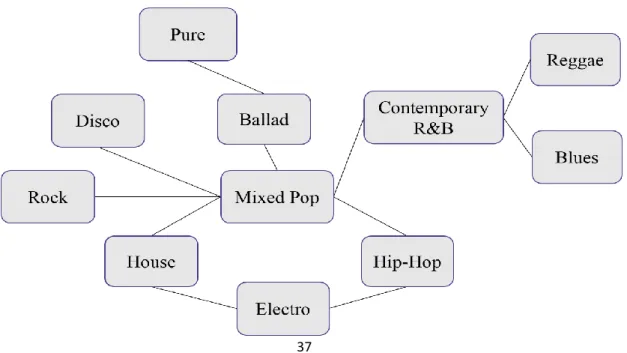
origin, these 58 music genres are categorized into 11 music styles: Hip-Hop, Contemporary R&B, Rock, Mixed Pop, Electro, House, Ballad, Blues, Reggae, Disco, and Pure (See Appendix B). Among them, the “pure” category aims to separate the innocent girl group’s bubblegum pop and teen pop genres from the other pop genres, such as electro pop, and synth-pop. Then, according to the history of music genres’ evolution, I draw a graph to show those 11 music styles’ relationships (see Figure 1).
This music genre framework helps to determine the image change extent between any two music categories. One unit of the distance (i.e., the image change extent) is defined as the stem connected two nearby music categories. For example, if the discography contains the Mixed Pop music genre, and the previous discography contains the Electro music genre, then the distance of this transformation is 2 (Mixed Pop→Hip-Hop→
Electro).
Figure 1. The relationship between each music styles.
In cases that a discography contains more than one music genre, I use the simple averages to represent the extent of image change. For example, if a previous discography contains the Mixed Pop, Electro, and House music styles and the current discography contains Electro and Ballad music styles, then I will calculate the extent of the image change by counting all the distance between any two music genres identified in these two discographies and calculate the simple average of the distances (Electro→Mixed Pop:2;
Electro → House:1; Ballad → Mixed Pop:1; Ballad → House:2; Ballad → Electro:3;
transformation= 2+1+1+2+3
5 =1.8).
Control variables
This research chooses five control variables: gender, the size of the management company, the discography type, whether the idol groups’ members have attended the talent show, and the number of the year goes through since the idol groups debuted.
The gender of K-Pop idol groups may result in differences in the scores of the audience preference of Music Bank K-chart because most of the idol group’s fandoms consist of the fans with the gender opposite to the idol groups. Furthermore, most of the K-Pop fans are female, so the boy idol group’s preference score is normally higher than the girl idol group’s score. The variable “Gender” receives the value of 1 if the idol group is the girl
idol group.
In the research, the size of management company is classified in three levels, listed company, subsidiary, and non-listed company. If the management company of the idol group has already gone public, such as JYP Entertainment and SM Entertainment, then the management company will be classified as the listed company; if the management company of the idol group has not gone public, but the company is a subsidiary of the listed company, such as STARSHIP Entertainment (the subsidiary of Kakao M) and Woollim Entertainment (the subsidiary of SM Entertainment), then the company will be classified as the subsidiary; neither big company nor middle company is classified as the non-listed company. The budget invested on the idol groups usually depends on the size of management company, and the more resources the company invests, the more likely the idol groups get good grades. Thus, I set two dummy variables, “Listed Company” and
“Non-listed Company”, to represent the size of the management company according to the above definition of the company sizes, and receive the value of 1 if the management company is classified as the listed company and non-listed company respectively, and the statistics is collected from Wikipedia and the website of Korea Exchange (KRX)3, Korean security exchange operator.
In K-Pop industry, the discographies of the idol groups can be categorized into three main types, single, extended play (as known as EP), and the full album. Each type of discography contains different number of songs, and releasing the full album implies that the idol group makes an effort on this comeback and the fans are willing to bring good grade to support the idol groups’ effort. Therefore, whether the discography is the full album or not might affect the performance of the comeback, and I set the variable “Album Type” receives the value of 1 if the discography type according to the data on Wikipedia is the full album.
In recent year, the talent shows, such as SIXTEEN and PRODUCE 101 series, become popular. Some idol groups are composed through the talent shows, the other idol groups debut after the talent show. Also, some management companies even assign the debuted idol groups’ members to participate the talent show and come back to the original group after the talent show ends. Even though the Korean idol talent shows broadcast on television for only two or three months, in the process of broadcasting, the show and the contestants can gradually accumulate many supporters, and after the talent show finishes, the supporters of the program probably become the fans of the talent show’s contestants.
Hence, the variable “Talent Show” receives the value of 1 if the members of the idol groups have attended the talent shows.
The research adds the number of the year goes through since the idol groups debuted as the control variable. If the idol groups have great reputation and the audiences’ preference, then the idol groups cannot be eliminated easily and can last for the long time compared to the other idol groups. Conversely, if the idol groups last for the long time, then the idol groups can gradually accumulate their fans and thus earn the higher preferences of the audiences. Hence, the variable “Year” indicates the number of the year between the debut day and the new discography launches.
Analysis
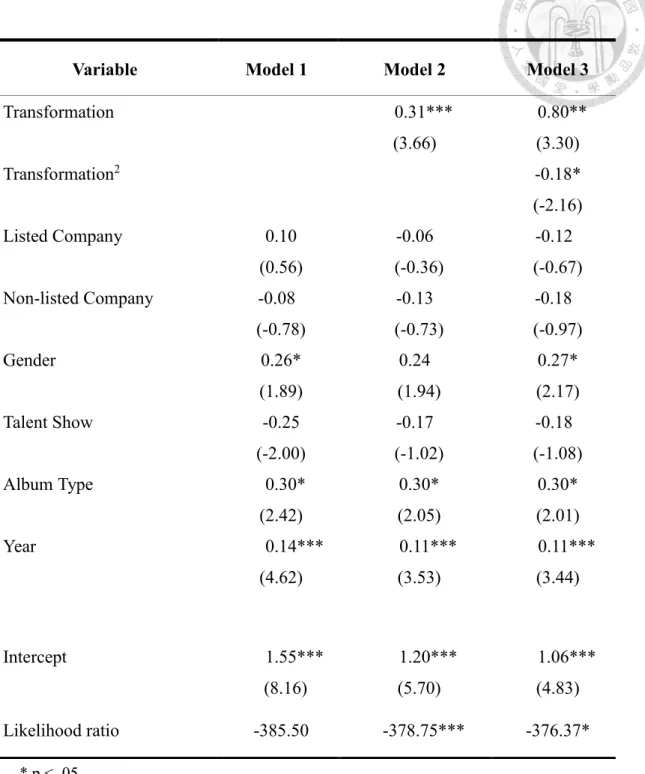
This research analyzes the data through R programming language and uses ordinary linear regression model to prove the hypothesis. In order to clarify the non-linear relationship, this research adds the independent variable’s general form (Transformation) and quadratic term (Transformation2) into the linear regression model. Therefore, this research shows Model 1 as the baseline model, Model 2 adds the general form of the independent variable, and Model 3 includes the general form and quadratic term of the independent variable to prove the hypothesis.
Result
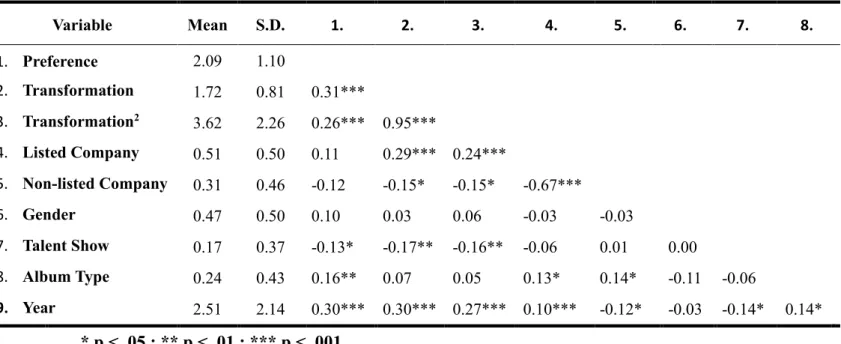
Table 3 provides the means, standard deviations, and the correlation for all variables, and
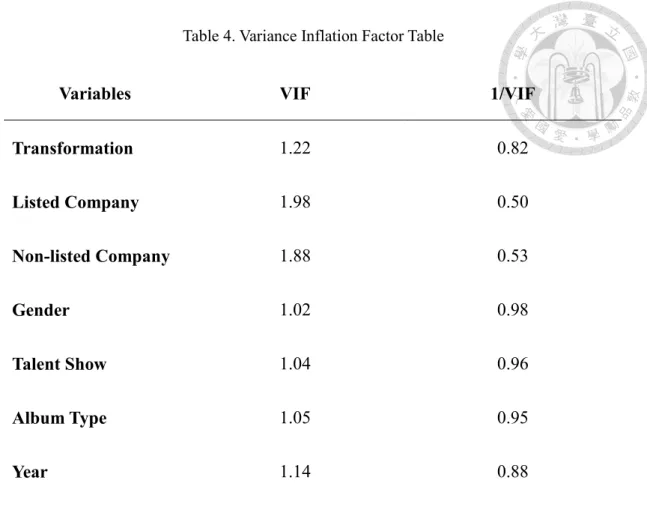
Table 4 provides the variance inflation factor (VIF) table to show whether the multicollinearity problem exists. According to the variance inflation factor test, the VIF of the variables are all below the threshold of multicollinearity, thus the variables in the regression model do not exist the problem of multicollinearity.
Table 5 presents the result of the linear regression analyses. Model 2 shows that the extent of the transformation of music genres is statistically significant and has the positive effect on audience preference. Model 3, compare with the Model 2, adds the quadratic term of the extent of the transformation of music genres to test the hypothesis. The result of Model 3 indicates that the general form and quadratic term of the extent of the transformation of
Table 3. Description Data and Correlation Table
Variable Mean S.D. 1. 2. 3. 4. 5. 6. 7. 8.
1. Preference 2.09 1.10
2. Transformation 1.72 0.81 0.31***
3. Transformation2 3.62 2.26 0.26*** 0.95***
4. Listed Company 0.51 0.50 0.11 0.29*** 0.24***
5. Non-listed Company 0.31 0.46 -0.12 -0.15* -0.15* -0.67***
6. Gender 0.47 0.50 0.10 0.03 0.06 -0.03 -0.03
7. Talent Show 0.17 0.37 -0.13* -0.17** -0.16** -0.06 0.01 0.00
8. Album Type 0.24 0.43 0.16** 0.07 0.05 0.13* 0.14* -0.11 -0.06
9. Year 2.51 2.14 0.30*** 0.30*** 0.27*** 0.10*** -0.12* -0.03 -0.14* 0.14*
* p < .05 ; ** p < .01 ; *** p < .001
Table 4. Variance Inflation Factor Table
music genres are statistically significant, and the Model 3 also proves the hypothesis that the relationship between the extent of incongruity and the consumers’ reaction for corporate rebranding is presented an inverted U relationship.
Moreover, this research also uses likelihood ratio test to test the model comparison between two regression models. According to the likelihood ratio test, Model 2 is statistically significantly better than Model 1, and Model 3 is also statistically significantly better than Model 2. Thus, the conclusion of likelihood ratio test indicates that Model 3, including the general form and quadratic term of the extent of the transformation of music genres, is the best regression model to explain the statistical data.
Variables VIF 1/VIF
Transformation 1.22 0.82
Listed Company 1.98 0.50
Non-listed Company 1.88 0.53
Gender 1.02 0.98
Talent Show 1.04 0.96
Album Type 1.05 0.95
Year 1.14 0.88
Table 5. Ordinary Linear Regression Analysis
Variable Model 1 Model 2 Model 3
Transformation 0.31***
(3.66)
0.80**
(3.30)
Transformation2 -0.18*
(-2.16)
Listed Company 0.10
(0.56)
-0.06 (-0.36)
-0.12 (-0.67)
Non-listed Company -0.08
(-0.78)
-0.13 (-0.73)
-0.18 (-0.97)
Gender 0.26*
(1.89)
0.24 (1.94)
0.27*
(2.17)
Talent Show -0.25
(-2.00)
-0.17 (-1.02)
-0.18 (-1.08)
Album Type 0.30*
(2.42)
0.30*
(2.05)
0.30*
(2.01)
Year 0.14***
(4.62)
0.11***
(3.53)
0.11***
(3.44)
Intercept 1.55***
(8.16)
1.20***
(5.70)
1.06***
(4.83)
Likelihood ratio -385.50 -378.75*** -376.37*
* p < .05 ** p < .01
*** p < .001
Likelihood ratio test for Model 2 compared to Model 1 and Model 3 compared to Model 2.
The value in the parentheses means the t-value of each variables.
N=268
Besides, the regression results also show some insights from the effects of the control variables. One is that the variable “Album Type” is statistically significant in Model 3, showing that relative to the single or EP, the full album may earn better market reaction.
Another finding is that the variable “Gender” is statistically significant in Model 3, and the result can be explained that the dependent variable of the research is determined by the audiences’ preference score on the K-chart of Music Bank, and this score is determined by the audiences’ text message votes. Normally, most of the fans tend to support the idol groups of the opposite gender, therefore, this result implies that the male fans are more likely to vote through the text message than the female fans, and the girl idol groups are statistically significantly better than the boy idol groups on this score.
The other finding is that the variable “Year” is statistically significant in Model 3, and result indicates that as the idol groups last for longer time, the opportunities of catching the audiences’ eyes increase.
Supplementary Analysis
Above research shows that the relationship between the extent of the music style change and audience reaction follows an inverted U relationship. However, the preference of the fans may not just only be influenced by the previous discography’s music style but also
earlier discographies’, so I try to add the extent of music style transformation among the first two discographies and the current discography, and that among the first three discographies and the current discography to calculate the new extent of music style transformation.
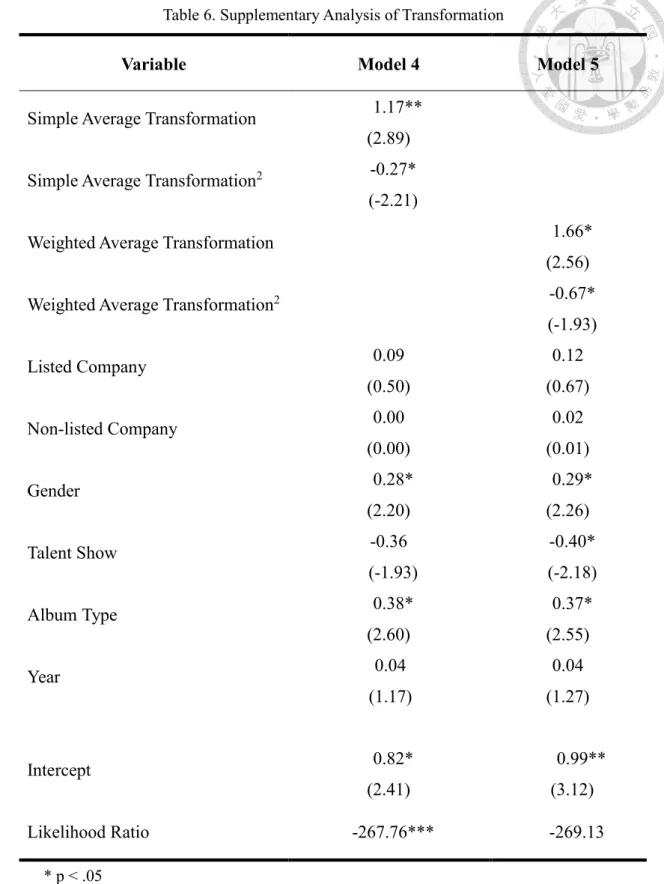
In addition, this supplementary research uses the two different methods of calculating the extent of music style transformation. First one is the simple average of three dimensions of transformation to represent the extent of music style transformation, and the last one is that I give the three dimensions of transformation the different weight and calculate the weighted average of the extent of music style transformation because the transformation of the closer time affects more than that of the farther time. Thus, the weight of the transformation, in my scenario, is halved when the compared transformation is distant from the one discography for each (i.e. the weight of the three dimensions of transformation, previous, past two, and past three discographies, is 1, 0.5, and 0.25 respectively).
The result of the analysis is shown in Table 6. In Table 6, Model 4 uses the simple average to calculate the extent of music style transformation, and Model 5 uses the weighted average to calculate the extent of music style transformation. These two regression models indicate that the inverted U relationship still exists in the other two scenarios, and