國立臺灣大學文學院語言學研究所 碩士論文
Graduate Institute of Linguistics College of Liberal Arts National Taiwan University
Master Thesis
語義優勢性對語法語境中詞彙歧義解析之影響—
中文歧義詞處理的事件相關電位研究
Effects of Meaning Dominance on Lexical Ambiguity Resolution in Syntactic Context— An ERP Study of
Homograph Processing in Chinese
曹景瑄
Ching-Hsuan Tsao
指導教授:李佳霖 博士 Advisor: Chia-Lin Lee, Ph.D.
中華民國 108 年 3 月
March 2019
致謝
莫泊桑在小說中寫道:「人的脆弱和堅強都超乎自己的想像。有時,可能脆弱 得一句話就淚流滿面;有時,也發現自己咬著牙走了很長的路。」
回首這一千多個日子,走在滿是荊棘的漫漫長路,我常常想,真的會看見盡頭 嗎?在見到曙光的那一刻,卻又覺得渺如夢境一般…我總算也踉蹌地抵達終點了。
完成論文的歷程,只有自己才能了解箇中滋味。想起那年為了追逐理想,亦不 甘安於舒適圈的性格,決定放下手中握有的安穩,踏入心目中的學術殿堂。而研究 生活除了投入感興趣的領域琢磨外,大部分的時間更像是在進行自我對話的過程。
尤其在將自己丟入一個不甚熟悉的領域,如同在迷霧中摸索,必須抱持堅強的信念,
才能在一次次的試錯中跌倒爬起進而茁壯。期間少不了自我懷疑、自我否定,甚至 近乎失去自我的真空狀態。或許,這就是走出舒適圈的成長代價。也只能憑著一股 執持加上飛蛾撲火的義無反顧,學習去調整慣有的思維,平心靜氣地審視每道關卡 與挑戰,思考自我選擇和取捨。更重要的是,這一路上若沒有身旁珍貴的事物給予 力量,不敢想像自己是否能完成現在這小小的一步。
感謝指導教授李佳霖老師,引領完全無基礎的我進門,嚴謹地要求每一個研究 細節,磨練我的心智,字斟句酌地修改論文及給予整體脈絡的建議。感謝口委詹曉 蕙老師及呂佳蓉老師,細心審閱並給予溫暖的反饋,讓我對研究拾起信心。感謝在 這一路上關心我的所有老師:再忙也願意陪我聊聊給予鼓勵的蘇以文老師、總是帶 著笑顏叮嚀要照顧好身體的宋麗梅老師、不時開導關心我狀況的林瑋嬪老師、不厭 其煩解答統計疑問的邱振豪老師、關心我研究生活的劉秀孌老師及胡裕仁老師等。
時至畢業,更心念的是當初推薦提攜我的大學恩師:陳麗美老師指引我方向,讓我 初探研究的面貌、林明澤老師總捎來字字句句溫暖的鼓勵、盧慧娟老師讓我看見對 研究的熱忱和堅持,感念孕育我成長的搖籃—母校成大外文系,豐富了我的人生。
大大的感謝要獻給在各國城市的摯友們:崔西、丹丹、艾迪、莉安、Dani、Amos、
廖翎、廖董、凱倫、Claire、Yellow、孝恆、昵君、書芩、齊齊、Vanessa、將將、
安蔔、茜茜、芃芃、新新等,有你們隨時當我的樹洞,支持著我,好讓我整理情緒 重振精神。感謝實驗室新舊夥伴柏亨、佳禾、伶玲、彥霖、乃文、敬淳、Jenny,
還有心理系助教鄭澈,在實驗資料不如預期的時候,還願意與我討論研究,分享資 料分析的經驗。謝謝運動紓壓夥伴瑀妮、瑋慈,讓我研究生活多了色彩。還有一同 在語言所奮鬥的逸如、安九、Craig、阿陞、Thomas、 Chester、小涵、Taco、Amber、
智傑、阿賢、宜臻、Mateja、靜琛、于萱、馨妍、高高等,謝謝有這溫暖的語言所 大家庭,總是願意傾聽我,彼此鼓勵。
最後,能夠在研究生涯記錄下這小小扉頁,最最重要的就是我的家人,默默地 在背後給予支持,做我最強大的後盾。感謝我的父母總是包容我的情緒與脾氣,在 我跌跌撞撞落寞的時候仍然選擇相信我,與我站在同一陣線,讓我知道我並不孤單。
感謝父母體諒我的疏於陪伴,卻總是為我的事牽腸掛肚;在我需要冷靜的時候給予 空間,需要出口的時候給予依靠,謝謝我的父母總是尊重我的想法,讓我無後顧之
更像是姊姊一樣常叮嚀著我的身體健康,不時搞笑讓苦悶的我一解憂愁。每每看到 家人來台北看我,所有的倦怠和無力都暫拋腦後,使我重新有勇氣面對眼前的課題。
最後,要感謝一直陪在我身邊的祐承。研究所大半的時間都是你陪我度過的,對於 無數個陪我寫論文的周末從無怨言,還得忍受我的各種情緒起伏;你總是選擇耐心 包容,樂觀正向地帶我找回生活中美好的點滴,解開我緊鎖的眉頭,無條件予我鼓 勵與支持。是你教會我如何與不完美共存,如何優雅地面對人生的輕重緩急。
寫下這篇扉頁的同時,代表對自己的選擇和追求負責,也意謂開啟了人生下一 個篇章。願自己能將在語言所的這些經歷所得,謙卑的帶上人生未來的旅途。得之 於人者太多了,點滴在心頭,願自己時時刻刻謹記付出的智慧,成為幫助他人的人。
中文摘要
過去的文獻指出,能夠影響詞彙歧義解困(lexical ambiguity resolution)的兩大主 因為語義頻率(meaning frequency)和語境訊息(context)。過去研究皆認為語境訊息 的存在能有效地幫助選擇適當的語義進而達成語義消歧,然而語法和語義語境是 否皆能影響一開始語義的提取似乎仍未明朗。單純操弄語法語境的研究多半未特 別區分同形異義詞(homograph)中主要語義及次要語義的語義頻率,而且實驗間採 用不同的典範如促發典範(priming paradigm)的詞彙判斷作業(lexical decision task) 以及方法如眼動追蹤技術(eye-tracking)、事件相關電位(Event-Related Potential, ERP) 有可能引發不同的反應策略。有鑑於此,本篇論文欲以中文為媒介來探討兩項議題:
(一)語法語境是否能影響中文非均勢同形異義詞(biased homograph)中語義之提 取;(二)語義優勢性在中文詞彙歧義解困處理歷程中是否能與語法語境互動。並 以事件相關電位(Event-Related Potential, ERP)技術來做為此議題的實證。
詞類歧義詞提供一個媒介來檢驗語義優勢性在語法單獨存在之語境下進行詞 彙歧義解困的作用。實驗一我們將兩種不同類型的中文非均勢同形異義詞置於只 有語法訊息但語意短缺的中文短語內,僅根據語法提示(syntactic cue)來提取非均勢 同形異義詞中的主要語義或次要語義為最適當的語義解讀。由於實驗一整體效果 不如預期顯著,實驗二為實驗一之改良,沿用相同材料,並搭配語義關聯性測驗 (semantic relatedness judgement task) 使受試者更需要整合語境以及歧異詞,同時受 試者須做兩個實驗列表以利檢視實驗一中觀察到的個體差異。
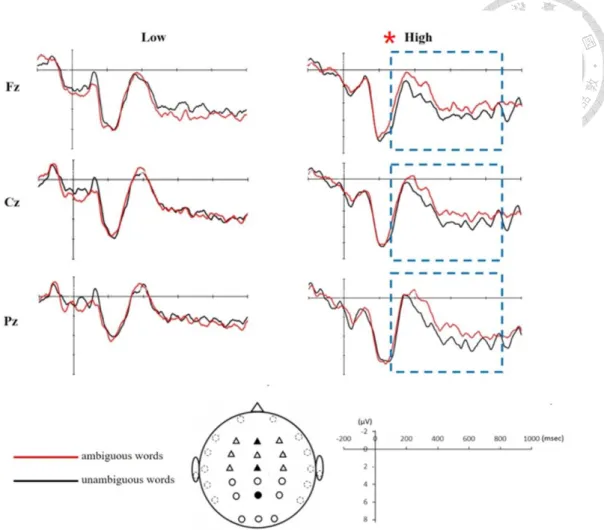
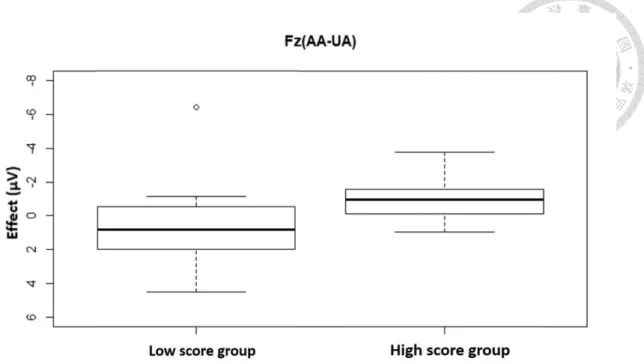
研究結果顯示,過往文獻中提到涉及詞彙歧義時會引發在前區持續的負向效 果(frontal negativity)在整體的受試者中效果並不明顯,但在閱讀經驗較高的受試者 上較為突出。此結果可能表示個體對於解歧語境有反應差異且體現於閱讀能力之 指標。根據中位數分組的結果顯示,閱讀經驗較高的受試者在歧義詞上引發負向腦 電位變化,另一半閱讀經驗較低的則引發正向腦電位變化,因而造成整體腦電位效 果的相互抵消。另外,我們也在閱讀能力較高的組別中發現負向的歧異效果主要出 現在當語法語境導向中文非均勢同形異義詞的次要語義,範圍由頭皮前區延續到 中後區。然而當語法語境導向主要語義時,除了與語義關聯的 N400 短暫出現外,
負向的效果似乎較不明顯。整體而言,本研究的結果顯示,語法訊息語境能夠提供 促進語義提取進而幫助解歧,且其受到語意優勢性的影響。當語境導向主要語義時,
主要語意可以被迅速且強烈的提取,次要語意即便有被提取,其所形成的語義競爭 甚小,意義選擇不須額外的上到下的資源即可語義競爭透過較為自動化的意義模 式(顯示在 N400 的效果)順利完成解歧。然而,當語境導向次要語意時,由於次 要語意的提取受到語境的支持,且主要語意的提取還是非常強烈,因而形成強烈的 語義競爭,需要由一上而下的處理歷程來幫助解歧。過去文獻顯示動用此資源的能 力有個體化的差異,本研究的結果與此一致,顯示擁有較好的閱讀能力者較容易啟 動此協助解歧的機制。
關鍵字:一詞多義、詞類歧義、語境、語意優勢性、詞彙歧義解困、個體差異、事 件相關電位
Abstract
In general, past literature has indicated that meaning dominance and context are the two main factors influencing lexical ambiguity resolution. Prior research suggested that context can help select contextually-appropriate meaning effectively, and thus succeed with lexical ambiguity resolution. However, it seems less evident whether the initial meaning access could be influenced by the context with only syntactic information. For one thing, most studies manipulating the syntactic information context alone did not distinguish the meaning dominance of the dominant and subordinate meaning of homographs specifically. For another, various paradigms adopted in different experiments such as priming with lexical decision task, eye-tracking, and event-related potential were likely to reflect different response strategies. In view of the above- mentioned facts, the present study targeted Chinese native speaker to investigate (1) does syntactic context affect meaning access of Chinese biased homographs, and (2) does syntactic context effect interact with meaning dominance. We used Event-Related Potential (ERPs) to examine the brain responses and attempt to make an empirical study.
Syntactic category ambiguous words, whose alternative meanings differ in syntactic categories (e.g., trip in English), serve as a means of examining this issue. In Experiment 1, two types of Chinese biased homographs (i.e., NV and VN homographs) were embedded into phrases in which syntactic information provided but lack of semantic. That is, either the dominant or the subordinate meaning of homographs would be extracted to be the contextual-appropriate meaning depending only on syntactic cues. On account of the more insignificant overall effect than predicted in Experiment 1, Experiment 2 adopted the same materials but replaced with the semantic relatedness judgement task to make participants further integrate the contexts and homographs. Meanwhile, all participants were required to do two experimental lists to examine the individual difference observed in Experiment 1.
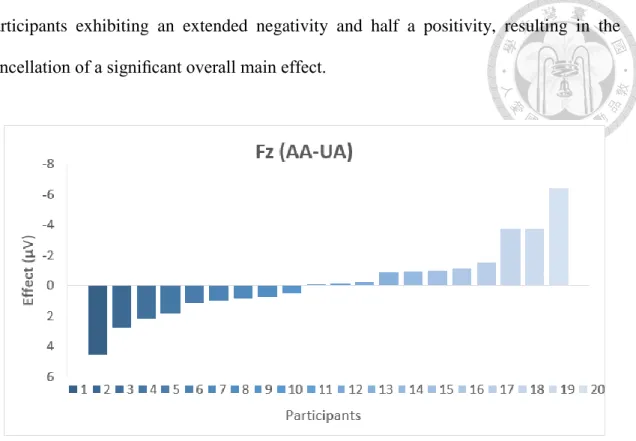
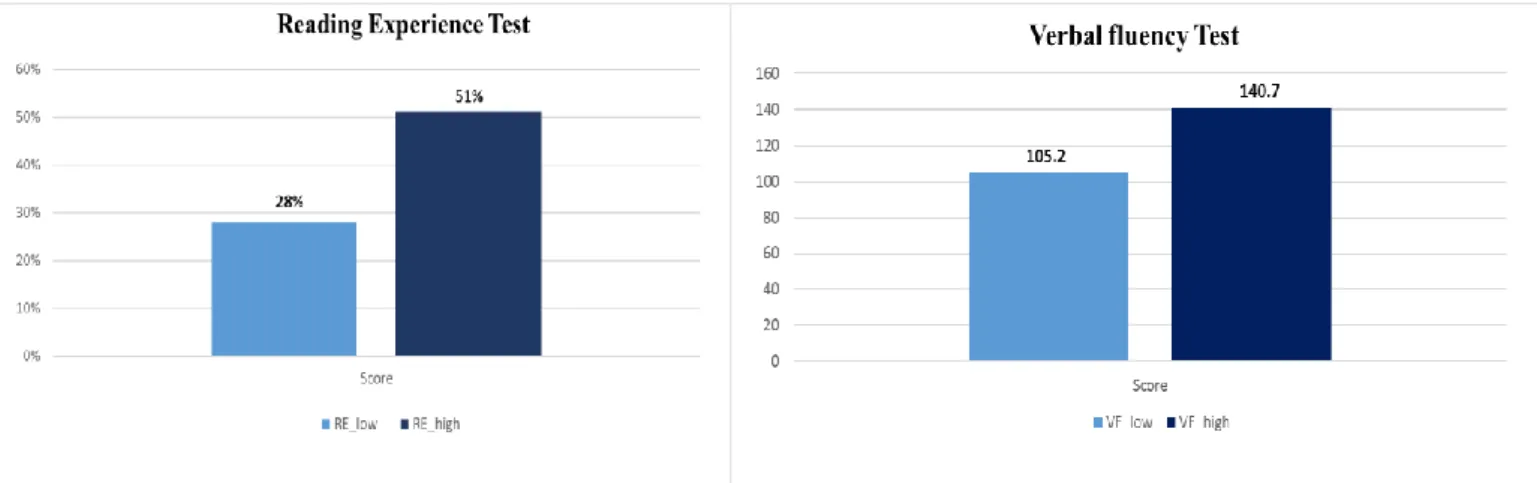
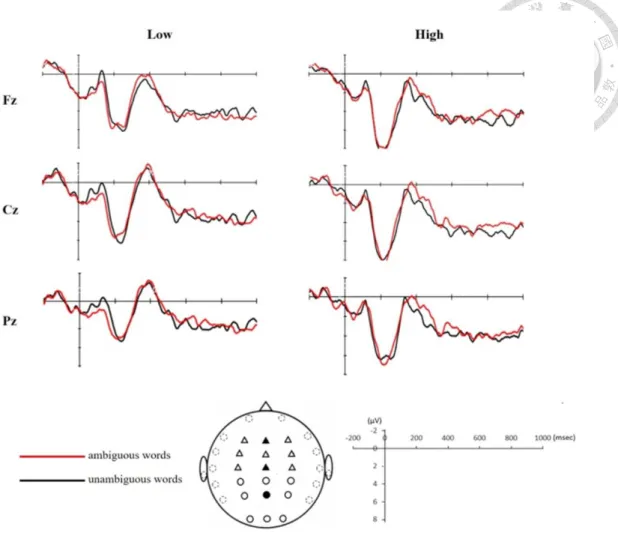
Our results showed that the overall ambiguity effect was not as prominent as that in the previous studies which have found an ambiguity-related sustained negativity at frontal regions, the effect was more obvious in the subjects with high score of reading experience instead. It might indicate that individual differed in reaction to the disambiguated context, and such an individual difference may manifest on reading abilities. Based on the result of grouping data with median split, participants with higher scores on reading experience showed a sustained negativity relative to unambiguous words, and half with low scores showed a positivity, and thus cancelled out the overall ambiguity effect.
On the other hand, in the high score group of reading experience, we found a clear negativity showed when the syntactic context favored the subordinate meaning of
context picked out the dominant meaning of homographs, except for the transient N400 effect related to semantic access, it seemed an absent sustained negativity. In sum, this current study indicated that the syntactic context is able to affect the meaning access and help disambiguation, yet such context effect is modulated by meaning dominance. In the dominant-biasing context, the dominant meaning could be accessed intensely and rapidly, and the meaning competition is thus very small even if the subordinate meaning is activated. Such a process of meaning selection can be accomplished through a model of meaning automation (displayed on the N400) and thus reach disambiguation successfully.
On the contrary, despite the fact that the subordinate-biasing context supports the activation of subordinate meaning, the access of dominant meaning is still robust at the same time. Hence, a strong meaning competition is generated, and an additional mechanism is necessary to be involved to help. As suggested by past literature, there is an individual difference for mobilizing the top-down resources, which is consistent with our result that those who have better reading abilities are more likely to initiate the kind of mechanism.
Key words: homograph, syntactic category ambiguity, context, meaning dominance, lexical ambiguity resolution, individual difference, Event-Related Potential
Table of Contents
口試委員審定書 ... i
致謝 ... ii
中文摘要 ... iv
Abstract ... vi
List of Figures ... x
List of Tables ... xii
Chapter 1 Introduction ... 1
1.1 General background ... 1
Chapter 2 Literature review ... 6
2.1 Hypotheses of lexical ambiguity resolution ... 6
2.1.1 Modular access hypothesis ... 6
2.1.2 Interactive access hypothesis ... 6
2.2 Issues of ambiguity resolution ... 7
2.2.1 Meaning dominance ... 7
2.2.2 Context ... 10
2.3 Lexical category difference ... 11
2.4 Studies of lexical ambiguity resolution in Chinese ... 14
2.5 Research question ... 16
Chapter 3 Experiment ... 18
3.1 Design and predictions ... 18
3.2 Method ... 20
3.2.1 Participants ... 20
3.2.2 Materials ... 20
3.2.3 Norming studies ... 23
3.2.3.1 Norming study 1: Meaning dominance ... 24
3.2.3.2 Norming Study 2: Meaning Relatedness ... 25
3.2.3.3 Norming Study 3: Familiarity ... 26
3.2.3.4 Norming Study 4: Concreteness ... 27
3.2.3.5 Norming Study 5: Grammaticality judgement task ... 29
3.2.4 Procedure for the ERP session ... 30
3.3 EEG recording parameters and data analysis ... 31
3.4 Result ... 32
3.4.1 Behavioral data ... 33
3.4.2 ERPs data ... 33
3.5 Interim summary and discussion ... 36
3.7 Follow up experiment: Modification of experimental task ... 43
3.7.1 Design and prediction ... 44
3.7.2 Method ... 45
3.7.3 Results of the first experimental list for each participant ... 47
3.7.3.1 Behavioral data ... 47
3.7.3.2 ERPs data ... 48
3.7.4 Within-subject comparison for potential list effects ... 50
3.8 Interim summary and discussion ... 50
Chapter 4 General discussion ... 53
4.1 Individual difference analyses ... 53
4.2 Effects of meaning dominance ... 57
4.3 Limitations and future research ... 59
4.4 Concluding remarks ... 62
References ... 64
Appendixes ... 70
A. Ratings scores of each Experimental list ... 70
B. Examples of the questionnaire for Norming study 1: Meaning dominance 72 C. Examples of the questionnaire for Norming study 2: Meaning relatedness73 D. Instructions and sample items for Norming study 3: Familiarity ... 74
E. Instructions and sample items for Norming study 4: Concreteness ... 75
F. Instructions and sample items for Norming study 5: Grammaticality judgement task ... 76
G. Questionnaire of reading experience test (Author Recognition Test) ... 77
H. Questionnaire of reading experience test (Magazine Recognition Test) ... 78
I. Examples of stimulus materials in experimental list 1 ... 79
J. Examples of stimulus materials in experimental list 2 ... 80
List of Figures
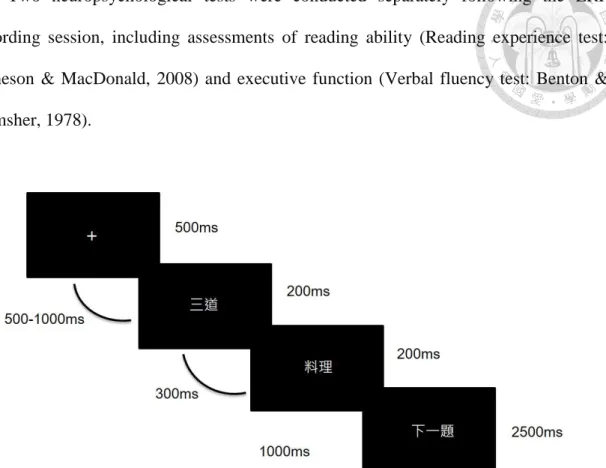
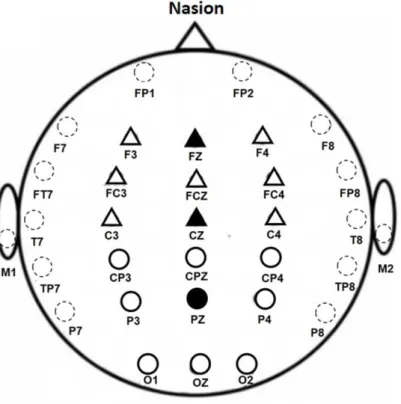
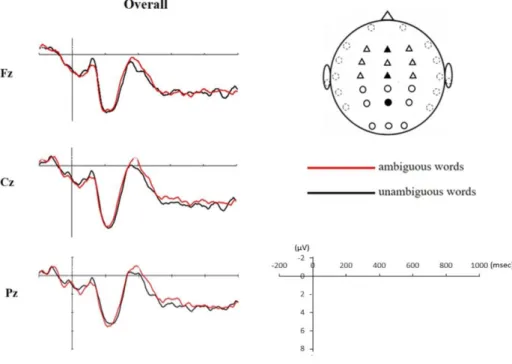
Figure 3.1 A diagram of trial procedure in Experiment 1 ... 31 Figure 3.2 Shown are the locations of the 30 scalp electrodes on the QuickCap used in the present study. The electrodes used for statistical analysis are triangles for frontal electrodes, and circles for central/posterior electrodes. For those electrodes filled in shapes are used for showing the representative waveforms.
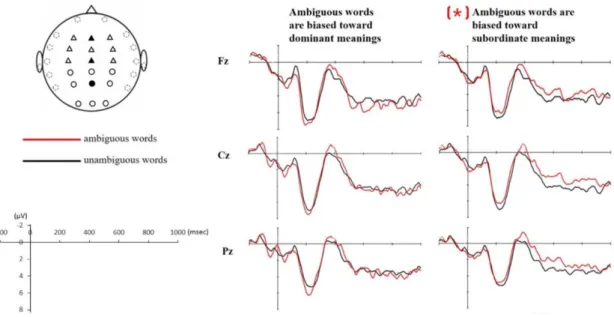
... 32 Figure 3.3 Grand average ERPs at three midline electrode sites for unambiguous words (black line) and ambiguous words (red line) in Experiment 1 ... 34 Figure 3.4 Grand average ERPs at three midline electrode sites for unambiguous words (black line) vs. ambiguous words (red line) when the context favors dominate meaning (left column) and subordinate meaning (right column) of the homographs in Experiment 1. ………..35 Figure 3.5 Effect sizes per participant for ambiguity manipulation at the representative frontal channel (Fz) within 250-900 ms. ... 38 Figure 3.6 High/low score group based on a median split for two neuropsychological tests across twenty participants ... 39 Figure 3.7 Grand average waveforms to ambiguous words (red line) and unambiguous words (black line) of the low and high score group for verbal fluency test are plotted at 3 representative midline electrode sites (Fz, Cz, and Pz) to observe the overall effect. There is no statistical significance between ambiguous words and unambiguous words in each group. ... 40 Figure 3.8 Grand average waveforms to ambiguous words and unambiguous words of the low and high score group for reading experience test are overlaid at 3 representative midline electrode sites (Fz, Cz, and Pz) to highlight the overall effect. There is a prominent statistical significance (p<.05) in high score group, while there is no difference between ambiguous words and unambiguous words in low score group. ... 41 Figure 3.9 The boxplot plotted on the basis of the high and low score group for reading experience test at Fz to represent the brain response within two groups………...42 Figure 3.10 In the high group of reading experience, ERPs’ responses at three
representative electrodes of ambiguous (red line) vs. unambiguous words (black line) when the context favors dominate meaning (left column) and subordinate meaning (right column) of the homographs. The bottom four isopotential voltage maps show scalp distributions viewed from the top of the head for brain responses in both contexts in two time windows (250-550 ms
unambiguous and ambiguous words is noted only in subordinate-biasing context. (p<.05) A clear contrast between groups shows that a notable frontal negative effect is elicited only in subordinate-biasing context. ... 43 Figure 3.11 A diagram of trial procedure in Experiment 2 ... 47 Figure 3.12 Grand average ERPs at three midline electrode sites for unambiguous words and ambiguous words in Experiment 2. The left-most column of the figure is the overall waveforms of ambiguous and unambiguous words, irrespective of meaning dominance. The middle column contrasts the brain responses to unambiguous vs. ambiguous words when the context biases to the dominant meaning of the homographs; the right-most column contrasts the brain responses to unambiguous vs. ambiguous words when the context biases the subordinate meaning of the homographs. Mean amplitude differences shown as isopotential voltage maps, whose distributions viewed from the top of the head for brain responses in two corresponding biasing contexts at middle and right-most columns in two time windows (250-550 ms and 550-900 ms) ... 49
List of Tables
Table 3.1 Examples of stimuli for each condition ... 19 Table 3.2 Mean values (with standard deviations in parentheses) of lexical features of
the targets and cues for each condition in Experiment 1 ... 22 Table 3.3 Proportion of meaning usages for NV- & VN- homographs (with ranges
specified in the parenthesis) ... 25 Table 3.4 Means and standard errors of two behavioral tasks in Experiment 1 and 2 .... 48
Chapter 1 Introduction 1.1 General background
Language, admittedly, is ubiquitous and plays a crucial role in our life. People may suppose that comprehending words or sentences is an inherent ability, which is quick and effortless most of the time. However, the complex underlying mechanism about how syntactic and semantic information interact and integrate in human’s brain have always been discussed.
Ambiguity is one of the robust examples since it is so prevalent at either word or sentence level in language. In English, for example, it is estimated that over 80 percent of high-frequency words have more than one meaning (Twilley, Dixon, Taylor & Clark, 1994; Rodd et al., 2002). Chinese, likewise, has a large number of word-class ambiguous words. According to the Modern Chinese Dictionary, nearly 80% of the monosyllables in Chinese are ambiguous between various meanings, and 55% have five or more homophones. Moreover, an estimate indicated that regardless of frequency, between 13%
and 29% of Chinese monosyllabic and disyllabic words can be used as nouns and as verbs (Hu, 1996). On the one hand lexical ambiguity makes language rich and flexible, but on the other hand it complicates language, creates processing load and somehow increases the chance of confusion or misunderstanding. With such distinctive feature that one-to- many meaning mapping, how to pick out the most appropriate meaning swiftly among many possible interpretations and thus reach an effective communication is a primary issue for psycholinguists and neuropsychologists.
When it comes to lexical ambiguity, most of the time, it can refer to either polysemy or homonymy. To be specific, polysemy denotes a word possesses multiple different but related meanings as shown in the case of foot (e.g., “my left foot” and “at the foot of the mountain”), while homonymy contains several meanings which are semantically
unrelated like bank (river bank and financial bank). As for the former, both meanings are related but not literally the same; for the latter, both meanings share a single orthographic form but semantically unrelated concepts. According to a number of prior neurolinguistic studies, homonymy and polysemy are vindicated psychological distinct and being processed differently (Frazier & Rayner, 1990; Pickering & Frisson, 2001; Rodd, Gaskell,
& Marslen-Wilson, 2002). Due to the distinctiveness, the present study is exclusively concerned with homonymy, the so-called homophonic homographs, to avoid making confounding (Cruse, 1986; Lyons, 1977).
Two competing hypotheses of lexical ambiguity resolution have been proposed in the past decades from psychological and linguistic perspectives. Context-dependent account declares that the context that precedes an ambiguous word can offer help to access only the contextually appropriate meaning, assuming that language processing is operated by an interactive mechanism in which information among different linguistic subsystems like lexical or grammatical levels can flow both bottom-up and top-down simultaneously in ongoing language processing (McClelland, 1987). In contrast, context-independent account postulates that language subsystems are operated independently of other cognitive systems; namely, language processing must be completed in each language subsystem before information is transferred. This view is based upon the premise that language processing is a modular, bottom-up approach in which non-lexical, sentential information does not penetrate lexical access (Fodor, 1983). These hypotheses, in fact, provide a basis for researchers to extend various models of language processing as well as highlight the importance of underlying cognitive architecture of language processing.
To demonstrate the influence of contextual information, a great many researchers have investigated it across languages via various experimental paradigms, and most focus on either semantic or syntactic constraints. A majority of findings suggest that semantic
information of context is able to facilitate word processing (Marslen-Wilson & Tyler, 1980; Van Petten & Kutas, 1990; Van Petten & Kutas, 1991), help access appropriate meaning and even reduce selection demands related to ambiguity though it seems not to operate independently but interact with meaning frequency (Duffy, Morris, & Rayner, 1988; Rayner & Frazier, 1989; Rayner, Pacht, & Duffy, 1994; Lee & Federmeier, 2009).
On the other hand, past research into the effects of syntactic context on word processing has also been studied yet yielded inconsistent results (Marslen-Wilson & Tyler, 1980;
Seidenberg et al., 1982; Tanenhaus, Leiman, & Seidenberg, 1979; Folk & Morris, 2003;
Lee & Federmeier, 2006, 2009, 2011; Chen, 2014). Some support that syntactic context information can affect word processing, whereas some concludes such the information alone is insufficient to eliminate the lexical ambiguity indexed by a frontal negativity.
Under discrepant basis, this issue has not reached a consensus unanimously. Moreover, previous neurolinguistic research has been widely conducted in English and other Indo- European languages such as German, Italian and French, but there are relatively few studies to explore the syntactic context information during Chinese processing.
In addition to context, the role of meaning dominance is also one of the essential factors in lexical ambiguity resolution. Meaning dominance refers to alternative meanings of an ambiguous word have different frequency of uses. In comparison to the subordinate meaning, the dominant meaning is much easier to reach a high activation level (Simpson
& Burgess, 1985; Burgess & Simpson, 1988; Hogaboam & Perfetti, 1975; Simpson, 1981). However, the alternative meanings of an ambiguous word will reach a high activation level at the same time and keep competing with each other if the frequency of uses of both meanings are equal. (Duffy, Morris, & Rayner, 1988; Rayner & Duffy, 1986;
Sereno, Pacht, & Rayner, 1992).
Since most of the previous research associated meaning dominance with semantic
issue; that is, they indeed manipulated two distinct meanings of ambiguous words but seemed to overlook the distinctiveness of dominant and subordinate meanings of experimental materials respectively, especially when the alternative meanings of ambiguous words fell in different word classes. The relevant studies were much less with respect to syntactic context. Despite the fact that some have asserted to inspect the meaning dominance under only the syntactic constraint, some did not control the equal numbers of syntactic category ambiguous words, some just used balanced homographs.
For example, Folk and Morris (2003) have investigated the function of syntactic context in lexical ambiguity resolution by embedding balanced NN- and NV-homographs in sentences which were syntactically instantiated either the dominant or the subordinate meaning of the homographs. Yet, the prior context contained syntactic information that disambiguated the NV ambiguous words, specifying the noun interpretation was intended only. Under the circumstance, meaning dominance did not be examined comprehensively.
Therefore, the current study is regarded as a pilot study, aiming to not only organize the materials in Chinese homographs but set up a protocol to approach the following issues regarding how syntactic information affect meaning access and aid lexical ambiguity resolution in Chinese biased homographs as well as what the role of meaning dominance is under such a context. Based on this consideration, a large body of this study will emphasize the material selection, in which we made efforts to verify the validity of the materials on various linguistic features. Despite the fact that we have done preliminary experiments through the established design by using the materials, the numbers of participants in this experiment was relatively small. In addition, the data was unexpectedly variable among participants. As the variation among participants was quite salient, we conducted a simple group-level statistical analysis, and most part of the current study focused on explaining the source of the inter-individual variance. Follow-up
analysis and testing was conducted to verify these speculations. Although the results of the present study are not conclusive, we hope that the stimuli and testing protocol would provide a basis for future research.
Chapter 2 Literature review 2.1 Hypotheses of lexical ambiguity resolution
Whether ambiguous words are accessed and integrated into comprehension through a bottom-up or a top-down mechanism has long been debated by a raft of researchers. In general, prior studies attempted to explain the phenomena found in lexical ambiguity from either the modularity hypothesis or the interactive hypothesis. Of great interest is whether the access and selection of a contextually appropriate meaning from among several possible definitions depends on the prior context.
2.1.1 Modular access hypothesis
According to Modularity hypothesis, a general theory of cognitive processing, the lexical processor is an autonomous, informationally encapsulated module, and occurs independently of processing in any other module, especially when language is being processed under natural conditions (Fodor, 1983; Forster, 1979; Simpson, G. B., & Kang, H., 1994). That is to say, a particular component process of comprehension is able to operate autonomously of the other processes. In the level of language comprehension, researchers postulated all meanings of an ambiguous word were accessed independently irrespective of the sentential context, which certainly did not penetrate lexical access.
Such notion has been considered that lexical access is completely a process driven by bottom-up inputs and is thus autonomous from the top-down, contextual influence.
2.1.2 Interactive access hypothesis
A contrasting viewpoint, Interactive access hypothesis, however, assumes that all subsystems of cognitive architecture might be interactive, unceasingly counting in any
developed. This hypothesis in favor of the contextual dependency argues that the contextually appropriate meaning of an ambiguous word can be selectively accessed early on, it thus an interactive process in which lexical and contextual information can mutually influence each other at a very early stage (Marslen-Wilson & Tyler, 1980; McClelland &
Elman, 1986). Since different levels of information can interact with each other earlier, it is regarded as a disambiguating processing between bottom-up and top-down mechanisms. The hypothesis therefore supports immediate effects of context, showing that a biasing context can lead to either the facilitation of the contextually-appropriate meaning or a competition between multiple meanings when they were equally available.
Although the two hypotheses have been extensively tested in numerous studies, there still remained discrepant conclusions. What only can be confirmed is that— both contextual and lexical features do play crucial roles in ambiguity resolution.
2.2 Issues of ambiguity resolution
In order to figure out how the two primary factors influence the processing of ambiguity resolution, a great number of prior studies have probed into this issue not only through various approaches but also across different languages. A few models based on either modular or interactive view thus were generated, aiming at providing the empirical evidence to examine the role of meaning dominance and context in ambiguity resolution.
2.2.1 Meaning dominance
For ambiguous words, it has been proved that the accessibility of the meaning is determined by its frequency of usage. Accordingly, the term meaning dominance is used to account for the relationship between the alternative meanings of an ambiguous word.
To assess the meaning dominance effectively, free-association was a common technique
which asked participants to write down the first meaning that came to mind when given the ambiguous word in isolation (Gawlickgrendell & Woltz, 1994; Hogaboam & Perfetti, 1975). Balanced homographs refer to the multiple meanings of the homograph have the equal frequencies of usage (equally dominant meanings), whereas biased homographs represent one meaning of the homograph is used most frequently (dominant meaning), and the other is used relatively low (subordinate meaning). The two types of homographs, in fact, are qualitatively distinct from each other after being studied through a variety of paradigms over the past few decades.
Depending on whether or not meaning dominance is taken into account, models of discrepant views were developed. Both Multiple access (Onifer & Swinney, 1981;
Swinney, 1979; Tanenhaus et al., 1979) and Selective access model (G.B. Simpson, 1981;
Tabossi et al., 1987; Tabossi & Zardon, 1993) supported that the process of disambiguation had nothing to do with meaning dominance, while Ordered access model (Hogaboam & Perfetti, 1975; Simpson, 1981; Simpson& Burgess,1985; Holmes, 1979) and Reordered access model (Simpson & Burgess, 1985; Simpson & Kreuger, 1991;
Rayner & Frazier 1989; Rayner, Pacht & Duffy, 1994) were proposed with the consideration for meaning dominance.
According to Multiple access model, all meanings of an ambiguous word were accessed momentarily and automatically following the occurrence of the word, without regard to the frequencies of use. Much of the ground-breaking research also led to the conclusion that multiple meanings were accessed simultaneously even in biasing context by using spoken homophones as stimuli (e.g., Onifer & Swinney, 1981; Swinney, 1979;
Tabossi & Zardon, 1993; Tabossi, Colombo & Job, 1987; Tanenhaus et al., 1979). For instance, in the cross-modal priming paradigm, Swinney (1979) combined auditory and visual stimuli, aiming to measure activation of each meaning of balanced homographs.
The result revealed that both meanings are accessed simultaneously and automatically.
Swaab et al. (2003) used ERPs to further explore if and when lexical factors such as relative meaning frequency of ambiguous words influence lexical ambiguity resolution during spoken sentence comprehension in Dutch, finding that both dominant and subordinate meaning are partly activated initially, regardless context. Sharing the similar views, Selective access model claimed that the key point determining the meaning access depended on contextual information rather than meaning dominance. Only when the context provided a strong bias was the contextually appropriate meaning of ambiguous words accessed (Simpson, 1981; Tabossi, Colombo & Job, 1987; Tabossi & Zardon, 1993). Therefore, neither of the two models saw the meaning dominance as a pivotal role in lexical ambiguity resolution.
However, the other two competing models believed that the importance of meaning dominance cannot be ruled out. When it comes to Ordered access model, findings showed that biased homographs were resolved based on the relative frequency of alternative meanings in the absence of disambiguating information, with more frequent meanings being accessed faster and less influence of the context. (Hogaboam & Perfetti, 1975;
Simpson, 1981; Simpson & Burgess, 1985; Holmes, 1979). Simpson (1981) investigated the order of meaning access by using biased homographs in one of the experiments, which revealed that the dominant meaning of a biased homograph became available prior to the subordinate meaning in the neutral context. In other words, lexical meanings are retrieved in the light of frequency rankings. Reordered access model, similarly, assumed that meaning frequency can make a great impact in lexical ambiguity resolution. However, the preceding contextual information can also influence ambiguous word processing at the same time (Rayner, Pacht & Duffy, 1994; Simpson & Burgess, 1985; Simpson &
Kreuger, 1991; Rayner & Frazier 1989; Rayner et al, 2006). Based on their evidence,
lexical access was exhaustive but the meaning activation was determined by not only contextual information but also meaning dominance, and thus engendered a competition.
2.2.2 Context
Despite the fact that the influence of contexts in lexical ambiguity resolution has been vindicated in voluminous studies, it has not yielded an agreed-upon statement over the past few decades. The more controversial issue is when contexts get involved in the process of ambiguity resolution as well as how it determines which meanings of ambiguous words are activated first. Findings in different experiments have led to conflicting perspectives on the timing of contextual information.
Based on the assumptions of modular access hypothesis, Multiple access model and Ordered access model state that the preceding context cannot exert any influence on lexical access until the post-access selection stage. Onifer & Swinney (1981) utilized the cross modal priming technique in which subjects listened to and apprehended a series of sentences containing ambiguous words whose meanings biased to either dominant or subordinate meaning. After that, the participants had to make a lexical decision concerning whether the letter strings were words or non-words. Decisions to words related to both dominant meaning and subordinate meaning were occurred to facilitation irrespective of contexts when presented immediately. When the visual probes were presented 1500ms delay, however, the facilitation was only limited to the contextual- related probes. Their result thus supported that the contextual information can only help to select the most appropriate meaning in the post-lexical stage since every meaning of an ambiguous word were activated initially. Similar to their result, Simpson and Burgess (1985) conducted a series of experiments by using the method of priming, which also exemplified that lexical access is considered to be independent of the context in the very
beginning of lexical processing.
On the contrary, Selective access model and Reordered access model are regarded as context-dependent processing. Their core idea is that the contextually- appropriate meaning of an ambiguous word can be selectively accessed early on if the preceding sentence context provides a strong bias to the appropriate meaning. In other words, language processing is operated by an interactive mechanism in which both top-down (contexts) and bottom-up (linguistic features) information can flow and mutually influence one another at a very early stage. According to Simpson (1984),
the ambiguous nature of the word did not have to be resolved because the context primes only the appropriate meaning. Moreover, the experiments of Tabossi & Zardon (1993) successfully reflected genuine context effects and introduced the issue of the time-course of context in their experiments. Having examined the data on lexical ambiguity resolution in Italian, they found that only the dominate meaning was activated when the sentential context biased was toward the dominate meaning. It indicated that lexical access, to some extent, might be early restricted to the information derived from contextual information.
Also, there were other research suggested that contextual information can mediate in lexical ambiguity resolution, and even render a competition between the most frequent meaning and the context-appropriate meaning (Simpson, 1981; Simpson & Kreuger, 1991;
Rayner & Frazier 1989; Rayner, Pacht & Duffy, 1994).
2.3 Lexical category difference
Such linguistic distinctions raised a question that whether the lexical ambiguity resolution is also influenced by the syntactic categories of meanings. As a result, some researchers began to count word class in, using SCA words (i.e., syntactic categories ambiguous words) as an ideal vehicle for examining the role of syntactic context in lexical
ambiguity resolution. However, the issue whether the syntactic contexts could resolve lexical ambiguous has been controversial due to the inconsistent evidence from various studies. As the variable delay naming paradigm conducted by Tanenhaus et al. (1979), they attempted to investigate the processing of noun-verb ambiguities in syntactic context sentences. In the experiment, noun-verb ambiguous words were preceded by a syntactically-biased but semantically-neutral context, and soon followed by a target word related to one of the alternative meanings. Two conditions were thus established—
congruent and incongruent. (i.e. congruent: “He bought a new saw.” – HAMMER;
incongruent: “They don’t believe what they saw.” – HAMMER). The ambiguous words in control sentences were replaced with unambiguous word whose meaning was distinct from the following target word (e.g., “He bought a new case.”; “They didn’t believe what they felt.”). Aside from the manipulation of congruency between syntactic contexts and target words, there were three different stimulus onset asynchrony (SOA: 0 ms, 200 ms, 600 ms) for the target words. Their results supported the exhaustive access for syntactic category ambiguous words because the two meanings of SCA words were activated simultaneously even with only the precedence of syntactic constraints. The similar paradigm was then replicated by Seidenberg et al. (1982), and also in favor of the conclusion that syntactic constraints alone could determine the meaning activation and thus select the most appropriate meaning.
However, findings from electrophysiological experiments have indicated that the frontal negativity only reflected on NV-homographs in the presence of syntactic, but not semantic, constraints (Lee & Federmeier, 2006, 2009). In order to examine the effects of syntactic and semantic context on ambiguity resolution for NV-homographs, Lee and Federmeier (2009) created two types of sentences: congruent sentences and syntactic prose, respectively. They found the sustained frontal negativity (200-700 ms) was elicited
by the NV-homographs in the syntactic prose sentences as compared with controls.
Moreover, the sustained frontal negativity was significantly reduced when additional semantic information was available in contexts, suggesting that the frontal negativity reflect additional cognitive processing that is recruited when meaning selection is difficult.
The inability to use syntactic information in online ambiguity resolution was again demonstrated in their following study. Using the same stimuli, Lee and Federmeier (2011) compared ERP responses to homographs and unambiguous words to examine how language processing changes with normal aging. Results showed that older adults did not exhibit the frontal negativity effect exhibited by the young adults, but older adults with higher verbal fluency showed young-like patterns. These results suggest that the frontally- mediated selection mechanism may be related to executive functions that tend to be compromised in advanced age. In brief, the series of related studies show no disagreement with the view that syntactic information alone is unable to exclusively select the context- appropriate meaning of SCA words so that fail to resolve the lexical ambiguity.
Despite the coherent results from ERP studies, findings from eye-tracking are more controversial. Fraizer and Rayner (1987) asked subjects to read sentences containing class-ambiguous phrases (e.g., desert trains, which can be either noun-verb or adjective- noun.) and found longer gaze durations on class-ambiguous phrases while preceded by a disambiguating determiner (e.g., this or these). Conversely, reading times on semantically disambiguating regions following the phrases were longer after the ambiguous modifier (e.g., the). They then proposed a delay model on the basis of the results, elucidating that when there is no enough disambiguating information, readers tend to delay assigning syntactic class until the presence of more disambiguating information is available in the sentence. Nevertheless, some studies are in favor of the view that syntactic information can guide lexical resolution online. Folk and Morris (2003) embedded biased NN-
homographs and NV-homographs in sentences which were semantically and syntactically instantiated either the dominant or the subordinate meaning of the homographs. While the subordinate bias effect was not shown on NV-homographs but on NN-homographs. More specifically, longer gaze durations showed on the NN-homographs when preceding context favored the subordinate meaning, but no longer gaze durations were found when prior context instantiated either the dominant or subordinate meaning of the NV homographs. They further inspected the another types of syntactic ambiguous words—
balanced NN- and NV-homographs in the context containing only syntactic information.
The result showed that longer gaze durations on the balanced NN-homographs compared with the unambiguous controls, but for NV-homographs, there seemed no any processing loads since the contextually-appropriate meaning could be initiated and selected under the aegis of syntactic contextual information. As a consequence, they suggested that syntactic information indeed mediates the meaning resolution of ambiguous words.
Together, the issue whether or not a lack of semantic information would lead readers to process more difficulty in resolving the lexical ambiguity is still less clear, the present study therefore aims to delve into the role of syntactic contextual information by using syntactic ambiguous words which has advantage in excluding the semantic reminders from the context.
2.4 Studies of lexical ambiguity resolution in Chinese
Since the massive number of studies were conducted in English and other Indo- European languages, the research on lexical ambiguity resolution in Chinese is relatively few. Some researchers have investigated Chinese lexical ambiguity resolution to broaden the knowledge base and suggested the similar findings that context and meaning dominance both make influences (Li et al., 2002; Ahrens, 2001; Wong & Chen, 2012;
Chen, 2014). However, by using different types of ambiguous words and paradigms, the studies of Chinese lexical ambiguity resolution showed inconsistent results and thus supported different theoretical hypotheses.
To illustrate, Li et al. (2002) used cross-modal method to examine the influence of sentence context on the meaning selection in Chinese biased homophones, finding that priming effects only elicited by the dominant meaning of the homophones when the dominant-related visual probe occurred 150 ms before the acoustic offset, but when the visual probe occurred at the acoustic offset, thee priming effect elicited by both meanings.
It is thus in favor of the reordered access model, indicating the access of ambiguous words is frequency-based; that is, that dominant meaning is activated initially, and the prior contexts can influence lexical access at an early stage, implicating that language processing is highly interactive.
Another more recent eye-tracking study by Chen (2014) conducted two experiments to address the issue about the role of syntactic category constraint in Chinese lexical ambiguity. Four types of words biased homographs (NN, VV, VN, and NV) were used as stimuli and embedded into different sentence contexts. In Experiment 1, both the preceding and the succeeding sentential contexts were semantically and syntactically biased toward the subordinate meaning of the homographs. The result demonstrated a delay of SBE (i.e., subordinate biased effect: longer processing time is needed at a lexically ambiguous word, relative to an unambiguous control, when the preceding context supports the subordinate meaning of the biased homograph, see Rayner, Pacht, &
Duffy, 1994 for details) on ambiguous words; that is, the SBE was not observed for syntactic category ambiguous words in the target region but found in the second-pass reading in the post-target region. It seemed as an evidence that preceding semantically and syntactically biased context both provided a strong information to guide the readers
to activate the subordinate meaning at the beginning. In contrast, in Experiment 2, the sentence frame changed to semantically-neutral but syntactically-biased toward the subordinate meaning for the purpose of observing whether the syntactic information alone influence the SBE during lexical ambiguity resolution. This time, the SBE for VN- homographs emerged in the first-pass and second-pass reading in the target and post- target region, whereas for NV-homographs, the SBE was relatively slight but still observed in the second-pass reading in the post-target region. It revealed that the dominant meaning is still quite strongly activated and then interfere the contextual- appropriate meaning so that syntactic category constraint seemed not very influential during the meaning resolution of Chinese syntactic ambiguous words. The ambiguity effect, to some extent, was probably affected modulated by meaning dominance. It was then supposed from the two opposite findings that the semantic constraints really exerted an influence during the processing of ambiguity, but the role of syntactic constraint seemed not that obvious.
Taken together, due to the fact that there are relatively few studies on the context with syntactic information only, especially in Chinese, and the current relevant studies are still far from reaching consensus on the processing mechanisms of lexical ambiguity either, the issue is thus of great significance to be examined to provide more evidence in Chinese. The present study therefore attempts to investigate the role of syntactic contextual constraint combing with meaning dominance by using syntactic cues as the preceding context, we aspire to reduce any possible influence and make an empirical study on these issues.
2.5 Research question
The present study made an attempt to investigate the influences of meaning
dominance within syntactic context by using the ERP technique, which is equipped with the feature of great time resolution as well as highly sensitive measure of the critical cognitive and linguistic processes that take place in real-time within a short time window.
In our experiments, two types of disyllabic Chinese biased homographs (NV and VN) were used as target words, preceded by two types of cues, to generate all either dominant or subordinate context. The corresponding numbers of unambiguous nouns and verbs were taken as the control groups, with matched linguistic features as biased homographs.
Specific research questions are addressed as follows:
(1) Does syntactic context affect meaning access of Chinese biased homographs?
(2) Does syntactic context effect interact with meaning dominance?
A primary goal of this study is to realize how Chinese lexical ambiguity is resolved in the brain as well as provide a perspective to explain its underlying cognitive-neural mechanisms. With this technique and manipulation, it is possible to examine whether a meaning-selecting mechanism indexed by frontal negativity mediate during Chinese biased homograph ambiguity resolution and to infer the influence of meaning dominance.
We hope this updated experiment on the basis of past research helps reconcile the discrepancies among a number of prior studies conducted through various methodologies.
Chapter 3 Experiment
Experiment 1 examined whether meaning dominance affects the processing of ambiguous words when the preceding context provides disambiguating syntactic information but very little semantic information.
3.1 Design and predictions
Two factors were manipulated, including the type of target words and preceding contexts. Target words were syntactically unambiguous words such as syntactically unambiguous nouns (e.g., zhèngcè /政策/policy) and syntactically unambiguous verbs (e.g., tǎohǎo/討好/flatter) as well as syntactic category ambiguous words. Syntactic category ambiguous words are words with very different meanings across the syntactic category noun and verb. Examples are like “bǎoquán/保全”, whose dominate meaning is a noun (security guard), whereas the verb usage (preserve) was the subordinate meaning. Likewise, “zuǒyòu/左右” has the dominate meaning as a verb (influences others to act, whereas the noun usage of “zuǒyòu/左右” (left and right side) was the
subordinate one. With respect to contexts, two sorts of syntactic cues— noun-predicting and verb-predicting cues— were used to construct either a noun-expecting context or a verb-expecting context.
These two factors were crossed, yielding the following critical conditions, including (1) syntactically and semantically unambiguous two-word phrases (UN and UV in Table 3.1), (2) phrases containing homographs with dominant-biasing context, and (3) phrases containing homographs with subordinate-biasing context. Among all phrases, half contained homographs, and the other half were unambiguous. Among the ambiguous phrases, half contained syntactic cues biasing toward the dominant meaning while the
Based on prior literature, we expect to replicate the sustained frontal negativity (around 250-900 ms) effect to ambiguous words as compared to unambiguous words. If preceding syntactic context does not influence initial meaning access, we expect to see the frontal negativity effect not only in dominant-biasing condition but also in subordinate-biasing one because both dominant and subordinate meanings would be activated so that there is a meaning competition. In this case, the meaning dominance would play a pivotal role determining the contextually-appropriate meaning ultimately.
Extending prior literature, if preceding syntactic context does influence initial meaning access, we aim to examine whether the frontal negative ambiguity effect would be moderated by meaning dominance of the contextually-favored meaning. Under this circumstance, the results would suggest that, in dominant-biasing context, the dominant meaning would be activated rapidly and strongly and the activation of the subordinate meaning is negligible such that homographs are processed indistinguishably from unambiguous words. Only in the subordinate-biasing context when the activation level of the subordinate meaning is boosted by the context to form a meaning competition with the dominant meaning do the executive processes reflected by the sustained frontal negativity is needed.
Table 3.1. Examples of stimuli for each condition
Word type Subtype Context Condition Cue Target
unambiguous words
UN Noun
context
Un- ambiguous
一些 yīxiē some
成員 chéngyuán
members
UV Verb
context
即時 jíshí immediately
趕到 gǎndào arrived
homographs
NV
Noun context
Dominant- biasing
一位 yīwèi one-CL
保全 bǎoquán
security guard
Verb context
Subordinate- biasing
努力 Nǔlì industriously
保全 bǎoquán preserve
VN
Verb context
Dominant- biasing
急著 jízhe imminently
掛號 guàhào registered
Noun context
Subordinate- biasing
三封 sānfēng three-CL
掛號 guàhào registered
3.2 Method
3.2.1 Participants
Twenty right-handed young adults took part in this ERP experiment (10 males; mean age 23.9 years, age range 21-27) for cash. All were Chinese native speakers and were neither exposed to other languages other than Taiwanese before the age of five nor had history of neurological or psychiatric disorders or brain damage. All participants were right-handed as measured by the Chinese translated version of Edinburgh inventory (Oldfield, 1970), with the mean laterality quotient being 0.81 (SD = 0.15 range = 0.5-1.0).
No participants had known left-handed blood relatives, as assessed by a familial handedness questionnaire (Lee & Federmeier, 2015). Written consent was obtained from all participants. No participants had participated in any norming studies (described below).
Sixty-four unambiguous words, with equal numbers of nouns and verbs (henceforth N and V respectively), and 64 biased cross-class homographs were selected as target words in this experiment. Half of the homographs were VN homographs with verb meaning as the dominant meaning and the other half were NV homographs with the noun meaning as the dominant meaning. Henceforth, the first and the second capitalized letter for homographs indicated the syntactic category of the dominant and the subordinate meaning respectively. These Chinese disyllabic nouns and verbs that are word-class
‘unambiguous’ are used as that word class for over 90% of the time based on Academia Sinica Balanced Corpus of Modern Chinese (Academia Sinica Balanced Corpus, 2004).
Conversely, if the word was not used as a certain word class for more than 90% of the time, the word would not be considered word-class unambiguous and would be excluded from the study. The two subtypes of syntactic category ambiguous words— NV- homographs and VN-homograph— were determined by rating (details are described in 3.2.3.). Examples of the stimuli and conditions could be found in Table 3.1. Contexts were established by one-word syntactic cues, which constructed either a noun- or a verb- context so that the appropriate meaning of the homograph could be well-specified. Noun- predicting cues included general classifiers (e.g., yīgè/ 一 個/one), determiners (e.g., zhèxiē/ 這 些 /these), and possessive pronouns (e.g., tāde/ 他 的 /his), whereas Verb- predicting cues are adverbs (e.g., jíshí/即時/immediately).
NV- and VN-homographs appeared once after Noun-predicting cues and once after Verb-predicting cues across list. In other words, across list, each homograph appeared both in the dominant-biasing context as well as the subordinate context. These phrases were then split into two lists. Across the two lists, homographs appeared either as a noun and a verb, while unambiguous words appeared in the same syntactically appropriate
homograph and unambiguous word sets so as to eliminate possible word-class influences on the ambiguity effect.
After a series of norming studies (described below), both syntactic cues and target words were matched across conditions within each list for lexical features (see Table 3.2).
Participants were randomly assigned to one of the two experimental lists so that each participant saw each critical word only once in either dominant or subordinate context.
Every participant read 128 minimal phrases in total, including 64 unambiguous trials, 32 dominant-biasing trials, and 32 subordinate-biasing trials. Trials were randomized within each list and presented to each participant in the same order.
Table 3.2. Mean values (with standard deviations in parentheses) of lexical features of the targets and cues for each condition in Experiment 1
Biasing Context Unambiguous Dominant-biasing Subordinate-biasing
Rating type UN UV NV-
homograph
VN- homograph
VN- homograph
NV- homograph
Number 32 32 32 32 32 32
Phrase
Grammaticality (1: very
ungrammatical;
7: very grammatical)
6.4 (0.3)
6.3 (0.3)
6.3 (0.5)
5.7 (0.9)
5.3 (0.9)
6.0 (0.6)
Target
Familiarity (1: very unfamiliar;
7: very familiar)
5.9 (0.4)
5.9 (0.4)
6.3 (0.4)
6.0 (0.5)
5.4 (0.6)
5.6 (0.7)
Concreteness (1: very abstract;
7: very concrete)
4.9 (0.8)
4.0 (0.7)
4.9 (1.3)
4.2 (1.1)
4.8 (1.0)
4.2 (1.0)
Meaning relatedness (1: very unrelated;
7: very related)
N/A N/A 3.3 (1.1)
3.6 (0.8)
3.6 (0.8)
3.3 (1.1)
Cue
Familiarity
6.2 (0.4)
6.1 (0.5)
6.1 (0.6)
6.4 (0.4)
6.1 (0.8)
6.3 (0.4)
Concreteness
4.0 (0.6)
2.8 (0.6)
4.6 (1.2)
3.3 (0.5)
4.4 (1.1)
3.2 (0.6)
Meaning frequency
Contextual appropriate
N/A N/A 0.7
(0.1)
0.7 (0.1)
0.2 (0.1)
0.2 (0.1)
Contextual inappropriate
N/A N/A
0.2 (0.1)
0.2 (0.1)
0.7 (0.1)
0.7 (0.1)
3.2.3 Norming studies
Prior to the experiment, a series of norming tasks of subjective rating were conducted to ensure the appropriate manipulations of target words and contextual constraint. For one thing, any linguistic feature between the biased homographs and unambiguous words should correspond to one another. For another, the context should be constrained by the specific syntactic cues biasing toward either the dominant or the subordinate meaning of homographs in two lists respectively. As a result, five norming tasks— meaning dominance, meaning relatedness, familiarity, concreteness, and grammaticality judgement— were delineated as below.
After a variety of norming tasks, both syntactic cues and target words were closely matched across conditions globally and locally within each list for lexical features that have shown to affect psycholinguistic processes such as familiarity, concreteness (Lee &
Federmeier, 2008) and grammaticality based on their rating values. Rating scores of each
found in Appendix A. Trials were randomized within each list and presented to each participant in the same order.
3.2.3.1 Norming study 1: Meaning dominance
The critical stimuli were adopted from the database of Chen (2014). Below we described the rating study conducted in Chen (2014) to determine the meaning dominance of ambiguous words. This part of the rating was not conducted in the present study. This norming study was designed to sift out appropriate Chinese biased ambiguous words of the two types (NV and VN).
Meaning dominance was defined in Chen (2014) as the probability that a particular meaning linked with the homograph itself is given as the first response in word- association norming tasks. Meaning dominance of 108 ambiguous words were determined by 40 participants whose native language were Mandarin Chinese. These Chinese disyllabic ambiguous words were collected from various resources, including Dictionary of Homonyms in Modern Chinese (Yuan, 2001), Word association for 600 Chinese homographs (Hue et al., 1996), The influence of syntactic category and semantic constraints on lexical ambiguity resolution: An eye-movement study of processing Chinese homographs (Chen, 2014), and Academia Sinica Balanced Corpus of Modern Chinese (Academia Sinica Balanced Corpus, 2004). All ambiguous words were divided into two lists and presented in a randomized order for 20 participants to rate either one.
Examples of the questionnaire were provided in Appendix B.
Participants were instructed to read the target word on the questionnaires for the meaning that firstly came to mind and then were asked to make use of each target to generate a comprehensible sentence. Participants’ interpretation of each word was then categorized according to the meaning listed in the two online resources: Revised Chinese
Dictionary and Chinese Wordnet (CWN). Meaning dominance of each target word was
calculated as proportion of the meaning used in participants’ responses. For example, if all participants generated their sentences based on the noun’s meaning of an ambiguous word, the meaning dominance of this noun meaning of this ambiguous word would be 1.
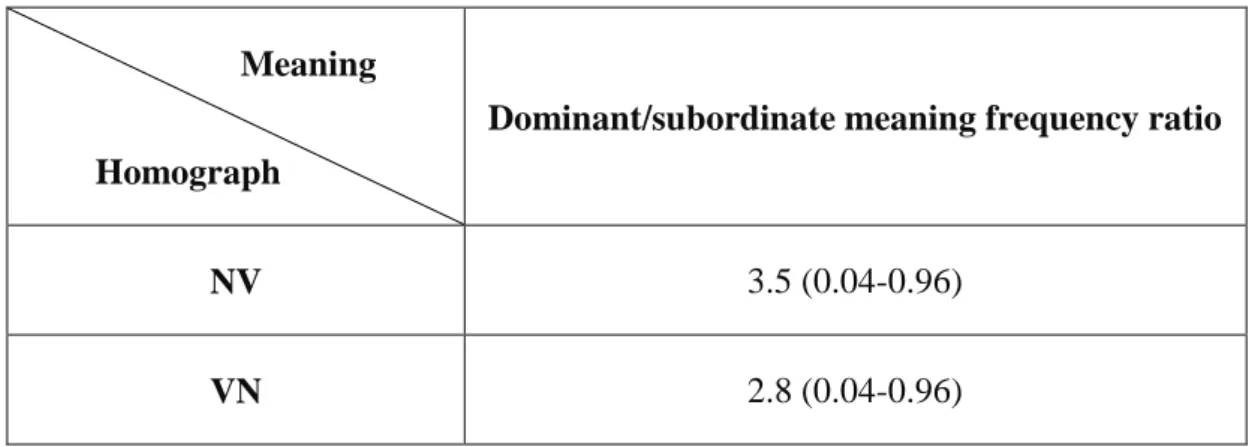
Based on these norming results, 32 NV-homographs and 32 VN-homographs were selected as critical words. Averaged values and ranges of the usage proportion (frequency of the meaning divided by 100) are listed below for the dominant and subordinate meanings for both NV- and VN-homographs respectively (see Table 3.3). Overall, the dominant interpretations of homographs were 3.2 more frequent than the subordinate ones in this study.
Table 3.3. Dominant/subordinate meaning frequency ratio for NV- & VN- homographs (with ranges specified in the parenthesis)
Meaning
Homograph
Dominant/subordinate meaning frequency ratio
NV 3.5 (0.04-0.96)
VN 2.8 (0.04-0.96)
3.2.3.2 Norming Study 2: Meaning Relatedness
Likewise, meaning relatedness of ambiguous words were rated in Chen (2014). Here we illustrate how this norming was done. The norming was not conducted in the present norming study.
The relatedness rating done in Chen (2014) followed the protocol used in Rodd et al.
(2002), and aimed to ensure that the selected ambiguous words were homographs with