行政院國家科學委員會專題研究計畫 期中進度報告
學生在 TIMSS 不同數學題型上的成就及其與性別、數學學習
情意、學習情境的交互作用(1/2)
計畫類別: 個別型計畫 計畫編號: NSC94-2522-S-004-001- 執行期間: 94 年 08 月 01 日至 95 年 07 月 31 日 執行單位: 國立政治大學教育學系 計畫主持人: 邱美秀 報告類型: 精簡報告 報告附件: 出席國際會議研究心得報告及發表論文 處理方式: 本計畫可公開查詢中 華 民 國 95 年 5 月 29 日
行政院國家科學委員會補助專題研究計畫期中精簡報告 計畫名稱:學生在TIMSS不同數學題型上的成就及其與性別、數學學習情意、 學習情境的交互作用(1/2) 計畫類別:個別型計畫 計畫編號:NSC 94-2522-S-004 -001 執行期間: 94 年 8 月 1 日至 95 年 7 月 31 日 計畫主持人:邱美秀 執行單位:國立政治大學教育學系 中華民國 95 年 5 月 10 日 此精簡報告主要包含三篇已發表或已被接受之論文:
Chiu, M. (2005). Predictors of Mathematical Achievement and Deep Approaches: A Comparison Between TIMSS Results of Taiwan, Japan, and England. Paper presented at the Japan-Taiwan Bilateral Symposium, The First International Conference on Asia Comparative Education, National Taiwan Normal University, Taiwan, 8th-12th November 2005. (Supported by NSC 94-2522-S-004 –001)
Chiu, M. (2006, accepted). Routine and novel mathematical solutions: central-cognitive or peripheral-affective participation in mathematics learning. Proc. 30th Conf. of the Int. Group for the Psychology of Mathematics Education. Prague, Czech Republic: PME. (Supported by NSC 94-2522-S-004 –001)
Chiu, M. (2006, accepted). A situated self-regulated learning system: Evidence from Taiwanese children’s constructs of mathematical problems. Paper presented at the 2nd International Biennial Conference of the Metacognition Special Interest Group (SIG 16) of the European Association of Research in Learning and Instruction (EARLI), The University of Cambridge Faculty of Education, UK, 19 – 21 July 2006. (Supported by NSC 94-2522-S-004 –001)
後二篇將於今年 7 月發表於國外的學術研討會,故「出席國際學術會議心得 報告」將於參加研討會後繳交。
Chiu, M. (2005). Predictors of Mathematical Achievement and Deep Approaches: A Comparison
Between TIMSS Results of Taiwan, Japan, and England. Paper presented at the Japan-Taiwan Bilateral
Symposium, The First International Conference on Asia Comparative Education, National Taiwan Normal University, Taiwan, 8th-12th November 2005.
Predictors of Mathematical Achievement and Deep Approaches:
A Comparison Between TIMSS Results of Taiwan, Japan, and England
Mei-Shiu Chiu*
National Chengchi University, Taiwan
Using 13-year-old students’ background and mathematics achievement data from the Trends in Mathematics and Science Study (TIMSS, 2003), the study aimed to identify significant predictors of mathematics achievement and deep approaches to mathematics; comparisons were also made between Taiwan, Japan and England. One-way ANOVAs were conducted to compare the students of the three cultures over the achievement indicators and 16 background variables. Stepwise regressions were performed to identify best variables predictive of mathematics achievements and deep approaches. There were different pictures of learning and teaching practices between the three cultures. Predictors of mathematics achievement were found to be quite different from those of deep approaches to mathematics.
Achievement has long been the focus for many educational studies; however, deep approaches, including intrinsic motivations and willingness to take or do more mathematics, are another important indicator of learning outcomes or teaching quality (Kember, Charlesworth, Davies, McKay, & Stott, 1997). The present study focused on educational issues that would be likely to contribute the two major outcomes of teaching and learning.
Byrnes (2003) proposed a 3C Model of Skill Acquisition and argued that students’ achievement was determined by the following three conditions: (1) the exposure condition, where genuine opportunities were provided to promote their skills/achievements; (2) the motivational condition, where students were willing to
* This research was supported by National Science Council, Taiwan (NSC 94-2522-S-004 –001).
Statements do not reflect the position or policy of the agency. Correspondence concerning this article should be addressed to Mei-Shiu Chiu, Department of Education, National Chengchi University, Taiwan. 64, Sec. 2, Zhi-nan Rd., Taipei 11605, Taiwan. E-mail: [email protected]
make use of these opportunities; (3) the skill level condition, where students were able to make use of these opportunities. In other words, teachable, manageable or changeable variables would be worth finding in order to improve educational practices and promote students’ learning outcomes. In the present study, these variables included variables related to affective contexts and teaching contexts. The only demographic variable explored in the present study was gender, as gender differences on mathematics achievements have long been the study focus of research on mathematics education.
Affective contexts and achievement
Research, in general, reveals that there is a significant relationship between self-efficacy and attainment. Past attainment was the best predictor of present attainment (McCaffery et al., 2001). Apart from cognitive variables, self-efficacy or confidence tended to be the best affective predictor of attainment (Pietsch, Walker, & Chapman, 2003). High achievers tended to have a high confidence and low achievers low confidence (Meyer & Koehler, 1990; Meece, Wigfield, & Eccles, 1990; Seegers & Boekaerts, 1996, 1993). Confidence even appeared to be a better predictor of students’ participation in mathematics than mathematics attainment (Meyer & Koehler, 1990). Zimmerman (1995) summarized several studies and claims that self-efficacy was a critical factor in predicting mathematics attainment and mathematics anxiety, while anxiety made no direct impact on attainment. Efficacy explained 13% of the variance in attainment even when mathematics ability was controlled.
Learning approaches were viewed as a significant predictor of achievement, as
revealed by Diseth & Martinsen (2003) and Saljo (1981), in which the participants were students at the stage of higher education, studying diverse subjects. Deep approaches normally positively relate to achievement, such as Saljo (1981) and Zeegers (2001). There are, however, some exceptions; for instance, Diseth & Martinsen’s study showed that the deep approach was not a predictor of achievement. They attributed the missing relationship between the deep approach and achievement to the ‘fixed curriculum’ and ‘examination procedure’. Another example is reported in Newble and Hejka (1991), in which the deep approach was not a significant predictor of attainment, for students from either traditional or problem-based medical schools. Newble and Hejka attributed this result to ‘examination systems which drive the students toward a surface or strategic approach’ (p. 339).
Relatively, fewer studies were focused on the role of students’ perceptions of value of mathematics in achievements. Usefulness/value of mathematics is the best predictor of participation in mathematics (Meyer & Koehler, 1990). In Whitebread &
Chiu’s (2004) and Chiu’s (2004) study, children with a rebellion or negative ambivalence toward mathematics tended to view mathematics in an instrumental way, not perceiving teachers as worth following, with little self-efficacy, not obeying existing rules to solve problems, not investing much time in learning mathematics, and not perceiving mathematics as interesting.
Research has revealed that positive possible selves (e.g. educational aspirations) would increase the possibility of development of plans, strategies and positive emotions; this in turn would trigger active actions and create positive achievement (Markus & Cross, 1994).
Teaching contexts and achievement
Askew, Brown, Rhodes, Johnson, & Wiliam (1997) identify three orientations of teaching: connectionist, transmission and discovery for English teachers. In terms of ‘numeracy subject knowledge’ (Askew et al., p. 49), connectionist teachers tend to introduce and elaborate links between different mathematical concepts; transmission teachers generates superficial and few links; discovery teachers work on problems as deep as the connectionist teachers but have difficulty elaborating the links. In addition, there is a moderately positive relationship between children’s attainment and teachers’ working on mathematical problems in depth, by using links ‘explained in conceptual terms rather than being only procedural (rule-based)’ (p. 52) without apparent rationales. Strongly transmission oriented teachers have lower depth than strongly connectionist and discovery teachers. The connectionist orientation was found to foster greater pupil achievement than discovery and transmission orientations. The characteristics of ‘connectionist’ teachers described by Askew et al. is also consistent with those of an ideal teacher suggested by Manouchehri & Goodman’s (2000) study.
McCaffery et al. (2001) compared two kinds of teaching practice in high schools in the US. Students’ achievement scores were obtained for open-ended and multiple-choice problems respectively. The teaching materials based on new curriculum reform in the US are called ‘integrated mathematics’, while there are still some schools who use ‘traditional sequence’ mathematics textbooks. There are two significant results of the two different teaching methods. Firstly, for the students receiving integrated mathematics, the more their teachers tended to be integrated-mathematics oriented, the higher achievement the students obtained for both the open-ended and multiple-choice problems. Secondly, for students receiving traditional mathematics, there was no relationship between the teaching method and students’ achievement for either kind of problem. The results imply that, according to
McCaffery et al. (2001), teachers have to put the principles of the curriculum reform into practice, in order to effectively implement the reform.
A common conclusion which Askew et al. (1997) and McCaffery et al. (2001) made was that strongly connectionist or integrated-oriented teaching tends to have positive impact on students’ attainment.
Gender and achievement
According to Fennema (1990), the equality of gender in mathematics should include ‘equal opportunity to learn mathematics’, ‘equal educational treatment’ and ‘equal educational outcomes’. However, males enrolled on the advanced mathematics courses more than females in the UK, Australia (Leder, 1990) and Germany (Koller, Baumert, & Schnabel, 2001). In terms of cognitive outcomes, by the end of secondary education, males tended to learn more mathematics than females (Fennema, 1990). Some studies have shown that the difference between attainments of males and females were minimal and only in the top bands of 10% to 20% (Leder, 1990). In 1992, the pilot of national curriculum tests for UK 14-year-olds showed that girls had higher attainment than boys, though gender differences still remained in the band of high achievers, in which there was a ratio of two girls to three boys obtaining grade ‘A’ at the age of 16 in the GCSE (Askew & Wiliam, 1995).
In order to delve into the deep meaning of what TIMSS data could possibly reveal, the present study would draw on raw data of TIMSS 2003 to conduct diverse kinds of statistical analyses, as have widely used in research of educational psychology. As a result, the study results should be interpreted under the condition of samples used in these analyses. Detailed procedures would be described about how the raw data were processed and analyzed.
Method
Participants
The participants were 1089 13-year-old students in Taiwan, Japan and England, who filled in the student questionnaires and took the Booklet 3 mathematics tests in the TIMSS 2003. They were 445 Taiwanese students (222 girls, 223 boys), 403 Japanese students (206 girls, 197 boys), and 241 English students (119 girls, 122 boys).
Taiwanese samples were chosen, as the study of the sample would provide implications for improvement on teaching and learning contexts for children of the
researcher’s major concerns. The implications could be further enriched by comparison with Japan, which shares some common eastern cultures with Taiwan, and has prestige of high-quality achievements. English samples were selected, since it was one of the western cultures which play significant roles in the world, and shared a common character with Taiwan and Japan: Their country land is composed of islands, which are near continents. This common geographical characteristic offers a ground for comparison, as some common characteristics might be shared by the people of these three cultures, such as outward looking because of their land limitation and ocean accessibility. The researcher has ever stayed in England for doctoral study during 2000-2004 and did field work there, which would facilitate the explanation of study results, especially where cultural comparisons were made.
Measures
There were two measures used in the present study: student self-report questionnaire and student mathematics achievement test of Booklet 3, in TIMSS 2003.
Student questionnaire. The TIMSS student background questionnaire contained a wide range of items which aimed to collect information about students’ diverse learning contexts. There were two kinds of items in the questionnaire: demographic/factual items, and Likert-scale items. With the aim of the present study and according to literature and study focus, potential predictors of mathematics achievements were selected from the factors identified by factor analysis for the Liker-scale items, or derived from the demographic/factual items.
The factor analysis drew on the data from Taiwanese students who filled in the Student Questionnaire, TIMSS 2003. The participants included 4661 Grade 4 students and 5379 Grade 8 students. In order to facilitate comparisons between Grades 4 and 8 students for future research, only common items in the two questionnaires were selected for analysis. Factor analyses were performed to identify factors for Likert-scale items grouped together in the two questionnaires respectively. Factors identified based on the Grade 4 data were compared with those based on the Grade 8 data. A factor would be confirmed in the present study for later analysis, only if it met the following two criteria. First, two sets of questionnaire data both revealed same factors with same items. Second, factors were identified by one set of the data only, but the literature on mathematics education showed that the factors had been significant predictors of mathematics achievement.
The final 16 background variables selected were organized into 6 groups, as can be seen in Appendix A, with information of scoring methods, and internal reliability
coefficients for the factors. Although the variable of constructivist teaching revealed low reliability, factor analysis on the items of mathematics teaching approaches for the 13,065 three-culture samples showed a clear three-factor structure, i.e. the Variables 5-7. In addition, the constructs of constructivist and transmission teaching are well documented in literature of mathematics education. Therefore, the variable of constructivist teaching was kept for the further analyses. The mean score of responses to items in a factor was obtained to work as the value of a factor in analysis.
Student achievement test. Students’ responses to the mathematics test items of Blocks 3, 4 and 13 on Booklet 3 in TIMSS 2003 were used as the indicators of the students’ mathematics achievement. There were 43 mathematics items in total, which included 28 multiple-choice items and 14 constructed-responses items, over the five mathematics content domains: algebra (11 items), data (3 items), geometry (6 items), measurement (8 items), and number (15 items). Any completely correct answer to an item was awarded one point; no point was awarded for other responses, including partially correct, incorrect, invalid and omitted ones. Mean scores of the 43 items were calculated and served as the indicators of mathematics achievement.
Items of Blocks 3, 4 and 13 on Booklet 3 were chosen as the achievement measures because they together made up the most quantity of released mathematics items, which could be obtained from a single booklet. In addition, none of these items was placed at the last sections of the test books, where some students might omit to solve the items because of their low speed in problem-solving, rather than their ability.
Data analysis
One-way ANOVA was conducted to compare the Taiwanese, Japanese and English students over the achievement indicators and 16 background variables. LSD post hoc multiple comparisons were made where there were significant ANOVA test results. Stepwise regressions were performed to identify best variables predictive of mathematics achievements and deep approaches for the Taiwanese, Japanese and English students respectively. Comparisons were also made for the results of regression analyses.
Results
Cultural differences on variables
Table 1 lists the means, standard deviations, and ANOVAs test results over the variables for the three cultures. As can be seen, there were cultural differences
between the three cultures, except for gender and deep approaches. Similar numbers of boys and girls attended the tests for the three cultures respectively. Students of the three cultures showed similar and relative high interest in learning mathematics and taking more mathematics in school.
There were significant differences between the three cultures on the mathematics achievements, in descending order: Taiwan, Japan and England. The result was consistent with that reported in TIMSS 2003 International Mathematics Report (Page 34, Chinese Taipei: 585; Japan: 570; England: 498). This result also implied that the achievement measure used in the present study provided reasonable indicators of students’ achievements.
Table 1
Means, standard deviations, and one-way ANOVAs test results comparison between three countries on variables
Taiwan Japan England LSD post hoc
Variables M SD M SD M SD F results
Math Achievement .66 .24 .62 .20 .52 0.2 34.29** T>E ,T>J, J>E
Learning affects
1. Self-efficacy in math 2.46 .74 2.25 .64 2.97 .64 78.2** T>J, E>T, E>J 2. Deep approach to math 2.25 .86 2.32 .75 2.24 .77 1.13
3. Value of math 2.61 .67 2.51 .57 2.88 .61 24.8** T>J, E>T, E>J 4. Educational aspiration 2.20 .73 1.52 .56 1.88 .85 83.19** T>J, T>E, E>J
Math teaching approach
5. Content-complexity 2.44 .70 2.68 .65 2.41 .57 18.24** J>T, J>E 6. Constructivist teaching 2.02 .69 1.99 .71 2.46 .62 38.85** E>T, E>J 7. Transmission teaching 3.02 .77 3.49 .68 3.16 .68 44.77** J>T, J>E, E>T
Teaching strategy
8. Math homework 1.85 .69 1.48 .60 1.55 .66 36.69** T>J, T>E 9.Extra math lessons or tutoring 2.31 1.1 1.73 .89 1.27 .55 97.97** T>J, T>E, J>E 10.Computer-use for learning 2.07 .84 1.5 .61 2.59 .87 144.76** T>J, E>T, E>J
School quality
11.Favorable school 3.01 .54 2.91 .57 2.9 .57 4.74** T>J, T>E 12.Safe school 4.86 1.36 5.35 1.04 5.06 1.12 17.51** J>T, J>E, E>T
Learning resources
13.Computer availability 4.78 .67 4.22 .98 4.78 .60 62.25** T>J, E>J 14.Books at home 2.92 1.25 3.05 1.22 3.21 1.29 4.05* E>T 15.Test language use home 3.23 .78 3.94 .31 3.85 .49 176.88** J>T, J>E, E>T
Others
16.Gender .50 .50 .49 .50 .51 .50 .11 * Significant at the .05 level,
** Significant at the .01 level
In the aspect of learning affects, English students had more confidence about their mathematics ability and more regarded mathematics as a valuable pursuit for their present and future lives than Taiwanese and Japanese students respectively; Taiwanese students were higher on these two variables than Japanese students. On the other hand, Taiwanese students showed higher educational aspiration than English and Japanese students. To summarize the three results, English students appeared to have the most positive learning affects among the three, Taiwanese students the second, and Japanese students the third. This result showed an interesting contrast to that of achievement comparison. It implied that what students perceived and what they really
gained were very likely to be different. A striking finding was that English students had high confidence in their mathematics ability (Mean= 2.97, above average=2.5), while Japanese and Taiwanese students have below average confidence, despite their high achievement on the international comparison tests.
In mathematics teaching approaches, Japanese teachers were perceived by their students as offering a wide variety of teaching contents in a single lesson, than their counterparts. English teachers were viewed by their students as offering more opportunities for them to work together in small groups and explain their answers. According to their students’ viewpoints, Japanese teachers were the most transmission-oriented, English teachers the next, and Taiwanese teachers the least. The result revealed that teachers of the respective three cultures took quite different approaches to mathematics teaching.
In the aspects of mathematics teaching strategies, Taiwanese students had more amount of mathematics homework to do than Japanese or English students. Taiwanese students also received the most extra mathematics lessons or tutoring from their teachers, Japanese students the next, and English students the least. In other words, Taiwanese students spent the most significant amount of time doing mathematics besides scheduled mathematics lessons. English students had the most amount of experience using computers to write reports and looking up ideas and information for learning, Taiwanese students the next, and Japanese students the least.
Taiwanese students liked to go to school, viewing their peers as hard workers and having a high regard for their teachers’ attentiveness and encouragement, more than Japanese and English students. However, Taiwanese students experienced the most number of unsafe events in school; Japanese schools were the safest, and English schools the next. The unsafe events mainly included stealing, bullying and ignoring by students.
In the aspect of learning resources, computers were more available for Taiwanese and English students than for Japanese students. A note to make was that, despite this difference, most students in the three cultures had computers at home and school (mean scores of the three cultures all above 4). English students had more books at home than Taiwanese students. Although most students in the three cultures spoke their respective test-use languages (Mandarin (Chinese), Japanese and English) (all high above average, 2.5), there were significant differences between the three cultures. The ratio of Japanese students who spoke Japanese at home was higher than that of their English and Taiwanese counterparts who spoke their official languages respectively. The ratio of English students who spoke English at home was higher than that of Taiwanese students who spoke Mandarin at home.
Regression analyses
Two dependent variables were used in the stepwise regression analyses; they were mathematics achievement and deep approaches to mathematics. For each dependent variable, the other 16 variables served as independent variables, as can be seen in Table 2. The results of analyses showed that, or Taiwanese students, the five predictors of mathematics achievement were, in descending order: educational aspiration, self-efficacy, transmission teaching, content-complexity teaching, and test language use at home. These predictors together predicted 53% of the variance of Taiwanese students’ achievement, as revealed by the R2 value in Table 2. Japanese students, the five predictors were educational aspiration, self-efficacy, transmission teaching, books at home and ‘constructivist teaching’ (at a reverse direction), which predicted 30% of the variance of Japanese students’ achievement. For English students, the four predictors were self-efficacy, educational aspiration, transmission teaching, test language use at home, and computer availability. These four variables together predicted 25% of the variance of English students’ achievement. The three regression models were all significant, as revealed by the F values in Table 2.
Table 2
Predictors of mathematics achievement and deep approaches to mathematics for Taiwan, Japan and England respectively
Dependent variables Math achievement Deep approaches to mathematics Taiwan Japan England Taiwan Japan England Independent Variables Beta(rank) Beta(rank) Beta(rank) Beta(rank) Beta(rank) Beta(rank)
Math Achievement
Learning affects
1. Self-efficacy in math .30**(2) .279**(2) .27**(1) .29**(2) .18**(2) .17*(3) 2. Deep approach to math
3. Value of math .41**(1) .32**(1) .33**(1)
4. Educational aspiration .32**(1) .280**(1) .25**(2)
Math teaching approach
5. Content-complexity .16**(4)
6. Constructivist teaching -.14**(5)
7. Transmission teaching .18**(3) .23**(3) .13**(3) .12*(5) .
Teaching strategy
8.Math homework
9.Extra math lessons or tutoring
10.Computer-use for learning .13*(4) .31**(2)
School quality 11.Favorable school .11**(4) .16**(3) 12.Safe school Learning resources 13.Computer availability .165*(4) 14.Books at home .17**(4) .166*(3) .
15.Test language use home .15**(5)
Others 16.Gender R .73 .56 .53 .69 .54 .62 R2 .53 .31 .28 .47 .29 .38 Adjusted R2 .53 .30 .25 .47 .28 .37 F 82.96** 26.27** 12.61** 82.15** 23.61** 27.11**
** Significant at the .01 level,
To summarize, educational aspiration and self-efficacy were best predictors of achievement for all the three cultures. Taiwanese and Japanese students’ achievement were more related to teachers’ teaching approaches; English students’ achievements were more related to learning resources, though Japanese students’ achievement also related to books at home and Taiwanese students’ achievement related to test-languages use.
Deep approaches failed to be a significant predictor of achievement; achievement also failed to predict deep approaches for the three cultures, as revealed in the right half of Table 2. The four significant predictors of Taiwanese students’ deep approaches to mathematics were, in descending order: value of mathematics, self-efficacy, transmission teaching and favorable schools. These four predictors together predicted 47% of the variance of Taiwanese students’ deep approaches to mathematics. The five predictors of Japanese students’ deep approaches were value of mathematics, self-efficacy, favorable schools, computer use for learning, and transmission teaching, which predicted 28% of the dependent variables’ variance. There were only three significant predictors of English students’ deep approaches; they were value of mathematics, computer use for learning, and self-efficacy.
The three cultures had two common predictors of students’ deep approaches; they were value of mathematics and self-efficacy in mathematics. Taiwanese and Japanese students’ interest and positive action towards mathematics were predicted by how much they liked their school and whether their teachers’ teachings were transmission-oriented. Japanese and English students’ deep approaches were influenced by the frequency of computer-use for learning purposes. No variables of learning resources served as significant predictors of student deep approaches.
A final note to make is that gender was neither a significant predictor of students’ mathematics achievement nor that of their learning approaches to mathematics for the students in the three cultures respectively.
Discussion
Based on the results of comparison between the cultures on several issues in relation to mathematics learning and teaching, a theme or picture of mathematics teaching and learning was likely to be delineated for each culture.
Taiwan. Most students might have desirable mathematics achievements in ‘international’ terms, but, in ‘personal’ terms, students failed to have corresponding confidence in their mathematics ability. They had high ambition in pursuit of higher
education; this motivation could promote their achievement. Perceptions of value of mathematics could increase their interest and action to learn more mathematics. Students worked on mathematics relatively quite often; they were given mathematics homework or extra lessons besides scheduled mathematics periods. Teachers used diverse approaches to mathematics teaching. Students’ achievement relied on teachers’ direct teaching and in-depth interpretation of connected mathematics concepts. Teaches’ direct teaching could promote their interest in learning more mathematics. Students liked their schools and teachers, which increase their interest in learning mathematics; on the other hand, peer quality might be a small trouble for their school life, such as bullying and stealing. Most students had computers at home and school, though computer-use could not increase their interest in mathematics. There were not many books at home for most families. Though most students spoke official language at home, there were a significant number of students speaking some other local languages; this was likely to be a disadvantage for them in taking tests, or this might relate to their social or economical background and, in turn, influence their achievement.
Japan. Students had high achievement but low confidence in their mathematics ability, though confidence was a significant factor in predicting their achievement and interest in studying mathematics. Their aspiration to higher education could increase their achievement, while their perceptions of value of mathematics could really promote their interest and action to do more mathematics. Teachers were good at giving content-rich mathematical knowledge in a specific period of teaching. Most teachers were transmission-oriented, which could increase students’ achievement and interest in doing more mathematics. Though there were few teachers focusing on a constructivist teaching approach, this approach had a negative influence on students’ achievement. Japanese schools were safe places, where there were very few events of bullying and stealing. Computer-use for learning was well-managed by teachers and therefore could enhance students’ interest in taking more mathematics. If students like their schools and teachers, they were also likely to have more interests and action to do more mathematics.
England. Students had relatively high regard for their ability in mathematics, despite the results of international comparison tests. Like Japan and Taiwan, students’ confidence and aspiration to higher education can predict their achievement. Transmission was a normal teaching practice in English mathematics classroom, but constructivist approaches were also often taken by teachers. English school was quite safe. However, teaching and schooling failed to influence students’ achievement and deep approaches to learning mathematics, except the experiences of computer-use for learning, which could increase students’ interest and action to do more mathematics.
Most students had many books at home, and computers at home and school; these two factors could predict students’ achievement. This implies that English students’ achievement and learning approaches are more likely to be influenced by other factors outside of school, such as social and economic status, while Taiwanese and Japanese teachers and schooling did have more influence on their students’ learning mathematics.
Neither culture had significant gender difference in mathematics achievement.
Implication for educational practice: What we can learn from other cultures?
Every culture offers an important mirror for others to more clearly look at themselves, and a lesson to learn from.
Japan provided their students very safe schools, very few events of bullying and stealing; English schools were safer than Taiwanese ones as well. Japanese teachers were good at giving students multiple, diverse and connected mathematical knowledge in a given period for students. This teaching has been identified by Askew et al. (1997) as a ‘connectionist orientation’, which was the most effective teaching approaches to prompting students’ mathematics achievement. ‘Content-complexity’ teaching approach could predict Taiwanese students’ achievement, but not in Japan. Further research is needed to explore this issue. In Japan and England, computer-use for learning had positive influence on students’ achievement, but this could be not found in Taiwan. It implies that computer-assisted learning for mathematics was better managed in Japan and England than in Taiwan. Taiwanese families had fewer books at home than English families. Further international joint studies are needed for clarifying these issues in order to learn from other cultures.
English students had high confidence in their mathematics ability. Research has indicated that confidence or self-efficacy has been a significant predictor of participation in mathematics (Meyer & Koehler, 1990) and mathematics achievement (Zimmerman, 1995). Although Taiwanese students had a good result on the test, the low confidence might inhibit their will in pursuit of learning opportunities or occupations related to mathematics. Future research is needed to identify significant factors in developing students’ confidence in mathematics and to develop appropriate teaching approaches which promote confidence and achievement at the same time.
Taiwanese teachers gave students a significant amount of homework and extra lessons and teaching for mathematics. These teaching strategies, however, failed to have positive influence on students’ achievement, not only for the samples of Taiwan but also for those of Japan and England respectively. Therefore, further research is needed to assess the necessary amount of homework and teaching time.
Implications for theories
Learning approaches are viewed as a significant predictor of achievement, as revealed by Diseth & Martinsen (2003), Saljo (1981), and Zeegers (2001). There are, however, some exceptions; for instance, Diseth & Martinsen’s study (2003) showed that deep approaches were not a predictor of achievement.
In the present study, achievement could not predict deep approaches; deep approaches failed to predict achievement. The predictors of them were also quite different, except for self-efficacy. Transmission teaching was found a significant predictor of achievement and deep approaches only in Taiwan and Japan. For achievement, apart from self-efficacy, educational aspiration was the best predictor; for deep approaches, value of mathematics was the best predictor. In addition, achievement appears to be more likely to be influenced by learning resources than by schooling and teaching strategies. Deep approaches were predicted more by computer-use for learning and favorable schooling, than by learning resources. High quality of schooling seems to be a necessity for students’ deep approaches to mathematics.
Further research is needed to explore whether there were separate paths toward mathematics achievement and deep approaches to mathematics, as some research has indicated that deep approaches can be related to achievement. In addition, it is also necessary to identify which learning context and affective variables are needed to promote them respectively and explore the relationships between these variables.
References
Askew, M., & Wiliam, D. (1995). Recent research in mathematics education 5-16. London: Stationery Office.
Askew, M., Brown, M., Rhodes, V., Johnson, D., & Wiliam, D. (1997). Effective teachers of numeracy: Final report (Feb 1997). London: King’s College, School of Education.
Byrnes, J. P. (2003). Factors predictive of mathematics achievement in White, Black, and Hispanic 12th Graders. Journal of Educational Psychology, 95(2), 316-326. Chiu, M. (2004). Children’s emotional responses to mathematical problem-solving:
The role of teaching methods and problem types. Unpublished PhD dissertation, University of Cambridge.
Diseth, A., & Martinsen, O. (2003). Approaches to learning, cognitive styles and motives as predictors of academic achievement. Educational Psychology, 23(2),
195-207.
Fennema, E. (1990). Justice, equity and mathematics education. In E. Fennema & G. C. Leder (Eds.), Mathematics and gender (pp. 1-9). New York: Columbia University, Teachers College.
Kember, D., Charlesworth, M., Davies, H., McKay, J., & Stott, V. (1997). Evaluating the effectiveness of educational innovations: Using the study process questionnaire to show that meaningful learning occurs. Studies in Educational Evaluation, 23(2), 141-157.
Koller, O., Baumert, J., & Schnabel, K. (2001). Does interest matter? The relationship between academic interest and achievement in mathematics. Journal for Research in Mathematics Education, 32(5), 448-470.
Leder, G. C. (1990). Gender differences in mathematics: An overview. In E. Fennema & G. C. Leder (Eds.), Mathematics and gender (pp. 10-26). New York: Columbia University, Teachers College.
Manouchehri, A., & Goodman, T. (2000). Implementing mathematics reform: The challenge within. Educational Studies in Mathematics, 42, 1-34.
Markus, H. R. & Cross, S. E. (1994). Self-schemas, possible selves, and competent performance. Journal of Educational Psychology, 86, 423-438.
McCaffery, D. F., Hamilton, L. S., Stecher, B. M., Klein, S. P., Bugliari, D., & Robyn, A. (2001). Interactions among instructional practices, curriculum and student achievement: The case of standards-based high school mathematics. Journal for Research in Mathematics Education, 32(5), 493-517.
Meece, J. L. Wigfield, A., & Eccles, J. S. (1990). Predictors of math anxiety and its influence on young adolescents’ course enrollment intentions and performance in mathematics. Journal of Educational Psychology, 82(1), 60-70.
Meyer, M. R., & Koehler, M. S. (1990). Internal influences on gender differences in mathematics. In E. Fennema & G. C. Leder (Eds.), Mathematics and gender (pp. 60-95). New York: Columbia University, Teachers College.
Newble, D. I., & Hejka, E. J. (1991). Approaches to learning of medical students and practising physicians: Some empirical evidence and its implications for medical education. Educational Psychology, 11(3 and 4), 333-342.
Pietsch, J., Walker, R., & Chapman, E. (2003). The relationship among self-concept, self-efficacy and performance in mathematics during secondary school. Journal of Educational Psychology, 95(3), 589-603.
Saljo, R. (1981). Learning approach and outcome: Some empirical observations. Instructional Science, 10, 47-65.
Seegers, G., & Boekaerts, M. (1993). Task motivation and mathematics achievement in actual task situations. Learning and Instruction, 3,
133-150.
Seegers, G., & Boekaerts, M. (1996). Gender-related differences in self-referenced cognitions in relation to mathematics. Journal of Research in Mathematics Education, 27(2), 215-240.
Whitebread, D. & Chiu, M. (2004). Patterns of children’s emotional responses to mathematical problem-solving. In O. McNamara & R. Barwell (Eds.), Research in Mathematics Education Volume 6: Papers of the British Society for Research into Learning Mathematics (pp.129-153). London: BSRLM.
Zeegers, P. (2001). Approaches to learning in science: A longitudinal study. British Journal of Educational Psychology, 71, 115-132.
Zimmerman, B. J. (1995). Self-efficacy and educational development. In A. Bandura (Ed.), Self-Efficacy in changing societies (pp. 202-231). Cambridge: Cambridge University Press.
Appendix A Student background variables
1.Self-efficacy in mathematics (1= agree a lot to 4= disagree a lot) (reversed coding, r) (α(Taiwan) = .59; α(Japan) = .54; α(England) = .55)
I usually do well in mathematics.
Mathematics is more difficult for me than for many of my classmates. (reverse meaning to the construct, so he original coding was remained)
2.Deep approaches to mathematics (1= agree a lot to 4= disagree a lot) (r) (α(T) = .78; α(J) = .74; α(E) = .69) I would like to take more mathematics in school.
I enjoy learning mathematics.
3. Value of mathematics (1= agree a lot to 4= disagree a lot) (r) (α(T) = .81; α(J) = .71; α(E) = .76) I think learning mathematics will help me in my daily life.
I need mathematics to learn other school subjects.
I need to do well in mathematics to get into the <university> of my choice. I would like a job that involved using mathematics.
I need to do well in mathematics to get the job I want.
4. Educational aspiration (1=below first degree, 2=first degree, 3=beyond first degree) How far in school do you expect to go?
Taiwan Japan England 1 = Senior high school, vocational
school
2 = Vocational high school 3 = College/junior college of technology
4 = Bachelor`s degree 5 = Master's or PhD 6 = I do not know
1 = Upper secondary school 2 = Junior college (2 years) 3 = Option not administered or data not available
4 = University 5 = Graduate school 6 = I do not know
1 = GSCE Level / A Level 2 = Access course for higher education
3 = HNC or HND 4 = Bachelor`s degree 5 = Master`s degree or higher 6 = I do not know
5. Content-complexity (1=every or almost every lesson to 4=never) (r) (α(T) =.75 ; α(J) = .74; α(E) = .66) We work on fractions and decimals
We interpret data in tables, charts, or graphs
We write equations and functions to represent relationships
6. Constructivist teaching (1=every or almost every lesson to 4=never) (r) (α(T) = .38; α(J) = .37; α(E) =.26 ) We work together in small groups
We explain our answers
7. Transmission teaching (1=every or almost every lesson to 4=never) (r) (α(T) = .60; α(J) = .63; α(E) = .43) We listen to the teacher give a lecture-style presentation
8.Math homework (1=high: at least 3-4 times, at least 31 minutes for each, to 3=Low: at most 1-2 times, at most 30 minutes for each) (r)
How often does your teacher give you homework in mathematics? (1= every day to 5=never)
When your teacher gives you mathematics homework, about how many minutes are you usually given? (1 = fewer than 15 minutes to 5=more than 90 minutes) 9.Extra math lessons or tutoring (1= every or almost every day to 4=never or almost never) (r)
During this school year, how often have you had extra lessons or tutoring in mathematics that is not part of your regular class?
10.Computer-use for learning (1= every or almost every day to 4=never or almost never) (r) (α(T) = .76; α(J) = .71; α(E) = .75)
How often do you do these things with a computer? I look up ideas and information for mathematics I look up ideas and information for science I write reports for school
11. Favorable school (1= agree a lot to 4= disagree a lot) (r) (α(T) = .68; α(J) = .69; α(E) = .73) I like being in school
I think that students in my school try to do their best I think that teachers in my school care about the students I think that teachers in my school want students to do their best
12.Safe school (1= Yes, 2=No, changed to 1=Yes, 0=No, counting the ‘yes’s and doing reversed coding, 6=no these unsafe things, to 1=5 unsafe things)
In school, did any of these things happen during the last month? Something of mine was stolen
I was hit or hurt by other student(s) (e.g., shoving, hitting, kicking) I was made to do things I didn’t want to do by other students I was made fun of or called names
I was left out of activities by other students
13.Computer availability (1=home & school; 2=home, not school; 3=school, not home; 4=use computer, but not school, not home; 5 no computer) (r)
Where do you use a computer? (1=yes, 2=no, for the following respectively) At home; At school; At a library; At a friend’s home; At an Internet café; Elsewhere
14.Books at home (1=None or very few (0-10 books) to 5=Enough to fill three or more bookcases (more than 200 books) (r)
About how many books are there in your home? (Do not count magazines, newspapers, or your school books.) 15.Test language use home (1=always to 4=never) (r)
How often do you speak <language of test> at home?
(Language of test: Taiwan=Mandarin (Chinese); Japan=Japanese; England=English) 16.Gender (0=girl, 1=boy)
Chiu, M. (2006, accepted). Routine and novel mathematical solutions: central-cognitive or peripheral-affective participation in mathematics learning. Proc. 30th Conf. of the Int. Group for the Psychology of Mathematics Education. Prague, Czech Republic: PME.
ROUTINE AND NOVEL MATHEMATICAL SOLUTIONS:
CENTRAL-COGNITIVE OR PERIPHERAL-AFFECTIVE
PARTICIPATION IN MATHEMATICS LEARNING
Mei-Shiu Chiu
∗National Chengchi University, Taiwan
The study aimed to identify influential variables that determined students’
routine and novel responses to a creative mathematical problem in the
TIMSS 2003 study. A special focus was placed on comparisons between
the five Asian outperforming countries and the five English-speaking
Western ones. The Western countries had more novel solutions than their
Asian counterparts. Routine solutions were related to a centrally
cognition-oriented context of mathematics learning; novel solutions came
from a peripherally affect-oriented context. Asian novel solvers
experienced a far more peripheral and negative affective participation in
their mathematical learning communities than Western novel solvers.
INTRODUCTION
There has been a growing concern on affective issues in mathematics
education (McLeod, 1994; Grootenboer, 2003). Most studies on the
affective domain of mathematics education, however, aimed at students’
attitudes toward mathematics as a whole (e.g. Di Martino & Zan, 2003;
Hannula, 2002). There are relatively fewer studies focusing on the
affective issue in relation to mathematical problem-solving, especially to
performance on actual mathematical problem-solving tasks (e.g.
Schoenfeld, 1989; Whitebread & Chiu, 2004; Chiu, 2004). The study
∗This research was supported by National Science Council, Taiwan (NSC 94-2522-S-004–001).
Statements do not reflect the position or policy of the agency. Corresponding author: Mei-Shiu Chiu, Department of Education, National Chengchi University. 64, Sec. 2, Zhi-nan Rd., Taipei 11605, Taiwan. E-mail: [email protected]
reported in this paper was a further endeavor in the study of ‘the
intersection of the cognitive and affective domains’ (Schoenfeld, 1989, p.
338) in mathematics education. Using student responses to TIMSS 2003
for five Asian performing and five English-speaking Western countries,
the present study compared students’ routine and novel solutions to a
creative mathematical problem in relation to their affective issues and
learning contexts. This ‘integrated approach’ will likely to broaden our
understanding of affective issues in mathematics education by taking
account of specific problem type, learning contexts and cultures at the
same time.
LITERATURE REVIEW
Mathematical problem-solving is not only a cognitive issue but also an
affective one. The affective moments in the process of mathematical
problem-solving are ‘feelings’ and ‘psychological states’ (Mason et al.,
1996, p. 130) hard to grasp but worth calmly observing, providing that we
avoid negative thoughts, such as criticism, judgment and embroidery.
With the trend toward constructivist mathematics in the US, McLeod
(1994) indicated that students’ affective responses to solving non-routine
mathematical problems deserve researchers’ attention. This is because, in
order to solve non-routine problems, students need to invest a significant
amount of time and intense feelings are likely to occur. Middleton &
Spanias (1998) also indicate that realistic mathematical problems tend to
‘provide more avenues for failure’ (p. 68). This suggests differential
affective responses to different types of mathematical problems.
Researchers have identified a variety of types of mathematical problems,
such as word and calculation problems (Vermeer et al., 2000), routine and
non-routine problems (e.g. McLeod, 1994), well-structured and
ill-structured problems (Nitko, 1996), and creative/construction problems
(e.g. Schoenfeld, 1989). Relating problem types to affective issues,
Schoenfeld found that students tended to solve proof tasks with
already-known procedures and to solve construction ones with a
trial-and-error approach. Vermeer et al.’s study showed that children
made a higher appraisal of computation problems than application
problems; they also had higher motivation to solve computation than
application problems. Boys tended to have more confidence than girls;
girls tended to attribute their failure to ability and the difficulty of tasks.
Boys had higher achievement than girls for application problems but
there was no difference between boys and girls for computation problems.
Boaler’s (1998) research indicated that boys had more confidence,
enjoyed more in mathematics and had higher achievement for
close-ended problems than girls. However, in the process-based,
mathematics-project teaching, this gender difference had been eliminated.
Whitebread & Chiu’s (2004) study identified four distinct patterns of
students’ affective response in relation to problem types, with
involvement students preferring ill-structured/challenging problems,
rebellion students preferring well-structured problems (with the degree of
difficulty fitting to or slightly higher than their ability), conformity
students preferring easy, diverse problems, and avoidance students
preferring easy well-structured problems. The above literature suggests
that there are complex interactions between students’ diverse
performances on complex mathematical problems and affective issues, in
relation to learning contexts, such as gender, teaching, and learning
resources, as was explored in the present study.
METHOD
Participants
The participants were 4,198 13-year-old students in five Asian
outperforming countries and five English-speaking Western countries
(Table 1 shows the student number of each country); they filled in the
student questionnaires and took the Booklet 3 mathematics tests in the
TIMSS study in 2003. As there were some missing data for the student
variables, these cases were deleted and ended with 3,269 students for the
analysis of influential variables (Table 2).
Indicators
Four kinds of indicators were taken from the TIMSS 2003 study. (1)
Country mathematics achievement. The individual country’s mathematics
achievements were indicated by their average scale scores of each
country, as provided by on Page 34 in the TIMSS 2003 International
Mathematics Report. (2) Student mathematics achievement. One set of
plausible values of student mathematical achievement provided by the
TIMSS database were used as the indicators of individual students’
overall mathematical achievements. These values were good estimates of
parameters of student populations. (3) Student responses to the focused
problem. The focused problem in the present study was ‘Write a fraction
in the TIMSS 2003 study, which had endless correct answers. In addition,
these correct answers can be clearly classified as ‘routine correct
solutions’(3/9, 1/3, 4/10, 2/5), ‘novel correct solutions’ (other correct
solutions), and ‘incorrect solutions’. (4) Student self-report results. There
were 16 other variables selected from the self-report TIMSS student
questionnaire (Table 2). The variables based on the Likert-scale were
derived from factor analysis on the sample of 4,198 students in the
present study.
RESULTS
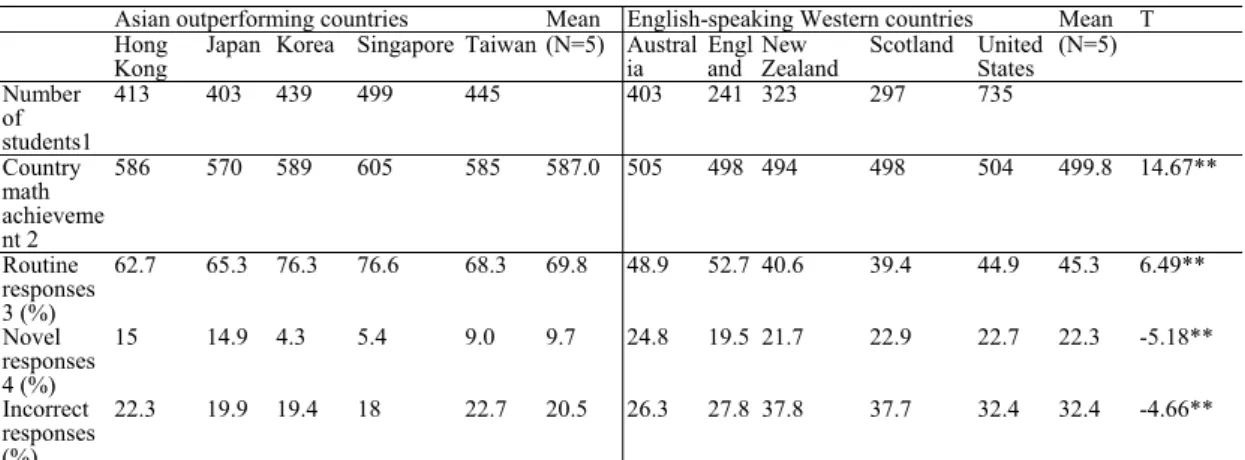
There were significant differences between the Asian and Western
countries in the four kinds of mathematical achievements, as presented in
Table 1. The Asian countries outperformed the Western counterparts in
the aspects of the overall mathematical achievements (t (8)=14.67) and
the percentages of routine responses to the focused problem (t (8)=6.49).
As a reasonable result, the Asian countries had less incorrect responses
than the Western countries (t (8)=-4.66). However, the Asian countries
had fewer novel ‘correct’ responses than the Western ones (t (8)=-5.18).
This result was a contrary to the above trend, as it is sensible to predict
that different samples should have similar distribution patterns of ‘correct
answers’ of many kinds. The result also implied that there are different
meanings of ‘novel responses to mathematical problem-solving’ between
the Asian and Western students.
Table 1: Achievements by countries, and test results
Asian outperforming countries Mean English-speaking Western countries Mean T Hong
Kong Japan Korea Singapore Taiwan (N=5) Australia England New Zealand Scotland United States (N=5) Number of students1 413 403 439 499 445 403 241 323 297 735 Country math achieveme nt 2 586 570 589 605 585 587.0 505 498 494 498 504 499.8 14.67** Routine responses 3 (%) 62.7 65.3 76.3 76.6 68.3 69.8 48.9 52.7 40.6 39.4 44.9 45.3 6.49** Novel responses 4 (%) 15 14.9 4.3 5.4 9.0 9.7 24.8 19.5 21.7 22.9 22.7 22.3 -5.18** Incorrect responses (%) 22.3 19.9 19.4 18 22.7 20.5 26.3 27.8 37.8 37.7 32.4 32.4 -4.66**
1For each country shows the number of students who solved the focused problem in Booklet 3, TIMSS 2003.
2Math achievements are the average scale scores as indicated in Exhibit 1.1, TIMSS 2003 International Mathematics Report, p. 34.
3Routine responses to the focused problem include 3/9, 1/3, 4/10, 2/5.
4Novel responses are the correct solutions to the focused problem, except the above routine responses. ** Significant at the .01 level
Discriminant function analyses were performed, in order to determine the
influential student variables in defining the three kinds of responses. The
analysis was conducted for the three samples of all the students, Asian
students and Western students respectively, given the possibility that
there were differential meanings of novel responses between the Asian
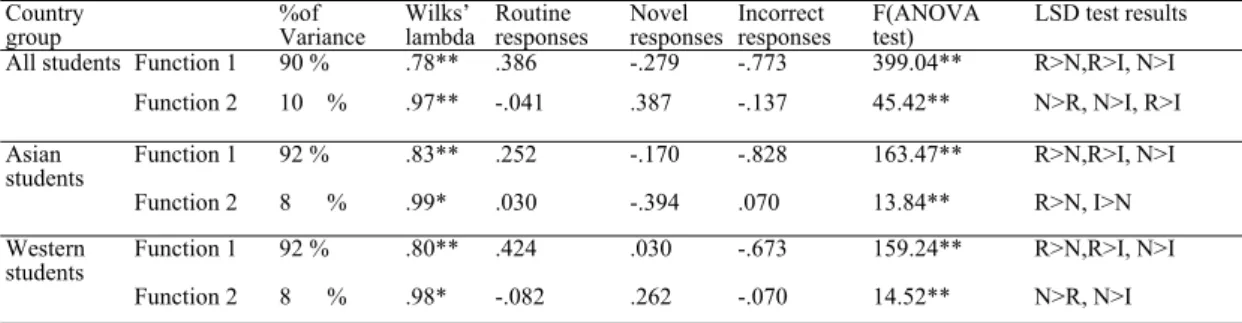
and Western students. As can be seen in Table 2, Function 1s for the three
samples can best distinguish routine responses from incorrect ones.
This implies that Function 1s address issues of achievements. Function 2s,
on the other hand, can distinguish novel responses from the other two
types of responses, addressing issues of novelty.
Table 2. Discriminant analysis: Functions at Group means Country
group %of Variance Wilks’ lambda Routine responses Novel responses Incorrect responses F(ANOVA test) LSD test results All students Function 1 90 % .78** .386 -.279 -.773 399.04** R>N,R>I, N>I
Function 2 10 % .97** -.041 .387 -.137 45.42** N>R, N>I, R>I Asian
students Function 1 92 % .83** .252 -.170 -.828 163.47** R>N,R>I, N>I Function 2 8 % .99* .030 -.394 .070 13.84** R>N, I>N Western
students Function 1 92 % .80** .424 .030 -.673 159.24** R>N,R>I, N>I Function 2 8 % .98* -.082 .262 -.070 14.52** N>R, N>I * Significant at the .05 level
** Significant at the .01 level
Table 3 reveals that, for all the students, the most significant influential
variables that distinguish routine responses from incorrect responses are
mathematics achievements and aspiration to higher education. Novel
solvers were distinguishable by their test-language use at home,
computer-use for learning, computer availability, positive mathematical
affect (self-efficacy and value), and low disposition toward schooling. In
addition, most novel solvers were boys and had fewer extra mathematics
lessons.
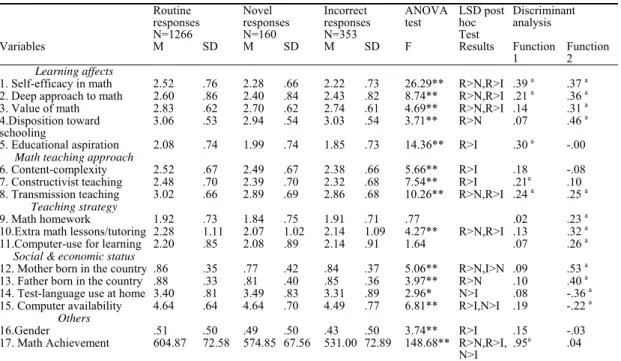
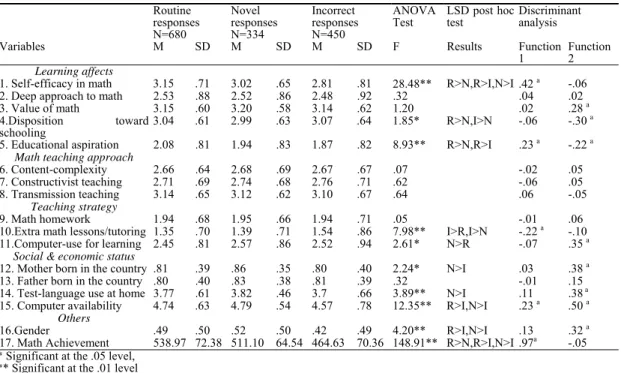
Both Asian and Western routine solvers were distinguishable by their
high mathematical achievements, self-efficacy in mathematics, and
aspiration to higher education (Tables 4-5). The two groups of students,
however, were different in their perceptions of mathematical teaching.
Transmission- and constructivist-oriented teaching approaches were both
positive variables in influencing Asian students’ achievements. Western
high-achievers experienced fewer extra mathematical lessons or tutoring.
Compared with their Asian counterparts, most Asian novel solvers’
parents were from other countries. They has low disposition toward
schooling and negative mathematical affects (including self-efficacy,
deep approaches, and value). Although Asian novel solvers had more
learning resources (such as speaking test-use languages at home and
having computers at home and school), they perceived few opportunities
of computer-use for learning purposes. They also experienced ‘freer’
mathematical teaching approaches or strategies: few extra mathematics
lessons or tutoring, few transmission-oriented teachings, and little
mathematical homework.
Table 3. Affective/contextual variables by all solvers Routine responses N=1935 Novel responses N=486 Incorrect responses N=790 ANOVA
test LSD post hoc test Discriminant analysis Student variables M SD M SD M SD F Results Functi
on1 Function2
Affects
1. Self-efficacy in math 2.74 .80 2.77 .74 2.55 .83 18.52** R>I,N>I .18 .37 a 2. Deep approach to math 2.58 .88 2.48 .86 2.46 .88 6.31** R >N, R >I .12 -.07 3. Value of math 2.94 .63 3.04 .63 2.96 .64 4.76** N> R,N>I -.05 .29 a 4. Disposition to schooling 3.05 .56 2.97 .60 3.06 .60 4.26** R >N .02 -.30 a 5. Aspiration to higher education 2.08 .76 1.95 .80 1.86 .78 24.08** R>N,R>I,N>I .25a .01
Math teaching approaches
6. Content-complexity 2.57 .67 2.62 .69 2.55 .68 1.75 .02 .19 7. Constructivist teaching 2.56 .71 2.62 .70 2.56 .73 1.64 -.02 .18 8. Transmission teaching 3.06 .66 3.04 .65 2.99 .69 3.39* R>I .09 .06
Teaching strategies
9. Math homework 1.93 .71 1.92 .69 1.93 .71 .047 -.00 -.03 10.Extra math lessons/tutoring 1.96 1.08 1.61 .88 1.81 1.01 23.45** R>N,R>I,I>N .17 -.51 a 11.Computer-use for learning 2.29 .84 2.41 .90 2.36 .94 4.83** N>R -.09 .21 a
Social & economic status
12. Mother born in the country .84 .36 .83 .38 .82 .39 1.78 .07 -.00 13. Father born in the country .85 .35 .82 .39 .83 .38 2.70 .07 -.10 14. Test-language use at home 3.52 .77 3.71 .63 3.53 .79 12.88** N>R,N>I -.05 .52 a 15. Computer availability 4.67 .64 4.74 .60 4.53 .78 17.22** R>I,N>I .14 .46 a
Others
16. Gender .50 .50 .51 .50 .42 .49 7.62** R>I,N>I .12 .20 a 17. Math Achievement 582.08 78.67 532.08 72.02 494.28 78.71 381.29** R>N,R>I,N>I .97 a .01 * Significant at the .05 level
** Significant at the .01 level
a Absolute correlation between the student variable and the Function 1 (or Function 2) equal to or larger than .20
Table 4. Student variables by responses for Asian students Routine responses N=1266 Novel responses N=160 Incorrect responses N=353 ANOVA
test LSD post hoc Test
Discriminant analysis Variables M SD M SD M SD F Results Function
1 Function2
Learning affects
1. Self-efficacy in math 2.52 .76 2.28 .66 2.22 .73 26.29** R>N,R>I .39 a .37 a 2. Deep approach to math 2.60 .86 2.40 .84 2.43 .82 8.74** R>N,R>I .21 a .36 a 3. Value of math 2.83 .62 2.70 .62 2.74 .61 4.69** R>N,R>I .14 .31 a 4.Disposition toward
schooling 3.06 .53 2.94 .54 3.03 .54 3.71** R>N .07 .46 a 5. Educational aspiration 2.08 .74 1.99 .74 1.85 .73 14.36** R>I .30 a -.00
Math teaching approach
6. Content-complexity 2.52 .67 2.49 .67 2.38 .66 5.66** R>I .18 -.08 7. Constructivist teaching 2.48 .70 2.39 .70 2.32 .68 7.54** R>I .21a .10 8. Transmission teaching 3.02 .66 2.89 .69 2.86 .68 10.26** R>N,R>I .24 a .25 a
Teaching strategy
9. Math homework 1.92 .73 1.84 .75 1.91 .71 .77 .02 .23 a 10.Extra math lessons/tutoring 2.28 1.11 2.07 1.02 2.14 1.09 4.27** R>N,R>I .13 .32 a 11.Computer-use for learning 2.20 .85 2.08 .89 2.14 .91 1.64 .07 .26 a
Social & economic status
12. Mother born in the country .86 .35 .77 .42 .84 .37 5.06** R>N,I>N .09 .53 a 13. Father born in the country .88 .33 .81 .40 .85 .36 3.97** R>N .10 .40 a 14. Test-language use at home 3.40 .81 3.49 .83 3.31 .89 2.96* N>I .08 -.36 a 15. Computer availability 4.64 .64 4.64 .70 4.49 .77 6.81** R>I,N>I .19 -.22 a
Others
16.Gender .51 .50 .49 .50 .43 .50 3.74** R>I .15 -.03 17. Math Achievement 604.87 72.58 574.85 67.56 531.00 72.89 148.68** R>N,R>I,
N>I .95
a .04 * Significant at the .05 level,
** Significant at the .01 level
Table 5: Student variables by responses for Western students Routine responses N=680 Novel responses N=334 Incorrect responses N=450 ANOVA
Test LSD post hoc test Discriminant analysis Variables M SD M SD M SD F Results Function
1 Function 2
Learning affects
1. Self-efficacy in math 3.15 .71 3.02 .65 2.81 .81 28.48** R>N,R>I,N>I .42 a -.06 2. Deep approach to math 2.53 .88 2.52 .86 2.48 .92 .32 .04 .02 3. Value of math 3.15 .60 3.20 .58 3.14 .62 1.20 .02 .28 a 4.Disposition toward
schooling 3.04 .61 2.99 .63 3.07 .64 1.85* R>N,I>N -.06 -.30 a 5. Educational aspiration 2.08 .81 1.94 .83 1.87 .82 8.93** R>N,R>I .23 a -.22 a
Math teaching approach
6. Content-complexity 2.66 .64 2.68 .69 2.67 .67 .07 -.02 .05 7. Constructivist teaching 2.71 .69 2.74 .68 2.76 .71 .62 -.06 .05 8. Transmission teaching 3.14 .65 3.12 .62 3.10 .67 .64 .06 -.05
Teaching strategy
9. Math homework 1.94 .68 1.95 .66 1.94 .71 .05 -.01 .06 10.Extra math lessons/tutoring 1.35 .70 1.39 .71 1.54 .86 7.98** I>R,I>N -.22 a -.10 11.Computer-use for learning 2.45 .81 2.57 .86 2.52 .94 2.61* N>R -.07 .35 a
Social & economic status
12. Mother born in the country .81 .39 .86 .35 .80 .40 2.24* N>I .03 .38 a 13. Father born in the country .80 .40 .83 .38 .81 .39 .32 -.01 .15 14. Test-language use at home 3.77 .61 3.82 .46 3.7 .66 3.89** N>I .11 .38 a 15. Computer availability 4.74 .63 4.79 .54 4.57 .78 12.35** R>I,N>I .23 a .50 a
Others
16.Gender .49 .50 .52 .50 .42 .49 4.20** R>I,N>I .13 .32 a 17. Math Achievement 538.97 72.38 511.10 64.54 464.63 70.36 148.91** R>N,R>I,N>I .97a -.05 * Significant at the .05 level,
** Significant at the .01 level
a Absolute correlation between the student variable and the Function 1 (or Function 2) equal to or larger than .20
DISCUSSION
Although some Asian countries outperformed other countries on several
international competition tests in mathematics and science, such as
TIMSS and PISA, the present study highlighted their significant lack of
novel problem-solutions in mathematics, even by analyzing responses to
one ‘creative’ mathematical problem in TIMSS 2003 study. While routine
solutions were related to their general mathematics achievements and
aspiration to higher education, novel solutions was more related to
positive affects about mathematics and plentiful learning resources. Novel
solvers also appeared to have negative disposition toward schooling and
did not rely on extra teaching. This result implies routine and novel
mathematical solutions are cultivated by different contexts of
mathematics learning, with ‘routine solutions’ determined by
mathematical achievement and performance/ability goals, and ‘novel
solutions’ determined by
Western novel solvers were distinguishable from their Asian counterparts
by their abundant learning resources and high regard for mathematics.
Most Western novel solvers were boys and their mothers were natives.
They, however, had slightly low disposition toward schooling and low
aspiration to higher education. A comparison between the three samples
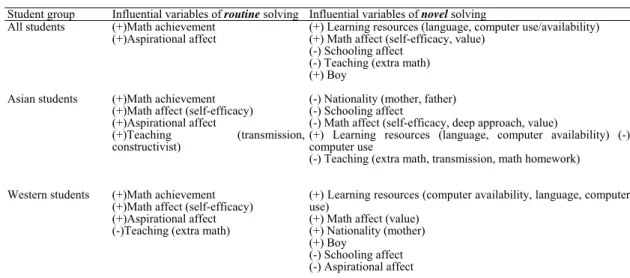
in the influential variables is presented in Table 6.
Table 6: Student groups by influential variables of routine and novel solving Student group Influential variables of routine solving Influential variables of novel solving
All students (+)Math achievement
(+)Aspirational affect (+) Learning resources (language, computer use/availability) (+) Math affect (self-efficacy, value) (-) Schooling affect
(-) Teaching (extra math) (+) Boy
Asian students (+)Math achievement (+)Math affect (self-efficacy) (+)Aspirational affect
(+)Teaching (transmission, constructivist)
(-) Nationality (mother, father) (-) Schooling affect
(-) Math affect (self-efficacy, deep approach, value)
(+) Learning resources (language, computer availability) (-) computer use
(-) Teaching (extra math, transmission, math homework)
Western students (+)Math achievement (+)Math affect (self-efficacy) (+)Aspirational affect (-)Teaching (extra math)
(+) Learning resources (computer availability, language, computer use)
(+) Math affect (value) (+) Nationality (mother) (+) Boy
(-) Schooling affect (-) Aspirational affect
strong learning-resource supports, positive mathematical affects, and
detached schooling/teaching experiences. In other words, routine
solutions were developed by an achievement-centered learning context or
centrally cognition-oriented context of mathematics learning; novel
solutions came from a self-centered learning context or a peripherally
affect-oriented contexts of mathematics learning. Mathematics has long
been regarded by students as full of routine problems that can be solved
by routine procedures (Schoenfeld, 1989). In order to become the ‘formal
member’ of mathematics learning, i.e. becoming a high-achiever,
providing routine solutions are likely to be the most significant means.
Given the critical aim of high-achievement in mathematics learning,
novel solvers are the ‘peripheral’ (Lave & Wenger, 1991, p. 29) members
of mathematics ‘classroom communities’ (Hamm & Perry, 2002, p. 135).
The tension between central-cognitive and peripheral-affective
participation tends to be stronger for the Asian students than for the
Western students. Both Asian and Western routine solvers have high
mathematics achievement, self-efficacy in mathematics and high
aspiration to higher education. Asian routine solvers benefited from both
transmission and constructivist approaches of mathematical teaching,
while Western routine solvers experienced few extra mathematics
lessons/tutoring in school. In other words, Asian routine solvers were at
the very center of mathematical learning, in terms of both achievement
orientation and participation in teaching activities; Western routine
solvers were at the center of learning, in terms of achievement orientation,
but less in terms of teaching.
Asian novel solvers experienced a far peripheral and negative affective
participation in their mathematical learning communities. The only
positive factor for Asian novel solutions was learning resources of
test-language use and computer availability. Asian novel solvers’ parents
were not natives; they had various kinds of negative affective responses
to schooling and mathematics; they experienced loose mathematical
teaching. This picture is a mirror image of their Asian routine solvers’, a
rather positive one. On the other hand, except for low disposition toward
schooling and low educational aspiration, Western novel solvers appeared
to possess advantages of strong support for independent learning from
abundant learning resources, high regard for mathematics, and native
mothers. The narrowly achievement goals fail to be their focus, Western
novel solvers had positive or no less social/economic and affective
support. This might encourage them to create their own novel/unique
solutions for the sake of their own and mathematics. The differential
achievements between Western and Asian novel solutions on the
international competition test, or later achievement of mathematics
expertise, are likely to be explained by the differences between the
positive learning contexts of Western novel solvers and the negative ones
of the Asian solvers.
A final point to make is that although some studies have shown that the
difference between mathematics achievements of boys and girls are
minimal and only in the top bands of 10% to 20% (e.g. Askew & Wiliam,
1995), the present study revealed that boys tended to produce novel
solutions more than girls, especially in Western countries. In comparison
with Vermeer et al.’s (2000) study, which indicated that boys tended to be
better at complex ‘application’ than girls, there appears a need to study in
depth gender differences in mathematics achievements in relation to
problem types and affective issues.
References
Araújo, C. R., Andrade, F., Hazin, I., da Rocha Falcão, J. T., do Nascimento, J. C., & Lessa, M. M. L. (2003). Affective aspects on mathematics conceptualization: From dichotomies to an integrated approach. In N. A. Pateman, B. J. Doherty, & J. Zilliox (Eds.), Proc. 27th Conf. of the Int. Group for the Psychology of Mathematics Education (Vol. 2, pp. 269-276). Honolulu, USA: PME.