國 立 交 通 大 學
管 理 學 院
企業管理碩士學位學程
碩 士 論 文
越南市場線上團購行為之驅動因素
Driving factors of Online Group Buying intention in Vietnam
研 究 生:阮青芳
指導教授:唐瓔璋 教授
中華民國 103 年 7 月
Driving factors of Online Group Buying intention in Vietnam
研 究 生:阮青芳
Student: Nguyen Thanh Phuong
指導教授:唐瓔璋
Advisor: Prof. Yingchan Edwin Tang
國 立 交 通 大 學
管理學院
企業管理碩士學位學程
碩 士 論 文
A Thesis Submitted to Master Degree Program of Global Business Administration College of Management National Chiao Tung University In partial Fulfillment of the Requirements For the Degree of Master in Business Administration July 2014 Hsinchu, Taiwan, Republic of China 中華民國 103 年 7 月
ABSTRACT
Recently, online group buying (OGB) is developing rapidly and impressively in Vietnam as a new type of online shopping. The aim of this report is to investigate the driving factors of Vietnamese customer behaviors toward using OGB services. In this thesis, a quantitative research with the survey questionnaire as a base is applied. This study employed various statistical methods, such as frequencies, reliability test (cronbach’s alpha), validity test (EFA), linear regression to evaluate the relationship among key factors.
This paper empirically derives dimensions influence consumer purchasing intention toward OGB and the results describe Technology acceptance model which has been considerably used to predict customer behavior with focus on two important factors: perceived ease of use and perceived usefulness. Supported by literature review, the study extends TAM via adding more external variables, namely service quality and perceived risk which are predicted to have noticeable impact on OGB intention, as previously found in studies of e-commerce and online shopping. In particular, social influence is defined as moderator role in this report. Data collected from 205 valid respondents in Hanoi and Hochiminh were tested against the extended TAM with the application of using SPSS software version 21. The result strongly supported the role of perceived usefulness, perceived ease of use and service quality in predicting users’ intention to adopt OGB and indicated important role of social influence in turning customer intention toward OGB. By contrast, the role of perceived risk is not significant for using OGB. This study not only suggests OGB websites vendors in Vietnam utilizing marketing communication tools to pay attention to the importance of social influence on both OGB intention and perceived ease of use, but also improving personalized service in order to enhance perceived usefulness as well.
ACKNOWLEDGEMENT
Working with my thesis has been a very interesting experience. All human resources involved in my research have shown a great cooperation, and significant contribution to the final results. First of all, therefore, I would like to express my great thankfulness to Professor Edwin Tang for his valuable guidance. To him, I would like to send my deepest thank for his patiently supervision and sincere encouragement, which help me to be eager in doing research and further learning during my thesis research. Without his support and encouragement, this research wouldn’t have been completed.
An honest thank is also sent to those entire in GMBA family, who supported me, especially during the completion of this report; and all my classmates, especially Kit, Mendy and Fatou who had been an indispensable part in my memorable GMBA trip. Thanks god for giving me a chance to ride next to wonderful guys and the many others joining in my survey, who are too numerous to name, but I thank all of them for helping me.
I thank my mom and dad for their supporting during this tough period, my sisters for helping me distribute and collect the paper questionnaires. Throughout my life, they have been and still are ever ready to assist me in my various endeavors, for which I am truly grateful.
Last but not least, I would like to express my thanks to my husband and my little boy. I am fortunate to have their encouragement and immeasurable support inspiring me in many ways. However, despite such all valuable help and support, there may remain many shortcomings and mistakes. I wish to receive comments and contribution to make this report comprehensive.
iii TABLE OF CONTENTS ABSTRACT ... i ACKNOWLEDGEMENT ... ii LIST OF FIGURES ... vi LIST OF TABLES ... vii CHAPTER 1: INTRODUCTION ... 1
1.1 Research motivation and background ... 1
1.2 Research Objective ... 2
CHAPTER 2: OVERVIEW OF B2C ECOMMERCE AND ONLINE GROUP BUYING IN VIETNAM 5 2.1 Overview of B2C e-commerce in Vietnam ... 5
2.2 Overall environment of Vietnamese e-commerce ... 6
2.2.1. Information Technology and Communications Infrastructure ... 6
2.1.2 Media expand ... 9
2.1.3. Supply chain infrastructure ... 10
2.1.4. Payment infrastructure ... 11
2.1.5. Education ... 13
2. 3. Group Buying Concept ... 13
2.4. Overview of Online Group Buying in Vietnam ... 15
CHAPTER 3: LITERATURE REIVEW ... 19
3.1 Research on customer behavior in e-commerce context ... 19
3.2 Research on Technology Acceptance Model (TAM) ... 21
3.3 Research on external variables of TAM... 23
3.4. Developing hypothesis ... 25
3.4.1 Technology Acceptance model for OGB ... 27
H7: Perceived ease of use (PE) positively affects consumer OGB intention ... 28
3.4.2 Service Quality ... 28
H8: Service Quality (SQ) positively affects consumer OGB intention ... 30
H9: Perceived risk (PR) negatively affects consumer OGB intention OGB intention ... 31
3.4.4 Moderation effect of social influence ... 31
CHAPTER 4: RESEARCH METHODOLOGY ... 35
4.1 Research process ... 35
4.2. Research framework ... 36
4.3 Questionnaire design ... 38
CHAPTER 5: DATA PROCESS AND ANALYSIS ... 41
5.1 Data processing ... 41
5.2 Data Analysis ... 41
5.2.1. Descriptive statistic ... 41
5.2.2. Measurement of internal consistency ... 46
5.2.3. Exploratory Factor Analysis (EFA) ... 48
5.2.3.1 EFA for dependent variables ... 49
5.3.2.2 EFA for dependent variables ... 53
5.2.4. Hypothesis test ... 54
5.2.4.1 Direct effect of driving factors (PE, SQ, PU, and PR) on customer attitude toward OGB . 54 5.2.4.2: Relationship between OA and OI ... 55
5.2.4.3 Direct effect of driving factors on OGB intention ... 56
5.2.4.4 Moderator effect of Social influence... 57
5.2.5 Assessment of Path Coefficients ... 60
CHAPTER 6: RESULTS AND CONCLUSION ... 62
6.1 Results ... 62
6.1.1 Antecedents of Attitude ... 62
6.1.2 Antecedents of Intention ... 63
6.1.3 Antecedents of moderators ... 65
6.2 Conclusion and contribution ... 65
6.3 Limitation and further research ... 67
v
APPENDIX A –ENGLISH QUESTIONNARIE ... 77
APPENDIX B: VIETNAMESE QUESTIONNARIE ... 80
APPENDIX C: MULTIPLE LINEAR REGRESSION ASSUMPTION TESTING RESULTS ... 84
LIST OF FIGURES
Figure 1: Proposed research structure ... 4
Figure 2: Rate of internet users participating in online shopping through a variety of research sources... 5
Figure 3: Growth of internet users ... 6
Figure 4: Number of personal computers ... 8
Figure 5: Number of mobile phone & 3G subscribers ... 8
Figure 6: Vietnamese logistics performance index ... 11
Figure 7: Rate of cash flow payment methods ... 12
Figure 8: Number of issued bank card since 2008 to 2012 ... 12
Figure 9: Number of universities training e-commerce ... 13
Figure 10: Increasing rate of 5 leading e-marketplaces by group-buying mode ... 16
Figure 11: Market share according to the revenue of 10 leading e-marketplaces in 2012 ... 18
Figure 12: The theory of planned behavior ... 20
Figure 13: Modified theory of planned behavior ... 20
Figure 14: Technology Acceptance Model ... 21
Figure 15: Technology Acceptance Model of attitude toward the use in e-commerce ... 22
Figure 16: Research Process ... 35
Figure 17: Technology acceptance model of OGB ... 37
Figure 18: Demographics information of respondents ... 43
Figure 19: Estimated Model ... 61
Figure 20: Histogram of OGB attitude variable ... 84
Figure 21: Normal P-P Plot of regression standardized residual for OGB attitude ... 85
Figure 22: Histogram of OGB intention variable ... 85
vii LIST OF TABLES
Table 1: Demographic data of respondents ... 42
Table 2: Characteristics of respondents & OGB services usage ... 44
Table 3: Cronbach's alpha reliability test results of pre-run data ... 46
Table 4: Cronbach's alpha summary results after deleting SI1 & SI2 ... 47
Table 5: KMO & Barlett's test result for PU, PE, SQ, PR toward OGB attitude ... 49
Table 6: Result of total variance explained ... 49
Table 7: Result of rotated component matrix ... 50
Table 8: Cronbach alpha for new Perceived ease of use group (PE1, PE2, PE3, PE4, SQ4) ... 52
Table 9: Cronbach's alpha for new Service Quality group (SQ1, SQ2, SQ3, SQ5) ... 52
Table 10: Cronbach's alpha summary after running EFA ... 52
Table 11: KMO & Barlett's test for customer attitude toward OGB ... 53
Table 12: Total variance explained for OGB attitude ... 53
Table 13: KMO & Barlett's test for OGB intention ... 53
Table 14: Total variance explained for OGB intention ... 54
Table 15: Results of testing hypothesis - Factors construct on customer attitude toward OGB .. 54
Table 16 : Regression result between OGB attitude & OGB intention ... 55
Table 17: Results of testing hypothesis - Factors construct on customer intention toward OGB 56 Table 18: Moderating effect of social influence - summary of multiple regression results ... 58
CHAPTER 1: INTRODUCTION
The beginning of the thesis starts with an introduction which will cover the author’s motivation about the topic entitled “driving factors of online group buying (OGB) intention in Vietnam”; then followed by section of research objectives. At the end of the introduction section the thesis structure is presented.
1.1 Research motivation and background
In the past, most of purchasing transactions were simply carried out by face-to-face methods and customers have to physically go to the stores to purchase commodities; however, since the explosion of the Internet in 1990s, e-commerce gradually transformed people’s shopping habits to a great extent. The e-commerce sector has rapidly emerged with its diversified applications and kept showing its vigorous energy. The market scale of worldwide e-commerce was at to top 1.2 trillion USD in 2012 with 903.6 million of digital buyers and this number is predicted to climb up to 1,015.8 million; 1,124.3 million and 1,228.5 million in 2013, 2015 and 2016 respectively (New Global Estimates by eMarketer).
The advent of e-commerce has led to the birth of many new internet-based selling models. There are several opportunities for buyers to form coalitions on Internet; among of them, group buying is one of the fastest growing e-commerce trends today. Group buying drives customers to get considerable lower prices by encouraging them to participate in a large group to purchase merchandise. A very original idea of group buying is to gain discount prices from retailers when a large number of buyers could be formed into a group, and now the same concept is widely adopted by many websites worldwide ((Eren and Mesut, 2011).). Meanwhile, e-commerce market in Vietnam has been also influenced by this form of group buying, significantly with
2 numerous new online shopping websites launched and the growing speed is getting faster than ever. The first OGB site entrance was phagia.com (an important partner of phununet.com, a social network for women in Vietnam) which appeared for the first time in June 2010 created an underground river to the field of electronic commerce Vietnam. According to action.vn, OGB model has been seen as a balloon inflated around three years ago in Vietnam, but it is now relatively flat and gradually transformed to survive despite of the current dismal sales declines of Groupon, the first group buying model in the world. Also, based on the Saigontimes (the famous economic papers in Vietnam) in August 13, 2013, the revenue of OGB in May and June 2013 reflects relatively higher returns due to the growing market demand for food, resort and travel deals, compared to the first quarter of 2013. Being inspired from the fast growing of OGB in Vietnam, in combination with the personal interest in both marketing and OGB topic, the author decides to write the graduation thesis relevant to OGB with the aim at examining the driving factors of Vietnamese customer intention toward OGB.
1.2 Research Objective
The purpose of this study is to explore factors affecting customer intention to use OGB to purchase merchandises. This paper begins with the customer behaviors theory and Technology Acceptance Model (TAM) then the TAM is extended to other external variables such as service quality, perceived risk and social influence to investigate customer buying intention. Thus, the objective of this Master thesis is to find out the answer to the key question “What are the driving factors of OGB intention in Vietnam?” However, in order to get a comprehensive answer for this topic, the sub-issues are indispensable parts in my thesis Investigating how TAM model with two dimensions of perceived usefulness and perceived ease of use impact customer attitude and customer intention toward OGB
i. Investigating how Technology acceptance model with two dimension of perceived usefulness and perceived ease of use impact attitude and customer intention toward OGB
ii. Exploring how to incorporate other external variables into Technology acceptance model so as to predict consumers purchasing intention toward OGB
iii. Identifying the moderating role of social influence on the relationship among perceived usefulness, perceived ease of use, service quality and perceived risk and OGB intention
1.3 Research structure
With the aim of carrying out this research, an overcall review of specialized literature which focuses on customer behavior in e-commerce and online group buying context will be first proceeded to figure out relevant aspects of customer purchase intention toward OGB. After that, the author presents a new framework, its results and discussion thereon. Finally, it will be concluded with the managerial implications for practice, pointing out the limitations of this study and making suggestions for future research.
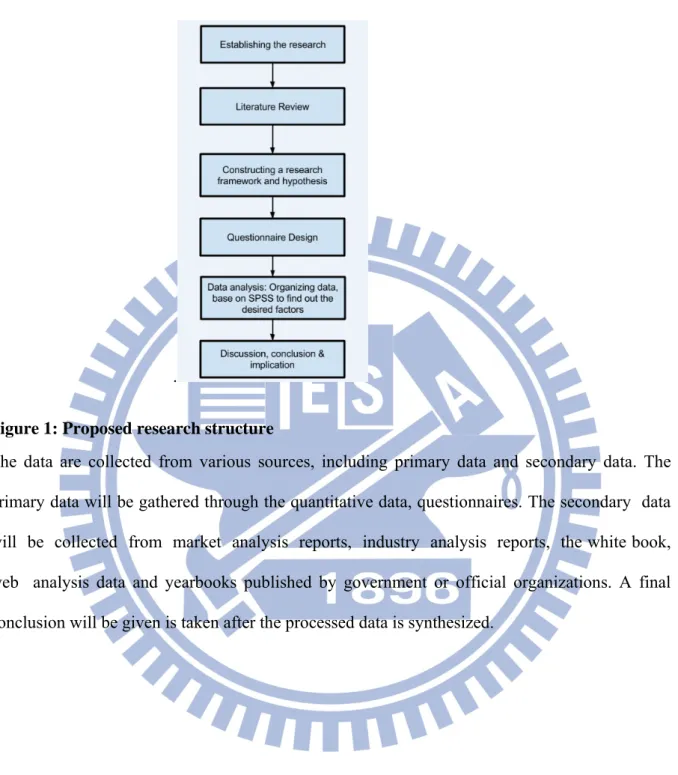
4 .
Figure 1: Proposed research structure
The data are collected from various sources, including primary data and secondary data. The primary data will be gathered through the quantitative data, questionnaires. The secondary data will be collected from market analysis reports, industry analysis reports, the white book, web analysis data and yearbooks published by government or official organizations. A final conclusion will be given is taken after the processed data is synthesized.
CHAPTER 2: OVERVIEW OF B2C ECOMMERCE AND ONLINE GROUP BUYING IN VIETNAM
2.1 Overview of B2C e-commerce in Vietnam
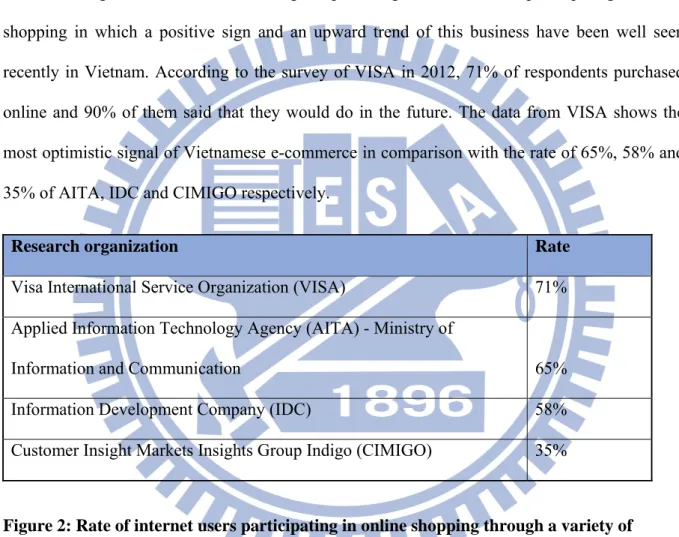
There is a huge source of data indicating the percentage of access users participating in online shopping in which a positive sign and an upward trend of this business have been well seen recently in Vietnam. According to the survey of VISA in 2012, 71% of respondents purchased online and 90% of them said that they would do in the future. The data from VISA shows the most optimistic signal of Vietnamese e-commerce in comparison with the rate of 65%, 58% and 35% of AITA, IDC and CIMIGO respectively.
Research organization Rate
Visa International Service Organization (VISA) 71%
Applied Information Technology Agency (AITA) - Ministry of
Information and Communication 65%
Information Development Company (IDC) 58%
Customer Insight Markets Insights Group Indigo (CIMIGO) 35%
Figure 2: Rate of internet users participating in online shopping through a variety of research sources
Moreover, Vietnam population is expected to stand at 93 million people and the percentage of internet users over population could reach 40% - 45% by the end of 2015. The Veitnamese B2C e-commerce revenue in 2012 reached 0.7 billion US dollar and based on the current status of
6 Vietnamese infrastructure and the forecasted statistics, this number likely jump to $1.36 billion in 2015 (Vietnam E-commerce report 2012; The Statistics Portal: statista.com)
2.2 Overall environment of Vietnamese e-commerce
Since the two-year implementation of Prime Minister’s Decision No. 1073/QD-TT, the Master Plan on E-commerce Development for the 2011-2015 periods, Vietnam has witnessed significant improvements in infrastructure and legal framework of e-commerce. The following parts introduce an overall of e-commerce environment in Vietnam, including but not limited to information technology & communication infrastructure, media platform & social network, logistics services infrastructure, online payment platform and education.
2.2.1. Information Technology and Communications Infrastructure
Internet
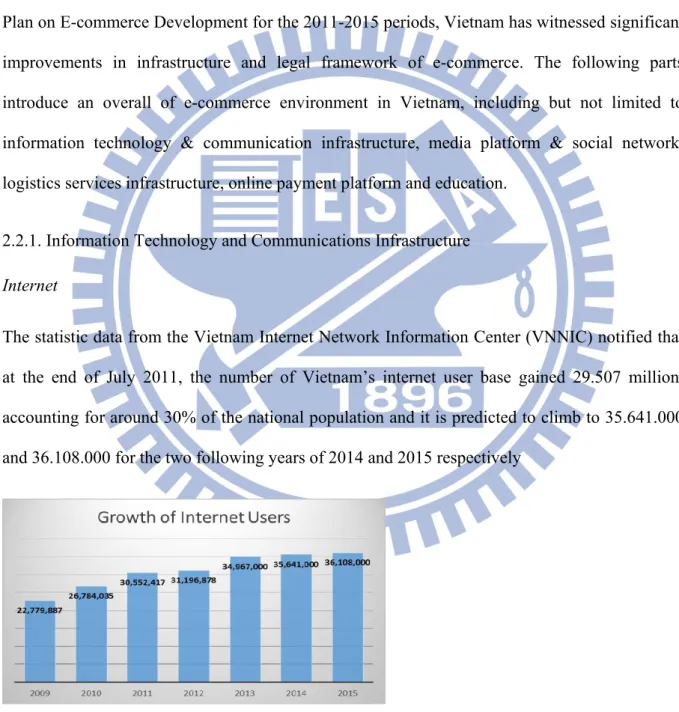
The statistic data from the Vietnam Internet Network Information Center (VNNIC) notified that at the end of July 2011, the number of Vietnam’s internet user base gained 29.507 million, accounting for around 30% of the national population and it is predicted to climb to 35.641.000 and 36.108.000 for the two following years of 2014 and 2015 respectively
Sources: Vietnam Internet Network Information Center (VNNIC)
In addition, the result of the survey with 3,405 respondents (from 15 to 64 years old) conducted by CIMIGO in 2012 indicated that the average amount of time a user spending on the internet per day was around 130 minutes and the rates of users accessing the internet daily (per week) and sometimes per week accounted for 68% and 24% respectively. Meanwhile, only 1% of respondents said that they had access to the Internet once a month and 4% of them did not often use the Internet.
Broadband
At the end of 2010, there were 3.63 million fixed broadband subscribers in Vietnam, which gave the country a broadband penetration rate of 4.1% and positioned Vietnam at the mid-point of regional broadband penetration, behind China and the Philippines (Sources VINNIC, BMI). With regard to the wireless internet access telephone technologies, it remains a difficult task to assess the exact size of this market. Based on Wireless Broadband Master Plan, the number of 2G mobile operators was around 8 million subscribers in 2009 and 10 million in 2010 whereas the number of 3G was 5 million for both 2009 and 2010 year, respectively.
The popularity of electronic means (User’s devices)
The period from 2008 to 2011 saw a rapid growth in the number of desktop and laptop computers used in Vietnam, from 4,478,500 in 2008 to 5,899,830 in 2011 and the number of household owing a computer was on the increasing trend from with 3,095,791 in 2009 to 3,831,397 in 2011.
8 No of desktop, laptop computers 4,880,800 5,319,000 5,899,833
Personal computers per 100 habitants 5.63 6.08 6.68
Number of household with a computer 3,095,759 3,371,051 3,831,397
Figure 4: Number of personal computers
Source: The White Book 2012 of Viet Nam Information and Communication Technology
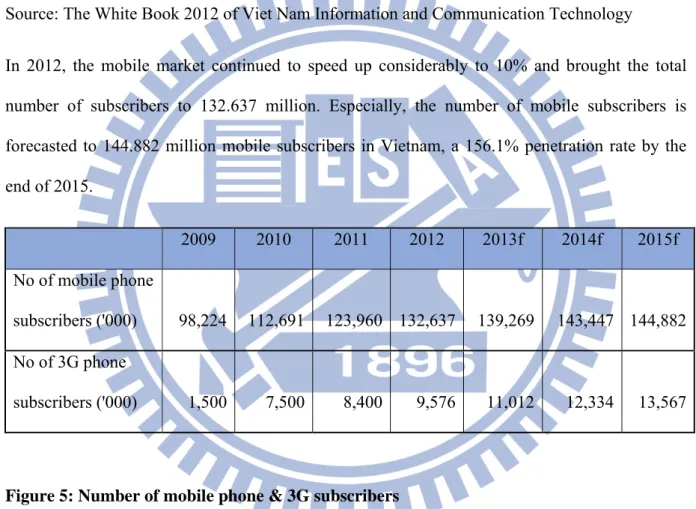
In 2012, the mobile market continued to speed up considerably to 10% and brought the total number of subscribers to 132.637 million. Especially, the number of mobile subscribers is forecasted to 144.882 million mobile subscribers in Vietnam, a 156.1% penetration rate by the end of 2015. 2009 2010 2011 2012 2013f 2014f 2015f No of mobile phone subscribers ('000) 98,224 112,691 123,960 132,637 139,269 143,447 144,882 No of 3G phone subscribers ('000) 1,500 7,500 8,400 9,576 11,012 12,334 13,567
Figure 5: Number of mobile phone & 3G subscribers
f: estimated/forecast. Source: International Telecommunication Union (ITU), BMI, MIC
In general, the current status of information technology as well as communications infrastructure is evaluated to be fairly qualified for the B2C e-commerce growth in Vietnam. In addition to this, thanks to a bright signal for the improvement in e-commerce infrastructure in coming years, the forecasted number of mobile subscribers will be 156.5million by the end of 2017, occupying a
166.3% penetration rate; more importantly, the total broadband subscribers will rise to 5.4 million at that period. However, the launch of a 4G network in Vietnam will be postponed until 2015, as the government strategy is keen for 3G services to improve the quality first (basing on the data from Vietnam Telecommunications Report Published 28 June 2013).
2.1.2 Media expand
Since 2006, the activities of propagating e-commerce knowledge to consumers have both intensified and expanded. The mass media and enterprises are the pioneers in these activities including Vietnam Television (VTV), Voice of Vietnam (VOV) and Vietnam Digital Television (VTC) that have developed their own programs specializing in information technology and e-commerce.
With its national radio coverage, VOV also played an active role in propagating knowledge related to e-commerce. The program “Informatics and Life” broadcasted everyday on VOV1 has brought many e-commerce related issues to listeners across the country. Besides, VTV is the active channel to spread knowledge about e-commerce and information technology in Vietnam. Programs such as “Digital life” of VTV1 and “Digital Space” of VTV2 have reached its popularity nationwide including the content of data privacy protection, information security in the banking sector.
Another important channel of propagation is newspapers, which also expresses considerable interests about information technology and e-commerce. Thanks to such magazines specializing in information technology as PC World, Digital World, Informatics and Life, Digital Mart, Digital Power, etc., readers can have access to concrete and in-depth information of e-commerce related issues.
10 As for awareness-raising activities, State regulatory agencies and professional-social organizations frequently hold competitions and award prizes related to e-commerce for those who can give birth to more new ideas that contribute to the e-commerce development process, such as the E-commerce Gold Cup by the Vietnam Association of Informatics, Sao Khue prize by the Vietnam Software Association, etc.
2.1.3. Supply chain infrastructure
To support the development of e-commerce, it is necessary to establish a supportive logistics infrastructure and smooth distribution channels from the sellers to the buyers in a convenient, fast and efficient way. This means there is a need of a highly connected postal services network that could reach residential areas with a low cost. Postal parcel delivery services market has opened up and rapidly diversified since 2007 with the number of enterprises operating in these sectors steadily growing over the years in Vietnam; for example, reaching 70 enterprises in total in October 2012 (statistical data from Ministry of Information and Communications). Also, demand for transportation and freight forwarding services is becoming strong due to huge volumes of materials and finished goods that need to be transported. However, the logistics industry in Vietnam is actually still in its infancy with the process of procurement of goods and materials, means of transportation, storage and delivery as well are not commonly carried out in an integrated manner.
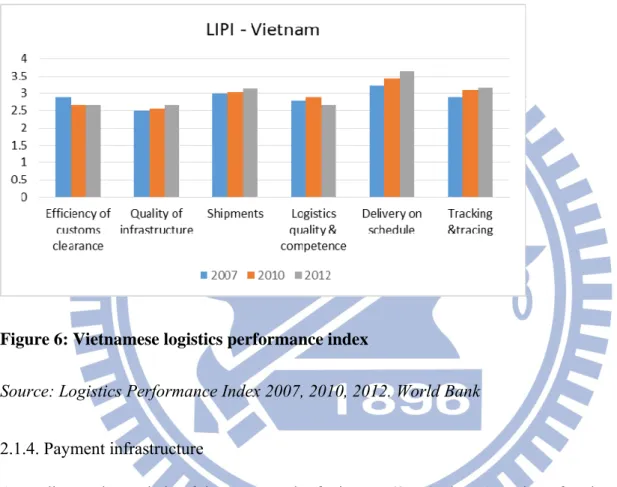
According to the Logistics performance index, Vietnam was last reported at the medium position within 5th out of ASEAN bloc and 53rd out of 155 countries with 3.00 points (Basing on LPI 2012, World Bank report published in 2012). Despite having a slight improvement in terms of quality of trade & transport-related infrastructure, ease of arranging shipments, delivery on
schedule (timeliness), tracking and tracing since 2007 to 2012; the quality of efficiency of customs clearance process & logistics quality and competence show a downward trend, which more and less lay an impact on the e-commerce performance in Vietnam. Thus, the transportation service sector as a whole in Vietnam is still relatively unwell developed.
Figure 6: Vietnamese logistics performance index
Source: Logistics Performance Index 2007, 2010, 2012. World Bank
2.1.4. Payment infrastructure
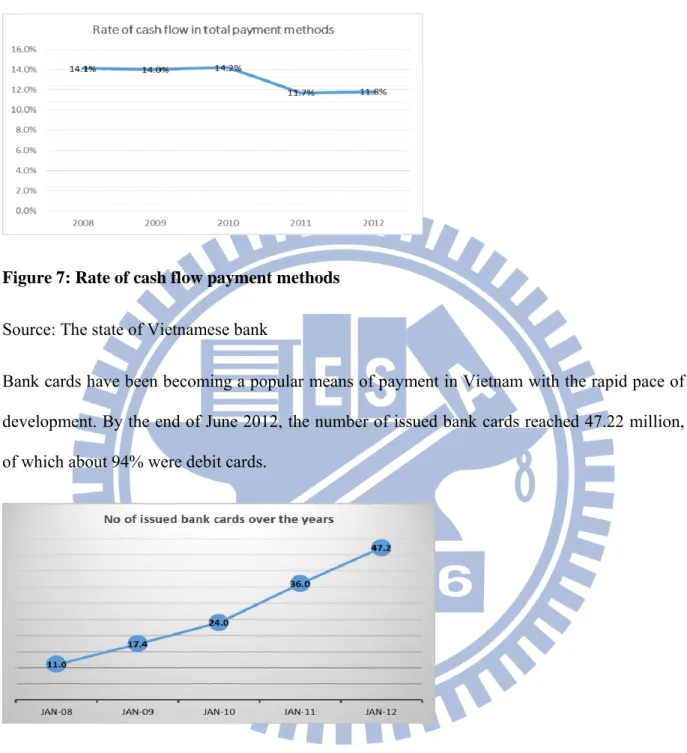
According to the statistic of the State Bank of Vietnam (SBV), the proportion of cash payment in the total payment methods has declined over years (from 31.6% in 1991 to 14.2 % in 2010 and 11.8% in September 2012). This factor is an important premise for the development of electronic payment service in Vietnam.
12 Figure 7: Rate of cash flow payment methods
Source: The state of Vietnamese bank
Bank cards have been becoming a popular means of payment in Vietnam with the rapid pace of development. By the end of June 2012, the number of issued bank cards reached 47.22 million, of which about 94% were debit cards.
Figure 8: Number of issued bank card since 2008 to 2012 Source: The state of Vietnamese bank
2.1.5. Education
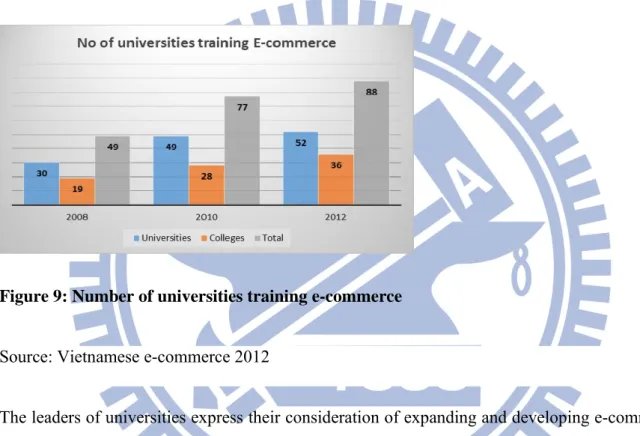
Formal training activities on e-commerce have started since the years of 2003-2004 in Vietnam. The survey of VECITA conducted in 2012 showed an increase in the total number of academic organizations offered e-commerce training and the results, from 49 in 2008 to 88 university and colleges in 2012.
Figure 9: Number of universities training e-commerce
Source: Vietnamese e-commerce 2012
The leaders of universities express their consideration of expanding and developing e-commerce training, however, universities are facing some obstacles in the preparation of training expansion such as lecturers, training programs, teaching materials and the e-commerce field code, etc. 2. 3. Group Buying Concept
Group buying is known as one of the fastest growing e-commerce trends, it drives customers to purchase products or services at considerable lower prices by encouraging them to participate in a large group. Although there are many different kinds of group buying model; however among
14 now (Eren and Mesut 2011). A common characteristic is that the seller offers discounted group rates to encourage individual customers make a purchase according to buying groups. Group-buy operators seek to aggregate disparate buyers who can operate remotely and asynchronously via the Web by providing them with price-based incentives for volume purchases. However, each type of group buying still has its own characteristics. First, in the dynamic pricing mechanism, a large number of consumers with similar purchase interests are pooled online, from a virtual coalition to bargain collectively with the sellers, it can reduce the transaction cost of each side (Lai, 1999). By forming a coalition, buyers can advantageously negotiate with sellers and buy merchandises at volume discount prices based on the number of pooled buyers (Yamamoto & Sycara, 2001). Thus, each potential buyer is willing to make an effort to expand the buying group size to increase the likelihood of getting a lower price. Compared to the traditional individuals selling strategies, the seller of this group buying type can use a group-buying discount as a technique to “hire” informed customers who work as “sales agents” to motivate novice customers to participate in the group (Jing and Xie 2011). In other words, group buying as a mechanism to encourage interpersonal information and knowledge sharing. This model looks for a high profit margin by selling a volume strategy through selling a high sales volume by charging a lower price. The seller may use a discounted group price, together with a group size requirement in order to motivate informed customers to disseminate product information to less-informed new customers (Jing and Xie, 2011). To entice buyers, the seller offers to sell at the discounted unit price and maybe drops lower each if more units are demanded. In effect, quantity discounts are offered, not on an individual customer’s order, but on the total of all customer orders.
The later type with stable pricing system is what this thesis refers to. This type offers a certain product or service at a large discount amount but the price is static and does not decrease when the number of consumers increases (Erdogmus & Cicek, 2011). There are three parties in in this group buying type; the suppliers, the websites (as the vendor or brokers) and the customers. The website acts as an intermediary to connect suppliers and customers. However, the discount price is only applied when the total number of the buyers who buy the deal is greater than the predetermined limit of the minimum required number of buyers.
2.4. Overview of Online Group Buying in Vietnam
Along with the rapid development of the Internet, in the context of electronic commerce, the growing speed of online group buying in Vietnam is very fast. According to Vu Hong Quang, a representative of the Southern VC Corp which is the parent company of the group-buying site muachung.com, there were almost 20 OGB sites in Vietnam in 2011; however, only five big players dominated this market at that time; namely, nhommua.com; muachung.vn; muare.vn, cucre.vn; 51deal.vn. After just 7 months of operation, the two main competitor’s nhomua.com and muachung.vn already had 100,000 members while some of the newer sites owned around 60,000 members. The year of 2012 witnessed the high growth of five leading group-buying mode in B2C e-marketplaces (Vietnam e-commerce 2012).
No OGB Sites Data Increasing rate
1 Nhommua
No of members (+)15%
No of successful transactions (+) 16% Total value of successful
16
No OGB Sites Data Increasing rate
Total revenue (+) 13%
2 Muachung
No of members (+) 55%
No of successful transactions (+) 75% Total value of successful
transactions (+) 70%
Total revenue (+) 70%
3 Muare.vn
No of members (+) 33%
No of successful transactions N/A Total value of successful
transactions N/A
Total revenue (+) 9%
4 Cucre.vn
No of members (+) 50%
No of successful transactions (+) 435 Total value of successful
transactions (+) 38%
Total revenue (+) 38%
5 51deal
No of members (+) 62%
No of successful transactions (+) 305 Total value of successful
transactions (+) 67%
Total revenue (+) 82%
Source: Vietnamese e-commerce 2012
Similar to the online group buying market in USA, websites like 50% off daily news provide one-stop-shop pages and play as pure information aggregators, making profit from online advertisement and network traffic directing. The first OGB site entrance was phagia.com (an important partner of phununet.com, a social network for women in Vietnam) which appeared for the first time in June 2010, after that created an underground river to the field of electronic commerce Vietnam. Secondly, the birth of ‘nhommua.com’ that was established in July 2010 has witnessed the registered users of 100,000 members and other OGB sites such as cungmua.com, muachung.vn, hotdeal.com have also caught the attention of many people and its effect on customers’ buying intention is enormous.
Until by the end of 2012, nhommua.com was ranking at the top based on traffic reaching the number of 6.7 million page views. According to Alexa ranking and Google Ad Plan May 2011, with the commitment to offer more and more diversified products with the best quality, nhommua.com is positioned for a very promising 2nd half of 2013 and 2014 thanks to its largest market share in 2012 and its outstanding achievements in the first 6 months of 2013 in Vietnam The second position belongs to muachung.vn (literally means buy together) with the number of page views reaching 2.4 million and that of visitors of 670.000 (asiadigitalmap 2011). Nhommua.com and muachung.vn are ranked at the second and the third position in the top 10 leading e-marketplaces in Vietnam
No E-commerce places Market shares
18 2 nhommua.com 15% 3 muachung.vn 12% 4 enbac.com 10% 5 solo.vn 10% 6 123mua.vn 6% 7 5giay.vn 4% 8 muare.vn 3% 9 rongbay.com 2% 10 az24.vn 1%
Figure 11: Market share according to the revenue of 10 leading e-marketplaces in 2012 Sources: Vietnamese e-commerce 2012
In summary, in spite of still having some obstacles supply chain infrastructure, education quality for e-commerce development in long run, however, the overall environment of Information Technology and Communications Infrastructure, especially the internet, broadband and the popularity of electronic means have been in relatively good preparation for the general practice of online commerce and OGB. OGB is becoming the new trend for Vietnamese shopping activities and it is supposed to contribute significantly to Vietnamese B2C e-commerce revenue in coming years.
CHAPTER 3: LITERATURE REIVEW
3.1 Research on customer behavior in e-commerce context
The thesis aims at conducting researches about the factors affecting customer intention toward OGB, thus, theory of customer behavior in e-commerce context and Technology Acceptance Model are seen as the primary theory for this thesis.
Many theoretical and empirical researches show the strong correlation among customer attitude and customer intention to actual behavior. Theory of planned behavior Azjen derived from theory of reasoned action (TRA) (Fishbein & Ajzen 1975) provides a behavior explanation of the importance of attitudes on a prospective buyer’s decision-making process. Azjen (1991) considers the influence, restrictions, and behavioral belief on adoption decision to describe the positive relationship between customer attitude and behavioral intentions. He showed that attitudes toward the behavior; subjective norms with respect to the behavior and perceived control over the behavior were usually found to predict behavioral intentions with a high degree of accuracy (Azjen 1991).
20 Figure 12: The theory of planned behavior
Source: Theory of planned behavior , Ajzen, 1991
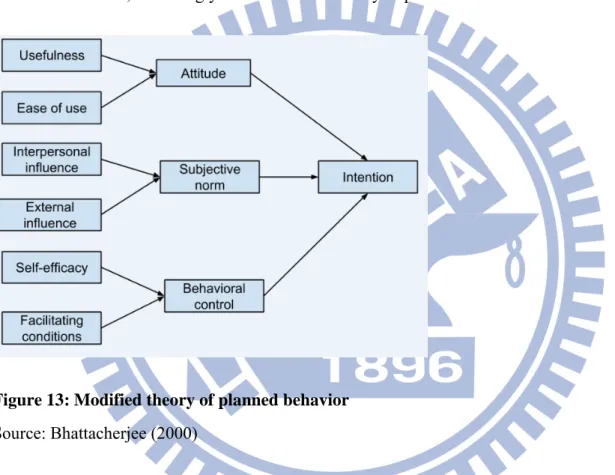
Via modifying the planned behavior, Anol Bhattacherjee (2000) found that attitude, subjective norm and behavioral control play a very significant role in explaining intentions to accept e-commerce services; accordingly he modified the theory of planned behavior as below:
Figure 13: Modified theory of planned behavior Source: Bhattacherjee (2000)
Customer’s attitude that is believed to influence shopping intention refers to the acceptance of customers toward a specific internet store and considering the internet as a shopping channel (Jahng et al. 2001). Customers’ intention for online shopping relates to their willingness to perform purchasing action in an internet store and it affects customer’s decision making and purchasing behavior.
3.2 Research on Technology Acceptance Model (TAM)
One of the most popular models applied in the study of adoption of technology acceptance is Technology Acceptance Model (TAM). The TAM model (Davis, 1989) with its basis in Theory of Reasoned Action (TRA) is a favored theory for explaining adoption of new IT. TAM proposed that both the perceived usefulness (PU) and perceived ease of use (PE) affect customer attitude toward using a new technology, which in turn affects the behavioral intention to use the actual system directly (Davis, 1989).
Figure 14: Technology Acceptance Model Source: Davis et al. (1989)
The TAM studies adoption of innovation technology first then it has been successfully applied in internet-related technologies acceptance due to its solid theoretical foundation, such as in e-healthcare (Lanseng and Andreassen, 2007), e-government (Phang et al., 2005; Sahu and Gupta, 2007) and mobile commerce (Wanget al., 2006). Also, this model has often been considered the most influential and extensively applied theory for understanding consumers' purchase intentions in ecommerce (Tong, 2010). A number of recent studies have successfully adopted TAM to study the acceptance of internet related technologies such as Chen, Gillenson & Sherrell (2002),
22 Since OGB is the web system based and an internet-related technology, it is seen as new business model in e-commerce. Thus, using TAM (Figure 15) is most suitable as the basis for investigating consumer behavior toward OGB.
Figure 15: Technology Acceptance Model of attitude toward the use in e-commerce Source: Chen, Gillenson and Sherrell 2002
Thus, in this thesis, an OGB attitude is defined as an individual belief and acceptance, considering OGB as a shopping channel, as well as this, OGB intention refers to the degree to which an individual believes they will be willing to use OGB to buy products.
Moreover, Tsai & Chen (2011) has successfully found that both perceived usefulness (PU) and perceived ease of use (PE) in TAM have positive and direct effect on behavioral intentions in OGB. Thus, for OGB buyers, they will adopt OGB if they believe that this type of model will bring benefits such as time saving, getting the best deal, or find more information about a product. As well as this, if the purchasers feel that OGB is easy to interact and do not require much effort to make transaction on it, the tendency to use OGB as an online shopping method will be higher.
In this thesis, planned behavior, TAM model is used as the basic research to find out the factors affecting customer’s intention toward OGB.
Application Author Attitude, subjective norms and behavioral control have a
significant and positive effect on behavior.
Ajzen (1991)
Customer acceptance and use of virtual store can be predicted from their intention, which is determined by their attitude toward using virtual stores.
Bhattacherjee (2000)
Perceived usefulness (PU) and perceived ease of use (PE) have an impact on customer attitude and customer intention in technology acceptance
Davis (1989); Venkatesh & Morris (2000)
Perceived usefulness (PU) and perceived ease of use (PE) are the primary determinants of customer attitude toward using the virtual stores
Bhattacherjee (2000); Chen, Gillenson & Sherrell (2002)
Leo (2003); Tong (2010) Perceived usefulness (PU) and perceived ease of use (PE)
have an impact on customer attitude and customer inattention toward using OGB
Tsai & Chen (2011); Chang, Lee & Su (2011)
3.3 Research on external variables of TAM
There are a large number of studies confirming the validity and implication of TAM as a parsimonious model in many technology - related (Davis 1989); in e-commerce (Tong 2010; Ha and Stoel, 2009) and in OGB contexts (Tsai & Chen 2011; Chang, Lee & Su 2011), however, only two factors perceived usefulness and perceived ease of use of TAM may not enough to capture many other hidden influencing factors on consumers' behavior towards OGB such as price (Pi, Liao, Liu & Lee 2011), gender, online shopping experience (Tong, 2010), service
24 quality, social and cultural factors (Cheng and Huang (2012), website quality, personal innovativeness, discount rate, and perceived risks (Javadi, 2012; Tsai & Chen 2011). All these factors are regarded as the determinants of the consumers' buying intention in a group-buying context as well.
In the past, most studies considered that the price factor mostly affects the purchase intention (Anand and Aron, 2003; Li et al., 2004; Chen et al., 2009; Li et al., 2010), especially in OGB, price is known as the obvious influence customer behaviors toward OGB. Customers come with the site because they can make a purchase with an acceptable discount price. The more discount price rises, the more customers are attracted, and also their satisfaction increases. However, the consumers consider not only the price factor, but the service quality, attitudes, the reference group and other factors. Therefore, this study tries to investigate factors influencing consumer intentions in online group-buying with the basis of rational action theory and TAM model.
Also, social influence was found to be an important factor in determining technology adoption (Glass and Li, 2010). OGB buyers will normally take the recommendations, warnings and comments that appear on relevant virtual communities into consideration before making a purchase. Such virtual communities as the main source of social influence will influence online shopping decisions. Therefore, since the focus of this study is OGB, it follows that the idea of the social influence should be taken into consideration when modeling OGB behavior.
External variable of TAM model literature review
Service Quality (SQ) has an effect on customer attitude and customer intention toward online shopping
Albert & Tung (1994);
Service Quality (SQ) has an impact on customer attitude and customer inattention toward using OGB
Erdogmus & Cicek (2011); Cheng & Hoang (2012); Tsai & Chen (2011)
Perceived risk has been shown to negatively influence consumers’ intention to shop online
Liang & Jin-Shiang (1998); Tan (1999); Xiao Tong (2010); Bhatnagar (2000); Ruyter (2001) Feathermana & Pavlou (2003); Javadi (2012); Forsythe & Shi (2003); Biswas & Biswas (2004).
Perceived risk (PR) has an impact on OGB attitude and OGB intention
Tsai & Chen (2011); Erdogmus & Cicek (2011)
Social influence (SI) has a positive effect on online shopping, OGB intention
Tsai & Chen (2011); Cheng & Hoang (2012)
3.4. Developing hypothesis
The OGB is a new business type in Vietnam, therefore, from a long time searching relevant to OGB topics, the author has learnt that there is no significant quantitative publications about Vietnamese customer behaviors towards OGB intention. There are some articles have examined the use of TAM and other additional factors impacts online shopping or OGB intention in China,
26 Hongkong, Taiwan, Turkey and so on, however, a few researches are done to study the factors influence Vietnamese intention to online shopping or OGB. There is one article titled “Vietnamese consumers’ intention to online shopping adoption” was conducted by Ho and Chen published in the Asian journal of social sciences & humanities proposed the intergraded model of TAM, social norm and customer’s trust in order to explain consumer’s adopting intention online shopping, however, this research only use the qualitative approach to understand of technology belief (TAM), customer trust, social norm belief to explain Vietnamese online shopping intention. Also, this journal does not take the role of other external variables of TAM in Vietnamese buying intention toward online shopping. Such studies relating factors influencing Vietnamese customer intention toward online shopping and OGB by employing the quantitative approach hardly have been found until now.
In addition, the author found the article titled “Online Group Buying: What Is There for the Consumers” that the author Erdogmus & Cicek (2011) used a qualitative method to study the effect of demographics, service quality and price on customer intention toward OGB in Turkey. Moreover, in the articled named “predicting intention to purchase on group buying website in Taiwan Virtual community, critical mass and risk” of Cheng, Tsai, Chen (2012) indicates that social influence directly influence purchasing intention for group buying.
Being deeply inspired from three above journals, in combination with the author’s personal interest with OGB topic, this master thesis plans to use the quantitative approach to examine the linkage among TAM dimension and OGB intention in Vietnam. As a result, TAM is chosen as the framework for this study to explain users’ intentions to perform shopping activities via OGB and to rationalize their attitude to buy in terms of perceived ease of use, perceived usefulness, service quality, perceived risk as well as social influence. Particularly, the effect of social
influence is regarded as moderators in the proposed framework. It is hoped that the findings suggest (1) managerial implications of how TAM dimension and other external variables of TAM impact OGB intention and (2) tangential contributions to the evolving body of knowledge about OGB are shown to some extent. Therefore, the structure of this chapter is separated into four main sections. The first section will test the impact of TAM’s, service quality and perceived risk on OGB attitude. Secondly, the relationship between above mentioned dimensions and OGB intention will be presented. The next section of this research will dig deeper into the direct effects of OGB attitude on OGB intention. Finally the moderation impact of social influence between above factors and OGB intention will be finally clear.
3.4.1 Technology Acceptance model for OGB
Attitudes are defined as the positive or negative feelings of an individual towards a specific behavior, which are influenced by perceived usefulness and perceived ease of use. In TAM, Perceived usefulness (PU) is defined by Davis as “the degree to which a person believes that using a particular system could enhance his/her job performance”, similarly, perceived ease of use (PE) is defined as "the degree to which the prospective user expects the system to be free of effort" (Davis, 1989).
In this thesis, an OGB attitude is defined as an individual belief and acceptance, considering OGB as a shopping channel while OGB intention refers to the degree to which an individual believes they will be willing to use OGB as a shopping channel. Perceived usefulness (PU) is defined as the degree to which a personal perceives that the use of OGB can enhance his/her efficiency regarding his/her shopping activity and by considering an OGB websites as a technology system and perceived ease of use is understood that using OGB does not require a lot
28 of thier effort. In this thesis, perceived usefulness (PU) and perceived ease of use are supposed to enhance user’s attitude to use OGB sites. Apart from having the direct and positive effect on OGB attitude, the author assumes that PU and PE will have a direct and positive effect on OGB attitude and OGB intention (Cheng, Tsai & Chen 2012). Thus the relationship between two dimensions of TAM and customer attitude toward OGB and OGB intention is constructed as follow:
H1: Perceived usefulness (PU) positively affects consumer OGB attitude. H2: Perceived ease of use (PE) positively affects consumer OGB attitude. H6: Perceived usefulness (PU) positively affects consumer OGB intention. H7: Perceived ease of use (PE) positively affects consumer OGB intention 3.4.2 Service Quality
Albert and Tung (1994) found that service quality has an effect on customer attitude and customer intention toward online shopping. Besides, the result from empirical evidence of Kim et al. (2006) proved that poor service quality would affect online retailers negatively. In 2003, Woldfinbarger and Gilly showed a positive relationship between overall service quality and satisfaction in case of fixed web retailing. Erdogmus & Çiçek (2011), Tsai & Chen (2011), Cheng & Hoang (2012) examined the effect of service quality on OGB intention. Thus, service quality is assumed to be related to customer’s purchasing attitude and intention toward OGB even when the customer made a purchase in OGB before because a good or bad provided service quality still affect their buying intention for next shopping times. Thus, one of the targets of
the research question in this study is to define how service quality dimensions affect to OGB attitude and OGB intention.
OGB has the dual nature of Web-based application system and traditional shopping method. This thesis explores online and offline features of OGB and their relationships with the acceptance behaviors of customers.
Online features of OGB
Service quality is important, especially the lack of face-to-face contact on a Web site. In this thesis, service quality is based on the perspective that the organization is composed of multiple processes with the goal of providing the customer with high-quality service. Typical dimensions of online features refers to reliability, responsiveness, availability of multiple communication mechanisms for accepting consumer complaints and timely resolution of complaints, but may also include assisting consumers in using a product effectively, suggesting complementary products or service.
Offline features of OGB
Although the online quality factors play an important role in the customer’s purchasing decision process toward OGB, there is also a need to consider other potential values of adoption from the consumer’s perspective. These benefits are typically rooted in traditional marketing criteria such as access to good products and prompt delivery service, especially the quality of physical product and physical logistics performed by offline operations rather than by Web presence (Gurau et al 2001). Although OGB deals with both physical and digital products and services, the basic concept of product quality is not too different from that of traditional commerce. The
30 quality means the actual quality of products, consistency between the quality specification on the OGB websites and real quality of the physical product. Variety is the assortment or a range of goods available from OGB websites and if the customers can find what they want to buy on OGB. If the product quality meets their expectation, customers tend to regard the OGB as useful and continue to visit it. Besides, reliable and timely delivery is one of the fundamental objectives for online shoppers. Online shoppers make their orders at their office or home anticipating quicker delivery than offline purchasing, and timely delivery on his convenient time. The timely and reliable delivery makes users satisfied so that they will keep using OGB services.
Overall, service quality in this thesis is defined as all benefit that the customers possibly get from OGB including the quality of information provided by OGB sites, the quality of products/services offered by OGB sites, responsiveness (feedback to users and the availability of response from the site managers or Web sites with just in time online support), delivery services, online payment method, return or refund policy. Thus I hence suggest the hypothesis:
H3: Service quality (SQ) positively affects consumer OGB attitude. H8: Service Quality (SQ) positively affects consumer OGB intention 3.4.3 Perceived risk
Perceived risk’s origin was back into 1960 when Bauer, R. (1960) firstly introduced the concept of perceived risks as a combination of uncertainty plus serious of outcome involved. Then Cox & Rich (1964) found perceived risk as the nature and amount of risk perceived by a consumer in contemplating a particular purchase decision. Also, Hoyer & Macinnis (1997) showed that perceived risk is a function of two key components: uncertainty (the likelihood that certain outcomes might occur) and consequences (whether these outcomes will be positive or negative
and how serve they are perceived to be). So far, perceived risk has been applied in many researches to point out its negative influence to consumers’ intention toward shop online (Liang and Jin-Shiang (1998), Bhatnagar et al. (2000) Ruyter et al. 2001; Feathermana & Pavlou (2003); Xiao Tong (2010)). The most frequently cited risks associated with online shopping include financial risk (relates a risk of the loss of money to a consumer in online shopping), social risk (defines as the fear of personal information given for transaction to the retailer may be compromised to 3rd party); performance or product risk (reflects uncertainty about whether product or service will perform as expected or is the product the same quality as viewed on the screen); time risk and non-delivery risk (What if the product is not delivered). Tan, 1999 and Kolsaker et al. 2004 points out the correlation between perceived risk and willingness to shop online: the higher the perceived risk is the lower likelihood the consumers purchase the product; whereas, the lower the perceived risk, the higher and the propensity for online shopping. It happens the same in OGB, for each time using OGB do make a purchase; buyers have to face the similar problem. Therefore I believe that a perceived risk is very important variable which critically influence customer attitude and intention toward OGB. Thus the effect of perceived risk on consumer online purchase making decision is supposed to be directly related to OGB intention (Tsai & Chen (2011); Erdogmus & Çiçek (2011); Javadi, (2012).
H4: Perceived risk (PR) negatively affects consumer OGB attitude.
H9: Perceived risk (PR) negatively affects consumer OGB intention OGB intention 3.4.4 Moderation effect of social influence
32 As mentioned above, social influence is supposed to impact individuals’ attitudes & intention and it should be recognized as a crucial determinant of user behavior in e-commerce, including in the context of OGB. In the reality, when making decision to purchase or do not purchase a certain of product, consumer’ behavior is influenced by not only one person but also many different group that they belong to. Especially when the decisions are difficult, customers are more likely to follow the advice because they need more information or when they have little knowledge about a product. They tend to follow the recommendations of others because more external input and recommendations from others help reduce the cognitive cost of thinking and increase the certainty surrounding a decision (Gino and Moore 2006).
In this study, social influence refers to the reference groups that may have the direct or indirect influence in building an individual intention. In other words, several individuals with face to face interaction may be a part of the consumer's purchase decision. The typical roles of these individuals are friends, colleagues or work groups. In addition, with the explosion of Internet and the rapid diffusion of the Internet-based social communication methods, the influence of inferences in the online social communication networks is very considerable (Fitzgerald, 2004). As a result, apart from direct WoM factors, nowadays, customers likely, in the e-commerce context, may be impacted by interpersonal information provided on the websites (Hsu and Chiu, 2004) or comments and recommendations in other virtual communities. Therefore, WoM in OGB is defined as indirect or electronic WOM (e-WOM), consisting of comments or recommendation written and posted directly by existing users or other buyers’ opinions discussing about the commodities or service sold in the OGB, on virtual communities such as social network, website discussion groups and the Internet forums (Cheng et al., 2012; Tsai & Chen (2011).
The first type refers to comments or recommendations written by existing users posted directly on the interface of the OGB websites. Most OGB sites have a section allowing experienced consumers to post comments on products and these comments likely influence consumer perceptions of product characteristics such as quality and function (Cheng and Huang, 2012). Some experienced consumers may express their feelings of satisfaction or dissatisfaction online after they have used products. If other users receive positive messages from existing users' reviews, they tend to refer and follow the opinions expressed and develop a purchase intention as regards certain products on group buying websites (Cheng and Huang, 2012). If customers see lot of negative comments they will hesitate to buy products or services you are looking for (Cheng and Huang, 2012). The later type is comments and recommendations written and discussed via virtual communities website such as social network websites (as facebook, blog, tiwntwer) or discussion groups (lamchame.com; webtretho, otofun, tratimvn, Zing me, Voz; Tinhte.vn). These online messages or comments have a strong persuasive effect on other people (Smith, 1993).
Social influence is found to be a crucial factor in shaping user behavior in online shopping (Hsu & Lu (2004; Venkatesh & Morris (2000) and in technology adoption (Glass & Li, 2010). There are a few researches defining social influence as a direct factor toward OGB intention (Tsai & Chen (2011) and Cheng & Hoang (2012)), however, until now from long time conducting researches relevant to OGB topics, the author has learnt that there is no significant publication examine the indirect effect or social influence.
Moreover, In addition, with the explosion of Internet since the year of 1990, go together with the rapid diffusion of the social network, the influence of e-WoM in Vietname is getting more
34 of Facebook users in 2011 with the users reached to 8.6 million (doubled compared to the previous year). Therefore social influence is assumed to be an important factor can influence Vietnamese behavior toward OGB intention.
Taking this research gap, this thesis would like to explore the moderation role of social influence not only in the relationship between itself and TAM dimensions and external variable of TAM factors (service quality and perceived risk) but its moderations role between customer’s attitude and customer intention toward OGB will be presented in this thesis. Thus, I proposed the social influence has a moderation effect between perceived usefulness (PU) and OGB intention; between perceived ease of use (PE) and OGB intention; between service quality (SQ) and OGB intention; between perceived risk and OGB intention and between OGB attitude and OGB intention as well.
H10a: Social influence (SI) has a moderation effect between perceived usefulness (PU) and consumer OGB intention
H10b: Social influence (SI) has a moderation effect between perceived ease of use (PE) and consumer OGB intention
H10c: Social influence (SI) has a moderation effect between service quality (SQ) and consumer OGB intention
H10d: Social influence (SI) has a moderation effect between perceived risk (PR) and consumer OGB intention
H10e: Social influence (SI) has a moderation effect between consumer OGB attitude and consumer OGB intention
CHAPTER 4: RESEARCH METHODOLOGY
This chapter presents a brief description of the research methodology used for the research, including the research process, research measurement, sample selection methods, data collection methods.
4.1 Research process
Throughout the research, a qualitative approach was adopted to obtain an in-depth understanding of driving factors influencing OGB intention in Vietnam. To collect the quantitative data, the survey method has been used and eventually the data has been analyzed by using SPSS software. The research process of this study is described in the below figure
36 Firstly, research problem is defined, and then research objective and research questions are identified to be the target of solving defined research problem. After that, this study conducted a literature review to review some relevant theories about factors influencing customer intention toward OGB to find out the suitable one to Vietnamese group buying model and built the hypotheses for this study. From this, a preliminary questionnaire is developed basing on questions used in some previous studies. Next step is research design with 2 sub-steps:
Pilot study: a preliminary survey to test the survey and measure before launching the main survey was conducted by interviewing face to face 8 students.
Main survey: conducted in many methods such as sending online survey through mail, social network and sending the hard copy of survey directly to respondents. Data collection was done two weeks later.
After that, collected data was cleaned and used to test reliability of scale and validity of questionnaire through Cronbach’s alpha coefficient and Exploratory Factor Analysis (EFA) method. Multiple regression method was used to evaluate the hypotheses which the implication and finding were stated and reported.
4.2. Research framework
According to the literature review, research framework is proposed. It is visually presented on Figure 16. In the first section, two dimensions of TAM, service quality, perceived risk are tested to know its impact on customer attitude toward OGB attitude; on the other hand; the impacts of these factors also are examined in the positive and direct relationship with customer intention toward OGB. Also, to gain an in-depth understanding of OGB intention, the moderator social
influence is presented to know its moderation effect between four factors and OGB intention and its moderation effect between buying attitude toward OGB and intention toward OGB as well. Figure 17: Technology acceptance model of OGB
In summary, this research proposes the following hypothesis
H1 Perceived usefulness (PU) positively affects consumer OGB attitude. H2 Perceived ease of use (PEOU) positively affects consumer OGB attitude. H3 Service quality (SQ) positively affects consumer OGB attitude.
H4 Perceived risk (PR) negatively affects consumer OGB attitude.
H5 Consumer OGB attitudes has a positive effect on consumer OGB intention. H6 Perceived usefulness (PU) positively affects consumer OGB intention.
38 H7 Perceived ease of use (PEOU) positively affects consumer OGB intention.
H8 Service Quality (SQ) positively affects consumer OGB intention.
H9 Perceived risk (PR) negatively affects consumer OGB intention OGB intention.
H10a Social influence (SI) has a moderation effect between perceived usefulness (PU) and consumer OGB intention.
H10b Social influence (SI) has a moderation effect between perceived ease of use (PE) and consumer OGB intention.
H10c Social influence (SI) has a moderation effect between service quality (SQ) and consumer OGB intention.
H10d Social influence (SI) has a moderation effect between perceived risk (PR) and consumer OGB intention.
H10e Social influence (SI) has a moderation effect between consumer OGB attitude and consumer OGB intention.
4.3 Questionnaire design
A questionnaire supporting this report was made in order to obtain information about which factors influence customer purchase intention on OGB. The questionnaire consists of three main parts (see appendix B). In the first part respondents were asked five questions about their current shopping activities on OGB site. These questions are defined as the screening questions to define type of respondents (who have used OGB to buy products and who have not used OGB services).
In the second part, respondents were asked questions about their beliefs and importance related to three main set of driving factors impact on OGB intention. The last part contains six questions used to collect demographic information. The questionnaire measured responses using 5-point Likert-type scale ranging from “strongly disagree – 1” to “strongly agree – 5”.
Pilot study
To conduct pilot study, after the research tools were developed, convenient sample of five Taiwanese students and three Vietnamese students studying in National Chiao Tung University, Hsinchu, Taiwan was selected. Through giving the survey questionnaires in hand to the respondents and explain & discuss face to face to them, the author was able to communicate with the participants and to observe if there is any problematic part of the survey, that need to be changed. The purpose of pilot study is to ensure those participants are able to understand thoroughly and answer questions exactly.
English survey was initially composed and then was interpreted into Vietnamese by the author. To ensure coherence and reliability of the questionnaire, another bilingual speaker, whose background was also OGB oriented, was in charge of re-translating it into English. The English and Vietnamese versions were then compared, and no differences were found in terms of cultural and context in language or particular differences in OGB in terms of translation background. The survey was mainly performed with Internet based (see appendix C and appendix D) and respondents were asked to answer the questionnaire as a means to test the primary hypotheses. Method
40 The executing method of data collection for this research is quantitative. The responses of respondents through questionnaire will be the primary data for this research. The questionnaires items of this study were revised from pervious researches and took four weeks to collect, starting from November 8th to December 12th of 2013. First, the primary data is collected using a paper
survey and e-mail survey distributed to convenient sample of university students. Vietnamese nationality participants are students of Foreign Trade University and National University of Civil Engineering in Hanoi. Paper questionnaires were filed and kept. Besides, a the questions were listed in an online survey uploaded on Google drive and kiwisurveys.com then sent through email, facebook, msn, yahoo, and skype messages to researcher’s friends and colleagues in both Hanoi and Hochiminh city. At the same time, said these friends and colleagues were asked to distribute the questionnaire to their friends, colleagues and relatives. The final number of response for this study up till 12 December was 217 with 12 invalid responses.
CHAPTER 5: DATA PROCESS AND ANALYSIS
5.1 Data processing
Google online and kiwisurveys.com providing detail time stream of respondents as well as a spreadsheet of all responses was used to collect the data. The spreadsheet was later coded for easier analysis. First, all respondent answers were coded in a proper way to be qualified to run SPSS, especially, dependent and independent variables were coded: perceived usefulness = PU, perceived ease of use = PE, service quality = SQ, perceived risk = PR, social influence = SI, OGB attitude = OA and OGB intention = OI. With regard to frequency of using OGB services to buy products, times of using OGB were categorized as follows:
Have not used OGB services: non-user (coded as 0)
Once or more than once a week were chosen: heavy user (coded as 1) Once a month were chosen: medium user (coded as 2)
Less than one a month were chosen: light user (coded as 3) 5.2 Data Analysis
5.2.1. Descriptive statistic Characteristics of respondents
In the first stage of the analysis, the demographic details of respondents (gender, age, marriage status, education, occupation and income) were tested with an aim to eliminate demographic influence on the constructs in questionnaire.
42 Table 1: Demographic data of respondents
Measure Items Frequency Percentage (%)
Gender Male 60 29.3
Female 145 70.7
Marriage status Single 124 60.5
Married 78 38 Others 3 1.5 Age 20 or below 20 5 2.4 21 - 30 158 77.1 31 - 45 41 20 Above 45 1 0.5
Education Below diploma 3 1.5
Diploma 11 5.4 Bachelor 139 67.8 Master or above 51 24.9 Others 1 0.5 Occupation Student 51 24.9 Employee 103 50.2 Manager/above 15 7.3 No income 36 17.6
Monthly income Below 5 million 77 37.6
5 – 9 million 57 32.7
10 – 14 million 34 16.6
15 or above 27 13.2
Note: 1 million VND equivalents to 50 US Dollar
The total numbers of respondents were 205 including 60 males and 145 females (29.3% and 70.7% respectively). The result shows that feminine users are more active in using OGB to buy products than male, what is consistent with a common stereotype is that females enjoy shopping more than males. Also, according to two charts below, the percentage of the respondents for age
between under 20; 21-30; 31-45; and above 45 are 2.4%, 77.1%, 20% and 0.5% respectively. Precisely, the majority of the respondents are at young age, under 30 years old (account for more than 79.5% of total respondents).
Figure 18: Demographics information of respondents
In the survey, 50% the respondents are employees with the income equal or less than 9 million VND (approximately 450 USD) (account for 32%). These mean OGB attracted many intentions of young people with moderate income, particularly the company employees who have chance to access to the internet most frequently and have time & money to use OGB as their shopping channel as well.
44 The survey required if the respondents have used OGB services to buy products and how frequently they use OGB to make a purchase. The result showed relatively higher usage rate (76.1%). The characteristics of OBG usage were identified by examining the relationship between the respondents’ demographic profiles and frequency of buying products in OGB. Chi-square with confident level of 95% was employed to test the variance of usage of population under demographic variables.
Table 2: Characteristics of respondents & OGB services usage
Categories None Heavy usage Medium
usage Light usage
P-value sig. f % f % f % f % Gender Male 16 34.8 1 16.7 12 30 30 27 0.701 Female 30 65.2 5 83.3 28 70 81 73 Marriage status Single 31 67.4 3 50 18 45 71 64 0.377 Married 14 30.4 3 50 21 52.5 39 35.1 Others 1 2.2 0 50 1 2.5 1 0.9 Age 20 or below 20 3 6.5 0 0 0 0 2 1.8 0.341 21 – 30 37 80.4 5 83.3 31 77.5 81 75.7 31 – 45 6 13 1 16.7 8 20 25 22.5 above 45 0 0 0 0 1 2.5 0 0 Education Below diploma 2 4.3 0 0 0 0 1 0.9 0.632 Diploma 1 2.2 0 0 1 2.5 9 8.1 Bachelor 28 60.9 5 83.3 29 72.5 75 67.6