1
行政院國家科學委員會補助專題研究計畫
▇成果報告
□期中進度報告
台灣華語:書目、語料庫與教學參考語法—
台灣華語中的分類詞:
語料庫、書目與詞彙功能語法分析
計畫類別:
▇
個別型計畫 □整合型計畫
計畫編號:
NSC
99-2410-H-004-190-MY2
執行期間:
2008/08/01~2013/07/31
執行機構及系所:國立政治大學語言學研究所
計畫主持人:何萬順
共同主持人:
計畫參與人員:
成果報告類型(依經費核定清單規定繳交):□精簡報告
▇
完整報告
本計畫除繳交成果報告外,另須繳交以下出國心得報告:
□赴國外出差或研習心得報告
□赴大陸地區出差或研習心得報告
▇
出席國際學術會議心得報告
□國際合作研究計畫國外研究報告
□涉及專利或其他智慧財產權,□一年□二年後可公開查詢
中 華 民 國 100 年 10 月 30 日
國科會補助專題研究計畫成果報告自評表
請就研究內容與原計畫相符程度、達成預期目標情況、研究成果之學術或應用價
值(簡要敘述成果所代表之意義、價值、影響或進一步發展之可能性)
、是否適
合在學術期刊發表或申請專利、主要發現或其他有關價值等,作一綜合評估。
1. 請就研究內容與原計畫相符程度、達成預期目標情況作一綜合評估
▇
達成目標
□ 未達成目標(請說明,以 100 字為限)
□ 實驗失敗
□ 因故實驗中斷
□ 其他原因
說明:
2. 研究成果在學術期刊發表或申請專利等情形:
論文:
▇
已發表 □未發表之文稿□撰寫中 □無
專利:□已獲得 □申請中 □無
技轉:□已技轉 □洽談中 □無
其他:(以 100 字為限)
附件二
3
值(簡要敘述成果所代表之意義、價值、影響或進一步發展之可能性)(以
500 字為限)
分類詞與量詞是否能精準的區分一直存有爭議。贊成區分的學者所提出的兩
個測試:「「的」插入法」與「形容詞修飾法」,已被證實缺乏準確性。本文深
入檢視此二測試法,進而提出兩組精確且真實可靠之測試。並且運用亞里斯多德
對於「本質特徵、偶然特徵」、以及康德對「分析命題、綜合命題」之區分,適
切地描繪出「分類詞、量詞」之區辨。由於量詞具有實質之語義,因此阻絕了數
詞及形容詞對名詞的修飾;相對的,分類詞僅彰顯名詞本身既有之某些語義特
徵,並不貢獻任何額外的語義,因此數詞及形容詞可穿透分類詞而修飾名詞。
對於數詞(Num)
、分類詞與量詞(C/M)
、名詞(N)
,如「三匹馬」或「三
箱書」
,三者之間的結構,先前的看法可分三種,一是[Num C/M]先形成詞組,
二是[C/M N]先形成詞組、三是兩種結構都需要。本文主旨在於論證[Num C/M]
的結構不僅能捕捉 C/M 兩者之間的共通性(例如兩者在數學上均可解讀為被乘
數,其質分別為 l 與 ¬l)
,同時在類型學上也能完整解釋[Num C/M N]在語言
中 存 在 的 四 種 詞 序 ; 相 形 之 下 , 另 外 兩 種 看 法 均 會 產 生 過 度 生 成
(overgeneralization)與生成不足(undergeneralization)的缺失。本文並在詞彙
功能語法(Lexical-Functional Grammar, LFG)的理論架構下對漢語分類詞與量
詞做出形式分析。C/M 兩者的詞組結構(c-structure)相同;但其功能結構
(f-structure)不同:分類詞與 N 同為中心語(co-heads),在此也表現出分類詞
如何彰顯(profile)N 的某項本質特徵,而量詞的功能則是 N 的 QUANTIFIER。
LANGUAGE AND LINGUISTICS 11.3:527-551, 2010 2010-0-011-003-000291-1
On the Semantic Distinction between Classifiers and
Measure Words in Chinese
*One-Soon Her and Chen-Tien Hsieh
National Chengchi University
Whether classifiers (C) and measure words (M) can be meaningfully distinguished in Chinese has been a controversial issue, reflected also by the drastic discrepancy in the inventories of classifiers previously proposed. The two tests, i.e. de-insertion and adjectival modification, that proponents for the C/M distinction proposed have been shown to be unreliable and thus rejected. We re-examine these two tests closely and propose two sets of refined, reliable, and revealing tests. We further employ the Aristotelian distinction between essential and accidental properties as well as the Kantian distinction between analytic and synthetic propositions to characterize the C/M distinction. M is therefore semantically substantive and thus blocks numeral quantification and adjectival modification to the noun; C, in contrast, does not form such a barrier, for it is semantically null in the sense that it merely highlights a semantic aspect inherent to the noun and thus contributes no additional meaning.
Key words: classifier, measure word, essential property, analytic proposition
1. Introduction
The classifiers this paper is concerned with are often referred to as ‘numeral classifiers’ because they are required to co-occur with numerals (e.g. Aikhenvald 2003:2). More specifically, it focuses on the so-called sortal classifiers. Such classifiers have lexical meanings in that classifier selection is based on certain intrinsic properties of the noun referents (e.g. Allan 1977, C. Hsieh 2009). Greenberg (1990[1975]:227) in fact claims that, in classifier languages, a numeral first forms a unit with a classifier, which in turn forms a unit with the noun. The fixed word order in a nominal phrase in Mandarin Chinese, a typical classifier language, is [(D)-NUM-CL-(N)], where a
* We are sincerely grateful to the anonymous reviewers of Language and Linguistics for their
careful and insightful comments, which led to significant improvements of the paper. The contribution of the two co-authors is 80% and 20%, respectively, and the first author is also the corresponding author.
One-Soon Her and Chen-Tien Hsieh
528
semantically compatible classifier or measure word must be employed before the noun when a numeral is present (e.g. M. Hsieh 2008, Tang 1990).
Previous studies of Mandarin classifiers, however, have come up with very different inventories, ranging from as many as six hundred (Hu 1993), four hundred and twenty-seven (Huang & Ahrens 2003), two hundred (Hung 1996), to as few as just several dozen (Erbaugh 1986); as noted by Liang (2006:17), this drastic discrepancy arises primarily from the dispute over what counts as a ‘classifier’. It is uncontroversial that besides sortal classifiers, as in (1a), there are mensural classifiers, as in (1b) (e.g. Chao 1968, Allan 1977, Loke 1983, C. Hsieh 2009). The former subcategorizes objects with reference to their intrinsic properties, while the latter measures the quantity (e.g. Liang 2006, C. Hsieh 2009). However, they do seem to occupy the same slot and are mutually exclusive, as shown in (1c-d).1
(1) a. 一 本 書 (Sortal classifier) yi ben shu2 one C book ‘one book’ b. 一 箱 書 (Mensural classifier) yi xiang shu
one box book
‘one box of books’
c. * 一 箱 本 書
yi xiang ben shu
one box C book
d. * 一 本 箱 書
yi ben xiang shu
one C box book
However, measure words are a mundane part of all natural languages, but sortal classifiers uniquely set apart the small number of classifier languages like Chinese and Japanese.3 Tai (1994) thus points out the significance of this distinction from a
typological point of view. We shall hereafter reserve the term classifiers, or C for short,
1 However, we shall demonstrate in §2.3 that this is not the real picture and that they are not
mutually exclusive and thus do not occupy the same slot.
2 Hanyu Pinyin is used in the paper for transcription.
3 Such classifier languages include most Southeast Asian languages, indigenous languages of
On the Semantic Distinction between Classifiers and Measure Words in Chinese
for sortal classifiers only, and refer to mensural classifiers as massifiers or measure
words, or M in short.4 We shall argue in the paper that the C/M distinction is real and it is crucial. The paper is organized as follows. Section 2 first justifies two sets of tests that serve to distinguish C and M. Section 3 then offers a precise semantic characterization for C and M. Section 4 concludes the paper with a summary.
Note that, unlike most previous studies on Mandarin classifiers, this study uses only data from a single dialect, Taiwan Mandarin (cf. Cheng 1985, Hsu 2006, Her 2009). All grammaticality judgments are thus based on native speakers from Taiwan and corpus data are from the Sinica Corpus and Google searches in the Taiwan domain.
2. Tests for the distinction between C and M
In this section, we shall first briefly review some of the formal syntactic analyses for C/M and then establish the count/mass distinction in relation to the C/M distinction, followed by a review of the two previous tests for the distinction of C as a distinct category from M. We shall offer three precisely formulated tests for the C/M distinction.
2.1 Formal syntactic analyses
In terms of the formal syntactic structure involving C and M, there are two opposing views in recent studies. Tang (2005) and M. Hsieh (2008) consider C and M to be syntactically alike and offer the same structure analysis. Thus, in (2a), Tang (2005) has both C and M as the head of a classifier phrase (ClP), while M. Hsieh (2008) likewise has either C or M as #, the head of a #P.
(2) a. [DP…[NumP…[ClP…[NP…]]]]
b. 三 箱/本 書
san xiang/ben shu
one box/C book
‘three (boxes of) books’
4 Cheng & Sybesma (1998) is the first to use the term massifier, adopted also in M. Hsieh
One-Soon Her and Chen-Tien Hsieh 530 NP #P N´ DemP/QP #´ # 3 na NumeralP/QP/AP #´ # # san # shu # ben/xiang
Such a unified analysis certainly explains why C and M occupy the same syntactic slot and are mutually exclusive. However, we shall demonstrate in §2.3 that this is not the real picture and that M in fact is structurally more prominent than C. Also, note crucially that even some of the proponents of the unified analysis, i.e. Tang (2005) and M. Hsieh (2008), acknowledge the count/mass distinction: C can only select count nouns, while M can occur with either count or mass nouns.
Though a unified analysis, even if justified, is not necessarily detrimental to our position that C and M are cognitively and semantically distinct, assigning C and M to different syntactic slots is certainly more conducive. This is precisely what Cheng & Sybesma (1998, 1999), Borer (2005), Watanabe (2006), and N. Zhang (2009) argue for. C, according to Cheng & Sybesma (1998, 1999), is base-generated as the head of ClP, as in (3a), while M, as shown in (3b), is based-generated under N and then moves upward to C. N. Zhang (2009), on the other hand, contends that C is base-generated as the head of SortP and can move up to Q, the head of QP and also where M is base-generated, as shown in (4). (3) a. 十 枝 筆 shi zhi bi ten C pen ‘ten pens’ ClP 3 shi Cl’ ‘ten’ 2 Cl NP zhi bi Cl ‘pen’ N
On the Semantic Distinction between Classifiers and Measure Words in Chinese
b. 三 碗 湯
san wan tang
three bowl soup ‘three bowls of soup’
ClP 2 san Cl’ ‘three’ 2 Cl NP wani 2 ‘CL’ N NP/ClP ti ! tang ‘soup’ (4) DP 3 D QP (for counting) 3 3 Q’ 3
Q SortP (for sorting & dividing)
3
numeral NP Sort
4 !
counting unit Clsort [DIV]
In either account, C eventually ends up in the same position as M, and thus also explaining why C and M occupy the same syntactic slot and are mutually exclusive. Again, this may be incorrect, as we shall demonstrate in §2.3. We shall thus no longer be concerned with the debate over the formal syntactic analysis and move on to the count/mass distinction and syntactic tests for the C/M distinction.5
5 For a critical review on the C/M distinction, see M. Hsieh (2008), and for a critical review of
One-Soon Her and Chen-Tien Hsieh
532
2.2 Count/mass distinction
It has been widely observed that C is restricted to things perceived as inherently discrete, thus countable, as in (5), while measure words are not, as in (6) (e.g. Allan 1977, Loke 1983, Cheng & Sybesma 1998, 1999, W. Li 2000, Tang 2005, Liang 2006, M. Hsieh 2008, H. Zhang 2007, N. Zhang 2009, C. Hsieh 2009).
(5) 一 根 香蕉/*水 yi gen xiangjiao/shui one C banana/water ‘one banana/*water’ (6) 一 箱 香蕉/水 yi xiang xiangjiao/shui
one box banana/water ‘one box of bananas/water’
In (5), the C gen denotes a discrete and elongated object, e.g. a banana, and thus rules out the mass noun water.6 On the other hand, in (6), both the countable banana and the mass water can be contained in a box xiang, an M. Thus, the crucial difference is that the numeral one in effect quantifies the countable noun banana in (5), while it quantifies the countable M box in (6), not the noun banana or water. The count/mass distinction thus serves to distinguish C and M in that C, not M, fails to co-occur with mass nouns. Cheng & Sybesma (1999:515, 1998:403) are thus correct in stating that ‘the count/mass distinction is clearly reflected in the classifier system’.
Tai (2003:312), however, contends that, in terms of the linguistic relativity hypothesis, there is no count/mass distinction in classifier languages, where all nouns can be treated as mass, and this is reflected in the fact that nouns in Chinese are not inflected for plurality,7 cannot be counted without the accompaniment of classifiers, and can be either definite or indefinite when standing alone. He thus concludes that ‘nouns in classifier languages denote materials or substances, non-discrete and unbounded, while in English and other European languages, they denote objects with discrete boundaries’. The weaker version of Tai’s claim, i.e. that count nouns can be interpreted as mass nouns, is in fact not necessarily inconsistent with the conventional view, e.g. in Cheng & Sybesma (1998) and Tang (2005), which can be interpreted as: M does not
6 Likewise, it should also rule out count nouns that do not have a compatible inherent feature. 7 Y.-H. Li (1999) argues that the -men suffix in Chinese is indeed a plural morpheme; however,
Iljic (1994) contends that it indicates collectivity. We thank an anonymous reviewer for the latter reference.
On the Semantic Distinction between Classifiers and Measure Words in Chinese
distinguish between count and mass nouns, while C requires count nouns. Take (6) for example: while the most natural reading of yi xiang xiangjiao is ‘one box of bananas’, where the boxful of bananas comes in the natural discrete units of banana, it is possible, though not probable, to have another reading where what is contained in the box is bits or pieces of banana or even mashed banana. In this second reading, banana, like water, is substance or material, and the measure word xiang serves to ‘carve out’, or ‘parcel’ (in Au Yeung’s (2007) terminology) the volume of a boxful from the banana or water mass. Thus, conceptually, the count/mass distinction does not exist, but only for M under such a reading.
However, the stronger version would mean that nouns in Chinese always denote mass, never discrete units. This seems to be the position upheld in Chierchia (1998), who contends that Chinese is a kind-denoting language, where common nouns must denote mass properties and thus can only be counted with the aid of an imposing classifier. In object-denoting languages, e.g. English, common nouns can denote discrete units and can be quantified by a numeral without a classifier. Under this interpretation, the C/M distinction also does not exist as they now function exactly the same: both serve to ‘carve out’ discrete, bounded units from substance or material. This view cannot be sustained. Take (5) for example. Under this view, xiangjiao ‘banana’ can only refer to the banana mass, and the reading of a natural unit of banana with peel is only accidental and due to the classifier gen, which ‘carves out’ an elongated discrete unit. This view thus predicts that (5), besides this natural reading, can also mean an elongated unit of bits or pieces of the banana substance or mashed banana. Such a reading is simply impossible. Tai & Wang (1990:38) characterize the C/M distinction as follows:
A classifier categorizes a class of nouns by picking out some salient perceptual properties, either physically or functionally based, which are permanently associated with entities named by the class of nouns; a measure word does not categorize but denotes the quantity of the entity named by noun.
According to this characterization, in Chinese there are natural classes of nouns that name entities which come in discrete countable units and such properties are indeed permanently associated with these nouns. The example in (7) should drive this point home.
(7) 一 個 新 汽車
yi ge xin qiche
one C new car
One-Soon Her and Chen-Tien Hsieh
534
The generic classifier ge, unlike gen, only serves to highlight the intrinsic discreteness of the thing in question and does not indicate shape, function, animacy, or any other semantic feature. Cars, especially those newly produced by automobile manufacturers come in naturally countable units and a forced reading of one newly and randomly assembled unit out of the car mass is not available. Nouns in Chinese that similarly denote entities with ‘inherent’ and ‘permanent’ properties, to quote Tai (1994:3), of being discrete units are count nouns; otherwise, mass nouns.8
The count/mass distinction thus serves as an indication to the C/M distinction. Here is the rule of thumb. Given a noun denoting an intrinsically discrete object or, as we shall demonstrate later, something abstract but perceived to be intrinsically discrete (e.g. jiaoyi ‘business transaction’ and guiding ‘regulation’), the single bare element required between a numeral and this noun is either C or M; if this element is only grammatically required in the counting of the natural unit of the noun and therefore contributes no additional semantic value to the phrase, it is a C; otherwise, it is an M. As seen in (7), the generic classifier ge contributes no semantic value to the compositional meaning of ‘one’ and ‘car’.
2.3 Formal tests for the C/M distinction
There have been two well-known syntactic tests for the C/M distinction: adjective insertion and de-insertion. Given the on-going controversy, it is not surprising that both tests have been rejected by opponents to this distinction. However, we shall demonstrate that both tests can in fact be made much more accurate, and thus reliable. The two tests can ultimately be unified under the observation that M blocks numeral quantification and adjectival modification to the noun, while C does not. Finally, ge-substitution will be introduced as a heuristic for C/M distinction.
Test A: Adjectival Modification
Cheng & Sybesma (1998:390) claim that only M—and not C—can be modified by some bare adjectives, as shown in (8a) and (9) respectively. However, note that the bare adjectives allowed for M are in fact also strictly restricted to size (e.g. da ‘big’ and xiao ‘small’) and fullness or wholeness (e.g. zheng ‘whole’, as indicated by (8b)). We note further that even this highly restricted set of bare adjectives does not necessarily apply to all members of M, as shown in (8c). In other words, Cheng & Sybesma (1998) could
8 Our position is thus more compatible with Borer’s (2005) universalist view that all nouns in all
languages are mass. In languages like Chinese, the use of classifiers turns a noun to a count noun; whereas in non-classifier languages like English, plural inflections are used for the same purpose.
On the Semantic Distinction between Classifiers and Measure Words in Chinese
thus only have meant for this to be a sufficient, but not necessary, condition for M. (8) a. 一 小/大 箱 書
yi xiao/da xiang shu
one small/big box book
‘one small/big box of books’
b. * 一 紅/美 箱 書
yi hong/mei xiang shu
one red/pretty box book
c. * 一 小/大 磅 書
yi xiao/da bang shu
one small/big pound book
(9) a. * 一 小/大 隻 狗
yi xiao/da zhi gou
one small/big C dog
b. * 一 紅/美 隻 狗
yi hong/mei zhi gou
one red/pretty C dog
However, though confirmed by some linguists, e.g. Liang (2006) and Tsai (2003), some of the native speakers we consulted do find (9a) acceptable and counter-examples to this test are acknowledged even by Cheng & Sybesma (1998) themselves, albeit in a footnote, and have been subsequently corroborated by many others, e.g. Tang (2005), M. Hsieh (2008), and N. Zhang (2009). Tang (2005) and M. Hsieh (2008) in fact utilize Taiwan Mandarin examples from the Sinica Corpus. Our own Google searches in the Taiwan domain have also come up with numerous [Adj-C] examples. For instance, there are 20 and 161 exact matches of (10a) and (10b) respectively.9
(10) a. 一 大 顆 蘋果
yi da ke pingguo
one big C apple
‘one big apple’
b. 一 大 本 書
yi da ben shu
one big C book
‘one big book’
One-Soon Her and Chen-Tien Hsieh
536
This clear evidence is enough for even the proponents of C/M distinction, e.g. N. Zhang (2009), to write off this test as unreliable. However, we note a crucial difference here between C and M. As pointed out earlier, the pre-C numeral in effect quantifies the noun together with the C, while a pre-M numeral only quantifies the M itself, not the noun. Thus, concurrent numeral quantification at M as well as at the noun via a C, as in (11a), or stacking of M, as in (11b), is perfectly fine. However, comparable cases for C are entirely nonsensical, as in (12a-b). The concurrent M and C in (11a) also clearly indicate that C and M are not mutually exclusive as previously assumed, and M is in fact structurally more prominent than C.10
(11) a. 一 箱 十 顆 蘋果
yi xiang shi ke pingguo
one box ten C apple
‘one box of ten apples’
b. 一 箱 十 包 蘋果
yi xiang shi bao pingguo
one box ten pack apple
‘one box of ten packs of apples’ (12) a. * 一 個 十 顆 蘋果
yi ge shi ke pingguo
one C ten C apple
b. * 一 個 十 包 蘋果
yi ge shi bao pingguo
one C ten pack apple
Like the limited scope of quantification, a pre-M adjectival modification has only M as its scope, while a pre-C adjective transcends the C and also modifies the noun.
10 The examples in (11a-b) are noun phrases, rather than a clause (i.e. topic-comment structure),
because both can appear as the subject or object in a sentence, as shown below. We thank the reviewer who raised the question.
(i) 他 給了 我 一 箱 十 顆 蘋果 Ta gei-le wo yi xiang shi ke pingguo he give-ASP I one box ten C apple ‘He gave me one box of ten apples.’
(ii) 這 一 箱 十 顆 蘋果 夠 嗎? Zhe yi xiang shi ke pingguo gou ma this one box ten C apple enough Q ‘Is this one box of ten apples enough?’
On the Semantic Distinction between Classifiers and Measure Words in Chinese
This fact is clearly illustrated in the English translations of (8) and (10), where the pre-C adjective in essence modifies the noun. Given the transcending modification of pre-C adjective, we can derive two precise predictions. First, adjectival modification on C is equivalent to that on N, as shown in (13b); M does not have this effect, as shown in (13a).
(13) a. 一 大 箱 蘋果 ≠ 一 箱 大 蘋果
yi da xiang pingguo yi xiang da pingguo
one big box apple one box big apple ‘one big box of apples’ ‘one box of big apples’
b. 一 大 顆 蘋果 = 一 顆 大 蘋果
yi da ke pingguo yi ke da pingguo
one big C apple one C big apple ‘one big apple’ ‘one big apple’
The second prediction is that stacking of antonymous adjectives is impossible for C, as shown in (15), as the apple cannot be big and small at the same time.11 Yet, it is perfectly fine for M, as in (14), where the box is big while the apples are red/small.
(14) a. 一 大 箱 紅/小 蘋果
yi da xiang hong/xiao pingguo
one big box red/small apple
‘one big box of red/small apples’
b. 大大的 一 箱 紅/小 蘋果
dadade yi xiang hong/xiao pingguo
big one box red/small apple
‘one big box of red/small apples’ (15) a. 一 大 顆 紅/#小 蘋果
yi da C hong/xiao pingguo
one big C red/small apple
‘one big red/*small apple’
b. 大大的 一 顆 紅/#小 蘋果
dadade yi ke hong/xiao pingguo
big one C red/small apple
‘one big red/*small apple’
11 Thus, the only coercible reading is that xiao pingguo is the name of a particular variety of
One-Soon Her and Chen-Tien Hsieh
538
To conclude, while M blocks numeral quantification and adjectival modification to the noun, C does not. Thus, Adj-C is more restricted than Adj-M. Furthermore, given a well-formed Adj-C, the same adjective can be shifted to modify the noun without altering the meaning. Also, both numeral stacking and antonymous adjective stacking prove to be prudent tests. Test A is thus revised in much more accurate terms as follows.
Test A (revised): Numeral/Adjectival Stacking
Test 1: If [Num X Num Y N] is well-formed, then X = M, X ≠ C, and Y = C/M.
Test 2: If [Num A X N] = [Num X A N] semantically, then X = C and X ≠ M.
Test 3: Given antonyms A1 and A2, if [Num A1 X A2 N] is
semantically incongruent, then X = C and X ≠ M; otherwise, X = M and X ≠ C.
Test B: de-insertion
Many linguists claim that de may be optionally inserted after M but not C, as shown in (16) (e.g. Chao 1968:555, Paris 1981:32, Zhu 1982:51, Tai & Wang 1990, Tai 1994, Cheng & Sybesma 1998:388, 1999:515, H. Zhang 2007:49).
(16) 一 箱/*本 的 書
yi xiang/ben de shu
one box/C DE book
‘one box of/*C books’
Again, the real picture is far from being so clear-cut. Both opponents, e.g. Tang (2005) and M. Hsieh (2008), and proponents, e.g. N. Zhang (2009), to the C/M distinction have come up with plenty of well-formed C-de-N examples. M. Hsieh (2008) again cites examples from the Sinica Corpus, as shown in (17) and (18). Note that de does not change the meaning at all for either C or M.
(17) 五百萬 隻 的 鴨子
wubaiwan zhi de yazi
five-million C DE duck ‘five million ducks’
(18) 幾百 條 的 海蛇
jibai tiao de haishe
several-hundred C DE sea-snake ‘hundreds of sea snakes’
On the Semantic Distinction between Classifiers and Measure Words in Chinese
Again, the evidence seems rather obvious. Nonetheless, the intuition behind the observation that C-de-N is much more restricted than M-de-N is also reasonable: C and N merge as one unit semantically, while M and N form two separate entities; the C-N sequence is thus more resistant to de-insertion. Possessive de before a human noun reveals the same insight, as shown in (19) and (20). Note again the meanings remain the same with or without de.
(19) 我 (?的) 爸爸 wo de baba I DE papa ‘my papa’ (20) 我 *(的) 理髮師 wo de lifashi I DE barber ‘my barber’
The intimate kinship between me and my father is indicative to the resistance of de intervention; the much more distant relationship between me and my barber, on the contrary, much favors the separation of the two nouns by de. Thus, given this iconic value of de-insertion (cf. Chappell & Thompson 1992),12 all is not lost for its use in C/M distinction. And indeed, as noted by Tang (2005), further corroborated by N. Zhang (2009), that, in a [Number-C-de-N] phrase, the lower the number, the less acceptable is the phrase. Thus, the higher the number, the more naturally de intervenes between C and N. This observation is certainly confirmed by M. Hsieh’s two Sinica Corpus examples in (17) and (18), with five million and several hundred respectively. N. Zhang (2009) cites Croft (1994:163), Aikhenvald (2003:100), and Sato (2009:7) in noting that different properties between constructions with low and high numerals are observed in other languages as well and goes on to claim specifically that if the number is less than ten, then post-C de is ill-formed. This is confirmed by the examples cited in relevant literature and by our half dozen Taiwan Mandarin informants. However, our experiments also indicate that fractions of a number, including those with a value smaller than one, drastically increase acceptability. Google searches turned up 70 instances of 之一顆的 zhi yi ke de ‘one fraction of’, two of which are listed in (21).13
12 Chappell & Thompson (1992) propose two principles governing the optional associative de.
(1) The closer the relationship between NP1 and NP2, the less likely de is to be used. (2) The closer the relationship between NP1 and the speaker, the less likely de is to be used.
We thank the anonymous reviewer that provided this reference.
One-Soon Her and Chen-Tien Hsieh 540 (21) a. 八分之一 顆 的 高麗菜 bafenzhiyi ke de gaolicai one-eighth C DE cabbage ‘one-eighth cabbage’ b. 四分之一 顆 的 洋蔥 sifenzhiyi ke de yangcong one-eighth C DE onion ‘one-eighth onion’
An explanation is attempted in Tang (2005:444), where numeral contrast is interpreted as a contrast in ‘information weight’, thus the higher the number, the higher its information weight. However, our data in (21) indicates that it is not the absolute
value of the number that affects the ‘weight’; rather it is the computational complexity
that makes it ‘heavy’.14 Compare (22a) with (22b): ban ‘half’ and yi ‘one’ are similarly discrete and monosyllabic, but the latter is ‘heavier’ and thus better, with 20 exact Google matches, because it is computationally more complex than the former, with merely one single token found.15
(22) a. 半 顆 的 蘋果 ban ke de pingguo half C DE apple ‘half an apple’ b. * 一 顆 的 蘋果 yi ke de pingguo one C DE apple ‘an apple’
The insight of information weight measured by computational complexity thus also predicts that any increased complexity of C itself should likewise increase the acceptability of de-insertion. The prediction is correct, as Adj-C-de with even the simplest number, one, is much better than bare C-de. Again, both examples in (23) are from Google searches, which gave 13 and 9 exact matches for each example respectively.16
14 The term ‘heavy’ here is deliberate and relates nicely to Tang’s (2005) use of ‘information
weight’. Also, the phenomenon under discussion here is surely reminiscent of the ‘heavy NP shift’ in English, where an ill-formed word order is allowed for a ‘heavy’ NP.
i. * I gave to Mary them/the flowers.
ii. I gave to Mary the flowers that I personally picked from the garden of my country cottage.
15 Data accessed on February 22, 2010. 16 Data accessed on November 12, 2009.
On the Semantic Distinction between Classifiers and Measure Words in Chinese
(23) a. 一 大 顆 的 高麗菜
yi da ke de gaolicai
one big C DE cabbage
‘one big cabbage’
b. 一 大 條 的 魚
yi da tiao de yu
one big C DE fish ‘one big fish’
Assuming further that Greenberg (1990[1975]:227), along with Paris (1981:105- 117),17 C.-T. Huang (1982), Lin (1997), and M. Hsieh (2005, 2008) (see the tree in
(2b)), is correct that the numeral and C first form a constituent, say ClP, before merging with the noun, we can state with confidence that any increased computational complexity in ClP increases the acceptability of de intervention. But, why should it be any different for M, assuming that M likewise forms a constituent, say MP, first with the numeral? Recall our generalization earlier that M blocks numeral quantification and adjectival modification to the noun, but C does not. ClP is thus inherently more closely tied to N than MP and thus naturally more resistant to intervention by de. This insight therefore nicely unites Test A and Test B. Assuming that one is computationally the least complex number,18 we can now restate Test B in much more restricted terms and much more accurately as follows.
Test B (revised): De-insertion Test: [yi M/*C de N]
Test C: Ge-substitution
Tai & Wang (1990) and Tai (1994) propose that, for C/M distinction, if the element in question can be substituted by 個 ge, the generic classifier, without any loss in meaning, then it is C; otherwise, it is M.
(24) 三 顆 蘋果 = 三 個 蘋果
san ke pingguo san ge pingguo
three C apple three C apple ‘three apples’ ‘three apples’
17 We thank the anonymous reviewer that provided this reference.
18 It certainly is not zero, the concept of which was developed much later in the number systems
One-Soon Her and Chen-Tien Hsieh
542
(25) 三 箱 蘋果 ≠ 三 個 蘋果
san xiang pingguo san ge pingguo
three box apple three C apple ‘three boxes of apples’ ‘three apples’
Note that ge-substitution does not have the same status as the previous two tests. Logically, before it can be used as a test for C, the C/M distinction needs to be made valid first, and then ge needs to be independently proven to be C. Both premises should be uncontroversial at this point of discussion. The reader is welcome to run the previous two C/M distinction tests on ge. However, it has its limitations, as many nouns require specific classifiers and do not readily take ge, except perhaps in casual or even sloppy speech (e.g. Erbaugh 1986, Hu 1993). Ge-substitution thus may serve only as a heuristic for C and is formulated as follows.
Test C: Ge-substitution
Test: If [Num X N] = [Num ge N] semantically, then X = C and X ≠ M.
3. Semantic characterization of the C/M distinction
Having established three reliable tests for the C/M distinction, we shall now attempt to crystallize the semantic distinction between C/M. C classifies or categorizes nouns by highlighting some salient or inherent properties of the noun and thus contributes no additional meaning. M, on the other hand, plays a substantive role in denoting the quantity of the entity named by the noun. In §3.2, we demonstrate that this distinction also implies that C is a closed set and M an open set.
3.1 Aristotle and Kant
In Metaphysics Aristotle distinguishes between the essential features of a thing and its merely accidental features (Bostock 1994). Robertson (2008) offers this precise definition.
P is an essential property of an object o just in case it is necessary that o has P whereas P is an accidental property of an object o just in case o has P but it
On the Semantic Distinction between Classifiers and Measure Words in Chinese
This characterizes the C/M distinction perfectly. A classifier picks out an essential property of the entity the noun denotes; in other words, it does not impart any information to the noun that it does not already have. For example, having a tail is part of what necessarily makes a fish. Thus, in (26), the classifier 尾 wei and 魚 yu ‘fish’ are compatible in that the latter has a tail as an essential property. The classifier clearly adds no information to the phrase and merely identifies this essential property, tail.
(26) 一 尾 魚
yi wei yu
one C fish
‘one fish’
A measure word does just the opposite: it provides an additional property to the noun, a property that is accidental and thus not a necessary part of the entity denoted by the noun. In (27), the measure word 桶 tong ‘bucket’ thus furnishes additional information to the phrase, indicating that the fish are inside the bucket and mass the bucketful quantity, both accidental properties.
(27) 一 桶 魚
yi tong yu
one bucket fish
‘one bucket of fish’
Along this lineage of philosophizing, we further recruit the analytic/synthetic distinction, which Kant was the first to introduce in the Introduction to the Critique of
Pure Reason, to illustrate the C/M distinction. Here is Kant’s definition, cited in Rey
(2003), from which the examples are also obtained.
Analytic proposition: a proposition whose predicate concept is contained in its
subject concept; e.g. all bachelors are unmarried.
Synthetic proposition: a proposition whose predicate concept is not contained
in its subject concept; e.g. all bachelors are happy.
According to this distinction, what C contributes to the noun can only be paraphrased into an analytic proposition with the noun as subject and C itself as the predicate concept, while what M contributes can only be restated as a synthetic proposition. To illustrate, the C and M in (26) and (27) are now restated as (28) and (29), respectively.
One-Soon Her and Chen-Tien Hsieh
544
(28) The fish has a tail.
(29) The fish are in the bucket and fill the bucket.
Having a tail is an essential property of fish and this predicate concept is thus contained in the subject concept in (28), which is thus an analytic proposition. Being in a bucket or filling the bucket is an accidental property of the fish and is thus not contained in the subject concept of (29), which is therefore a synthetic proposition. The above two distinctions thus illuminate Adams & Conklin’s (1973:2) insight that classifiers ‘qualify rather than quantify the head noun’ and also confirm W. Li’s (2000:1117) insight that ‘classifiers are semantically redundant’. Thus, C serves to classify or categorize nouns by highlighting certain properties inherent to the noun. C is therefore semantically null, or redundant, in the sense that it contributes no additional semantic value that the noun does not already have. M, on the other hand, serves as an integral part, together with the numeral, in the quantification of the noun. Consider the data in (30) and (31).
(30) 五 個 餅 二 條 魚 = 五 餅 二 魚
wu ge bing er tiao yu wu bing er yu
five C loaf two C fish five loaf two fish ‘five loaves and two fish’
(31) 五 餅 二 魚 ≠ 五 箱 餅 二 箱 魚
wu bing er yu wu xiang bing er xiang yu
five loaf two fish five box loaf two box fish ‘five loaves and two fish’ ‘five boxes of loaves and two boxes of fish’ The example refers to the familiar story of Jesus feeding five thousand people with five loaves and two fish, and is commonly referred to in Chinese simply as the story of 五餅二魚 wu bing er yu ‘five loaves and two fish’. The fact that C, not M, can be dropped due to stylistic pressure attests to their semantic distinction: M contributes additional meaning to the noun; C does not. This semantic characterization thus also explains the C/M contrast in blocking numeral quantification and adjectival modification to the noun.
Having formulated three sets of reliable tests for the C/M distinction in §2, we can now give it a more precise semantic description. C refers to an essential property of the noun, which can be restated as the predicate concept in an analytic proposition with the noun as the subject concept; M refers to an accidental property of the noun in terms of quantity, which can be restated as the predicate concept in a synthetic proposition with the noun as the subject concept.
On the Semantic Distinction between Classifiers and Measure Words in Chinese
3.2 C a closed set versus M an open set
We have thus far demonstrated that C and M are similar in that syntactically they both serve as the required link between the numeral and the noun; however, semantically they are drastically different in that, while M contributes additional and unique value and thus serves as an integral part in the total semantic composition of the phrase, C does not. C is thus more of a functional device, while M is semantically substantive. C thus should constitute a closed set, like other grammatical devices, e.g. case markers, prepositions, etc., while M should be more of an open set.
Thus, C is resistant to innovations, while M is quite the opposite. As Adams & Conklin (1973) point out, ‘essentially anything can function as the unit of measurement’. This indicates that common nouns can easily function as measure words, e.g. 一屋子人
yi wuzi ren ‘a houseful of people’ and 一卡車垃圾 yi kache lese ‘a truckload of trash’.
Many are created with body parts, e. g., 一肚子壞主意 yi duzi huai zhuyi ‘a stomachful of malicious intentions’, 一臉不悅 yi lian buyue ‘a faceful of displeasure’, and 一頭白髮 yi tou bai fa ‘a headful of gray hair’.19 All these innovative or temporary
uses of common nouns as measure words indicates that M is an open set. C, on the other hand, allows no such innovations. Thus, it is plausible to attempt a comprehensive inventory of C only, while such an effort for M is not meaningful.
4. Conclusion
It has been an ongoing debate as to whether classifiers can be meaningfully distinguished from measure words in Chinese. The two tests, i.e. de-insertion and adjectival modification, proposed previously by proponents of the C/M distinction have since been discredited and rejected by opponents. In this paper, we have first established
19 An anonymous reviewer questioned if Test 3 of Test A (i.e. occurrence of antonyms) is used
to distinguish M from C, then the fact that *一黑頭白髮 yi hei tou bai fa ‘*a black headful of gray hair’ is bad would mean 頭 tou here is C, not M as we claim. We thank the reviewer for this keen observation and note that, as pointed out earlier in the discussion of Test A: Adjectival Modification, the bare adjectives allowed for M are also strictly restricted to size, e.g. da ‘big’ and xiao ‘small’, and fullness or wholeness, e.g. zheng ‘whole’. Thus, the ill-formedness of *一黑頭白髮 yi hei tou bai fa ‘*a black headful of gray hair’ is due to the fact that 黑 hei ‘black’ is banned as a modifier to M (or C). In addition, the semantic incongruence is due to the fact that the actual color of the head is invisible as the head is covered by (gray) hair. So, *一白頭白髮 yi bai tou bai fa ‘*a gray headful of gray hair’ is likewise bad. We further note that 一整頭白髮 yi zheng tou bai fa ‘a complete headful of gray hair’ is much better and does have 4 tokens in Google Taiwan.
One-Soon Her and Chen-Tien Hsieh
546
the relationship between the count/mass distinction in nouns and the C/M distinction and then re-examined the precious two tests more closely. Based on the insight that M is semantically substantive and C is semantically null and thus M—not C—blocks numeral quantification and adjectival modification to the noun, we have refined the previous two tests and come up with much more reliable and accurate formulations. Likewise, we have stated ge-substitution as a heuristic.
Test A (revised): Numeral/Adjectival Stacking
Test 1: If [Num X Num Y N] is well-formed, then X = M, X ≠ C, and Y = C/M.
Test 2: If [Num A X N] = [Num X A N] semantically, then X = C and X ≠ M.
Test 3: Given antonyms A1 and A2, if [Num A1 X A2 N] is
semantically incongruent, then X = C and X ≠ M; otherwise, X = M and X ≠ C.
Test B (revised): De-insertion Test: [yi M/*C de N]
Test C: Ge-substitution
Test: If [Num X N] = [Num ge N] semantically, then X = C and X ≠ M.
In terms of semantics, we employ the Aristotelian distinction between essential and accidental properties as well as the Kantian distinction between analytic and synthetic propositions to characterize the C/M distinction. Precisely, C indicates an essential property of the noun, and can be paraphrased as the predicate concept in an analytic proposition with the noun as the subject concept; M indicates an accidental property in terms of quantity, and can be restated as the predicate concept in a synthetic proposition with the noun as the subject concept. Finally, given the above characterization, M can be demonstrated to be more of a content word, thus open to innovations, while C is more a function word, thus forms a closed set and is resistant to innovations.
On the Semantic Distinction between Classifiers and Measure Words in Chinese
References
Adams, Karen L., and Nancy F. Conklin. 1973. Toward a theory of natural classification.
Chicago Linguistic Society (CLS) 9:1-10.
Aikhenvald, Alexandra Y. 2003. Classifier: A Typology of Noun Categorization Devices. Oxford & New York: Oxford University Press.
Allan, Keith. 1977. Classifier. Language 53.2:285-311.
Au Yeung, Ben Wai Hoo. 2007. Multiplication basis of emergence of classifiers.
Language and Linguistics 8.4:835-861.
Borer, Hagit. 2005. Structuring Sense, Vol. 1: In Name Only. Oxford: Oxford University Press.
Bostock, David. 1994. Aristotle Metaphysics. Oxford: Clarendon Press.
Chao, Yuen Ren. 1968. A Grammar of Spoken Chinese. Berkeley: University of Cali-fornia Press.
Chappell, Hilary, and Sandra A. Thompson. 1992. The semantics and pragmatics of associative de. Cahiers de Linguistique – Asie Orientale 21.2:199-229.
Cheng, Lisa L.-S., and Rint Sybesma. 1998. Yi-wan Tang, Yi-ge Tang: classifiers and massifiers. Tsing Hua Journal of Chinese Studies, New Series 28.3:385-412. Cheng, Lisa L.-S., and Rint Sybesma. 1999. Bare and not-so-bare nouns and the
structure of NP. Linguistic Inquiry 30.4:509-542.
Cheng, Robert L. 1985. A comparison of Taiwanese, Taiwan Mandarin, and Peking Mandarin. Language 61.2:352-377.
Chierchia, Gennaro. 1998. Plurality of mass nouns and the notion of “semantic parameter”. Events and Grammar, ed. by Susan Rothstein, 53-103. Dordrecht & Boston: Kluwer.
Croft, William. 1994. Semantic universals in classifier systems. Word 45:145-171. Erbaugh, Mary S. 1986. Taking stock: the development of Chinese noun classifiers
historically and in young children. Noun Classes and Categorization: Proceedings
of a Symposium on Categorization and Noun Classification, Eugene, Oregon, October 1983, ed. by Colette G. Craig, 399-436. Amsterdam & Philadelphia: John
Benjamins.
Greenberg, Joseph H. 1990[1975]. Dynamic aspects of word order in the numeral classifier. On Language: Selected Writings of Joseph H. Greenburg, ed. by Keith M. Denning & Suzanne Kemmer, 227-240. Stanford: Stanford University Press. [First published 1975 in Word Order and Word Order Change, ed. by Charles N. Li, 27-43. Austin: University of Texas Press.]
Her, One-Soon. 2009. Language and group identity: on Taiwan Mainlanders’ mother tongue and Taiwan Mandarin. Language and Linguistics 10.2:375-419. (In Chinese)
One-Soon Her and Chen-Tien Hsieh
548
Hsieh, Chen-Tien. 2009. A Frame-based Approach to Classifiers: A Case Study of
Taiwan Mandarin. Taipei: National Chengchi University MA thesis.
Hsieh, Miao-Ling. 2005. Two types of modifiers and parallelisms between DPs and TPs in Chinese. Language and Linguistics 6.3:397-429.
Hsieh, Miao-Ling. 2008. The Internal Structure of Noun Phrases in Chinese. Taipei: Crane.
Hsu, Hui-ju. 2006. Some Aspects of Phonological Leveling in Taiwan Mandarin. Taipei: National Taiwan Normal University dissertation.
Hu, Qian. 1993. The Acquisition of Chinese Classifiers by Young Mandarin-speaking
Children. Boston: Boston University dissertation.
Huang, C.-T. James. 1982. Logical Relations in Chinese and the Theory of Grammar. Cambridge: MIT dissertation.
Huang, Chu-Ren, and Kathleen Ahrens. 2003. Individuals, kinds and events: classifier coercion of nouns. Language Sciences 25.4:353-373.
Hung, Feng-Sheng. 1996. Prosody and the Acquisition of Grammatical Morphemes in
Chinese Languages. Bloomington: Indiana University Linguistics Club.
Iljic, Robert. 1994. Quantification in Mandarin Chinese: two markers of plurality.
Linguistics 32.1:91-116.
Kant, Immanuel. 1998[1781]. Critique of Pure Reason. Translated by Paul Guyer & Allen W. Wood. Cambridge & New York: Cambridge University Press.
Li, Wendan. 2000. The pragmatic function of numeral-classifiers in Mandarin Chinese.
Journal of Pragmatics 32.8:1113-1133.
Li, Y.-H. Audrey. 1999. Plurality in a classifier language. Journal of East Asian
Linguistics 8.1:75-99.
Liang, Yu-Chang. 2006. Nominal Phrases in English and Japanese Speakers’ L2
Mandarin Grammars. Cambridge: Cambridge University dissertation.
Lin, Jo-wang. 1997. Noun phrase structure in Mandarin Chinese: DP or NP? Chinese
Languages and Linguistics, Vol. 3: Morphology and Lexicon, ed. by Feng-fu Tsao
& H. Samuel Wang, 401-434. Taipei: Institute of History and Philology, Academia Sinica.
Loke, Kit-Ken. 1983. A Psycholinguistic Study of Shape Features in Chinese (Mandarin)
Sortal Classifiers. York: The University of York dissertation.
Nichols, Johanna. 1992. Linguistic Diversity in Space and Time. Chicago: University of Chicago Press.
Paris, Marie-Claude. 1981. Problèmes de syntaxe et de sémantique en linguistique
On the Semantic Distinction between Classifiers and Measure Words in Chinese
Rey, Georges. 2003. The analytic/synthetic distinction. Stanford Encyclopedia of
Philosophy, ed. by Edward Zalta. Accessed online, December 1, 2009. http://plato.
stanford.edu/entries/analytic-synthetic/
Robertson, Teresa. 2008. Essential vs. accidental properties. Stanford Encyclopedia of
Philosophy, ed. by Edward Zalta. Accessed online, December 1, 2009. http://plato.
stanford.edu/entries/essential-accidental
Sato, Yosuke. 2009. Radical underspecification, general number, and nominal denotation in Indonesian: an exo-skeletal approach. Manuscript. Vancouver: University of British Columbia.
Tai, James H-Y. 1994. Chinese classifier systems and human categorization. In Honor of
William S-Y. Wang: Interdisciplinary Studies on Language and Language Change,
ed. by Matthew Y. Chen & Ovid J. L. Tzeng, 479-494. Taipei: Pyramid.
Tai, James H-Y. 2003. Cognitive relativism: resultative construction in Chinese.
Language and Linguistics 4.2:301-316.
Tai, James H-Y., and Lianqing Wang. 1990. A semantic study of the classifier tiao (條).
Journal of the Chinese Language Teachers Association 25.1:35-56.
Tang, Chih-Chen Jane. 1990. A note on the DP analysis of the Chinese noun phrase.
Linguistics 28.2:337-354.
Tang, Chih-Chen Jane. 2005. Nouns or classifiers: a non-movement analysis of classifiers in Chinese. Language and Linguistics 6.3:431-472.
Tsai, Wei-Tien Dylan. 2003. Three types of existential quantification in Chinese.
Functional Structure(s), Form and Interpretation: Perspectives from East Asian Languages, ed. by Y.-H. Audrey Li & Andrew Simpson, 161-179, London:
RoutledgeCurzon.
Watanabe, Akira. 2006. Functional projections of nominals in Japanese: syntax of classifiers. Natural Languages and Linguistic Theory 24.1:241-306.
Zhang, Hong. 2007. Numeral classifiers in Mandarin Chinese. Journal of East Asian
Linguistics 16.1:43-59.
Zhang, Niina. 2009. Syntactic properties of numeral classifiers in Mandarin Chinese. Talk given on April 10, 2009, at the Graduate Institute of Linguistics, National Chung Cheng University. Accessed online, December 1, 2009. http://www.ccunix. ccu.edu.tw/~lngnz/index. files/May%202009.pdf
Zhu, Dexi. 1982. Yufa Jiangyi [Lectures on Grammar]. Beijing: The Commercial Press.
One-Soon Her and Chen-Tien Hsieh
550
One-Soon Her
Graduate Institute of Linguistics &
Research Center of Mind, Brain, and Learning National Chengchi University
64, Sec. 2, Zhinan Road Taipei 116, Taiwan [email protected]
Chen-Tien Hsieh
Graduate Institute of Linguistics National Chengchi University 64, Sec. 2, Zhinan Road Taipei 116, Taiwan [email protected]
On the Semantic Distinction between Classifiers and Measure Words in Chinese
論華語中分類詞與量詞之語意區分
何萬順 謝禎田
國立政治大學 分類詞與量詞是否能精準的區分一直存有爭議。贊成區分的學者所提出 的兩個測試:「『的』插入法」與「形容詞修飾法」,已被證實缺乏準確性。 本文深入檢視此二測試法,進而提出兩組精確且真實可靠之測試。並且運用 亞里斯多德對於「本質特徵、偶然特徵」、以及康德對「分析命題、綜合命 題」之區分,適切地描繪出「分類詞、量詞」之區辨。由於量詞具有實質之 語義,因此阻絕了數詞及形容詞對名詞的修飾;相對的,分類詞僅彰顯名詞 本身既有之某些語義特徵,並不貢獻任何額外的語義,因此數詞及形容詞可 穿透分類詞而修飾名詞。 關鍵詞:類別詞,量詞,本質特徵,分析命題LANGUAGE AND LINGUISTICS 13.6:1211-1251, 2012 2012-0-013-006-000291-1
Structure of Classifiers and Measure Words:
A Lexical Functional Account
One-Soon Her
National Chengchi University
Previous accounts of the distribution of classifiers (C) and measure words (M) in Chinese [Num C/M N] include a uniform left-branching, right-branching, or split structure. This paper demonstrates that the left-branching structure best captures C/M’s common properties─among others, they are unified mathematically as the multiplicand (1 and ¬1 respectively) ─ and also offers the simplest account of word order typology. By contrast, the right-branching and the split account both over-generate and under-generate. A formal account is offered within Lexical Functional Grammar. C/M share the same left-branching (constituent) c-structure but differ in (functional) f-structure, where C serves as a co-head of N, but M heads the QUANTIFIER function. The f-structure proposed reflects the insight that cognitively C, not M, serves to profile an essential feature of N, in the sense of Fillmore (1982), and also captures the selectional restrictions between C and N.
Key words: classifier, measure word, constituency, c-structure, f-structure, profile, multiplication
1. Introduction
Whether classifiers (C) and measure words (M) in a [Num C/M N] phrase in Chinese, as shown in (1) and (2) respectively, give rise to an identical syntactic structure or two different structures has been a rather contentious issue.
I offer my sincere thanks to the four anonymous L&L reviewers for their insightful comments,
especially their suggestions that helped improve the LFG formulation. The research reported here has been presented in part in several conferences, including the 16th International Lexical
Functional Grammar Conference (LFG 2011), the Third Symposium on Linguistics Research Methods, and the International Conference on Language Evolution: Origin and Change of Language in Descriptive and Formal Linguistic Theories. I am especially thankful to Adams Bodomo for inviting me to present the LFG account at LFG 2011 and also for his encourage-ment and input. I also thank Ash Asudeh and Mary Dalrymple for their help with the LFG formulation. I gratefully acknowledge the financial support of two NSC grants, 99-2410-H-004-190-MY2 and 101-2410-H-004-184-MY3. However, I am solely responsible for the content of the paper.
One-Soon Her
(1) a. 一百 尾 魚
yibai wei yu
one hundred C fish
‘one hundred fish’
b. 三 根 香蕉
san gen xiangjiao
three C banana ‘three bananas’ c. 十 匹 馬 shi pi ma ten C horse ‘ten horses’ (2) a. 一百 箱 魚 yibai xiang yu
one hundred M-box fish ‘one hundred boxes of fish’
b. 三 公斤 香蕉
san gongjin xiangjiao
three M-kilo banana
‘three kilos of bananas’
c. 一 群 馬
yi qun ma
one M-herd horse
‘one herd of horses’
Some studies assign C/M a unified structure, which some argue to be left-branching, or [[Num C/M] N], and others right-branching, or [Num [C/M N]]. Yet, in some syntactic accounts both structures are required for C/M. A consensus seems rather elusive. Contra syntax, a semantic distinction between C/M is nearly universally recognized. A well-cited example is Tai & Wang’s (1990:38) characterization:
A classifier categorizes a class of nouns by picking out some salient perceptual properties, either physically or functionally based, which are permanently associated with entities named by the class of nouns; a measure word does not categorize but denotes the quantity of the entity named by noun.
This paper aims to provide convincing evidence for C/M’s unified left-branching structure and render a formal account within the Lexical Functional Grammar (LFG).
Structure of Classifiers and Measure Words
1213
The paper is organized as follows. Section 2 first summarizes the distinction between C/M from semantic, cognitive, and mathematical perspectives and then documents a set of consequential formal tests to distinguish between C/M. Section 3 then moves on to demonstrate that C/M share at least seven common properties in syntactic behavior. Section 4 consists of a succinct critical review of previous syntactic accounts. A formal LFG account is offered in §5, one that captures how C/M are different as well as what they have in common. Section 6 concludes the paper with a summary.
2. C/M distinctions
This section first documents how C/M are inherently different in §2.1 and then illustrates how these differences lead to observable phenomena in §2.2.
2.1 Semantic, mathematical, and cognitive distinctions between C/M
Her & Hsieh (2010) pinpoint the distinction between C/M with Aristotle’s essential vs. accidental feature.
(3) Essential vs. Accidental Property
P is an essential property of an object o just in case it is necessary that o has P whereas P is an accidental property of an object o just in case o has P but it
is possible that o lacks P. (Robertson 2008)
Thus, in (1a), the C 尾 wei and the N 魚 yu ‘fish’ are compatible in that having a tail is an essential property for fish. The classifier thus only highlights a certain inherent feature of N and provides no additional information to the phrase. A measure word, e.g. 箱 xiang ‘box’ in (2a), does provide additional information to the noun: the fish are inside the box and/or mass the boxful quantity, which is an accidental property of the N. Adams & Conklin’s (1973:2) insight that C’s qualify and M’s quantify the head noun thus receives a precise interpretation. Her (to appear) further proposes that in set-theoretic terms this simply means that the properties denoted by C constitute a subset of those denoted by N, which is not true for M.
(4) C/M Distinction in Set-theoretic Terms (Her to appear)
Given a well-formed phrase [Num K N], X the set of properties denoted by K, and Y the set of properties denoted by N, K=C iff XؿY; otherwise, K=M.
One-Soon Her
Therefore, in (5), even though fish, sheep, chicken, elephant, and germ may each have very different semantic content, they are all inherently animate. That they can all share the same C 隻 zhi is because zhi precisely denotes animacy.
(5) 三 隻 魚/羊/雞/大象/細菌
san zhi yu/yang/ji/daxiang/xijun
three C fish/sheep/chicken/elephant/germ ‘three fish/sheep/chickens/elephants/germs’
Thus, though C may be required syntactically, C is semantically redundant in [Num C/M N]; M is not.1 As we shall see later, this difference is central to the various different behaviors that C/M display, one of which is mathematical. Integrating insights gained from the concepts of parceler (Landman 2004), divider (Borer 2005), and multiplicand (Au Yeung 2005, 2007), Her & Lai (to appear) and Her (to appear) propose that the relation between Num and C/M can be seen as multiplier and multiplicand.2
Crucially, C/M are unified under the notion of multiplicand and yet with distinct values: C’s value is necessarily 1 and M ¬1.
(6) C/M Distinction in Mathematics
[Num K N] = [Num×k N], where K=C iff k=1, otherwise K=M.
Multiplication is a fundamental operation in the number system, which is strictly regular in Chinese and follows this nearly universal pattern [(n × base) + m, where m <
base] (Comrie 2006, 2011). In its 3000 years of recorded history, numbers in Chinese
have consistently followed this pattern. A high number round figure, e.g. 九千 jiu-qian ‘9000’ and 六十 liu-shi ‘60’, employs the simple multiplication [n × base], e.g. [jiu ‘9’
× qian ‘1000’] and [liu ‘6’ × shi ‘10’]. In the [Num C/M N] sequence, [Num C/M] can
likewise be viewed as a [n × base], or [multiplier × multiplicand], operation, a natural extension of the number system (Au Yeung 2005, 2007, Her to appear). In (7), therefore, the C’s all have precisely the same mathematical value, 1, though each characterizing a unique semantic aspect of the noun.
1 A reviewer pointed out that while C is mathematically redundant, it may not be so syntactically
or semantically, because C may be strictly required in certain contexts, e.g. *jibai yu ‘several-hundred fish’ in Mandarin. However, note that jibai (ge) ren ‘several-‘several-hundred persons’ is perfectly acceptable. Also, in many classifier languages, C is optional. Among the 140 classifier languages reported in Gil (2011), a whopping 62 allow numeral classifiers to be optional.
2 Using san da meiguihua or three dozen roses as an example, in the equation 3 × 12 = 36, 12 is
the multiplicand, representing the number in a group, and 3 is the multiplier, referring to the number of groups.
Structure of Classifiers and Measure Words
1215
(7) a. 三 位 老師
san wei laoshi ([3 × 1] teacher)
three C teacher
‘three teachers’
b. 七 隻 老虎
qi zhi laohu ([7 × 1] tiger)
seven C tiger
‘seven tigers’
c. 十 顆 西瓜
shi ke xigua ([10 × 1] watermelon)
ten C watermelon
‘ten watermelons’
d. 八 輛 汽車
ba liang qiche ([8 × 1] car)
eight C car
‘eight cars’
M’s value, on the other hand, is anything but 1, thus ¬1. The possibilities of an M’s value are thus infinite, and the actual value can be numerical or non-numerical. In the case of it being numerical, it can denote a specific number, e.g. (8a-b), or it can designate an unspecified number, e.g. (9a-b).
(8) a. 兩 打 玫瑰
liang da meigui ([2 × dozen(=12)] rose)
two M-dozen rose
‘two dozen roses’
b. 三 雙 鞋
san shuang xie ([3 × pair(=2)] shoe)
three M-pair shoe
‘three pairs of shoes’
(9) a. 一 群 野馬
yi qun yema ([1 × herd(n=?)] wild-horse)
one M-herd wild-horse
‘one herd of wild horses’
b. 三 組 學生
san zu xuesheng ([3 × group(n=?)] student)
three M-group student
One-Soon Her
The actual value of an M can also be non-numerical, which can in turn be of a predetermined fixed value, such as standard measures, e.g. (10a-b), or it can be a non-determined variable value, e.g. (11a-b).
(10) a. 四 公斤 鹽
si gongjin yan ([4 × kilo] salt)
four M-kilo salt
‘four kilos of salt’
b. 三 碼 布
san ma bu ([3 × yard] fabric)
three M-yard fabric
‘three yards of fabric’ (11) a. 四 箱 鹽
si xiang yan ([4 × box] salt)
four M-box salt
‘four boxes of salt’
b. 三 堆 布
san dui bu ([3 × pile] fabric)
three M-pile fabric
‘three piles of fabric’
This mathematical distinction of 1 versus ¬1 between C/M reflects M’s ‘opacity’ and C’s ‘transparency’ (see §2.2), as the multiplicand is vacuous when it has precisely the value of 1, but it is substantive otherwise. C/M thus share this important common property, i.e. being the multiplicand, and yet differ crucially in their values. This is why C/M share some common behaviors but also differ in significant ways.
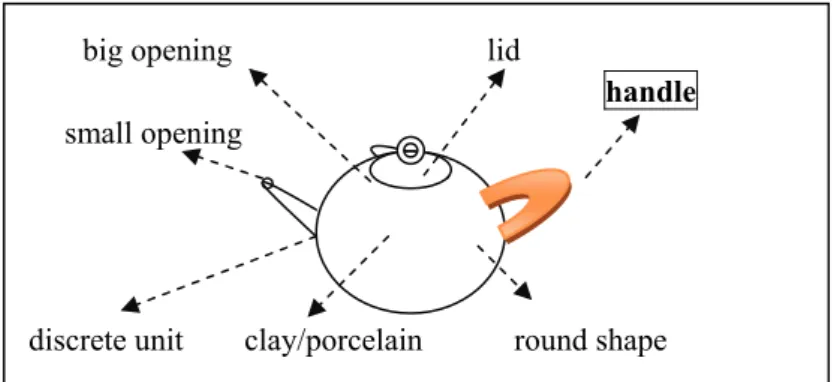
Finally, though C/M share the cognitive function as a divider (Borer 2005) or parceler (Landman 2004) for the noun, C uniquely serves the function as a profiler, in the sense of Fillmore (1982) and Langacker (1987), and highlights a certain inherent semantic feature of the noun (Hsieh 2009, Her & Lai to appear, Her & Hsieh 2011). Take (12) for example.
(12) 一 把 壺
yi ba hu
one C(handle) teapot
Structure of Classifiers and Measure Words
1217
big opening lid
handle
small opening
discrete unit clay/porcelain round shape Figure 1: N as Frame and C as Profile
Figure 1 shows schematically that N pot provides the frame, where having a handle is an inherent feature, which is profiled by C ba.3 This view explains why C, as a mathematically vacuous element, is needed for a cognitively-motivated linguistic function. The many C’s in a classifier language thus represent the many ways to profile the multiplicand 1 in the language (Greenberg 1990a:172, Her & Lai to appear). Since a C can only profile a feature that the noun inherently possesses, this view also explains quite naturally why each C selects its class of nouns. Different languages can thus have different ways to profile this multiplicand 1, and therefore different ways to classify nouns. In fact, within the same language, the same noun may have more than one profilable feature. For example, teapot can also co-occur with the general classifier ge, as in yi ge hu (1 C teapot). In the case of a general classifier, it profiles the discreteness of the entity and thus selects nouns that are countable.
2.2 C/M’s differences in behavior
This subsection first illustrates the different behaviors that C/M display, which, as revealed by Her & Hsieh (2010) and Her (to appear), is due to the semantic distinction between C/M in [Num C/M N], where C is redundant and M substantive.
3 A reviewer pointed out that this analysis fails to account for ba in such examples as 一把鼻
涕、一把眼淚 yi ba biti, yi ba yanlei (one handful nasal-mucus, one handful tear) ‘a handful of nasal-mucus and a handful of tears’, indicating some serious crying and sobbing. Note, however, as noted by many researchers (e.g. Her & Lai to appear), certain lexemes may function as a C and an M, ba being a good example. The two instances above involve ba as an M, meaning handful, not a C profiling the handle. The reviewer is correct, nonetheless, in suggesting that both cases should find origin in the verbal meaning of hold in Archaic Chinese.