
網路中介模擬環境中的多元智能評量-在情境中利用Agents收集學生資訊
103
0
0
全文
(2) 網路中介模擬環境中的多元智能評量- 在情境中利用 Agents 收集學生資訊. Assessing Multiple Intelligences in Internet-mediated Simulation Environments: Using Agents to Collect Student Information. 研 究 生:雷佩嵐. Student:Pei-Lan Lei. 指導教授:孫春在. Advisor:Chuen-Tsai Sun. 國 立 交 通 大 學 資 訊 科 學 系 碩 士 論 文. A Thesis Submitted to Institute of Computer and Information Science College of Electrical Engineering and Computer Science National Chiao Tung University in partial Fulfillment of the Requirements for the Degree of Master in Computer and Information Science June 2004 Hsinchu, Taiwan, Republic of China. 中華民國九十三年六月.
(3) 網路中介模擬環境中的多元智能評量- 在情境中利用 Agents 收集學生資訊. 學生:雷佩嵐. 指導教授:孫春在 教授. 國立交通大學資訊科學系碩士班. 摘要. 評量不該侷限於容易施測與評分的評量方式,透過科技的協助,電腦可以設 計不同層次的遷移情境,可得知學生的解題過程與結果,進而可以瞭解學生對概 念掌握的層次,利用科技整合的趨勢使評量可以更多元化、更深入。 在電腦網路中介模擬的環境中,透過模擬環境營造適合的場景、情境與氣 氛,利用代理人扮演各種角色,與使用者進行多次訪談來收集學生資訊,讓學生 在進行教學活動的過程中不知不覺地進行評量,評估學生在電腦網路中介模擬環 境中各方面的學習成效,驗證在此環境從事學習活動可提升學生的多元智能,亦 可驗證多元智能評量也很適合在電腦網路中介模擬環境中進行。. 關鍵詞:網路中介模擬、Multiple User Dungeon(MUD)、多元智能、多元智能 評量、訪談式評量、真實性評量、智慧型代理人、語意網路。. i.
(4) Assessing Multiple Intelligences in Internet-mediated Simulation Environments: Using Agents to Collect Student Information Student:Pei-Lan Lei. Advisor:Dr. Chuen-Tsai Sun. Institute of Computer and Information Science National Chiao Tung University. ABSTACT With the help of modern technology, assessments methods nowadays are not confined to traditional tests and grades. Through computer generated multi-layer scenario simulations, the process of students solving problems and obtaining results can be recorded and analyzed, providing means of measurements of students’ actual understanding and mastery of the target knowledge. The integration with technology gives assessments more dimensions and depth. With internet-mediated simulation, appropriated scene, situation and atmosphere are simulated, and agents are used to act upon different roles, interviewing students multiple times to gather data for assessments, all without students aware of the on-going assessments, which covers every aspects of internet-mediated simulation assisted learning. This method is proven to enhance the development of students’ multiple intelligences, the assessments of which has also been proven to be best achieved via internet-mediated simulation.. Keywords:Internet-mediated simulation, multiple user dungeon, MUD, multiple intelligence assessments, authentic assessment, interaction model assessment, intelligent agents. ii.
(5) 誌 謝 完成這篇碩士論文需要花上許多的時間與功夫,當然也需要許多人的幫助; 就像建立一個 MUD 遊戲一樣,需要許多的大神及巫師來共同努力。能夠很順利 的在兩年內完成學業,我很感謝所有給我幫助的人。 首先要感謝的就是我的指導教授孫春在老師,老師不但指導我作研究的方 法,從他身上還可以學習許多為人處事的道理。感謝林珊如老師在教育理論及統 計學方面不厭其煩的指導。也很感謝王淑玲老師、袁賢銘老師在口試時給了我許 多寶貴的意見。 再來要感謝本實驗室熱心又能幹的學習伙伴們,特別是博士班的學長姊: Kenny、岱伊、宜敏,碩士班的偉智、宗翰,以及學弟學妹,大家在 meeting 時 會給我很多批評指教、激勵、督促與協助;還有在職專班的學長姊家玉、翠萍等 人在做教學實驗時所給予的協助,有了大家的鼓勵與幫助,我的論文才能如期完 成。 另外還得感謝我的家人、朋友在經濟上、生活上的支援,讓我沒有後顧之憂, 得以專心的完成論文,像是外語能力不錯的弟弟及乾媽,謝謝他們幫我修改英文 論文;還有謝謝小 J 及熊寶寶在這兩年來陪伴我,分享我的喜怒哀樂。 最後再次感謝曾經在這兩年內給予我協助的人,謝謝大家!. iii.
(6) 目錄 中文摘要 ....................................................................................................................... I 英文摘要 ......................................................................................................................II 誌 謝........................................................................................................................... III 目錄............................................................................................................................. IV LIST OF TABLES....................................................................................................VII LIST OF FIGURES .................................................................................................VII 表目錄 ..................................................................................................................... VIII 圖目錄 ........................................................................................................................ IX. Condensed Version in English 1. INTRODUCTION....................................................................................................2 2. BACKGROUND ......................................................................................................3 2.1. COMPUTER-ASSISTED SIMULATION ...................................................................3 2.2. MUDS ..............................................................................................................4 2.3. MULTIPLE INTELLIGENCE ASSESSMENTS ..........................................................5 2.4. INTELLIGENT AGENTS .......................................................................................7 3. METHOD ...............................................................................................................10 4. STUDY DESIGN.................................................................................................... 11 4.1. 4.2.. DEVELOPMENT ENVIRONMENT .......................................................................11 SCENES ...........................................................................................................12. 4.3. AGENT DESIGN ...............................................................................................12 4.3.1. Agent Questions ......................................................................................12 4.3.2. User response..........................................................................................13 5. EXPERIMENT ......................................................................................................14 6. RESULTS................................................................................................................15 6.1. QUESTION VERIFICATION.................................................................................15 6.1.1. Item analysis ...........................................................................................16 6.1.2. Reliability analysis & factor analysis .....................................................16 iv.
(7) 6.2. TEST RESULTS ANALYSIS .................................................................................16 6.2.1. Analysis of the paired-samples t test.......................................................17 6.2.2. Analysis using oneway ANOVA...............................................................18 6.3. VALIDITY OF MULTIPLE INTELLIGENCE ASSESSMENTS WITH COMPUTER INTERNET-MEDIATED SIMULATION ............................................................................20 6.3.1. The result of polygon...............................................................................20 6.3.2. The result of the Spearman rank order correlation coefficient...............22 7. CONCLUSIONS ....................................................................................................22 REFERENCES...........................................................................................................25. 中文版論文 一、. 導論..............................................................................................................28. 1.1 1.2 1.3. 研究動機.........................................................................................................28 研究目標.........................................................................................................29 論文架構.........................................................................................................29. 二、. 文獻探討 .....................................................................................................30. 2.1 電腦社會模擬.................................................................................................30 2.1.1 網路中介模擬..........................................................................................30 2.1.2 MUD ........................................................................................................31 2.2 多元智能.........................................................................................................32 2.2.1 多元智能理論..........................................................................................32 2.2.2 多元智能評量..........................................................................................33 2.3 評量.................................................................................................................34 2.3.1 真實性評量..............................................................................................34 2.3.2 訪談式評量..............................................................................................35 2.4 智慧型代理人.................................................................................................36 2.4.1 代理人......................................................................................................36 2.4.2 語意網路..................................................................................................38 2.4.3 自然語言處理..........................................................................................39 三、. 研究方法 .....................................................................................................42. 3.1 3.2 3.3. 評量方法.........................................................................................................42 量化分析.........................................................................................................42 質化分析.........................................................................................................44. v.
(8) 四、. 系統設計 .....................................................................................................45. 4.1 系統設計之目標.............................................................................................45 4.2 發展環境.........................................................................................................45 4.3 場景.................................................................................................................45 4.4 AGENT 之設計 ................................................................................................46 4.4.1 Agent 說話 ...............................................................................................46 4.4.2 User 答話 .................................................................................................47 4.5 介面說明.........................................................................................................48 4.6 記錄功能.........................................................................................................53 五、. 實驗..............................................................................................................54. 5.1 實驗設計.........................................................................................................54 5.1.1 實驗目標..................................................................................................54 5.1.2 實驗對象..................................................................................................54 5.1.3 實驗流程..................................................................................................55 5.2 實驗經過與記錄.............................................................................................55 5.3 實驗結果.........................................................................................................64 5.3.1 MUD 課程心得問卷結果 .......................................................................64 5.3.2 量化分析結果..........................................................................................65 5.3.3 質化分析結果..........................................................................................84 六、. 總結與展望 .................................................................................................86. 6.1 6.2 6.3. 結論.................................................................................................................86 實驗之貢獻與限制.........................................................................................86 未來展望.........................................................................................................88. 參考文獻 .....................................................................................................................90. vi.
(9) List of Tables TABLE 1. ACTIVITIES, SCENES, AND AGENT DESCRIPTIONS FOR THE THREE MUD ASSESSMENT PROCESSES. ......................................................................................11 TABLE 2. WORDS USED TO MEASURE AND ANALYZE USER RESPONSES TO AGENT QUESTIONS. ...........................................................................................................14 TABLE 3. DESCRIPTION OF THE STUDY PARTICIPANTS....................................................15 TABLE 4. RESULTS FROM STATISTICAL TESTS ON SCORES ON PRE-TEST AND POST-TEST QUESTIONNAIRES. .................................................................................................18 TABLE 5. MEAN AND STANDARD DEVIATION STATISTICS FOR STUDENT SCORES ON PRE-TEST, POST-TEST 1, AND POST-TEST 2 INSTRUMENTS OF MUD. ......................18 TABLE 6. STATISTICAL RESULTS FROM A ONEWAY ANOVA OF STUDENT SCORES ON PRE-TEST, POST-TEST 1, AND POST-TEST 2 INSTRUMENTS OF MUD. ......................19 TABLE 7. THE COEFFICIENT OF CORRELATION OF THE INTELLIGENCES BETWEEN TWO KINDS OF ASSESSMENTS OF THE FIRST WEEK AND OF THE THIRD WEEK..................22. List of Figures FIGURE1. PORTION OF CONVERSATIONAL NETWORK. ......................................................9 FIGURE 2. ASSESSMENT METHODS USED IN THE STUDY. ................................................10 FIGURE 3. ONE SECTION OF A SEMANTIC NETWORK CONSTRUCTED TO CONTROL AGENT INTERVIEWS. .........................................................................................................13 FIGURE 4. TWO ILLUSTRATIONS OF THE USER INTERFACE..............................................14 FIGURE 5 TWO ILLUSTRATIONS OF THE EXPERIMENT.....................................................15 FIGURE 6 METHODOLOGY USED TO SHOW LEARNING UNDER THIS ENVIRONMENT MAY PROMOTE MULTIPLE INTELLIGENCES OF THE STUDENTS. .......................................17 FIGURE 7 THE METHOD OF PROVE THAT MULTIPLE INTELLIGENCE ASSESSMENTS ARE VERY SUITABLE PROCEED UNDER COMPUTER INTERNET-MEDIATED SIMULATION.. .20. FIGURE 8. THE POLYGON OF THE SCORES OF THE FIVE INTELLIGENCES THAT WE USED THE “QUESTIONNAIRE” AND “AGENT INTERVIEW” TO MAKE ASSESSMENT. ............21. vii.
(10) 表目錄 表 表 表 表 表 表 表 表 表 表 表 表 表 表 表 表 表. 1 在 MUD 中三次評量活動、場景、人物簡介 .................................................46 2 使用者答案各種詞類得分表 ............................................................................47 3 實驗對象簡介 ....................................................................................................54 4 實驗流程與內容 ................................................................................................55 5 紙本問卷版的前測題目之項目分析結果總表 ................................................65 6 MUD 中的前測題目之項目分析結果總表.....................................................67 7 MUD 中的後測 1 題目之項目分析結果總表.................................................69 8 MUD 中的後測 2 題目之項目分析結果總表.................................................71 9 紙本問卷版的後測題目之項目分析結果總表 ................................................73 10 五次評量整份問卷題目之內部一致性信度 ..................................................75 11 紙本問卷前測之因素分析摘要表 ..................................................................76 12 MUD 中前測之因素分析摘要表 ..................................................................77 13 MUD 中後測 1 之因素分析摘要表 ..............................................................78 14 MUD 中後測 2 之因素分析摘要表 ..............................................................79 15 紙本問卷後測之因素分析摘要表 ..................................................................80 16 學生五項智能紙本問卷成績前後測之 T 考驗摘要表 ..................................81 17 學生五項智能在 MUD 中評量成績前測、後測 1、後測 2 之敘述統計摘要 表..........................................................................................................................81 表 18 學生五項智能在 MUD 中評量成績前測、後測 1、後測 2 之重複量數變異 數分析摘要表......................................................................................................82 表 19 五種智能用兩種不同評量方式所得到成績的相關係數摘要表 ..................84 表 20 語言智能與人際智能用兩種不同評量方式所得到成績的相關係數摘要表 ..............................................................................................................................85. viii.
(11) 圖目錄 圖 圖 圖 圖 圖 圖 圖 圖 圖 圖 圖 圖 圖 圖 圖 圖 圖 圖 圖. 1 語意網路圖 ........................................................................................................38 2 PORTION OF CONVERSATIONAL NETWORK ..........................................................39 3 評量進行方式 ....................................................................................................42 4 驗證網路中介模擬環境可提升學生多元智能的方式 ....................................43 5 驗證多元智能評量很適合在網路中介模擬環境中進行的方式 ....................43 6 一部份對話的語意網路圖 ................................................................................47 7 進入算命活動,AGENT(心心王子)出現。..................................................49 8 「心心王子」與使用者的對話情形。 ............................................................49 9 AGENT(記者小立)出現在花蓮車站。 ........................................................50 10 USER 可在場景內任意移動,記者「小立」也會跟隨使用者一起移動。 51 11 AGENT(黃金蟒)與 USER 的對話情形。 .....................................................52 12 AGENT(炎魔)在「末日火山」中出現。 ..................................................52 13 USER 回答完問題後,「炎魔」幫助他過關。 ..............................................53 14 部分測驗題目 ..................................................................................................56 15 觀看學生活動情形 ..........................................................................................58 16 講解如何進行活動 ..........................................................................................61 17 指導學生進行活動 ..........................................................................................63 18 部分測驗題目 ..................................................................................................64 19 從第一週到第三週語言智能成績變化折線圖 圖 20 從第一週到第三週邏 輯智能成績變化折線圖......................................................................................83 圖 21 從第一週到第三週空間智能成績變化折線圖 圖 22 從第一週到第三週人 際智能成績變化折線圖......................................................................................83 圖 23 從第一週到第三週內省智能成績變化折線圖 ..............................................83. ix.
(12) Assessing Multiple Intelligences in Internet-mediated Simulation Environments: Using Agents to Collect Student Information. Pei-Lan Lei, and Chuen-Tsai Sun Department of Computer Information Science, National Chiao Tung University, Hsinchu, Taiwan, ROC. Email: [email protected], [email protected]. ABSTRACT With the help of modern technology, assessments methods nowadays are not confined to traditional tests and grades. Through computer generated multi-layer scenario simulations, the process of students solving problems and obtaining results can be recorded and analyzed, providing means of measurements of students’ actual understanding and mastery of the target knowledge. The integration with technology gives assessments more dimensions and depth. With Internet-mediated simulation, appropriated scene, situation and atmosphere are simulated, and agents are used to act upon different roles, interviewing students multiple times to gather data for assessments, all without students aware of the on-going assessments, which covers every aspects of Internet-mediated simulation assisted learning. This method is proven to enhance the development of students’ multiple intelligences, the assessments of which has also been proven to be best achieved via Internet-mediated simulation.. Keywords: Internet-mediated simulation, multiple user dungeon, MUD, multiple intelligence assessments, authentic assessment, interaction model assessment, intelligent agents.. 1.
(13) 1. Introduction Multi-intelligence in teaching and learning and diversification of teaching assessments methods have become a major trend in today’s education practice. According to Gardner(Gardner,1993,1998), multiple intelligences may be presented in 8 aspects. The teaching results of any subject can be presented and assessed with these 8 aspects. The proceedings of multiple intelligences assessments are particularly fit for real-life situations. However, real-life situations are not easy or practical to construct, for example, we cannot give every student ten million dollars to learn how to invest. Via technology, however, we can simulate some situations that are hard to create otherwise and to facilitate learning. Combining “multiple intelligences assessments ” and “Internet-mediated simulation system”, multiple intelligences assessments can be processed without unduly interrupt learning or rehearsal processes. The current learning system of Internet-mediated simulation lacks tests and assessments mechanism, making it impossible to evaluate the results of the learning; while the current “on-line questionnaire data-base” or ” on-line questionnaire” are almost the same as the traditional paper-and pencil test and paper questionnaire except that they are on the Internet. Such a simple design seems to violate current educational goals in that the assessment method really does not match the Internet-mediated simulation environment. In an effort to narrow this gap, we will propose to combine multiple intelligences assessments method and Internet-mediated simulation to evaluate students learning.. 2.
(14) We hope that, on the one hand, by role-playing in virtual reality, students have more opportunities to utilize their multiple intelligences. Accordingly, assessments based on this will be a better fit for assessing multiple intelligences. On the other hand, by means of putting multiple intelligences assessments into practice, we may evaluate and judge the learning effect of student during the simulating process and know what the students have learnt. In sum, our research aims at proving that 1) computer simulation can help the development of multiple intelligence and the proceeding of multiple assessments (with the case of Internet-mediated simulation enhancing students’ multiple intelligence), and 2) integrating multiple intelligence assessments into computer simulation system will be more interesting and lively than traditional questionnaire based tests (i.e. multiple intelligence assessments is a good fit for Internet-mediated simulation).. 2. Background 2.1. Computer-assisted simulation Previous research (Lin and Sun, 2003) has identified that the most important features of Internet-mediated simulations are 1. Convenience of observation. Observations of social experiences are made difficult by potential interference, the speed of the observed phenomenon, legal issues, and ethical concerns. Simulations have the advantage of being able to control a scenario without accidentally interfering in its outcome (Epstein & Axtell, 1996). 2. Convenience in training and entertainment. Today, computer hardware or 3.
(15) software is becoming more accessible in terms of costs, and high-level language and simulation software tools are making complicated simulation easy to achieve. Using simulation can greatly reduce the cost and risk involved in training. Two simple examples are the reduced risks involved in using a simulation program instead of an airplane to train pilots, and the use of Richman and EC MUD to teach economic principles (Lin and Sun, 2003) without the actually risk of bankruptcy. 3. Ability to construct artificial prototype societies. Simulations allow for the participates to role play, be it real humans and/or agents, and it provides parameters that are large enough to allow for direct observations of social reactions (Gilbert, 1999). Furthermore, simulations allow for“person to person”interactions that support the study of social processes and multiple interactions through computer and the Internet. These features of Internet-mediated simulation make it suitable for educational purposes. On the one hand it is cost effective, safe, and convenient; on the other hand, computers can monitor the whole learning process and provide detailed record to assist our observation.. 2.2. MUDs MUD is one kind of Internet-mediated simulation. The MUD acronym refers to Multi-User Dungeon, Multi-User Domain, or Multi-User Dimension—three names for multiple user platforms with written language interfaces. MUDs allow for situational simulations, role-playing, multiple online users, and real-time communication, and can therefore create a strong sense of belonging to an area or community. The interaction mechanisms of a MUD 4.
(16) society allow its users to strengthen the feeling of reality in virtual space. Most of the earliest MUDs are combat-oriented MUDs, users are now familiar with educational, social, and role-playing MUDs. See Cherny (1995), Curtis (1992), Hsieh & Sun (2004), Isbell & Kearns (2000), Reid (1995) and Turkle (1995). MUDs are widely deployed in education. Educational MUDs (of which there are many) are used to motivate learning and promote interactive learning. As the metaphors in MUDs are considered a major factor in situated learning, MUDs are used to create situated learning environments. In Teacher-centered learning, MUDs transfer knowledge to learners/players via human teacher or intelligent agent; while in learner-centered learning, teachers act as facilitators or consultants rather than instructors when attending to learner needs. They do not actively teach but just answers questions promptly to assist learning. (Hsieh & Sun, 2004). With the rich features of MUDs, our goal is to create a system utilizing MUDs, through which students participate and interact with the system and each other to learn the concept concerning programming language intuitively rather than passively. Because they learn the concepts through role-playing, it brings more meaning to them. We as educator use MUDs as a research environment, conducting multiple intelligence assessments to research and analyze the result of teaching and learning.. 2.3. Multiple Intelligence Assessments Howard Gardner, professor in the department of education in Harvard, has been researching the development of human intelligence for many years. He successfully challenged the hypotheses of traditional intelligence theory, i.e. 5.
(17) human intelligence is single vectored and that we can use a single, quantitative approach to evaluate each individual. He defined intelligence as (Gardner,1983): The ability of coping with problem in life, the ability of coming up with a solution, and the ability of contribution to the culture which he belongs to. Gardner came up with the concept of multiple intelligences, arguing that human being has several important and individual capabilities, breaking the broad-defined intelligence into functions and capabilities applicable in life. Gardner’s (1983) list of eight intelligences includes linguistic, logical-mathematical, spatial, bodily-kinesthetic, musical, interpersonal, intrapersonal, and naturalist. A considerable number of studies have confirmed his theoretical assumptions, and a large number of school systems are incorporating the multiple intelligence concept into their curricula across subjects and age groups (Armstrong, 1994; Campbell & Campbell, 1999; Hoerr, 2001). Gardner (1993) has criticized the practice of using paper-and-pencil tests to measure multiple intelligences (see also Checkley, 1997), preferring instead to base assessment efforts on actual social situations. Specifically, he believes that the best way to assess student intelligences is to use a notation system while observing students operating a machine or dealing with disputes in collaborative learning groups. For Gardner and his supporters (e.g., Stanford, 2003), the best assessment system is to observe student actions under real-world conditions. Gardner (1993) also created a list of eight general features of any successful multiple intelligence assessment process: a) it should emphasize 6.
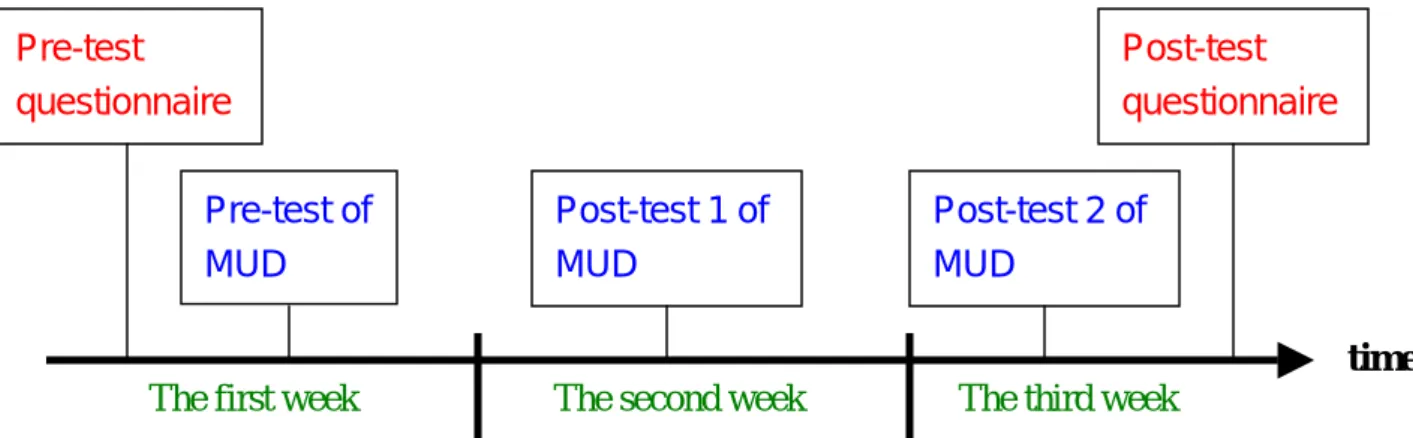
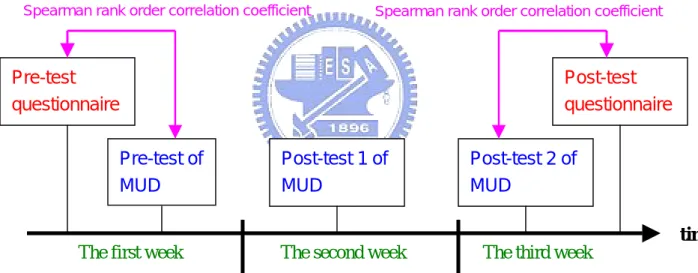
(18) assessment rather than testing; b) it should be simple, natural, and take place according to a reliable schedule; c) it should have good ecological validity; d) it should make use of instruments that are intelligent and fair; e) it should use multiple measures; f) it should be sensitive to individual differences, developmental levels, and forms of expertise; g) it should use intrinsically interesting and motivating materials; and h) it should be of benefit to students. Gardner hopes the idea of multiple intelligence can help to bring forward more effective teaching and evaluation methods. Nowadays, with the advent of computers and virtual technologies, it is possible to look directly at individuals’ performances—to see how they can argue, debate, look at data, critique experiments, execute works of art, and so on.(Gardner, 1998) We wish to take advantage of the abilities of the computer, i.e. to simulate real-life situations, to feedback and record during the learning process while improving the user experience with user-friendly processes and interfaces with computers. The MUDs environment is a good fit for multiple intelligences assessments proposed by Gardner, so we decided to use Internet-mediated environment to conduct our assessments.. 2.4. Intelligent Agents Another common name for intelligent agent is “software robot” (“bot” for short). Generally speaking, an agent is something that can be programmed to automatically execute instructions according to specific parameters within user-defined environments. Even in the absence of user supervision, bots can respond to environmental changes—for instance, an e-mail agent can classify or reply to a message (Malone, Lai & Grant, 1997). Other common agents are 7.
(19) used to schedule meetings, collect and organize data, and perform simple negotiations. Bradshaw (1997) used the following characteristics to describe intelligent agents: 1) autonomy, 2) adaptivity, 3) collaborative behavior, and 4) inferential capability. In computer-assisted learning, educational agents can increase the level of multiplicity in learning environments, broaden community diversity, and encourage student communication. Using scripts to add some human qualities, agents can play non-authoritative roles in social learning environments—for example, knowledge suppliers (tutors), information suppliers (advisors or learning companions), subordinates or rivals, or guides who adjust a MUD game or environment according to user progress (Chou, Chan & Lin, 2003). By writing detailed, flexible scripts, MUD designers can create agents with considerable amounts of autonomy and inferential capability. Such agents basically wait patiently inside a game or learning environment for the appropriate situation to emerge so that they can interact with student users. A semantic network, as defined in Quillian (1968), is a graph structure in which nodes (or vertices) represent concepts, while the arcs between these nodes represent relations among concepts. From this perspective, concepts have no meaning in isolation, and only exhibit meaning when viewed relative to the other concepts to which they are connected by relational arcs. For example, the Figure 1.. 8.
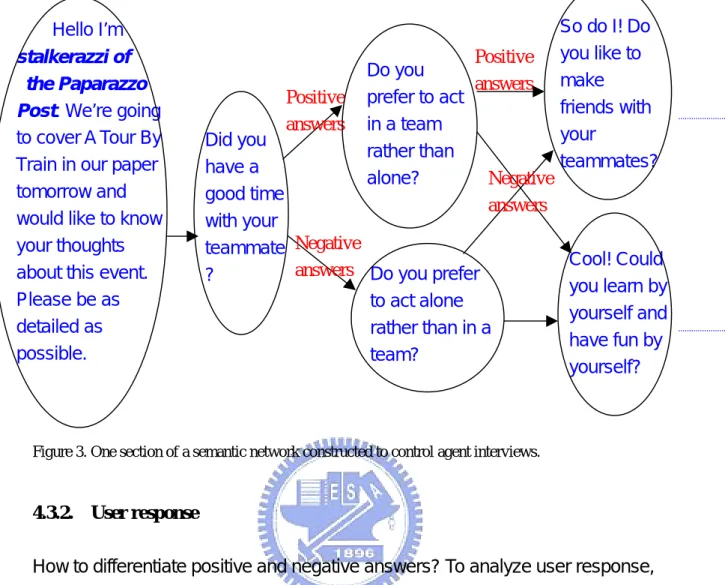
(20) Figure1. Portion of conversational network.. Semantic networks are an attempt to model the way we think about concepts, and have been used by psychologists and computer scientists alike in trying to explain, and simulate, intelligent behavior. Teachers and writers could find them useful in planning the structure of a handout, lesson plan, or even a whole syllabus. By analyzing topics in terms of their concepts and relationships one can quickly pinpoint how one concept might depend on another, what needs to be already known before the topic will make sense, a possible logical sequence in which topics should be taught, and where specific examples (and non-examples) of concepts might need to be given. In our studies, we use natural language processing to stimulate the conversation between intelligent tutoring system and students(Chou, Chan, & Lin, 2003). Through various technologies of natural language processing, we could achieve recording and tracking and user activities and data.. 9.
(21) 3. Method The five assessment tests designed for this study were a) a pre-test questionnaire, b) a pre-test of MUD, c) two post-tests of MUD (numbered as 1 and 2), and d) a post-test questionnaire. (Fig. 2) Since the student participants were attending schools in Taiwan, we used Dai’s (2001) Questionnaire on Students’ Multiple Intelligences, which she developed to assess student performance in National Kaohsiung Normal University’s Department of English. Her questionnaire was developed from Armstrong’s (1994) MI Inventory for Adults. The questionnaire contains 80 items that address all of Gardner’s intelligences; since our focus was on 5 of the 8 intelligences, we used 50 of the original items for our assessment purposes: 10 linguistic, 10 logical-mathematical, 10 spatial, 10 interpersonal, and 10 intrapersonal. Questions used in the 5 assessments are of the same style and nature, making it easier for comparison and analysis.. Pre-test questionnaire Pre-test of MUD. Post-test questionnaire Post-test 1 of MUD. Post-test 2 of MUD time. The first week. The second week. Figure 2. Assessment methods used in the study.. 10. The third week.
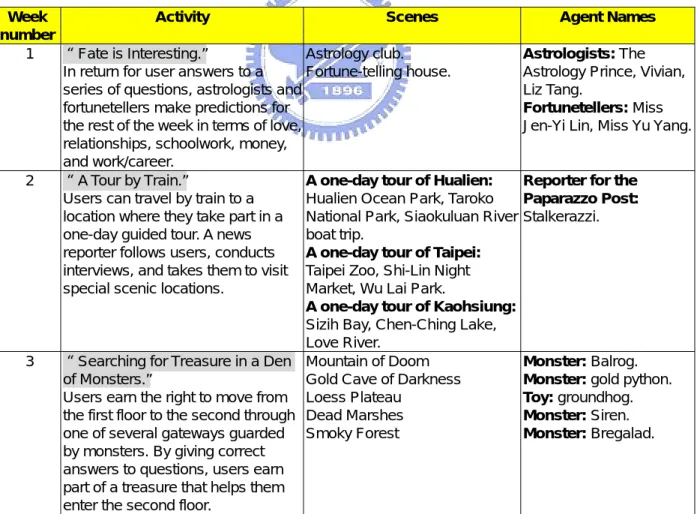
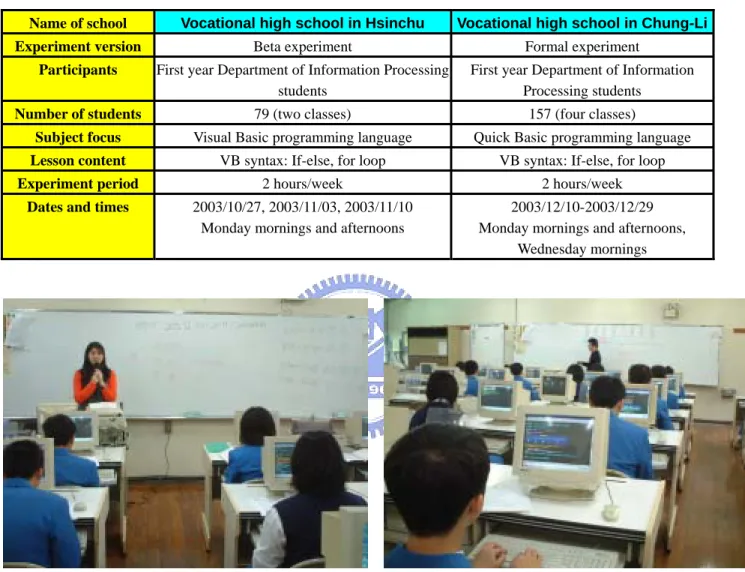
(22) 4. Study Design 4.1. Development Environment The experimental environment was an Internet-based, role-playing MUD with a written language interface. Upon entering, MUD visitors are introduced to the virtual room with detailed description. Various foreground and background elements can be mix and matched in the room by MUD program designers, depending on their intended purposes. Participants are able to meet and communicate with other users or agents. Important attributes that determine player status include gender, age, energy and amount of available money. Table 1. Activities, scenes, and agent descriptions for the three MUD assessment processes. Week Activity Scenes number 1 “Fate is Interesting.” Astrology club. In return for user answers to a Fortune-telling house. series of questions, astrologists and fortunetellers make predictions for the rest of the week in terms of love, relationships, schoolwork, money, and work/career. 2 “A Tour by Train.” A one-day tour of Hualien: Users can travel by train to a Hualien Ocean Park, Taroko location where they take part in a National Park, Siaokuluan River one-day guided tour. A news boat trip. reporter follows users, conducts A one-day tour of Taipei: interviews, and takes them to visit Taipei Zoo, Shi-Lin Night special scenic locations. Market, Wu Lai Park. A one-day tour of Kaohsiung: Sizih Bay, Chen-Ching Lake, Love River. 3 “Searching for Treasure in a Den Mountain of Doom of Monsters.” Gold Cave of Darkness Users earn the right to move from Loess Plateau the first floor to the second through Dead Marshes one of several gateways guarded Smoky Forest by monsters. By giving correct answers to questions, users earn part of a treasure that helps them enter the second floor.. 11. Agent Names Astrologists: The Astrology Prince, Vivian, Liz Tang. Fortunetellers: Miss Jen-Yi Lin, Miss Yu Yang.. Reporter for the Paparazzo Post: Stalkerazzi.. Monster: Balrog. Monster: gold python. Toy: groundhog. Monster: Siren. Monster: Bregalad..
(23) 4.2. Scenes It was considered essential to create good matches among assessment activity design, MUD content, and teaching activities. As stated above, our goal was to remove all sense of disconnection between teaching/learning and assessment activities. Accomplishing this required scenarios that were both exciting and varied in order to maintain a high level of user attention. Although the primary purpose of our intelligent agent was to communicate with users in order to gather data, it was important to make agent-centered interruptions as short and seamless as possible. We therefore divided the 50 questions into several small groups, and tried our best to match questions with appropriate scripts and scenes. We also gave the agent different external appearances, and took care to insert and remove the agent into activities in an entertaining manner.. 4.3. Agent Design 4.3.1.. Agent Questions. We gave our agents the ability to converse with and ask questions of users. User responses were analyzed, scored according to their content (see 4.3.2.), and recorded. Using semantic network, we’ll be able to develop logical dialogues with users. Several semantic networks were designed to match a range of potential script developments. Question order followed semantic network links (Fig. 3).. 12.
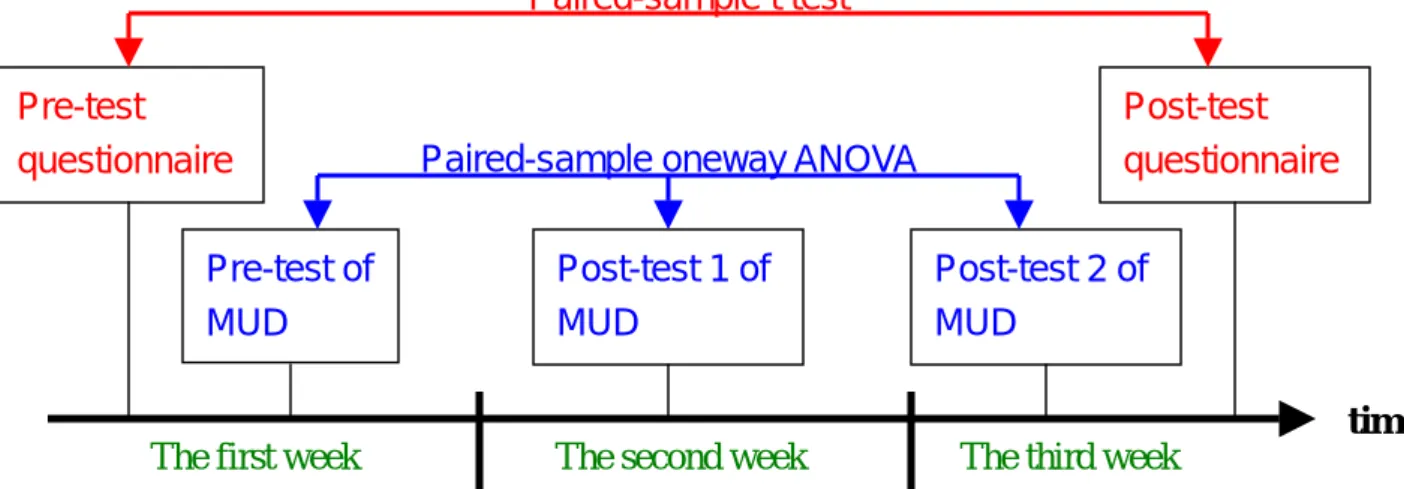
(24) Hello I’m stalkerazzi of the Paparazzo Post. We’re going to cover A Tour By Train in our paper tomorrow and would like to know your thoughts about this event. Please be as detailed as possible.. Positive answers. Positive Do you answers prefer to act in a team rather than alone? Negative answers. Did you have a good time with your teammate Negative answers Do you prefer ? to act alone rather than in a team?. So do I! Do you like to make friends with your teammates?. Cool! Could you learn by yourself and have fun by yourself?. Figure 3. One section of a semantic network constructed to control agent interviews.. 4.3.2.. User response. How to differentiate positive and negative answers? To analyze user response, sentence elements were identified and categorized as adverbs, or words of negation; points were either given (0, 1, or 2) or subtracted (1) depending on the appearance of these words (Table 2). Ambiguous responses (e.g., “not bad,” “so-so”) received 0 points, and answers implying uncertainty or nonsense ideas triggered an agent to repeat a question. Points for individual words were multiplied to produce a total score (from –2 to +2) for each sentence. For example: I love him very much. I felt so-so. I don’t like it. I really hate to keep a diary. I don’t know.. 1*1*2=2 +2 points 0 0 points -1*1*1=-1 -1 point 1*-1*2=-2 –2 points repeat questions. 13.
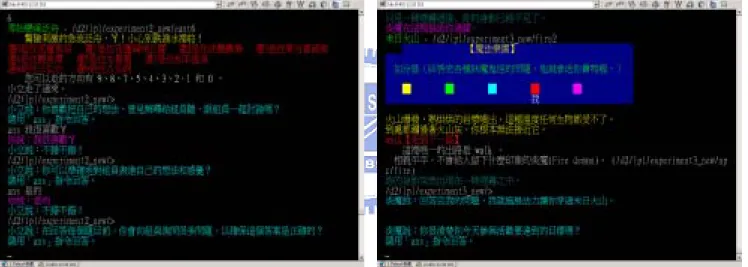
(25) Table 2. Words used to measure and analyze user responses to agent questions. Answers ambiguous responses or nonsense ideas triggered like, love, yes, fit in not, none, very, greatly, pretty, only just, just on, I don’t know, uncertain, without…etc. with, may, ok, clear, extremely, often, not bad, so-so, not sure…etc, or can, agree with, proper, no affect, always, super, the most, nonsense able, want, much…etc. acceptable, fairly, absolutely…etc. Gain 1 point passable, Gain 2 point Gain –1 point common…etc. No use any adverb. No use any bad, dislike, hate, no, negative. disagree, less…etc Gain 0 point ask again Gain 1 point Gain 1 point Gain –1 point Adverb. Negative. Adjective. Implying uncertainty. The primary purpose of this scoring system was to make it possible to conduct a quantitative analysis and to make comparisons between agent-based calculations and scores from questionnaire responses.. Figure 4. Two illustrations of the user interface.. 5. Experiment The experiment was performed with two sets of participants. Immediately after creating the system, first-year Department of Information Processing students from the vocational high school in Hsinchu took part in our beta experiment. We used the students’ in-class responses, usage records, and responses to usage-experience questionnaires to modify the first version of the experiment. We then performed the actual experiment with first-year Department of 14.
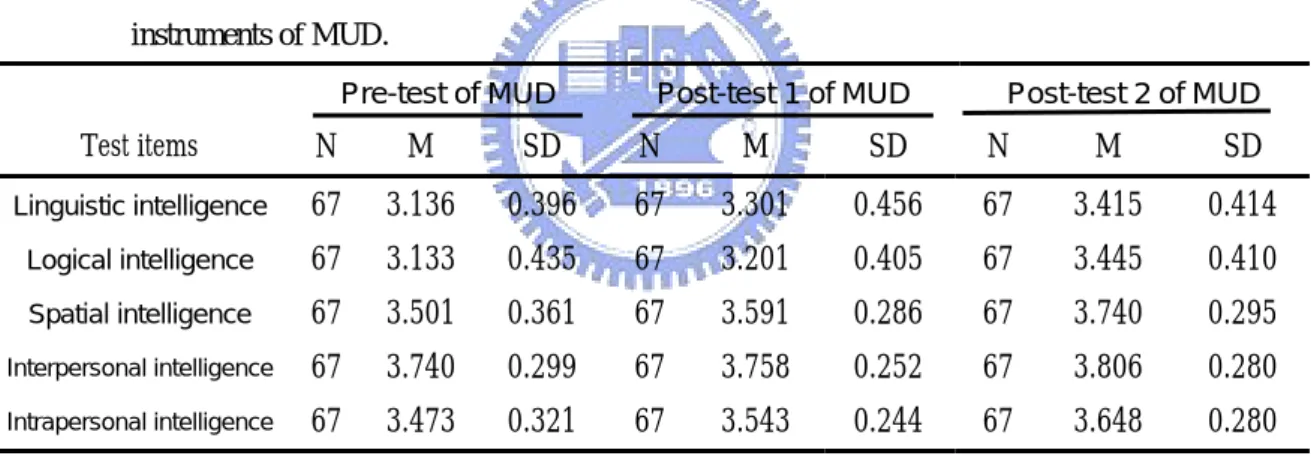
(26) Information Processing students from the vocational high school in Chung-Li. Details on the participants and other aspects of the test run and final experiment are presented in Table 3. Table 3. Description of the study participants. Name of school. Vocational high school in Hsinchu. Vocational high school in Chung-Li. Experiment version. Beta experiment. Formal experiment. Participants. First year Department of Information Processing students. First year Department of Information Processing students. Number of students. 79 (two classes). 157 (four classes). Subject focus. Visual Basic programming language. Quick Basic programming language. Lesson content. VB syntax: If-else, for loop. VB syntax: If-else, for loop. Experiment period. 2 hours/week. 2 hours/week. Dates and times. 2003/10/27, 2003/11/03, 2003/11/10 Monday mornings and afternoons. 2003/12/10-2003/12/29 Monday mornings and afternoons, Wednesday mornings. Figure 5 Two illustrations of the experiment.. 6. Results 6.1. Question verification Item analysis was used to assess the reliability of individual exam questions, and a combination of reliability and factor analysis was used to evaluate. 15.
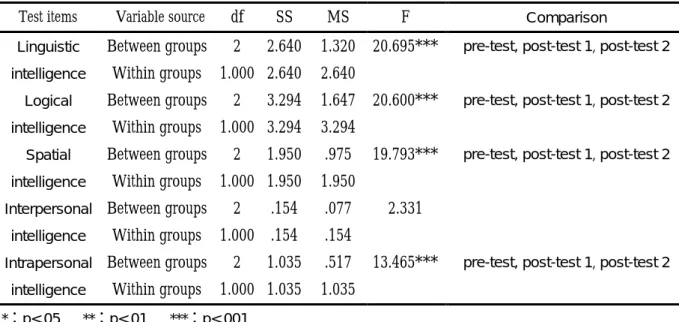
(27) overall questionnaire reliability. Improper and redundant questions are deleted upon the analysis.. 6.1.1.. Item analysis. Each question will go through 6 tests and some questions were deemed unreliable and deleted if they matched three or more of the 6 reasons for disqualification: unequal means distribution, small standard deviation, large skewness factor, t test results that did not match observed significance levels, correlation coefficients less than 0.2, and/or factor loadings less than 0.3. In all, 14 of the original 50 items on the questionnaire were deleted.. 6.1.2.. Reliability analysis & factor analysis. A Cronbach’s coefficient test was used to examine the assessment tools and their individual sections (linguistic, logical, spatial, interpersonal, and intrapersonal intelligences). A minimum coefficient of 0.7 was required for acceptance. Cronbach coefficient statistics were calculated as follows: 0.8880 for the pre-test questionnaire, 0.8121 for the pre-test of MUD, 0.8307 for the post-test 1 of MUD, 0.8015 for the post-test 2 of MUD, and 0.9102 for the post-test questionnaire. Most of the Cronbach statistics were acceptable, but several reliability statistics were at the very low end of the acceptable range. We will make an effort to address this issue before using these questions in future studies.. 6.2.. Test results analysis. We adopted paired-sample t test and paired-sample oneway analysis of variance (oneway ANOVA) to analyze the assessments of the two 16.
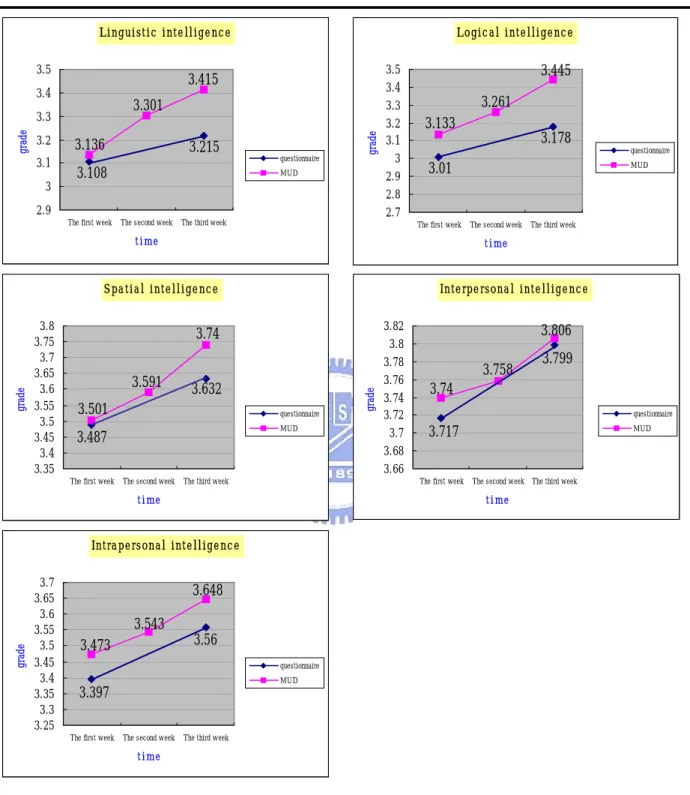
(28) paper-and-pencil questionnaires and three MUDs to see whether there’s correlation between these two samples(see Fig 6). This demonstrates the impact of MUDs assisted learning in enhancing multiple intelligences.. Paired-sample t test Pre-test questionnaire. Post-test questionnaire. Paired-sample oneway ANOVA. Pre-test of MUD. Post-test 1 of MUD. Post-test 2 of MUD time. The first week. The second week. The third week. Figure 6 Methodology used to show learning under this environment may promote multiple intelligences of the students.. 6.2.1.. Analysis of the paired-samples t test. Statistical results on differences in the five intelligences among the student participants, as measured by t test calculations using scores from the pre- and post-test questionnaires, are presented in Table 4. The data reveal statistically significant differences between the scores for four of the five intelligences: linguistic, logical, spatial, and intrapersonal. For all five intelligences, average post-test scores exceeded pre-test scores. We therefore suggest that the students benefited from the agent interview feature of our MUD.. 17.
(29) Table 4. Results from statistical tests on scores on pre-test and post-test questionnaires. Pre-test questionnaire. Post-test questionnaire. Test items. M. SD. M. SD. df. Linguistic intelligence. 3.108 3.010 3.487 3.717 3.397. 0.567 0.622 0.611 0.354 0.501. 3.215 3.178 3.632 3.799 3.506. 0.517 0.605 0.574 0.585 0.528. 114 114 114 114 114. Logical intelligence Spatial intelligence Interpersonal intelligence Intrapersonal intelligence. *:p<.05. 6.2.2.. **:p<.01. t -2.925** -5.004*** -3.324*** -1.464 -4.278***. ***:p<.001. Analysis using oneway ANOVA. Below are the results by oneway ANOVA among the scores of pre-test of MUD, post-test 1 of MUD and post-test 2 of MUD(see Table 5 & Table 6): Table 5. Mean and standard deviation statistics for student scores on pre-test, post-test 1, and post-test 2 instruments of MUD. Pre-test of MUD. Post-test 1 of MUD. Post-test 2 of MUD. Test items. N. M. SD. N. M. SD. N. M. SD. Linguistic intelligence. 67. 3.136. 0.396. 67. 3.301. 0.456. 67. 3.415. 0.414. Logical intelligence. 67. 3.133. 0.435. 67. 3.201. 0.405. 67. 3.445. 0.410. Spatial intelligence. 67. 3.501. 0.361. 67. 3.591. 0.286. 67. 3.740. 0.295. Interpersonal intelligence. 67. 3.740. 0.299. 67. 3.758. 0.252. 67. 3.806. 0.280. Intrapersonal intelligence. 67. 3.473. 0.321. 67. 3.543. 0.244. 67. 3.648. 0.280. 18.
(30) Table 6. Statistical results from a oneway ANOVA of student scores on pre-test, post-test 1, and post-test 2 instruments of MUD. Test items. Variable source. df. SS. MS. F. Comparison. Linguistic. Between groups. 2. 2.640. 1.320. 20.695***. pre-test, post-test 1, post-test 2. intelligence. Within groups. 1.000 2.640. 2.640. Logical. Between groups. 20.600***. pre-test, post-test 1, post-test 2. intelligence. Within groups. Spatial. Between groups. 19.793***. pre-test, post-test 1, post-test 2. intelligence. Within groups. Interpersonal Between groups intelligence. Within groups. Intrapersonal Between groups intelligence *:p<.05. Within groups. **:p<.01. 2. 3.294. 1.647. 1.000 3.294. 3.294. 2. 1.950. .975. 1.000 1.950. 1.950. 2. .154. .077. 1.000 .154. .154. 2. 1.035. .517. 1.000 1.035. 1.035. 2.331 13.465***. pre-test, post-test 1, post-test 2. ***:p<.001. The data shows a significant difference in linguistic intelligence, logical intelligence, spatial intelligence and intrapersonal intelligence in pre-test of MUD, post-test 1 of MUD and post-test 2 of MUD. The average scores of the post-test 2 of MUD is higher than the post-test 1 of MUD; and the post-test 1 of MUD is higher than the pre-test of MUD. We can also see from the data that students made steady and noticeable progress in the linguistic intelligence, logical intelligence, spatial intelligence and intrapersonal intelligence after every MUD course with agent interview. They performed better in the four aspects week by week. Although they made some progress in interpersonal intelligence, it was subtler. According to the statistics of the assessments of the two paper-and-pencil questionnaires and the results tested with agent interviews, we found that in both cases students made significant progress in linguistic intelligence, logical intelligence, spatial intelligence and intrapersonal intelligence, but the progress in interpersonal intelligence is less obvious. It. 19.
(31) preliminarily confirmed that the results of the two methods of assessments were the same.. 6.3.. Validity of multiple intelligence assessments with computer Internet-mediated simulation. In order to compare results from the MUD-embedded assessment mechanism with results from the two paper-and-pencil questionnaires, we created two polygons, compared variances among the scores, and performed a Spearman rank order correlation coefficient test to determine if any relationships existed between the two assessment formats in weeks 1 and 3 (Fig. 7). Spearman rank order correlation coefficient. Spearman rank order correlation coefficient. Pre-test questionnaire. Post-test questionnaire Pre-test of MUD. Post-test 1 of MUD. Post-test 2 of MUD time. The first week. The second week. The third week. Figure 7 The method of prove that multiple intelligence assessments are very suitable proceed under computer Internet-mediated simulation.. 6.3.1.. The result of polygon. The results from the variance comparison indicate that both assessment formats were capable of measuring the same levels of the five intelligences (Fig. 8). We could see from the chart that the scores had similar variation trends and patterns in all five intelligences whether we used the. 20.
(32) “questionnaire” or “agent interview” to make assessment(see FIGURE 8). Both results are positive, providing compatible outcome. Li ngui st i c i nt e l l i ge nc e 3.5. 3.415. 3.4 grade. 3.1 3. 3.136. grade. 3.301. 3.3 3.2. Logi c a l i nt e l l i ge nc e. 3.215 questionnaire. 3.108. MUD. 2.9 The first week. The second week. 3.5 3.4 3.3 3.2 3.1 3 2.9 2.8 2.7. The third week. 3.445 3.261 3.133 3.178 questionnaire. The first week. t i me. grade. grade. 3.632. 3.501. questionnaire MUD. 3.487 The first week. The second week. The third week. Int e rpe rsona l i nt e l l i ge nc e. 3.74 3.591. The second week. t i me. S pa t i a l i nt e l l i ge nc e 3.8 3.75 3.7 3.65 3.6 3.55 3.5 3.45 3.4 3.35. MUD. 3.01. 3.82 3.8 3.78 3.76 3.74 3.72 3.7 3.68 3.66. 3.806 3.758 3.74 questionnaire. 3.717. The first week. The third week. 3.799. MUD. The second week The third week. t i me. t i me. grade. Int ra pe rsona l i nt e l l i ge nc e 3.7 3.65 3.6 3.55 3.5 3.45 3.4 3.35 3.3 3.25. 3.648 3.543 3.56. 3.473. questionnaire MUD. 3.397 The first week. The second week. The third week. t i me. Figure 8. The polygon of the scores of the five intelligences that we used the “questionnaire” and “agent interview” to make assessment.. 21.
(33) 6.3.2.. The result of the Spearman rank order correlation coefficient. Spearman rank order correlation coefficient was conducted to see whether the intelligences of the two kinds of assessments of the first week and that of third week are related.(see Table 7). Table 7. The coefficient of correlation of the intelligences between two kinds of assessments of the first week and of the third week. Test items. Correlation coefficient between. Correlation coefficient between. pre-test questionnaire and pre-test post-test questionnaire and post-test 2 of MUD during week 1. .441** .627** .449** .481** .509**. Linguistic intelligence Logical intelligence Spatial intelligence Interpersonal intelligence Intrapersonal intelligence. *:p<.05. **:p<.01. of MUD during week 3. .316** .329** .463** .382** .395**. ***:p<.001. A statistically significant correlation was a noted between the results of the two assessment formats between weeks 1 and 3 of the study period (Table 7). Combined, the results of these statistical tests indicate that it is feasible and accurate to use agent interviews to assess multiple intelligences in Internet-mediated simulation environments.. 7. Conclusions We have found we can stimulate the development of students’ multiple intelligences via teaching activities with Internet-mediated simulation. In the past two decades, a growing number of educators have made efforts to identify and develop the multiple intelligences of their students, and are acknowledging that traditional teaching methods tend to stimulate only one type of intelligence. Recently, researchers have designed studies to determine whether (and how) 22.
(34) Internet-mediated simulations can be designed to provide multiple learning environments that address different learning styles and take advantage of students’ personal strengths in terms of individual intelligences. According to the results our study, it is possible to stimulate multiple intelligences in students via Internet-mediated simulations. Specifically, the student participants in this study made statistically significant progress in four of the five targeted intelligences (linguistic, logical, spatial and intrapersonal) during a three-week period in which they worked with a MUD environment. We have established a kind of assessments suitable in Internet-mediated simulation environment. Until recently, assessment techniques embedded in Internet-mediated simulation environments were considered too inefficient to be of use. Our focus was to design an assessment mechanism that matched the learning environment. To meet the needs of multiple online users of virtual reality and role–playing MUDs, we decided to use intelligent agents to interview students as they are engaged in online activities, taking care to ensure that students did not feel as though the agents were interfering with their work in an annoying or distracting fashion. We compared student responses to online intelligent agent assessment questions and a paper-and-pencil questionnaire, and determined that their ability to measure change in student intelligences was equal. However, the students clearly preferred the online assessment technique. We have developed a new method for multiple intelligences assessments via agent interview in Internet-mediated simulation environment. The traditional multiple intelligences assessments take two forms: observing students in class or asking students to fill in questionnaires. The disadvantage 23.
(35) of the former is that it’s time-consuming, and difficult for teachers if they have to evaluate a considerable number of students; the major disadvantage of the latter is that it’s boring. Now, we have developed a new method in multiple intelligences assessments via agent interview in Internet-mediated simulation environment. With computers, we could record, track, and rearrange the process, which make it convenient for teachers to inspect. The agent interview is vivid thus students are more likely to respond. This greatly improves the lack of efficiency and interest to respond with traditional multiple intelligences assessments. In a word, the contributions of this research are: a) finding that we can stimulate the development of multiple intelligences of students via teaching activity in Internet-mediated simulation surroundings; b) finding that a suitable assessment used in Internet-mediated simulation surroundings; and c) proving that we can make the assessment of multiple intelligences with the way of agent interview in Internet-mediated simulation surroundings. The limitations of this research are: a) it is hard to have scene, plot, and the reliability and factor of the test question all; b) there are limitations in questioning each question once for each user in semantic network; c) it is hard to judge the emotion and tone accurately with computer; and d) it is hard to express the user’s feeling when the dialog is long, spelling error or the structure of the sentence is complex. The improvements of the research in the future are: a) we can consider the more suitable knowledge representation to improve the representation of the questionnaire; b) we can use more grammatical particle and expression symbols; and c) we can analyze the sentence with complex structure further.. 24.
(36) References Armstrong T, 1994. Multiple Intelligences: Seven Ways to Approach Curriculum. First published in Educational Leadership, November. Armstrong, T., 1994. Multiple intelligences in the classroom. Virginia: Association for Supervision and Curriculum Development. Bradshaw, J.M.,1997. An Introduction to Software Agents. Software Agents, J.M. Bradshaw (Ed.), Menlo Park, Calif., AAAI Press, 3-46. Checkley, K., 1997. The First Seven and the Eight: A Conversation with Howard Gardner. Educational Leadership, 55, 8-13, January. Cherny, L., 1995. The Modal Complexity of Speech Events in a Social MUD, Electronic Journal of Communication, 5(4). Chou, C. Y., Chan, T. W., & Lin, C. J., 2003. Redefining the learning companion: the past, present, and future of educational agents. Computers & Educatio, 40, 255-269. Curtis, P., 1992. Mudding: social phenomena in text-based virtual realities, Intertrek, 3(3), 26–34. Epstein, J.M. & Axtell, R., 1996. Growing Artificial Societies. Washington, DC: Brookings Institution. Gardner, H., 1999. Intelligence Reframed: Multiple intelligences for the 21st century. New York: Basic Books. Gardner, H., 1998. A Multiplicity of Intelligences, Scientific American, Inc. Gardner, H., 1993. Multiple intelligences: The theory in practices. New York: Basic Books. Gardner, H., 1987. Developing the Spectrum of Human Intelligences: Teaching in the Eighties, a Need to Change. Harvard Educational Review , 57, 87-93. Gardner, H., 1983. Frames of mind: The theory of multiple intelligences. New York: Basic Books. Gilbert, N., 1999. Simulation: A new way of doing social science. American Behavioral Scientist, 42(10), 1845-1847. Hoerr, T. R., 2001. Becoming a Multiple Intelligences School. ASCD Books. Hsieh, C. H., & Sun, C. T., 2004. MUD for Learning: Classification and Instruction. International Journal of Instructional Media, 33(3). Isbell, C. L., Kearns, J. M, Kormann, D., Singh, S. & Stone, P., 2000. American Association for Artificial Intelligence. Lin, H. L., & Sun, C. T., 2003. Problems in Simulating Social Reality: Observations on a MUD Construction. Simulation & Gaming, March. Linda C., & Bruce C., 1999. Multiple Intelligences and Student Achievement:Success 25.
(37) Stories from Six Schools. ASCD Books. Malone, T. W., Lai, K. Y., & Grant, K. R., 1997. Agents for information Sharing and Coordination: a History and Some Reflections. SOFTWARE AGENTS, Jeffrey M. Bradshaw (Eds.). Cambridge, MA: The MIT Press. Mauldin, M. L., 1994. Chatterbots, Tinymuds, And The Turing Test: Entering The Loebner Prize Competition. AAAI Magazine, January 24. McDonald, A. S., 2002. The impact of individual differences on the equivalence of computer-based and paper-and pencil educational assessments. Computers & Education, 39, 299-312. Quillian M.,1968. Semantic Memory in Semantic Information Processing. M. Minsky (ed.), MIT Press. Reid, E.,1995. Virtual worlds: culture and imagination. In Steven. Jones (Ed.). Cybersociety: computer-mediated communication and community. London: Sage Publication, Inc. 164-183. Stanford, P.,, 2003. Multiple intelligence for every classroom. Intervention in School and Clinic, 39, 80-85. Turkle, S., 1995. Life on the Screen: Identity in the Age of the Internet, Simon and Schuster, New York.. 26.
(38) 網路中介模擬環境中的多元智能評量- 在情境中利用 Agents 收集學生資訊. Assessing Multiple Intelligences in Internet-mediated Simulation Environments: Using Agents to Collect Student Information. 摘要 評量不該侷限於容易施測與評分的評量方式,透過科技的協助,電腦可以設 計不同層次的遷移情境,可得知學生的解題過程與結果,進而可以瞭解學生對概 念掌握的層次,利用科技整合的趨勢使評量可以更多元化、更深入。 在電腦網路中介模擬的環境中,透過模擬環境營造適合的場景、情境與氣 氛,利用代理人扮演各種角色,與使用者進行多次訪談來收集學生資訊,讓學生 在進行教學活動的過程中不知不覺地進行評量,評估學生在電腦網路中介模擬環 境中各方面的學習成效,驗證在此環境從事學習活動可提升學生的多元智能,亦 可驗證多元智能評量也很適合在電腦網路中介模擬環境中進行。. Keywords:網路中介模擬、Multiple User Dungeon(MUD)、多元智 能、多元智能評量、訪談式評量、真實性評量、智慧型 代理人、語意網路。. 27.
(39) 一、 導論 1.1. 研究動機 網路中介模擬的學習系統缺乏評量的機制,而現有的「線上題庫」 、 「線上問 卷」亦不適用於這種環境。. 現行網路中介模擬的學習系統中很少見到測驗與評量的機制,我們無法從中 得知學生學習的效果如何,不知道學生在使用的過程中是否有收穫,而現有的「線 上題庫」 、 「線上問卷」只是將傳統的紙筆測驗、紙本問卷搬到網路上進行,有違 目前的教育理念,而且將這些測驗題庫放在網路中介模擬的環境中感覺很不搭 調。因此我想在此環境中建立測驗與評量的機制,而且是一個能配合環境、能符 合當今教育理念的評量機制,所以決定在「網路中介模擬的系統」進行「多元智 能評量」,用此來評估學生在這種環境中的學習成效。 多元智能的評量特別適合在真實情境下進行,但真實的情境又不容易去營 造 。 目前教育界正在推動多元智能的教與學,以及多元化的教學評量。根據 Gardner(1993,1998)的論點,多元智能有八種呈現的方式,任何科目的教學結 果都能從這八種不同的方面來呈現和評量,而多元智能的評量特別適合在真實情 境下進行,但真實的情境又不容易去營造,例如:無法發給每個學生一千萬讓他 們練習投資。但利用現行的電腦技術我們可以在電腦中模擬一些日常生活中不容 易營造的情境,以利學生學習。所以我想將「多元智能評量」與「網路中介模擬 的系統」作結合,多元評量可在我們所營造的情境下不知不覺地進行。 舉例說明在 EC MUD 中可進行的多元智能評量。 我希望在虛擬實境的系統中請學生去扮演各種角色,可以讓學生有更多機會 運用他們的多元智能。在此環境中所設計出來的評量也較能符合多元智能評量方 式的特點;另一方面,我們亦可透過多元評量的實施來評估、判斷學生在模擬過 程中的學習成效,得知學生在此環境中學習的收穫。以下是以 EC MUD 為例,分 別舉例說明在 EC MUD 中可作哪些多元智能評量: 1.語言智能:記錄並觀察學生在 MUD 中的對話內容。 2.邏輯-數學智能:讓學生製作帳簿,列出每天的收支情況。 3.空間智能:讓學生試著設計自己的房間。 4.肢體-運作智能:偵測與觀察學生在 MUD 中操作的流暢度。 5.音樂智能:辦一個活動,請學生點一首歌給朋友並說明為什麼會點這首歌給 28.
(40) 他?是因為歌詞還是旋律? 6.人際智能:觀察學生在 MUD 中常跟哪些人互動?透過什麼方式聯絡對方? 7.內省智能:讓學生製作店長日誌,寫下開店的經營理念與心得。 8.自然觀察者:觀察學生是否能選擇在天時、地利、人和的情況下做最適合的投 資。. 1.2. 研究目標. 1. 利用電腦模擬各種真實的情境,可幫助多元智能的發展與多元評量的進行。 (驗證網路中介模擬環境可提升學生的多元智能。) 2. 將多元智能評量搬到此系統中進行,會比原本問卷式的測驗生動有趣,且符 合教育上的需求。 (驗證多元智能評量很適合在網路中介模擬的環境中進行。). 1.3. 論文架構 本論文的共有七個章,以下是每個章節的簡介:. 第一章-介紹論文的研究動機與研究目標,說明我為什麼會想進行本研究。 第二章-介紹研究背景,說明目前各學者已經發表的理論。 第三章-介紹研究方法,說明我要用什麼方法來驗證我的研究目標。 第四章-介紹本系統,說明本實驗使用之系統的設計理念。 第五章-介紹實驗流程,說明在兩個中學進行實驗的過程與實驗結果的分析。 第六章-做總結,說明本研究對人類之貢獻以及未來還可以改善的地方。. 29.
(41) 二、 文獻探討 2.1 2.1.1. 電腦社會模擬 網路中介模擬. 電腦網路中介模擬(internet-mediated simulation)環境,是在網路上使用 模擬方式(包括虛擬實境的應用)建構概念並彼此分享,可說是網路與電腦特色 的結合,是學生在教室中不易使用的學習方式,例如:自然學科可以模擬一個力 學系統、化學程序、或是演化過程,讓學生調控參數,進行觀察分析。在網路上 提供適宜的模擬軟體教學工具,是為了達到「由做中學(learning by doing)」 的目的,所謂「在虛擬的環境中進行真實的學習(real learning in virtual environment)」,其中一環就是要讓學生能夠動手做實驗或做設計,而不只是閱 讀與討論。電腦網路中介模擬環境其特色與優點有(Lin & Sun, 2003): 1.為了觀察便利(convenience of observation) 社會實驗除了觀察者涉入可能造成干擾之外,某些社會過程發生得太快或是進 行得太慢,人們觀察不易,或牽涉到法律、倫理問題,無法進行實驗。因此用 模擬方法來代替,使用模擬技術將某些現象轉換成便於觀察的規模或速度,在 模擬的環境中能夠做控制實驗(controlled experiment)且可進行無干擾的觀 察(observation without interference)。(Epstein & Axtell, 1996)。 2.便於訓練或遊樂(training and entertainment) 電腦軟硬體相當便宜又容易取得,使用風險低,加上各種高階語言與模擬軟體 工具的出現,使模擬技術的門檻降低。利用電腦模擬來進行訓練、娛樂或學習 可避免危險或是過高的成本,例如:飛行模擬可避免飛行員因技術不熟而造成 的危險,而像大富翁、EC MUD 這類經濟型的遊戲可讓使用者練習投資、買賣, (Lin & Sun, 2003)不會因投資失敗造成本人傾家蕩產。 3.創建一個人工的原形社會 「模擬」提供一個能夠做角色扮演對象的「人」,不論是「真人」或者是「代 理人」,它提供夠大的母體,透過它研究者可以直接觀察記錄到人的社會互動 行為(Gilbert, 1999)。「模擬」亦能提供一個可供「人們」互動的場域,研究者 仍然可以透過電腦或網路系統觀察記錄到人際互動行為,探索其社會過程與互 動型態。 電腦網路中介模擬環境的這些特點很適合我們來從事教學活動或進行教學 實驗,一方面省錢、安全、方便,另一方面利用電腦可對學生的學習歷程作一個 詳細的紀錄,讓我們容易觀察。 30.
(42) 2.1.2. MUD. MUD 多人地下城堡(Multi-User Dungeon)、多人世界(Multi-User Dimension)或多人對話(Multi-User Dialogue),主要為文字介面的「虛擬實 境」,是一個具有情境模擬、角色扮演、多人線上即時溝通的虛擬環境,它融合 了許多因素,能在使用者間建立起很強的地域或社群歸屬感,MUD 中的社會互動 機制,可以讓使用者在虛擬空間中加強真實的感覺。早期 MUD 是以戰鬥型態為 主,目前 MUD 有多功能的展現,例如:以交談為主的「社交性 MUD」,以砍殺怪 獸、尋找寶藏、解決難題為主的「冒險性 MUD」,以模擬人類複雜的社會活動為 主的「教育性 MUD」及「專業社群的 MUD」。(蘇芬媛,1996; Cherny,1995; Curtis,1992; Hsieh & Sun,2004; Isbell & Kearns,2000; Reid,1995; Turkle,1995) MUD 在教育上的應用很廣,教育性 MUD 可增進學習的主動性及互動性,MUD 提供了一個情境學習的環境,因為 MUD 中的隱喻可視為情境學習的必要因素。而 以教師為中心的 MUD 是以人類教師或智慧型代理人傳遞知識給予學習者/玩家。 以學習者為中心的 MUD 中,指導者不用像傳統的教師一樣主動地參與學習者的學 習過程,相反的,要像顧問一般適時的回答問題,會讓學習者知道自己的錯誤。 (Hsieh & Sun, 2004) 將 MUD 應用於教學中可分為以下幾種形式: 1.視 MUD 為學校場景 可在不同的教室中呈現課程或教學活動,主要木地勢提高學生的學習興趣,增 進學生互動的機會,例如:Diversity University(Suzi,1994)。 2.在 MUD 中透過尋寶的方式或由 NPC 提供相關知識 以故事情節誘導學生向 NPC 求取在某場景中解決問題所需的知識,多半有闖 關、累積分數、排行榜等設計,以提高學生的成就動機為目的,例如:以三國 時代歷史背景之失落的歷史 MUD(交大資科,1996)。 3.使用 MUD 為某教學主題的隱喻 視房間或 NPC 為知識單元,讓學生透過遊歷探索作整合建構,例如:以電腦網 路為教學主題的 MUD,將各元件表示成 NPC 或房間,要求學生將元件整合成系 統(郭昕周,1997)。 4.在 MUD 中模擬一個生態系統 讓學生透過扮演不同的角色以及彼此間的互動全面性的了解某一學習範疇,例 如:永恆的文明(謝崇祥,1998;黃建銘,1998) ,使學習者從生產、消費、金融、 仲介、都市規劃等方面來了解經濟社會的基本運作原理。 所以我們希望充分利用 MUD 具有的特性,將之運用在教育上,使用者經由參. 31.
(43) 與整個活動的運作,進而學習到程式語言方面的一些概念,因為這些概念不是強 硬灌輸給使用者,而是在遊戲過程中使用者自己體認到的,對使用者來說會更有 意義。 我們使用 MUD 作為一個提供學術研究的環境,在 MUD 中進行「多元智能評 量」,藉由觀察與記錄 MUD 中遊戲的發展及產生的現象來進行分析與研究,以便 我們了解學生在此環境中的學習成就。. 2.2 2.2.1. 多元智能 多元智能理論. 哈佛大學的教育教授 Howard Gardner 在人類認知才能的發展方面已進行多 年的研究,1983 年他打破了一般傳統智慧(intelligence)理論所信奉的兩個 假設,即「人類的認知是一元化的」,以及「只要用單一、可量化的智慧就可適 切地描述每個個體」。Gardner 認為稱為智能的並不是單一向度,無法僅就此單 一向度將個人區分為高下等級,他把智能定義為:(Gardner,1983) 在實際生活中解決所遭遇問題之能力 提出新問題來解決的能力 對自己所屬文化做有價值之創造及服務的能力 因此 Gardner 提出多元智能(multiple intellgences),認為人有好幾個重要 的、獨立的心智能力,將以往所認為的智慧變成在生活中能以各種方式運作的功 能概念,用來界定人類能力所擁有寬廣的範圍,至 1993 年 Gardner 總共提出了 以下八項智能:(Gardner,1993,1998) 1.語言智能(linguistic intelligence) 有效的運用口語或書寫文字的能力,包括辯論、寫作、閱讀等。作家、詩人、 記者等職業都展現高度的語言智能。 2.邏輯-數學智能(logical-mathematical intelligence) 有效地運用數字和推理能力,包括因果關係、分類、推論、計算、假設等。而 科學家、數學家、會計師、工程師、電腦程式設計師都展現很強的邏輯-數學 智能。 3.空間智能(spatial intelligence) 準確地感覺視覺空間,以三度空間的方式來思考,並把所知覺到的表現出來, 包括色彩、形狀、空間、方向等,這種人不但自己可以在空間中從容的遊走, 還可以隨心所欲地操弄物件的位置。就如同航海家、飛行員、雕塑家、畫家、 建築師所表現的一樣。. 32.
數據
+7
Outline
相關文件
運用想像力、形式/技巧表現一個 的夢境 回憶 的一刻,以形式/技巧,表達 的情 景/情緒。. 從評賞
培養學生掌握 所需的工作技 能和態度,發 展消閒生活,.
建築資訊建模(Building Information Modeling, 簡稱
全方位學習指學生在真實情境中的學習,以達至在課堂
應用 情境 課前 課堂中 課後.. 學生
因為… 覺得 增強… 容易… 準確… 多角度… 不同很 多途徑可以找… 多元資料… 在IES過程中有用過/.
2.「情境」創設對非華語學生學中文的影響 3.應用「調適架構」配合情境訂立教學目標 二、 第二語言教學流派..
1.在系統內:有分為在 TOP N 裡跟在 Change Table 裡,在 TOP N 裡就將票數加上去 後利用 Jump Table 作排序,在 Change Table 裡的話就將票數加上去並拉回到 TOP N
