經濟、社會和文化地位對數學表現的影響:
動機信念和先驗內容知識的激活之多層次
中介效應分析
楊文佳
1張國祥
2薛寶嫦
3蘇啟禎
4麥瑞琪
5摘 要
研究目的 本研究旨在驗證自我調適學習(SRL)的多層次機制是否與分析 數據所反映的影響模式相一致,並檢驗此機制是否能中介經濟、社 會和文化地位(ESCS)對數學表現的影響。 研究設計/方法/取徑 本研究採用澳門學生能力國際評估計劃(PISA)2012 的數據進 行分析,澳門全部 45 所中學及超過 98% 的 15 歲學生參加了此次測 試。此外,本研究根據社會認知理論建構分析模型,並採用層階線 性模式對 SRL 的兩個層面(即動機信念及先驗內容知識的激活)進 行分析。 楊文佳(通訊作者),澳門大學教育測驗與評核研究中心高級研究員 電子郵件:[email protected] 張國祥,澳門大學教育學院教授 電子郵件:[email protected] 薛寶嫦,澳門大學教育學院助理教授 電子郵件:[email protected] 蘇啟禎,新加坡南洋理工大學新加坡華文教研中心研究顧問 電子郵件:[email protected] 麥瑞琪,澳門大學教育測驗與評核研究中心高級研究員 電子郵件:[email protected] 投稿日期:2015 年 12 月 2 日;修正日期:2016 年 3 月 23 日;接受日期:2016 年 10 月 25 日研究發現或結論 學生層次的數據分析結果顯示,SRL 中介變量有三,分別是數 學自我效能感、數學內在動機和數學概念熟悉度。考慮到學校 ESCS 引起的同儕效應,跨學校至學生層次的分析方面,本研究發現數學 自我效能感可中介學校 ESCS 對學生數學表現的校間影響。 研究原創性/價值性 本研究的意義在於,針對學校數學課程引入並實現學生動機和 認知方面的自我調適,學生之間因 ESCS 的差異所造成的數學表現差 距可被收窄;因此教育工作者在提升教育質量的同時,也能為 ESCS 方面處於劣勢的學生改善教育公平狀況。 關鍵字:自我調適學習、數學表現、ESCS、多層次中介分析、PISA
EFFECTS OF ECONOMIC, SOCIAL AND
CULTURAL STATUS ON MATHEMATICS
PERFORMANCE: A MULTILEVEL MEDIATION
ANALYSIS OF MOTIVATIONAL BELIEFS AND
PRIOR CONTENT KNOWLEDGE ACTIVATION
Man-Kai Ieong Kwok-Cheung Cheung Pou-Seong Sit Kaycheng Soh Soi-Kei Mak
ABSTRACT
Purpose
This study seeks to verify if the multilevel mechanisms of self- regulated learning (SRL) processes are consistent with the analyzed data and test whether the mechanisms are mediating the effects of economic, social and cultural status (ESCS) on mathematics performance.
Design/methodology/approach
This study draws its data from Macao-China’s Programme for International Student Assessment (PISA) 2012 study. Macao-China Man-Kai Ieong (corresponding author), Senior Researcher, Educational Testing and
Assessment Research Centre, University of Macau, Macao, China. E-mail: [email protected]
Kwok-Cheung Cheung, Professor, Faculty of Education, University of Macau, Macao, China. E-mail: [email protected]
Pou-Seong Sit, Assistant Professor, Faculty of Education, University of Macau, Macao, China. E-mail: [email protected]
Kaycheng Soh, Research Consultant, Singapore Centre for Chinese Language, Nanyang Technological University, Singapore.
E-mail: [email protected]
Soi-Kei Mak, Senior Researcher, Educational Testing and Assessment Research Centre, University of Macau, Macao, China.
E-mail: [email protected]
conducted the census of 45 schools and across those schools more than 98% of 15-year-old Macao-China students have participated in this study. Based on social cognitive theories, two aspects of SRL (motivational beliefs and prior content knowledge activation) are examined by using Hierarchical Linear Modeling.
Findings
At the student level of data analysis, the three SRL variables: Mathematics self-efficacy, mathematics intrinsic motivation, and familiarity with mathematical concepts are the mediating variables. Across school to student level where peer effects arise from school ESCS composition, mathematics self-efficacy is able to mediate the between-level effect of school ESCS composition on student mathematics performance.
Originality/value
The significance of this study is that ESCS-performance gap in mathematics amongst students can be narrowed down by introducing student’s regulation of motivation and cognition into the school’s mathematics curriculum. The promotion of the educational quality can be done in tandem with the improvement of educational equity for ESCS-disadvantaged students.
Keywords: Self-regulated learning, Mathematics performance, ESCS, Multilevel mediation analysis, PISA
In nowadays’ credential societies, the improvement of student’s capabilities (especially those of lower economic, social and cultural status (ESCS)) and them moving up the social ladder is high up on the agenda of government’s officials responsibilities for the education of its citizens. It is hoped that ESCS-disadvantaged students, who succeed in school can have better career prospects and better quality of life. In the past decades, there was ongoing research on self-regulatory learning (SRL) (e.g., Zimmerman, 1989, 2000a, 2008; Zimmerman & Labuhn, 2012). Educational practitioners are interested if SRL as practiced in specific learning contexts (e.g., school mathematics) has a bearing on the learner’s performance (Boekaerts, 1997; Pintrich & De Groot, 1990; Pintrich, 2000, 2004; Zimmerman, 1989, 2000a, 2008; Zimmerman & Labuhn, 2012). The SRL processes and mechanisms are hypothesized to be mediators of the social contexts on students’ outcomes of schooling for the ESCS-disadvantaged students (Pintrich, 2003, 2004). With this backdrop, the present study seeks to examine what processes or mechanisms the two pertinent aspects of SRL in mathematics (i.e., motivational beliefs and prior content knowledge activation) mediate the multilevel effects of ESCS on mathematics performance of 15- year-old students that receive basic education in Macao-China.
Theories That Support the Postulates of the SRL Mediating
Processes
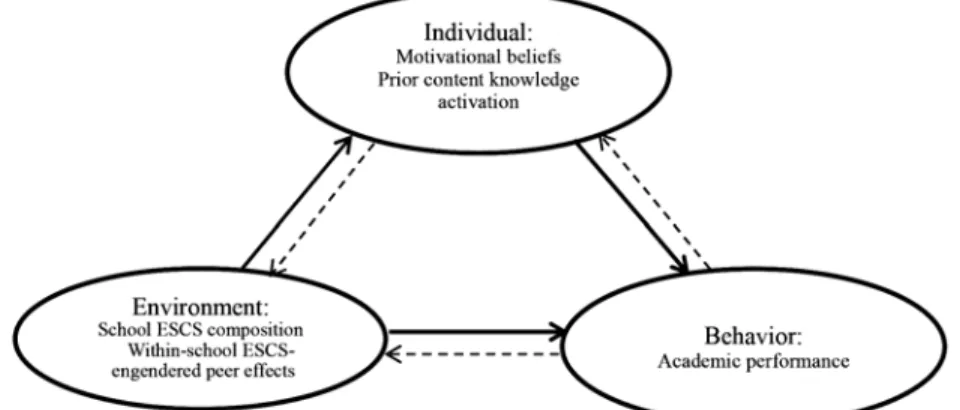
Social cognitive theory emphasizes that the individuals learn from observation. Students form their behaviors through imitation and modelling in learning environments (Bandura, 1977, 1986). The triadic reciprocity model proposed by Bandura (1986) depicts reciprocal determinism of three conceptual components (i.e., individual, environment, and behavior) that are essential to explain determinants of an individual’s behavior. This model is a conceptual model guiding conduct of enquiry of this study (see Fig. 1). It depicts reciprocal mechanisms of the school ESCS composition and the within-school ESCS-engendered peer effects (i.e., peer effects as a result of the ESCS composition of school that students attended) on student learning.
In the triadic reciprocity model, “Individual’’ refers to student’s motivational beliefs (e.g., self-efficacy) and prior content knowledge activation in the SRL literature (see Pintrich, 2004, p. 390). Both constructs are of great importance that regulated the affect and cognition in the SRL
Figure 1. A Triadic Reciprocal SRL Model Shows the Impact of School ESCS Composition
on Individual Student Learning
processes during the first phase, and possibly the other phases. “Environment’’ refers to the ESCS composition of the school student attended, as well as the within-school ESCS-engendered peer effects. ESCS- disadvantaged students studying in high-ESCS schools need to adjust their learning goals (and other SRL strategies such as self-monitoring, self-control and self-reflection) after comparing the academic success of their more affluent peers with their own to secure a higher rate of success in school learning. “Behavior’’ refers to the cognitive and affective outcomes of student learning. In Macao-China, and possibly in other places, “Behavior’’ can have reciprocal effect on “Environment’’ because ESCS-disadvantaged students with outstanding academic performance can apply to the high-performing schools that are normally better-resourced and that are targeting the high- ESCS students. In this study, we focused on the direct effect of “Environment” on “Behavior”, and the meditational role of “Individual” regarding the effects of “Environment” on “Behavior”, both of these effects are indicated by the black arrows in Fig. 1. More specifically, this study sought to verify whether or not the mediation mechanisms of “Individual” (i.e., student’s motivational beliefs and prior content knowledge activation) are consistent with the analyzed data.
In 1980s, SRL researchers integrated the reciprocal processes and related determinants into their own perspectives of SRL. They highlighted the importance of metacognition and motivational beliefs of the SRL processes.
For example, Zimmerman and colleagues presented a cyclical SRL model, which depicts how SRL learners engage meta-cognitively, motivationally and behaviorally in their learning (Zimmerman, 1989, 2000a, 2008; Zimmerman & Labuhn, 2012). In Zimmerman’s SRL model, self-regulatory phases are activated and sustained mainly by two components: Metacognitive processes and motivational beliefs. The first component has been explored extensively in the past three decades. On the one hand, an abundance of studies revealed that the proficient SRL learners not only can plan, monitor, manage, control and evaluate their learning activities and progress meta-cognitively during different phases of learning (Boekaerts, 1997; Pintrich & De Groot, 1990; Pintrich, 2004; Zimmerman & Schunk, 2001; Zimmerman & Labuhn, 2012), but also are aware of the cognitive processes such as the activation of prior knowledge and utilization of cognitive learning strategies (Boekaerts, 1997; Pintrich, 2000, 2004; Zimmerman & Labuhn, 2012). On the other hand, SRL involves not only the metacognition, but also the underlying motivational processes to put the students’ effort into effect (Zimmerman, 1995; Zimmerman & Labuhn, 2012). Recently, increasing attention has been paid to the other SRL component on motivational beliefs (Zimmerman & Labuhn, 2012).
In the present study, we follow this trend of research to adopt Pintrich’s (2004) SRL conceptual framework for assessing motivation beliefs and prior content knowledge activation in Macao-China students. Specifically, self- regulatory variables associated with efficacy judgments, interest activation, affective reactions, goal orientation adoption, and prior content knowledge activation are hypothesized to be mediators between personal and contextual characteristics associated with ESCS, and student mathematics literacy performance attained (see Pintrich, 2004, p. 388 for the mediation assumption of the SRL research paradigm).
Hypotheses of This Study
Effects of Student- and School-Level ESCS on Student Learning
The literature of the subject is replete with reports documenting the adverse effects of low level ESCS on the adolescents, including: academic performance and school experiences (Walpole, 2003), psychological development and adaptation (Felner et al., 1995), problematic behaviors (Dodge, Pettit, & Bates, 2008), career prospects (Roberts, Kuncel, Shiner,
Caspi, & Goldberg, 2007), and health conditions (Pickett & Pearl, 2001). The common findings of these studies are that low-income families are usually unable to make significant investment in children’s education. Children from disadvantaged families, compared to those from high-income families are more likely to have less learning opportunities and educational resources. Their learning motivation may also be lower than their more affluent peers (Organization for Economic Cooperation and Development [OECD], 2007, 2010, 2013a). Generally, in most cases they are behind their affluent peers in their academic studies.
Furthermore, high-ESCS parents tend to send their children to high-ESCS schools, where most of their peers are also students from high-ESCS families. Hence, learning groups with high-ESCS homogeneity will be formed. This kind of learning groups, particularly those in the East Asian economies (e.g., the established schools in Macao-China), usually study in better-resourced learning environments (e.g., mathematics rooms equipped with lots of teaching aids and equipment). It is common to see students receiving better instructions in classrooms as well as them having more opportunities to interact with qualified teachers than in ESCS-disadvantaged schools. This explains why high-ESCS students usually are able to develop better psychological and cognitive capabilities that are facilitative to their learning. For instance, they are more likely to achieve their study goals by self- regulating their cognition and emotion. Based on the discussion above, two hypotheses (H1, H2) that are applicable to the Macao-China schooling context are given below for statistical significance testing:
H1: ESCS composition of school is positively related to student mathematical literacy performance.
H2: ESCS of student is positively related to student mathematical literacy performance.
Mechanisms of the SRL Variables Mediating the Effects of Student- and School-Level ESCS on Student Learning
Pintrich (2000, 2004) claims that learners are capable of regulating their cognition and motivation in their learning processes. He says that SRL variables (e.g., self-belief, learning motivation) have a potential to mediate the relationship between contextual variables (e.g., personal and demographic characteristics of the students) and student’s academic achievement. Recently,
the meditation mechanisms of motivation between student’s social background and academic achievement have been investigated. Steinmayr, Dinger and Spinath (2010, 2012) discuss the causal mechanisms, which explained the association between parents’ social-economic status, students’ personality and motivation, as well as their academic achievement. The authors also demonstrate that student’s personality and motivation significantly mediate the effect of parents’ social-economic status on student’s academic achievement. However, as an important element of SRL, whether domain-specific prior knowledge can influence the relationship between student’s social background and academic achievement has not been sufficiently studied so far.
At the school level, SRL may promote the peer effects of group activities in school. Wilkinson and Fung (2002) seek to explain student learning and achievement from the social-cognitive and social-cultural perspective. They suggest that student learning is embedded in the social and cultural contexts, and stemmed from interactions with other learners. Regarding the heterogeneous school ESCS composition, they maintain that peer effects stem from learning interactions with heterogeneous peers within a school. The occurrence of these interactions depends on students’ perceived ability (e.g., self-efficacy) and relative influences of their peers inside the group that they belong to. For example, after evaluating one’s own competence in solving mathematical problems, the student compares the results with other peers’ and is motivated by those peers’ competencies or performance. As a result, he may set his learning goals according to peers’ competencies and accomplishments. It is worthy of note that the peer effects can potentially mediate the impact of group compositions on student performance (Wilkinson & Fung, 2002). However, the meditational mechanisms of the peer effect (e.g., whether and to what extent the student’s perceived self-ability can mediate the effect of school ESCS composition on student performance) has not been sufficiently investigated yet.
Summing up, contextual variables (e.g., school ESCS composition) are affecting student learning work in tandem with mediating SRL cognitive and motivational variables to bring about the school composition effects on the achievement and development of the students. The third and fourth hypotheses (H3, H4) given below are based on the discussion above.
H3: SRL variables mediate between the effects of school ESCS composition and student mathematical literacy performance.
H4: SRL variables mediate between the effects of student ESCS and student mathematical literacy performance.
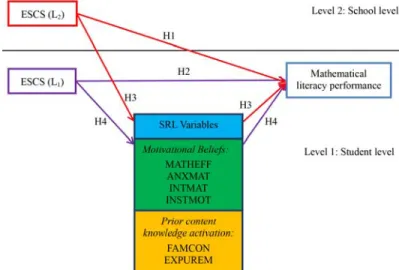
Figure 2 shows the four hypotheses (H1-H4) of the multilevel mediation processes of school- and student-level ESCS in the explanation of mathematical literacy performance.
Method
ParticipantsThis study draws its data from Macao-China’s PISA 2012 mathematics literacy study. All the 45 secondary schools in Macao-China and a total of 5,335 students born in 1996 participated in the assessment (Cheung, Sit, Mak, & Ieong, 2013). It is essentially a census of all 15-year-old students in Macao. SRL Aspects Examined
This study is a secondary analysis of the PISA 2012 data publicly available on the official website of Organization for Economic Cooperation and Development (OECD). A variable-centered data analytic approach is adopted to test the four hypotheses (H1-H4). The SRL variables are chosen in
Figure 2. Hypotheses of Multilevel Mediation Processes (H1-H4)
ESCS (L1) Student ESCS; ESCS (L2) School ESCS composition; MATHEFF Mathematics self-efficacy; ANXMAT Mathematics anxiety; INTMAT Mathematics intrinsic motivation; INSTMOT Mathematics instrumental motivation; FAMCON
Familiarity with mathematical concepts; EXPUREM Experience with pure mathematics tasks at school.
accordance with Pintrich’s (2004) conceptual framework for assessing motivation and SRL in college students. Two aspects of SRL are drawn respectively from two research paradigms. One entails the motivational beliefs (Pintrich & De Groot, 1990; Pintrich, 1999, 2000, 2004; Zimmerman, 1989, 2000a, 2000b), and the other one involves the cognitive prior knowledge possessed by the students in their learning (Boekaerts, 1997; Zimmerman & Schunk, 2001).
First SRL aspect: Motivational beliefs.
The aspect comprises three components: expectancy, affection and value. The expectancy component refers to student’s beliefs about their capacity to carry out tasks in order to achieve learning goals-Mathematics self-efficacy (MATHEFF) is a variable of use in the study. The affection component focuses on students’ negative emotional reactions to the learning tasks, and mathematics anxiety (ANXMAT) is an example of this component. Lastly, the value component concerns with student’s belief in the importance of the goals of the learning tasks, as well as his/her interest in undertaking of the learning activities. There are two types of motivation in the literature, intrinsic and extrinsic. The two variables mathematics intrinsic motivation (INTMAT) and mathematics instrumental motivation (INSTMOT) are good representations of those two types of motivation.
Second SRL aspect: Prior content knowledge activation.
This aspect is about prior knowledge possessed by the student, which includes mastered concepts and classroom learning experiences of a subject. Two variables are relevant to this study: Familiarity with mathematical concepts (FAMCON) and experience with pure mathematics tasks at school (EXPUREM).
Variables
Figure 2 presents the variables used in the testing of the four hypotheses H1-H4 of this study. There are three types of variables, i.e., independent, dependent and mediating, delineated below:
Independent variable: ESCS.
ESCS derives from three components associated with a student’s family background, i.e., home possessions, the highest parental occupation status, and the highest parental education in years (OECD, 2013a, 2014b). Home possessions comprise cultural possessions, home educational resources, wealth and the number of books at home. Given its composition, this index is an extensive measure of three basic kinds of capital (i.e., economic, human, and cultural), and even part of the social capital of student’s home. ESCS has been standardized across the 34 OECD countries, with mean 0 and standard deviation 1. For Macao-China, the mean is .886 and the standard deviation is .867. ESCS for Macao-China is therefore slightly lower than the OECD average, and slightly more homogeneous than the OECD average.
Dependent variable: Student mathematics performance.
MATHPVs is a set of five plausible values measuring the mathematical literacy performance of the students in PISA 2012 (OECD, 2014a). MATHPVs is the dependent variable of the first and third step of the multilevel mediation analyses (see appendix for the model equations). The five plausible values are used one by one in each of the three steps of the multilevel mediation analyses, and the overall results are averaged with appropriate calculation of standard errors for significance testing (see Wu, 2005 for details regarding the conduct of plausible value analysis). The PISA 2012 mathematics proficiency scale (mean 494 and standard deviation 92), has been mapped onto the previous PISA 2003 mathematics proficiency scale (mean 500 and standard deviation 100) through link items in order to assess the change of student achievement across the two cycles of PISA assessment, both of which mathematics is the major domain of assessment. Macao-China’s mean and standard deviation are 538 and 95, respectively. Macao-China’s mean is much higher than that of the OECD average, and is slightly more heterogeneous than the average of OECD countries.
Mediating variables: SRL variables.
The two SRL aspects examined in this study consist of the six SRL variables: MATHEFF, ANXMAT, INTMAT, INSTMOT, FAMCON and EXPUREM. They are explained briefly below:
problems covering four mathematics content areas in the real world, or the purely mathematical contexts (OECD, 2013b, p. 199). There are 8 items rated on a four-point Likert-type scale, ranging from Not at all confident (1) to Very confident (4).
ANXMAT (MV2) measures student anxiety about their studying of mathematics, e.g., whether they feel the mathematics learnt in class is difficult; feel of tension, nervousness and helplessness to do mathematics homework; worry of getting poor grades, etc., (OECD, 2013b, p. 199). There are 5 items rated on a four-point Likert-type scale, ranging from Strongly disagree (1) to Strongly agree (4).
INTMAT (MV3) measures student intrinsic motivation to learn mathematics, e.g., looking forward to the mathematics class; enjoying reading about mathematics; doing mathematics because of enjoyment that it brings, etc., (OECD, 2013b, p. 199). There are 4 items rated on a four-point Likert- type scale, ranging from Strongly disagree (1) to Strongly agree (4).
INSTMOT (MV4) measures student instrumental motivation to learn mathematics, e.g., improvement of career prospects; importance for academic advancement, etc. (OECD, 2013b, p. 199). There are 4 items rated on a four- point Likert-type scale, ranging from Strongly disagree (1) to Strongly agree (4).
FAMCON (MV5) measures student perception of familiarity of mathematical contents that cover the various content domains commonly occurring in the junior secondary school mathematics curriculum (OECD, 2014b, p. 329). There are 16 items rated on a five-point Likert-type scale, ranging from Never heard of it (1) to Know it well, understand the concept (5).
EXPUREM (MV6) measures student experience with pure mathematics tasks at school. All items are related to the content domain change and
relationship, which is a topic normally learned later on in the secondary
school mathematics curriculum (OECD, 2014b, p. 329). There are 4 items rated on a four-point Likert-type scale, ranging from Never (1) to Frequently (4).
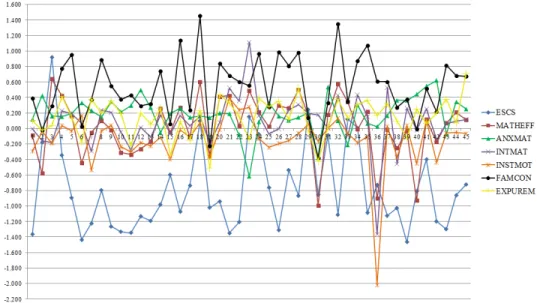
Each of the six SRL variables is the dependent variable in the second step of the multilevel mediation analyses, of which ESCS is the independent variable predicting it (see appendix for the model equations). Figure 3 shows the mean of ESCS and the six SRL variables across the 45 schools examined
in the present study. All measures are standardized across the 34 OECD countries, with mean 0 and SD 1.
Figure 3. Mean of ESCS and SRL Variables Across the 45 Schools in Macao-China
Descriptive Statistics and Reliability of the SRL Variables
The descriptive statistics and reliability of the SRL variables (MV1-MV6) are shown in Table 1. The means of the six SRL variables range from .082 to .677, and their standard deviations range from .804 to 1.064. The reliabilities (Cronbach’s Alpha) of the SRL variables are very satisfactory, varying from .899 to .837. There is very small amount of missing data (0.4%) due to student non-response of the questionnaire items. Nevertheless, there are 33% or 67% missing data for the six SRL variables due to the rotated PISA 2012 questionnaire design in the random distribution of the student questionnaires to the respondents. Hence, SRL scale items are only responded by students in one or two, but not all three of the student questionnaires. Due to the negligible student non-response rate to the SRL scale items, and the fact that student is randomly given a questionnaire to respond, in this study, the missing data are regarded as missing completely at random (MCAR) in the multiple imputation of missing values.
Correlations of the SRL Variables With ESCS and Mathematics Performance
The Pearson correlation matrix of the six SRL variables with ESCS and mathematics performance isshown in Table 2. Amongst the six SRL variables, Table 1
Descriptive Statistics and Reliability of SRL Variables
SRL Variable Mean SD Cronbach’s Alpha
% of missing, due to Rotated questionnaire design Student non-response MATHEFF (MV1) .122 .959 .855 33.33 .28 ANXMAT (MV2) .198 .999 .861 33.33 .32 INTMAT (MV3) .121 .921 .899 66.66 .28 INSTMOT (MV4) .082 .871 .899 66.66 .28 FAMCON (MV5) .677 1.064 .837 33.33 .28 EXPUREM (MV6) .204 .804 .890 33.33 .30
Note. Macao-China’s 15-year-old students born in 1996 are randomly assigned to answer one of the
three booklets of the PISA 2012 student questionnaires.
Table 2
Pearson Correlations of SRL Variables and Mathematics Performance With ESCS
Variable Pearson r IV MV1 MV2 MV3 MV4 MV5 MV6 DV ESCS (IV) 1.000 MATHEFF (MV1) .166 1.000 ANXMAT (MV2) .014 .354 1.000 INTMAT (MV3) .050 .333 .352 1.000 INSTMOT (MV4) .022 .245 .221 .763 1.000 FAMCON (MV5) .131 .456 .244 .204 .210 1.000 EXPUREM (MV6) .018 .112 .014 .038 .003 .124 1.000 MATHPVs (DV) .153 .510 .323 .317 .248 .473 .148 1.000
Note. MATHPVs is mathematical literacy performance.
MATHEFF and FAMCON correlate strongly with mathematics literacy performance (r .510, .473 respectively). The correlations of ANXMAT,
INTMAT, INSTMOT and EXPUREM are moderate (ANXMAT is negative). The correlation between ESCS and MATHPVs is .153.
Aggregation of Variables
Before conducting multilevel analyses, aggregation characteristics of the SRL variables need to be calculated in order to examine their applicability to the Hierarchical Linear Modelling (HLM) mediation analysis procedures. This study deploys aggregation indices and related criteria proposed by Bliese (2000). Specific indices include r*
WG(J) (Lindell, Brandt, & Whitney, 1999), ICC1 (Kashy & Kenny, 2000), and ICC2 (Bliese, 2000). To check tenability of data aggregation of the SRL variable, it is desirable that r*
WG(J) .80, ICC1 .05, ICC2 .80, and 2 of between-school variance is statistically significant (p .05). Table 3 presents the three aggregation indices and the Chi-square tests for the between-school variances of the HLM null model of the SRL variables. Except ICC1 of ANXMAT, all indices indicate that the SRL variables are appropriate for data aggregation. Because of the significant Chi- square value of between-school variance of ANXMAT, the study has kept this variable in the HLM mediation analyses.
Analysis Strategy
Hierarchical Linear Modelling (HLM) is used for the statistical analyses of multilevel mediation effects (Raudenbush & Bryk, 2002; Preacher, 2015). HLM treats the upper-level (i.e., level 2) hierarchical structure data as a simple random sample. Therefore the sampling variances estimated by HLM will be greater than the actual estimation (OECD, 2009; Raudenbush & Bryk, 2002). Researchers should be cautious with the increase of probability of type- two error when using HLM in data analyses. In this study, Macao-China conducted a census of the 45 schools and across those schools more than 98% of 15-year-old Macao-China’s students have participated in PISA 2012 (Cheung et al., 2013). Therefore, the estimation error from using HLM in this research is minimal.
Table 3
Aggregation Characteristics of SRL Variables
Variable r* WG(J) ICC1 ICC2 2 of between-school variance Motivational beliefs MATHEFF (MV1) .954 .103 .932 487.129* ANXMAT (MV2) .903 .028 .772 193.200* INTMAT (MV3) .879 .067 .895 308.266*
INSTMOT (MV4) .884 .057 .874 307.234*
Prior content knowledge activation
FAMCON (MV5) .958 .125 .944 850.700*
EXPUREM (MV6) .878 .082 .914 458.428*
*
p .05.
According to Zhang, Zyphur and Preacher (2009), 2-1-1 and 1-1-1 mediation models are analyzed, and the indirect effects are tested for statistical significance. In this study, they apply to test the tenability of the third and fourth hypotheses (i.e., H3, H4). The 2-1-1 model specifies that the independent variable is measured at the school level (i.e., level 2) while the mediation and the dependent variable are measured at the student level, whereas the 1-1-1 model specifies that all the independent, mediating and dependent variables are measured at the student level (i.e., level 1) (see Tofighi & Thoemmes, 2014 for considerations regarding conceptualization of variables in the 2-1-1 model).
In order to avoid potential confounding in multilevel mediation effect estimates in the 2-1-1 and 1-1-1 models when the within-school effects differ from between-school effects, the multilevel data needs to be CWC(M), i.e., the independent and mediating variables are needed to be “centered within context” (Kreft & de Leeuw, 1998). This means that there is a need to employ group-mean centering in the specification of the HLM analyses, and in addition, the subtracted mean of each level 1 (i.e., student-level) variable is reintroduced in the level 2 (i.e., school-level) equations. PRODCLIN (Product Confidence Limits of Indirect Effect) and Sobel test are used to test statistical significance of the between-school and between-student within-school mediation effects of the SRL variables on mathematics performance (Li, 2011; MacKinnon, Fritz, Williams, & Lockwood, 2007; Tofighi & MacKinnon, 2011). As suggested by Wen and Fan (2015), the ratio of indirect effect to overall effect (PM) as the effect size of mediating effect is calculated.
Calculated are also the variances of the outcome variable in the multilevel mediation models (i.e., step-3 of the 2-1-1 and 1-1-1 models in the appendix Table A1) that are explained by the student- and school-level variables.
Finally, because of the rotated PISA 2012 questionnaire design, not every questionnaire item is responded by the examinee, there is a need for special treatment of missing data by design (OECD, 2013c). Missing values are regarded as MCAR and are imputed by the SPSS multiple imputation procedures based on the iterative Markov Chain Monte Carlo (MCMC)
method. In accordance with Rubin (1987) and Schafer (1997), multiple imputations of five datasets are undertaken, taking into account the relationships among all the variables in the analyses to estimate imputed data for the missing values. In the 2-1-1 and 1-1-1 analyses reported below, all five datasets with multiple imputation of missing data have been deployed.
Results
Preliminary analyses of the null and contextual model of mathematical literacy performance have been run before proceeding to the 2-1-1 and 1-1-1 model of multilevel mediation analyses (see appendix for the model equations). First, based on the results of HLM null model of mathematical literacy performance, the intra-class correlation coefficients (ICC1) of mathematical literacy performance is .364, and the Chi-square values of between-school variance of the random effects is 2389.10 (p . 05), indicating that there is significant difference between variances of mathematical literacy performance across schools. Next, the contextual model of mathematical literacy performance shows the effect of ESCS on mathematical literacy performance. The coefficients of student ESCS (10 7.21, p .05) and school ESCS composition (i.e., the mean of student ESCS in school) (01 32.66,
p .05) are statistically significant, indicating that the higher the level of
student ESCS and the level of school ESCS, the higher students’ mathematical literacy. Also, the variance of the random effects of the ESCS slope is only 11.04 and is not statistically significant (u1j 11.04, df 44, 2 50.862,
p .05). Across schools, the contextual effects shown in the model equations
in the appendix are not random but fixed. The 2-1-1 Model of Mediation Analysis
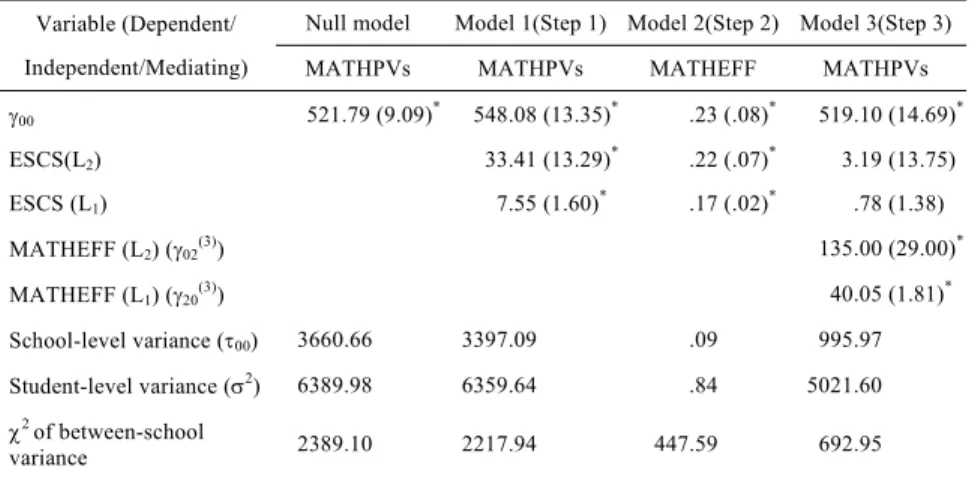
The first step of 2-1-1 mediation analysis is examining the overall effect of school ESCS composition on student mathematical literacy performance, and the result is shown in Model 1 (Step 1) of Table 4. The overall effect is statistically significant (01(1) 33.42, p .05). After that, we examined one by
one, the effect of school ESCS composition on the six SRL variables. Model 2 (Step 2) in Table 4 only illustrates the result of MATHEFF, and this variable is the only SRL variable that can be statistically significantly explained by school ESCS composition (01(2) .22, p .05). That means, students who
study in a high-ESCS school are more likely to have a higher level of MATHEFF. Then, as shown in Model 3 (Step3) in Table 4, the coefficient of student MATHEFF (within-school effect) (10(3) 40.13, p .05) and the school mean of MATHEFF (between-school effect) (02(3) 135.00, p .05) are both statistically significant, and the coefficient of school ESCS composition is no longer significant (01(3)3.19, p .05). The HLM result Table 4
SRL Mediation Model of MATHEFF (HLM 2-1-1 Model)
Variable (Dependent/ Independent/Mediating)
Null model Model 1(Step 1) Model 2(Step 2) Model 3(Step 3) MATHPVs MATHPVs MATHEFF MATHPVs 00 521.79 (9.09)* 548.10 (13.36)* .23 (.08)* 519.10 (14.69)* ESCS (L2) 33.42 (13.29)* .22 (.07)* 3.19 (13.75) MATHEFF (L2) (02(3)) 135.00 (29.00)* MATHEFF (L1) (10(3)) 40.13 (1.79)* School-level variance (00) 3660.66 3396.01 .08 996.00 Student-level variance ( 2) 6389.98 6390.09 .86 5021.14 2 of between-school variance 2389.10 2207.22 438.87 693.01
Note. Nschool45; Indirect effect 30.105 (SESobel 11.901), PRODCLIN (95% CI) [9.253, 56.420]; %
of school level variance explained by variables in Model 3 72.8, % of student level variance explained by variables in Model 3 21.4; PM.901.
*p .05.
illustrates that MATHEFF is a full mediator in the mediation of the impact of school ESCS composition on student mathematical literacy performance. Besides, the indirect effect is 30.105 (SESobel 11.901, p .05), the PRODCLIN 95% CI (Confidence Interval) does not include 0, and both indicate that the indirect effect is statistically significant (p .05). The effect size of indirect effect (PM) is .901. Moreover, in model 3 (step 3), compared to
the null model, the mediator MATHEFF and school ESCS composition explain 72.8% and 21.4% of the school- and student-level variance of mathematical literacy performance.
Table 5 to 7 present the results of the 1-1-1 mediation model. The effects of ESCS at the student and school level on student mathematical literacy performance are shown in Model 1 (Step 1) of Table 5 to 7 (10(1) 7.55,
p .05; 01(1) 33.41, p .05), the results indicate that student ESCS and school ESCS composition (i.e., within-school and between-school components of ESCS in the CWC(M) model) significantly influence student mathematical literacy performance.
Table 5
SRL Mediation Model of MATHEFF (HLM 1-1-1 Model)
Variable (Dependent/ Independent/Mediating)
Null model Model 1(Step 1) Model 2(Step 2) Model 3(Step 3) MATHPVs MATHPVs MATHEFF MATHPVs 00 521.79 (9.09)* 548.08 (13.35)* .23 (.08)* 519.10 (14.69)* ESCS(L2) 33.41 (13.29)* .22 (.07)* 3.19 (13.75) ESCS (L1) 7.55 (1.60)* .17 (.02)* .78 (1.38) MATHEFF (L2) (02(3)) 135.00 (29.00)* MATHEFF (L1) (20(3)) 40.05 (1.81)* School-level variance (00) 3660.66 3397.09 .09 995.97 Student-level variance (2) 6389.98 6359.64 .84 5021.60 2 of between-school variance 2389.10 2217.94 447.59 692.95
Note. Nschool45; % of school level variance explained by variables in Model 3 72.8, % of student
level variance explained by variables in Model 3 21.4; PM_school .901; PM_student = .897.
*p .05.
Table 6
SRL Mediation Model of INTMAT (HLM 1-1-1 Model)
Variable (Dependent/ Independent/Mediating)
Null model Model 1(Step 1) Model 2(Step 2) Model 3(Step 3) MATHPVs MATHPVs INTMAT MATHPVs 00 521.79 (9.09)* 548.08 (13.35)* .13 (.10) 541.82 (13.68)* ESCS(L2) 33.41 (13.29)* .04 (.10) 30.71 (12.30)* ESCS (L1) 7.55 (1.60)* .07 (.02)* 5.74 (1.59)*
INTMAT (L2) (02(3)) 50.24 (39.06) INTMAT (L1) (20(3)) 27.37 (2.07)* School-level variance (00) 3660.66 3397.09 .06 3078.60 Student-level variance (2) 6389.98 6359.64 .81 5757.05 2of between-school variance 2389.10 2217.94 309.08 1995.73
Note. Nschool 45; % of school level variance explained by variables in Model 3 15.9, % of student
level variance explained by variables in Model 3 9.9; PM_school.062; PM_student.239.
*p .05.
Table 7
SRL Mediation Model of FAMCON (HLM 1-1-1 Model)
Variable (Dependent/ Independent/Mediating)
Null model Model 1(Step 1) Model 2(Step 2) Model 3(Step 3) MATHPVs MATHPVs FAMCON MATHPVs 00 521.79 (9.09)* 548.08 (13.35)* .55 (.11)* 481.63 (12.47)* ESCS(L2) 33.41 (13.29)* .00 (.11) 33.50 (8.76)* ESCS (L1) 7.55 (1.60)* .20 (.02)* 1.26 (1.42) FAMCON (L2) (02(3)) 123.80 (13.49)* FAMCON (L1) (20(3)) 31.88 (1.52)* School-level variance (00) 3660.66 3397.09 .15 817.73 Student-level variance (2) 6389.98 6359.64 .98 5370.66 2 of between-school variance 2389.10 2217.94 869.98 628.01
Note. Nschool45; % of school level variance explained by variables in Model 3 77.7, % of student
level variance explained by variables in Model 3 16.0; PM_school .007; PM_student.832.
*p .05.
Furthermore, three SRL variables, i.e., MATHEFF (10(2) .17, p .05), INTMAT (10(2) .07, p .05), and FAMCON (10(2) .20, p .05) can be significantly explained by student ESCS. The data of these three SRL variables are shown in Model 2 (Step2) in Table 5 to 7 respectively. Particularly, in Table 5, the coefficients of ESCS at both student and school levels reach statistical significance level (p .05) in the CWC(M) model of MATHEFF, indicating that the within-school and between-school effects of
ESCS both can significantly explain MATHEFF. In the next step, as shown in Model 3 (Step 3) in Table 5, student MATHEFF (the within-school component of MATHEFF) and school MATHEFF (the between-school component of MATHEFF) both significantly explain student mathematical literacy performance (20(3) 40.05, p .05; 02(3) 135.00, p .05), and the within-school and between-school components of ESCS do not reach the statistical significance level of this model (10(3) .78, p .05; 01(3) 3.19,
p .05), so MATHEFF is a full mediator of student ESCS on student
mathematical literacy performance.
Regarding the estimation of school-level indirect effect, a comparison of the modeling results between the 2-1-1 and 1-1-1 models shown in Table 4 and 5 shows that one can base on the formula of school-level indirect effect in the 1-1-1 model to estimate the school-level indirect effect across the level from school- to student-level via the mediating variable onto the outcome variable. As seen in the modeling equations shown in the appendix, this is a consequence of the application of CWC(M) in the mediation analysis of the multilevel data (Zhang et al., 2009).
In addition, in Table 7, the coefficient of FAMCON at the student level is statistically significant (20(3) 31.88, p .05), and the within-school component of ESCS is no longer significant in this model (10(3) 1.26,
p .05). That means, at the between-student within-school level, FAMCON is
a full mediator of student ESCS on student mathematical literacy performance. Interpreted in the same vein, in Table 6, the coefficient of INTMAT at the student level is statistical significant (20(3) 27.37, p .05), while the coefficient of the within-school component of ESCS in the related model is smaller than that of Step 1. Since it is still statistical significant (10(3) 5.74,
p .05), INTMAT is therefore a partial mediator of student ESCS on student
mathematical literacy performance. Finally, for all the three 1-1-1 models, the effect sizes of school level indirect effect (PM_school) and student level indirect
effect (PM_student) varied a lot. The most influential SRL variable is MATHEFF
(PM_school .901; PM_student.897), followed by FAMCON (PM_school .007,
PM_student .832), and the least amongst the three is INTMAT (PM_school .062;
PM_student .239).
Table 8 presents significance testing of indirect effects of the HLM 1-1-1 models. The student level indirect effect of the three SRL variables ranged from 1.806 to 6.768, and all of them passed the significance of Sobel test
(p .05) and PRODCLIN (95% confidence). On the other hand, only the school level indirect effect of MATHEFF is statistical significant (abMATHEFF 30.105, SEsobel_MATHEFF 11.901, p .05; PRODCLIN 95% CI does not include 0). MATHEFF is a full mediator of ESCS on mathematical literacy performance at both the student and school level. Of note is that the school- and student-level indirect effects in the 1-1-1 model (i.e., 30.105 vs. 6.768) are not directly comparable. This is because the independent variables related to the two indirect effects are not on the same measurement scale when the effect of an independent variable on outcome variable via the mediating variable is to be interpreted. With reference to the model equations shown in the appendix, it can be seen that the school-level indirect effect in the 1-1-1 model is mathematically having the same formula asthat oftheacross-level indirect Table 8
Significance Test of Indirect Effects (HLM 1-1-1 Model)
Variable
School level Student level
Indirect effect SE (Sobel) PRODCLIN (95% CI) Indirect effect SE (Sobel) PRODCLIN (95% CI) MATHEFF 30.105* 11.901 [9.253, 56.421] 6.768* .820 [5.193, 8.411] INTMAT 2.060 5.321 [10.403, 17.729] 1.806* .644 [.566, 3.102] FAMCON .248 13.618 [26.733, 27.245] 6.280* .704 [4.932, 7.695] *p .05.
effect in the 2-1-1 model (i.e., both are 01(2)02(3)). Therefore, the school-level
indirect effect in the 1-1-1 model should be interpreted as a school-level effect operating across-level from school- to student-level via the mediating variable onto the outcome variable. Last, FAMCON mediates in full the impact of ESCS on mathematical literacy performance at the student level only, whereas INTMAT mediates partially the impact of ESCS on mathematical literacy performance also at the student level only.
In order to investigate the independent effects of the three SRL mediators on student mathematical literacy performance, the variables are entered into the HLM equation in Step 3 of the HLM 1-1-1 mediation analysis, again using the CWC(M) method in its analysis (Zhang et al., 2009). Results are shown in Table 9. Firstly, the effects of ESCS at both student and school level are not statistically significant (p .05). The ESCS effects on student mathematics performance at both student and school level are fully explained by the three SRL mediators. Compared to the null model, the percentages of school- and
student-level variances explained by all the variables in the final multiple- mediators model are respectively 85.2% and 29.0%. Secondly, the independent effects of MATHEFF, INTMAT and FAMCON at the student level are all statistical significant (p .05). Hence, MATHEFF, INTMAT and FAMCON are conceptually distinct SRL variables in their mediation of the impact of ESCS on student mathematics performance. Thirdly, the independent effects of MATHEFF and FAMCON at the school level on student mathematics performance are statistical significant (p .05), whereas it is not the case for INTMAT. However, each of the two aspects of SRL (i.e., motivational beliefs and prior content knowledge activation) does contribute to an explanation of the impact of ESCS on student performance.
Table 9
HLM Regression of SRL Mediators on Mathematical Literacy Performance (Final Multiple-Mediators Model)
Fixed effects Mean SE Approx. df
00 489.769* 12.986 40 ESCS (L2) 18.020 10.730 40 MATHEFF (L2) 70.432* 29.721 40 INTMAT (L2) .263 23.313 40 FAMCON (L2) 80.355* 22.465 40 ESCS (L1) 1.765 1.331 139 MATHEFF (L1) 26.850* 2.131 62 INTMAT (L1) 14.817* 2.572 7 FAMCON (L1) 19.274* 1.414 84
Random effects Variance df 2
School-level variance 00 (f) 542.189 40 488.703* Student-level variance 2(f) 4535.249
Note. % of school level variance explained by variables 85.2, % of student level variance explained
by variables 29.0. *p .05.
Discussion of Findings
Self-Regulatory Mechanisms of Mathematics Self-EfficacyIt has been proved in this study that MATHEFF is a core self-belief in mathematics learning for the students of Macao-China. The findings echoed around the other researchers’ in the literature (e.g., Ho, 2004; Kitsantas, Cheema, & Ware, 2011). At both student and school level, MATHEFF substantially mediates the impact of ESCS on mathematical literacy performance, and the mediation effect is the greatest among all the six SRL variables examined in this study. On one hand, this finding makes an important contribution to the SRL literature by providing empirical evidences from large-scale surveys to support the tenability of the mediation assumption of the SRL variables, i.e., via core SRL variables in an academic subject of study, such as mathematics self-efficacy, learning contexts in school settings are connected meaningfully with student performance. On the other hand, MATHEFF is a powerful mediating SRL variable that provides schools in Macao-China with an insightful direction researching into effective mathematics intervention programs to help the ESCS-disadvantaged students. There is a need to analyze the mediation mechanisms, and this is discussed below.
At the school level, it was found that MATHEFF is the only SRL variable being able to fully mediate the impact of Macao-China's school ESCS composition on student mathematics performance. The mediation effect from school- to student-level uncovers an interesting phenomenon occurring in Macao-China schools; while school ESCS composition is positively associated with student mathematics performance; this performance is also significantly influenced by mathematics self-efficacy. The highlight of the mediation mechanism is that mathematics self-efficacy is able to fully mediate the effect of differing student’s groupings of various school ESCS composition, and suggests very strong evidence of ESCS-engendered peer effects on student mathematics performance (for an explanation of the emergence of the peer effects in schools of different contexts, see Wilkinson & Fung, 2002; Wilkinson, Parr, Fung, Hattie, & Townsend, 2002). Thus, by bringing up the quality of mathematics education of the ESCS-disadvantaged students in Macao-China through fostering of mathematics self-efficacy, educational equity of the educational provisions for the whole education system can be raised at the same time. This is the most important finding of this study.
Indeed, because of their excellent academic results, some ESCS- disadvantaged students in Macao-China are lucky enough to be enrolled in
high-ESCS schools, which generally are also schools of very high public reputation. If they are equally treated in teaching and learning as their affluent peers in these reputable schools, ESCS-disadvantaged students studying in high-ESCS schools will have a higher chance to achieve the same success as their high-ESCS peers, especially if they are equipped with the more favorable make-ups of the SRL personality. This gives them a higher chance to overcome ESCS-engendered barriers and achieve their learning goals by self- monitoring their performance while competing and cooperating with their high-ESCS peers. This study comes to the conclusion that mathematics self- efficacy is a crucial SRL personal quality that is needed by the ESCS- disadvantaged students in Macao-China.
Self-Regulatory Mechanisms of Intrinsic Motivation to Learn Mathematics
This study conceptualizes INTMAT from the PISA 2012 perspective as an integrative measure consisting of three operative components: intrinsic interest in mathematics, task values of mathematics, and intrinsic goal orientation about mathematics. The findings are consistent with previous research (Pintrich & De Groot, 1990; Pintrich, 2004). In the perspective of motivational regulation, the higher the level of a student’s INTMAT, the stronger the desire he wants to obtain intrinsic satisfaction from solving challenging mathematical problems and the stronger the persistence he exhibits in tackling challenging mathematical tasks. The present researchers believe that this SRL variable will affect the low-ESCS students in the following way: High student interest in mathematics will encourage them to persevere in challenging mathematical problems. Students realize that learning mathematics is important for university entry requirements, useful in a myriad of applications, and enjoyable due to the training of the mind. INTMAT is proved particularly vital for the low-ESCS students in Macao-China because it does help to stimulate them to persevere in school mathematics for better career prospects when entering adulthood.
Self-Regulatory Mechanisms of Familiarity With Mathematical Concepts Finally, FAMCON refers to the SRL component of prior content knowledge activation, and hence reflects the mathematical prior knowledge
learnt in the earlier grades that need to be mastered by the students. Macao- China, like other cognitive demanding East Asian learning contexts (i.e., Hong Kong-China, Chinese Taipei, Korea, and Singapore), teachers and students always emphasize mastery and accumulation of school-taught knowledge in preparation for assessment. Mastery of basic mathematical concepts is regarded as the foundation of mathematics learning in traditional mathematics curriculum. These mastered concepts are supposed to help scaffolding mathematics learning further up to new height. Once student has mastered a certain level of mathematical knowledge and skills, they will be ready to learn the more difficult and more advanced mathematical concepts, and thus progress to the ensuing cognitive learning accordingly. Therefore, students’ understanding of basic mathematical concepts often goes beyond a basic grasp of the concepts. Actually it entails students’ continual learning of the application of these concepts as well as perception of self-competencies in facing challenging mathematical problems. In this regard, classroom instruction of mathematics, as well as the frequent tests and examinations, are envisaged as effective methods of strengthening students’ mastery of mathematical concepts.
The ESCS-disadvantaged students in Macao-China (and elsewhere) may have less educational opportunities and resources than their more affluent peers, and they tend to have an unfavorable early head-start and usually end up going to the weaker schools for low-ESCS students. The harsh reality is that if they cannot acquire the essential mathematical knowledge and skills, there is little chance for them to learn enough prior knowledge from other channels. Subsequently, they may encounter problems in mathematics learning and therefore their cognition and learning for mathematics may be hampered. This is one of the most serious challenges for ESCS-disadvantaged students in Macao-China. On the contrary, if they can successfully master enough prior mathematical knowledge and skills, they will stand a higher chance to overcome obstacles due to their ESCS disadvantages. Therefore, successful school learning without grade repetition is essential to the ESCS- disadvantaged students in Macao-China. Educational practitioners need to think on how to remediate ESCS-disadvantaged low achievers’ learning deficits to promote their SRL capabilities (e.g., providing supplemental instruction to help build up a more solid foundation of mathematical prior knowledge for activation to catch up with their high-performing peers).
Summary of Findings
In summary, through multilevel mediation analyses, all four hypotheses in this study have been verified. That is, school ESCS composition and student ESCS significantly explain the variance of student mathematical literacy performance, and the SRL mediation processes that are mediating the impact of ESCS at both student and school level on student mathematical literacy performance. A total of three variables, i.e., mathematics self-efficacy, intrinsic motivation to learn mathematics, and mathematical prior knowledge, pertaining to the two aspects of SRL, i.e., motivational beliefs and prior content knowledge activation, are involved in the meditational processes. The three identified mediators have significant independent effects on student mathematical literacy performance. Based on the research findings, educational practitioners can design SRL interventions for Macao-China’s ESCS-disadvantaged students, as well as strengthen their teachers’ abilities in implementing such interventions, in order to nurture ESCS-disadvantaged students to become proficient in SRL. The contribution of the present study is that identification of the three SRL mediating mechanisms, particularly the one pertaining to mathematics self-efficacy, has great potential to help build an educational system which is not only high in educational quality but also educational equity. Research needs to be undertaken to see how such intervention studies in the SRL perspective can be designed and implemented in the school mathematics curriculum.
Implications of the Study
There are 65 economies participating in PISA 2012. Macao-China ranks sixth in the league table of mathematics performance, and is positioned at the top in terms of the least impact of ESCS on student mathematics performance (OECD, 2013a, 2014a). From the PISA perspective, Macao-China is an important economy which is simultaneously high in educational quality and equity (as measured by the ESCS index and the mathematics tests) and the example that other participating economies can learn from. Under this backdrop, Macao-China is keen to know what factors contribute to its success in educational quality and equity for its 15-year-old students. The findings of this study are important because, on the one hand, Macao-China can use the research findings to improve her educational quality and equity in
mathematics education to new heights and, on the other hand, share the research findings with other economies to improve their policy making (e.g., Thien & Ong, 2015).
Through the use of a triadic SRL conceptual model (Fig. 1), the present study lends support to the postulates of the SRL mediation processes. Three SRL variables pertaining to motivational beliefs and prior content knowledge activation are verified to mediate the impact of school ESCS across level from the school- to student-level onto a student’s mathematics performance. In the final multiple-mediators model, the percentages of school- and student-level mathematics variances explained by the ESCS and concerned SRL variables are 85.2% and 29.0% respectively. There is a strong evidence suggesting the presence of ESCS-engendered peer effects in operation to raise educational quality and equity of the school mathematics curriculum students attended. To the extent that a student’s motivational beliefs and prior content knowledge activation can be appropriately engendered in schools, Macao-China can continue maintaining its leading position in mathematics performance both in terms of education quality and equity in future cycles of PISA assessment. The afore-mentioned discussions on self-regulatory mechanisms of the three SRL variables in the Macao-China’s schooling context should have pedagogical implications to other economies which are keen to raise educational quality and equity in their mathematics curriculum. The three SRL variables are all at the disposal of mathematics teachers. They are shown in this study to not only be of a significant educational quality but also educational equity indicator. The most important message is that promoting ESCS-disadvantaged students’ educational quality can be done in tandem with educational equity for the betterment of mathematics education.
References
Bandura, A. (1977). Social learning theory. Englewood Cliffs, NJ: Prentice-Hall. Bandura, A. (1986). Social foundations of thought and action: A social cognitive
theory. Englewood Cliffs, NJ: Prentice Hall.
Bliese, P. D. (2000). Within-group agreement, non-independence, and reliability: Implications for data aggregation and analysis. In K. J. Klein & S. W. J. Kozlowski (Eds.), Multi-level theory, research and methods in organizations:
Foundations, extensions, and new directions (pp. 349-381). San Francisco, CA:
Jossey-Bass.
Boekaerts, M. (1997). Self-regulated learning: A new concept embraced by researchers, policy makers, educators, teachers, and students. Learning and Instruction, 7(2), 161-186.
Cheung, K. C., Sit, P. S., Mak, S. K., & Ieong, M. K. (2013). Macao-PISA 2012 report:
Assessment of mathematical, scientific and reading literacy performance of 15- year-old students from an international comparison perspective. Macao, China:
Educational Testing and Assessment Research Centre, University of Macao. Dodge, K. A., Pettit, G. S., & Bates, J. E. (2008). Socialization mediators of the
relation between socioeconomic status and child conduct problems. Child
Development, 65(2), 649-665.
Felner, R. D., Brand, S., DuBois, D. L., Adan, A. M., Mulhall, P. F., & Evans, E. G. (1995). Socioeconomic disadvantage, proximal environmental experiences, and socio-emotional and academic adjustment in early adolescence: Investigation of a mediated effects model. Child Development, 66(3), 774-792.
Ho, E. S. C. (2004). Self-regulated learning and academic achievement of Hong Kong secondary school students. Education Journal, 32(2), 87-107.
Kashy, D. A., & Kenny, D. A. (2000). The analysis of data from dyads and groups. In H. T. Reis & C. M. Judd (Eds.), Handbook of research methods in social and
personality psychology (pp. 451-477). London, England: Cambridge University
Press.
Kitsantas, A., Cheema, J., & Ware, H. W. (2011). Mathematics achievement: The role of homework and self-efficacy beliefs. Journal of Advanced Academics, 22, 310- 339.
Kreft, I., & de Leeuw, J. (1998). Introducing multilevel modeling. Thousand Oaks, CA: Sage.
Li, S. D. (2011). Testing mediation using multiple regression and structural equation modeling analyses in secondary data. Evaluation Review, 35, 240-268.
Lindell, M. K., Brandt, C. J., & Whitney, D. J. (1999). A revised index of inter-rater agreement for multi-item ratings of a single target. Applied Psychological
Measurement, 23(2), 127-135.
MacKinnon, D. P., Fritz, M. S., Williams, J., & Lockwood, C. M. (2007). Distribution of the product confidence limits for the indirect effect: Program PRODCLIN.
Behavior Research Methods, 39, 384-389.
Organization for Economic Cooperation and Development (2007). PISA 2006 results:
Science competencies for tomorrow’s world (Vol. 1). Paris, France: Author.
Organization for Economic Cooperation and Development (2009). PISA data analysis
manual. Paris, France: Author.
Organization for Economic Cooperation and Development (2010). PISA 2009 results:
Overcoming social background: Equity in learning opportunities and outcomes
(Vol. 2). Paris, France: Author.
Organization for Economic Cooperation and Development (2013a). PISA 2012 results:
Excellence through equity: Giving every student the chance to succeed (Vol. 2).
Paris, France: Author.
Organization for Economic Cooperation and Development (2013b). PISA 2012 results:
Ready to learn: Student’s engagement, drive and self-beliefs (Vol. 3). Paris,
France: Author.
Organization for Economic Cooperation and Development (2013c). PISA 2012
assessment and analytical framework: Mathematics, reading, science, problem solving and financial literacy. Paris, France: Author.
Organization for Economic Cooperation and Development (2014a). PISA 2012 results:
What students know and can do: Student performance in mathematics, reading and science (Rev. ed., Vol. 1). Paris, France: Author.
Organization for Economic Cooperation and Development (2014b). PISA 2012
technical report. Paris, France: Author.
Pickett, K. E., & Pearl, M. (2001). Multilevel analyses of neighbourhood socioeconomic context and health outcomes: A critical review. Journal of
Epidemiology and Community Health, 55(2), 111-122.
Pintrich, P. R. (1999). The role of motivation in promoting and sustaining self-regulated learning. International Journal of Educational Research, 31(6), 459-470.
Boekaerts, P. R. Pintrich, & M. Zeidner (Eds.), Handbook of self-regulation (pp. 451-502). San Diego, CA: Academic Press.
Pintrich, P. R. (2003). Motivation and classroom learning. In W. M. Reynolds & G. E. Miller (Eds.), Handbook of psychology: Educational psychology (Vol. 7, pp. 103-122). New York, NY: John Wiley & Sons.
Pintrich, P. R. (2004). A conceptual framework for assessing motivation and self- regulated learning in college students. Educational Psychology Review, 16(4), 385-407.
Pintrich, P. R., & De Groot, E. V. (1990). Motivational and self-regulated learning components of classroom academic performance. Journal of Educational
Psychology, 82(1), 33-40.
Preacher, K. J. (2015). Advances in mediation analysis: A survey and synthesis of new developments. Annual Review of Psychology, 66, 825-852.
Raudenbush, S. W., & Bryk, A. S. (2002). Hierarchical linear models: Applications
and data analysis methods (2nd ed.). Thousand Oaks, CA: Sage.
Roberts, B. W., Kuncel, N. R., Shiner, R., Caspi, A., & Goldberg, L. R. (2007). The power of personality: The comparative validity of personality traits, socioeconomic status, and cognitive ability for predicting important life outcomes. Perspectives on Psychological Science, 2(4), 313-345.
Rubin, D. B. (1987). Multiple imputation for nonresponse in surveys. New York, NY: John Wiley & Sons.
Schafer, J. L. (1997). Analysis of incomplete multivariate data. London, England: Chapman & Hall.
Steinmayr, R., Dinger, F. C., & Spinath, B. (2010). Parents’ education and children’s achievement: The role of personality. European Journal of Personality, 24, 535-550.
Steinmayr, R., Dinger, F. C., & Spinath, B. (2012). Motivation as a mediator of social disparities in academic achievement. European Journal of Personality, 26(3), 335-349.
Thien, L. M., & Ong, M. Y. (2015). Malaysian and Singaporean students’ affective characteristics and mathematics performance: Evidence from PISA 2012.
SpringerPlus, 4(563), 1-14.
Tofighi, D., & MacKinnon, D. P. (2011). RMediation: An R package for mediation analysis confidence intervals. Behavior Research Methods, 43(3), 692-700. Tofighi, D., & Thoemmes, F. (2014). Single-level and multilevel mediation analysis.
Journal of Early Adolescence, 34(1), 93-119.
Walpole, M. (2003). Socioeconomic status and college: How SES affects college experiences and outcomes. The Review of Higher Education, 27, 45-73.
Wen, Z., & Fan, X. (2015). Monotonicity of effect sizes: Questioning kappa-squared as mediation effect size measure. Psychological Methods, 20(2), 193-203. Wilkinson, I. A. G., & Fung, I. Y. Y. (2002). Small-group composition and peer
Wilkinson, I. A. G., Parr, J. M., Fung, I. Y. Y., Hattie, J. A. C., & Townsend, M. A. R. (2002). Discussion: Modeling and maximizing peer effects in school.
International Journal of Educational Research, 37(5), 521-535.
Wu, M. (2005). The roles of plausible values in large-scale surveys. Studies in
Educational Evaluation, 31, 114-128.
Zimmerman, B. J. (1989). A social cognitive view of self-regulated academic learning.
Journal of Educational Psychology, 81(3), 329-339.
Zimmerman, B. J. (1995). Self-regulation involves more than metacognition: A social cognitive perspective. Educational Psychologist, 30(4), 217-221.
Zimmerman, B. J. (2000a). Attaining self-regulation: A social cognitive perspective. In M. Boekaerts, P. R. Pintrich, & M. Zeidner (Eds.), Handbook of self-regulation:
Theory, research, and applications (pp.13-39). San Diego, CA: Academic Press.
Zimmerman, B. J. (2000b). Self-efficacy: An essential motive to learn. Contemporary
Educational Psychology, 25(1), 82-91.
Zimmerman, B. J. (2008). Investigating self-regulation and motivation: Historical background, methodological developments, and future prospects. American
Educational Research Journal, 45(1), 166-183.
Zimmerman, B. J., & Labuhn, A. S. (2012). Self-regulation of learning: Process approaches to personal development. In K. R. Harris, S. Graham, & T. Urdan (Eds.), APA Educational psychology handbook (Vol. 1, pp. 399-425). Washington, DC: American Psychological Association.
Zimmerman, B. J., & Schunk, D. H. (2001). Self-regulated learning and academic
achievement: Theoretical perspectives (2nd ed.). Mahwah, NJ: Lawrence
Erlbaum Associates.
Zhang, Z., Zyphur, M. J., & Preacher, K. J. (2009). Testing multilevel mediation using hierarchical linear models: Problems and solutions. Organizational Research
Appendix
The HLM equations of the contextual model of ESCS (Xij) on mathematical
literacy performance (Yij) are shown below:
Student level : Yij 0j β1j(Xij X.j) rij
School level : 0j 00 01X.j u0j 1j 10 u1j
The HLM equations of the multilevel mediation models of ESCS (Xij) via
Mij on mathematical literacy performance (Yij) are shown below:
1-1-1 models by Zhang, Zyphur and Preacher (2009).
Table A1
HLM Multilevel Mediation Models (2-1-1 & 1-1-1)
Model 2-1-1 Model 1-1-1
Null model
Student level : Yij β0jrij School level : β0j00u0j
Null model
Student level : Yijβ0jrij School level : β0jγ00u0j
Step 1
Student level : Yijβ0j(1rij(1)
School level : β0j(1)00(101(1)Xju0j(1)
Step 1
Student level : Yij β0j (β1j (1) (XijX.j) rij(1) School level : β0j(1)γ00(1γ01(1)X.j u0j(1)
β1j (1γ10(1)
Step 2
Student level : Mijβ0j(2rij(2)
School level : β0j(2)00(201(2)Xj u0j(2)
Step 2
Student level : Mijβ0j(2β1j(2)(Xij X.j) rij (2) School level : β0j(2)γ00(2γ01(2) X.j u0j(2) β1j(2)γ10(2) Step 3 Student level : Yijβ0j (β1j(3)(Mij M.j)rij(3) School level : β0j(3)00(301(3)Xjγ02(3)M.j u0j(3) β1j(3)10(3) Step 3 Student level : Yijβ0j(β1j(3)(Xij X.j) β2j(3) (MijM.j)rij(3) School level : β0j(3)γ00(3)γ01(3)X.j γ02(3)M.j u0j(3) β1j(3)γ10(3) β2j(3)γ20(3) Indirect effect (Across-level from school- to
student level)γ01(2)γ02(3)
Student level indirect effectγ10(2)γ20(3) School level indirect effectγ01(2)γ02(3)