行政院國家科學委員會專題研究計畫 成果報告
廠商外部研發資源取得策略與廠商績效之研究
研究成果報告(精簡版)
計 畫 類 別 : 個別型 計 畫 編 號 : NSC 95-2416-H-004-022- 執 行 期 間 : 95 年 08 月 01 日至 96 年 07 月 31 日 執 行 單 位 : 國立政治大學企業管理學系 計 畫 主 持 人 : 黃國 計畫參與人員: 此計畫無參與人員:無 處 理 方 式 : 本計畫可公開查詢中 華 民 國 96 年 08 月 04 日
行政院國家科學委員會補助專題研究計畫成果報告
廠商外部研發資源取得策略與廠商績效之研究
計畫類別:■ 個別型計畫 □ 整合型計畫
計畫編號:NSC 95-2416-H-004-022
執行期間:95 年 8 月 1 日 至 96 年 7 月 31 日
計畫主持人: 黃國峯 助理教授 國立政治大學企業管理學系
成果報告類型(依經費核定清單規定繳交):■精簡報告 □完整報告
本成果報告包括以下應繳交之附件:
□赴國外出差或研習心得報告一份
□赴大陸地區出差或研習心得報告一份
□出席國際學術會議心得報告及發表之論文各一份
□國際合作研究計畫國外研究報告書一份
執行單位:國立政治大學企業管理學系
中 華 民 國 96 年 8 月 5 日
行政院國家科學委員會補助專題研究計畫成果報告
廠商外部研發資源取得策略與廠商績效之研究
External R&D Resource Strategy and Firm Performance
計畫編號:NSC 95-2416-H-004-022
執行期間:95 年 8 月 1 日至 96 年 7 月 31 日
計畫主持人:黃國峯助理教授 國立政治大學企業管理學系
R&D Alliances and Firm Performance: Implications from Taiwan’s ICT Firms
Dr. Kuo-Feng Huang Assistant Professor
Department of Business Administration National Cheng-Chi University
No.64, Sec.2, Zhi-Nan Road, Taipei, 116, Taiwan TEL: +886 (2) 29393091 Ext. 88180
FAX: +886 (2) 29398005 E-mail: [email protected]
* This paper has been presented at 2007 SMS Special Conference, “China Strategy”, in Shanghai (May 2007). Please contact the author for the full paper.
INTRODUCTION
The capability of a firm’s technology innovation can be accumulated either from the firm’s endogenous technology resources or from the external collaborative R&D resources. Firms without sufficient internal research resources may obtain innovative capability via the technological collaboration externally. R&D alliances have been regarded as a critical source of a high-technology firm’s competitive advantage in previous management studies. Previous studies regarding R&D alliances mainly focus on issues of the process of technological collaboration or the performance evaluation of a single type of R&D alliances. Little effort has been conducted to explore the impact of different R&D alliances on a firm’s performance. Thus, the primary objective of this paper attempts to examine the impact of R&D alliances on a firm’s performance.
Based on previous studies, a number of hypotheses were examined in the context of the Taiwanese information and communication technology (ICT) firms. Firms with collaborative R&D projects with universities, research institutions, other firms, as well as received subsidies or technology transfers from the government, are expected to have better performance than those who do not have such collaborative projects, subsidies, or transfers. By examining empirical data, this paper attempts to compare the performance between firms having external R&D alliances and firms without such the external R&D alliances. To meet the research objectives, a questionnaire survey of 165 firms within Taiwan’s ICT industry has been conducted. Moreover, a range of secondary data has also been collected from various databases.
The results of this paper suggest that Taiwanese ICT firms tend to improve their technological performance via collaborative R&D projects with universities, research institutions, and other firms, while market performance and financial performance can be improved by receiving technology transfers and subsidies from the government. The results of this research not only can give some insights to Taiwanese ICT firms regarding choosing external R&D alliances, but also can provide the government the direction of resource allocation for future science and technology policies and subsidy policies. The contribution of this study can enrich the existing theories and empirical studies as well as to provide suggestions to both the industry and the government in China and Taiwan regarding the relationship between external R&D alliances and firm performance.
THEORETICAL BACKGROUND
The importance of the technology innovation as a source of the core competence of the firm has been discussed by an increasing number of scholars and researchers (Schumpeter, 1934; Porter, 1985; Barney, 1991; Kogut and Zander, 1992; Hamel and Prahalad, 1994; Dedrick and Kraemer, 1998). The capability of a firm’s technology innovation can be accumulated either from the firm’s endogenous technology resource or from the external technology transfer. Firms with abundant
research resources are possible to accumulate the capability of technology innovation internally while firms without sufficient internal research resources may obtain innovative capability via the technology collaboration externally.
“Technology transfer is any process by which basic understanding, information, and innovations move from a university, an institute, or a government laboratory to individuals or firms in the private and quasi-private sectors” (Parker and Zilberman, 1993). A number of studies have focused on the technology transfer between universities and entrepreneurial companies (Steffensen et al., 2000; Liu and Jiang, 2001; Shane, 2002). In addition to the university-industry collaboration, external R&D resources can be also conducted via collaboration with public-supported research institutions (Kassicieh et al., 2002; Sakabibara and Dodgson, 2003) and even via spin-offs from competitors (Yeheskel et al., 2001).
From the results of previous empirical research, a number of studies suggest that firms with collaborative research projects with universities outperform firms without such projects in terms of patent number (Zucker et al., 2002; Lockett et al., 2003; Power, 2003). Other studies assert that firms with collaborative research projects with universities have better financial performance than firms without such projects (Lockett et al., 2003; Niosi and Banik, 2005). Moreover, a firm’s investment on collaborative R&D projects with universities can enhance a firm’s growth (Lindelöf and Löfsten, 2004; Niosi and Banik, 2005). Based on the above discussion, the hypothesis can be derived as following:
Hypothesis 1: Firms with collaborative R&D projects with universities are expected to have better technological, market, and financial performance than those firms who do not have such collaborative projects.
Moreover, a firm’s collaborative R&D projects with external research centers or institutions can also improve its performance. A number of empirical studies suggest that firms conducting collaborative R&D projects with external research institutions improve their technological performance (Kennedy and Holmfeld, 1989; Herbert, 1995; Blau, 1999). However, very few studies attempts to examine whether collaborative R&D projects with external research centers or institutions can improve a firm’s market of financial performance not. In this research, I like to examine whether collaborative R&D projects with external research centers or institutions have an impact on market and financial performance. Thus, the hypothesis is derived as following:
Hypothesis 2: Firms with collaborative R&D projects with research institutions or centers are expected to have better technological, market, and financial performance than those firms who do not have such collaborative projects.
Inter-firm collaborative R&D projects may also influence a firm’s performance. There are fruitful empirical studies examining how firms apply inter-firm collaborative R&D projects to improve
their performance. A number of studies suggest that firms with collaborative R&D projects with other firms in the industry can have better technological performance (Koichi et al., 1990; Walker, 1995; Peters and Becker, 1998; Harding, 2001; Hemmert, 2003). Moreover, other studies also find that inter-firm collaborative R&D projects can improve a firm’s financial performance (Walker, 1995; Yeheskel et al., 2001; Hemmert, 2003; Branzei, 2005) as well as market performance (Branzei, 2005). Thus, based on the above discussions, the third hypothesis for this research is listed as following:
Hypothesis 3: Firms with inter-firm collaborative R&D projects are expected to have better technological, market, and financial performance than those firms who do not have such collaborative projects.
In addition to collaborative R&D projects with universities, research institutions or centers, and other firms, external R&D resources can be also obtained from the governmental sectors, such as subsidies. A number of empirical studies suggest that governmental subsidies can help to improve a firm’s financial performance (Poznanski, 1994; Grupp, 1997; Yi and Shin, 2000; Liu and Shieh, 2005). Several studies also advise that firms receiving subsidies have better market performance than firms without such subsidies (Grupp, 1997; Lerner, 1999; Lackman, 2005). Moreover, Lackman (2005) suggests that firms receiving subsidies have better technological performance than firms without such subsidies. Therefore, the hypothesis can be concluded as following:
Hypothesis 4: Firms receiving financial subsidies from the government are expected to have better technological, market, and financial performance than those firms who do not have such subsidies.
Technology transfer from the government is another type of external R&D resources. Firms with collaborative R&D projects with the government, including technology transfer, may have better technological performance (Cohen et al., 2002; Jang and Huang, 2005) or financial performance (Mowery, 1998) than firms without such projects. Therefore, the final hypothesis of this research can be draw as following:
Hypothesis 5: Firms receiving technology transfers from the government are expected to better technological, market, and financial performance than those firms who do not have such transfers.
RESEARCH METHOD
There have been a number of studies on the technology development in Asia Pacific countries, such as Japan, Korea, China, or Taiwan (Hobday, 1995; Dedrick and Kraemer, 1998). These studies provide the insight of the trajectory of technology development in these countries. The Taiwanese ICT industry can be also traced back to the 1970s. With extensive government support, Taiwan has been the world’s largest manufacturer of personal computers and peripherals since the 1990s and rapidly caught up in the semiconductor and liquid crystal display (LCD) sectors in the
late 1990s (Tung, 2001). Since a majority of Taiwanese ICT firms are latecomers, it is vital to explore how Taiwanese firms improve their performance via various external R&D resources. Therefore, this paper attempts to explore whether different R&D alliances can influence a Taiwanese ICT firm’s technological, market, and financial performance.
Sample firms of this research were Taiwanese ICT manufacturing listed firms. In 2002, a total number of 165 firms returned the questionnaire, making 40% of response rate for this study. The questionnaire asked respondents whether firms had adopt the following R&D alliances: collaborative R&D projects with universities, research institutions or centers, other firms, as well as whether receiving subsidies and technology transfer from the government. Performance measurement was divided into three main categories: technological performance, market performance, and financial performance. Technological performance was measured by number of patents. Market performance was measured by market share in terms of production value. Financial performance was measured by returns on assets, returns on equities, operating profit rate, and gross profit rate1. Data of all performance measurement were the secondary data collected via the governmental agent database. An analysis of variance (ANOVA) was employed to examine whether firms with external R&D alliances or activities have better performance than firms without such alliances or activities.
RESULTS AND FINDINGS
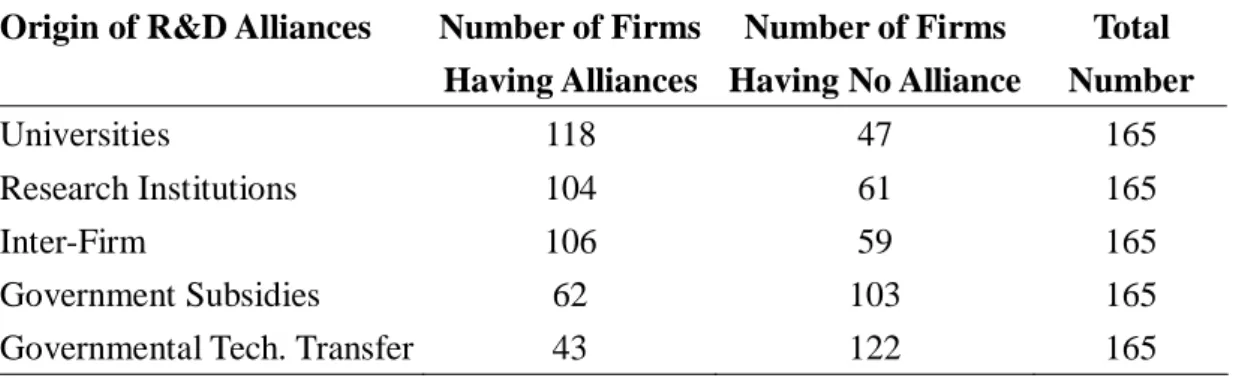
Table 1. Descriptive Summary of Types of R&D Alliances Origin of R&D Alliances Number of Firms
Having Alliances Number of Firms Having No Alliance Total Number Universities 118 47 165 Research Institutions 104 61 165 Inter-Firm 106 59 165 Government Subsidies 62 103 165
Governmental Tech. Transfer 43 122 165
Table 1 shows a summary of different types of R&D alliances in this research. As can be seen in Table 1, a majority of Taiwanese ICT firms have collaborative R&D projects with universities, research institutions, and other firms in the industry. In contrast, fewer firms in this research received subsidies or technology transfers from the governmental agents. This implies that collaborative R&D projects with universities, research institutions, and other firms are main choices of external R&D resources for Taiwanese ICT firms.
1
Table 2. Summary of ANOVA Results
F Value Universities Research
Institutions Inter-Firm Government Subsidies Government Technology Transfer Tech. Performance 8.139* 3.023† 5.161* 0.668 1.987 Market Performance 0.394 0.333 1.553 0.504 4.174* 3-Year ROA 0.086 0.612 0.163 0.309 0.578 7-Year ROA 0.596 2.594 0.742 2.827† 0.188 3-Year ROE 0.032 0.654 0.261 0.092 0.549 7-Year ROE 0.021 2.694 0.151 2.967† 0.951 3-Year Operational Profit 0.890 0.000 0.136 0.402 0.384 7-Year Operational Profit 0.504 0.837 0.709 0.386 0.415 3-Year Gross Profit 0.693 1.166 1.446 2.144 0.025 7-Year Gross Profit 1.717 2.056 0.419 3.034† 0.542 ** p<0.001; * p<0.05; †<0.1.
Table 2 summarizes the results of ANOVA. A number of significant findings are observed and concluded as following:
Finding 1: Firms with collaborative R&D projects with universities have better technological performance (measured by patents) than firms without such collaborative R&D projects.
Finding 2: Firms with collaborative R&D projects with research institutions have better technological performance (measured by patents) than firms without such collaborative R&D projects.
Finding 3: Firms with collaborative R&D projects with other firms have better technological performance (measured by patents) than firms without such collaborative R&D projects.
Finding 4: Firms receiving technologies transferred from the government have better market performance (measured by market share) than firms without such technology transfers.
Finding 5: Firms receiving R&D subsidies from the government have better financial performance (measured by 7-year averaged ROE, ROA, and gross profit rate) than firms without such subsidies.
CONCLUSION
The results suggest that firms with collaborative R&D projects with universities, research institutions, and other firms, have better technological performance measured by patent number than firms without such collaborative projects. However, market performance and financial performance cannot be improved through these collaborative R&D projects with universities,
research institutions, and other firms. As shown in the results, market performance only can be improved via technology transfers from the government while financial performance, including 7-year ROA, ROE, and gross profit rate, can only be improved by the governmental subsidies. Some implications from the above results can be drawn in this paper. If a firm would like to improve its number of patents and then to accumulate its technological competence, it is better for this firm to conduct collaborative R&D projects with universities, research institutions, and other firms. If a firm is inclined to improve its revenues, then it is better to receive technology transfers from the government directly. Finally, if a firm would like to improve its financial performance, such as ROA, ROE, or gross profit rate, then it is better for this firm to receive subsidies from the governmental agents. Our results are mainly consistent with previous research.
For business practices, the results of this paper suggest that Taiwanese ICT firms tend to improve their technological performance via collaborative R&D projects with universities, research institutions, and other firms. Taiwanese ICT firms can improve their market performance by receiving technology transfers from the government while improve their financial performance by receiving subsidies from the government. For the policy makers, our results suggest that R&D subsidy policies or technology transfers from the government can not improve a firm’s technology competency, which is measured by patents, but can improve a firm’s market performance or financial performance. Thus, this provides an insight for both Chinese and Taiwanese governments that the government should encourage firms to conduct collaborative R&D projects with universities, research institutions, and other firms instead of relying on the subsides or technology transfer from the governmental sectors. Moreover, another insight for Chinese or Taiwanese firms is that a firm can employ an appropriate R&D alliance strategy in order to achieve its various strategic intentions.
REFERENCES
Barney J. 1991. Firm resources and sustained competitive advantage. Journal of Management
17(1): 99-120.
Blau J. 1999. Research collaborations drive Global Telecoms industry. Research Technology
Management 42(4): 4-5.
Branzei O. 2005. Product innovation in heterogeneous R&D networks: Pathways to exploration
and exploitation. The University of British Columbia, 274 pages, AAT NQ99444.
Cohen WM., Nelson RR., Walsh JP. 2002. Links and impacts: The influence of public research on industrial R&D. Management Science 48(1): 1-23.
Dedrick J., Kraemer KL. 1998. Asia’s Computer Challenge. Oxford University Press: New York. Grupp H. 1997. The links between competitiveness, firm’s innovative activities and public R&D
support in Germany: An empirical analysis. Technology Analysis & Strategic Management 9(1): 19-34.
Hamel G., Prahalad CK. 1994. Compete For The Future. Harvard Business School Press: Boston. Harding R. 2001. Competition and collaboration in German technology transfer. Industrial and
Corporate Change 10(2): 389-418.
Hemmert M. 2003. International Organization of R&D and Technology Acquisition Performance of High-Tech Business Units. Management International Review 43(4): 361-382.
Herbert F. 1995. Industrial research - Where it's been, where it's going. Research Technology
Management 38(4): 52-56.
Hobday M. 1995. Innovation in East Asia---the Challenge to Japan. Edeard Elgar Publishing Ltd: Cheltenham.
Jang S., Huang G. 2005. Public R&D and industrial innovations at the project level: an exploration of Taiwan’s public research projects. Contemporary Economic Policy 23(4): 636-646.
Kassicieh S.K., Kirchhoff B.A., Walsh S.T., McWhorter P.J., 2002. The role of small firms in the transfer of disruptive technologies. Technovation 22: 667-674.
Kennedy KJ., Holmfeld JD. 1989. A Corporate R&D Metric. International Journal of Technology
Management 4(6): 665-672.
Kogut B., Zander U. 1992. Knowledge of the firm, combinative capabilities, and the replication of technology. Organization Science. 3(3): 383-397.
Koichi F., Yoshiya T., Makoto K. 1990. Network Organization for Inter-Firm R&D Activities: Experiences of Japanese Small Businesses. International Journal of Technology Management
5(1): 27-40.
Lackman CL. 2005. The Comparative Influence of Government Funding by the US Commerce Department's Advanced Technology Program and Private Funding on the Marketing Strategy of the High-Tech Firms. Journal of Nonprofit & Public Sector Marketing 13(1/2): 179-198.
Lerner J. 1999. The government as venture capitalist: The long-run impact of the SBIR program.
The Journal of Business 72(3): 285-318.
Lindelöf P., Löfsten H. 2004. Proximity as a Resource Based for Competitive Advantage: University-industry Link for Technology Transfer. Journal of Technology Transfer 29(3-4): 311-326.
Liu D., Shieh L. 2005. The effects of government subsidy measures on corporate R&D expenditure: a case study of the leading product development programme. International
Journal of Product Development 2(3): 265-281.
Liu H., Jiang Y., 2001. Technology transfer from higher education institutions to industry in China: nature and implications. Technovation 21: 175-188.
Lockett A., Wright M., Franklin S. 2003. Technology Transfer and Universities: Spin-Out Strategies. Small Business Economics 20(2): 185-200.
Mowery DC. 1998. Collaborative R&D: How effective is it? Issues in Science and Technology
15(1): 37-46.
Niosi J., Banik M. 2005. The evolution and performance of biotechnology regional systems of innovation. Cambridge Journal of Economics 29(3): 343-357.
Parker, D.D., Zilberman, D., 1993. University technology transfers: impacts on local and US economies. Contemporary Policy Issues 11(2): 87–96.
Peters J., Becker W. 1998. Vertical corporate networks in the German automotive industry: Structure, Efficiency, and R&D spillovers, International Studies of Management &
Organization 27(4): 158-185.
Porter ME. 1985. Competitive Advantage. First Press: New York.
Powers JB. 2003. Commercializing academic research: Resource effects on performance of university technology transfer. The Journal of Higher Education 74(1): 26-50.
Poznanski PJ. 1994. Big help for small businesses. Management Accounting 76(2): 53-56.
Sakakibara M., Dodgson M. 2003. Strategic research partnership: Empirical evidence from Asia.
Technology Analysis and Strategic Management 15(2): 227-245.
Schumpeter JA. 1934. The Theory of Economic Development. Harvard University Press: Cambridge, Mass.
Shane S., 2002. University technology transfer to entrepreneurial companies. Journal of Business
Venturing 17: 537-552.
Steffensen M., Rogers E.M., Speakman K. 2000. Spin-offs from research centers at a research university. Journal of Business Venturing 15: 93-111.
Tung A. 2001. Taiwan’s semiconductor industry: What the state did or did not. Review of
Development Economics 5(2): 266-288.
VanderWerf PA. 1992. Explaining Downstream Innovation by Commodity Suppliers with Expected Innovation Benefit. Research. Policy 315-333.
Walker WE. 1995. Technological innovation, corporate R&D alliances and organizational
learning, The RAND Graduate School, AAT 0530186.
Yeheskel O., Shenkar O., Fiegenbaum A., Cohen E., Geffen I. 2001. Cooperative wealth creation: Strategic alliances in Israeli medical-technology ventures. The Academy of Management
Executive 15(1): 16-25.
Yi S., Shin H. 2000. Endogenous formation of research coalitions with spillovers. International
Journal of Industrial Organization 18(2): 229-256.
Zucker LG., Darby MR., Armstrong JS. 2002. Commercializing knowledge: University science, knowledge capture, and firm performance in biotechnology. Management Science 48(1): 138-153.