Research Express@NCKU - Articles Digest
Research Express@NCKU Volume 4 Issue 1 - April 18, 2008 [ http://research.ncku.edu.tw/re/articles/e/20080418/2.html ]
An industry-level knowledge management
model – a study of information-related
industry in Taiwan
Chinho Lin
1,*, David C. Yen
2, David D.C. Tarn
31Department of Industrial and Information Management, National Cheng Kung University
2Decision Sciences and Management Information Systems, RTF School of Business, Miami
University
3Graduate Institute of Human Resource and Knowledge Management, National Kaohsiung
Normal University
Email:[email protected]
“Information & management”, Vol. 44, pp. 22-39, 2007
1.I
ntroductionKnowledge management (KM) has recently played a critical role in management and economics. Experts have tried to develop and promote KM ideology in order to maintain competitive advantage and improve the organizational use of IT.
Most knowledge management (KM) literature investigates related issues from the perspectives of organizational and national layer. However, the organizational and national perspectives might be insufficient. This is particularly true for certain industries and countries, e.g., the hi-tech industries in Asia is primarily made up of medium or small firms which do not have the same degree of independent knowledge resources as their larger competitors in the US and Europe. As a result, they need to share knowledge, such as cooperative R&D, joint knowledge alliance, and even their patents, with other organizations in the same or similar industry. Specifically, in less developed countries (LDCs), and even some developed countries, such as Japan, many industries conduct their knowledge activities (KA) by cooperating with other firms. Many KM activities are happened in industrial layer. Hence, the primary purpose of this study is to explore the content of industry-layer knowledge management (i.e., ILKM) and how ILKM activities are practiced.
2.The industry-layer knowledge management (ILKM) model 2.1 Classification dimensions for ILKM model
Industry-layer knowledge management (ILKM) has significant impact on particular industries and countries because:
KM needs considerable support from R&D activities and the technological infrastructure. For example, large US-owned companies have devoted large amounts of R&D resources to KM and this would be difficult for smaller organizations. Consequently, smaller firms need to group, provide financing in a team-oriented manner, and execute R&D activities in a joint effort. Indeed, this is the normal practice of firms in LDCs. These joint activities share the costs and also this achieves economy of scale.
For most LDCs, such as India, Singapore, Taiwan, Korea, and China, the connections (or ‘‘Guanxi’’) between firms are close, tight, inseparable, and sophisticated. Even though the R&D infrastructure is weak, the firms can still utilize their knowledge or patents mutually via interaction. By doing so, they are 1 of 4
Research Express@NCKU - Articles Digest
able to create technological
Since ILKM is a new ideology, it is essential to classify the model before exploring it further. Ansoff’s construction regarding corporate development strategy provides a theoretical base for building the model. He, after conducting, many case studies, classified corporate development strategy in two dimensions: (1) whether the firms stay in the same markets or enter into new ones based on their ontological view and (2) whether they concentrate on the existing products or develop new ones based on their epistemological perspective. In addition, Smith and Wolfe provided an interfacial insight on the typology of knowledge activities by treating knowledge management as efforts to fit the knowledge body into the context that conducts knowledge activities. Hence, a two dimension, four-mode model was formed as presented in Fig. 1. This follows Ansoff and Smith and Wolfe, to classify ILKM.
The activities (content or index) of the four-mode model are described in subsection 2.2, 2.3, 2.4, and 2.5.
Fig. 1. Taxonomy of industry-level knowledge management.
2.2 Knowledge clustering
Knowledge clustering includes the following activities:
●Knowledge flows, transfer, diffusion, learning, and assimilation within the industry and related arena. ●Knowledge circulation within the industry and related fields.
●Dividing knowledge works and duties to achieve the requirements of industrial synergy. ●Making the best use, application, and employment to enlarge its value.
●Establishing appropriate mechanisms and relationships to effectively transfer, diffuse, and intermediate knowledge in the industry and related fields.
2.3 Knowledge enlarging
According to literature, knowledge enlarging may contain the following activities: ●Leading members within the industry to enter new and correct knowledge domain.
●Guiding firms/organizations within the industry to extend and/or expand knowledge using existing core knowledge of the industry.
●Supporting members in knowledge extending and /or expanding via knowledge transfer, integration, modification, and purification.
●Assisting members in stretching knowledge/technology life cycle, usage, and utility. 2.4 Knowledge exchanging
The increasing cross-industrial KAs have made knowledge exchanging prevalent today. It consists of: ●Knowledge licensing, franchising, strategic alliances and instructing across the industry.
●Integrating and coordinating the existing knowledge between industries.
●Cross-industry mercantile affairs, including knowledge trade, interchange, and related exchange behavior.
Research Express@NCKU - Articles Digest
●Knowledge cooperation among divergent interfaces, including industry, education sectors, research agencies, customers, and even competitors.
●Providing a proper culture and climate for knowledge cooperation. ●Playing an intermediary role for knowledge cooperation.
●Cross-national knowledge cooperation. 2.5 knowledge initiating
Practices associated with knowledge initiating include:
●Setting up the scale, standards, and prototypes of knowledge and its outcomes. ●Establishing proper mechanism for cross-industrial cooperation and organization. ●Duty assigning, consulting, and territory/domain assigning in the KAs.
●Establishing laws, regulating, and rules for KAs.
●Planning, implementing, and auditing cooperative projects.
●Determining sources and allocation of resource, such as time, R&D capital, etc. ●Setting R&D policy and priority of alternatives.
●Prospecting new ideas and searching inspiration.
●Deciding knowledge domains (including defining broadness and depth of the knowledge) and sources.
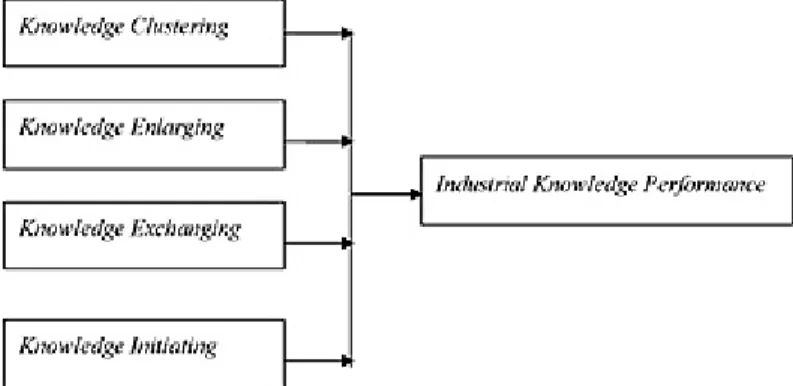
Fig. 2. Research framework with IKP
3.Methodology
Our study involved testing of the criterion validity of ILKM. To follow the ‘‘Environment - Strategy - Conduct- Performance’’ paradigm (ESCP), it was reasonable to select Industrial Knowledge Performance as a criterion to study ILKM. To examine the effectiveness and validity of the scale, we used a three-type knowledge performance indicator: knowledge depth, knowledge broadness, and knowledge integration. The test on criterion validity was vital in examining the appropriateness of the data collected.
A 123-respondents empirical survey, selecting Taiwan’s information equipment industry as the sample, confirms the reliability and validity of ILKM scale. We employed multivariate statistical techniques to analyze the results of the questionnaire.
4.Conclusions
As most studies tend to consider KM issues from organizational and national levels, they neglect the fact that many knowledge activities in developing countries occur at the industrial level. Our attempted to explore industrial-level knowledge management via model construction and an empirical survey. After reviewing prior work, we concluded that there were four distinct ILKM modes which we termed:
knowledge clustering, enlarging, exchanging, and initiating. From responses to a questionnaire from 123 respondents in Taiwan we found that the ILKM scale matched the basic requirements of face validity, internal consistency reliability, and constructs validity. It also indicated that the tendencies of the four
Research Express@NCKU - Articles Digest
modes correlated positively with one another, implying good criterion validity for the ILKM model.