明新科技大學 校內專題研究計畫成果報告
考慮產品世代交替之鋁 基 板硬碟片供應鏈之績效評估
Performance Evaluation of a ASHD Supply Chain with
Substitution of Successive Generations of Products
摘要
Abstract
New Product Development (NPD) management is the crucial part of a company’s competitive edge due to global competition and short product life cycle. The challenging topics involve the integration of multidisciplinary knowledge. NPD managers should lead experts from different backgrounds to resolve unknown technical bottlenecks and complete NPD missions on schedule.
Currently IC design management was procedure-oriented, from market survey to product release. It has the following drawbacks: (1) lack of collaboration mechanism among NPD team members, (2) deficiency of performance measurement in real time, (3) difficulty in quick response to market change, (4) difficulty in accumulating company’s core technologies, and (5) weak support of necessary information.
From literatures and field management experiences, successful NPD management consists of following characteristics: (1) an interactive platform for NPD activities, (2) enabling accumulation and reuse of developed technologies, (3) with well-defined performance index and probing system, (4) supporting collaborative-design and optimal resource allocation, and (5) quick response to market change.
This study explores how to construct a robust NPD management framework and apply such result in IC design industry to well-manage NPD team members with enhanced performance. A management framework of Interactive-Collaborative NPD (IC NPD) is proposed to overcome the stated drawbacks and fulfill future requirements. Furthermore, an object-oriented based model is constructed for implementing the framework. The study covers the analysis of IC design interactive roles and collaborative mechanisms. Use case of IC NPD applications are also illustrated.
目錄
摘要 ... i Abstract... ii 目錄 ...iii 表目錄 ... v 圖目錄 ... vi 第一章 緒論 ... 1 1.1 研究背景與動機 ... 1 1.2 研究目的... 6 1.3 研究範圍與限制 ... 6 1.4 研究方法及步驟 ... 6 1.5 論文架構... 7 第二章 相關文獻探討 ... 9 2.1 核心競爭力-新產品開發(Core Competence) ... 10 2.2 新產品開發團隊管理(NPD Team Management) ... 10 2.3 管理模型(Management Model) ... 11 2.4 互動式管理(Interactive Management) ... 12 2.5 協同設計(Collaborative Design)... 13 2.6 績效指標(Performance Index)... 13 2.7 成功的新產品開發管理(Successful NPD) ... 14 2.8 結語(Summary)... 15 第三章 IC設計管理... 16 3.1 IC設計管理之問題... 16 3.2 IC設計管理之展望... 17 3.2.1 IC設計之管理方式 ... 17 3.2.2 IC設計之發展架構 ... 18 3.2.3 IC設計之資訊系統 ... 19 第四章 互動協同新產品開發管理架構 ... 20 4.1 新產品開發管理之構面... 20 4.2 協同機制佈署 ... 21 4.3 互動協同新產品開發管理架構設計 ... 24 第五章 物件導向塑模設計... 26 5.1 活動圖設計(Activity Diagram) ... 26 5.2 互動協同矩陣(Interactive-Collaborative Matrix) ... 305.3 IC NPD使用案例圖(Use Case Diagram) ... 33
IC NPD類別圖(Class Diagram) ... 37
IC NPD套裝圖(Package Diagram) ... 38
5.6 IC NPD佈署圖(Deployment Diagram) ... 38
第六章 應用探討 ... 40
第一章 緒論
1.1 研究背景與動機
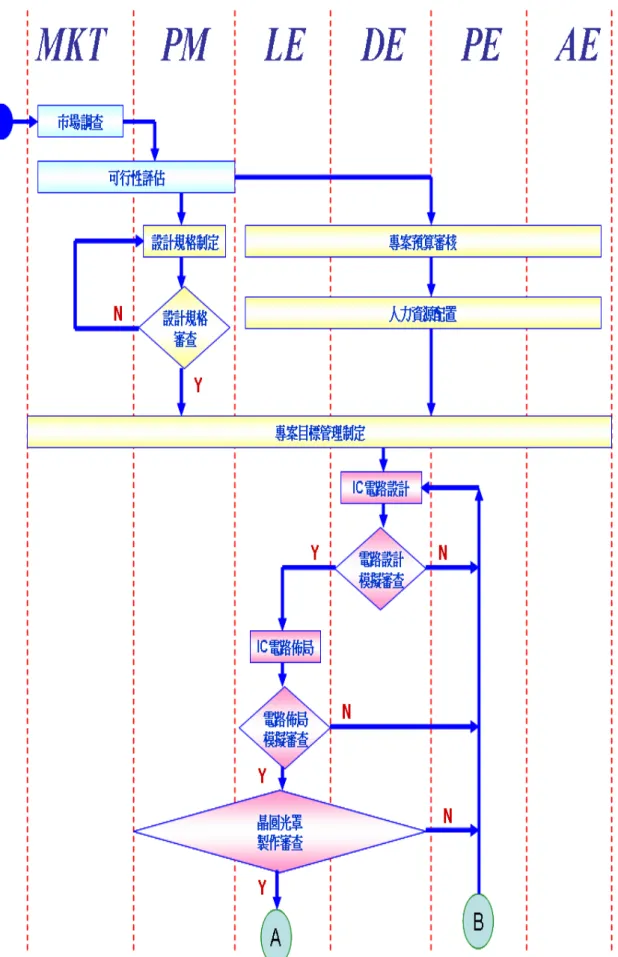
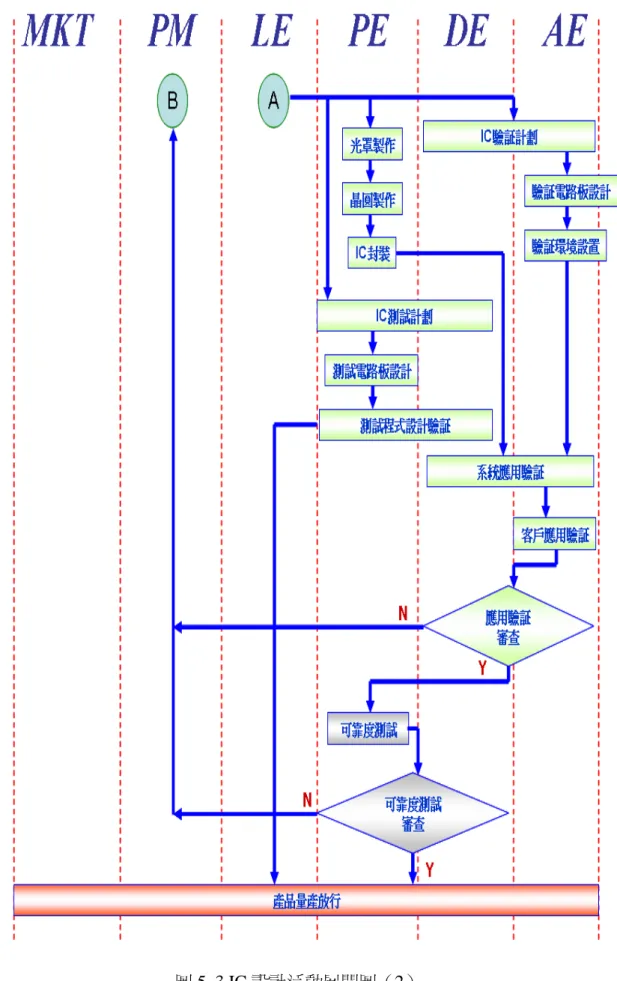
新產品開發(NPD)為公司核心競爭力之重要環節 [Kesser 2002]。由於全球 化的競爭及產品生命週期縮短,更突顯 NPD 管理之重要性;NPD 管理涵蓋跨領域 待整合的知識,是一極具挑戰性的課題;管理人員須引領不同文化素質的專業人 員,克服未知的技術瓶頸,及時達成新產品開發任務。 以業界常見的 IC 設計管制流程,如圖 1.1 及圖 1.2 所示(參考相關公司 ISO-9001 規範):IC 設計產業具有專業分工的特質,各階段之任務需要各領域專才分工完 成;實務上,IC 設計公司內部是多專案並行;由於任務的繁雜,專案間的互動並 不明顯,一顆 IC 從無到有必須經過以下階段: 1. 市場調查及產品規劃:藉以瞭解客戶需求、市場現況、產品之市場行情、 以及競爭對手動態等。結合公司既定之策略及可用之核心技術,進行新 產品規劃與專案可行性評估(例如:ROI;Return On Investment);主要 參與者為市場人員(Marketing;MKT)及產品經理(Product Manager; PM)。 2. 專案成立:包含設計規格制定及審查、專案預算審核、人力資源配置、 以及目標管理設定等。主要目的在於界定專案之各項需求及執行目標; 主要參與者為所有專案成員,包括市場人員(MKT)、產品經理(PM)、設計工程師(Design Engineer;DE)、佈局工程師(Layout Engineer;LE)、
平台,以及發展相關測試程式,這些工作是與光罩晶圓委外製作時同步 進行;主要參與者為設計工程師(DE)、應用工程師(AE)及產品工程 師(PE)。
5. 可靠度認證:在各公司品質規範的要求下,進行各項品質參數測試;包
Statement )、 需 求 分 析 ( Requirement Analysis )、 架 構 佈 署 ( Framework Deployment)、塑模設計(Modeling Design)及應用探討(Applications Discussion)。
3.2.3 IC 設計之資訊系統
從資訊系統角度來看,現行 IC 設計之資訊系統屬於程序式導向,每個大小專 案皆須透過同樣的執行程序,系統在標準化的作業下運作。然而,這也限制了系統 彈性擴充及應變的能力,且埋下了日後系統維護的隱憂(程序一旦改變,前後不相 容的問題)。例如:是否對於小型專案可簡化發展程序加速開發時辰?是否能彈性 的合併執行中(完)的專案,而又成為另一專案?程序式導向系統並無法提供這樣 機制。 在物件式導向技術應用的成熟下,本研究提出以此種思維建構系統,以克服程 序式導向資訊系統的困難課題。物件導向式系統具有互動的特質、物件可抽換的優 勢、系統可彈性擴充的實力;將 NPD 管理平台建構在物件導向式系統,能有效克 服程序導向式系統之限制,同時符合未來系統維護之需求。 1. 物件導向系統是透過物件之互動完成運作,NPD 之成員及專案間則必須 以互動完成專案之任務,無形中互動協同之成效將最好。 2. 每個物件皆可被抽換、更新及擴充。在界面一致的前提下,各物件可發展 其局部最佳化,並兼具可維護性。 3. 專案開發的內容程序,可允許專案自行定義執行情節(Scenario);依專案 規模大小及複雜度,整合必須參與之協同機制及相關互動成員,即可彈性 的定義專案之執行內容。而每個協同機制也會在系統精煉下,日益成熟而 成為另一種形式的核心競爭力。 綜合以上管理展望之探討,以下將現行 IC 設計管理與成功的 NPD 管理比較如 表 3.2 所示。 表 3. 2 IC 設計管理之展望 展望課題 現行 IC 設計管理 成功的 NPD 管理 管理方式 嘗試錯誤法(Try & Error)
參考。
Intellectual Property Coordinator:新產品開發對於智慧財產權的保護尤其重 要,在設計過程也須避免侵犯到別人的專利;對於有價值之研發成果,可以申請專 利避免別人的抄襲,以保護新產品開發成果在市場上擁有一定的競爭優勢。此類有 關智慧財產權的查詢及申請,皆透過此協同機制互動進行之。
4.3 互動協同新產品開發管理架構設計
綜合以上不同構面之分析,以及相關協同機制之佈署,本研究設計互動協同新 產品開發管理架構(IC NPD Management Framework)如圖 4.3 所示。本研究以三 個 構 面 區 分成不同領域(Product-Marketing、Engineering Management、Technical
Management),各個領域分別對應相關的協同機制(Strategy Coordinator、Roadmap
Coordinator、Marketing Coordinator、Resource Coordinator、Objective Coordinator、 Performance Coordinator、Documentation Coordinator、Training Coordinator、Knowledge Coordinator、Intellectual Property Coordinator)以涵蓋 NPD 管理流程之所有範圍。
圖 4. 3 互動協同新產品開發管理架構
蓋較全面性的考量(藉由三個構面所佈署之協同機制);未來其他應用層面的管理 需求亦可在此系統下開發。由於系統將以物件導向系統觀念建構,協同機制在界面 不變的前提下可隨時被抽換,系統就具可有循序改善之彈性。另外,系統亦可增加 協同機制以強化廣泛性,例如:現在新的 NPD 設計理念強調 Design for X,更需要 考 量 生 產 測 試 ( Design for Testing, DFT); 更 需 要 結 合 製 造 系 統 ( Design for
Manufacturing, DFM);更需要接符合環保(Design for Green, DFG)等,依不同需
求可佈署新的協同機制,將之建構於此系統上。在 IC NPD 的管理資訊平台下,前 述 NPD 管理的重點都不再是難事:資訊能有效即時的交換,核心技術能不斷累積及 再利用,可執行動態績效評核,能進行協同設計與最佳化資源分配,以及產品可因應 市場變化進行動態調整。相較於現行 IC 設計管理流程,IC NPD 的經營管理效率得 以有效提升之。表 4.1 將成功的 NPD 條件與 IC NPD 管理架構做一比較回顧: 表 4. 1 IC NPD 管理架構之比較回顧 成功的 NPD 條件 相關構面 參與之協同機制 即時資訊交換 產品市場面 工程管理面 技術管理面
Strategy Coordinator、Roadmap Coordinator、 Marketing Coordinator、Resource Coordinator、 Objective Coordinator、Performance Coordinator、 Documentation Coordinator、
Training Coordinator、Knowledge Coordinator、 Intellectual Property Coordinator
累積核心技術 技術管理面
Documentation Coordinator、 Knowledge Coordinator、 Intellectual Property Coordinator
執行動態績效評核 工程管理面 Objective Coordinator、Performance Coordinator
最佳化資源分配 工程管理面 Resource Coordinator、Objective Coordinator、
Performance Coordinator、Training Coordinator
有效因應市場調整 產品市場面 Strategy Coordinator、Roadmap Coordinator、
第五章 物件導向塑模設計
塑模之目的,在於產生應用系統規格,對系統之行為進行分析及預測,以供日
後系統發展實作參考。UML 為物件導向系統塑模之標準工具 [黃 2003],提供以視 覺化的方式訂定及建構系統 [張 2004]。本節將應用 UML 之塑模技術,對上述 IC
NPD 管理架構進行高階應用系統塑模。未來研究若要以程式實際建構系統,則還須
5.2 互動協同矩陣(Interactive-Collaborative Matrix)
經由以上活動圖之任務分析及說明,以下將各階段任務、NPD 成員及協同機 制之關係彙整成一互動協同矩陣如表 5.1 所示,以下各節之塑模設計將根據此一矩 陣為主軸進行之。 表 5. 1 互動協同矩陣 NPD 成員(表 5.2) 協同機制(表 5.3) 階段 任務 MKT PM DE LE AE PE SC RC MC HC OC PC DC TC KC IC 1 V V V V V V V V 2 V V V V V V V V V V V 3 V V V V V V V V V V V 4 V V V V V V V V V 5 V V V V V V 6 V V V V V V V V V V 表 5. 2 任務成員定義表 階段任務定義 NPD 成員定義 1 市場調查及產品規劃 MKT 市場人員,Marketing Staff 2 專案成立 PM 產品經理,Product Manager 3 設計 DE 設計工程師,Design Engineer 4 驗證及生產測試 LE 佈局工程師,Layout Engineer 5 可靠度認證 AE 應用工程師,Application Engineer 6 量產放行審查 PE 產品工程師,Product Engineer 表 5. 3 協同機制定義表SC Strategy Coordinator PC Performance Coordinator RC Roadmap Coordinator DC Documentation Coordinator MC Marketing Coordinator TC Training Coordinator
HC Resource Coordinator KC Knowledge Coordinator OC Objective Coordinator IC Intellectual Property Coordinator
統知識庫之一部份。 6. 量產放行審查:此階段為新產品開發之最後階段,所以 NPD 成員必須全員 參與,綜合設計、驗證、生產測試、可靠度認證之結果,整合市場、工程、 業務人員之意見,決定是否將此產品放行量產,同時將相關生產規格及技術 文件移交給量產單位。在此階段 Strategy Coordinator 可審核產品開發之結 果,以做為修改或更新產品策略方向之依據,同時 Roadmap Coordinator 也 要更新 Roadmap,對未來產品開發時辰做適度修正。
5.3 IC NPD 使用案例圖(Use Case Diagram)
IC NPD 類別圖(Class Diagram)
類別圖是呈現系統的骨幹,用來描述物件之間的關係,以方便系統發展辨識。 類別圖為一種靜態的圖形,每一個類別包含了屬性、方法以及存取的限制,類別之間 都有相互的關聯性。目前本研究為管理架構階段,圖 5.8 為 IC NPD 之高階類別圖(High level class diagram)。
IC NPD Web Server
Web Server
<<Technical Management>>
<<Engineering Management>> <<Product-Marketing>>
<<Project Development Management System>>
IC NPD 可將各專案之任務執行狀態即時收集。因此,要從管理者的角度 Zoom-in
或 Zoom-out 專案狀態都不是難題。如圖 6.2 專案管理中心所示:將專案各任務執行 狀態分級,從順利達成的綠色十分到嚴重落後的紅色零分,透過 Objective Coordinator 及 Performance Coordinator 協同機制的幫助,就可以綜觀所有專案各階段任務的執行 狀態。接著再點選有問題之任務,以展開方式往下找出根本原因,此時 Resource Coordinator、Training Coordinator 及 Knowledge Coordinator 都可幫忙提取出有效之資
業,相較於循序式流程銜接後才得知問題(例如:佈局時才發現設計電路 之訊號排列不佳),IC NPD 在各方面之績效均優於現行 IC 設計管理流 程。以圖 6.5 為例,每個專案任務進度的呈現,包括了現階段及下一階段所 負責之 NPD 成員,對於有問題之專案也可再繼續往下展開,以找出相關被 影響之專案。 圖 6. 6 市場資訊驅動應用
2. IC NPD 具有市場資訊驅動(Marketing Information Driven)之能力。市場
自主自律及互動協同。相較於現行 IC 設計管理流程,IC NPD 在各項機制的協助 下,更能有效縮短開發時辰,充分掌握 Time-To-Market。
6.5 互動排程系統
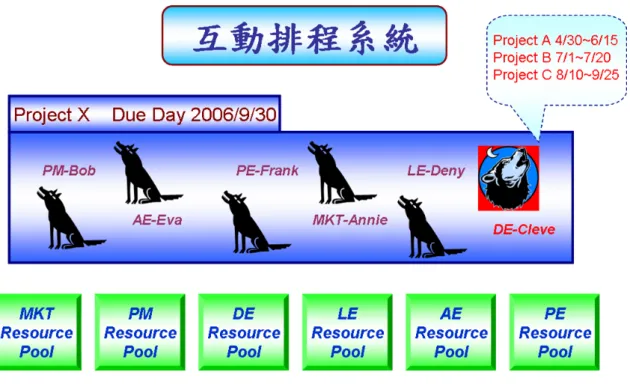
如前述,現行 NPD 管理於專案人力配置時,大部份以主觀感受來決定 NPD 成 員組合。久而久之,人員多工的問題成為專案之瓶頸,進而影響更多專案進度。於
IC NPD 管理架構下,可善用 Resource Coordinator 及 Objective Coordinator 的特質,
設計一互動排程系統。
如圖 6.8 所示,要執行 Project X 人力配置時,可透過 Roadmap Coordinator 了 解及定義產品預定量產時間(Product Release Due Day)。接著在各部門之 Resource Pool 以拖曳方式將各專案成員置放於 Project X 內,由 Resource Coordinator 及 Objective Coordinator 可得知專案及成員目前工作排定情形,以及預計完成日期。系統可自動計 算(或執行不同排程演算法)所排定之人員是否會影響 Project X 之 Due Day,若有 問題,則以互動方式呈現,同時提供延遲原因相關訊息。
圖 6. 8 互動排程系統應用示意圖
延伸 5.4 節及綜合上述各節之應用需求探討,類別設計如圖 6.9 所示,未來可
5. 展示了如何運用物件導向系統分析設計理念,對一個管理架構實現塑 模之過程,以提供應用系統規格供未來實作參考。套用此研究過程及 方法,亦可實現對其他管理系統之塑模與改善。 6. 列舉管理應用實例,呼應 IC NPD 之設計理念,證明未來想法能實現 於現有架構。對於日後系統反覆及漸近改善之發展,提供應用導向 (Application Driven)之思維方向。
7.3 未來研究方向
因應 NPD 求新、求快、求變的需求特質,本研究在互動協同基礎上,建立 了一套新的管理架構,後續相關研究可朝以下方向進行之: 1. 依塑模結果所產生之應用系統規格,繼續往下發展及修正,以程式實作 IC NPD 管理資訊系統。 2. 根據此基礎架構,朝實務應用面發展。如第六章所提及:互動協同指標及資料探勘等應用課題,就 Application Driven 方式找出更多 Use Case。
3. 將此 IC NPD 之應用連結至企業資訊系統,進行績效研究。例如:與
ERP 系統之連結,以擴展 NPD 管理視野之通透性於企業運作。
4. 探討如何將現行 IC 設計管理流程,順利轉換至 IC NPD。
參考文獻
中文部份
1. [朱 1999] 朱道凱 譯,Kaplan, R.S. and Norton, D.P. 原著,平衡計分卡:資訊 時代的策略管理工具,臉譜文化出版,1999。
2. [伍 2001] 伍忠賢 著,知識管理-策略與實務,華泰文化,2001。
3. [李 2002] 李于青 譯,結城 浩 原著,Design Patterns 於 Java 語言上的實習
應用,博碩文化,2002。
4. [李 1997] 李長貴 著,績效管理與績效評估,華泰文化,1997。
5. [徐 2000] 徐作聖、邱奕嘉 譯,Afuan, A. 原著,創新管理,華泰文化,2000。
6. [黃 2003] 黃聖峰 譯,Pender, T.A. 原著,UML 教學手冊,博碩文化,2003。
英文部份
1. [Anthony 1999] Anthony, C. and Benedetto, D., “Identifying the key success factors in new product launch,” Journal of Product Innovation Management, Vol. 15, 1999, pp. 530-544.
2. [Åstebro 2004] Åstebro, T., “Key success factors for technological
entrepreneurs’ R&D projects,” IEEE Transactions on Engineering Management, Vol. 51, No. 3, 2004, pp. 314-321.
3. [Bailetti 1995] Bailetti, A.J. and Litva, P.F., “Integrating customer requirements into product designs,” Journal of Product Innovation Management, Vol. 12, 1995, pp. 3-15.
4. [Betz 1997] Betz, F., Managing technological innovation, John Wiley & Sons, 1997.
5. [Bommer 2004] Bommer, M. and Jalajas, D.S., “Innovation sources of large and small technology-based firms,” IEEE Transactions on Engineering
Management, Vol. 51, No. 1, 2004, pp. 13-18.
6. [Bonner 2002] Bonner, J.M., Ruekert, R.W., and Walker, O.C., “Upper management control of new product development projects and project
performance,” Journal of Product Innovation Management, Vol. 19, 2002, pp. 233-245.
7. [Borwning 2002] Browning, T.R., Deyst, J.J., Eppinger, S.D., and Whitney, D.E., “Adding value in product development by creating information and reducing risk,” IEEE Transactions on Engineering Management, Vol. 49, No. 4, 2002, pp. 443-458.
8. [Chang 2002] Chang, P.L. and Tsai, C.T., “Finding the niche position- competition strategy of Taiwan’s IC design industry,” Technovation, Vol. 22, 2002, pp. 101-111.
9. [Chapman 2004] Chapman, R. and Hyland, P., “Complexity and learning behaviors in product innovation,” Technovation, Vol. 24, 2004, pp. 553-561. 10. [Chiu 2002] Chiu, M.L., “An organizational view of design communication in
design collaboration,” Design Studies, Vol. 23, No. 2, 2002, pp. 187-210. 11. [Cooper 2003] Cooper, L.P., “A research agenda to reduce risk in new product
development through knowledge management: a practitioner perspective,”
Journal of Engineering and Technology Management, Vol. 20, 2003, pp.
12. [Detienne 2002] Detienne, D.R. and Koberg, C.S., “The impact of
environmental and organizational factors on discontinuous innovation within high-technology industries,” IEEE Transactions on Engineering Management, Vol. 49, No. 4, 2002, pp. 352-364.
13. [Dolk 2000] Dolk, D.R., “Integrated model management in the data warehouse era,” European Journal of Operational Research, Vol. 122, 2000, pp. 199-218. 14. [Driva 2000] Driva, H., Pawar, K.S., and Menon, U., “Measuring product
development performance in manufacturing organizations,” International
Journal of Production Economics, Vol. 63, 2000, pp. 147-159.
15. [Foulquié 2004] Foulquié, P.C., Alemán, L.M., and Escudero, I.R., “Criteria employed for go/no-go decisions when developing successful highly innovative products,” Industrial Marketing Management, Vol. 33, 2004, pp. 307-316. 16. [Garcia 2000] Garcia, J., Entrialgo, J., Suárez, F.J., and Garcia, D.F.,
“Model-driven monitoring support for the multi-view performance analysis of parallel embedded applications,” Performance Evaluation, Vol. 39, 2000, pp. 81-98.
17. [Glunk 2001] Glunk, U., Heijltjes, M.G., and Olie, R., “Design characteristics and functioning of top management teams in Europe,” European Management
Journal, Vol. 19, No. 3, 2001, pp. 291-300.
18. [Hafeez 2002] Hafeez, K., Zhang, Y.B., and Malak, N., “Core competence for sustainable competitive advantage: a structured methodology for identifying core competence,” IEEE Transactions on Engineering Management, Vol. 49, No. 1, 2002, pp. 28-35.
19. [Huang 2004] Huang, X., Soutar, G.N., and Brown, A., “Measuring new product success: an empirical investigation of Australian SMEs,” Industrial Marketing
Management, Vol. 33, 2004, pp. 117-123.
20. [Jiang 2001] Jiang, J.J., Klein, G., and Discenza, R., “Information system success as impacted by risks and development strategies,” IEEE Transactions
on Engineering Management, Vol. 48, No. 1, 2001, pp. 46-55.
21. [Jun 2002] Jun, H.B. and Suh, H.W., “The hierarchical frame of enterprise activity modeling (HF-EAM),” IEEE Transactions on Engineering Management, Vol. 49, No. 4, 2002, pp. 459-478.
22. [Kaga 2001] Kaga, A., Nakahama, K., Hamada, S., Yamaguchi, S., and Sasada, T., “Collaborative design system with hypermedium and networking,”
Automation Construction, Vol. 10, 2001, pp. 309-318.
23. [Kesser 2002] Kesser, E.H. and Bierly, P.E., “Is faster really better? An empirical test of the implications of innovation speed,” IEEE Transactions on
24. [Kichuk 1997] Kichuk, S.L. and Wiesner, W.H., “The big five personality factors and team performance: implications for selecting successful product design teams,” Journal of Engineering and Technology Management, Vol. 14, 1997, pp. 195-221.
25. [Kim 2002] Kim, B. and Oh, H., “An effective R&D performance measurement system: survey of Korea R&D researchers,” Omega, Vol. 30, 2002, pp. 19-31. 26. [Kvan 2000] Kvan, T. and Candy, L., “Designing collaborative environments
for strategic knowledge in design,” Knowledge-Based Systems, Vol. 13, 2000, pp. 429-438.
27. [Laitinen 2002] Laitinen, E.K., “A dynamic performance measurement system: evidence from small Finnish technology companies,” Scandinavian Journal of
Management, Vol. 18, 2002, pp. 65-99.
28. [Lannes 2001] Lannes, W.J., “What is Engineering Management?” IEEE
Transactions on Engineering Managements, Vol. 48, No. 1, 2001, pp. 107-110.
29. [Lee 2000] Lee, J., Lee, J. and Souder, W.E., “Differences of organizational characteristics in new product development: cross-culture comparison of Korea and US,” Technovation, Vol. 20, 2000, pp. 497-508.
30. [Leenders 2003] Leenders, R., Jo, M.L., and Kratzer, J., “Virtuality,
communication, and new product team creativity: a social network perspective,”
Journal of Engineering and Technology Management, Vol. 20, 2003, pp. 69-92.
31. [Lichtenthaler 2004] Lichtenthaler, U. and Lichtenthaler, E., “Alliance functions: implications of the international multi-R&D-alliance perspective,”
Technovation, Vol. 24, 2004, pp. 541-552.
32. [Loch 2002] Loch, C.H. and Tapper, U.A.S., “Implementing a strategy-driven performance measurement system for an applied research group,” Journal of
Product Innovation Management, Vol. 19, 2002, pp. 185-198.
33. [Lurey 2001] Lurey, J.S. and Raisinghani, M.S., “An empirical study of best practices in virtual teams,” Information & Management, Vol. 38, 2001, pp. 523-544.
34. [Lynn 1999-a] Lynn, G.S., Skov, B., and Abel, K.D., “Practices that support team learning and their impact on speed to market and new product success,”
Journal of Product Innovation Management, Vol. 16, 1999, pp. 439-454.
35. [Lynn 1999-b] Lynn, G.S., Abel, K.D., Valentine, W.S., and Wright, R.C., “Key factors in increasing speed to market and improving new product success rates,”
Industrial Marketing Management, Vol. 28, 1999, pp. 319-326.
36. [Ma 1995] Ma, J., “An object-oriented framework for model management,”
Decision Support Systems, Vol. 13, 1995, pp. 133-139.
for intra-firm technology transfer,” Technovation, Vol. 22, 2002, pp. 427-436. 38. [McDonough 2000] McDonough III, E.F., “Investigation of factors contributing
to the success of cross-functional teams,” Journal of Product Innovation
Management, Vol. 17, 2000, pp. 221-235.
39. [Millar 2001] Millar, A., Simeone, R.S., and Carnevale, J.T., “Logic models: a systems tool for performance management,” Evaluation and Program Planning, Vol. 24, 2001, pp. 73-81.
40. [Moenaert 2000] Moenaert, R.K., Caeldries, F., Lievens, A., and Wauters, E., “Communication flows in international product innovation teams,” Journal of
Product Innovation Management, Vol. 17, 2000, pp. 360-377.
41. [Nellore 2001] Nellore, R. and Balachandra, R., “Factors influencing success in integrated product development (IPD) projects,” IEEE Transactions on
Engineering Management, Vol. 48, No. 2, 2001, pp. 164-174.
42. [Nieto 2003] Nieto, M., “From R&D management to knowledge management: an overview of studies of innovation management,” Technological Forecasting
& Social Change, Vol. 70, 2003, pp. 135-161.
43. [Nobelius 2004] Nobelius, D., “Towards the sixth generation of R&D
management,” International Journal of Project Management, Vol. 22, 2004, pp. 369-375.
44. [Quélin 2000] Quélin, B., “Core competencies, R&D management and partnerships,” European Management Journal, Vol. 18, No. 5, 2000, pp. 476-487.
45. [Reid 2000] Reid, F.J.M., Culverhouse, P.V., Jagodzinsky, A.P., Parsons, R., and Burningham, C., “The management of electronics engineering design teams: linking tactics to changing conditions,” Design Studies, Vol. 21, No. 1, 2000, pp. 75-97.
46. [Ring 2000] Ring, P.S., “The three T’s of alliance creation: task, team and time,” European Management Journal, Vol. 18, No. 2, 2000, pp. 152-163. 47. [Romijn 2002] Romijn, H. and Albaladejo, M., “Determinates of innovation
capability in small electronics and software firms in southeast England,”
Research Policy, Vol. 31, 2002, pp. 1053-1067.
48. [Schach 2004] Schach, S.R., Introduction to object-oriented analysis and design, McGRAW.Hill, 2004.
49. [Schoenecker 2002] Schoenecker, T. and Swanson, L., “Indicators of firm technological capability: validity and performance implications,” IEEE
Transactions on Engineering Management, Vol. 49, No. 1, 2002, pp. 36-44.
50. [Sedairy 2001] Sedairy, S., “A change management model for Saudi
2001, pp. 161-169.
51. [Shen 2002] Shen, Q. and Chung, K.H., “A group decision support system for value management studies in the construction industry,” International Journal
of Project Management, Vol. 20, 2002, pp. 247-252.
52. [Shi 2001] Shi, J., Huang, G.Q., and Mak, K.L., “Synchronous system for
developing performance measurement tools on the web,” Computers in Industry, Vol. 44, 2001, pp. 67-78.
53. [Silvester 2002] Silvester, K.J., Durgee, J.F., McDermott, C.M., and Veryzer, R. W., “Perspective: integrated market-immersion approach to teaching new product development in technologically-oriented teams,” Journal of Product
Innovation Management, Vol. 19, 2002, pp. 18-31.
54. [Stummer 2003] Stummer, C. and Heidenberger, K., “Interactive R&D portfolio analysis with project interdependencies and time profiles of multiple
objectives,” IEEE Transactions on Engineering Management, Vol. 50, No. 2, 2003, pp. 175-183.
55. [Takayama 2002] Takayama, M., Watanabe, C., and Charla, G.B., “Alliance strategy as a competitive strategy for successively creative new product development: the proof of the co-evolution of creativity and efficiency in the Japanese pharmaceutical industry,” Technovation, Vol. 22, 2002, pp. 607-614. 56. [Thiry 2002] Thiry, M., “Combining value and project management into an
effective programme management model,” International Journal of Project
Management, Vol. 20, 2002, pp. 221-227.
57. [Torkkeli 2002] Torkkeli, M. and Tuominen, M., “The contribution of technology selection to core competencies,” International Journal of
Production Economics, Vol. 77, 2002, pp. 271-284.
58. [Willoughby 2001] Willoughby, K.A., “Project procurement and disposal decisions: an inventory management model,” International Journal of
Production Economics, Vol. 71, 2001, pp. 467-472.
59. [Witt 2002] Witt, L.A., “The interactive effects of extraversion and