科技部補助專題研究計畫成果報告
期末報告
新興市場廠商組織間知識保護策略的前項與結果之分析:以外
國VS中國汽車供應商在中國為例(第3年)
計 畫 類 別 : 個別型計畫 計 畫 編 號 : MOST 103-2410-H-004-193-MY3 執 行 期 間 : 105年08月01日至106年10月31日 執 行 單 位 : 國立政治大學國際經營與貿易學系 計 畫 主 持 人 : 簡睿哲 計畫參與人員: 大專生-兼任助理:李書萱 報 告 附 件 : 出席國際學術會議心得報告中 華 民 國 107 年 02 月 02 日
中 文 摘 要 : 過去文獻對於關係管理以及創新間的關係探討仍然充滿不一至,因 此試圖彌補過去文獻缺失,本論文主要探討關係資本以及創新間的 關係,以台灣製造業資料為例,本研究發現關係資本以及創新間的 關係會受到兩個能力的中介影響包括客戶導向能力以及聯合學習能 力。此外,本研究也發現廠商間相互依賴程度以及設計能力會干擾 此一中介關係。 中 文 關 鍵 詞 : 關係管理。全球供應鏈。創新。
英 文 摘 要 : Global supply chains offer a range of expertise to
suppliers interested in generating innovative new products through capitalizing on the closeness of their working relationships with other firms. However, current knowledge on whether and how relational capital between firms can be leveraged for innovation is equivocal, conceptualizing little of the underlying processes responsible for
mobilizing relational capital, as well as yielding mostly contradictory empirical results. This study proposes and tests the intermediate mechanisms of proactive customer orientation and joint learning capability as two
distinctive capabilities that may account for how
relational capital drives relationship-based innovation. Our conceptual model posits that the relational
capital–innovation link is neither simple nor direct. An empirical test on 204 Taiwanese suppliers demonstrates the complexity of the innovation generation process. Two
pathways from relational capital to innovation are revealed: joint learning capability fully mediates the link, whereas the role of proactive customer orientation is moderated by aspects of the suppliers' ties to their
international customers; our theory is thereby largely confirmed. Finally, implications for the theory and
practice of innovation in global supply chain relationships are drawn.
1
科技部補助專題研究計畫成果報告
(□期中進度報告
/
□
期末報告)
(計畫名稱)新興市場廠商組織間知識保護策略的前項與結果之分
析:以外國
VS 中國汽車供應商在中國為例
計畫類別:
□
個別型計畫 □整合型計畫
計畫編號:
MOST 103-2410-H-004-193-MY3
執行期間: 2014.08.01 至 2017.10.31
執行機構及系所:政大國貿系
計畫主持人:簡睿哲
共同主持人:
計畫參與人員:李書萱
中
華 民 國 107 年 1 月 29 日
附件一報告內容:
Relationship-Based Innovation: Evidence from the Global Supply Chain
ABSTRACT
Global supply chains offer a range of expertise to suppliers interested in generating innovative new products through capitalizing on the closeness of their working relationships with other firms. However, current knowledge on whether and how relational capital between firms can be leveraged for innovation is equivocal, conceptualizing little of the underlying processes responsible for mobilizing relational capital, as well as yielding mostly contradictory empirical results. This study proposes and tests the intermediate mechanisms of proactive customer orientation and joint learning capability as two distinctive capabilities that may account for how relational capital drives relationship-based innovation. Our conceptual model posits that the relational capital–innovation link is neither simple nor direct. An empirical test on 204 Taiwanese suppliers
demonstrates the complexity of the innovation generation process. Two pathways from relational capital to innovation are revealed: joint learning capability fully mediates the link, whereas the role of proactive
customer orientation is moderated by aspects of the suppliers’ ties to their international customers; our theory is thereby largely confirmed. Finally, implications for the theory and practice of innovation in global supply chain relationships are drawn.
KEYWORDS
Relationship-based innovation; relational capital; global supply chains, proactive customer orientation; joint learning capability.
Relationship-Based Innovation: Evidence from the Global Supply Chain
Developing leading-edge innovations through collaboration with supply chain partners from other parts of the world is often feasible for firms. Global supply chains expose suppliers to a diverse customer base in which close relationships can facilitate suppliers’ acquisition and creation of knowledge, enhancing the discovery and development of innovative products (Soosay, Hyland, and Ferrer, 2008). For instance, the most successful Apple products incorporate multiple innovations from Apple’s global supply chain partners,
including Samsung and LG in South Korea and TPK in China; in turn, those partners gain market knowledge and innovative ideas from Apple (Dedrick, Kraemer, and Linden, 2010). To compete effectively, more firms are relying on relationships with their global supply chain partners (Doz and Wilson, 2012); strong supply chain relationships possess the relational capital necessary for suppliers to deeply engage with customers in order to discover unexpressed customer needs and jointly create innovative knowledge (Dedrick et al., 2010).
In particular, suppliers from emerging markets (EMs) can benefit greatly by offering innovative products, yet their focus on low-value assembly and contract manufacturing critically limits their knowledge base, restricting their ability to develop innovative products (Bello et al. 2016). In addition, suppliers from EMs such as China and Taiwan are usually in an asymmetric bargaining power position with their
international customers (Jean, Sinkovics, and Cavusgil, 2010). These multinational customers hesitate to share their core knowledge with EM suppliers, and seek to avoid potential risks of knowledge leakage. Moreover, geographic and cultural distance render social interaction more difficult in global supply chain relationships than in interorganizational relationships in domestic settings (Blocker, Flint, Myers, and Slater, 2011). Thus, EM suppliers face particular challenges in leveraging their relational capital and relationships with
international customers to develop radical innovations.
Current theories argue that organizations with strong relational networks and tight communities bounded by shared norms, trust, and reciprocity are more willing to collaborate and attempt risky ideas, which can
enhance innovation (Inkpen and Tsang, 2005; Nahapiet and Ghoshal, 1998). However, the available empirical evidence is equivocal: some studies have found that relational capital has positive effects on
relationship-based innovation because relational capital enhances knowledge sharing and learning in
collaborative relationships (Tsai, 2001); others report no or negative effects, suggesting that strong relational capital may result in organizations becoming complacent and insulated from outside influences, thereby stifling innovation. For example, Fang (2008) shows that sharing information with close customers in EMs can lead to undesirable new product outcomes because close ties can narrow and homogenize market
information. Noordhoff et al. (2011) argue that embedded ties may stifle innovation because of opportunism and knowledge redundancy.
Such contradictory findings suggest the relational capital–innovation link is neither simple nor direct; rather, if novel concepts and breakthrough ideas are to emerge from a supply chain, complex processes and mechanisms embedded in strong relationships likely come into play. However, only a few, limited studies have examined the processes and context through which relational capital generates relationship-based innovation in the context of global supply chains (e.g Sivakumar, Roy, Zhu, and Hanvanich, 2010). The purpose of this study is to develop a better understanding of the mechanisms and the conditions under which
relational capital can efficiently and effectively influence EM firms’ innovative outcomes. Drawing on the resource-based view (RBV) (Glavas, Mathews, and Bianchi, 2016) and capabilities building literature (Barney, 1991), this study extends relational capital–innovation research by investigating the mediating roles of
proactive customer orientation and joint learning capability as distinctive capabilities that can transform the potential benefits of relational capital into desirable innovation outcomes within global supply chain
relationships ((Lu, Zhou, Bruton, and Li, 2010; Teece, Pisano, and Shuen, 1997).
Because the context of global supply chains varies across markets, this study also assesses a possible
moderating effect of supplier characteristics related to innovation capability in terms of design responsibility and the degree of supplier dependence. Supplier design responsibility refers to whether suppliers take
responsibility for a design, rather than just the assembly of products supplied to international customers (Teece et al., 1997). Supplier design responsibility indicates suppliers possess technical capacity and are involved in creative design tasks. Previous research indicates that supplier design responsibility may enhance innovation generation in exchange relationships (Petersen, Handfield, and Ragatz, 2005). In turn, supplier dependence refers to whether the power–dependence structure in the exchange relationship favors the supplier or customer. Prior research indicates that supplier dependence may moderate innovation generation in
interorganizational relationships (Petersen et al., 2005). Hence, we investigate the moderating effects of supplier design responsibility and supplier dependence on the link between relational capital and radical innovation.
This study considers the relationships of Taiwanese suppliers with global buyers in the electronics industry. Global supply chains present these EM suppliers with unique opportunities and challenges regarding engaging their downstream customers in radical innovation. Although cross-border, customer-supplier relationships possess a rich diversity of resources and skills, suppliers may find it difficult to mobilize relational capital and fully exploit the generative capabilities of close, cooperative relationships. Furthermore, many contracting suppliers, particularly those from EMs, often compete through low-cost, standardized production, and are highly dependent on their international original equipment manufacturer (OEM) customers due to their
limited resources and organizational capabilities (Jean, Kim, and Sinkovics, 2012). Nevertheless, new product development is a critical growth opportunity for EM suppliers; capitalizing on relationships with major international customers offers the potential to develop radically new innovations that can broaden suppliers’ product lines for other customers, enhancing their international market competitiveness. For example, some Taiwanese suppliers have recently taken on more responsibility for product design for their international customers and have transitioned from the role of assembly-oriented OEMs to that of original design manufacturers (ODMs). For example, ASUS, a Taiwanese electronics firm, has evolved its business model from OEM to ODM and now takes responsibility for new product development for many leading global customers (Doz and Wilson, 2012). Hence, the empirical context of this study offers an excellent opportunity to examine the ability of suppliers to generate innovations from customer relationships in global supply chains.
This study strives to make three contributions to the international business literature on innovation in international buyer–supplier relationships. First, whereas prior studies focus on the drivers of innovation activities in individual firms, this study investigates the mechanisms of innovation generation in
buyer–supplier relationships in global supply chains, referred to as relationship-based innovation in this study. Few studies are conducted with integrated models to coherently investigate the mechanisms that account for
innovation from interfirm relationships (Berger and Lester, 2015). Recent studies call for additional research to understand the capabilities required for successful radical innovation in business-to-business (B2B) markets (Roy and Sivakumar, 2010; Roy, Sivakumar, and Wilkinson, 2004). Our contribution lies in addressing the gap in the literature regarding relationship-based innovation (Griffin, Josephson, Lilien, Wiersema, Bayus, Chandy, Dahan, Gaskin, Kohli, Miller, Oliva, and Spanjol, 2013) by focusing on radical innovation in the context of global supply chains. Second, this study empirically examines the processes through which relational capital affects the radical innovation that emerges from international customer–supplier
relationships. We advance conceptual understanding of the relational capital–innovation link by analyzing alternative paths and mechanisms. We contribute by identifying distinctive capabilities including proactive customer orientation and joint learning capability as key enablers that help realize the potential benefits of relational capital in the process of radical innovation generation. Third, this study explores the contextual moderating effects of supplier design responsibility and supplier dependence on the linkages between relational capital and innovation generation. Thus, we contribute by offering an alternative, context-based explanation for the conflicting and occasionally contradictory empirical evidence regarding the relational capital–innovation link.
1 Theory and hypotheses
Relationship-based Innovation in Global Supply Chains
In line with (Story, Daniels, Zolkiewski, and Dainty, 2014), in this study radical innovation refers to the propensity of a supplier to introduce novel products in the marketplace that incorporate substantially different technology and can fulfill customer needs better than existing products. Relationship-based innovation is defined as generating radical innovations through engagement with a supply chain partner, often an international customer; these innovations enable a supplier to offer new products to other customers, enhancing its overall competitiveness (1998).
Prior studies use different approaches to identifying the drivers of radical innovation. In recent reviews, (Roy and Sivakumar, 2010; Roy et al., 2004) synthesize different drivers of radical innovation including
organizational culture, senior leadership, process, organizational characteristics, and product launch strategy. However, previous conceptual and empirical studies do not fully examine the process of radical innovation generation based on relationships in an international B2B context (2014). To address this gap, we focus on relational capital as a key driver of radical innovation in international customer–supplier relationships. Unlike incremental improvements, radical innovation involves high risk, uncertainty, and complexity. Relational capital is characterized by trust, congruent goals, and a harmonious atmosphere between exchange partners oriented toward the long term (Dyer and Singh 1998). Importantly, relational capital can enhance the amount and quality of knowledge and information-sharing between partners, and curtail the risks and complexity that can hinder radical innovation in global supply chains (Soosay et al., 2008).
1.1 Relational Capital and Innovation
Previous research identifies the important role of relational capital in managing interorganizational
capital as the extent to which long-term oriented relationships between suppliers and their international customers are based on trust and goal congruence. Whereas trust involves confidence in the benevolence and reliability of a partner (De Clercq and Sapienza, 2006), goal congruence is the extent to which suppliers and international customers share similar goals and values (Das and Teng, 2001). The RBV treats organizations as unique bundles of accumulated tangible and intangible resource stocks, including specific internal capabilities, processes, and procedures, and routines that are linked to or are controlled by the organization (De Clercq and Sapienza, 2006). Relational capital theory extends the RBV to the interorganizational context, and highlights relational resources that can be a source of competitive advantage (Barney, 1991).
The relationship between relational capital and innovation is empirically examined in previous studies (Dyer and Singh, 1998; Xueming, Griffith, Liu, and Yi-Zheng, 2004). However, most studies focus on a direct link between relational capital and innovation (e.g.Cuevas-Rodríguez, Cabello-Medina, and Carmona-Lavado, 2014; Pérez-Luño, Cabello Medina, Carmona Lavado, and Cuevas Rodríguez, 2011). Few studies examine the organizational mechanisms that mediate the relational capital–to–innovation link. Furthermore, empirical studies on the relational capital–innovation link present equivocal results. Some empirical studies reveal that strong relationship ties and embeddedness can enhance innovation (e.g. Pérez-Luño et al., 2011), whereas others caution that there may be a potential dark side to embedded relationships and relational capital. For example, Villena et al. (Tsai, 2001) argue that relational capital may also become a source of blindness by restricting information flows and increasing the risk of opportunistic exploitation. Noordhoff et al. (2011) note that embedded relationships may be detrimental to innovation due to knowledge redundancy and potential risks of opportunism. Likewise, strong ties can lead to inertia and complacency, creating over-embeddedness, which may insulate firms from novel ideas. In line with these contradictory findings, more research is
necessary to understand the organizational mechanisms through which relational capital in global supply chains can deliver positive innovation outcomes.
1.2 Conceptual model
To address this gap, building on RBV (Barney 1991) and the capability-building perspective (2011), we develop a conceptual framework that examines the distinctive capabilities of suppliers that transform
relational capital into relationship-based radical innovation. Capabilities can translate resources into an innovation-based, competitive advantage because capabilities are embedded in organizational processes that facilitate knowledge development and deployment (Eisenhardt and Martin, 2000; Teece et al., 1997).
According to this perspective, firms must develop capabilities to acquire, integrate, reconfigure, and release resources that are embedded in their social and relationship contexts to stay ahead of competition (Rai,
Patnayakuni, and Seth, 2006). Following this logic, we argue that potential benefits from relational capital are realized through leveraging distinctive capabilities in the process of generating innovation in global supply chains. The generative capabilities a supplier gains from its relationship with an international customer are derived from knowledge acquisition and sharing, the two knowledge integration mechanisms that affect a supplier’s knowledge base and generate radical innovation (Zhou and Li 2012).
Generative Capabilities Based on the extant literature (Teece et al., 1997), we focus on proactive customer
orientation and joint learning capabilities as two vital organizational capabilities crucial for suppliers to generate novel ideas and innovations from supply chain relationships. These are generative capabilities
because they are critical for knowledge acquisition and sharing between supply chain partners, thereby mediating the relational capital–innovation link. Customer proactive orientation and joint learning are separately identified in previous literature as critical organizational capabilities that can generate innovation (Blocker et al., 2011). Proactive customer orientation is proposed by Blocker et al. (2011) and defined as the “capability to continuously probe existing and potentially new customers’ latent needs and uncover future needs” (p. 217). Proactive customer orientation plays a crucial role in generating innovation because it helps firms to acquire information regarding future trends, and assists in obtaining a better understanding of existing and new customers’ current and future requirements (Narver, Slater, and MacLachlan, 2004). With this
generative capability, a supplier is able to probe and uncover a customer’s unexpressed needs, exercise strategic foresight, and generate innovative solutions and products. Another knowledge-based generative mechanism is joint learning capability, which Fang and Zou (2010) define as “the ability of the partners to develop relationship-specific organizational infrastructure and communication channels to integrate the partners’ knowledge, [and] create a new knowledge base for relationships” (p. 908). With joint learning capability, suppliers and international customers are able to utilize their relationship to acquire and share the new knowledge necessary to generate innovative solutions and products.
Supplier-based Contingencies In addition, we argue that the effects of these generative capabilities may be
contingent on, and contextually moderated by, supplier design responsibility and dependence. According to the RBV and capabilities-related research (Narver et al., 2004), the effective use of a firm’s capabilities relies on its organizational characteristics. Reflecting the nature of a supplier’s tie to its customer, our model
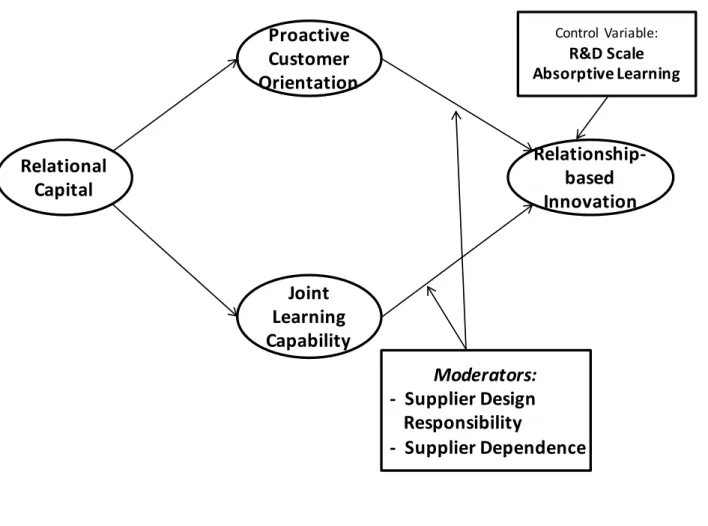
examines the moderating effects of a firm’s organizational capability (supplier design responsibility) and power-dependence in the exchange relationship (supplier dependence) on the effect of proactive customer orientation and joint learning on relationship-based innovation. Supplier design responsibility refers to whether suppliers take responsibility for the design role in the products supplied to international customers (Petersen et al. 2005). Supplier dependence refers to power-dependence in an exchange relationship in which a supplier is highly reliant on a customer that is difficult to replace (Jean et al., 2012).
Insert Figure 1 here
1.3 Generative Capabilities for Relationship-Based Innovation
Mediating role of proactive customer orientation
Proactive customer orientation describes the extent to which suppliers are capable of discovering and
addressing their customers’ latent and future needs (Fang and Zou, 2009). In contrast to responsive customer orientation, which focuses on addressing customers’ current and expressed needs, proactive customer
orientation is a critical capability that aids suppliers in sensing and uncovering the emerging needs and market trends among customers. We argue that relational capital is a critical resource that enables a supplier’s
proactive customer orientation towards an international partner. Relational capital triggers proactive customer orientation through the development of a shared vision between trusted supply chain partners; this shared vision encourages a customer to collaborate with its supplier, enabling the supplier to probe its business and acquire deep insights into its operations (Dyer and Singh 1998).
Relational capital is, as noted, characterized by trust, manifested as a firm’s belief in its partner’s goodwill, competence, capabilities, benevolence, and openness (Blocker et al., 2011). In the supply chain context, trust is defined as one partner relying on the other to protect its business interests, thereby mitigating fear of opportunism and enabling information exchange and knowledge sharing (Nahapiet and Ghoshal, 1998). Trust creates a platform for a supplier to build its ability to probe latent customer needs and market opportunities by supporting an environment conducive to search and sense activity without fear of information leakage or misappropriation (Dyer and Singh 1998). Proactive customer orientation in the innovation generation process involves certain risks and uncertainties due to the unconstrained nature of exploratory engagement with a customer in the exchange of customer-related information. However, trust and the expectation of a long lasting relationship enable customers to feel secure in permitting suppliers to learn and understand their latent needs.
Relational capital reflects a sense of mutual understanding and shared vision among exchange partners, which can reinforce customer-focused organizational culture and capabilities. When the goals of supply chain partners converge, mutual understanding and communication are enhanced, supporting a supplier’s access to its customer’s organization and operations (Dyer and Singh 1998). Furthermore, a relationship characterized by long-term vision is more adaptable and focused on future customer trends and preferences (Nahapiet and Ghoshal, 1998). Therefore, a trusted customer that shares a long-term vision with a supplier is more willing to permit activities related to understanding and addressing the customer’s future needs. As a consequence, we suggest relational capital operates through proactive customer orientation to generate relationship-based radical innovations from the interactions of supplier and customer. According to the market orientation literature, proactive customer orientation is potentially linked to firm innovation (Grinstein, 2008). This literature views customer orientation as a critical element of organizational culture and as a strategic orientation supporting firm innovation (Narver et al., 2004). A proactive customer orientation is a creative capability that enables a supplier to probe and evaluate a customer’s business, uncovering latent and future needs. As exploratory behavior, it involves searching for a customer’s untapped or unrealized opportunities and for new ideas that challenge and improve upon the customer’s conventional practices.
In this way, the orientation permits the supplier to exercise strategic foresight and enhance its
problem-solving skills, facilitating novel and meaningful insights into its customer’s business (Narver, Slater, and MacLachlan 2004). In contrast to suppliers lacking this orientation, a supplier having a proactive
customer orientation has an increased ability to conceive and develop innovative products, moving the firm beyond the scope of its experience and increasing its receptivity to unconventional and radical ideas. Such a supplier not only better understands its customer’s latent needs, but also has superior insight into its
customer’s market context and technological issues, thereby enhancing the supplier’s ability to produce innovative, new products (Atuahene-Gima, Slater, and Olson 2005). Hence, relational capital encourages a supplier’s proactive customer orientation towards its international customers that, in turn, facilitates the supplier’s ability to develop innovations due to its in-depth familiarity with its customer.
H1: Suppliers’ proactive customer orientation mediates the positive impact that relational capital has on relationship-based radical innovation from global supply chain relationships.
Mediating role of joint learning capability
Joint learning capability (Fang and Zou, 2010) is a relationship-level construct that captures the degree of partner cooperation and involvement in developing relationship-specific organizational infrastructures (i.e., systems, rules, routines, and processes) and communication channels aimed at creating, integrating, and institutionalizing knowledge for exchange relationships. Researchers (e.g. Gatignon and Xuereb, 1997; Han, Kim, and Srivastava, 1998) differentiate joint learning capability from absorptive learning capability in collaborative relationships. Joint learning capability is a firm’s ability to learn collectively with its channel partner in creating value through new knowledge for both parties in a relationship. In contrast, absorptive learning capability refers to a learning competition where a party unilaterally attempts to acquire knowledge and benefits from the exchange relationship. The concept of joint learning is similar to that of relationship learning (2010) and of collective learning in the extant literature, and highlights the importance of learning at the alliance and relationship level, rather than one party gaining knowledge unilaterally.
Radical innovation features breakthrough concepts that require questioning prevailing norms and determining fundamentally different solutions to existing problems (Selnes and Sallis, 2003). As a generative capability, joint learning is collaborative, helping firms access and expose themselves to diverse knowledge domains, and enlightening organizations on novel approaches by which existing problems can be solved through joint deployment of various organizational resources (Chandy and Tellis, 1998). By integrating knowledge from relationships into their existing knowledge bases, suppliers can detect future market trends and implement breakthrough ideas in commercial technology (Subramaniam and Youndt, 2005). Accordingly, joint learning capability is a key capability that can help generate relationship-based radical innovation.
Although joint learning capability potentially enhances innovation, developing it is difficult because of the uncertainty and risks inherent in knowledge-sharing and creation processes (Taylor and Greve, 2006). A partner may attempt to exploit novel knowledge, resulting in a loss of intellectual property. Relational capital mitigates opportunism through relational means that allay apprehensions, encouraging knowledge sharing and information exchange (Dyer and Singh 1998). In terms of relational safeguards, trust can create a transparent context that may reduce opportunistic behavior and facilitate knowledge-sharing. (Kale, Singh, and Perlmutter, 2000) suggest that relational capital can enhance the extent of knowledge acquisition in new ventures.
Likewise, a recent study shows that trust is a relational means to facilitate learning and knowledge discovery in international joint ventures (2001).
Shared values and understanding between parties in an exchange relationship can further facilitate meaningful communication, which is essential in both the exchange and integration required for knowledge creation. (Nielsen and Nielsen, 2009) state that shared goals raise the level of mutual understanding among organizational members, which acts as a factor influencing both the anticipation of potential value through collaboration and the motive to combine and share knowledge. Nahapiet and Ghoshal (1998) further
emphasize that shared goals and vision can enhance the knowledge assimilation process in the exchange dyad, allowing firms to develop and apply shared knowledge.
We suggest that relational capital operates through joint learning to generate relationship-based radical innovations from the interactions of supplier and customer. Joint learning capabilities entail combining and integrating different knowledge sets provided by the exchange partners that create novel knowledge sets. Therefore, relational capital encourages joint learning between supply chain partners, facilitating the
generation of breakthrough concepts and leading to relationship-based radical innovation.
H2: Joint learning capability mediates the positive impact relational capital has on relationship-based radical innovation for global supply chain relationships.
1.4 Supplier-Based Contingencies for Relationship-based Innovation
Generating relationship-based innovations with one customer and making these innovations available to others is likely constrained by the nature of the originating customer-supplier relationship. Consistent with the relational capital literature (2001), the nature and strength of a supplier’s tie to a focal customer are important boundary conditions, potentially affecting the impact of relational capital on relationship-based innovation. That is, the innovation generation capability of relational capital with one customer to yield relationship-based radical innovations is contingent on the tie-related issues of the supplier’s design responsibility and
dependence on the original customer. These tie-related aspects of the relationship are critical because, as RBV and the capability building literature suggest, the effective use of the supplier’s capabilities is influenced by the nature of inter-firm characteristics (Acquaah, 2007). Thus, we suggest the impact of proactive customer orientation and joint learning on relationship-based innovation is contextually moderated by the supplier’s organizational capability (supplier design responsibility) and the nature of the relationship (supplier dependence).
Moderating effects of supplier design responsibility on relationship-based innovation
Reflecting the nature of a supplier’s tie to its customer, design responsibility refers to whether the business a supplier has with its customer emphasizes the creation and design of new items (Zheng Zhou, Yim, and Tse, 2005). A supplier without design responsibility engages in simple contract manufacturing, focusing on
providing processed materials, delivering components or assembling parts. By contrast, a supplier with design responsibility requires competencies that emphasize creative tasks, including product design, product
development, and strategic and facility planning. Examples of suppliers with design responsibility are those that provide ODM (original design manufacturer) services to their customers. With the trend toward
outsourcing design, more contractual manufacturers have shifted from simply delivering components from specifications to ODM, thereby engaging in more design and development responsibility in global supply chains (Bello, Lothia, and Dant 1999).
Recent studies show supplier design responsibility requires technical competency that may affect capability development, learning, and innovation in inter-organizational relationships (Azadegan and Dooley, 2010). As for proactive customer orientation, a supplier with design responsibility may focus more on exploring detailed knowledge and assessing complex knowledge sets. That is, a supplier with design responsibility has the technical ability to transform the customer insights and market trends obtained through proactive customer orientation into radical new products. In terms of joint learning, such a supplier may be more likely to
recognize the technical importance of new knowledge developed from joint learning, therefore such a supplier may find it easy to transform knowledge into new products. Supply chain relationships characterized by joint learning can develop organizational procedures and systems that nurture new knowledge (Fang and Zou, 2010); suppliers with design responsibilities are better able to selectively apply this new knowledge to innovation. Thus, we present the following hypotheses:
H3a: The relationship between proactive customer orientation and relationship-based radical innovation is stronger when a supplier has design responsibility.
H3b: The relationship between joint learning capability and relationship-based radical innovation is stronger when a supplier has design responsibility.
Moderating effects of supplier dependence on relationship-based innovation
Supplier dependence refers to the extent of the difficulty a supplier would have in replacing a focal
international customer; if, for example, a supplier lacks alternative customers capable of replacing its focal customer’s purchase volume and contribution to profits, then supplier dependence exists (Pfeffer and Salancik, 1978). The impact of firm dependence on innovation generation has not received a great deal of research attention in the literature, although dependence plays an important role in the level of control and power one party has over another (Gulati and Sytch, 2007). Whereas high dependence means a supplier faces great difficulty and cost to replace a customer, low dependence means replacement is easy, which provides a supplier with a degree of independence, strengthening its bargaining power with the focal customer (Zhuang and Zhou, 2004). Based on power-dependence theory (Heckathorn, 1983), we suggest that supplier
dependence is a key feature of relationships, potentially influencing the effect a supplier’s generative capabilities have on relationship-based innovation (Azadegan and Dooley, 2010; Azadegan, Dooley, Carter, and Carter, 2008).
This study proposes that the impact of a supplier’s proactive customer orientation and joint learning capability on innovation is moderated by the degree of supplier dependence. Yli-Renko and Janakiraman (2008) find that dependence is detrimental to supplier innovation due to the inability of suppliers to control the nature and direction of innovation when faced with dominant customers. A highly dependent supplier lacks alternatives and is locked in to its relationship with its focal customer; this reduces the supplier’s bargaining power,
thereby lessening the customer’s motivation to attend to and comply with supplier initiatives to commercialize new ideas (Jean et al., 2012). By contrast, a less dependent supplier can gain the attention and engagement of customers due to its bargaining power (Yli-Renko and Janakiraman 2008). If a focal customer recognizes that its supplier is not very dependent on it, the customer is increasingly motivated to attend to supplier initiatives and requests; this occurs because ignoring a partner who is not locked in may jeopardize the trading
relationship (Kim and Hsieh, 2003). Thus, low dependence empowers a supplier to gain the attention and engagement of the customer in applying novel insights and ideas revealed through its proactive customer orientation, enhancing relationship-based innovation.
A lack of dependence characterized by a low degree of supplier reliance on a focal customer is expected to influence the impact joint learning capability has on radical innovation. Low dependence on a focal customer suggests the supplier has access to alternative customers, exposing the supplier to additional sources of novel information and knowledge (Yli-Renko and Janakiraman 2008). This can enhance the supplier’s breadth and depth of its knowledge base and help it overcome potential knowledge overlap in close relationships (Jean et al., 2012). Diverse knowledge lessens the cognitive inertia that may result from knowledge redundancy that partners may experience in close relationships (Zhou and Li, 2012), thereby facilitating the effective
application of joint learning to innovation. For example, given the limited and narrow knowledge base of many Taiwanese contracting suppliers, we expect that those in low-dependence relationships engage with a
wider set of alternative customers, enriching their knowledge base in a way that enhances their ability to innovate. Accordingly, a less-dependent supplier is better able to leverage, combine, and integrate novel information from joint learning, fostering the development of radical new products derived from its focal customer relationships (Corine S. Noordhoff et al., 2011). Hence, we predict that the effects of joint learning and proactive customer orientation on innovation generation are stronger with low supplier dependence.
H4a: The relationship between proactive customer orientation and relationship-based radical innovation is stronger when supplier dependence is low.
H4b: The relationship between joint learning capability and relationship-based radical innovation is stronger when supplier dependence is low.
R&D Scale and Absorptive Learning Capability as Control Variables
To increase confidence in our model, we adopt a supplier’s R&D scale, measured by the current number of R&D employees, and absorptive learning capability as control variables. In this way, our model accounts for their potential effects in facilitating a supplier’s ability to develop innovative, new products. Absorptive learning capability may directly enable some suppliers to introduce innovations (Kotabe, Jiang, and Murray, 2014), apart from the effects of proactive customer orientation and joint learning. Likewise, a supplier with a large in-house R&D staff is likely to have the direct capability to introduce new products, independent of study variables. The R&D scale was log-transformed before being specified as a control variable to alleviate univariate non-normalities and account for nonlinear effects (Zhou and Li, 2012)
2 Method
This research examines the specific cross-border relationships between Taiwanese suppliers and their international OEM customers in the global supply chain for electronics. This was a deliberate choice because Taiwanese suppliers tend to be smaller than their international OEM customers; thus, their relationships usually demonstrate contextual variety regarding supplier design responsibility and dependence. Furthermore, the Taiwanese electronics industry offers a valuable empirical context because its industry members have served as pioneers in IT development, have championed cross-border relationships with U.S. and European industry leaders, and are active participants in the global economy (Wooldridge, 2009). Taiwanese suppliers compete fiercely for contracts and cross-border exchange relationships with leading micro- and
component manufacturing, and advanced product innovation and design (Dedrick, Kraemer, Linden, Brown, and Murtha, 2007). For those customers, this move toward outsourcing traditional value-chain activities is significant due to potential performance benefits and competitive advantages.
Sampling frame and data collection
Data collection in this study was conducted in two stages. First, in-depth interviews were conducted with 15 senior product and marketing managers, and directors of Taiwanese suppliers. This initial qualitative and exploratory approach provided valuable input for the refinement of the questionnaire and the adaptation of key constructs in the industry context. The interviews served as an a priori test of the usefulness and appropriateness of the key constructs. Second, the final survey instrument was mailed to Taiwanese electronics companies. The questionnaire was originally prepared in English, and translated into and back-translated from Chinese by scholars competent in both languages and with substantial research experience in Taiwan.
To enhance the response quality, we designed the questionnaire to include two parts. Part I contained questions on industry-related variables including demand, R&D, and technological uncertainty. Part II
contained questions on relationship variables, including proactive customer orientation, electronic integration, long-term orientation, joint learning, and innovation in relationships. For each Taiwanese electronic supplier, we invited two senior managers to participate. Part I of the questionnaire was completed by the general managers. General managers are more familiar with industrial and general information in the company. Part Part II of the questionnaire was completed by the senior product and account managers in charge of managing relationships with their key customers. Senior product and account managers are more familiar with new product development and key account management management issues. Each respondent was only required to complete a part of the questionnaire, thus reducing the response burden and improving response accuracy.
The sampling frame consisted of all the electronics companies from the 2010 directory of the Top
5,000 Largest Firms in Taiwan published by China Credit Information Service Ltd. (1,020 electronic
companies). All of the firms in the database were contacted to assess their eligibility and to locate appropriate informants for the study. Respondents were asked to specify their most important international OEM
nature of cross-border relationships. In our sample, on average 75% of the suppliers’ sales were derived from their single most important foreign OEM customer.
Suggestions from a relevant study (Pete, Einhorn, and Reinhardt, 2005; Quinn, 2000) for maximizing response rates were applied, and multiple contact points recommended by Yu and Cooper (1983) were
established by telephone and personal contact to solicit responses for the study. Questionnaires were also sent by e-mail to accommodate participant preferences for this particular response option. For telephone and e-mail surveys, each informant who agreed to participate in the study was faxed or e-mailed a questionnaire packet. The data collection was conducted from April 2011 to August 2011.
Survey response and informant evaluation
In total, 204 usable questionnaires were returned, resulting in an effective response rate of 20%
(204/1,020). International OEM customers in the data set were from the United States, Japan, Germany, China, and France. Taiwanese electronics suppliers in the sample are engaged in the supply of computer components, semiconductors, communication products, computer peripherals, and optoelectronics. Over 67% of Taiwanese suppliers are of small to medium size, with fewer than 250 employees.
We assessed non-response bias by classifying the responses in terms of the following two groups: early respondents (the first quartile) and late respondents (the last quartile) (Dillman, 2000). Independent t tests were performed on demographic variables such as revenue and employee numbers. No significant differences for these descriptive variables were identified between the early and late respondents of our mail survey. In addition, t-tests were performed between the two groups on key variables for the proposed
conceptual model such as trust, shared vision, proactive customer orientation, joint learning capability, and innovation; these results showed no significant differences (Armstrong and Overton, 1977). In addition, we identified a group of randomly selected non-respondents and contacted them to obtain their explanations for their lack of response to obtain a reliable assessment because non-response bias can only be achieved through direct feedback from the non-respondents themselves. In all cases, the reasons provided to us for the lack of response were related to a lack of time to complete the questionnaire, the general belief that the questionnaire was too demanding, and that other requests for feedback should be prioritized. These findings imply that non-response bias does not pose a significant threat to this study.
Measurement scales
Multiple-item scales and a 7-point response format were used to operationalize most constructs and variables in the study. The measures were adapted from existing studies and refined based on feedback from experienced researchers and practitioners in the area of inquiry. Relational capital was measured using a four-item scale adapted from Pérez-Luño et al. (2011). The scale assessed the relational dimension of relational capital in terms of the extent of supplier perceptions of long-term, trustworthy relationships with their international customers (Dyer and Singh 1998).
For proactive customer orientation, we measured the extent to which the supplier was able to identify and address the latent needs of their business customers. The scales for proactive customer orientation were adopted from Blocker et al. (2011) and adapted for the current investigation. The joint learning capability scale was measured using items adapted from Fang and Zhou (2011) that measured the extent to which a supplier was capable of developing a relationship-specific organizational structure and communication channels that integrate a partner’s knowledge, create new knowledge sets for the relationship, and institutionalize new knowledge for the relationship. We measured a supplier’s design responsibility by assessing whether that supplier had a design-based ODM business (= 1) relationship with a key international customer involving creative design and development tasks or has a non-design OEM (= 0) relationship providing materials, components from specification, or assembling parts. We obtained a measure of the supplier’s dependence on the customer by using three items adapted from Ryu and Eyuboglu (2010). The relationship-based radical innovation scale was measured using three items adapted according to the context of the current study from Atuahene-Gima (2007), assessing the degree of technological advancement and revenue performance from radical innovation associated with focal international customer relationships. For absorptive learning capability, a scale was adopted from Fang and Zhou (2005) that captured a firm’s ability to understand, assimilate, and apply its customers’ knowledge and skills. Table 1 shows individual scale items.
Measurement model results
In conducting the model estimation, we followed the two-step approach suggested by (2010). First, to evaluate the measurement model, we conducted confirmatory factor analysis (CFA) by using IBM SPSS Amos 20.0. The CFA model (M2) included all provided study constructs. In the measurement purification
process, items with an unacceptable loading (i.e., less than 0.5) were eliminated to increase convergent
validity, following Anderson and Gerbing (1988). For discriminant validity, any measure loaded on more than one construct was removed. As shown in Table 1, after this process, at least three items remained for each construct. The final CFA model demonstrated that the measurement model has a good fit with the covariances provided by the data set: c2 = 242.951 on 155 d.f., TLI = .967, CFI = .973, and SRMR = .060 (Bagozzi and Yi,
1988; Bollen, 1989).
With the good fit of the measurement model, we evaluated the construct validity of every construct by investigating its unidimensionality, convergent and discriminant validity, and reliability for internal
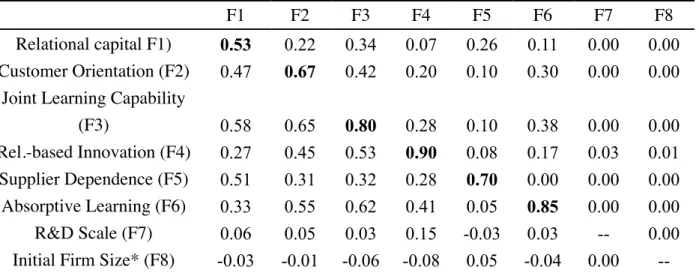
consistency (Bentler and Chou, 1987; Hu and Bentler, 1999). First, for unidimensionality, standardized residuals should not be greater than 4.0. Our results showed that no residuals were greater than 4.0, indicating no significant threat existed to the unidimensionality of the constructs (Fornell and Larcker, 1981; Gerbing and Anderson, 1988). Moreover, all items were significantly loaded on their corresponding factors (p < .01), and their loadings were all greater than .5, as shown in Table 1. These loadings indicated an adequate level of convergent validity (Fornell and Larcker, 1981). For discriminant validity, average variance extracted (AVE) should be greater than the shared variances of each construct (Nunnally and Bernstein, 1994). As shown in Table 2, the AVEs ranged from .53 to .90, and the shared variances among the constructs ranged from .00 to .42, as reported in the upper triangle of Table 2. These indicated a good level of discriminant validity among the constructs in our study (Fornell and Larcker, 1981). Finally, to assess the internal consistency of our measurements, the composite reliability of each construct was calculated using the formula suggested in the literature (Bagozzi and Yi, 1988; Fornell and Larcker, 1981), and the results are presented in Table 1. All composite reliabilities were greater than .80, which was above the widely recognized acceptable level of .7 discussed in the literature (Fornell and Larcker, 1981).
---
Insert Tables 1 and 2 About Here
--- Common method bias assessment
We assessed the level of common method bias present in our study using the marker variable
bias, the study used firm size as operationalized by the number of employees at its inception; its correlations with the study constructs are reported in Table 2. Specifically, we estimated the smallest correlation, RM, in the
correlation matrix, a well-accepted technique (Lindell and Whitney, 2001; Malhotra, Kim, and Patil, 2006). However, to use a more conservative measure, we implemented the second smallest correlation, RM2, instead
of the smallest one, RM1, as discussed in the literature (Lindell and Whitney, 2001; Malhotra et al., 2006). The
second smallest correlation in the correlation matrix, RM2=.01, between the marker variable and study
constructs/variable was used to adjust the correlations among the study constructs and control variable (Lindell and Whitney 2001). According to the results, none of the significant correlations among the study constructs/variable became insignificant. Consequently, we concluded that common method bias does not pose a major threat to the study (Lindell and Whitney, 2001; Malhotra et al., 2006).
3 ANALYSIS AND RESULTS
To test our hypotheses, the proposed structural model was estimated (IBM SPSS Amos 20.0). The control variables, R&D scale and absorptive learning, were included in the analyses.
Mediating Effects of Proactive Customer Orientation and Joint Learning ---
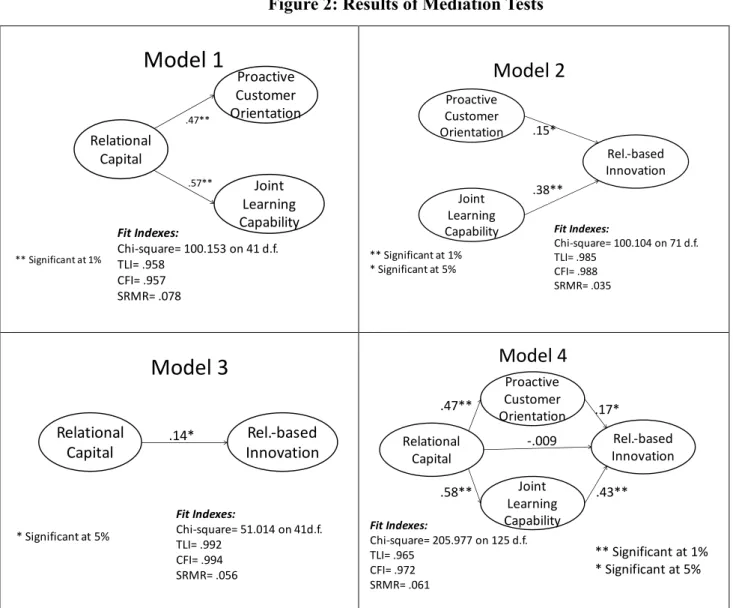
Insert Figure 2 About Here
---
We proceed formally to test for the mediating effects of customer orientation and joint learning on the relational capital–innovation relationship. Methodologists (Lindell and Whitney, 2001; Malhotra et al., 2006) state that several conditions must be met to identify a partial or full mediation. First, the independent variable should affect the mediators significantly. We estimated a model using relational capital as the independent variable and proactive customer orientation and joint learning as dependent variables to test this. As shown in Figure 2 (Model 1), the results indicated the significant effects of relational capital on proactive customer orientation (b = .47, p < .01) and joint learning capability (b = .57, p < .01). The model fit indices included c2
= 100.153 on 41 d.f., TLI = .958, CFI = .957, and SRMR = .078. The second condition required is a significant impact of mediators on the dependent variable. In our results (Model 2), both joint learning capability (b = .38, p < .01) and proactive customer orientation (b = .15, p < .05) significantly influence
relationship-based innovation. The model fit indices included c2 = 100.104 on 71 d.f., TLI = .985, CFI = .988,
and SRMR = .035, showing an excellent fit. The third condition is a significant direct effect of the independent variable on the dependent variable without specified mediators. In our analysis (Model 3), relational capital affected relationship-based innovation significantly (b = .14, p < .01), and the model fit indices showed an excellent fit with c2 = 51.014 on 41 d.f., TLI = .992, CFI =.994, and SRMR = .056. Thus,
the third condition was met.
Finally, in testing the mediation hypotheses (H1, H2), the significant impact of the independent variable on the dependent variable should be diminished in a partial mediation or become non-significant in a full mediation when the mediators are added to the third model. Regarding our control variables, it should be noted that the R&D scale (b = .14, p < .01) had a significant impact on the dependent variable, whereas that of absorptive capability (b = .10, p > .05) did not.
According to our results (Model 4), the coefficient of the independent variable, relational capital, on the dependent variable, relationship-based innovation, decreased from .14 (p < .05) to -.009 (p > .10) with an excellent model fit, including c2 = 205.977 on 125 d.f., TLI = .965, CFI = .972, and SRMR = .061. As
summarized in Figure 2, these results support Hypotheses 1 and 2 in this study.
Moderation Effect of Supplier Design Responsibility and Dependence
Hypotheses 3a-b and 4a-b posit that a supplier’s design responsibility and low dependence on the international customer enhance the positive effects of proactive customer orientation and joint learning on relationship-based innovation. To test these moderating effects, we performed multi-group analyses according to the participants’ design responsibility (i.e., yes vs. no) and by median-splitting the sample according to supplier dependence, according to Baron and Kenny (1986). Two-group analysis was then conducted. However, the literature suggests that measurement invariance should be assessed when multiple groups are involved in statistical analyses (Bentler, 2005; Bollen, 1989; Johnsen and Ford). Specifically, the literature requires both configurable invariance and partial metric invariance to be supported so that a comparison of standardized path coefficients can be performed across groups, as in our study (Steenkamp and Baumgartner, 1998). Therefore, we followed the procedure presented by Steenkamp and Baumgartner’s (1998) for
According to the results of the measurement invariance tests, the configural invariance was supported for both two-group analyses because the combination of significantly loaded items was consistent for both groups, all factor loadings were significantly and substantially different from zero, and the factor correlations were significantly below unity across all groups for both two-group analyses (Steenkamp and Baumgartner, 1998). Subsequently, metric invariance was assessed. For both two-group analyses, all of the measurement items were metrically invariant (p > .05) among the groups. Because partial metric invariance is a sufficient condition for a two-group comparison of standardized coefficients (Steenkamp and Baumgartner, 1998), we proceed with the multiple-group analysis.
---
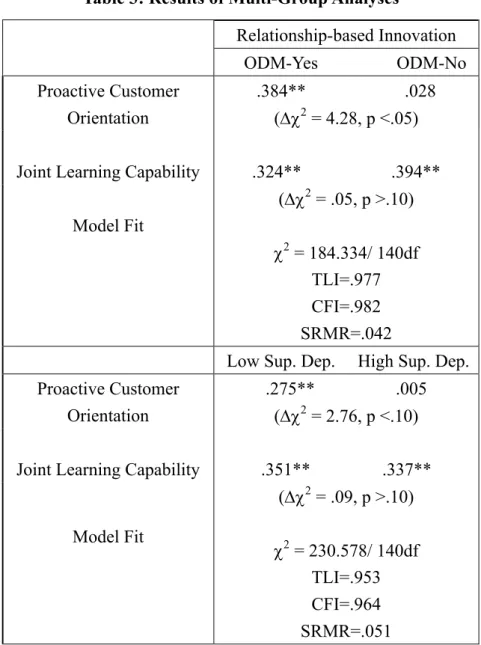
Insert Table 3 About Here
---
Table 3 shows tests for our final hypotheses. We first estimated a two-group model based on the supplier’s design responsibility by adding and dropping an equal constraint for each hypothesized path (see upper panel, Table 3). The Chi-square difference tests showed that the impact of proactive customer
orientation on relationship-based innovation was moderated by supplier design responsibility (Dc2 = 4.28, p
< .05), but not by joint learning on relationship-based innovation (Dc2 = .05, p > .10). The results supported
Hypothesis 3a, but not Hypothesis 3b; supplier design responsibility moderated the impact of proactive customer orientation (byes = .384, p < .01 and bno = .028, p > .10) on relationship-based innovation, but not the
impact of joint learning on relationship-based innovation (byes = .324, p < .01 and bno = .394, p < .01). With
the equality constraint on the moderated path removed, the model showed a good fit (c2 = 184.334 on 140 d.f.,
TLI = .977, CFI = .982, and SRMR = .042).
The moderating effects of supplier dependence were evaluated by performing another two-group analysis based on the level of supplier dependence, which was determined by adding and dropping an equal constraint on each hypothesized path (see lower panel, Table 3). The model estimation results showed that the effects of proactive customer orientation on relationship-based innovation is moderated by supplier
dependence (Dc2 = 2.76, p < .10), but not by joint learning on relationship-based innovation (Dc2 = .09, p
> .10). Specifically, supplier dependence moderated the impact of proactive customer orientation on relationship-based innovation (blow = .275, p < .05 and bhigh = .005, p > .05), but not by joint learning on
relationship-based innovation (blow = .351, p < .01 and bhigh = .377, p < .01), supporting Hypothesis 4a but not
Hypothesis 4b. With the equality constraint on the moderated path removed, the model estimation results revealed a good model fit (c2 = 230.578 on 140 d.f., TLI = .953, CFI = .964, and SRMR = .051). Table 3
presents a summary of our hypothesis-testing results.
The results of multi-group analyses suggest that proactive customer orientation has a fully moderated mediation effect (Steenkamp and Baumgartner, 1998) between relational capital and relationship-based innovation. This orientation only mediates the impact of relational capital on relationship-based innovation when the supplier has either design responsibility or has low dependence on the international customer. Reflecting this complexity, our Hypothesis 1 is only supported under specific conditions, namely when the supplier has design responsibility or low dependence on the international customer. By contrast, Hypothesis 2 is fully supported because the mediating role of joint learning on innovation is not contingent on our
contextual moderators.
4 Discussion and implications
This research examines whether and how suppliers can develop innovative, new products based on their relationships with customers in global supply chains. In particular, many EM suppliers are less able to innovate independently due to limited knowledge and internal resources. However, their close working relationships with international customers may offer opportunities to innovate. Problematically, prior research on the relational capital-innovation link is equivocal, with contradictory empirical findings and limited
conceptual explanation of how close relationships trigger innovation. Furthermore, much innovation research focuses on the way individual firms marshal internal resources to generate innovations, leaving
relationship-based innovation less understood. In an era of global supply chains, it is important to expand knowledge regarding relationship-based innovations, because suppliers may greatly enhance competitiveness by leveraging their relational capital with supply chain partners.
Our research contributes to this field by conceptualizing the pathways and boundary conditions through which relational capital with an international customer enables a supplier to develop new, innovative products. Drawing on the RBV and capability building literature, we theorize that proactive customer
orientation and joint learning are key relationship mechanisms that transform the potential benefits of relational capital into innovations. Furthermore, we posit that the innovation capabilities of supply chain relationships are constrained by the nature of suppliers’ ties to their international customers. A supplier’s design responsibility and dependence appear to be crucial in moderating innovation outcomes from relational capital. Overall, this study broadens and deepens our understanding of how and through what mechanisms relational capital can lead to innovation by suppliers in international customer–supplier relationships. We discuss the theoretical and managerial implications of the results of our study in the following section.
Role of proactive customer orientation and joint learning capability
Unlike innovation within an individual firm, innovations derived from global supply chain
relationships are not well understood because innovative knowledge results from aspects of the relationship itself. Although the relevant literature specifies little regarding the way a supplier’s engagement with a partner generates innovation, we identify two key capabilities that facilitate innovation by uncovering needs and creating new knowledge. Our research hypothesizes that the process of relationship-based innovation occurs as a supplier actively probes a customer’s business to reveal latent needs and as the partners organize to create and share knowledge. Our empirical findings suggest that relational capital creates a supportive supply chain environment that facilitates proactive customer orientation in identifying unexpressed needs and joint learning to develop new knowledge. In this way, innovations emerge from global supply chains as relational capital enables key processes leading to the acquisition and sharing of new knowledge.
For proactive customer orientation, a long-term trusting relationship reduces concerns of opportunistic exploitation, enabling a supplier to gain deep insight into a customer’s operations, thereby facilitating an understanding of latent needs and key trends. Consequently, relational capital between supply chain members supports an environment conducive to search and sensing activities without fear of
information misappropriation, enabling a supplier to proactively uncover the emerging needs of a customer. Our conceptualization of this mechanism receives empirical support from our sample of Taiwanese suppliers, in which relational capital is positively related to proactive customer orientation. This finding is consistent with our notion that relational capital enables innovative ideas to surface by providing suppliers with access to customer operations, permitting the proactive probing that reveals new possibilities for innovation. Suppliers
can benefit by recognizing that current business operations with a customer may be the basis for future innovations. To the extent that supply chain partners can nurture a long-term trusting relationship, their relational capital may enable a supplier to engage in an exploratory process of discovery, uncovering needs not yet recognized by its international customer. In this way, relational capital can enhance the competitive advantage of both parties: the customer benefits by having its unanticipated needs identified and addressed, and the supplier gains deep insights into customer requirements that lead to innovative, new products.
Regarding joint learning, innovation also relies on the partners’ ability to develop and sustain relationship-specific routines and processes that stimulate collective learning. Learning at the
relationship-level requires the parties to engage with each other and freely communicate, collaboratively creating and integrating new knowledge (Fang and Zou 2010). As we theorize, relational capital underpins the knowledge-sharing process by allaying the uncertainties and risks associated with information exchange, thereby mitigating fears of opportunistic exploitation by the partner. Empirical results support our hypothesis, indicating that relational capital is positively related to joint learning. Our research highlights that supply chain partners benefit by focusing on their routines and processes to ensure that their interaction and communication facilitates, rather than inhibits, collective learning. Relationships based on trust and shared goals have a relational climate that not only motivates collaboration but also supports organizational arrangements that institutionalize joint learning.
Overall, this study demonstrates that both proactive customer orientation and joint learning capability mediate the relationship between relational capital and innovation, indicating the twin pathways to innovation activated by relational capital. By finding that the relational capital–innovation link operates through our proposed mediators, our research highlights the utility of long-term, trustworthy relations between supply chain partners. That is, partners that lack relational capital forgo important sources of competitive advantage because unexpressed needs are not revealed and joint learning does not emerge, hindering relationship-based innovation.
Role of supplier design responsibility and dependence
Although our results demonstrate that the link between relational capital and innovation is mediated, our findings suggest that the link is complex because it is also influenced by the nature of a supplier’s tie to its
key customer. Specifically, we find that a supplier’s design responsibility and dependence on its customer alter the impact that proactive customer orientation has on relationship-based innovation. Our results indicate that proactive customer orientation is a context-specific capability, meaning that it yields relationship-based innovation when a supplier has design responsibility and low dependence on its key customer. By contrast, we find that joint learning capability has a robust influence on innovation because its influence is unaffected by the nature of a supplier’s tie in terms of design responsibility and dependence.
Complexity in the relational capital-innovation link may help to address the equivocal nature of the extant empirical literature on this topic. As noted, various conflicting studies have found that relational capital is positively, negatively, or not related to the development of innovative new products (Tsai, 2001; Yli-Renko et al., 2001; Zheng, 2010). Our research accommodates such mixed findings by recognizing that our mediator, a supplier’s proactive customer orientation, is sensitive to the context of certain supply chain conditions, specifically when a supplier has design responsibility or is less dependent on the key customer. In such supply chain contexts, a supplier has technical design competency and a diverse knowledge base derived from
alternative customers, by which the supplier can exploit latent needs revealed by its proactive customer orientation. A supplier with these contextual ties to its key customer is shown to innovate based on its deep engagement with its customer’s operations and business situation. Such ties create a supportive supply chain context; relational capital is positively related to innovation due to the favorable impact design responsibility and low dependence have on proactive customer orientation. By contrast, when a supplier lacks design responsibility and is highly dependent on its key customer, the supply chain context does not support innovation because proactive customer orientation is less easily leveraged for innovation. An unsupportive supply chain context weakens the capacity to innovate from discovered needs, breaking the relational capital–innovation link and potentially accounting for equivocal empirical findings.
Regarding supplier design responsibility, our empirical findings are consistent with recent arguments that supplier task responsibility may shape inter-organizational interactions and innovation generation
(Azadegan and Dooley, 2010). A supplier with design responsibility may effectively engage in more explorative activities with its key customer and be more likely to leverage information related to both addressed and unexpressed customer needs. Thus, design responsibility gives suppliers the creative and
technical capability to translate the discovery of the latent needs of one customer into innovations that can be marketed to other customers. By contrast, suppliers merely providing basic materials and assembled
components are less able to utilize information about hidden needs and to apply insights to develop innovations.
Regarding dependence, our findings reveal that low dependence has an important role in managing supply chain relationships, and can shape firms’ control of the strategic resources necessary to generate innovative activities. Despite the presumed impact of dependence on innovation generation and performance in the customer–supplier relationship (Tangpong, Michalisin, and Melcher, 2008), the literature does not closely examine these links. Our results demonstrate the moderating role of supplier dependence on the innovation generation process in terms of proactive customer orientation. Our findings suggest that a less dependent supplier may leverage more information and knowledge resources that are generated from a proactive customer’s orientation, which can yield relationship-based radical innovation. Less dependent suppliers are more autonomous with respect to key customers, having a pool of alternative customers and being exposed to a wider and deeper stock of knowledge, thereby facilitating the creative development of insights gained from latent needs. By contrast, a highly dependent supplier is tied to its dominant customer, focusing on a narrower and less diverse knowledge stock and being less able to creatively develop and extend novel insights. These findings extend those of Tsai (2009) on the role of a network position within an
intra-firm network to the inter-organizational context.
Importantly, joint learning is found to have a direct effect on relationship-based innovation because neither moderator impacts the learning–innovation link. Regardless of supplier’s design responsibility or dependence, joint learning leads to greater innovation. This finding implies that supply chain partners who are capable of organizing their procedures in a way that develops and shares new knowledge can directly facilitate innovation without requiring the supportive ties of supplier design and low dependence. That is, joint learning capability is a critical inter-organizational competence that has a stable ability to leverage relational capital, regardless of the nature and strength of the supplier’s tie to the customer. Such a robust finding for the
innovative potential of joint learning highlights the potency of collaborative learning in generating innovative ideas from supply chain relationships. Thus, joint learning capability is shown to be a fundamental process