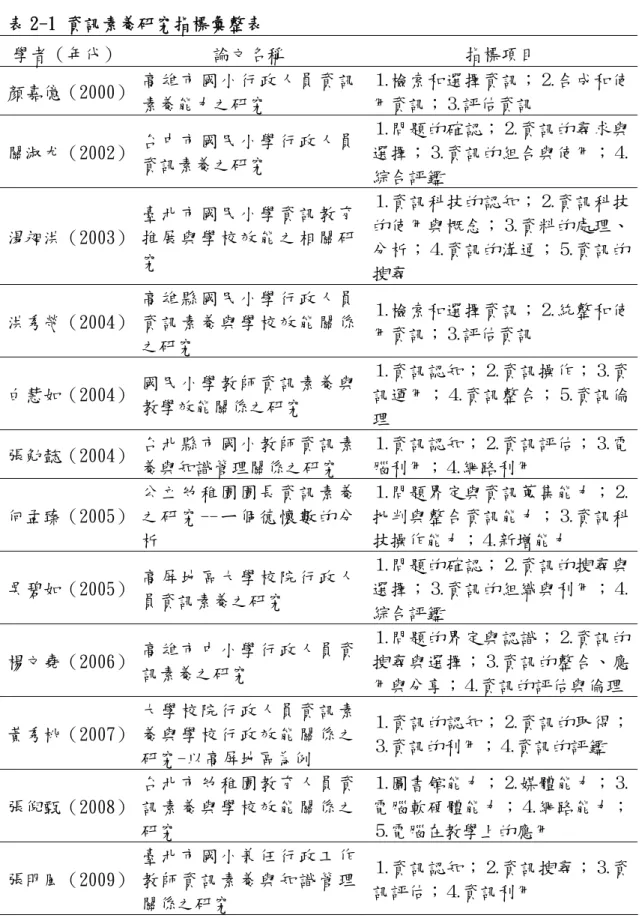
的資訊能力,其涵蓋層面有四,如圖 2-1 所示: ⒈傳統素養:具備讀、寫、說、算之基本能力與認知,並具有在圖書館找尋 資料的傳統能力。 ⒉媒體素養:會運用非平面、非紙本之電子媒體技能來解決資訊問題,諸如 光碟片、幻燈片、錄影帶與微縮片等操作使用等。 ⒊電腦素養:利用電腦設備、應用軟體與程式設計來完成實際上的工作,其 等同狹義的「資訊素養」。 ⒋網路素養:運用網際網路溝通互動、檢索資訊、線上查詢、遠端視訊與解 決問題等之能力。 資訊素養 (Information Literacy) 資訊問題解決技能 圖 2-1 資訊素養概念示意圖 資料來源:McClure,1994,117. 電腦素養 (Computer Literacy) 網路素養 (Network Literacy) 傳統素養 (Traditional Literacy) (Information Problem-Solve Skills)
媒體素養
國民教育研究所碩士論文,未出版,台中市。
嚴振農(2006)。國民小學教師資訊素養與學校效能知覺關係之研究。國立暨南
國際大學教育政策與行政學系研究所碩士論文,未出版,南投縣。
Bruce,C.S.(1995). Information literacy: A framework for higher education. (ERIC Document Reproduction Service No. EJ518344)
Dickinson,G.K.(2006). The spirit of inquiry in information literacy.Teacher Librarian, 34(2), 23-27.
Doyle,C.S.(1992). Outcome measures for information literacy within the national education goals of 1990.(ERIC Document Reproduction Service No. ED351033)
Doyle,C.S.(1994). Information literacy in an information society. Syracuse,NY:ERIC Clearinghouse on Information and Technology(ERIC Document Reproduction Service No. ED372756)
ISTE(2007). ISTE national educational technology standards for administrators. Retrieved August 15,2007,from http:
//www.iste.org/inhouse/nets/cnets/administrators/a_stands.html ISTE(2007). ISTE national educational technology standards for teachers.
Retrieved August 15, 2007, from http:
//www.iste.org/inhouse/nets/cnets/teachers/t_stands.html