
高雄市婦女生活狀況與需求之研究 期末報告
256
0
0
全文
(2) 目 錄 中文摘要. Ⅰ. 英文摘要. Ⅵ. 第一章. 前言. 第一節. 研究背景………………………………………………………. 1. 第二節. 研究目的與研究問題…………………………………………. 2. 第三節. 研究範圍、名詞解釋及研究限制. 2. 第二章. 文獻探討. 第一節. 台灣與高雄市婦女人口結構現況……………………………. 4. 第二節. 台灣與高雄市婦女生活狀況…………………………………. 16. 第三節. 台灣與高雄市婦女福利服務現況……………………………. 23. 第四節. 台灣與高雄市婦女生活重要議題……………………………. 36. 第三章. 研究設計. 第一節. 研究方法質與量並重……………………………………. 61. 第二節. 資料收集方法…………………………………………………. 63. 第三節. 研究對象與抽樣………………………………………………. 65. 第四節. 測量工具………………………………………………………. 67. 第五節. 資料收集過程…………………………………………………. 71. 第六節. 資料分析與報告撰寫…………………………………………. 73. 第四章. 研究結果重點摘要. 第一節. 高雄市婦女生活現況與幸福感………………………………. 76. 第二節. 高雄市婦女福利服務使用現況與需求………………………. 109. 第三節. 高雄市婦女福利服務服務輸送的困境與建議………………. 140. 第五章. 結論與建議. 第一節. 婦女生活重要面向……………………………………………. 148. 第二節. 整體婦女相關福利服務輸送系統……………………………. 157. 第三節. 政策思維與未來願景…………………………………………. 158. 一、都市化分類步驟……………………………………………………. 166. 二、職業職稱與內容之分類標準………………………………………. 173. 三、問卷…………………………………………………………………. 194. 四、訪談大綱……………………………………………………………. 209. 五、訪員名單……………………………………………………………. 211. 六、焦點團體之成員基本資料…………………………………………. 212. 七、幸福感模型驗證……………………………………………………. 220. 參考書目………………………………………………………………………. 229. 附錄.
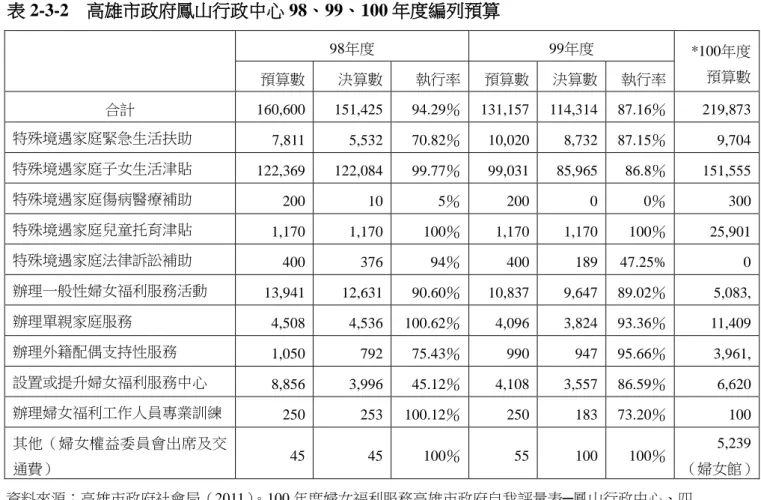
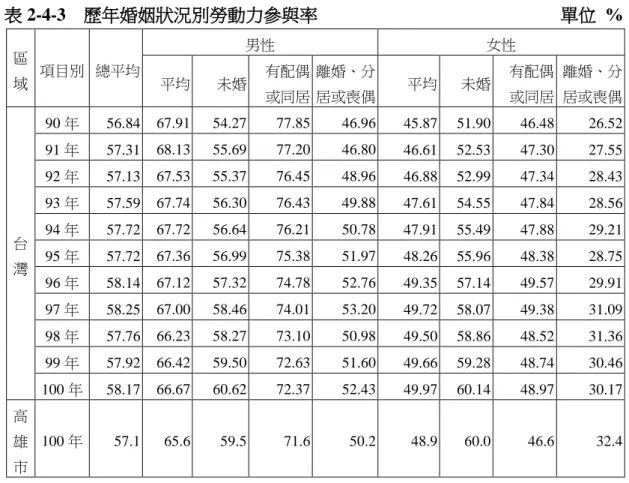
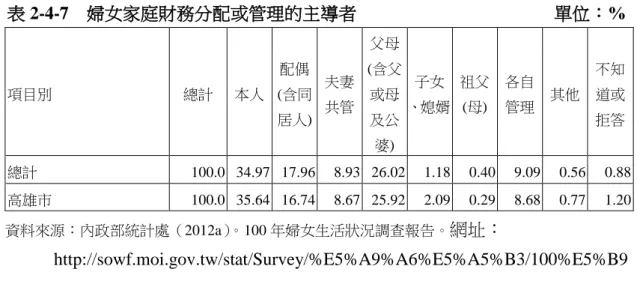
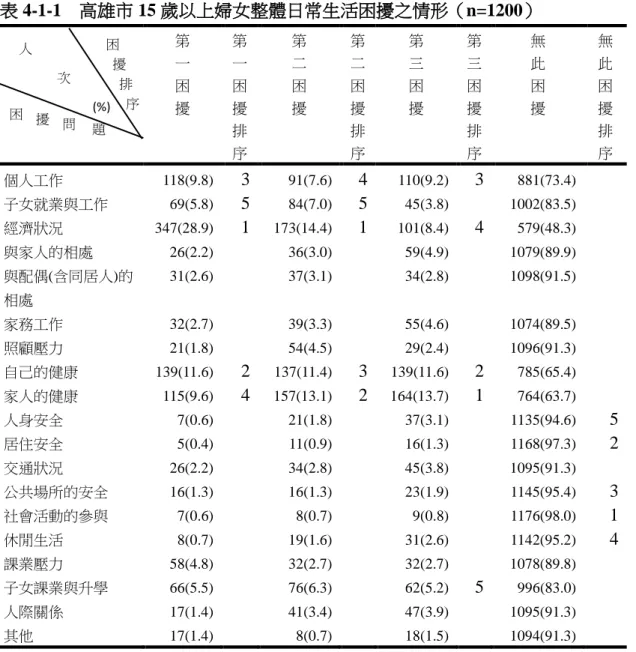
(3) 表目錄 表 2-1-1. 台灣 15 歲以上之婦女歷年年齡人口分布…………………….... 5. 表 2-1-2. 原高雄市 15 歲以上之婦女歷年年齡人口分布……………….... 5. 表 2-1-3. 原高雄縣 15 歲以上之婦女歷年年齡人口分布………………... 6. 表 2-1-4. 100 年高雄市(含原高雄市與原高雄縣)15 歲以上之婦女歷 年年齡人口分布…………………………………………………. 表 2-1-5. 6. 100 年高雄市(含原高雄市與原高雄縣)各區 15 歲以上之婦 女人口數分布……………………………………………………. 7. 表 2-1-6. 台灣 15 歲以上之婦女歷年教育程度之分布…………………. 9. 表 2-1-7. 原高雄市 15 歲以上之婦女歷年教育程度之分布……………. 10. 表 2-1-8. 原高雄縣 15 歲以上之婦女歷年教育程度之分布……………. 11. 表 2-1-9. 100 年高雄市(含原高雄市與原高雄縣)15 歲以上之婦女歷 年教育程度之分布………………………………………………. 12. 表 2-1-10. 台灣婦女歷年婚姻狀況之分布…………………………………. 14. 表 2-1-11. 原高雄市婦女歷年婚姻狀況之分布……………………………. 14. 表 2-1-12. 原高雄縣婦女歷年婚姻狀況之分布……………………………. 15. 表 2-1-13. 100 年高雄市(含原高雄市與原高雄縣)婦女歷年婚姻狀況之 分布……………………………………………………………. 15. 表 2-2-1. 91 年、95 年與 100 年婦女生活狀況調查比較表……………... 19. 表 2-2-2. 98 年國民生活狀況調查性別比較摘要表…………………….... 21. 表 2-3-1. 台灣婦女福利服務成果 ………………………………………... 24. 表 2-3-2. 高雄市政府鳳山行政中心 98、99、100 年度編列預算……..... 26. 表 2-3-3. 婦女福利機構(100 年 3 月底)……………………………….. 27. 表 2-3-4. 高雄市政府四維行政中心 98、99、100 年度編列預算…..…... 30. 表 2-3-5. 婦女福利機構(100 年 3 月底)……………………………….. 31. 表 2-4-1. 台灣歷年勞動力參與率…………………………………………. 37. 表 2-4-2. 部分工時就業者及受雇者人數按性別分………………………. 37. 表 2-4-3. 歷年婚姻狀況別勞動力參與率…………………………………. 38. 表 2-4-4. 受雇者因性別在職場上遭受不平等待遇之情形………………. 40. 表 2-4-5. 兩性平均每月經常性薪資………………………………………. 42. 表 2-4-6. 女性有所得收支概況………………………………………….... 42. 表 2-4-7. 婦女家庭財務分配或管理的主導者……………………………. 43. 表 2-4-8. 15 至 64 歲已婚女性曾經離職者之離職情形………………….. 44. 表 2-4-9. 99 年 15 至 64 歲曾經離職已婚女性之離職原因…………...…. 44.
(4) 表 2-4-10. 95 年 15 至 64 歲已婚女性最小子女照顧方式-按教育程度分…. 45. 表 2-4-11. 99 年 15 至 49 歲已婚女性最小子女照顧方式-按教育程度分…. 45. 表 2-4-12. 99 年 15 至 49 歲已婚生育婦女近年出生子女之托育費用……. 47. 表 2-4-13. 99 年 15 至 64 歲已婚婦女就業者之每月經常性收入…………. 47. 表 2-4-14. 98 年老人起居活動有困難者之主要幫忙料理者…………….... 48. 表 2-4-15. 97 年國民生活狀況調查–文化休閒生活層面………………….. 49. 表 2-4-16. 家庭暴力事件通暴被害人性別概況……………………………. 54. 表 3-3-1. 高雄市 38 區都市化程度之分佈………………………………... 65. 表 3-3-2. 高雄市各類都市化社區之年齡分布及應/已完成份數分布表.... 66. 表 3-4-1. 問卷編製過程……………………………………………………. 70. 表 3-5-1. 訪員訓練舉行之時間與地點……………………………………. 71. 表 3-5-2. 一般婦女焦點團體舉行之時間與地點…………………………. 72. 表 3-5-3. 福利服務提供者焦點團體舉行之時間與地點…………………. 72. 表 3-6-1. 焦點團體分析概念化步驟範例…………………………………. 74. 表 4-1-1. 高雄市 15 歲以上婦女整體日常生活困擾之情形……………... 86. 表 4-1-2. 高雄市 15 歲以上婦女生活各面向傾向感到滿意之排序……... 87. 表 4-1-3. 一般婦女代表對高雄市 15 歲以上婦女生活中常遭遇之問題或 困難………………………………………………………………. 表 4-1-4. 88. 福利服務提供者對高雄市 15 歲以上婦女生活中常遭遇之問題 或困難……………………………………………………………. 89. 表 4-1-5. 結構因素負荷量群組比較………………………………………. 91. 表 4-1-6. 結構權重(structural weights)與潛在平均數(laten mean)的群組 比較………………………………………………………………. 96. 表 4-1-7. 幸福感潛在平均數的群組比較…………………………………. 101. 表 4-1-8. 幸福感六個構面潛在平均數的群組比較………………………. 104. 表 4-1-9. 一般婦女代表對高雄市 15 歲以上婦女幸福情形觀察之整理.... 106. 表 4-1-10. 福利服務提供者對高雄市 15 歲以上婦女幸福情形觀察之整理. 108. 表 4-2-1. 高雄市 15 歲以上之婦女有使用政府所提供的各面向服務之情 形…………………………………………………………….... …. 表 4-2-2. 123. 高雄市 15 歲以上之婦女對於政府所提供的各類服務使用之情 形…………………………………………………………….... …. 123. 表 4-2-3. 政府所提供各面向服務對個人幫助之程度……………………. 125. 表 4-2-4. 高雄市 15 歲以上之婦女沒有使用政府所提供的各面向服務之 原因………………………………………………………………. 126.
(5) 表 4-2-5. 高雄市 15 歲以上之婦女現在需要的各個面向福利服務協助內 容……………………………………………………………........ 表 4-2-6. 一般婦女代表觀察高雄市 15 歲以上婦女較常使用的福利服務 項目…………………………………………………………….... 表 4-2-7. 130. 福利服務提供者觀察高雄市 15 歲以上婦女較常使用的福利服 務項目………………………………………………………........ 表 4-2-8. 127. 131. 一般婦女代表觀察高雄市 15 歲以上婦女最有幫助的福利服務 項目…………………………………………………………….... 132. 表 4-2-9. 福利服務提供者觀察高雄市 15 歲以上婦女最有幫助的福利服. 表 4-2-10. 務項目………………………………………………………....... 133 都市化程度與對政府提供的各項服務協助感受到的幫助程度 之交叉分析……………………………………………………... 134. 表 4-2-11. 一般婦女代表觀察高雄市 15 歲以上婦女沒有使用相關福利服 務之原因……………………………………………………….... 表 4-2-12. 136. 福利服務提供者觀察高雄市 15 歲以上婦女沒有使用相關福利 服務之原因…………………………………………………….... 137. 表 4-2-13. 一般婦女代表對未來要強化或增加的婦女服務項目………..... 138. 表 4-2-14. 福利服務提供者對未來要強化或增加的婦女服務項目………. 139. 表 4-3-1. 一般婦女代表對婦女使用福利服務困難之整理………………. 141. 表 4-3-2. 福利服務提供者對婦女使用福利服務困難之整理……………. 141. 表 4-3-3. 婦女福利服務相關單位提供相關福利服務面臨之困難………. 142. 表 4-3-4. 一般婦女代表對高雄市婦女福利服務之建議或需要改進之處. 145. 表 4-3-5. 福利提供者對高雄市婦女福利服務之建議或需要改進之處…. 147.
(6) 圖目錄 圖 3-1-1. 質化與量化研究整合的概念圖…………………………………. 62. 圖 3-2-1. 焦點團體法運用之步驟…………………………………………. 64. 圖 4-1-1. 高雄市 15 歲以上婦女整體幸福感模型………………………... 94. 圖 4-1-2. 高雄市 15 歲以上單親婦女整體幸福感模型…………………... 96. 圖 4-1-3. 高雄市 15 歲以上未婚婦女整體幸福感模型…………………... 97. 圖 4-1-4. 高雄市 15 歲以上已婚婦女整體幸福感模型…………………... 97. 圖 4-1-5. 高雄市 15 歲以上單親婦女整體幸福感模型潛在平均數……. 98. 圖 4-1-6. 高雄市 15 歲以上未婚婦女整體幸福感模型潛在平均數……. 99. 圖 4-1-7. 高雄市 15 歲以上已婚婦女整體幸福感模型潛在平均數……. 100. 圖 4-1-8. 高雄市 15 歲以上單親婦女整體幸福感模型六個構面潛在平 均數……………………………………………………………. 圖 4-1-9. 高雄市 15 歲以上未婚婦女整體幸福感模型六個構面潛在平 均數……………………………………………………………. 圖 4-1-10. 101 102. 高雄市 15 歲以上已婚婦女整體幸福感模型六個構面潛在平 均數……………………………………………………………. 103.
(7) 中文摘要 本研究主要在瞭解高雄市婦女之生活狀況及福利服務需求,研究對象為設籍 於高雄市 38 個行政區、且截至 2011 年底年滿 15 歲以上之本國籍婦女,收集的 資料包含個人基本資料、生活狀況、福利服務使用現況與需求及幸福感,其中生 活狀況及福利服務與需求共分為就業情形、經濟生活、婚姻與家庭、家庭照顧、 健康醫療、人身安全、居住,交通與環境、社會參與、休閒生活等面向。 研究取向採取量與質並重,運用社會調查及焦點團體兩種資料收集方法。社 會調查部分以研究者自行設計之問卷作為研究工具,運用接受過訪員訓練之訪員 進行面訪。原高雄市在 98 年底與原高雄縣縣市合併之後,成為共有 38 個行政區 的都市,幅員遼闊,行政區之間的異質性高,因此本研究根據人口密度、專科以 上教育程度之比例、產業類別等三個劃分基礎,將 38 個行政區區分為四類都市 化程度的社區─低度都市化、中低度都市化、中度都市化、高度都市化。為了能 夠完整地呈現不同都市化程度之婦女的生活狀況與需求,本研究採分層立意抽樣, 每個不同都市化程度之行政區皆完成 300 份問卷,最後一共完成有效樣本 1,200 份。焦點團體部分共舉行 10 場,透過研究者自行設計的訪談大綱進行訪談,訪 談對象分為婦女福利服務提供者及一般婦女代表,婦女福利服務提供者焦點團體 舉行 4 場,一般婦女代表焦點團體舉行 6 場。研究進行時間是從 2011 年的 12 月 到 2012 年的 11 月,共計一年。 有關目前生活重要面向的滿意情形,調查結果發現,是以對目前的人身安全 傾向滿意人數比例最高,其次是家庭生活,再其次是婚姻生活;傾向滿意人數比 例最低者是經濟狀況,其次是公共場所安全,再其次是交通運輸。居住於不同都 市化社區之研究樣本對於目前經濟狀況、人身安全、居住狀況及參與社會活動或 社會團體的滿意情況,是存在明顯的差異。對於經濟狀況,居住於高度都市化社 區之樣本傾向滿意的人數比例,明顯高於中度和中低度都市化社區之樣本。對於 目前人身安全狀況居住於低度都市化社區之樣本傾向滿意人數比例明顯高於其 他三個不同都市化社區。對於目前居住狀況傾向滿意人數比例,以低度及高度都 市化社區之樣本比較高。對於目前參與社會活動或社會團體低度都市化社區之樣 本傾向滿意人數比例,明顯高於其他三個不同都市化社區。所以,居住地區都市 化程度與婦女的生活有著密切的關係。. I.
(8) 有關整體日常生活困擾方面,調查結果發現,是以經濟狀況、自己與家人的 健康、自己與子女的就業與工作為主。可見,經濟、就業、健康是牽動婦女生活 品質與滿意度的重要議題。另外,在焦點團體中,一般婦女代表與婦女福利服務 提供者是更細緻的討論婦女在生活中所面臨的困境。在就業面向,偏遠地區缺乏 工作機會、二度就業婦女找工作不易、缺乏完善的托育制度做為後盾、薪資結構 對女性不利。在經濟生活面向,經濟收入不足與不穩定、養育子女費用沉重、經 濟自主性低。在婚姻與家庭面向,遭受婚姻暴力、與青少年子女親子關係不佳、 婆媳關係費心經營、婚姻移民婦女難受到婆家的尊重。家庭照顧面向,工作與家 庭照顧兼顧負荷重、托育資源城鄉差異大、托育費用高、隔代教養照顧負荷重影 響中高齡婦女身心健康。健康醫療面向,多重生活角色負荷造成身體不適、偏鄉 地區醫療資源不足、缺乏足夠心理支持。交通面向,主要是城鄉交通資源差異太 大,在偏鄉地區大眾交通運輸工具不夠普及與便利,需要負擔高額的交通費用, 以及道路狀況不佳,影響偏鄉地區的就業、經濟生活、社會參與。在進修學習與 休閒面向,偏鄉地區缺乏合適的親子遊憩文教空間,以及中高齡婦女深感本身電 腦能力不足。 有關幸福感的方面,調查結果發現,多數皆表示能夠自我接納、能夠做好環 境駕馭、可以感受到自己個人的成長、生活中也充滿著目標,相較之下,較多數 者也表示生活中的自主性、積極正向的人際關係較薄弱。進一步發現,研究樣本 已婚、未婚、單親不同的婚姻狀況與其幸福感之間存在著差異。首先,研究發現 三組研究樣本的整體幸福感的正向感受是以已婚研究樣本最高,其次是單親研究 樣本,再其次是未婚研究樣本,並且已婚研究樣本明顯高過於未婚研究樣本。另 外,已婚研究樣本明顯比未婚者研究樣本更能接納自己,已婚與單親研究樣本明 顯比未婚研究樣本更能掌握本身生活安排,已婚與未婚研究樣本明顯比單親研究 樣本更能感受到生活中的成長。 另外,在焦點團體中,一般婦女代表與婦女福利服務提供者是更細緻從不同 的年齡層、婚姻狀態、族群,討論婦女目前的幸福狀況。青少女不需擔心經濟, 生活是幸福的,不過沉重的升學壓力、生涯方向未定、緊繃的親子關係、缺乏家 庭互動,會降低幸福感。高齡婦女若是有家人相伴、參與志工服務、知足,生活 是幸福的;但若是,經濟狀況不好、負起隔代教養之責,會降低其幸福感。未婚 婦女因為生活是自在的,相對的幸福感較高。已婚婦女在須要兼顧家務、照顧子 女、工作的多重角色下,又缺乏政府在養育子女的支持,因此經濟生活壓力大, II.
(9) 生活較不幸福。婚姻移民婦女,因為來台生活與期望有所落差,且缺乏支持系統, 生活幸福感低。不過,台灣政府友善的福利服務資源,是新移民婦女幸福感的後 盾。務農之婦女,因為需要看天吃飯、看市場吃飯,工作收入不穩定,有著不穩 定的幸福。整體而言,婦女之生活幸福普遍受到經濟、家庭、工作之影響,經濟 與婚姻關係牽動已婚婦女的幸福感,經濟與隔代教養照顧壓力降低高齡婦女幸福 感。然而,生活自主權、社會參與、知足,以及有足夠的社會支持,可提高婦女 幸福感。 有關相關福利服務使用情形,調查結果發現,以使用健康醫療面向─免費預 防保健或健康醫療服務為居多,其次依序為經濟生活面向─經濟協助、社會參與 及休閒面向─進修學習活動。在焦點團體中,一般婦女代表與婦女福利服務提供 者提到婦女較常使用的項目,是經濟生活面向─政府或是民間單位提供的經濟補 助,以及家庭照顧面向─托育服務、學童課後照顧、喘息服務。另外,調查結果 也發現,使用過各個面向的福利服務中,感受到健康醫療面向─免費預防保健或 健康醫療服務,對個人是有幫助的人數比例最高,其次依序為社會參與及休閒面 向─進修學習活動、居住交通與環境面向─居住或交通協助。在焦點團體中,一 般婦女代表與婦女福利服務提供者提到最有幫助的項目是以經濟生活面向、家庭 照顧面向居多。量化與質化研究結果間的落差是值得我們探索。原因可能是社會 調查對象是一般的婦女為主,而焦點團體不論是一般婦女代表與福利服務提供者, 印象較深刻或所接觸的多數是以經濟弱勢、處境艱困、多重角色負荷的婦女居 多。 至於,高雄市婦女沒有使用相關福利服務的原因,調查結果發現,除了是因 為生活中不需要之外,主要是因為不知道相關訊息、資格不符無法申請使用、內 容不符合需求、時間無法配合、地點不便、申請程序繁雜。在焦點團體中,一般 婦女代表與婦女福利服務提供者討論的原因,主要是相關單位的宣傳不夠、資訊 的流通不夠、申請程序繁瑣、資格門檻過高。值得注意的是,有些婦女仍害怕被 標籤,或者是礙於個人的面子,害怕他人知道家中的事,而不敢去使用相關的福 利服務。 有關現階段需要的福利服務項目,調查結果發現: 一、就業面向─以職業訓練居多,其次依序為考照輔導、就業媒合。 二、經濟生活面向─以生活補助居多,其次依序為教育補助、傷病或醫療補 III.
(10) 助。 三、婚姻與家庭面向─以親職講座居多,其次依序為夫妻講座、夫妻成長團 體。 四、家庭照顧面向─以居家服務居多,其次依序為課後照顧、交通接送服務。 五、健康醫療面向─以婦女子宮頸抹片檢查(30 歲以上女性)居多,其次依 序為婦女乳房攝影檢查(45~未滿 70 歲女性;40~未滿 45 歲且二親等內 血親曾罹患乳癌女性)、提供對婦女更友善的醫療環境。 六、人身安全面向─以法律諮詢居多,其次依序為心理諮商、警察來制止暴 力。 七、居住、交通與環境面向─以提升飲水品質居多,其次依序為公共場所的 規劃與設計應重視婦女的安全性、管控空氣品質。 八、社會參與及休閒面向─以開闢更多休閒場地居多,其次依序為符合需求 的進修學習課程、訊息的提供。 在焦點團體中,一般婦女代表與婦女福利服務提供者提出有別於調查結果的 需求是,在就業面向,能夠建立彈性工時的工作環境、鼓勵企業雇主聘用單親婦 女;在健康醫療面向,可以提供婦女疫苗費用補助、更年期與性教育知能、心理 諮商,以及廣設社區型的老人復健中心;在居住、交通與環境面向,能擴大大眾 公共運輸系統與網絡,尤其要特別顧及偏遠地區的大眾運輸工具的需求;社會參 與及休閒生活面向,提供婦女休閒活動場所的優惠、社區型的自我成長課程,以 及協助中年婦女重新回顧重整自己的生命經驗。 在焦點團體中,一般婦女代表與婦女福利服務提供者對於高雄市婦女福利服 務輸送的建議: 一、對福利服務宣導的方式,期待可以更多元化,是直接在現場,是可以貼近婦 女生活場域,以及善用基層村里長、村里幹事之網絡。 二、對服務輸送的地點,應該善用閒置空間,並且是以社區為基地,一方面可以 提高服務的近便性,另一方面服務內容也才能貼近婦女的真正需求。 三、對公部門的工作人員,尤其是村里幹事,是期待可以強化服務態度與品質; 透過措施,招攬公務員回家鄉服務,振興當地社區發展。 四、對行政作業程序,是希望可以更有效的整合社會福利資源,避免被關說;相 關行政程序,考量城鄉生活脈絡與文化的差異;建置資源網絡平台,促進資 IV.
(11) 源有效的運用。 五、對相關團體的計畫經費補助,希望可以提高對偏鄉地區的活動補助費用,鼓 勵偏鄉多為弱勢者提供服務;以及落實對經費補助計畫的督導,讓補助經費 可以真正發揮效益。 六、對整體福利政策,期待政府可以定期檢視與修訂政策,符合時代需要;目前 高雄市幅遠遼闊、城鄉差異大,措施制定內容應考量在地化特性;福利政策 的制定,應以維持社會公平正義為原則,並以充權為導向,可以更積極的協 助弱勢婦女自立。. 根據上述,提出環境正義(environment justice) 、社會排除(social exclusion) vs.社會融合(social inclusion)、性別主流化(gender mainstreaming)、照顧公共 化(care public governance)此四個概念,做為高雄市政府未來發展婦女相關福利 服務之願景: 一、環境正義方面,透過各種政策來弭平城鄉差距,包括偏鄉地區醫療設備 的改善、經濟產業的投資、大眾運輸系統的建置;在進行各相關決策時,應該建 置多元的管道與透過不同的機制,讓不同地區、階級、身分別的婦女或是婦女代 表能夠有機會取的相關資訊,以及有機會參與相關決策。 二、社會排除 vs.社會融合方面,政策必須要保障婦女在勞動市場能夠擁有 公平的就業與升遷機會,並積極創造相關就業機會;同時也要建置完善、普及的 大眾運輸系統、家庭照顧政策,協助婦女免於空間的排除,以及家庭照顧責任的 牽絆,亦能夠有均等機會享有勞動市場、健康醫療、社會政治、教育休閒等資源。 三、性別主流化方面,期待未來能夠透過決策系統或過程的改變,以及強化 公務員的性別敏感度訓練,使婦女相關的制度與政策,更考量婦女的觀點與生活 經驗,以及積極提高福利政策之性別敏感度與友善性,如消弭不同性別同工不同 酬及升遷機會有別、男女家務負擔不均等現象。此外,還可以看見單一性別內的 多種差異(族群、階級、年齡、性傾向),以落實性別正義。 四、照顧公共化方面,是期待照顧服務公共化的走向,是要「去家庭(私領 域)化」,也要「去市場(私營)化」,促進民間非營利組織與政府合作,形成 共同治理的照顧服務系統。如此,才能提供普及、平價、具品質的照顧服務,將 無酬家務勞動導向有酬的照顧服務產業,也才能夠將照顧去除單一性別化,家庭 照顧者可行使社會權與公民權,提昇婦女經濟生活安全。 V.
(12) Abstract This study seeks to study the living status and the needs for social welfare services among the women in Kaohsiung. The surveyed population was the women whose household registered in 38 administrative districts of Kaohsiung and who were beyond the age of 15 in the end of 2011. The data gathered included the demographic backgrounds, living status, the usage of and needs for social welfare services, and well-beings among the participants. The living status and the usage of and needs for social welfare services all comprised ten dimensions, including employment, home economics, marriage and family life, family care, health and medic treatment, personal safety, inhabitation, social involvement, and leisure. Questionnaire surveys and focus group interviews were used to collect data. In the questionnaire survey, a questionnaire was constructed by the researchers, and the questionnaires were administered to the participants face to face by the interviewers. Kaohsiung City, which merged with Kaohsiung County in 2010, has 38 administrative districts. There is diversity among these administrative districts. Therefore, the study divided 38 administrative districts of Kaohsiung, based on population density, education levels above junior colleges and industrial categories, into four urbanized areas—low, median-low, median and high urbanized areas. To show women’s living status and needs of different levels in urbanized areas, the study collected data by stratified purposive sampling. A total of 300 questionnaires in different urbanized areas were completed, along with a total of 1,200 valid samplings as well as 10 focus group interviews conducted based on researchers’ self-designed interview outlines. Interviewees were the women social welfare services providers and the representatives from general women population. Four focus group interviews were for the providers of women social welfare services, and six for the representatives from general women population. One year was taken to conduct the research, from December in 2011 to November in 2012. About the current life satisfaction, according to the survey, the highest ratio is personal safety, followed by the family life and marriage. Yet the lowest ratio in current life satisfaction is economic situation, followed by security in public places, and transportation . There are significant differences among samples living in different urbanized areas in current state of the economy, personal safety, inhabitation and social involvement or participation in social groups. In economics, samples’ satisfaction of living in highly urbanized community is significantly higher than those living in medium or medium-low urbanized areas. For personal safety, satisfaction of samples living in the low urbanized areas is significantly higher than those living in the other three different urbanized areas. For inhabitation, satisfaction of samples living in the low and high urbanized areas is higher. For social involvement, VI.
(13) satisfaction of samples living in the low urbanized areas is significantly higher than those living other three different urbanized areas. Therefore, there is close relationship between the degree of urbanization and women's lives. In the category of general daily life problems, it was found that those problems are based on economics, the health of themselves and their families, employment and jobs for themselves and their children. It is obvious that economics, employment, and health are important elements to affect women's life quality and satisfaction. In addition, in focus groups, women representatives and women social welfare services providers gave more detailed discussion about the difficulties women faced in lives. In the category of employment, the lack of job opportunities in remote areas, the difficulties in looking for second employment for women, a lack of proper care system as the backing, salary structure to the detriment of women were included. In the economics category, income inadequacy and instability, heavy children rearing costs, low economic autonomy were included. In the category of marriage and family, victims of marital violence, poor parent-child relationships with adolescent children, trouble management in the relationship between mother-in-law and daughter-in-law, and immigrant women hard to get respect from her marriage were included. In the category of family, there were heavy load in work and family care, urban-rural differences in care resources, high caring cost, and load of skipped grandparent caring which affected elder women's physical and mental health. In the category of health, there were physical discomfort caused by the load of multiple life roles, lack of medical resources in rural areas, and lack of adequate psychological support. In the category of transportation, there was a wide gap between urban and rural transportation resources. Especially with no popularized and convenient mass transportation, with high transportation costs, as well as the bad road condition, these all affected employment, economics and social involvement in rural areas. In the category of continuing learning and leisure, there were the lack of appropriate cultural and educational space for family recreation, and elder women’s self awareness of insufficient computer capacity. In the category of well-beings, most subjects showed they accepted themselves, they could control environment, they sense their own personal growth and their lives were filled with goals. In contrast, most thought they were less independent and had weaker positive interpersonal relationship. Furthermore, there were significant differences in well-beings among married, unmarried and single-parent subjects. First, it was found that married subjects had the highest positive feeling of well-beings. It was followed by single-parent and unmarried subjects. In addition, married subjects obviously could accept themselves more. Unmarried and single-parent subjects could arrange their lives better, and married and unmarried subjects could sense their VII.
(14) growing in the lives better. In focus groups, women representatives and women social welfare services providers discussed more details from different age groups, marital status and ethnic to investigate their current state of well-beings. Adolescent girls do not need to worry about the economy, so their lives are happy. But heavy pressures from going further study, uncertain future career, tense parent-child relationship and the lack of family interactions all reduced the sense of well-beings. If Elderly women had family to company with, participated in volunteer service, were in contentment, their lives would be happy. But if they had bad economic conditions or had responsibilities to take care of grandchildren, their sense of well-beings would be reduced. Unmarried ones had better sense of well-beings because of their unrestrained life. Married women need to give consideration to both housework and child caring, and working in multiple roles, and also lack the support of government in child-rearing, that caused economic pressure, so they were less happy. Because immigrant women’s lives and expectations were different and lack of support systems, their marriage had lower sense of well-beings. However, Taiwan government’s friendly social welfare services resource is the backing for new immigrant women’s well-beings. As for farm women, because they earn their living by the weather and market, their income was unstable, so they had unstable well-beings. Overall, women's well-beings were generally affected by economics, family and work. Economics and marriage affected their sense of well-beings. Economic and skipped grandparents caring reduced elder women’s sense of well-beings. However, decision-making power of life, social involvement, contentment, and enough social support can enhance women’s sense of well-beings. About the usage of social welfare services, it was found that in the category of health and medic treatment, the using of free preventive medical care or health medical care were the most, they are followed by the category of economics – economic assist and social involvement and leisure -- further education. In focus groups, women representatives and women social welfare services providers mentioned the items women used more often, that is the category of economics – the economic assist from government or non-government institutions, and the category of family care – child-care service, after-school care and respite services. In addition, it was also found in the survey that in various welfare services, the sense of the category of health and medic treatment -- free preventive medical care or health medical care, were the most helpful. It was followed by social involvement and leisure category – further education and transportation and environment category – the assist of living or transportation. In focus groups, women representatives and women social welfare services providers mentioned the most helpful items were the categories of economics and family care. The gap between the results of the quantitative and qualitative VIII.
(15) research was worth exploring. The possible reason was that social survey gave priority to ordinary women, yet whether women representatives and women social welfare services providers in focus groups who came into contact with more economically disadvantaged, vulnerable women and women in multiple roles load. As for the reasons why the women in Kaohsiung city did not use welfare services, according to the survey, in addition, there was no need for social welfare services in their lives, main reasons were that they did not know the information, they did not match the qualifications to apply for the services, they could not meet the time and places and the procedures of application were complicated. In focus groups, women representatives and women social welfare services providers claimed that the reasons were insufficient of publicizing of government’s related department, insufficient information, complicated procedures for application, and high eligibility threshold. Worthy of note was that some women were afraid of being labeled, or due to their self-esteem, they feared that others knew their private matters, so they did not dare to use social welfare services. According to the survey, social welfare services which meet current needs are: 1. In employment, vocational training is most needed, followed by certificate counseling and job matching. 2. In economics, living benefits in are most needed, followed by educational benefits, injury or medical benefits. 3. In marriage and family life, parenting seminars are most needed, followed by the lectures for husband and wife, and husband and wife growing groups. 4. In family care, in-home services, after-school care and transportation shuttle service are in the second priority. 5. In health and medic treatment, a cervical Pap smear (women over 30 years old) is in the most need, and women breast photography check (age 45 to under the age of 70 female; 40 to under the age of 45 and second degree blood relatives who had breast cancer), to provide a more friendly medical environment to women. 6. In personal safety, legal consultancy service is most needed, and psychological counseling, and stopped the home violence by the police are in the second priority. 7. In inhabitation and transportation and environment, enhancing water quality is most needed, followed by paying attention to women's security when planning and designing of public places, and management and control of air quality are in the second priority. 8. In leisure and social involvement, providing more leisure places is most needed, followed by further education courses and information. In focus groups, different needs from survey results from women social welfare IX.
(16) services providers are: in employment, providing elastic working hours in work environment, and encouraging enterprise employers employed single-parent women. In health and medic treatment, providing women vaccine costs grants, knowledge of menopause and sexual education, psychological consult, and setting community type elderly health center. In inhabitation and transportation, and environment, expanding mass public transportation system and network, especially care the needs of public transportation in remote areas. In social involvement and leisure, providing women favorable prices in places of recreation, personal growth courses, and helping middle-aged women recall and reform their own life experiences. In focus groups, the advices about women's social welfare services in Kaohsiung from women representatives and women social welfare services providers are: 1. The ways to publicize social welfare services are expected to be more diversified or directly in the field, which can be closer to women's lives and the use of grass-roots units, such as network of village heads and village officers. 2. Locations for service delivery, free spaces should be made good use and based on the community. On one hand, it can enhance convenience of services; on the other hand, the contents of services can meet the real needs of women. 3. The staffs in the public department, especially the village officers, are expected to improve the quality of services. By effective measures, recruit civil servants to return their hometowns to revitalize the local community development. 4. About the administrative operating procedures, it is hoped to effectively integrate social welfare resources and to avoid lobbying illegally. And related administrative procedures should consider the differences between rural and urban living context and culture, and also to build network resource platform to boost effective utilization of resources. 5. As for the subsidy for related groups, it is hoped to enhance the subsidy costs to the activities of rural areas, to encourage the rural areas to provide more services, and to implement the supervision of the financial assistance scheme, so that the financial assistance can really bring benefits. 6. In overall welfare policies, the government is expected to regularly review and revise policies to meet current needs. Now Kaohsiung city has extensive executive areas, and there are big differences between urban and rural areas, so localized characteristics should be considered when formulating policies. The formulation of social welfare policies should maintain the principle of social fairness and justice, and take empowerment as an orientation to assist vulnerable women to be independent. Based on these important research results, four concepts of environmental justice, social exclusion vs. social inclusion, gender mainstreaming, care public governance X.
(17) are offered. These four concepts will be Kaohsiung City Government's vision of the future in developing welfare services relating to women: 1. Environment justice: through various policies to quell the gap between urban and rural areas, including improvement of medical equipment, investment of economic industry, and the constructing of mass transportation system in remote areas. When making related decisions, it’s necessary to have multiple ways and through different mechanics to let women in different areas, classes, and identities get related information, and have opportunities to participate in related decision-making. 2. Social exclusion vs. social inclusion: policies must protect women in labor market to have fair opportunities in employment and promotions. And also to set perfect and popularized mass transportation system, family care policies, to assist women from space excluding, and to be free from the stumbles of family care responsibility, and also to have equal opportunities in having resources in labor market, health and medic treatment, social politics, education and leisure. 3. Gender mainstreaming: it is expected that through the changes of decision-making systems or processes, the training of strengthening gender-sensitive of the civil service, the systems and policies relating to women can take women's perspectives and living experience into account, and enhance gender sensibility and offer friendly social policies, such as reduce the same work with different payment, different opportunities in career promotion and unequal household duties. Besides, know the differences (ethnicity, class, age, sexual orientation) in single-gender and implement sexual justice. 4. Gender mainstreaming: it is expected that through the changes of decision-making systems or processes, training of strengthening gender-sensitive of the civil service, the systems and policies relating to women can take women's perspectives and living experience into account, and enhance gender sensibility and offer friendly social policies, such as reducing the equal work with unequal payment, unequal opportunities in career promotion and unequal household duties. Besides, this allows identifying the differences (ethnicity, class, age, sexual orientation) in single-gender and implementing gender justice. 5. Care public is to expect the orientation of care public services. That is de-family (private domain) and de-market (private operation). Promote the cooperation of not-for-profit organization with the government, and form a care system under both sides. Therefore, a common, affordable, and qualified care can be provided. Put unpaid household affairs into paid care service industry. That will be also able to remove single-gender care, and family carers can exercise social rights and civil rights and improve their economic security. XI.
(18) 第一章 第一節. 前言. 研究背景. 需求是民眾期待目標與現況生活之間的差距,故以民眾需求為導向是社會福利 政策規劃的重要原則之一,因為社會福利的主要目的即是維持民眾基本生活所需, 以及提昇生活品質(莊秀美譯,2001)。然而,隨著社會及環境的變遷,民眾為了 生活及追求自我實現,其需求並非一成不變,而是會產生變化或是被迫改變。因此, 如何有效的隨時掌握、瞭解民眾社會福利之需求的內涵及其改變,是社會福利政策 規劃與修正過程中重要的一部份。 需求(needs)係指為了生存、生理健康與自我實現,而產生生理、心理、經 濟、文化及社會之需求;也就是個人感受到的一種緊張或不滿足之狀態,會促使各 人極力爭取那些可以滿足自身的目標(Barker, 1995;蔡漢賢,2000)。因此,是被 視為個人期待的目標狀態與現況之間的差距;或是以某種狀態為其一定的目標,從 基準上來看是處於差距的狀態,並在社會的認可下,必須改善此狀態(莊秀美譯, 2001) 。另外,Mckillip(1987)認為需求是一種價值判斷,能夠反應出某群人面臨 了問題,但這些問題是可以被解決的。仔細分析,需求是具體四各元素:一、是種 價值判斷;二、有一定的主要人口群;三、主要人口群的問題是被期待處理的;四、 主要人口群的問題是有方法可以解決的(引述自周月清,1998,p.188-211)。 所以,事實上需求是一種感覺、一種狀態、一種價值判斷,其必要性與迫切性 不僅會因人而異,更會因隨著社會環境的變遷而產生改變,基本上是一個抽象且難 以界定的概念。若回歸需求的本質—即個人現有之生活狀態與應有生活狀態之差 距,以及反應出個人需要被解決的問題。因此,當在討論民眾的社會福利需求時, 必須回到民眾生活中真實所面臨的問題。另外,由於民眾所面臨的問題,常依其身 分、角色或是生活條件中而有所差異,所以為能具體的呈現某一特定的群體需求, 在進行需求評估時,是有必要收集與特定人口群需求相關的屬性,如數量、人口特 徵、個人能力、生活情況及資源等(莊秀美譯,2001)。 高雄市因應縣市合併之後,一方面婦女人口人數與人口結構有了改變,另一方 面婦女生活型態因族群的更多元而有更多的存在。因此,在此情況下實在有必要重 新了解高雄市現階段的人口結構、生活狀況、生活需求與面臨的問題,一方面做為 訂定婦女福利服務相關政策與措施之參考,另一方面重新檢視現階段服務輸送系 統,調整服務輸送系統的可近性。本研究將採用量化與質化研究方法進行,在量化 1.
(19) 研究方面以社會調查方式,大量收集高雄市婦女的生活現況與需求,掌握高雄市婦 女生活型態之樣貌,另一方面透過婦女福利服務工作者與婦女本身的質化焦點團體 訪談,深刻瞭解婦女生活的社會脈絡,以及對婦女福利服務政策與輸送系統的建議。. 第二節. 研究目的與研究問題. 綜上所述,高雄市縣市合併之後,整個高雄市有了更豐富的元素及更多元的樣 貌,為了能夠更完整的了解高雄市婦女之現況及制定更貼近的福利服務政策,以下 為執行本研究之研究目的與研究問題: 本研究之目的為: (一)瞭解高雄市婦女之生活狀況、幸福感及福利需求,以作為擬定相關服務政 策之參考。 (二)瞭解高雄市婦女對婦女福利服務政策與輸送系統之建議,作為調整相關服 務政策之參考,改善服務輸送系統之依據。 本研究之研究問題則為: (一)瞭解高雄市婦女之生活現況與幸福感。 (二)瞭解高雄市婦女使用福利服務之現況與需求。 (三)瞭解高雄市婦女對於對於福利服務政策內容與服務輸送過程之建議。. 第三節. 研究範圍、名詞解釋及研究限制. 本研究之研究題目為「高雄市婦女生活狀況與需求」,研究對象是設籍於高雄 市 38 個行政區,且截至 2011 年底年滿 15 歲以上之本國籍婦女。本研究的重要名 詞如下: (一)生活狀況與需求:本研究依據行政院所頒佈之性別平等政策綱領,將生活 狀況與需求分為九個面向:1.就業;2.經濟生活;3.婚姻與家庭;4.家庭照 顧;5.人身安全;6.醫療健康;7.居住、交通與環境(含科技);8.社會參 與;9.休閒生活,進行高雄市婦女生活現況與需求之瞭解。 (二)幸福感:本研究在進行問卷建構時,幸福感是採用 Ryff 的心理幸福感為 研究之概念,其內容主要六個面向,分別是自我接受、積極關係、自主性、 環境駕馭、個人成長及生活目的。在進行焦點團體時,則對於幸福感沒有 一定的界定,是由焦點團體成員進行主觀性的解讀與分享,內容包括了從 2.
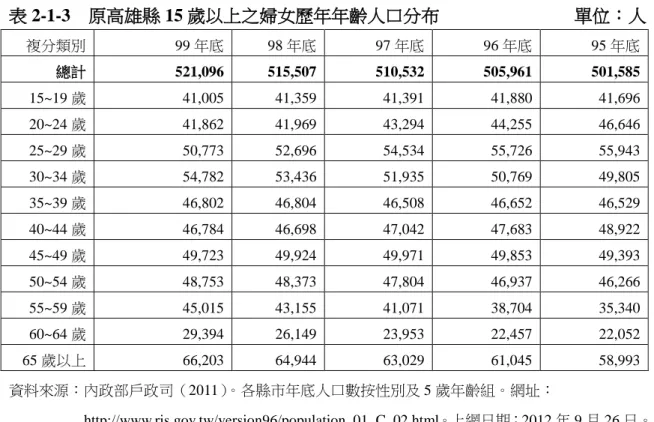
(20) 快樂主義為基礎的幸福觀,即是生活滿意度與生活品質、正向情緒與負面 情緒;以及是以完善論為基礎的幸福觀,即是「心理幸福感」,即是自我 接受、積極關係、自主性、環境駕馭、個人成長及生活目的。 (三)服務輸送:本研究在討論服務輸送主要是系統運轉機制(system operational mechanism)為主要架構,並且也考量服務輸送過程中的效能,特別是服 務可近性與可及性。 至於,本研究之研究限制,主要在進行了六場一般婦女焦點團體及四場福利服 務提供者焦點團體時,焦點團體成員的分享與討論,會受到當時團體動力之影響, 因此他們的發言內容僅是當時團體討論的想法,不能呈現當地婦女生活狀況與需求 的全貌。另外,在進行調查研究分析時,為了能夠聚焦討論研究對象排名前三至五 名之議題,在表格呈現時,無法鉅細靡遺的標出少數特殊族群婦女的需求。因此, 也建議讀者若要清楚得知少數特殊婦女生活狀況與需求,應進一步查看相關表格。. 3.
(21) 第二章 第一節. 文獻探討. 台灣與高雄市婦女人口結構現況. 一、年齡層與居住地 根據內政部戶政司統計報告我國婦女總人口數有逐年升高的趨勢,由 95 年至 100 年統計婦女人口數已增加約 48 萬人,其中以「60 歲以上~未滿 65 歲」增加最 多,增加約 21 萬人,其次依序為「55 歲以上~未滿 60 歲」增加約 20 萬, 「65 歲以 上」增加約 17 萬。同時從數據中可發現,「25 歲以上~未滿 30 歲」婦女人口數下 降最多,下降約 10 萬 5 千人,其次依序為「20 歲以上~未滿 25 歲」下降約 8 萬 6 千人, 「40 歲以上~未滿 45 歲」下降約 3 萬 2 千人,因此我們可以歸納出台灣婦女 人口老年化有日漸增多的趨勢(表 2-1-1)。 另外,根據內政部戶政司統計發現,原高雄市 95 年至 99 年整體婦女人口數增 加約 3 萬 1 千人,其中以「55 歲以上~未滿 60 歲」增加最多,增加約 1 萬 2 千 7 百人,其次依序為「65 歲以上」增加約 1 萬 2 千 5 百人、「60 歲以上~未滿 65 歲」 增加約 1 萬 1 千人,因此我們可發現原高雄市 55 歲以上之婦女人口數是逐漸增加 的。同時從數據中可發現, 「20 歲以上~未滿 25 歲」婦女人口數下降最多,下降約 7 千人,其次依序為「25 歲以上~未滿 30 歲」下降約 5 千人、「15 歲以上~未滿 20 歲」下降約 150 人,從此則可發現原高雄市 15 歲以上~未滿 30 歲之婦女人口數是 逐漸下降的(表 2-1-2)。另外,同樣根據內政部戶政司統計發現,原高雄縣 95 年 至 99 年整體婦女人口數增加約 1 萬 9 千人,其中以「55 歲以上~未滿 60 歲」增加 最多,增加約 9 千人,其次依序為「60 歲~64 歲」及「65 歲以上」皆增加約 7 千 人,因此我們可發現原高雄縣 55 歲以上之婦女人口數是逐漸增加的。同時從數據 中可發現, 「25 歲以上~未滿 30 歲」婦女人口數下降最多,下降約 5 千人,其次依 序為「20 歲以上~未滿 25 歲」下降約 4 千 7 百人、 「40 歲以上~未滿 45 歲」下降約 2 千人,從此則可發現原高雄縣 20 歲以上~未滿 30 歲之婦女人口數是逐漸下降的 (表 2-1-3)。故我們可以了解,無論是在原高雄市或原高雄縣中,55 歲以上之婦 女人口數皆是逐漸增加的,而 20 歲以上~未滿 30 之婦女人口數則是逐漸下降的。 根據上述,隨著台灣人口的老化,台灣婦女與高雄市婦女皆呈現人口老化的情 形。100 年年底高雄市(含原高雄市與原高雄縣)婦女年齡層以「65 歲以上」所占 比例最高,約 12.63%,其次依序為「30 歲以上~未滿 35 歲」約占 10.31%、 「35 歲 以上~未滿 40 歲」約占 9.63%(表 2-1-4) 。高雄市 15 歲以上之婦女的居住地以「三 民區」所占比例最高,約 13.04%,其次依序為「鳳山區」約占 12.47%、「前鎮區」 4.
(22) 約占 7.23%、「左營區」約占 6.85%、「楠梓區」約占 6.20%(表 2-1-5)。 表 2-1-1. 台灣 15 歲以上之婦女歷年年齡人口分布. 單位:人. 複分類別. 100 底. 99 年底. 98 年底. 97 年底. 96 年底. 95 年底. 總計. 9,904,593. 9,793,886. 9,675,322. 9,542,077. 9,419,933. 9,300,369. 15~19 歲. 774,423. 771,420. 774,675. 768,840. 775,575. 771,109. 20~24 歲. 771,069. 765,670. 770,663. 797,136. 814,957. 857,516. 25~29 歲. 878,871. 933,395. 965,727. 985,307. 995,008. 984,295. 30~34 歲. 1,015,193. 1,016,997. 991,472. 955,283. 929,007. 912,357. 35~39 歲. 930,095. 902,236. 905,787. 910,492. 918,842. 917,352. 40~44 歲. 922,634. 930,305. 930,830. 932,657. 940,956. 955,249. 45~49 歲. 954,537. 952,402. 950,826. 945,023. 931,153. 912,538. 50~54 歲. 907,285. 896,683. 883,697. 862,593. 841,159. 825,295. 55~59 歲. 817,458. 798,855. 760,244. 720,458. 672,051. 614,591. 60~64 歲. 603,327. 526,541. 466,877. 427,415. 404,197. 392,948. 65 歲以上. 1,329,701. 1,299,382. 1,274,524. 1,236,873. 1,197,028. 1,157,119. 資料來源:內政部戶政司(2012a) 。年底人口數按性別及年齡。網址: http://www.ris.gov.tw/version96/population_01_C_02.html。上網日期:2012 年 9 月 26 日。. 表 2-1-2. 原高雄市 15 歲以上之婦女歷年年齡人口分布. 單位:人. 複分類別. 99 年底. 98 年底. 97 年底. 96 年底. 95 年底. 總計. 664,186. 657,031. 649,395. 641,205. 633,097. 15~19 歲. 48,663. 48,737. 48,372. 48,979. 48,816. 20~24 歲. 47,857. 48,280. 50,520. 51,896. 55,558. 25~29 歲. 61,726. 64,158. 66,030. 67,410. 67,145. 30~34 歲. 70,453. 69,507. 67,863. 66,372. 65,182. 35~39 歲. 65,044. 65,205. 65,503. 65,814. 65,346. 40~44 歲. 65,907. 65,334. 65,020. 64,997. 65,521. 45~49 歲. 64,459. 64,873. 64,758. 64,343. 63,866. 50~54 歲. 62,774. 62,628. 62,145. 61,548. 60,893. 55~59 歲. 58,886. 56,399. 53,802. 50,503. 46,091. 60~64 歲. 38,244. 33,923. 30,946. 28,441. 27,033. 65 歲以上. 80,173. 77,987. 74,436. 70,902. 67,646. 資料來源:內政部戶政司(2011) 。各縣市年底人口數按性別及 5 歲年齡組。網址: http://www.ris.gov.tw/version96/population_01_C_02.html。上網日期:2012 年 9 月 26 日。. 5.
(23) 表 2-1-3. 原高雄縣 15 歲以上之婦女歷年年齡人口分布. 單位:人. 複分類別. 99 年底. 98 年底. 97 年底. 96 年底. 95 年底. 總計. 521,096. 515,507. 510,532. 505,961. 501,585. 15~19 歲. 41,005. 41,359. 41,391. 41,880. 41,696. 20~24 歲. 41,862. 41,969. 43,294. 44,255. 46,646. 25~29 歲. 50,773. 52,696. 54,534. 55,726. 55,943. 30~34 歲. 54,782. 53,436. 51,935. 50,769. 49,805. 35~39 歲. 46,802. 46,804. 46,508. 46,652. 46,529. 40~44 歲. 46,784. 46,698. 47,042. 47,683. 48,922. 45~49 歲. 49,723. 49,924. 49,971. 49,853. 49,393. 50~54 歲. 48,753. 48,373. 47,804. 46,937. 46,266. 55~59 歲. 45,015. 43,155. 41,071. 38,704. 35,340. 60~64 歲. 29,394. 26,149. 23,953. 22,457. 22,052. 65 歲以上. 66,203. 64,944. 63,029. 61,045. 58,993. 資料來源:內政部戶政司(2011) 。各縣市年底人口數按性別及 5 歲年齡組。網址: http://www.ris.gov.tw/version96/population_01_C_02.html。上網日期:2012 年 9 月 26 日。. 表 2-1-4. 100 年高雄市(含原高雄市與原高雄縣)15 歲以上之婦女歷年年齡人口分布 單位:人 複分類別. 高雄市. 人口比. 總計. 1,197,084. 15~19 歲. 89,845. 0.0751. 20~24 歲. 90,402. 0.0755. 25~29 歲. 104,446. 0.0873. 30~34 歲. 123,411. 0.1031. 35~39 歲. 115,275. 0.0963. 40~44 歲. 112,164. 0.0937. 45~49 歲. 114,085. 0.0953. 50~54 歲. 111,956. 0.0935. 55~59 歲. 105,133. 0.0878. 60~64 歲. 79,117. 0.0661. 65 歲以上. 151,250. 0.1263. 資料來源:內政部戶政司(2012b) 。現住人口數按性別及單一年齡分。網址: http://www.ris.gov.tw/version96/population_01_C_02.html。上網日期:2012 年 9 月 26 日。. 6.
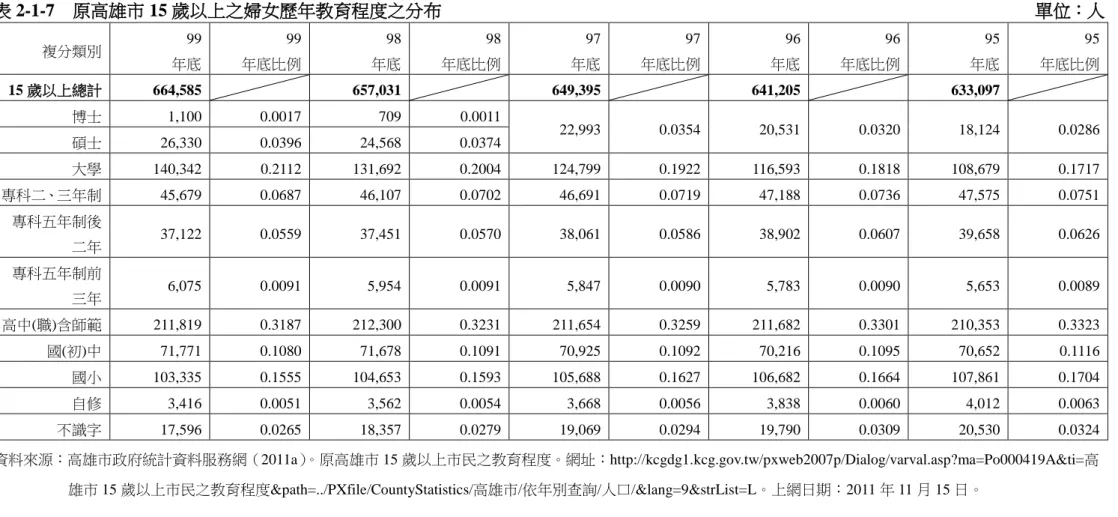
(24) 表 2-1-5. 100 年高雄市(含原高雄市與原高雄縣)各區 15 歲以上之婦女人口數分布 單位:人. 區域別 人數 各區比例 高雄市 1,197,084 鹽埕區 11,943 0.0100 鼓山區 58,229 0.0486 左營區 82,060 0.0685 楠梓區 74,245 0.0620 三民區 156,099 0.1304 新興區 25,000 0.0209 前金區 13,277 0.0111 苓雅區 82,594 0.0690 前鎮區 86,540 0.0723 旗津區 12,473 0.0104 小港區 66,005 0.0551 鳳山區 149,327 0.1247 林園區 29,197 0.0244 大寮區 46,097 0.0385 大樹區 18,318 0.0153 大社區 14,284 0.0119 仁武區 31,036 0.0259 鳥松區 19,086 0.0159 岡山區 41,362 0.0346 橋頭區 15,757 0.0132 燕巢區 12,625 0.0105 田寮區 3,277 0.0027 阿蓮區 12,777 0.0107 路竹區 22,123 0.0185 湖內區 12,301 0.0103 茄萣區 12,929 0.0108 永安區 6,028 0.0050 彌陀區 8,273 0.0069 梓官區 15,361 0.0128 旗山區 16,560 0.0138 美濃區 18,137 0.0152 六龜區 5,828 0.0049 甲仙區 2,881 0.0024 杉林區 4,917 0.0041 內門區 6,340 0.0053 茂林區 762 0.0006 桃源區 1,820 0.0015 那瑪夏區 1,216 0.0010 資料來源:高雄市政府統計資料服務網(2012) 。高雄市各區現住人口數按性別、年齡及婚姻狀況 分。網址:http://kcgdg.kcg.gov.tw/。上網日期:2012 年 9 月 26 日。. 7.
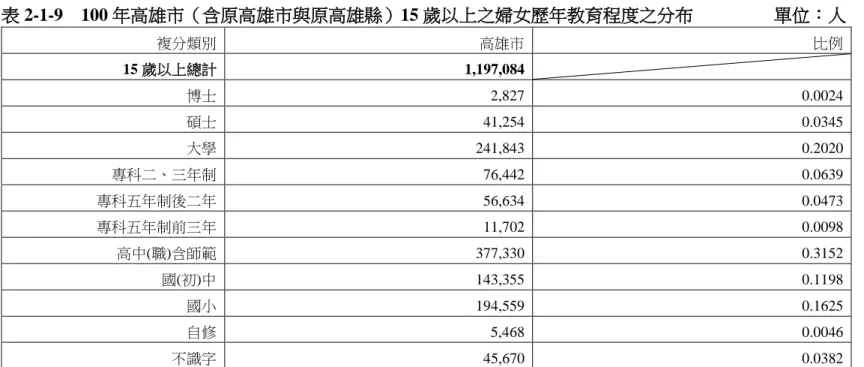
(25) 二、教育程度 根據內政部戶政司的統計資料,台灣婦女教育程度整體人口數於 95 年至 99 年之間,婦女的教育程度以「大學」之人口數增加最多,增加約 62 萬人,其次依 序為「博士、碩士」增加約 15 萬人、 「高中(職)含師範」增加約 6 萬人。另外以 「國小」之人口數下降最多,下降約 9 萬 5 千人,其次依序為「不識字」下降約 8 萬 8 千人、「專科五年制後二年」下降約 2 萬 7 千人。由此我們可以歸納出台灣婦 女整體的教育程度較以往提高(表 2-1-6)。 另外,根據內政部戶政司的統計資料,原高雄市婦女於 95 年至 100 年之間接 受教育人口數增加約 3 萬 1 千人,婦女的教育程度以「大學」增加最多,增加約 3 萬 1 千人,其次依序為「碩士、博士」增加約 9 千人。另外以「國小」之人口數下 降最多,下降約 4 千 5 百人,其次依序為「不識字」下降約 2 千 9 百人、「專科五 年制後二年」下降約 2 千 5 百人。整體而言高雄市婦女之教育程度趨勢與全國婦女 教育程度出現相同的趨勢(表 2-1-7)。 此外,同樣根據內政部戶政司的統計資料,原高雄縣婦女於 95 年至 100 年之 間接受教育人口數增加約 5 萬 8 千人,婦女的教育程度以「大學」增加最多,增加 約 2 萬 3 千人,其次依序為「碩士、博士」增加約 4 千人、「高中(職)含師範」 增加約 3 千人。另外以「不識字」之人口數下降最多,下降約 5 千 5 百人,其次依 序為「國小」下降約 3 千 5 百人、「專科二、三年制」下降約 2 千 2 百人。整體而 言原高雄縣的婦女之教育程度有日漸提升之現象(表 2-1-8)。 根據上述,隨著台灣義務教育的實施,教育愈來愈普及,婦女的教育程度呈現 逐漸提升的情形。100 年高雄市婦女的教育程度以「高中(職)含師範」所佔比例 最高,約占 31.52%,其次依序為「大學」,約占 20.2%、「國小」約占 16.25%(表 2-1-9)。. 8.
(26) 表 2-1-6. 台灣 15 歲以上之婦女歷年教育程度之分布. 複分類別. 單位:人. 100. 100. 99. 99. 98. 98. 97. 97. 96. 96. 95. 95. 年底. 年底比例. 年底. 年底比例. 年底. 年底比例. 年底. 年底比例. 年底. 年底比例. 年底. 年底比例. 15 歲以上總計. 9,904,593. 博士. 24,694. 0.0025. 12,634. 0.0013. 7,933. 0.0008. 碩士. 353,856. 0.0357. 328,366. 0.0335. 303,178. 0.0313. 大學. 2,104,360. 0.2125. 1,990,292. 0.2032. 1,857,908. 專科二、三年制. 694,108. 0.0701. 695,687. 0.0710. 專科五年制後. 427,848. 0.0432. 431,152. 0.0073. 二年 專科五年制前. 71,903. 三年 高中(職)含師. 2,978,768. 範. 9,793,886. 9,675,322. 9,542,077. 9,419,933. 9,300,369. 283,630. 0.0297. 254,064. 0.0270. 223,995. 0.0241. 0.1920. 1,737,447. 0.1821. 1,613,704. 0.1713. 1,480,123. 0.1591. 699,775. 0.0723. 706,354. 0.0740. 710,918. 0.0755. 714,791. 0.0769. 0.0440. 435,167. 0.0450. 441,622. 0.0463. 448,622. 0.0476. 455,271. 0.0490. 69,463. 0.0071. 67,582. 0.0070. 63,952. 0.0067. 63,950. 0.0068. 63,654. 0.0068. 0.3007. 2,967,311. 0.3030. 2,961,067. 0.3060. 2,933,191. 0.3074. 2,925,682. 0.3106. 2,917,027. 0.3136. 國(初)中. 1,258,132. 0.1270. 1,266,348. 0.1293. 1,271,461. 0.1314. 1,270,133. 0.1331. 1,259,303. 0.1337. 1,263,004. 0.1358. 國小. 1,622,851. 0.1638. 1,646,162. 0.1681. 1,666,130. 0.1722. 1,681,995. 0.1763. 1,699,870. 0.1805. 1,718,052. 0.1847. 自修. 47,583. 0.0048. 49,182. 0.0050. 50,293. 0.0052. 51,748. 0.0054. 53,134. 0.0056. 54,991. 0.0059. 不識字. 320,490. 0.0324. 337,289. 0.0344. 354,828. 0.0367. 372,005. 0.0390. 390,686. 0.0415. 409,461. 0.0440. 資料來源:內政部戶政司(2012c) 。15 歲以上人口數按性別及教育程度分。網址:http://www.ris.gov.tw/version96/population_01_C_02.html。上網日期:2012 年 9 月 26 日。. 9.
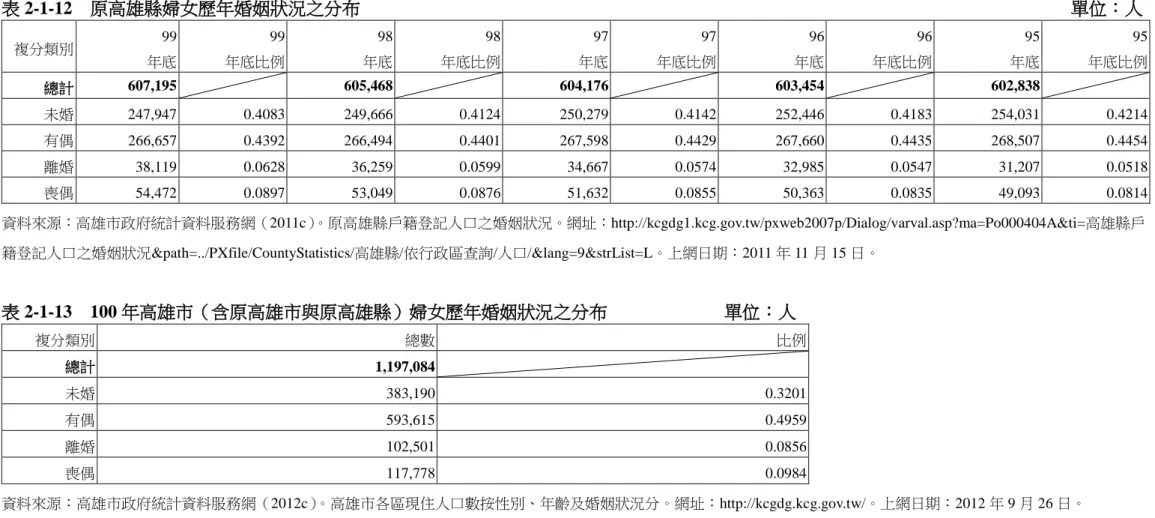
(27) 表 2-1-7. 原高雄市 15 歲以上之婦女歷年教育程度之分布. 複分類別. 單位:人. 99. 99. 98. 98. 97. 97. 96. 96. 95. 95. 年底. 年底比例. 年底. 年底比例. 年底. 年底比例. 年底. 年底比例. 年底. 年底比例. 15 歲以上總計. 664,585. 博士. 1,100. 0.0017. 709. 0.0011. 碩士. 26,330. 0.0396. 24,568. 0.0374. 大學. 140,342. 0.2112. 131,692. 專科二、三年制. 45,679. 0.0687. 37,122. 657,031. 649,395. 641,205. 633,097. 22,993. 0.0354. 20,531. 0.0320. 18,124. 0.0286. 0.2004. 124,799. 0.1922. 116,593. 0.1818. 108,679. 0.1717. 46,107. 0.0702. 46,691. 0.0719. 47,188. 0.0736. 47,575. 0.0751. 0.0559. 37,451. 0.0570. 38,061. 0.0586. 38,902. 0.0607. 39,658. 0.0626. 6,075. 0.0091. 5,954. 0.0091. 5,847. 0.0090. 5,783. 0.0090. 5,653. 0.0089. 高中(職)含師範. 211,819. 0.3187. 212,300. 0.3231. 211,654. 0.3259. 211,682. 0.3301. 210,353. 0.3323. 國(初)中. 71,771. 0.1080. 71,678. 0.1091. 70,925. 0.1092. 70,216. 0.1095. 70,652. 0.1116. 國小. 103,335. 0.1555. 104,653. 0.1593. 105,688. 0.1627. 106,682. 0.1664. 107,861. 0.1704. 自修. 3,416. 0.0051. 3,562. 0.0054. 3,668. 0.0056. 3,838. 0.0060. 4,012. 0.0063. 不識字. 17,596. 0.0265. 18,357. 0.0279. 19,069. 0.0294. 19,790. 0.0309. 20,530. 0.0324. 專科五年制後 二年 專科五年制前 三年. 資料來源:高雄市政府統計資料服務網(2011a) 。原高雄市 15 歲以上市民之教育程度。網址:http://kcgdg1.kcg.gov.tw/pxweb2007p/Dialog/varval.asp?ma=Po000419A&ti=高 雄市 15 歲以上市民之教育程度&path=../PXfile/CountyStatistics/高雄市/依年別查詢/人口/&lang=9&strList=L。上網日期:2011 年 11 月 15 日。. 10.
(28) 表 2-1-8. 原高雄縣 15 歲以上之婦女歷年教育程度之分布. 複分類別 15 歲以上總計. 單位:人. 99. 99. 98. 98. 97. 97. 96. 96. 95. 95. 年底. 年底比例. 年底. 年底比例. 年底. 年底比例. 年底. 年底比例. 年底. 年底比例. 519,281. 513,185. 508,137. 博士. 472. 0.0009. 303. 0.0006. 碩士. 11,923. 0.0230. 10,790. 0.0210. 大學. 88,851. 0.1711. 82,375. 專科二、三年制. 31,162. 0.0600. 19,779. 503,503. 499,057. 9,926. 0.0195. 8,782. 0.0174. 7,753. 0.0155. 0.1605. 77,196. 0.1519. 71,266. 0.1415. 65,244. 0.1307. 31,560. 0.0615. 32,194. 0.0634. 32,811. 0.0652. 33,368. 0.0669. 0.0381. 19,686. 0.0384. 19,905. 0.0392. 20,195. 0.0401. 20,707. 0.0415. 5,414. 0.0104. 5,503. 0.0107. 5,570. 0.0110. 5,582. 0.0111. 5,443. 0.0109. 165,559. 0.3188. 164,936. 0.3214. 163,791. 0.3223. 163,338. 0.3244. 162,183. 0.3250. 國(初)中. 72,241. 0.1391. 72,283. 0.1409. 71,483. 0.1407. 70,962. 0.1409. 71,359. 0.1430. 國小. 93,789. 0.1806. 94,382. 0.1839. 95,301. 0.1875. 96,408. 0.1915. 97,382. 0.1951. 不識字. 30,091. 0.0579. 31,367. 0.0611. 32,771. 0.0645. 34,159. 0.0678. 35,618. 0.0714. 專科五年制後 二年 專科五年制前 三年 高中(職)含師 範. 資料來源:高雄市政府統計資料服務網(2011b) 。原高雄縣 15 歲以上市民之教育程度。網址:http://kcgdg1.kcg.gov.tw/pxweb2007p/Dialog/varval.asp?ma=Po000419A&ti=高 雄市 15 歲以上市民之教育程度&path=../PXfile/CountyStatistics/高雄市/依年別查詢/人口/&lang=9&strList=L。上網日期:2011 年 11 月 15 日。. 11.
(29) 表 2-1-9. 100 年高雄市(含原高雄市與原高雄縣)15 歲以上之婦女歷年教育程度之分布. 單位:人. 複分類別. 高雄市. 15 歲以上總計. 1,197,084. 博士. 2,827. 0.0024. 碩士. 41,254. 0.0345. 大學. 241,843. 0.2020. 專科二、三年制. 76,442. 0.0639. 專科五年制後二年. 56,634. 0.0473. 專科五年制前三年. 11,702. 0.0098. 高中(職)含師範. 377,330. 0.3152. 國(初)中. 143,355. 0.1198. 國小. 194,559. 0.1625. 自修. 5,468. 0.0046. 不識字. 45,670. 0.0382. 資料來源:高雄市政府統計資料服務網(2012a) 。高雄市各區十五歲以上現住人口數按性別、年齡及教育程度分。網址: http://kcgdg.kcg.gov.tw/。上網日期:2012 年 9 月 26 日。. 12. 比例.
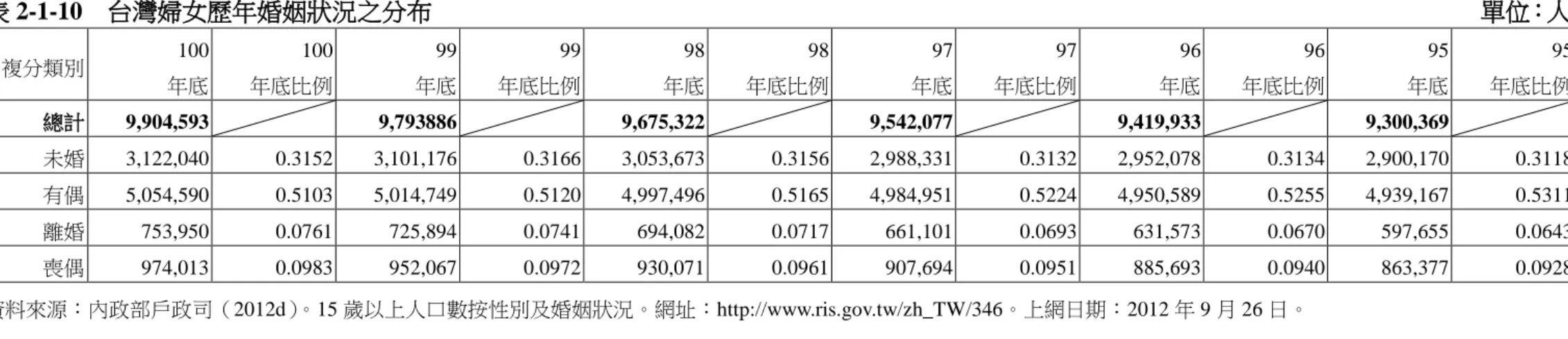
(30) 三、婚姻狀況 根據內政部戶政司的統計資料,95 年至 99 年 15 歲以上全國婦女之婚姻狀 況,以「未婚」狀況之婦女增加最多,增加約 22 萬人,其次為「離婚」狀況增 加約 15 萬人(表 2-1-10)。 另外,根據高雄市政府統計資料服務網之統計資料,原高雄市於 95 年至 99 年之間 15 歲以上婦女之婚姻狀況,以「離婚」狀況之婦女增加最多,增加近 1 萬人,其次依序為「喪偶」增加約 6 千人、「有偶」增加約 3 千人,而「未婚」 狀況之婦女則有所下降,下降約 3 千人(表 2-1-11)。 此外,根據內政部統計處的統計資料,原高雄縣於 95 年至 99 年之間 15 歲 以上婦女之婚姻狀況,以「離婚」狀況之婦女增加最多,增加近 7 千人,其次為 「喪偶」增加約 5 千人,而「未婚」狀況之婦女下降最多,下降約 6 千人,其次 為「有偶」下降約 1 千人(表 2-1-12)。. 四、小結 根據上述,在年齡層方面,無論是全國或高雄市婦女, 「55 歲以上~未滿 60 歲」、「60 歲以上~未滿 65 歲」及「65 歲以上」之婦女人口數是逐漸增加的,而 「20 歲以上~未滿 25 歲」、「25 歲以上~未滿 30 歲」則是逐漸減少的,由此可歸 納出,全國或高雄市之婦女人口皆呈現出日漸老化之趨勢。在教育程度方面,無 論是全國或高雄市婦女,皆以「高中(職)含師範」 、 「大學」及「小學」教育程 度之人數為較多,且教育程度隨著義務教育之實施,愈來愈普及,整體的教育程 度呈現逐漸提高之情形。在婚姻狀況方面,高雄市婦女與全國婦女之婚姻結構相 似,高雄市婦女與全國婦女則有所異同,相異之處為 100 年高雄市婦女中「未婚」 狀況之婦女人數比例是較全國性高(高雄市 32.01%>全國 31.52%),同時「離 婚」人數比例亦較全國性高(高雄市 8.56%>全國 7.61%);相同之處則為無論 是全國或高雄市婦女,「離婚」狀況之婦女人數比例皆呈現增加之趨勢。. 13.
(31) 表 2-1-10 複分類別. 台灣婦女歷年婚姻狀況之分布. 單位:人. 100. 100. 99. 99. 98. 98. 97. 97. 96. 96. 95. 95. 年底. 年底比例. 年底. 年底比例. 年底. 年底比例. 年底. 年底比例. 年底. 年底比例. 年底. 年底比例. 總計. 9,904,593. 未婚. 3,122,040. 0.3152. 3,101,176. 0.3166. 3,053,673. 0.3156. 2,988,331. 0.3132. 2,952,078. 0.3134. 2,900,170. 0.3118. 有偶. 5,054,590. 0.5103. 5,014,749. 0.5120. 4,997,496. 0.5165. 4,984,951. 0.5224. 4,950,589. 0.5255. 4,939,167. 0.5311. 離婚. 753,950. 0.0761. 725,894. 0.0741. 694,082. 0.0717. 661,101. 0.0693. 631,573. 0.0670. 597,655. 0.0643. 喪偶. 974,013. 0.0983. 952,067. 0.0972. 930,071. 0.0961. 907,694. 0.0951. 885,693. 0.0940. 863,377. 0.0928. 9,793886. 9,675,322. 9,542,077. 9,419,933. 9,300,369. 資料來源:內政部戶政司(2012d) 。15 歲以上人口數按性別及婚姻狀況。網址:http://www.ris.gov.tw/zh_TW/346。上網日期:2012 年 9 月 26 日。. 表 2-1-11 複分類別. 原高雄市婦女歷年婚姻狀況之分布. 單位:人. 99. 99. 98. 98. 97. 97. 96. 96. 95. 95. 年底. 年底比例. 年底. 年底比例. 年底. 年底比例. 年底. 年底比例. 年底. 年底比例. 總計. 775,361. 未婚. 330,028. 0.4256. 331,690. 0.4295. 331,881. 0.4319. 333,460. 0.4365. 333,591. 0.4396. 有偶. 324,533. 0.4186. 323,740. 0.4192. 324,075. 0.4217. 322,162. 0.4217. 321,001. 0.4230. 離婚. 60,529. 0.0781. 58,179. 0.0753. 55,452. 0.0722. 53,049. 0.0694. 50,577. 0.0667. 喪偶. 60,271. 0.0777. 58,656. 0.0760. 57,014. 0.0742. 55,277. 0.0724. 53,633. 0.0707. 772,265. 768,422. 763,948. 758,802. 資料來源:高雄市政府統計資料服務網(2012b) 。原高雄市戶籍登記人口之婚姻狀況。網址:http://kcgdg1.kcg.gov.tw/pxweb2007p/Dialog/varval.asp?ma=Po000404A&ti= 高雄市戶籍登記人口之婚姻狀況&path=../PXfile/CountyStatistics/高雄市/依行政區查詢/人口/&lang=9&strList=。上網日期:2012 年 9 月 26 日。. 14.
數據

+7
相關文件
具有計畫主持人資格,且於國內外擔任教學、研究職務在
一、 主辦單位:臺北市政府教育局 二、 承辦單位:臺北市新民國中 三、 協辦單位:臺北海洋科技大學 四、
為了解人力市場供需情況,在此將探討本分署轄區求職民眾及企業廠商於 各工作地點之需求狀況。本分署轄區縣市 103
臺灣研究 參考工具 電子期刊 報紙 社會科學 文學 綜合. 國中小 高中職
a01 籐藝 2 陳昭瑩 高雄市政府勞工局博愛職業技能訓 練中心.. a01 籐藝 3
C7 國立台中護理專科學校護理科 台中市 主任 C8 中臺科技大學老人照顧系 台中市 助理教授 C9 中山醫學大學公共衛生學系 台中市 助理教授 C10
於報名時繳交 101 年度
教授 电视播音主持 电视播音主持业务 播音主持业务研究 业务研究.. 教授
