
不同英語能力之大學生的寫作策略及寫作困擾
95
0
0
全文
(2) 不同英語能力之大學生的寫作策略及寫作困擾. 摘要 如何運用策略對於自主學習是非常重要的。目前為止,尤其是在英語為外國 語(EFL)的語境中,專門探討寫作策略的文獻極少。本研究的目的在探討不同英 語能力之大學生的寫作策略及寫作困擾。184 位英語系的學生參與填寫兩份寫作 策略及寫作困擾的問卷。此問卷調查研究產生幾個重大發現:(1) 一般而言,台 灣大學生在寫作時,使用寫作策略的頻率並不高;(2) 相較於擬稿及校正階段, 大學生在寫作階段運用最多的策略,而擬稿時寫作策略運用最少;(3) 高、中及 低成就學生使用策略的頻率無顯著差異。英語能力影響策略使用的類型,而非策 略使用的頻率,即不同英語能力之大學生在寫作時,使用不同策略,但策略使用 的頻率卻很相近;(4) 英語能力不足是造成學生寫作困擾的主因。學生在組織文 章內容時(discourse level)感到最困難的是文章架構往往受中文思維的影響,而在 撰寫語句時(sentence level),則感到字彙能力不足;(5) 學生英語能力對其寫作困 擾的類型及程度有顯著影響,即不同英語能力之學生有不同的寫作困擾,而中、 低成就學生比高成就學生之寫作困擾更加嚴重。作者根據此研究結果提出在英語 教學及對未來相關研究之建議,以供參考。. i.
(3) Abstract Use of strategies is a key to learner autonomy.. Up to date, very few empirical. studies have explored writing strategies, in particular, in the context of EFL.. The. purpose of the study was to examine writing strategies and writing difficulties among college students with different levels of English proficiency. 184 English majors were asked to complete two questionnaires of writing strategies and writing difficulties. Several significant results were found in this survey research. writing strategies were moderately used among college students.. First,. Second, more. strategies were used in the writing stage than in the planning or editing stage.. The. planning stage received the least strategy use. Third, high-, mid- and low-achievers used writing strategies with equivalent frequency. English proficiency affected type of strategy use, rather than frequency of strategy use.. College students of differing. ability had preference over different strategies, but the frequency of strategy use remained the same among these learners. Fourth, insufficient English competence was mainly responsible for student writing difficulties.. First language interference. was found to be the greatest writing difficulty in the discourse level, and insufficient vocabulary knowledge, in the sentence level. Last, English proficiency significantly affected both type and degree of writing difficulties.. College students of differing. ability had different writing problems, and mid- and low-achievers encountered. ii.
(4) greater writing difficulties than their high-achieving counterparts.. Pedagogical. implications and suggestions for future research were provided to conclude the study.. iii.
(5) Acknowledgements I would like to express my greatest appreciation to my advisor, Dr. Mei-Chen Chen (Dr.陳美貞), for her professional instruction and intellectual inspiration to help me complete this thesis writing. In addition, I would like to extend my special thanks to Dr. Lihung Chang (Dr. 張理宏) and Dr. Shih-Chung Lin (Dr.林世忠) for their careful reviewing and invaluable suggestions on my thesis. My final acknowledgement goes to my parents for their spiritual support and encouragement.. Without the help of these people, this thesis would be impossible.. I am very glad I have the chance to express my sincere thanks to all of them.. iv.
(6) Table of Contents Abstract (Chinese)............................................................................................. Abstract……………………………………………………………………….. Acknowledgements…………………………………………………………… Table of Contents……………………………………………………………… Tables…………………………………………………………………………. Chapter One Introduction……………………………………………………...................... Problem Statement………………………………………………………. Purpose of the Study………………………………………...................... Research Questions……………………………………………………… Significance of the Study………………………………………………… Definitions of Terms…………………………………………………….. Chapter Two Literature Review…………………………………………………………… Language Learning Strategies…………………………………………… Language Learning Strategies and English Proficiency………………… Writing Strategies and English Proficiency……………………………... Writing Difficulties……………………………………………………… Summary………………………………………………………………… Chapter Three Methodology………………………………………………………………… Subjects…………………………………………………………………. Instruments……………………………………………………………… Data Collection Procedures……………………………………………... Data Analysis………………………………………………..................... Chapter Four Results………………………………………………………………………. Validity and Reliability of the Questionnaires………………………….. Semester Grade of English Writing……………………………………... Learner Characteristics………………………………………………….. Results of Questionnaires…………………………………...................... Results of Post-questionnaire Interviews……………………………….. Summary of Results……………………………………………………... Chapter Five Conclusions…………………………………………………………………. Discussion………………………………………………………………. v. i ii iv vi 1 3 5 5 7 8 11 11 13 16 21 23 25 25 26 34 37 38 38 39 40 43 62 64 66 66.
(7) Pedagogical Implications……………………………………………… Suggestions for Further Research……………………………………….. References………………………………………………………………. Appendix A: Writing Strategy and Writing Difficulty Questionnaire………………………………………………….. Appendix B: Writing Strategy and Writing Difficulty Questionnaire (Chinese)………………………….............................................. vi. 69 70 71 79 83.
(8) Tables Table 1. Demographic Data of the Subjects and Average years of English Learning…………………………………………………………….. Table 2 Sample Items of Three Writing Stages in the Writing Strategy Questionnaire……………………………………………………….. Table 3 Sample Items of Five Factors in the Writing Difficulty Questionnaire……………………………………………………….. Table 4 Data Collection Procedures…………………………………………. Table 5 Descriptive Statistics for Students of Differing English Proficiency.. Table 6 Grade, Gender, and Years of English Learning……………………... Table 7 Ways of Practice on English Writing………………………………... Table 8 English Writing Motivation………………………………………..... Table 9 Perception of the Importance of English Writing…………………… Table 10 Self-rating of English Writing Ability……………………………….. Table 11 Summary of Writing Strategy Use by Writing Stage………………… Table 12 ANOVA on Writing Strategy Use by Writing Stage…………………. Table 13 Scheffé Post-hoc Tests on the Three Stages of Writing Strategy Use.. Table 14 General Description of Writing Strategies…………………………… Table 15 Most Frequently-used Strategies in Each Writing Stage…………….. Table 16 Use of Writing Strategies among Three Different Proficiency Levels. Table 17 Summary of Writing Strategy Use by Proficiency Level……………. Table 18 ANOVA on Writing Strategy Use by Proficiency Level…………….. Table 19 Summary of Writing Strategy by Proficiency Level………………… Table 20 ANOVA on Writing Strategy Use in Three Stages by Proficiency Level……………………………………………………………….... Table 21 General Description of Writing Difficulties…………………………. Table 22 Type of Writing Tasks in Relation to Writing Difficulty…………...... Table 23 Summary of Writing Difficulties among Different Proficiency Level………………………………………………………………… Table 24 Summary of Writing Difficulty Factor by Proficiency Level………... Table 25 ANOVA on Writing Difficulty Factor by Proficiency Level………… Table 26 Scheffé Post-hoc Tests on Writing Difficulty Factor by Proficiency Level………………………………………………………………… Table 27 Summary of Writing Difficulty Level by Proficiency Level………… Table 28 ANOVA on Writing Difficulty Level by Proficiency Level…………. Table 29 Scheffé Post-hoc Tests on Writing Difficulty by Proficiency Level…. vii. 26 28 31 36 40 40 41 42 42 43 44 44 45 45 47 49 51 51 52 52 54 56 57 58 59 59 60 61 61.
(9) CHAPTER 1 Introduction. Writing presents a great challenge for most people, both in the mother tongue and in a foreign language.. As English has become the most popular language. worldwide, the importance of English writing cannot be too emphasized.. Among the. four language learning skills, writing is the most difficult, especially for EFL learners (Richards & Renandya, 2002).. When it comes to writing, these learners not only. have to think up and organize their ideas, but, the toughest task, transform them into meaningful text in English.. “As a rule, writing requires some conscious mental. effort:we ‘think out’ our sentences and consider various ways of combining and arranging them” (Byrne, 1988, p.1).. Composing an article is generally regarded as a. challenging task imposed on students, especially in the EFL writing class. Being at a loss for ideas is a common experience to most learners when they are obliged to write (Byrne, 1988). Due to the fact that Chinese and English have different linguistic systems, Chinese learners frequently have difficulties, in particular, with writing in English. These writing difficulties may reflect at a sentence level and/or at a discourse organization level. As Kaplan (1972) claimed, the problems of organization in academic writing by ESL students resulted from cross-cultural differences in rhetoric.. 1.
(10) Note that English writers directly write up their main ideas into topic sentences for paragraphs, then work on detailed ideas to support the topic sentence in a paragraph, and provide examples, if necessary. In contrast, Chinese learners tend to organize the ideas of an English paragraph by following conventional four-part writing model, Qi-Cheng-Jun-He, which reflects an indirect writing approach—from details to generals (Guanjun, 2004).. Namely, Chinese writing is distinct from English writing. in the organization and structure of an article.. Chinese learners usually structure. their ideas in Chinese and then translate these thoughts into English. In addition to the organization-level difference, Mohan and Lo (1985) stated that some of language learners’ difficulties were sentence-level problems with grammar and vocabulary. Moreover, Yi (2001) indicated that cultural and linguistic differences were the primary factors that interfered with Chinese students’ English writing. Guanjun (2004) discussed the cultural factors which influenced Chinese learners’ English writing. These factors included social and political ideologies.. In sum, the differences. between Chinese and English found in previous research may interfere with Chinese learners’ English writing performance and thus cause writing difficulties. Strategies facilitate language learning.. A great number of language teachers. and researchers have long observed that some learners acquire English as a second or foreign language more quickly and effectively than others (e.g., Dreyer & Oxford,. 2.
(11) 1996; Lightbown & Spada, 1999; Vance, 1999). Most of them have regarded learning strategies as a significant variable in the process of language learning.. Yang. (1998) investigated the use of language learning strategies with college students of English major in Taiwan and suggested that it was imperative to help foreign language learners to build a repertoire of learning strategies. The effect of learning strategies on EFL learning should, in fact, never be underestimated. Furthermore, many studies have explored the relationship between language learning strategies and learners’ English proficiency (e.g., Green & Oxford, 1995; Nisbet, Tindall & Arroyo, 2005; Park, 1997).. English proficiency has been. considered as an important factor that affects learners’ strategy use.. Park (1997). indicated that the relationship between language learning strategies and second language proficiency was linear, suggesting that there was a significant relationship between English proficiency and six types of language learning strategies.. Green. and Oxford (1995) declared that more proficient, successful learners used greater strategies. Oxford and Burry-Stock (1995) also found that the frequency of strategy use was significantly related to English proficiency. Generally, the effect of language proficiency on strategy use has been studied and recognized.. 3.
(12) Problem Statement Although tons of research on learning strategies have been documented, very few studies to date have explored the domain of writing strategy use and, in particular, its relationship to English proficiency and writing difficulties. Writing is gradually becoming an important issue nowadays in English learning. Bereiter and Scardamalia (1987) proclaimed that writing process was a highly complex way because of “the interdependency of components, which requires that a number of elements be coordinated or taken into account jointly” (p.12). Writing is also a language-switching process, especially to learners whose native language is not English.. Some studies investigated writing strategy use and analyzed some possible. factors that might cause difficulties in English writing for foreign language learners (e.g., Lee, 2002; Mohan & Lo, 1985; Sue, 2004; Uzawa, 1996; Yi, 2001). These factors included cultural and linguistic differences. However, so far, very few studies have examined writing strategy use with learners of different English proficiency levels.. The relationship between writing strategies and proficiency has. not been well-explored. In addition, some writing strategy-related studies were basically case studies with a limited number of subjects, and it was therefore difficult to form conclusive generalization via such research.. The present study attempted to. study writing difficulties and strategy use among technological college students with. 4.
(13) different levels of English proficiency. The relationship between proficiency and strategies was studied by comparing the differences of strategy use among high-, mid-, and low-achievers in the process of academic English writing.. Purpose of the Study The purpose of this study was to examine general writing strategy use and writing difficulties among technological college students with different levels of English proficiency. By exploring the writing strategies and difficulties, we could better understand the role and effectiveness of writing strategies employed by such learners in the process of writing. The present study also attempted to determine the effect of English proficiency and asked whether students of different English proficiency levels (i.e., high-, mid-, and low-writing achievement) used different strategies and encountered different difficulties while writing.. It was hoped that, via. the study, helpful information would be generated in assisting students to be aware of their writing strategy use and writing difficulties, and for EFL writing teachers to recognize the role of individual differences (i.e., differing English proficiency) in learners’ strategy use.. 5.
(14) Research Questions The research questions examined in this study are addressed as follows: 1. What writing strategies do college students of technology use while writing to English composition? How often do they apply these strategies in the stages of planning, writing, and editing? 2. Do students of different English proficiency levels use different writing strategies? If so, what writing strategies are frequently used by high-, mid-, and low-achievers, respectively?. In addition, is there any significant difference among high-, mid-,. and low-achievers in the frequency of general writing strategy use?. Do these. three levels of learners differ, more specifically, in the frequency of strategy use across the three writing stages of planning, writing, and editing? 3. What writing difficulties do college students of technology encounter while writing to English composition?. Do these difficulties occur more often at a. sentence level or at an organization level?. Among the four factors of lack of. English proficiency, lack of background knowledge, lack of practice, and lack of motivation, which of them is more responsible for students’ writing difficulties? In addition, what type of English writing tasks is more difficult for college students?. 6.
(15) 4. Do students of different English proficiency levels encounter different writing difficulties? To be more specific, do high-, mid-, and low-achievers have different levels of writing problems, in particular, related to the factors of English proficiency, background knowledge, practice intensity, and writing motivation? In addition, do these learners experience different degrees of writing difficulties in the sentence level or in the organization level?. If so, to what extent?. Significance of the Study The significance of the study can be viewed from three perspectives.. First,. many related studies showed that learning strategies played an important role in English learning, and instructing those strategies could promote EFL learners’ ability. The present study focused on probing the use of writing strategies to see if they could really benefit English writing performance of four-year technological college students. The findings of this study would not only help students realize the importance of employing strategies in their writing process but also assist writing instructors to be aware of EFL learners’ writing difficulties, so appropriate writing strategies could thus be taught accordingly. Second, very few studies have explored whether learners of different proficiency levels use different writing strategies. The current study intended to determine if English proficiency was a key factor to strategy use.. 7. Third,.
(16) in the strategy-related literature, very few studies have recruited college students in their research on writing strategies and writing difficulties. The present study did so, hopefully, to shed light on the research of the habitual learning behavior of such learners.. Definitions of Terms Writing Writing is defined as thinking up ideas or thoughts, combining them, and expressing them through tasks, such as letters, journals, articles, etc. It is also regarded as a process that composes writers’ thoughts in a language. Learning Strategy Strategies are plans formed deliberately to achieve particular goals. Oxford (1990) published the Strategy Inventory for Language Learning in order to examine second or foreign language learners’ strategies use.. The inventory was composed of. six types of learning strategies including memory strategies, cognitive strategies, compensation strategies, metacognitive strategies, affective strategies, and social strategies. Foreign language learners could make use of these strategies to achieve particular goals while learning English.. 8.
(17) Writing Strategy Cohen (1998) defined writing strategies as behaviors deliberately formed by writers for the purpose of making their writing more efficient. In this study, writing strategies used by foreign language learners were detected through three stages of strategy use. They were planning stage, writing stage, and editing stage. Writing Difficulty Writing difficulties are problems learners encounter in the process of writing. It is generally recognized that many second or foreign language learners have difficulties with academic writing in English. The present study explored five factors that might cause such writing difficulties. They were lack of English proficiency, lack of background knowledge, lack of practice, lack of motivation, and type of writing tasks. English Proficiency English proficiency refers to the degree of capacity with which foreign language learners can use to read, speak, write, and understand English.. There were three. levels of English proficiency in this study: high-, mid-, and low-achievement according to learners’ course grades of English writing.. The top one third learners of. the class was grouped as high-achievers, the middle part as mid-achievers, and the bottom part as low-achievers.. 9.
(18) Translation Strategy It is defined as using the first language as a base for understanding or producing the second language. During the composing of their English writing, learners organize their ideas in Chinese, and then translate these thoughts into English. Qi-Cheng-Jun-He(起承轉合) Qi-Cheng-Jun-He is an indirect writing approach to organize and structure ideas in writing. It is an organizational pattern Chinese students usually use while writing a composition.. The first part refers to introducing the topic, the second part,. elaborating on the topic, the third part, presenting other related points, and the last part, giving the conclusion. Such approach is characterized by organizing ideas from details to generals. (Guanjun, 2004). 10.
(19) CHAPTER 2 Literature Review This chapter consists of four parts that present the relevant literature in the domain of learning strategies.. The first part introduces language learning strategies.. The second part discusses the previous studies of language learning strategies and English proficiency.. The third part focuses on writing strategies and English. proficiency. The fourth part describes writing difficulties. A summary of the literature being reviewed is provided to conclude the chapter.. Language Learning Strategies Many research studies that explored the area of learning strategies generally found that these strategies could promote the learning performance of second/foreign language learners (e.g., Bialystok, 1979; Chamot & O’Malley, 1990; Cohen, 1995; Rigney, 1978; Rubin, 1975; Yang, 1998). As Cohen (1995) stated, language learning strategies had an explicit goal of assisting learners in improving their knowledge of a target language.. Chamot and O’Malley (1990) also indicated that language learning. strategies helped ESL learners with their mastery of language forms and functions and thus influenced their achievement.. Oxford (1990) further classified language. learning strategies into six types: memory strategies, cognitive strategies,. 11.
(20) compensation strategies, metacognitive strategies, affective strategies, and social strategies. ESL/EFL learners’ use of learning strategies is greatly related to their English proficiency (Green & Oxford, 1995; Nisbet, Tindall & Arroyo, 2005; Park, 1997). Regardless of the emphasis on the importance of strategy use, writing strategies have received little attention from the past literature.. Flavell (1992) indicated that. cognitive learning was concerned with three variables—personal, task, and strategy. To be more specific, personal variable dealt with knowledge of self, and concerned whether students were influenced by internal or external factors to complete a task (Borich & Tombari, 1997).. Students with internal type attributed the success of a. task to effort and ability, in contrast, students with external type, to luck and task difficulty.. Unfortunately, to date, writing instruction in the EFL classroom has often. neglected both of the personal and strategy variables.. Writing difficulties which. involve the type of writing tasks assigned to learners have not been thoroughly examined as well.. The current study intended to explore these variables in the. context of EFL writing. In addition to the aforementioned three variables, a great number of studies further indicated that the frequency of overall language strategy use varied due to some other variables, such as language proficiency (Green & Oxford, 1995; Nisbet,. 12.
(21) Tindall & Arroyo, 2005; Wen & Johnson 1991), gender (Dreyer, 1992; Ehrman & Oxford, 1989; Green, 1991; Noguchi, 1991), learning motivation (Davis & Abas, 1991; Mullins, 1992), and cultural background (Bedell, 1993). It was the English proficiency variable that was of great concern in the present study.. In addition, this. study focused on the study of writing strategies with which very few studies had been generated in the domain of learning strategies.. It was hoped that the results would. shed some light on the research of writing strategies with learners of differing English ability.. Language Learning Strategies and English Proficiency A number of studies explored the relationship between English proficiency and learning strategy use (e.g., Chang, 1991; Green & Oxford, 1993; Nisbet, Findall & Arroyo, 2005; Park, 1994; Phillips, 1990, 1991; Rossi-Le, 1989; Wen & Johnson, 1991).. These studies used various ways to measure learners’ English proficiency. level. Most of them implemented standardized language proficiency test (e.g., Chang, 1991; Green & Oxford, 1993; Park, 1994; Phillips, 1990, 1991; Rossi-Le, 1989; Wen & Johnson, 1991). Oxford and Burry-Stock (1995) concluded that most findings of the relationship between learning strategies and English proficiency were linear, suggesting that more proficient students used strategies more frequently.. 13.
(22) Park (1997) investigated the correlations among six types of language learning strategies, total language learning strategies, and L2 proficiency.. Three hundred and. thirty two intermediate to advanced level university students in Korea participated in this study. The participants were divided into three groups (i.e., high-achievers, mid-achievers, and low-achievers) according to their TOEFL scores.. The data were. collected via the Strategy Inventory for Language Learning (SILL) and the Individual Background Questionnaire (IBQ). The findings showed that the more students used learning strategies, the higher their TOEFL scores were.. That is, language learning. strategies and English proficiency had a positive linear relationship.. Furthermore, all. six types of language learning strategies were correlated with the learners’ TOEFL scores; cognitive and social strategies were more predictive of English proficiency level.. Two recommendations were made accordingly. First, the relationship. between learning strategies and L2 proficiency required further study on different populations with different instruments.. Second, the question of whether the. importance of cognitive and social strategies in predicting English proficiency was specific to Korean learners or general to other different cultural groups called for further examination. A similar study which also explored the relationship between English proficiency and learning strategies was conducted by Nisbet, Tindall and Arroyo (2005).. 14. The.
(23) subjects were 168 senior college students majoring in English.. The instruments of. the study included the SILL and the Institutional Testing Program TOEFL (ITP-TOEFL). The results of this study showed that the six types of language learning strategies were significantly correlated with one another.. Note that. metacognitive and affective strategies were significantly correlated with English proficiency, the results somewhat different from those of Park (1997) mentioned previously. Green and Oxford (1995) examined the effect of L2 proficiency on learning strategy use.. The subjects were 374 university students with different English ability. levels (i.e., Prebasic, Basic, and Intermediate) according to their scores of the English as a Second Language Achievement Test (ESLAT).. The study found that proficiency. level had a significant effect on the use of cognitive, compensation, metacognitive, and social strategies.. The prebasic students used fewer strategies than those of the. other two levels; however, there was no significant difference of strategy use between the Intermediate and Basic levels. English proficiency still had certain effect on strategy use. To sum up, from the studies being reviewed in this section, English proficiency was positively correlated with and might, to a certain degree, have effects on general strategy use or type of strategy use.. 15.
(24) Writing Strategies and English Proficiency The use of writing strategies has become increasingly important, especially for academic writing (Ferris, 2001; Hedge, 1988; Nunan, 1991; Petric & Czarl, 2003; Raimes, 1983; Zamel, 1982).. Petric and Czarl (2003) validated a writing strategies. questionnaire with both qualitative and quantitative methods.. They pointed out. potential problems and limitations of research on writing strategies using questionnaires.. Those problems were that items with specialist vocabulary might. confuse participants; however, items with too general vocabulary might cause misunderstandings and misinterpretations of the text.. One limitation mentioned by. these researchers was that the questionnaire research on writing strategies did not provide sufficient understanding of strategy use. Instead, using multiple data sources would be more suitable and fruitful than questionnaire research alone.. The present. study intended to use questionnaires and interviews to collect both qualitative and quantitative data of college students’ writing strategy use and writing difficulties as well. Yeon (2002) investigated how 41 international graduate students of differing writing proficiency used writing strategies.. The question of how L1 background,. length of residence, and majors affected writing strategy use was also explored. writing proficiency was rated into three levels, high-, mid- and low-achievement.. 16. The.
(25) The data were collected through a writing questionnaire and interviews. results were found.. Several. There was no significant difference in the frequency of strategy. use among high-, mid- and low-achievers.. The use of translation strategy had. significant association with writing proficiency. In particular, high-achievers were very conscious about how to improve their L2 writing skills and made efforts accordingly. They also knew how to internalize feedback or corrections. In contrast, mid- and low-achievers realized the need for improvement, but did not take further actions on their writing.. Unfortunately, specific writing difficulties. encountered by these learners were not reported in Yeon’s study. With a qualitative research method, Feng (1995) explored eighteen college students’ general writing strategies in a sophomore EFL composition class in Taiwan. Their English proficiency ranged from high-intermediate to lower-advanced.. With a. writing strategy questionnaire and group interviews to probe their strategy use, the researcher found that most students preferred cognitive strategies to social strategies while doing their writing tasks, and they used the technique of outlining before actually engaging in writing an English composition. However, only half of them kept a regular habit in revising their own writing when it was finished.. They were. more capable of finding the mistakes in wording, expressions, and grammar than identifying problems in the overall organization of the composition. This suggested. 17.
(26) organizing a composition was more difficult than anything else in writing. However, specific strategies being used based on different writing stages of planning (pre-stage), writing (in-stage), and editing (post-stage) were not identified and reported in Feng’s study.. The present study intended to analyze students’ strategy use in terms of these. three stages of writing. Different strategies were used by learners of different English proficiency levels. Baker and Boonkit (2004) examined general reading and writing strategies among 149 undergraduate students. Students’ grades in English reading and writing were used to identify “successful” and “unsuccessful” learners.. The data were collected. through a self-developed strategy questionnaire, students’ learning journals, and interviews. The results showed that all subjects used metacognitive, cognitive, and compensation strategies more than memory, social, and affective strategies. Although there was no significant difference in the frequency of using writing strategies between high-achievers and low-achievers, there were some differences in the type of strategies they used. than high-achievers.. Low-achievers made more use of negative strategies. These negative strategies, or composing behaviors, were, for. example, “I like to start writing immediately without a plan” and “when I have finished my work, I don’t read it again.” The biggest difference of writing strategy use for the two types of learners was that high-achievers paid more attention to every. 18.
(27) level of their writing than low-achievers.. Furthermore, low-achievers frequently. used the translation strategy when writing.. The study concluded that it was very. necessary to make low-achieving learners aware of such negative writing strategies in foreign language learning. Due to the fact that identifying unsuccessful writers’ problems of composing can promote English writing, many researchers have shifted their attention from successful language learners to unsuccessful ones for the past decades. They examined what unskilled second language writers did while writing and compared different writing strategies used by successful and unsuccessful writers. Raimes (1990) did a writing strategy study on unskilled second language writers. Eight college students in an English composition course participated in this study. They were identified as unsuccessful learners through an English proficiency test. Some methods including questionnaire, writing assessment test, and think-aloud composing (a technique which records learners’ thoughts into a tape recorder while they are writing a composition) were used to explore the composing behaviors and features of unskilled learners in the process of writing.. These learners were asked to do a. narrative task, which required them to write on a topic with no specification of purpose or audience and think aloud into a tape recorder as they composed in order to find out their thoughts and behaviors of writing. Raimes found that although many. 19.
(28) of the unskilled students were attentive and committed to the task, they did not go back to edit the compositions often because they thought it was unavoidable to make errors in second language learning. In addition to that, during the process of revising, they focused on the flow of ideas and the communication of content, not on the accuracy of sentences. These results were inconsistent with those of Feng (1995), which showed that learners focused more on the accuracy of sentences, expressions, and grammar than the overall organization of the composition.. Such inconsistency. called for more research on writing problems with regard to sentence-level and organization-level for learners of differing English proficiency. Moreover, Vann and Abraham (1990) attempted to find out why unsuccessful language learners failed to complete academic compositions. Fifteen college students were identified as successful and unsuccessful learners according to an English proficiency test.. Four successful and four unsuccessful learners were then. selected from the fifteen students to take part in the study.. From the interview,. think-aloud process (that is, to report what they are thinking as they are writing), and observation, the researchers found that the unsuccessful learners used as many strategies as the successful learners did, but they lacked a systematic approach to monitor their work.. They appeared to be active strategy users; however, they failed. to apply strategies appropriately to the writing task at hand. That is, they might lack. 20.
(29) metacognitive strategies or self-regulatory skills to manage their appropriate strategy use. Generally, the present study intended to probe the effect of differing English proficiency (high-achievement, mid-achievement, and low-achievement) on writing strategy use.. To be more specific, whether learners of different English abilities used. different writing strategies when on task was of great concern in the study.. Writing Difficulties English writing is considered as a tough task for EFL learners, especially for Chinese students because of cultural and linguistic differences.. According to Yi. (2001), “Chinese and English linguistically belong to different language families; their grammar and writing systems are drastically different from each other. In addition, the eastern and western cultures have a lot of discrepancies, or even controversies” (p.1).. The researcher identified four cultural differences and three. linguistic differences in writing conventions.. The former were (1) the presentation. of ideas, (2) the citation of idioms, proverbs, or citing from famous people or writing, (3) the organization of exposition, and (4) classroom implications. word inflexion, (2) modifier, and (3) verb.. The latter were (1). Both of the cultural and linguistic. differences might lead to writing difficulties for EFL learners.. 21. In particular, the.
(30) linguistic differences might result in grammatical errors and cause misunderstandings in context. Making these learners aware of such differences was of great importance in producing authentic English compositions. Furthermore, as Cai (2004) claimed, the cultural factor had a large impact on Chinese writers’ rhetorical habits.. “Chinese students write the articles that are. characterized by long windedness, digression, and indirectness” (Fagan & Cheong, 1987, p.25).. In the rhetorical convention of Chinese composition, learners usually. follow the four-part writing model, Qi-Cheng-Jun-He, which reflects an indirect writing approach.. On the contrary, native English speakers use a relatively direct. method in organizing the flow of ideas with clear topic statements at the start of paragraphs and supporting sentences in the following. In addition to cultural and linguistic factors, developmental factor may be responsible for ESL/EFL learners’ difficulties in writing.. Schuy (1981) presented a. developmental model of writing, consisting of both sentence-level and discourse-level skills.. The sentence-level skills included spelling, punctuation, and grammatical. accuracy. As Nold (1981) indicated, skilled adult writers first revised at the discourse level and then revised at the sentence level. However, unskilled ones simply considered the sentence-level correction and were unable to revise at the discourse level.. Chinese EFL learners might have difficulties on the two levels of. 22.
(31) sentence and organization due to the aforementioned differences in culture and language itself. In addition, Mohan and Lo (1985) indicated that many second language learners had difficulties with academic writing in English.. Some of them. were sentence-level problems with grammar and vocabulary; others were discourse organization. Furthermore, lack of practice, lack of motivation, and type of writing tasks were also factors that might cause problems in English writing. These three factors were identified by experienced English writing teachers and adult EFL learners in the pilot study.. In sum, the writing difficulties in the present study were arranged into five. categories, including lack of English proficiency (sentence level vs. organization level), lack of background knowledge, lack of practice, lack of motivation, and type of writing tasks.. This study attempted to determine which of the five factors was more. responsible for Chinese EFL learners’ writing difficulties.. Summary Although many studies on learning strategies have been documented, very few of them have explored writing strategy use, particularly in its relationship to English proficiency. Mixed results have also been found in such limited literature.. Besides,. the difficulties EFL students have encountered in the process of writing have rarely. 23.
(32) been reported in the literature.. The writing difficulties which are more at a sentence. level or at an organization level still remain undetermined. The present study intended to examine the effect of different English proficiency levels (i.e., high, mid, and low) on the use of writing strategies.. Moreover, Chinese. learners’ English writing difficulties were explored in terms of five identified factors, including lack of English proficiency, lack of background knowledge, lack of practice, lack of motivation, and type of writing tasks.. It was hoped that the results would. assist EFL learners of differing ability to be aware of their writing strategy use and difficulties in English academic writing.. 24.
(33) CHAPTER 3 Methodology The purpose of the current research was to explore the effect of different English proficiency levels on writing strategies and writing difficulties.. It is, basically, a. quantitative-oriented survey study with questionnaires and interviews.. In this. chapter, the first section introduces the subjects of the study. The second section presents four instruments, including subjects’ semester grades of English writing, questionnaires of writing strategies, questionnaires of writing difficulties, and interview forms.. The third section is the procedure of data collection. The last. section deals with data analysis.. Subjects The participants of the study were 184 sophomore and junior college students of technology in southern Taiwan, including Tainan, Kaohsiung, and Pintung. They were English majors and currently enrolled in six different English writing classes. Most of them had received at least eight years of formal English education. The demographic data of the subjects are shown in Table 1. In the study, the students were asked to complete a questionnaire booklet of writing strategies and writing difficulties (see Appendix A).. Afterwards, three students of differing ability from. 25.
(34) each writing class were selected to join a post-questionnaire interview. In addition, six experienced English teachers instructing the six writing classes were recruited for the interview.. They were asked to tell about their students’ writing strategy use and. specific writing difficulties in English academic writing.. Table 1 Demographic Data of the Subjects Location. Tainan. Kaohsiung. Pintung. Class A. B. C. D. E. F. 24. 20. 44. 34. 42. 20. Male. 3. 1. 9. 9. 10. 10. Female. 21. 19. 35. 25. 32. 10. Subject Class Size (no. of students) Gender. Instruments Semester Grade of English Writing The subjects’ semester grades of English writing were used to determine their English proficiency levels (i.e., high-, mid-, and low-writing achievement) and to explore the effect of such ability levels on writing strategies and writing difficulties. In this study, high achievers were those who were identified as the top-one-third. 26.
(35) learners in their respective classes, mid-achievers as the middle-one-third learners, and low-achievers as the bottom-one-third learners based on the writing grades. The subjects were unaware of such classifications.. The Writing Strategy Questionnaire In order to probe EFL students’ writing strategy use, a writing strategy questionnaire was constructed chiefly based on the questionnaire used in the study of Petric and Czarl (2003). Some items of writing strategies were modified and several new items were added to suit different cultural orientations and the intention of this study.. The adapted questionnaire was reviewed and revised by three experts to. ensure the content validity of the survey study. Basically, this instrument is composed of two parts: student background information and English writing strategies (see Appendices A & B). The first part was designed to elicit the subjects’ background information, such as college grade level, gender, and years of learning English.. There are also some questions concerning student motivation and attitudes. toward English writing. The second part consists of writing strategy items categorized by the three different stages of planning, writing, and editing. items of each stage are provided in the following table.. 27. Sample.
(36) Table 2 Sample Items of Three Writing Stages in the Writing Strategy Questionnaire Stage. Sample Questions I think about what I want to write and have a plan in my mind. (我會思考要寫些什麼內容,並在心中擬定寫作藍圖。). Planning. I write an outline of my paper in Chinese. (我會先用中文寫出大綱。) I read models and related data written by a native speaker or more proficient writer. (我會閱讀並參考外國人或專業寫作者的文章及相關資料。) I start with the topic sentence. (我會先寫出主題句。). Writing. I think about whether the supporting sentences I wrote are related to and support the statements of topic sentences. (我會思考所寫出的支持句是否相關且足以支持該段的主題 句論點。) If I don’t know a word in English, I stop writing and look up the word in the dictionary. (寫作時遇到不知道的英文生字,我會停下來查字典。) I go back to make changes in sentence structures. (我會回頭修改句子結構。). Editing. I go back to make changes in the content or ideas. (我會回頭修改文章的內容或想法。) I look back on the requirements to see if my essay matches them. (我會檢查我所寫的作文是否符合寫作要求。). There are totally—8, 11, and 9 items for the three aforementioned stages, respectively. These items are measured by the five-point Likert scale with frequency options ranging from always (5), often (4), sometimes (3), seldom (2), and never (1). There are two items of negative strategy use in the stage of editing: I only read what I 28.
(37) have written when I have finished the whole paper (我只在寫完整篇文章之後,才會 回頭閱讀我所寫的內容) and When I have written my paper, I hand it in without reading it (我直接繳交所寫的作文,不會檢查所寫的內容).. They would be scored. inversely. In addition to the 28 items, one open-ended question that requires students to write down other writing strategies they frequently use is given at the end of the questionnaire.. The Writing Difficulty Questionnaire The writing difficulty questionnaire was, basically, developed from the findings and suggestions of relevant literature (i.e., Cai, 2004; Fagan & Cheong, 1987; Schuy, 1981; Yi, 2001).. It was reviewed and revised by three experts for the content. validity of the instrument. The questionnaire items can be categorized into five factors of writing difficulties: Lack of English proficiency, Lack of background knowledge, Lack of practice, Lack of motivation, and type of writing tasks. items of each group are provided in table 3. respective groups.. Sample. There are 8, 1, 1, 2, & 1 items for the. All items but the last (i.e. type of writing tasks) are measured by. the five-point Likert scale as those in the writing strategy questionnaire. Note that the factor of lack of English proficiency consists of two subcategories, which are sentence-level difficulties and organization-level difficulties proposed by Schuy (1981). 29.
(38) and Cai (2004).. The former are concerned about clear idea expression and the. accurate use of words, punctuation, and grammar at a sentence level.. The latter deal. with the organization of ideas and the influence of learners’ Chinese rhetorical habits on their English writing at a discourse level.. In addition, the factors of lack of. background knowledge, lack of practice, and lack of motivation are included according to the researcher’s personal experience and suggestions made by experienced English writing teachers and adult EFL learners in the pretest on the questionnaire.. As for the factor of type of writing tasks, several common types are. taken into account: summary, journal, critique, response, and e-mail.. Besides the 13. items, one open-ended question that requires students to write down other writing difficulties they often encounter is given at the end.. 30.
(39) Table 3 Sample Items of Five Factors in the Writing Difficulty Questionnaire Category. Lack of English Proficiency. Sentence-Level Difficulties (items 1-5). Sample Questions I am not good at grammar and often neglect tense, singular and plural numbers, and different parts of speech. (自已的文法觀念不清楚,常忽略英文的時態、單 複數、及詞性的不同。) I don’t know many words, so I cannot use appropriate words to describe what I actually mean in a sentence. (自已的單字量太少,無法用適當的單字來表達句 意。). I have many ideas, but I don’t know how to Organization-Level organize them at a discourse level. (雖然有很多想法,但不知道如何有條理地架構文 Difficulties 章內容。) (items 6-8) I construct an English composition as the way I do in Chinese writing. My English writing is greatly affected by the Chinese thinking. (常用中文思考模式來架構英文文章,即英文整篇 文章結構常受中文思路影響。) Lack of Background Knowledge (item 9) Lack of Practice (item 10) Lack of Motivation (items 11-12) Type of Writing Tasks (item 13). I have little background knowledge of the topic. (對於所寫作文題目之背景知識了解太少。) I have few opportunities to practice English writing, so I don’t know how to get started. (平常很少練習用英文寫文章,不知如何下筆。) The topics of composition don’t interest me. (寫到我不感興趣的作文題目。) Summary(摘要)、Journal(週記)、Critique(批評式 短文)、Response(心得感想)、E-mail(電子郵件). 31.
(40) Interview Forms Two interview forms were constructed for the eighteen selected students and six English writing teachers in the study. The purpose of interviewing the students was to validate the results found in the two questionnaires, and interviewing the teachers, to discover the strategies that would benefit students most in their writing and factors that were most responsible for student writing difficulties. There were five questions in each of the two forms as follows: Student Interview Form. 1. 在剛才所做的問卷調查中,你覺得題目表達清楚嗎?有沒有看不懂的地方? Are the items in the questionnaires clearly stated? 2. 平常在寫英文作文時,最常運用的寫作策略是哪些? What writing strategies do you often use in writing an English composition? 3. 在寫英文作文時,是否常使用中英對譯策略?常使用(或不常使用)的原因為 何? Do you often use translation (transfer) strategy when writing an English composition?. Why or why not?. 4. 平常在寫英文作文時,最常遇到的寫作困難有哪些? What writing difficulties do you often encounter in writing an English composition?. 32.
(41) 5. 這些寫作上的困難常發生在句型方面,還是發生在文章組織架構方面? Are these writing difficulties more at a sentence level or at an organization level?. Teacher Interview Form. 1. 您教英文寫作有多久了? How long have you been teaching English writing? 2. 您在教英文寫作時,最大的困難在哪裡? What difficulties do you encounter in teaching English writing? 3. 您覺得有哪些寫作策略對於提升學生的寫作能力最有幫助? In your opinion, what writing strategies can help promote students’ writing ability? 4. 您覺得中英對譯策略對學生寫作有幫助嗎? Do you encourage your students to use translation (transfer) strategy?. Do they. benefit from such strategy? 5. 在五項學生常遇到的寫作問題裡: (1) 英文能力不足 (2) 缺乏題目的相關資 料 (3) 缺乏練習 (4) 缺乏寫作動機 (5) 不同的寫作類型,哪一項是造成學生 寫作困難的最大因素? 其次為何? Among the five factors of lack of English proficiency, lack of background knowledge, lack of practice, lack of motivation, and type of writing tasks, which is most responsible for student writing difficulties?. 33. Which is considered the.
(42) secondary factor?. It was hoped that such interviewing procedures would produce valuable information to validate the data collected through the questionnaires of writing strategies and writing difficulties.. Data Collection Procedures There were several stages to collect data in this survey study. First, six English writing teachers of four-year college in southern Taiwan were selected and were then asked for the permission of implementing the survey in their writing classes.. These. teachers agreed to help and were also willing to provide their students’ semester grades of English writing for the study.. The grades were used to classify the. students into three ability levels—high, mid, and low. They were unaware of such classifications.. Afterwards, an assistant was trained to help the researcher administer. the questionnaires and hold interviews with the students and teachers. The survey study was then conducted. study was revealed in class.. At the beginning, the purpose of the. The students were also informed that (1) they had to. answer the questions honestly, (2) the individual responses would be kept confidential, and (3) the results of the study would not affect their grades. They were then instructed to fill out the three parts of the given questionnaire booklet including 34.
(43) background information, writing strategies and writing difficulties.. The students had. thirty minutes to complete the questionnaires. Later, the booklets were collected, and the researcher and the well-trained assistant checked for any missing items for each booklet. The whole surveying procedure took about 35 minutes to complete. The interviews with the students and the teachers were conducted individually right after the completion of the questionnaires. Three students of differing writing proficiency were selected from each class to join the interviews. high-achiever, one mid-achiever, and one low-achiever.. They were one. When the interviews with. the three students were finished, an interview with their writing teacher was conducted. The same surveying and interviewing procedures were done throughout the six classes.. As each interview with a student or a teacher started, the interviewer. unveiled the purpose of the interview.. Then, the interviewee was asked to tell about. his/her perspectives toward (student) writing strategy use and writing difficulties based on the questions listed in the interview forms. tape-recorded and key words were noted down.. The whole process was. The recorded responses were later. transcribed verbatim to validate the data collected from the questionnaires. entire data collection procedures are provided in Table 4.. 35. The.
(44) Table 4 Data Collection Procedures Step _ _Data Collection 1. Select six English writing classes from four-year colleges of technology in southern Taiwan. 2. Contact the English writing teachers in charge of the six classes.. 3. Give training to the assistant. 4. Conduct survey study for each class. 4.1 Provide orientation of the study 4.2 Administer the questionnaire booklets 4.3 Collect the questionnaire booklets on the spot and check for any missing items Immediately interview three selected students from each class 5.1 Tell about the purpose for the individual interview 5.2 Conduct the interview with the student interview form 5.3 Tape-record student opinions and note down key words. Time. 5 minutes 20 minutes 10 minutes. 5. 6 Interview the writing teacher from each class 6.1 Tell about the purpose of the interview 6.2 Conduct the interview with the teacher interview form 6.3 Tape-record teacher opinions and note down key words 7. Transcribe the recorded data. 36. 2 minutes 15 minutes During the interview. 2 minutes 15 minutes During the interview.
(45) Data Analysis In this study, there were two types of data: quantitative and qualitative. The quantitative data collected via the questionnaires of writing strategies and writing difficulties were analyzed by the SPSS (Statistical Packages for the Social Science). Descriptive statistics such as frequencies, means, and standard deviations were utilized to explore general writing strategies and writing difficulties among college students.. To detect the effects of differing English proficiency (i.e., high, mid, and. low) on writing strategies and writing difficulties, the one-way analysis of variance (ANOVA) and the follow-up Scheffé post-hoc procedure were performed to determine if there were significant among-group mean differences and specific between-group mean differences, respectively. In addition, the qualitative data of interviews with the English writing teachers and their students were recorded and transcribed verbatim to validate the results generated from the quantitative-analysis procedure.. The Cronbach alpha for the. questionnaires of writing strategies and writing difficulties would be computed separately to examine the internal-consistency reliabilities of these instruments. independent judges would be used to grade all written responses from the two questionnaires. Interrater reliabilities would be generated using the Pearson. 37. Two.
(46) correlation procedure on the scores obtained from the two judges. CHAPTER 4 Results This chapter consists of four sections that report the results of the study.. The. first section presents validity and reliability of the questionnaires of writing strategies and writing difficulties. The second section describes subjects’ English proficiency levels.. The third section focuses on learners’ characteristics.. The fourth section. deals with the results of the survey study and post-questionnaire interviews.. A. summary of the results is then provided to conclude this chapter.. Validity and Reliability of the Questionnaires Several steps were taken to achieve the content validity of research instrument. First and foremost, the questionnaires of writing strategies and writing difficulties were empirically based and carefully reviewed by three experts specializing in English teaching and questionnaire design.. In addition, qualitative-oriented. interviews on teachers and students were held to validate the quantitative results generated from these questionnaires. During such interviewing procedures, eighteen students of differing English ability were asked a specific question—“are the items in the questionnaires clearly stated?” They generally responded that the items and. 38.
(47) layout of the questionnaires were clear; the questions were well-stated. Furthermore, the Cronbach α procedure was implemented to demonstrate the internal-consistency reliability of this survey study.. The results showed that the. questionnaire of writing strategies had an overall reliability coefficient as 0.866, and more specifically, the planning stage with eight items as 0.670, the writing stage with eleven items as 0.781, and the editing stage with nine items as 0.789. The questionnaire of writing difficulties also had a good reliability coefficient as 0.875. These aforementioned statistics suggested the two questionnaires were reliable instruments to measure student writing strategies and writing difficulties. As for interrater reliability, two raters were invited to grade all written responses from the two questionnaires.. The grading between the two judges produced high. correlations for the questionnaires of writing strategies (r = .99, p < .01) and writing difficulties (r = .99, p < .01).. These figures suggested high scoring consistency. between the two judges.. Semester Grade of English Writing According to their semester grades of English Writing, subjects were further divided into high-, mid-, and low-achievers.. The top-one-third learners in each of. the recruited classes were classified as high-achievers, the mid-one-third learners as. 39.
(48) mid-achievers, and the bottom-one-third learners as low-achievers. The subjects were unaware of such divisions.. Table 5 shows the descriptive statistics of the three. levels of English proficiency in each class.. Table 5 Descriptive Statistics for Students of Differing English Proficiency Range of scores Class Class Class Class Class Class Numbers Average Proficiency A B C D E F (n) scores levels High-achievers. 88-95 80-89 80-88 70-82 86-94 56-86 n = 8 n = 6 n = 15 n = 11 n = 13 n = 7. 60. 82.18. Mid-achievers. 78-85 76-77 70-78 64-69 80-85 40-50 n = 8 n = 7 n = 17 n = 10 n = 13 n = 7. 62. 72.81. Low-achievers. 50-77 67-75 51-69 32-63 51-79 34-38 n = 8 n = 7 n = 12 n = 13 n = 16 n = 6. 62. 62.68. Learner Characteristics Table 6 Grade, Gender, and Years of English Learning Grade Sophomore Junior Total. Male. Female. Number. Percentage. 25 20 45. 65 74 139. 90 94 184. 48.9% 51.1% 100.0%. Number. Percentage. 35 94 38 17 184. 19.0% 51.1% 20.7% 9.2% 100.0%. Experience of English Learning Under 8 years 8-9 years 10-11 years Over 11 years Total 40.
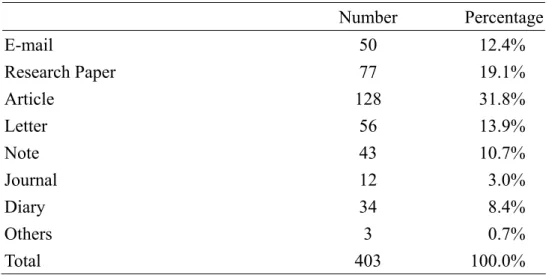
(49) As Table 6 shows, the recruited college subjects were 90 sophomores and 94 juniors.. Among these 184 subjects, 45 were males, and 139, females. In addition,. 81% of them had at least 8 years of English learning experience.. Table 7 Ways of Practice on English Writing Number. Percentage. E-mail. 50. 12.4%. Research Paper Article Letter Note Journal Diary Others Total. 77 128 56 43 12 34 3 403. 19.1% 31.8% 13.9% 10.7% 3.0% 8.4% 0.7% 100.0%. Table 7 summarizes different ways of practice on English writing among the subjects. According to the frequency of practice on varying writing tasks, articles (31.8%) listed top, the second, research papers (19.1%), the third, letters (13.9%), and the fourth, e-mails (12.4%).. The subjects did little practice on diary writing (8.4%). and journal writing (3.0%).. Other types of writing, such as blogs, messages,. responses, etc., were reported in “others” (0.7%).. 41.
(50) Table 8 English Writing Motivation Number. Percentage. Very much Much. 2 30. 1.1% 16.3%. So-so Little Very little Total. 132 12 8 184. 71.7% 6.5% 4.3% 100.0%. According to Table 8, most of the students (71.7%) were not much into English writing. 17.4% liked such learning, and 10.8% disliked it.. Table 9 Perception of the Importance of English Writing Number. Percentage. Very important Important So-so. 51 108 23. 27.7% 58.7% 12.5%. Unimportant Of no importance Total. 2 0 184. 1.1% 0% 100.0%. As to student perception of the value of English Writing, 86.4% thought English Writing as important, in contrast to 1.1% as unimportant (see Table 9). They generally regarded English Writing as an important part in learning English.. 42.
(51) Table 10 Self-rating of English Writing Ability Number. Percentage. Very Good Good So-so Poor. 0 7 100 67. 0% 3.8% 54.3% 36.4%. Very Poor Total. 10 184. 5.4% 100.0%. Table 10 indicates that more than half of the subjects (54.3%) perceived their English writing ability as so-so, 41.8% as poor, and only 3.8% as good. In sum, although a great proportion of the college subjects perceived their English writing ability as poor and were not much into such writing activity, they still valued the learning of writing in English. that had discouraged such learning?. What was the source of writing problem. It was of great importance to further explore. what strategies they used and what difficulties they might encounter in writing.. Results of Questionnaires Research question 1: General Writing Strategies What writing strategies do college students of technology use while writing to English composition? How often do they apply these strategies in the stages of. 43.
(52) planning, writing, and editing? Table 11 Summary of Writing Strategy Use in Each Stage Stage. M. SD. Planning. 2.99. .56. Writing Editing Overall writing strategy use. 3.74 3.38 3.41. .52 .54 .44. Descriptive statistics of mean and standard deviation for average strategy use in each of the three writing stages and overall strategy use are listed in Table 11.. Note. that the mean of overall strategy use was 3.41, which suggested that writing strategies were not frequently but moderately used among college students.. In addition, the. mean of strategy use in the stage of writing (M= 3.74) appeared to be higher than that of the stage of planning (M= 2.99) and editing (M= 3.38).. Table 12 ANOVA on Writing Strategy Use by Writing Stage SS. df. MS. F. Sig.. Between groups. 3188.66. 2. 22.78. 19.14. .01. Within groups. 511.58. 181. 11.90. Total. 3700.24. 183. 44.
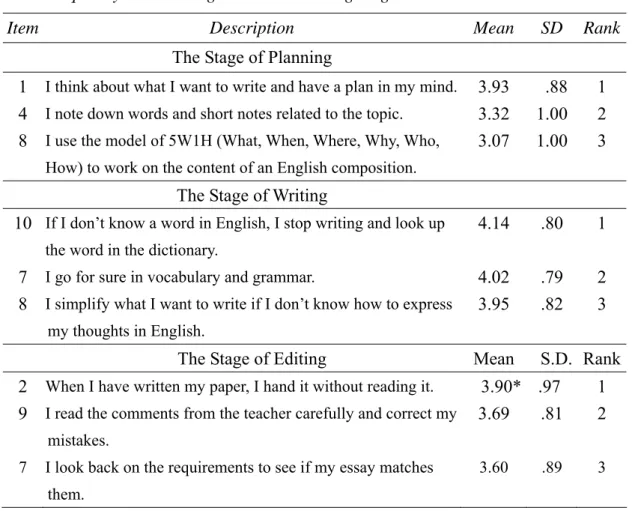
(53) Table 13 Scheffé Post-hoc Tests on the Three Stages of Writing Strategy Use t. df. sig. Planning vs. Writing. -18.762. 183. .000. Writing vs. Editing Planning vs. Editing. 9.817 -8.643. 183 183. .000 .000. Table 12 shows that there was a significant difference among the means of strategy use in these three stages (F = 19.14, p= .01< .05). Further paired sample t-tests in Table 13 revealed that the students used significantly more strategies in the writing stage than in the planning stage (writing vs. planning: t = 18.76, p< .05) or in the editing stage (writing vs. editing: t = 9.82, p< .05).. The planning stage received. the least strategy use (editing vs. planning: t =8.64, p< .05). Detailed descriptions of each strategy use and frequently-used strategies in each stage are provided in the following Tables 14 and 15.. 45.
(54) Table 14 General Description of Writing Strategies Item. Description. M. SD. *3.93 2.69 3.01 *3.32 2.47 2.60. .88 .95 1.23 1.00 1.00 1.05. 2.82. 1.04. 8 I use the model of 5W1H (What, When, Where, Which, Who, How) to *3.07. 1.00. The Stage of Planning 1 2 3 4 5 6. I think about what I want to write and have a plan in my mind. I write an outline of my paper in English. I write an outline of my paper in Chinese. I note down words and short notes related to the topic. I make a timetable for the writing process. I read models and related data written by a native speaker or more proficient writer.. 7 I discuss the contents related to topics with group members or classmates. work on the content of an English composition.. The Stage of Writing 1 I start with the topic sentence.. 3.82. .90. 2 I think about whether the supporting sentences I wrote are related to. 3.50. .91. 3.49 3.85 3.70 3.35. .94 .88 .99 1.24. *4.02 *3.95. .79 .82. 3.90. .99. 10 If I don’t know a word in English, I stop writing and look up the word *4.14. .80. and support the statements of topic sentences.. 3 4 5 6. I stop after each sentence to read or revise it. I reread what I have written to get ideas how to continue. I go back to my outline and make changes in it if necessary. I write bits of the contents in Chinese and then translate them into English.. 7 I go for sure in vocabulary and grammar. 8 I simplify what I want to write if I don’t know how to express my thoughts in English.. 9 If I don’t know a word in English, I write it in Chinese and later try to find an appropriate English word. in the dictionary.. 11 I ask classmates or English teachers to help out when I have problems. 3.37. .93. 1 I only read what I have written when I have finished the whole paper. 3.24 2 When I have written my paper, I hand it without reading it. *3.90. .95 .97. while writing.. The Stage of Editing. 46.
(55) 3 4 5 6 7 8. I go back to make changes in vocabulary. I go back to make changes in sentence structures. I go back to make changes in the structure of the essay. I go back to make changes in the content or ideas. I look back on the requirements to see if my essay matches them. I revise appropriately by asking the opinions of classmates or other. 3.38 3.27 3.02 3.21 *3.60 3.09. .78 .86 .88 .85 .89 .97. *3.69. .81. people.. 9 I read the comments from the teacher carefully and correct my mistakes.. Note: * indicates top writing strategies Table 15 Most Frequently-used Strategies in Each Writing Stage Item. Description. Mean. SD. Rank. 1 I think about what I want to write and have a plan in my mind.. 3.93. .88. 1. 4 I note down words and short notes related to the topic. 8 I use the model of 5W1H (What, When, Where, Why, Who,. 3.32 3.07. 1.00 1.00. 2 3. 4.14. .80. 1. 4.02 3.95. .79 .82. 2 3. Mean. S.D. Rank. The Stage of Planning. How) to work on the content of an English composition.. The Stage of Writing 10 If I don’t know a word in English, I stop writing and look up the word in the dictionary.. 7 I go for sure in vocabulary and grammar. 8 I simplify what I want to write if I don’t know how to express my thoughts in English.. The Stage of Editing 2 When I have written my paper, I hand it without reading it. 9 I read the comments from the teacher carefully and correct my. 3.90* .97 3.69 .81. 1 2. 3.60. 3. mistakes. 7. I look back on the requirements to see if my essay matches. .89. them.. Note: * signifies being reversely scored.. Table 15 shows that the strategies of making a plan, making notes, and using. 47.
數據
相關文件
The purpose of this study was to explore the effects of learning organization culture on teachers’ study and teaching potency in Public Elementary Schools.. The research tool of
The purpose of this study is to use schematic video and animation to help students with LD solve real-life mathematical word problems.. The single-subject
The purpose of this study was to investigate the current situation of multicultural literacy and intercultural sensitivity of junior high school teachers in Taichung
The purpose of the study is to explore the relationship among variables of hypermarkets consumers’ flow experience and the trust, the external variables, and the internal variables
The main purpose of this research was to explore the learning performance of grade 7 students with different competencies during mathematics problem posing instruction.. According
The main purpose of this study is to explore the work enthusiasm of the Primary School Teachers, the attitude of the enthusiasm and the effect of the enthusiasm.. In this
The purpose of this study was to explore the knowledge management status of elementary excellent teachers, strategy used and promoting factors.. A questionnaire
The purpose of this study is to examine the teaching process with the integration of games which has been used in number and calculation instructions for fifth grade
