國 立 交 通 大 學
企業管理碩士學位學程
碩 士 論 文
新科技導入供應鏈管理關鍵成功因素 以 LG Electronics 為例
Determinant Factors of Adopting New Technology in Supply Chain
Management – A Case Study of LG Electronics
研 究 生: 朴真英
指導教授: 姜真秀 教授
National Chiao Tung University
Global MBA
Thesis
Determinant Factors of Adopting New Technology in
Supply Chain Management – A Case Study of LG
Electronics
Student: Jin-Young Park
Advisor: Prof. Jin-Su Kang
Determinant Factors of Adopting New Technology in
Supply Chain Management – A Case Study of LG
Electronics
研 究 生:朴真英 Student: Jin-Young Park
指導教授:姜真秀 Advisor: Jin-Su Kang
國 立 交 通 大 學
企業管理碩士學位學程
碩 士 論 文
A Thesis
Submitted to Global MBA Program College of Management National Chiao Tung University in partial Fulfillment of the Requirements
for the Degree of Master
in
Global Master of Businesss Administration July 2011
Hsinchu, Taiwan, Republic of China
I
新科技導入供應鏈管理關鍵成功因素 以LG Electronics為例
Determinant Factors of Adopting New Technology in Supply Chain
Management – A Case Study of LG Electronics
Student: Jin-Young Park
Advisor: Prof. Jin-Su Kang
Global Master of Business Administration Program
National Chiao Tung University
Abstract
This case study illustrates that under what circumstances, the organization could lead the adopting new technology successfully in supply chain management, with a case company, LG Electronics. LG Electronics succeeded to integrate a new technology, Radio Frequency Identification (RFID), to their supply chain with accomplishing cost reduction and real time supply synchronization. Three variables were selected to analyze the impact upon the supply chain technology adoption from literature. There variables are : (1) organizational factor including organizational size, structure, and top management support, (2) environment factor including pressure from competition, rapid shifts in production life cycle, and volatile price fluctuation, and (3) technology factor including technology maturity. The analysis shows how the contextual factors enabled diffusion of the technology in this big organization, with providing meaningful hypotheses which can be researched further.
II
Acknowledgement
First of all, thanks God for guiding and leading me through life.
I want to express my heartfelt gratitude to my advisor Prof. Jin-Su Kang helped me to complete this thesis on time. GMBA program gave me lots of opportunities to know many friends and world, thanks GMBA faculties; Prof. Tang, Prof. Han, and thanks Vanessa Chung for supporting me officially and personally. Also Thanks to the committee members of oral defense; Prof. Kevin Huang and Prof. Chun-Fang Chiang.
I would appreciate to my Hsinchu Korean church members for encouraging, supporting, and praying for me, and my family, I love you. My beloved friends and classmates in Korea and Taiwan, I will never forget you all.
III
Table of contents
Abstract ... I Acknowledgement ... II Table of contents ... III List of Figures ... V List of Tables ... V 1. Introduction ... 1 1.1 Research Background ... 1
1.2 Brief introduction of LG Electronics ... 2
2. LG Electronics‟ Supply chain management innovation and RFID system ... 4 2.1 Radio Frequency Identification (RFID) System ... 4
2.2 Supply Chain Management and The scope of RFID Application in LGE ... 4
2.3 Inside of LGE‟ SCM and RFID ... 6
2.4 Financial performance after RFID ... 9
3. Literature review... 12 3.1 Literature review ...12
3.2 Frame work ...13
4. Organizational factors and LG electronics ... 14 4.1 Organizational size ...14
4.2 Organizational structure ...16
4.3 Top Management support ...18
5. Environmental Factors and LG electronics ... 21 5.1 Environmental uncertainty ...21
IV
5.1.2 Rapid shifts in product life cycle... 24 5.1.3 Volatile price fluctuation ... 25 5.2 Favorable transaction climate ...25
6. Technology factor and LG electronics ... 28 6.1 Technology Maturity ...28
7. Conclusion ... 32 Reference ... 34 Appendix ... 39
V
List of Figures
Figure 1: Established scope of RFID in the HE business unit ... 5 Figure 2 : FRID portal and scope of RFID application of LGE ... 6 Figure 3 : Supply synchronization of order fulfillment ... 7 Figure 4 : Supply synchronization of e-JIT ... 7 Figure 5: Smart mold management and Vehicle Management system ... 8 Figure 6 : Simplified value chain model with performance measures ... 10 Figure 7: LGE‟s performance last five years from 2005 to 2009. ... 10 Figure 8: Long-term inventory ... 11 Figure 9: Simplified Research Structure ... 13 Figure 10: Global Operations ... 15 Figure 11: Global Procurement result (2008) ... 15 Figure 12: Current status of Sales & Global Market Share of Main Product ... 16 Figure 13: Organizational structure (as of end of 2005) ... 17 Figure 14: Organizational structure ... 18 Figure 15: Product life cycle time by industry in 2005 ... 24 Figure 16: Average cycle time by industry – A time of design completion ... 24 Figure 17: Main raw material changes (domestic) ... 25 Figure 18: Main raw material changes (Import). ... 25 Figure 19: Integrated system with Global ERP ... 29 Figure 20: Manufacturing Execution System in LGE ... 31
List of Tables
Table 1 : 11 tasks ... 19 Table 2 : Steps of LGE Global ERP establishment ... 29
1
1. Introduction
1.1 Research Background
LG Electronics continues to grow into a leading global brand through emphasizing on technology and design. However they faced challenges that the market position of LGE in mobile and LCD TV markets was No.5 in 2006. The report researched by „SCM world (Viswanathan and Sloane 2010)‟ said that LGE's manufacturing processes were Best-in-Class in 2006, however they were mostly in-sourced and not really a global organization. Even though they had global facilities, they were not global by process of management. They also lacked an end to end approach towards SCM. These were the reasons resulting in a below-average position.
However from 2008, there were lots of news media, and journals published articles regarding the LG Electronics‟ SCM improvement under the titles such as „LG Sees Benefits in Supply Chain Management‟ (Kim, Korea Times 2008), „LG Aims to Save $320 Mil. From Better Supply Chains‟ (Kim, Korea Times 2009), „LG sees the cost saving effects more than Ten billion (KRW) by adopting RFID‟ (Kim, RFID Journal Korea 2010). LGE said that there were some of the key benefits in 2010 that they have realized through their SCM transformation that were as bellows.
• Cash flow improvement of $ 728 M due to inventory reduction • Cost reduction of $ 135 M
All of the above resulted in LG Electronics rising to the No.2 or No3 status across their key mobile and LCD TV divisions at every major global market. Also LG Electronics has ranked 27th at the „AMR research Supply chain Top25‟ in 2010 from 44th in 2009, named „Winner of SCM World Supply Chain Achievement Award 2010‟ by SCM Logistics World, and ranked No.7 on the „2010 year‟s Most Innovative Companies‟ list from 27th in 2009 by building a better supply chain system.(Moon, Business week. 2010)
In this study, factors that made an organization adopt new technology successfully in supply chain management will be identified and illustrated with case study of LG Electronics, and also it will provide deeper understanding about the Korean enterprise culture by analyzing the process applying new system and operation.
2
1.2 Brief introduction of LG Electronics
LG Electronics (LGE) is the one of the largest electronic devices products manufacturing company. LGE ranked as the third producer of mobile phones and the second largest-producer of television sets in the world in 2009. Its central headquarter is located in the LG Twins Towers on Seoul, South Korea.
LG was established in 1947 as Lak Hui Chemical Industry Corp. by Im-hwoi Koo, and the company manufactured cosmetic Creams at that time. In 1952, they became the first Korean company to enter the plastics industry to make cosmetic containers‟ lids. With the expansion of the company‟s plastic businesses, they established an electronic company which is called GlodStar in 1985. In 1959, GlodStar produced Korea‟s first radio which opened a new era for the electronics industry in Korea. As the sales grew, the company started to prepare for a more diversified business area, and began to establish mass product centers. In 1966, Goldstar produced fist black and white TV set.
The Korean electronics industry showed promising growth with the active support from Government in the 1970s. Goldstar established large plants and it became the foundation for the nationwide production line, also it helped that company to expand their market to the global. In 1975, they established a central R&D center to develop color TV, VCR, and computers, and next year they introduced the first color TV that made in Korea. In 1977, the sales were over 100 billion, and in 1978, the export volume reached US$100million. After this the company was ready for globalizing the Korean electronics industry.
In the of 1980s, GlodStar started to establish overseas manufacturing bases to pursue profit-oriented operation, compete rising competition, be effective in globalization program, and to get the international market. They established manufacturing and sales subsidiaries in US (1982), Germany (1982), UK (1988), and Mexico (1989).
The energy crisis and political unrest in the early 1980s had a negative effect on Goldstar‟s growth. But the company was able to overcome the situation. GoldStar followed effective business strategies and focused on product diversification and strengthened its national sales channels in Korea. At the same time the company also focused on diversification of its export structure in international sales.
In the late 1980s LG had adopted a new strategy focusing on quality of product and expanding marketing capabilities. When the South Korean government relaxed trade barriers, there was great penetration of foreign companies entered to compete with domestic firms including LGE. As a result, sales of LG products dropped by US$ 1 billion and profits
3
deceased by 18% between 1986 and 1987. The company was able to challenge foreign companies by restructuring the organization and adopting a new management style with decentralized structure. From 1992 onwards the company focused on „creating value for customers‟, highlighting its commitment to excellence for customers and internally helped employees to renew their devotion to customer satisfaction. The strategy was successful and GoldStar‟s exports crossed US$ 2.56 billion in 1992. (Pinal 2006)
In 1995, Goldstar changed their name to LG Electronics (LGE) and started new vision that was becoming world leading company. They also required Zenith Electronics Corp. in the same year. . In 1998, Jahong Ku, the President of LGE proclaimed "Digital-LG Vision" under which drives like Six Sigma, TL2005 and Super A were launched to improve and maintain competitive edge and profitability through innovation.
In 2000, LGE and LG Information and Communication (LGIC) were merged to take advantage of LGIC's expertise in telecommunication systems for LGE's core competency. The company formed strategic alliances in the digital television sector. In collaboration with Philips, LGE formed LG Philips Display in 2001 and the home appliance plant established in Mexico.
In 2001, LGE reorganized its business unit into four separate companies to create a new corporate structure, and also LGE was reorganized into a holding company structure in which business operation and equity investment were separated in 2002 in order to enhance shareholder value. Under LG Holding Company system, the name set as LG Electronics and LG Corporation. The holding company focused on managing investment assets with observation of operating company's management. The operating company comprised business divisions, joint ventures and overseas & domestic subsidiaries while the holding company took care of affiliated companies in telecommunication service area and other related companies. In 2003, LGE became top global CDMA producer. They set up the visions which were „Global Top 3‟ and „Great Company, Great People‟ for the organization, and presented a new slogan „Life is Good (LG)‟ as well.
4
2. LG Electronics’ Supply chain management innovation and RFID system 2.1 Radio Frequency Identification (RFID) System
Radio Frequency Identification (RFID) is a data collection and storage technology that uses radio waves to automatically identify products that are within a given range. It is a promising technology that is intended to supplement or replace to the conventional barcode system as a means to automatically identify, track, and trace products throughout the supply chain. A basic RFID system consists of three components which are transponders (tags), antennas and readers, and a host computer loaded with the necessary software to fully utilize RFID‟s capabilities.
The RFID tag contains a microchip with a tiny antenna, and it holds electronic product code (EPC) that can use for product identification, data transmission, product expiration, service history, and storage instructions. RFID reader is a device that transmits radio waves and collect data from the tag. RFID reader uses antennas to communicate with the RFID chip by sending signals to RFID tag. These signals provide the power for passive RFID tags, which in turn, the tag sends the signal back to the reader with the information contained in the tag. Middleware and software applications also need to the RFID environment for managing the flow of data from the readers to the back-end information system which store the data for processing and output. In general, the data received from the reader is not in a user friendly format, therefore processes are put in place to filter and cleanse the data using RFID software and middleware. Retrieving data from readers, Filtering data feeds to application software, monitoring network performance of tag and reader, capturing history, and analyzing tag-read events are the primary functions of the RFID middleware and software. (Kim and Garrison 2010)
2.2 Supply Chain Management and The scope of RFID Application in LGE
Christopher (1998) suggests that Supply chain is the network of organizations that are involved in different processes and activities, through upstream and downstream linkages, that produce value in the form of products and service to the ultimate customer. Better information exchange between supply chain partners provides more up-to-date information and allows for more accurate inventory responses to changes in demand and thus more appropriate inventory levels throughout the supply chain (Levary 2000). He suggests the benefits of supply chain
5
integration include minimizing the bullwhip effect, maximizing the efficiency of conducting activities along the supply chain, minimizing inventories along the supply chain, minimizing cycle times along the supply chain, achieving an acceptable level of quality along the supply chain.
Within a firm, all supply chain activities belong to one of three macro processes which are Supplier Relationship Management (SRM), Internal Supply Chain Management (ISCM), and Customer Relationship Management (CRM). Briefly, SRM is the process that focus on upstream inter-actions between the enterprise and its suppliers, and that includes the evaluation and selection of suppliers, negotiation of supply terms, and communication regarding new product and orders with suppliers. It aims to arrange for and manage supply sources for various goods and services. ISCM is the process that focus on internal operations within the enterprise, and that includes the planning internal production and storage capacity, preparation of demand and supply plans, and fulfillment of actual orders. It aims to fulfill demand generated by the CRM process in a timely manner and at the lowest possible cost. CRM is the process that focus on downstream interactions between the enterprise and its customers, and that includes processes such as marketing, pricing, sales, order management, and call center management. It aims to generate customer demand and facilitate the placement and tracking of orders. For a supply chain to be successful, it is crucial that the three macro processes are well integrated.
In 2008, LGE applied RFID which is a technology that uses communication through the use of radio waves to exchange data between a reader and an electronic tag attached to an object, as a tool for the purpose of identification and tracking to secure visibility and traceability of information at the supply chain system. Followings are the changes of LGE‟s supply chain system according to three macro processes, and see what has been changed with RFID system and how they integrates these three process.
So far LGE applied RFID system to the SRM, and ISCM process during the last 2years (2008~2009), and they plan to extend to the CRM process. Figure 1 shows the established scope of RFID in the HE (Home Entertainment) business unit as an example.
Figure 1: Established scope of RFID in the HE business unit Source: LG Electronics, “SCM innovation based on RFID”
6
2.3 Inside of LGE’ SCM and RFID
- RFID Portal system
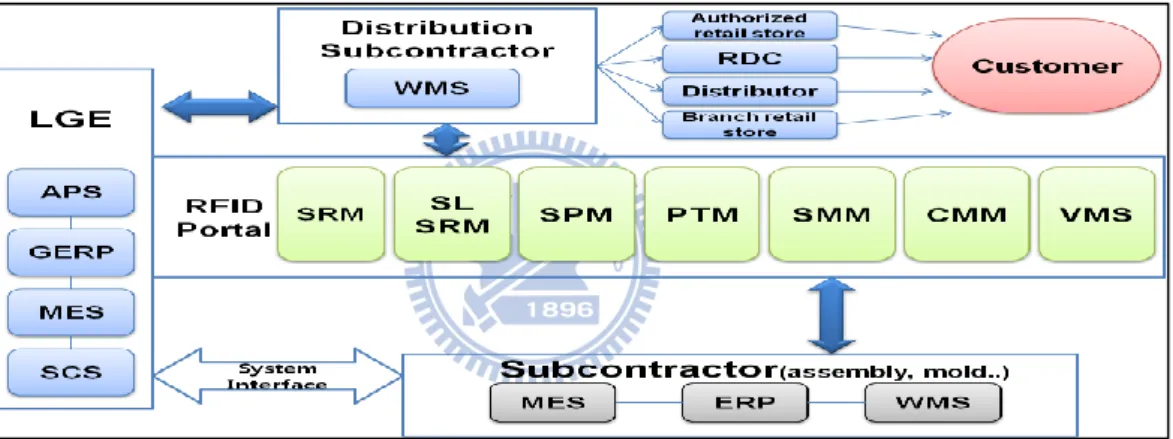
LGE have build up the portal system that can strengthen the real time information sharing among the supplier, subcontractor and LGE, and can tie the existing system such as MES (Manufacture Execution System), ERP (Enterprise Resource Planning), WMS (Warehouse Management System), APS (Advanced planning and scheduling), and SCS (Supplier Collaboration System) which have set up in LGE and SCM members already.
Also LGE can secure visibility throughout the whole supply chain with the subcontractor‟s SRM, Small line SRM (SLSRM), Supply progress management (SPM), Product trace management (PTM), Smart mold management (SMM), Core material management (CMM), and Vehicle management system (VMS).
Figure 2 : FRID portal and scope of RFID application of LGE 1 Source: LG Electronics, “SCM innovation based on RFID”
- Supply synchronization of order fulfillment with RFID Portal
Basically LGE‟s purchase order process was by e-mail, phone, or fax with the suppliers. When the supplier‟s problem broke out, they spent additional time for searching alternative supplier, and reconfirming process. The new supplier usually had to have overtime working to
1 MES - Manufacture Execution System ERP - Enterprise Resource Planning
WMS - Warehouse Management System APS - Advanced planning and scheduling SCS - Supplier Collaboration System SLSRM - Small line SRM
SPM - Supply progress management PTM - Product trace management SMM - Smart mold management CMM - Core material management VMS - Vehicle management system
7
fulfill the order amount, and LGE should change production plan caused by delaying supply schedule. Because most of the processes were handling by phone, or e-mail, they didn‟t know related information in real time, and there was low ability to respond to urgency order or sudden problem.
After applying RFID portal, supplier and LGE could have interactive communication through RFID portal in real time when the problem breaks out. By quick reaction with the processes of order, confirming, rejecting, and additional order, they could ensure product plan stability and reduce overhead cost in supplier as well.
Figure 3 : Supply synchronization of order fulfillment Source: LG Electronics, “SCM innovation based on RFID”
- Supply synchronization of e-JIT (Just in time) with RFID Portal
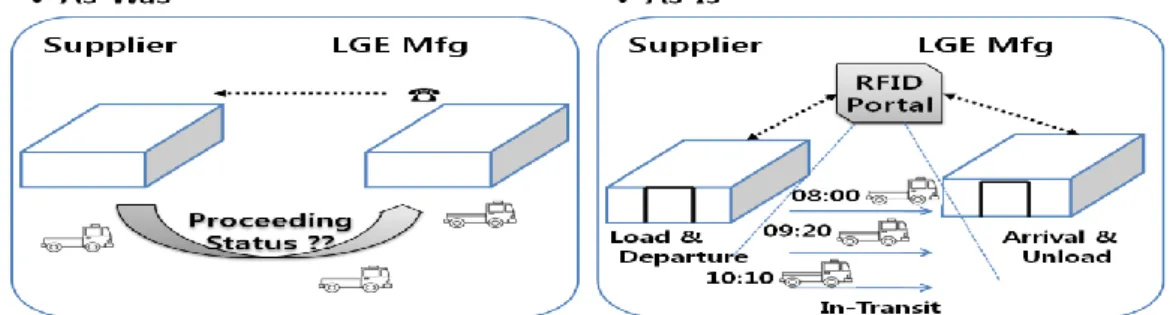
Before the RFID portal system, there was no information about proceeding status when the loading and departure was done from the supplier side, and when it could arrive and upload to LGE in real time. These uncertainties increased management cost for Just-in-time supply, and data reliability was low.
But now, when the suppliers load material and departs from their factory, RFID system identify information and update the data at the RFID portal, then LGE can track supply status and get the latest information for their inventory and production management, and can keep the most suitable material inventory. Also suppliers can supply the according to timely production plan.
Figure 4 : Supply synchronization of e-JIT
8
- Smart mold management (SMM)
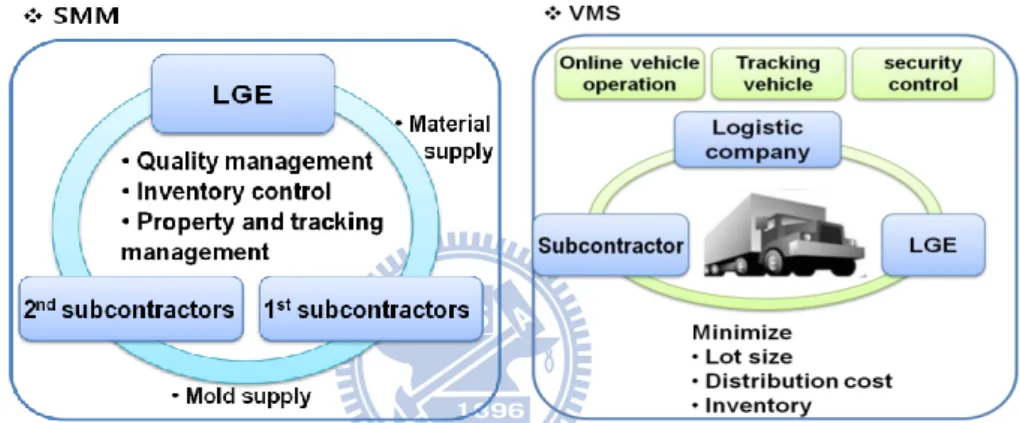
In case of 2nd subcontractors, generally capability of management is fairly inadequate for the production planning, managing material inventory and quality. Caused by a low material quality of 2nd subcontractor, 1st subcontractor and LGE have had manufacturing delays, and the cost of product went up. To solve the problems, they built SMM system that can control quality management, inventory control (law material, mold location), property and tracking management (mold, history of material) using RFID. By smart mold management, LGE could extend their visibility to the 2nd subcontractor, secure quality reliability of raw material, and could improve manufacturing reliability and efficiency of property management by unified management from the development to manufacturing.
Figure 5: Smart mold management and Vehicle Management system Source: LG Electronics, “SCM innovation based on RFID”
- Vehicle Management system (VMS)
As the production lot volume decreased by changing to mass customization, LGE‟s the number of distribution and management load has been increased. A security control about the incoming and outgoing vehicles was insufficient as well. After applying RFID system to the subcontract companies, logistic company, and LGE, they could operate vehicles by online, track location of vehicle, also could tighten up security about the incoming and outgoing vehicles. By monitoring vehicle control system, LGE could achieve their goal which was minimizing lot size, distribution cost and inventory.
- D+3 Production System
Today, it is a trend to transfer from mass production to mass-customization by the diversified customer demand in consumer electronics industry. Under the mass-customization, the product life cycle is getting shorter and production unit is getting smaller, so the
9
manufacturing process should react agilely according to the rapid change of market and to cope with the diversified customer‟s needs.
LGE also set up the 3days determinate production system which calls as D+3 production to keep pace with and lead trend in the market. D+3 production is the minimum unchangeable period for the managing of material releasing and or for instruction of delivery to the subcontract company. It targets achieving the goal of production within the determinate date (in LGE‟s case, it is 3days). There are three steps for the system which are planning production schedule, carrying out the plan, and analyzing causes of setback if they have. Throughout the processes they could figure out the problems and improve it more speedily and flexibly. There are some features of D+3 production system. First one is the production schedule is unchangeable, and there is no precedence to the following schedule within the determinate date even if the production plan is stopped or there is a capacity to produce more. As the schedule is fixed strictly, subcontractor and supplier can have a systematic layout of production schedule and provide them stably.
- War Room (WR)
Only 10% of the problems in the product development are technical problems! 90% are based on communication! (H.Kogler,VW)
On Dec.2008 LGE established „Crisis War room‟ at twin-tower headquarters as a mediator which could liaise with five business units, eight regional headquarters and C-level officers. Originally war room was a military facility for seeing the whole situation, planning their strategy, carrying out orders and supervising tasks. It enables the real-time visibility and management of an entire operation.
By the war room, they could respond with quick fix and first aid when the problem comes up, avoid the repetition, secure transparency with establishing and monitoring KPI regularly (Key Performance indicator), and could implant it into organization. Eventually buyer could have reliable delivery, subsidiaries could have transparent communication, production could have visibility and capacity forecast accuracy, and head quarter could have visibility and synchronized information.
2.4 Financial performance after RFID
Bruce Dehning et al. (2006) examined the financial benefits of information technology investment around newly adopted IT-based supply chain management system in
10
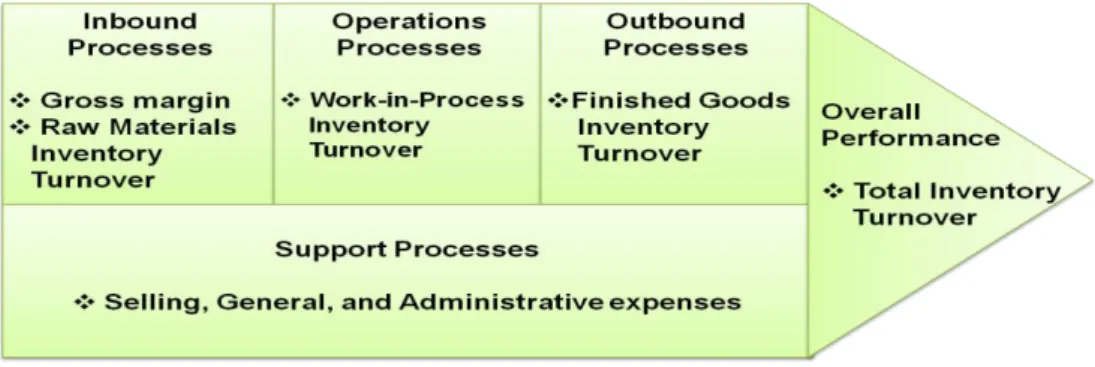
manufacturing firms. They specified the expected financial impact of SCM systems using value chain. Figure6 describes that the simplified value chain model that has five key components which are inbound processes, operations processes, outbound processes, support processes, and overall performance.
Figure 6 : Simplified value chain model with performance measures Source: Bruce Dehning et al. (2006)
The study shows that the firms that adopt IT-based SCM systems have improved performances in
inbound processes as reflected in raw materials inventory turnover and increased gross margin,
operation processes as reflected in increased work-in-process inventory turnover, outbound processes as reflected in increased finished goods inventory turnover, in support processes as reflected in decreased SG&A (selling, general, and
administrative expenses)
firms that adopt SCM systems have improved overall performance as reflected in increased total inventory turnover.
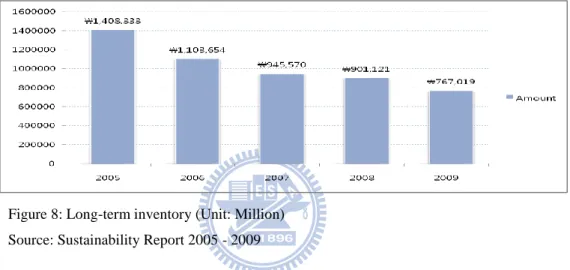
Figure 7 shows that LGE‟s performance last five years from 2005 to 2009, and Figure8 shows the changes in amount of long-term inventory.
11
We can see the improved performance of SCM in the overall inventory turnovers aspect, and they have biggest changes especially in the operation processes (work-in-process inventory turnover). Also we can notice that the SG&A (selling, general, and administrative expenses) has decreased gradually.
Higher gross margins for a manufacturer reflect greater efficiency in turning raw materials into income. The growth margin increased in 2008 comparing with 2007, however its change is irregular overall year from 2005 to 2009, there is not a significant relationship with the SCM performance. Therefore it is need to observe in the long term. In terms of long-term inventory amount, it has decreased consistently, and its amount became almost a half of 2005‟s one in 2009.
Figure 8: Long-term inventory (Unit: Million) Source: Sustainability Report 2005 - 2009
12
3. Literature review 3.1 Literature review
A variety of factors may have impact on organization when they adopt new technology. Tornatzky and Fleischer (1990) suggest that the adoption and implementation of technological innovation would be affected by the technological context, organizational context, and the external environmental context. Organizational context is typically defined in terms of several descriptive measures which are firm size, centralization, formalization, and complexity of its managerial structure. Environment context is the arena in which a firm conducts its business - its industry, competitors, access to resources supplied by others, and dealings with government. Technological context describes both the internal and external technologies relevant to the firm. This includes existing technologies inside the firm, as well as the pool of available technologies in the market. Their framework has a theoretical basis of IS adoption, empirically tested, and has been found a useful starting point for understanding the adoption of technological innovations which can apply to any type of organization or unit of analysis.
Grover and Goslar (1993) classify variables that influence technology‟s initiation, adoption, and implementation into three broad categories which are organizational factors, environmental factors and information system (technology) factors. In this study, the process of organizational innovation is defined as three stages which are initiation, adoption, and implementation. In the initiation stage, organizations have pressure to change, gather and evaluate of information, and culminate in the adoption stage. Adoption involves the decision to commit resources to the innovation, and the implementation stage includes development and installation activities to ensure that the expected benefits of the innovation are realized. Size, centralization, formalization and specialization are considered as organization factors, environmental uncertainty is considered as environmental factor, and IS maturity is considered as information system factor.
Patterson et al. (2003) indicate that technology adoption in supply chain management is affected by organizational factors which include large organizational size, decentralized organization structure, less successful past financial performance, and supply chain integration and, environmental factors which include higher environmental uncertainty, greater pressure from supply member and more favorable transaction climate.
Kang et al. (2010) classified the variables into technological, organizational, and environmental factors, and the result shows that information system maturity and top
13
management support are the most important determinants of SCM system success.
Zhu et al. (2002) also identified three aspects of firm‟s context that influence the process by which it adopts and implements technological innovation: organizational context, technological context and environmental context. In this study, the organization context defined as firm scope and firm size, for the environmental context, consumer readiness, competitive pressure, and lack of trading partner readiness was defined. Lastly technology competence including IT infrastructure, IT expertise, and E-business know-how was defined.
3.2 Frame work
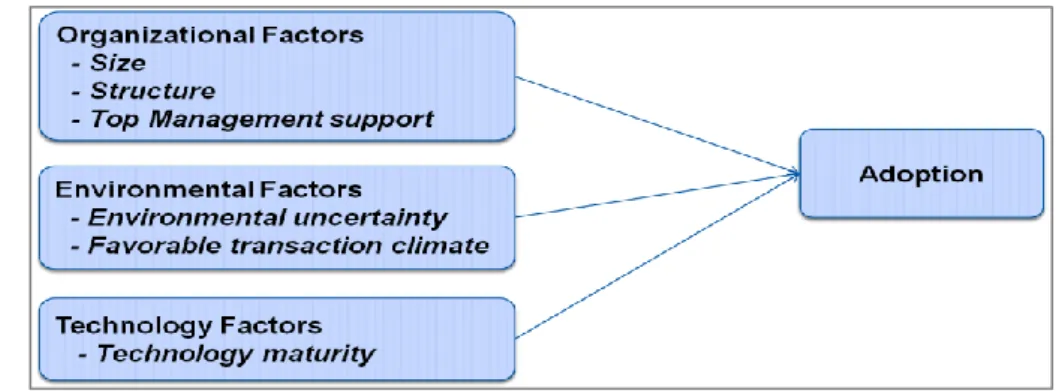
Based on those studies, organizational factor, environmental factor, and technology factor are set as the key factors influencing the adoption of new technology in supply chain of LG Electronics. As shown below with figure 9, organizational size, organizational structure, and top management support will be examined for organizational factors, and environmental uncertainty and favorable transaction climate will be examined for environmental factors. Technology factor will be dealt with technology maturity.
One important consideration of this case study is the concept of “adoption”. Some studies distinguished between adoption, diffusion, initiation, implementation, however a number of studies have defined “adoption” as the broadest sense to encompasses whole stages, moreover the organization usually do not distinguish between stage of the adoption process in real, therefore for this study “adoption” has been chosen for explanations.
14
4. Organizational factors and LG electronics
Organization factors are increasingly required to incorporate new technology into business practices to improve competitiveness. As mentioned in this study, there are three factors under the organization factors which are organization size, organization structure, and support of top management.
4.1 Organizational size
In terms of organizational factor, the first factor is organizational size. Larger organizations have greater volumes of transactions, more geographically dispersed operations, more supply chain partners, and/or more information to manage (Patterson et al. (2003)), so they are more likely to adopt information technology systems to improve operational efficiency and low cost. Financial and technology resources that larger organizations have would be the other causes to invest in new technologies, and absorb the risk as well. Zhu et al. (2002) also mentioned that organizational size has been consistently recognized as an adoption facilitator. Large firm have several advantages over small firms. Large firms:
(1) tend to have more slack resources to facilitate adoption;
(2) are more likely to achieve economies of scale, an important concern due to the substantial investment required for projects;
(3) are more capable of bearing the high risk associated with early stage investment in new technology; and
(4) possess more power to urge trading partners to adopt technology with network externalities.
By three aspects, we can see the LGE‟s organization size. The first one is geographically dispersed operations. LGE‟s global network consisted of 7 production subsidiaries in Korea (Changwon, Gumi, Pyeongtaek, and Cheongju), and 71 subsidiaries globally that were 36 sales subsidiaries, 22 production subsidiaries, 8 product sales subsidiaries, 5 service subsidiaries, and branch offices in 2006. The number of employees at LG Electronics stood at approximately 82,000 as of the end of 2007. More than 60% of employees (53,000) were working overseas, and the number of overseas employees would continue to increase in line with LGE‟s localization strategy. Figure 10 shows the global operations.
15 Figure 10: Global Operations
Source: 2006 LG Electronics Sustainability Report
Next one is the more supply partners. LG Electronics has roughly 5,500 suppliers, and its total purchases account for as much as 80% of total revenue. Total purchase amounted to KRW39.38 trillion (on a global basis, direct/indirect material costs included), and direct material costs were about 2.5 times higher than indirect material costs. As shown figure 11, the most of the purchases come from the Asia area, and North America, Europe, and South America is follow.
Figure 11: Global Procurement result (2008) Source: LGE Sustainability Report 2008
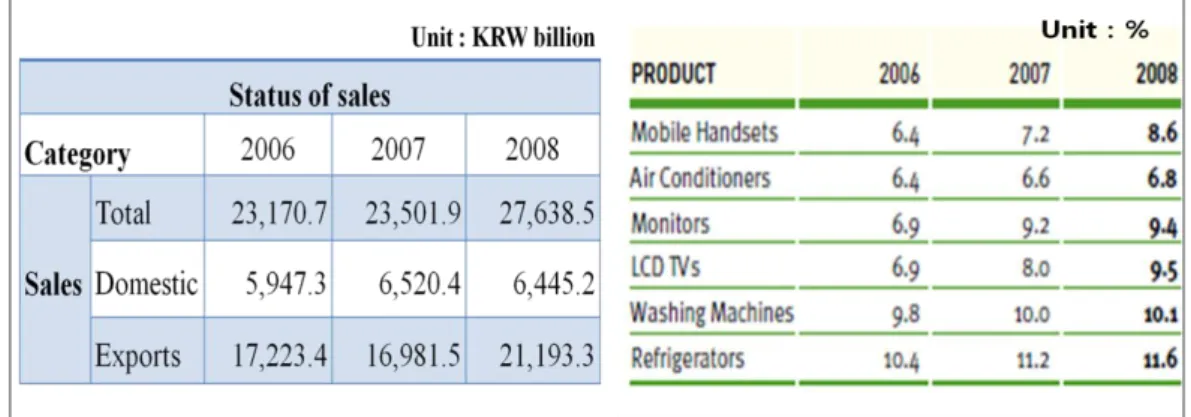
Last one is the great volumes of transaction. LGE‟s amount of sales was increasing year after year (figure 12), and exports accounted more than 70% of total sales. In 2008, its total sales were 27,638.5 billion. The market share also has increased continuously in every main product area, and the market shares were around from 8% to 11% globally except the air conditioners area.
In terms of Mobile handsets, its number of sales unit was around 54.9 million in 2005, 64.4million in 2006, 80.5 million in 2007, and it exceed around one hundred million in 2008. It has grown 20% every year. LGE‟s steam washing machine was sold around 50 thousand units in 2005, 150 thousand units in 2006, 250 thousand units in 2007, and in 2008 its
16
accumulated sales volume reached 1.5 million units. LGE‟s refrigerator was sold 7.7 million units in 2006, 7.9 million units in 2007, and 8.4 million units in 2008.
Figure 12: Current status of Sales & Global Market Share of Main Product Source: LG Electronics Sustainability Report 2006-2008
4.2 Organizational structure
Second factor is organizational structure. Organizational structure has been considered an important factor to technology adoption as well.
There are two main concepts in organizational structure which are centralized and decentralized organizational structure. Centralized organization‟s decisions usually are taken at the most senior or central level, whereas decentralized organization‟s decisions are taken at some level lower than the most senior; typically by individual work units within the organization (Heeks, 1999).
Each of them has pros and cons. Centralized organization can achieve the potential benefits such as sharing resources, avoidance of duplication, producing highly quality information systems, reducing costs, and achievement of scale economies, however there are some disadvantages such as heavy time consumption, inflexibility, and increased dependence and vulnerability. On other hand, decentralized organization has advantages such as greater fit between systems and local needs, higher usage of computerized systems, faster system development, and perceived lower costs. Its disadvantages are barriers to sharing data, duplication of effort, lack of learning and control, failure to achieve, and scale economies (Heeks 1999).
Previous research has provided ambiguous results with some studies indicating positive effects of a centralized organizational structure on technology adoption while others have shown negative relationships (Gatignon and Robertson, 1989). Pierce and Delbecq (1977) suggest centralization of decision-making may reduce conflict between organizational units
17
and foster innovation adoption. Ettlie et al. (1984) found that organizations with a centralized structure were more likely to adopt new technologies. On the other hand, other researches show that more decentralized structure would be expected to have adopted more innovative and cutting edge technology in order to enhance communication and coordination within the organization as well as with supply chain members (Bowersox and Daugherty, 1995).
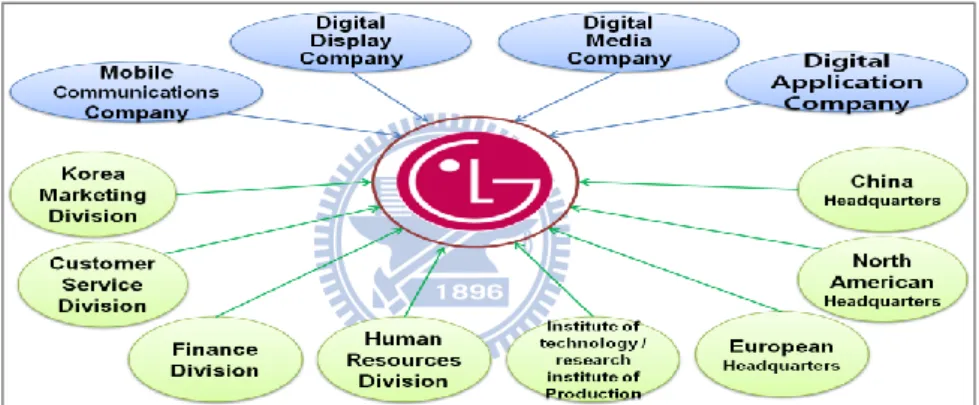
Before year of 2007, LG‟s organizational structure divided into 4 business units which were Mobile communications company, Digital display company, Digital Media company and Digital appliance company, 4 functional division which were Korea marketing division, Customer service division, Finance division, and Human resources division, 3 regional headquarters which were European headquarter, North American headquarters, and China headquarter, and functional areas which were institute of technology and research institute of production.
Figure 13: Organizational structure (as of end of 2005) Source: 2005 LG Electronics Sustainability Report
In terms of supply chain management, the organization structure was decentralized and managed by separated business unit, and each business unit had its own supply chain strategy and processes, supplier development. Its purchasing, for instance, was done by four different business units and was split among factories and subsidiaries in 110 countries.
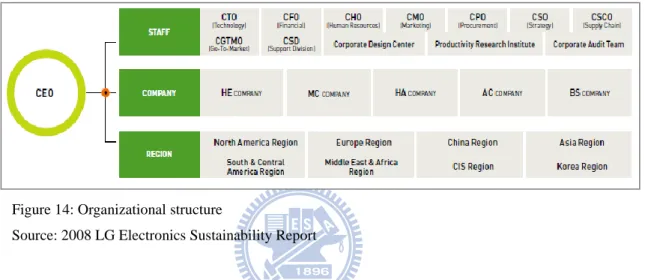
Since 2007, Mr. Nam became a LGE‟s Vice Chairmen and the Chief Executive Officer, and LGE‟s organizational structure has changed, and transferred to center-led organization. Organization divided into three part which were companies (Business unit), regional company and staff part. There were CTO, CFO, CHO, CMO, CPO, CSO, CSCO, CGTMO, CSD, Corporate design center, Productivity research institute and Corporate audit team as a Staff part, and HE(Home Entertainment), MC(Mobile Communications), HA(Home Appliance),
18
AC(Air Conditioning), BS(Business Solutions) as Company(Business unit) part. 2
The six foreign C-level executives were hired for core parts of LGE‟s senior leadership which were CMO, CHO, CPO, CSO, CGTMO, and CSCO. They didn‟t really drive a business and were not in charge of a region or P & L (profit and loss), they were mostly advisors at the staff level, and reporting to the CEO. It has not been a regular part in Korea business culture. The current state of foreign executive in Korea‟s 200 largest enterprises researched by „Chosun.com‟ in August, 2010, only 28 enterprises had foreign executives and LGE ranked as No. 12 with 5.6 percentages of foreign executives rate in whole executives.
Figure 14: Organizational structure
Source: 2008 LG Electronics Sustainability Report
For the supply chain management, a supply management division newly established, and Didier Chenneveau was appointed as first CSCO. Because the supply chain function had not really been aggregated across the company, so they had setting up the organization and setting the vision for supply chain and key performance indicators (KPI). Supply chain division consisted with two parts which were SC Planning part and SC Execution part. SC Planning part dealt with demand and supply management, supply chain innovation, and SC Execution part dealt with Logistics cost management, logistics process innovation, and network optimization.
4.3 Top Management support
Last one is the support of top management. It helps focus efforts toward the realization of
2
CTO - Chief Technology Officer CFO - Chief Financial Officer CHO - Chief Human Resources Officer CMO - Chief Marketing Officer CPO - Chief Procurement Officer CSO - Chief Strategy Officer
CSCO - Chief Supply Chain Officer CGTMO - Chief Go-To-Market Officer CSD - Chief Support Division
19
inter-organizational benefits and lend credibility to functional managers responsible for its implementation. Active involvement, vision, and direction of high level executives provide the impetus needed to sustain the implementation of SCM. (Kang et al. 2010) The support of the top management of an organization has been shown to be another important IT adoption predictor. In terms of RFID, as a network technology, where strategic benefits may be realized through improved partner coordination, higher transparency, and the need for new processes, signals need to be send out within a company and the supply chain about the importance of the adoption of RFID and the commitment of the top management. (Schmitt and Michahelles 2009)
Young Nam took office as CEO in 2007, he chose 11 tasks to overcome the economic recession and prepare itself for the upcoming post-recession era, coordinating roles for each company, region and c-level division, which it has been closely monitoring since then. The 11 takes was as follows.
Market Intelligence
1. Quick market intelligence (QMI) 2. Sales performance tracking
Cost Reduction & Cash Flow Improvement 3. Overhead reduction
4. Material and manufacturing cost reduction
5. Working capital and cost reduction by SCM innovation 6. Product portfolio / SKU(Stock keeping unit) optimization 7. Improvement of R&D efficiency
8. Improvement of marketing efficiency Restructuring
9. Improvement of organization efficiency 10. Manufacturing footprint optimization 11. Business portfolio restructuring
Table 1 : 11 tasks
Source: LG Electronics Sustainability Report
Dedier Chenneveau who was the CSCO of LGE recalled the CEO Young Nam‟s vision for SCM in the interview with KBC(Korea Business Center), and it showed the CEO‟s keen concern in innovation of Supply chain management.
20
He mentioned that “I think the vision of the CEO Young Nam was really good. He was committed to the vision of globalization for LG. ” and said “I think the CEO and the rest of the management staff really understood that great products and great design, which was one of the strengths of LG, and great branding and consumer insight can only work if those two things are linked by an underlying, strong supply chain. It would mean nothing to have really great design, R&D centers, and great consumer understanding if you cannot bring those products to the shelves and to where the customers want to buy it. So I think an underlying supply chain that's operationally excellent and really focused on execution is really critical to the success of the brand. I think the CEO really understood that, and that's why he was pushing for improved capability and skill around supply chain.” (Tom, Interview with KBC, 2011 )
He also invested to talented human resources, and hired first new CSCO, Dedier Chenneveau, and over 200 professionals in major divisions such as purchasing and SCM to better meet the highest global standards.
21
5. Environmental Factors and LG electronics
Globalization and rapid change in customer preferences brought fiercer market competition, and along with the accompanying change in the industry environment. Especially consumer electronics industry has become one of the most dynamic parts of economy today due to the ongoing innovation of electronic device manufacturers‟ products. Therefore the consumer electronics organization especially requires constant investment in SCM‟s technology to reduce this environmental condition. In this chapter, environmental uncertainty and a favorable transaction climate will be carried as environmental factors.
5.1 Environmental uncertainty
The first environmental factor is an environmental uncertainty. Walton and Miller (1995) mentioned that uncertainty exists because organizations do not have perfect information to make decisions. Greater environmental uncertainty makes it necessary for organizations to evaluate more SCM technologies as well as to adopt and implement them, in order to cope with greater information processing, because organization tends to depend on more and more technology to remain competitive and rapid respond to business problems under the uncertainty environment. (Ahmad and Schroeder 2001) Environmental uncertainty could be characterized by rapid shifts in product life cycle, a pressure from competition, unpredictable changes in customer demand, and volatile price fluctuations. (Patterson et al. 2003) In this part, pressure from competition, rapid shifts in product life cycle, and volatile price fluctuation will investigated to show LGE‟s external environmental situations when they decide to adopt new technology in SCM system.
5.1.1 Pressure from competition
- Samsung Electronics SCM
Samsung Electronics realized the importance of supply chain management, and started the SCM project from the late in 1999. They focused on SCM optimization, and have integrated IT and process during past 10 years under the active leadership of Pre-Chairman Jongyong Yun. He emphasized and announced that there were SCM and decision making process only in Samsung Electronics.
22
Planning(S&OP). Executives set the sales and supply plan every week at S&OP meeting held by Global operation center, and the plan is based on the collected real-time information from the worldwide sales and production corporations. Also collaborating with marketing division, they could achieve sales goal.
They developed user interface based business intelligence and global SCM system such as ERP, MES, PDM, APS (Manufacturing Execution System, Product Data Management, Advanced Planning & Scheduling System) to collect the exact information and to see the whole information at a glance. Sales part can make a decision based on the exact current state of production data and inventory data, and production part can adjust schedule based on the exact current state of sales. Suppliers can supply the planned quantity in time according to the fixed production schedule, and distributors can deliver the products to retailers in time as well. (Yu, 2009)
Samsung was ranked 10th in 2007, 9th in 2008, by AMR Research SCM Global Top 25. They mentioned that Samsung‟s processes leverage technology brilliantly. With explicit CEO sponsorship, the supply chain organization has tremendous influence on corporate strategy (2007 AMR research report). Also in the use of IT for essential processes such as sales and operations planning (S&OP) and demand modeling, Samsung's supply chain team persists in applying best practices to build market share and profits in notoriously competitive markets such as mobile devices, flat-panel televisions and memory chips.
- Nokia
Nokia‟s SCM transformation was started in 1995 with creating a pull-driven supply chain end-to-end integration linking suppliers, factories, telecom operators, channel partners, contract manufacturers, sales, and logistics service provider to the consumer. Nokia‟s approach was to create the most efficient supplier network for providing the best solutions to meet customer‟s expectations. Fundamentals for success included creating a value based partnership with supply members, based upon factual information, leadership and trust. Under the motto “Making the impossible possible through collaboration”, the supplier network is considered the central point for reaching their corporate objectives: Great products, Operational excellence, and customer satisfaction.
The results of their transformation have been impressive with increased sales and reduced component inventories in both side which were Nokia and throughout the pipeline, including supplier and customer inventories. Sourcing excellence is a key ingredient for Nokia‟s business model transformation. Nokia believed two critical factors were instrumental to their
23
success. Those were leadership and the communication of the vision. The leadership philosophy relies on four equally important elements: head, heart, hands, and guts. These leadership attributes are exemplified through energy and passion, trust as the base for business, focus and drive, active communication and finally, flawless execution. (IBM Global Services 2006) Nokia‟s ranking in AMR research was 1st in 2007 and 2nd in 2008.
Besides of Samsung and Nokia, Several competitor companies in consumer electronics industry ranked at AMR research including Apple (No.2), IBM (No.4), Motorola (No.12), HP (No.21). In this report, they interpreted each company‟s improvement and innovation in SCM as below.
- Apple‟s unparalleled demand-shaping capability lets its supply chain record spectacular results without sweating costs like everyone else.
- IBM, which has led the demand-driven revolution within its own manufacturing, has been instrumental in the use of IT for many other Top 25 companies.
- Motorola‟s supply chain leadership has driven huge change and improvement in its operations. With a CEO looking here for a competitive edge, the premium on demonstrating excellence is high.
- HP has digested Compaq very successfully, managed a high-profile CEO change to great effect, and even taken the lead in greening the global supply chain.
- LG Electronics
LGE started their effort to improve SCM from 2000 at Digital display business unit. They adopted the SCM system that had an effect to rival company, however they couldn‟t see the expected result because of some reasons. First reason was they didn‟t much focus on the managing data system. Even lots of overseas sales and production subsidiaries established, their main inventory information for production wasn‟t shared well, and it caused inaccuracy in production plan. Second reason was the organizational structure‟s limitation. LGE was traditionally decentralized culture, usually every overseas sales and production subsidiaries made decision by them. So there was a difficulty to control for Korea head office. Head office had to discuss with sales subsidiaries and production subsidiaries separately under the urgent situation for make a decision.
In 2005, LGE‟s days of inventory on hand were more than 50% compare to Samsung Electronics. Long-term inventory on hand in Mobile communication business unit was more than 20%, and there was a big gap between purchasing, producing and sales. It also affected
24
bad influence in finance performance. Before 2009, LGE was not in the list within Top 50 of AMR Research as well. Under such situations, supply chain management became essential ingredient of business management, and the fast development and achievement in SCM of competitors became a catalyst that makes LGE adopt new technology in SCM.
5.1.2 Rapid shifts in product life cycle
The research done by PTC, Reed research group, and IBM in 2005, we could look into general product life cycle of consumer electronics industry. In this research, we can see that product life cycle time of consumer electronics had most short life cycle with 38 month compare to other areas such as peripheral device, hardware OEM, semiconductor/IC manufacturing company, and telecommunication system & equipment in Electronics and high-tech industry. Also comparing with two year ago, the cycle time in terms of design completion shorten as 9 month from 12 month.
Figure 15: Product life cycle time by industry in 2005 (Unit: month) Source: Adrian Mello 2005
Figure 16: Average cycle time by industry – A time of design completion (Unit: month) Source: Adrian Mello 2005 ( 2003 2005)
25
5.1.3 Volatile price fluctuation
Next figures show that mail law material changes from 2002 to 2007. LGE‟s raw materials consist with big two part which are domestic and import one. As shown at the figures, the changes are irregular and are not easy to forecast. These changes come from the increase of an international raw material price, lack of raw material volume, exchange rate fluctuations, and, product development and so on. These changes have an effect to the product price, and also to product competitiveness as well.
Figure 17: Main raw material changes (domestic)
Figure 18: Main raw material changes (Import) UNIT: USD / JYP (for IC only).
5.2 Favorable transaction climate
Transaction climate represents the trust and commitment between the firm and its supply chain partners. A positive transaction climate would lead to greater technology adoption and constructive relationships with supply chain partners, and would encourage firms to invest in equipment and technology. (Patterson et al. 2003) Also a high level of trust and commitment between firms which are adopting supply chain technology may be required because the automation of transactions eliminates manual oversight systems and the paper documentation that exist to ensure accurate and reliable transactions (Premkumar and Ramamurthy 1995). In this part, LGE relationship with supply chain members will be investigated to show how they
26
lead the cooperation from the supply chain members based on the trust.
LGE has been committed to supporting the growth of its firms by enhancing their basic competitiveness. Fair opportunity is granted for all transactions and transactions follow the principle of free competition. By supporting transparent and fair transactions, LGE aims to build a relationship of mutual trust and cooperation with its partner firms and pursue mutual growth over the long term.
After holding the „Great Partnership Convention‟ in 2004 with some 300 business partners, LG Electronics announced its support measures and created a related team at each regional headquarters to oversee financial support, educational and innovation activity support and personnel support. They were striving to build trust with thier business partners and spread the culture of fair trade.
In the following four areas, LGE has supported their business partners. First area is personnel support. There are helping partners secure highly skilled personnel through a system where experienced managers of LG Electronics shift to partner firms. The system is focused on transferring managerial-level personnel to partner firms to satisfy their need for qualified people. Their presence helps suppliers improve their key capabilities in a short period of time. To maintain this support measure over the long-term in an efficient manner, LGE offers financial support for transferred personnel (providing 60% of wages for 2 years), and surveys the personnel and head of the supplier on their satisfaction levels with the process for further improvements (accumulated number of transferred personnel from 2005 to 2007 : 54 persons)
Second one is education support. For specialized education that is difficult for partner firms to conduct on their own, LGE has offered training free-of-charge. One such measure was the vocational training consortium for SMEs. The consortium was a vocational training course integrating parts and customer service training. On July 1, 2006, LG Electronics was selected by the Ministry of Labor as an operator in the large corporation sector and oversees the LG Electronics Business Partner Vocational Training Consortium. The consortium, comprising the purchase strategy team of LG Electronics head office, purchasing-related personnel of business units and training department personnel, in addition to representatives of suppliers and a consulting company, discuss the needs of suppliers or develop an educational program. There were 736 persons (from 164companies) educated in 2006, and 2,003 persons (541companies) in 2007.
27
payments and activating programs such as network loans to help supplier‟s financial stability (100 billion KRW over 5 years / companywide). They invested funds into model suppliers and promising firms to form the foundation for win-win partnerships, and provide funds to partner firm through banks as well.
Last one is management innovation support. To introduce innovation activities in quality, productivity, cost reduction and processes at suppliers, LGE has offered consulting with their in-house and external consultants, furthermore, they offered Six Sigma consulting activities in which LG Electronics belt holders directly take part and provide support in improvement activities on selected subjects. LGE also supported IT areas which were ERP construction and IT consulting to partner firms to increase competitiveness using IT and create foundation for e-business. They suggested IT model suitable for partner firms and provided information on solution providers.
28
6. Technology factor and LG electronics 6.1 Technology Maturity
Information system (technology) maturity is considered as a technology factor. It is necessary for the overcoming information system obstacles and resistance to innovation diffusion successfully within the supply chain network organization. (Kang et al. 2010) Premkumar and Ramamurthy (1995) said that the organizations which have a firm infrastructure of information system could lighten the burden cased by adopting new technology, and could utilize strategically by adopting new technology at the right timing. Next shows what LGE‟s information system was before adopting RFID system, and how they supported and integrated with new technology.
- Global Enterprise resource planning (GERP)
Enterprise resource planning (ERP) is a system that integrates internal and external management information across an entire organization, embracing accounting, manufacturing, sales, service, human resource, etc. The benefit of ERP system is that all enterprise data are collected once during the initial transaction, stored centrally, and updated in real time. This ensures that all levels of planning are based on the same data and that the resulting plans realistically reflect the prevailing operating conditions of the firm. For example, a single, centrally developed forecast ensures that operational processes remain synchronized and allows the firm to provide consistent order information to customers. (Bancroft et al., 1998)
LGE‟s main information system was GERP. Its global ERP system development was started from 2006, but the actual preparation was started 2004. They had ERP system in some part such as accounting, sales and so on, but they operated separately by the each subsidiaries and business unit until 2004. This decentralized system brought inefficiency and un-collaborated management, and had some problem internally. So they started initial PI (Process innovation) project first before developing and installing GERP system. They applied global COA (Chart of account), and unified sales program and material release system. In 2005, they began PI project and reduced amount of 1200~1400 complicated process to around 400 processes, and also standardized business terms and data architecture. The GERP division which consisted with IT experts and the people who were on operation was established on January 2006.
29
LGE GERP system was developed dividing into 4 business areas which were manufacturing, sales, finance, and service. The first operation of GERP system was Korea head office and Australia subsidiary. They began in earnest Roll-Out project after went through stabilized period which was around 3month, and the Roll-Out project proceeded with 5 main areas every six months. In 2011, as Brazil‟s GERP system established lastly, LGE‟s 92 subsidiaries including Korea head office complete its GERP project. Figure shows the process of building GERP briefly.
Period Steps of project Details
2004 Initial PI Established Best - Process
2005 PI Standardized business terms and data architecture, and simplified process.
2006 System Development Build GERP division & Developed system
2008.01 Running a system First operation in head office and Australia subsidiary
2008.03 Roll-Out project Proceeded with 5 main areas, Modify according to the additional requirement from the each subsidiary.
2011 Complete Roll-Out project 92 subsidiaries including Korea head office
completed its GERP project
Table 2 : Steps of LGE Global ERP establishment
Source: Park, 2011 'Global ERP establishment' took five years to complete.
There were eight ERP systems, and 66 monitoring system in 2007, now there is only one system which is GERP. By the system, they could get more information from the system, and their speed of work increased, but the system became simple.
Figure 19: Integrated system with Global ERP
30
- Manufacturing Execution System (MES)
Manufacturing Execution System (MES) is a control system for managing and monitoring work-in-process on a factory floor. MES keeps track of all manufacturing information in real time, receiving up-to-the-minute data from robots, machine monitors and employees, and is often integrated with other applications such as MRP or ERP used in purchasing, shipping-receiving, inventory control, and maintenance and scheduling. The goal of a manufacturing execution system is to improve productivity and reduce cycle-time, the total time to produce an order. (BusinessDictionary.com)
In the of 2003, LGE established mid & long term plan for building Manufacturing Execution System and carried out pre-MES project. By pre-MES project, they decided two business sites and built first MES, and eleven series of products line in three domestic business sites and two overseas production subsidiaries scheduled for establishment during next five year step by step.
LGE‟s MES consisted of four areas which were Product management, Process management, Quality control, and Plant engineering, and additionally Reporting program that can make a decision and solve problems by the monitoring, and analyzing indicators. Operation planning, operation order, the amount of material injection were managed in the Production management step, the work history and progress of material injection, assembling, repairing, and inspection were managed in the Process management step. When the field claim occurred, they could track the history of defective product and the product that had a same history figure out the causes in this stage. Also by uploading output of products to ERP work order system automatically, it provided basic data for cost accounting. In the Quality control step, an abnormality quality information and quality analysis that occurred in the course of production were managed and in the Plant engineering step, they could get the real time information regarding the facilities, could take action immediately to the facility trouble, and could have planned maintenance by managing PM (Preventive Maintenance) schedule. Figure 21 shows that simplified image of LGE‟s MES.
31 Figure 20: Manufacturing Execution System in LGE
Source: Lee 2008, “A Study of Manufacturing Execution Systems Implementation and Expansion”
There was a weakness the existing system (ERP) that was the user should read the bar code tagged on product one by one manually. For the large amount of inventory or raw materials, its process was inefficient to gather all the information in real time. By using RFID system, they could overcome its weakness. LGE could work faster and accurately.
32
7. Conclusion
This case study illustrates what factors have influenced when the company introduces new technology in supply chain management, also look into the details with case study of LG Electronics. The factors are divided into three areas, organizational factor, environmental factor, and technology factor.
The organizational size, organizational structure, and top management support considered as organizational factors. In terms of organizational size including geographically dispersed operations, more supply partners, and volumes of transactions, we could see that LGE has a large operational complexity needed to handle efficiently, so it influenced adopting new SCM technology positively. Thus, based on the above researches, we could expect the proposition 1 as follows.
Proposition 1: Large organizational size will be positively related to the adoption of supply chain technology
In LGE‟s organizational structure, we could see that the overall organizational structure transferred from decentralized to centralized organization in terms of supply chain management after the year of 2008. According to the Grover and Goslar (1993), decentralization has a positive relationship with the initiation and adoption stage for new technology, whereas centralization has a positive relationship with the implementation stage. Thus, it shows that the decentralized organizational structure has positive relationship with initiating and adopting new technology in supply chain, and centralized organizational structure facilitates implementation. So the second proposition put as:
Proposition 2: Decentralized organization structure will be positively related to the initiation and adoption stage of supply chain technology, and centralized organization structure will be positively related to the implementation stage of supply chain technology.
Top management support was the driving force for the LGE‟s SCM. The CEO pushed ahead aggressively by supporting SCM with investment human resources and funds with great concerns. Thus the third proposition is put as:
33
chain technology.
In the environmental factors, the pressure of competitors and uncertain market situations such as rapid shift in product life cycle and volatile price fluctuation made LGE require more accurate information throughout whole organization‟s processes to compete with advanced competitors in SCM, and the fourth proposition is expected as:
Proposition 4: Environmental uncertainty will be positively related to the adoption of supply chain technology.
Building a trustful relationship with supply chain members is also important to facilitate cooperation from them in a constructive way, and LGE‟s efforts to build a trust in relationship are examined. So the fifth proposition is:
Proposition 5: Favorable transaction climate will be positively related to the adoption of supply chain technology.
Last factor is technology maturity. LGE has build infrastructure of information system such as ERP, MES, SCR and so on, and it made burden lighten to adopt new technology which is RFID. When the RFID integrated with the well established existing system, it could create a synergy effect. Thus last proposition is follows:
Proposition 6: Technology Maturity will be positively related to the adoption of supply chain technology.
In this case study, LG Electronics selected and researched to look the factors that have an influence when the company adopts new technology in supply chain management. Also qualitative research method used only for analyzing. So it is recommended that analyzes more companies and make a comparison by industry and by different culture from each country, or combine with quantitative research for a further research.