
合作背後的矛盾:南海爭議下的東協與中國關係之探討 - 政大學術集成
167
0
0
全文
(2) In memoriam of my beloved father Adao Lopes de Souza (1938- 2010). We will be together again.. 2.
(3) TABLE OF CONTENTS ACKOWLEDGMENTS ABSTRACT INTRODUCTION .................................................................................................................................09 RESEARCH PURPOSE.......................................................................................................................12 RESEARCH QUESTION ....................................................................................................................12 METHODOLOGY ................................................................................................................................. 13 LITERATURE REVIEW.....................................................................................................................13. CHAPTER 1 – THE SOUTH CHINA SEA: BACKGROUND ....................................................22 1.1 – The Strategic aspects of the SCS’ Disputes .......................................................... 24 1.2 – The importance of the sea lanes of communication(SLOCs) ............................... 26 1.3 – The UNCLOS III and its impacts in the South China Sea disputes ........................ 29 1.4 – The claimants and demands.......……………………………………………………………….…… 31 1.5 – The United States interests .................................................................................. 41 1.6 – The Japan interests .............................................................................................. 48 1.7 – Diplomacy and clashes. ....................................................................................... 49 1.8 – The living and non-living resources question .................................................... 57 1.9 –The dilemma of common interests and the dilemma of common aversion: the two dynamics in the South China Sea ............................................................................... 62 1.10 – Chapter Summary: Analysis ............................................................................ 64. 3.
(4) CHAPTER 2 – THE NEGOTIANTING DYNAMIC : THE CBMS IN THE SCS ISSUE.....68 2.1 –Confidence Building Measures (CBM): Definition of Term ................................... 70 2.2 – The CBMs efforts in the South China Sea ............................................................ 75 2.4 –The preventive diplomacy .................................................................................... 86 2.5 –Sovereignty concepts and ASEAN Way: independent variables ........................... 88 2.6 – The China factor .................................................................................................. 91 2.7 –Perceptions and Outcomes ................................................................................... 92 2.8 – Chapter Summary: analysis................................................................................. 99. CHAPTER 3 – THE MILITARY DYNAMIC: THE ARMS BUILD UP IN THE SOUTHEAST ASIA ................................................................................................................................................... 103 3.1 – The Source of Military Dynamic in the Southeast Asia ..................................... 111 3.2 – The SCS’ Claimants’ Military Modernization and Capabilities .......................... 118 a) China .................................................................................................................... 120 b) Malaysia ............................................................................................................... 124 c) Vietnam ................................................................................................................ 125 d) Philippines ............................................................................................................ 129 3.3 – Chapter Summary: Analysis .............................................................................. 130. CHAPTER 4 – LATEST DEVELOPMENTS (2009-2010): AN ANALYSIS ................. 136 a) The Malaysia-Vietnam joint-submission at the United Nations Commission on the Limits of the Continental Shelf .................................................................................. 137. 4.
(5) b) New Philippine Border Law: the baselines question ............................................ 140 c) The Chinese submarine harbor building................................................................. 141 d) China’s naval exercises in the South China Sea .................................................... 142 e) The Vietnam-Russia Arms deal and Military Cooperation with US ....................... 145 4.1 –Chapter Summary: Analysis ............................................................................... 147. CONCLUSION .................................................................................................................................... 151 BIBLIOGRAPHY. TABLE OF FIGURES Fig.1 - Maritime claims........................................................................................................................ 32 Fig. 2 – Nine-Dotted Line (Taiwan) ............................................................................................... 37 Fig. 3 – U-Shaped Line (China) ........................................................................................................ 37 Fig. 4 - China’s naval exercises (2010) ...................................................................................... 114 INDEX OF TABLES Table 1- Summary of Territorial Claims Basis and Occupation in South China Sea ...... 39 Table 2- Incidents South China Sea .............................................................................. 54 Table 3- Types of Confidence Building Measures ......................................................... 74 Table 4- Military Expenditure of SCS’s States claimants ............................................ 106 Table 5- China’s Naval Forces ..................................................................................... 122 Table 6- The Flotillas Deployed by China from its North, East and South Sea Fleets . 123. 5.
(6) Table 7- The Malaysian’s Air and Maritime Arms Acquisitions and Capabilities (2003-2004). ............................................................................................................... 124 Table 8-The Vietnam’s Air and Maritime Arms Acquisitions and Capabilities (2003-2004) .................................................................................................................................... 126 Table 9-The Philippine’s Air and Maritime Arms Acquisitions and Capabilities (2003-2004) .................................................................................................................................... 130 ACRONYMS ARF: ASEAN Regional Forum ASEAN: Association of Southeast Asian Nations CBM: Confidence Building Measure PD: Preventive Diplomacy SCS: South China Sea SEA: Southeast Asia SLOC: Sea Lanes of Communication UNCLOS: United Nations Convention on the Law of the Sea US: United States of America PRC: People’s Republic of China ROC: Republic of China – Taiwan. 6.
(7) ACKOWLEDGMENTS. Foremost, I would like to express my sincere gratitude to my advisor Professor Kuan-Hsiung Wang for his continuous support for my graduate studies and research, for his patience, encouragement, enthusiasm, and immense knowledge that have been most helpful. His guidance helped me in all aspects of research and writing of this thesis. I cannot even imagine someone more patient than my advisor in my graduate studies. Along with my advisor, I would like to thank my thesis committee members Profesor Fu-kuo Liu and Professor John K.T. Chao for their patience, encouragement and insightful comments. Gentlemen, it was a great pleasure, thank you. My sincere thanks also to Dr. Tsung-Yu Lai, for providing me the necessary strength to carry on my studies under some critical moments. To him, my sincere thanks, especially for that decisive conversation in my first year in the IMAS program. Also I cannot forget to thank my dear Prof. Dr. Alexandre Ratsuo Uehara. His generosity and support were decisive for my being able to come to Taiwan and enjoy all the opportunities that I have had. Thank you for everything. However, this master thesis was written under four hands. Without the presence of my Canadian girlfriend, who has also been my partner, friend, supporter, cook and the English editor, without whom I could not have accomplished this daunting task to write a masters thesis in English. Saying thanks to dear Miss Natashia Curtis is not sufficient to express all the gratitude I would like to express in return for her kind gestures to me. Her generosity and constant presence were determinant factors in my experience in Taiwan. For you Natashia, from the bottom of my heart, thank you very much for everything. I wish all the happiness for you and your life of travel to the distant lands of Asia. Thank you. 7.
(8) ABSTRACT. This thesis aims to describe the two dynamics present in the maritime disputes of the South China Sea: the negotiation dynamic and the military dynamic. This thesis will focus on two aspects: first, the history of the confidence building measures in the South China Sea; and second, analysis of each relevant nations‟ motivation for the current stage of the Southeast Asian military dynamic. The role of ARF in this process and the characteristics of the Track I and Track II diplomatic tools are analyzed along with its difficulties in progressing from the CBMs to preventive diplomacy (PD). The effects of the CBMs‟ lack of progress on the current military power acquisitions of the South China Sea claimant states are objects of analysis as well. Within of the analysis of the confidence-building measures, this thesis also contemplates the role of China as the most important variable in the dispute. The second part of this thesis works with the connections between the developments of the South China Sea and the current military buildup in Southeast Asia. Aiming to identify the causes of the military dynamic, the thesis describe the current military capabilities of the main actors of the South China Sea disputes; namely China, Vietnam, Malaysia and the Philippines. Moreover, it provides a detailed description of the new equipment acquisitions and the impacts, in terms of the power capabilities, of these actors. A final analysis of the current panorama of the disputes is conducted, analyzing the key events between 2009 and 2010. This thesis concludes that the CBM‟s efforts suffer from structural bottlenecks as the adamant adherence to the concept of sovereignty impedes the bloc‟s advancement in the establishment of solutions for the maritime territorial disputes. The absence of diplomatic solutions has directly influenced the momentum of militarization in the Southeast Asia.. 8.
(9) INTRODUCTION This thesis aims to describe the two dynamics present in the South China Sea maritime disputes: the negotiating dynamic and the military dynamic. Since the 1940s, the states of China, Brunei, Malaysia, Philippines, Taiwan and Vietnam have, by different means, developed new negotiation tools in claiming either portions of or the entire area of the South China Sea. In parallel to these claims, there is an intensive program of military modernization taking place as well. The process of island occupation in the South China Sea has been ongoing since 1950, when Taiwan occupied Itua Aba Island. Later, during the 1970s, the Philippines began to occupy several reefs and islands. South Vietnam also occupied several islands that later were replaced by the Hanoi forces. In 1974, China took over the Paracel Islands from the Vietnamese. During the 1980s, the path of occupation increased dramatically when Vietnam, China, Malaysia, and Philippines expanded their occupied holdings to the Spratly Islands and beyond. In conjunction with this occupation process, were held with the United Nations Convention of the Law of the Sea (UNCLOS III). This event gave a new dimension to the disputes in the South China Sea. The disputant states decided to use their own interpretation of the UNCLOS articles to justify their occupations, sovereignty claims and extension of their exclusive economic zone. The combination of these elements led to a successive series of clashes and skirmishes among the claimants, resulting in the development of intense and sophisticated diplomatic tools aimed to reach a peaceful solution to the conflict. From this was the birth of the negotiating dynamic, which has been in development since 1992, 9.
(10) with the establishment of official diplomatic relations between China and the Association of Southeast Asia Nations (ASEAN). Later, in order to create an appropriate coping mechanism with the regional security questions, the ASEAN Regional Forum (ARF) was created in 1994. Together with the ARF, The confidence building measures, a set of tools designed to improve the level of mutual trust among rival sides utilized since the Cold war, started to be used as a way to accommodate all demands and resistances of the claimant states. The negotiating dynamic gained strength. Nevertheless, little by little the events showed that the national interests, strategic reasoning and historical mistrust between all claimants were becoming intensely consistent. For each diplomatic effort established, new conflicts erupted. This is the moment where China‟s assertiveness is shown more clearly. A combination of diplomatic ambiguity and an intensive growth of China‟s naval capabilities have shown the Southeast Asia the real dimension of the South China Sea issue. Moreover, the linkages of internal security imperatives with the scenario established in the South China Sea triggered the second regional dynamic, the military. Since then, the other claimant actors of Malaysia, Vietnam and the Philippines, have consistently been adding new air and naval capabilities establishing an military dynamic with power to undermine one of the most strategic and economic important regions of the world. This can potentially affect other surrounding countries in the South China Sea, such as Thailand, Indonesia and Singapore Furthermore, the United States, Japan and South Korea also have been monitoring very carefully all developments in the South China Sea. This thesis will work on these two dynamics. The intent is to show their structures, as well as their principal actors and bottlenecks. It is not the intention of this thesis to. 10.
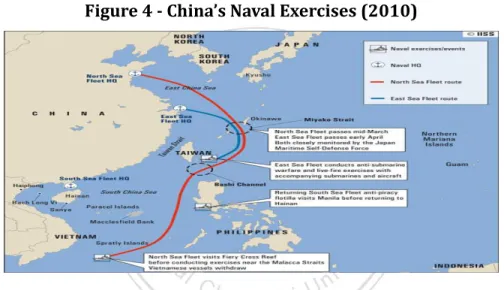
(11) propose solutions or policies to the conflict, better qualified efforts have been made towards to its resolutions. However, comparing the variables that have been influencing both dynamics, identifying their correlations with each other and analyzing the recent developments, we can see new perspectives to the disputes. The link between the lack of transparency with the current regional military buildup and the hesitations among the ASEAN countries to develop and implement the preventive diplomacy in the region is important example. The difficulties in progressing from the CBMs to preventive diplomacy, due to the fear of intervention in internal affairs promoting uncertainties that feed the current military dynamic in a classical question of perception and misperception. The thesis is divided into the follow parts: Introduction, literature review, and methodology. Chapter 1 will provide a general background of the South China Sea disputes, describing the national interests of each country and the consequences of the UNCLOS III in the disputes. Chapter 1 also provides basic theoretical support to the concepts of common interest and common aversion utilized in the formulation of ideas for the negotiating dynamic and military dynamic. Chapter 2 will analyze the negotiating dynamic by describing of the concept of confidence building measures (CBM). The chapter also brings to the light all regional efforts made to implement them, the role of ARF in this process and a description of the Track I and Track II diplomatic tools. Chapter 3 aims to provide details about the current regional military dynamic. The chapter establishes differences between the military dynamic and the arms race, where it is necessary to understand the nature of the military phenomenon in Southeast Asia. Additionally, individual information is given about the current capabilities and recent. 11.
(12) military acquisitions by China, Malaysia, the Philippines and Vietnam, being the main actors in the South China Sea. For reasons of practicality and concise analysis, Taiwan and Brunei will not be included in this examination. Chapter 4 reviews the most symbolic events during 2009-2010. The events that have been used have direct and indirect relations with the debate concerning the negotiating dynamic and the military dynamic. The thesis culminates with a conclusion about the perspectives of the negotiating and military dynamic. RESEARCH PURPOSE The purpose of this thesis is to analyze the effects of the lack of progress in the negotiation dynamic in the South China Sea disputes on the current military build-up in the Southeast Asia. To achieve this end, the thesis focuses on two basic aspects: 1) the history of the confidence building measures in the South China Sea and 2) analysis of the national motivations of the current stage of the Southeast Asian military dynamic. The conclusion intends to provide arguments to establish a linkage between both, the negotiation and military dynamics and its regional effects. RESEARCH QUESTION What are the causes that led the Southeast Asian claimant countries into several skirmishes and clashes after the signature of the Declaration on the Conduct of Parties in the South China Sea that was adopted in 2002? What are the reasons for the current military modernization process in Southeast Asia since 2002? Which are the connections between the current Southeast Asian military dynamic and the absence of progress in the negotiations of the South China Sea territorial disputes? 12.
(13) METHODOLOGY To respond to the research question, the research method consisted in the primary and secondary data analysis. The primary data is conducted in one interview with an ASEAN and China specialist/scholar who intends to submit the subject to a more accurate perspective from the respectful academic researchers. As the thesis topic has been well documented by many different sources such as books, specialized academic journals and newspapers, these sources will be explored to support the research hypothesis. Moreover, analyses related to official documents utilized by the two actors will be conducted. The research limitations are of multiple magnitudes. Undoubtedly, working under time constraints to conduct research was the principal impediment of a more accurate development of the research. The second was the financial limitations. The possibility to include submission by military officials and scholars could have given a broader scope for the formulation of conclusions.. LITERATURE REVIEW Research on the South China Sea is as fascinating as it is challenging. There is no better way to understand the characteristics of Southeast Asian countries and the composition of its foreign policies than the South China Sea issue. The theme creates necessity to understand a range of interconnect mechanisms, as the ASEAN regional mechanisms. Linked to the ASEAN, we can look to ARF, with all its catalogue of events and services to improve the level of communication and mutual trust in the Southeast Asia. Consequently, in studying the ARF structure it is possible to understand the track I and track II diplomatic channels utilized in the region. Thus, the contact with the CBMs. 13.
(14) efforts becomes natural and possible to handle without too many problems. However, these conveniences finish with the giant task of reviewing the vast literature available on these topics, those of which are linked with the research topic. The literature review is based and connected with two main areas of this thesis: the development of confidence building measures and the current military buildup that the Southeast Asia has been experiencing in the last decades. The debate about the South China Sea and its disputes over its sovereignty is a duel between (neo) realist approaches and constructivist. Furthermore, more than a theoretical debate, the issue interlaced different perspectives to better understand the international environment and principally the regional arrangements. Mely-Caballero1 proposes the constructivist approach as a more adequate approach to analyze the regional mechanisms as ASEAN and the achievements of the Southeast Asian integration experience. Caballero argues that the limitation of (neo) realism is that it fails to explain the types of cooperative behavior among states that became extremely common after the post-Cold War era. The existence of CBMs‟ sophisticated apparatus that is trying to create a propitious environment to resolve the regional disputes cannot be explained by the (neo) realist approaches. Given that within the (neo) realist‟s mind the states were only concerned about relative gains, how would one explain the emergence of multilateral types of negotiations on issues like trade liberalization and the environment, where relative gains become extremely difficult to calculate? Caballero concludes that the (neo) realist approach grounded on the discourse of the national interest is extremely narrow,. 1. Mely Anthony-Caballero, Regional Security in Southeast Asia: Beyond the ASEAN Way, (Singapore:. ISEAS Press, 2005). 14.
(15) since it does not take into consideration important variables such as the ideas, values, and identities when explaining states behavior. The constructivism supported by Caballero, and further developed by Alexander Wendt; put the people actions toward subjects on a perceptional basis as Wendt explains “on the distribution of knowledge, that constitute their conception of self and other” 2. The constructivism understands the different behaviors of the states on inter-subjective means. The distribution of power might always affect states‟ calculations, but how it does it depends on the inter-subjective understandings and expectations. Basically, the constructivism approaches follow the idea that much of the world we live in is of our own making. Consequently, the world is a social construction of reality where people believe in shapes what they create. Or as Caballero asserts, constructivism it is all about human consciousness and how it is applied to international relations3. Therefore, even if the world has been operating under the concept of anarchy, it is always subject of different interpretations, and hence the term “anarchy” cannot be viewed as a solid and close term, but needs to take into consideration the multiple understandings about it. Finally, another basic element of the constructivism approach relies on the idea of identity. The states identities and interests are constructed by social structures which are endogenous within the system rather than exogenous by the world system. Given its characteristics, Caballero argues that the advantages of the constructivism approach are their special attention on ideational factors, including norms and ideas on the study of states. In this context, examining ASEAN‟s mechanisms of conflict 2. Alexander Wendt, “Anarchy is What States make of it: The Social Construction of Power Politics”. International Organization: Vol. 46, No. 2 (Spring, 1992),391-425. 3. Supra Note 1 at page 15.. 15.
(16) resolution, or the so called ASEAN Way, is possible understand how this mechanisms were shaped. Even though, recognizing that the preference of constructivist approach does not invalidate other theoretical tools, Caballero assures the constructivism perspective of analysis as the most appropriate to examine the functioning of the Southeast Asian states interactions. Therefore, the constructivist approach could better explain the nature and bottlenecks of confidence-building measures in the Southeast Asia. The constructivism theoretical assumptions match very much with the basic concepts of implementation of confidence-building measures. According with Hasjim Djalal and Ian Townsend-Gault, the CBMs in Southeast Asia were developed to prevent disputes from arising, adopting means to manage potential conflicts by promoting cooperation among the states or authorities in the region in as many sectors as possible4. Generally speaking, the literature about the CBMs works with the imperative to maintain the current efforts and to improve them as soon as possible. First, openness and transparency are to be encouraged at every opportunity. The most effective cure for the mutual suspicions that dominate thinking about the South China Sea is transparency. There should be established and mutually previously agreed procedures for state-sponsored activity in the area; from hydrographic research to military exercises. Prior notification is an essential part of this package. Information Sharing and inviting observers will go along the way to ease suspicions and increase trust. 4. Hasjim Djalal and Ian Townsend-Gault, “Preventive Diplomacy: Managing Potential Conflicts In The. South China Sea” in Hampson, and All editors, Herding Cats: Multiparty Mediation in a Complex World, Crocker (Washington: United States Institute of Peace Press, 1999), 107-133.. 16.
(17) among the various claimants to the area5. Cossa, Snyder and Glosserman6 also work with the same CBMs assumptions, providing to the confidence building measure in the Southeast Asia inescapable constructivist characteristics. The literature regarding the confidence-building measures is spread along different terms and types of bibliography. In a general sense, the Henry L. Stimson Center provides comprehensive material related to the CBMs, Track II, informal diplomacy and similar issues. Its “Handbook of Confidence Measures for Regional Security”, in several editions, provides a confidence-building historical data bank from around the world, namely the Middle-East and South Asia experiences. Another Institute with an important contribution of information is Intractability.org, a think-tank specialized in confidence-building measures initiatives. The CBM‟s literature regarding the South China Sea issue has also been collected from a variety of sources, specifically from the CBMs on the South China Sea, Scott Snyder, Brad Glosserman and Ralph A. Cossa7 from the Center for Strategic & International Studies – Pacific Forum, offers a useful analysis about the necessity of developing the CBMs in the South China Sea. On the other hand Emmers has a different perspective about the nature of the Southeast Asia relations and its territorial disputes. He argues that the geographical questions are key factors for the Southeast Asian States behavior, characterized in three basic aspects: territory, natural resources and power distribution. This way, Emmers 5. Ibid. 4. 6. Scott Snyder, Brad Gloseserman and Ralph A. Cossa, Confidence Building Measure in the South China Sea;. Issues & Insights, No 2 (2001). 7. Ibid.6. 17.
(18) assumes a perspective essentially realist of the Southeast Asia relations and disputes8. With these three basic strategic variables, Emmers affirms that is possible to understand the nature of the South China Sea disputes and consequently the difficulties in achieving the goals established by the confidence- building measures supporters. Moreover, the combination of these variables clears out the reasons behind the current States‟ resistances in implementing the preventive diplomacy mechanisms and, in some extends the current military buildup. Emmers assures that the interpretation of territory, natural resource, and the distribution of power is based on a material and an ideational reading of their role in international security relations. Moreover, even though each variables itself is important to analyze the nature of Southeast Asia disputes, Emmers assumes that territory, natural resources and power distributions are linked, and hence not easily separable form one another9. Emmers‟ assumptions match very much with the concepts established by Mearsheimer about the nature of international systems. Mearsheimer assumes that the States‟ behavior is guided by the fear of each other, what invariably leads to suspicions and therefore threaten of a war is always lurking10. Using the realists‟ assumptions as the anarchic nature of international systems, the necessity of power to posses military capabilities to use against each other, the condition of permanent uncertainties given one state can never know exactly about the intentions of another and its inescapable desire to survive, Mearsheimer understands the post Cold War operating under these assumptions. Regarding the last assumption of survival as States‟ 8. Ralf Emmers, Geopolitics and Maritime Territorial Disputes in East Asia (New York: Routledge Press,. 2010). 9. Ibid. 8.. 10. John Mearsheimer, Anarchy and the Struggle for Power (New York: Norton Press, 2001),61.. 18.
(19) primary goal, Mearsheimer emphasizes that States seek to maintain their territorial integrity and the autonomy of their domestic political order. Here the territorial integrity works as a cement of the national identity and therefore is a pre-condition of the States‟ survival within of the International System11. Within of these perspectives, the South China Sea claimant countries are, even under a process of cooperation and negotiation, looking for maximizing their gains, employing a variety of economic, diplomatic, and military means to shift the balance of power in their favor. With these concepts in mind, is possible to understand why military dynamics occurs in parallel with negotiating dynamics. Tan 12 even highlights the differences between an armed uprising and military dynamics or arms competition, utilizing the concepts elaborated by Gray13, he affirms that the domestic constrains are the main drivers of the current military dynamic in the Southeast Asia. With an incomplete nation-building process, internal menaces and the fear of external powers dominance are understood as the menaces for the existence of the Southeast Asia states, principally the small and weak ones. Bitzinger also agrees that the ongoing military phenomenon in the region does not fulfill the prerequisites to be characterized as an armed uprising. However, he also highlights the need to complete the nation-building process and the fight against the domestic enemies as the principal reasons for the current arms acquisition path in the Southeast Asia. However, both agree that the South China Sea disputes work on the very sensitive aspects of the formation of national interests and composition of national identities that unavoidably are linked with the composition of the 11 12. 13. Ibid. 10. Andrew Tan, “Force Modernization Trends,” RSIS Working Paper, No. 59 (2004). Colin S. Gray, “The Arms Race Phenomenon,” World Politics, Vol. 24, No. 1 (1971).. 19.
(20) territory, as Emmers assumed previously. Therefore, the protection of the national interests on the South China Sea, more than a legal disputes or interpretation of international law, is part of the consolidation of the national elite‟s aspiration and thus has exacerbated nationalism that is reflected in both dynamics by different ways. Aside from agreeing with Caballero‟s proposition in using the constructivist approach to understand the dynamic of the ASEAN‟s experience, this thesis also accepts that the compositions of strategic variables have been guiding the behavior of the South China Sea claimants‟ countries. The strategic way of thinking have influenced or blocked the progress from confidence-building measures to preventive diplomacy, at the same time that has been the principal factor for the modernization process of acquisition of new power capabilities. In terms of additional readings on the South China Sea issue and all its developments in terms of strategic regional implications, the researchers from S. Rajaratnam School of International Studies have provided an abundant source of material. Their working papers have caught the essence of the events and are currently a necessary source of information about the economic and security in Southeast Asia and Asia Pacific. Joyner14 (2002) highlights the necessity to enhance the transparency as an important step to the achieve success in the negotiations. However, he proposed a series of actions to implement them without making a connection to the current militarization process.. 14. Christopher C. Joyner, “The Spratly Dispute in the South China Sea: Problems, Policies, and. Prospects for Diplomatic Accommodation” in Cooperative Monitoring in the South China Sea, ed. John C. Baker and David G. Wiencek (London: Praeger Publishers,2002).. 20.
(21) Buchholz15 (1987) and Gendreau16 (2000) conducted discussions on the essential legal aspects without taking into consideration any political or strategic facets. As we can observe, all literature available only takes into consideration the topics of this thesis as separate entities, without establishing elements of comparison or connection. The contribution of this thesis will work with the South China Sea issue to establish linkages between the two dynamics triggered by its territorial disputes: negotiating dynamic and military dynamic. These two dynamics have been running parallel to one another, and use a high level and well prepared bureaucracy to undertake them. However, it seems that level of transference from the formal and informal diplomatic channels negotiations to the military circles is very limited or, at times, even nonexistent. Given the strategic variables that are permeating the debate about the South China territorial disputes, the possibilities of progressing of confidence building is very low.. 15. Hanns J. Buchholz, Law of the Sea Zones in the Pacific Ocean (Singapore: Institute of Southeast. Asian Studies, 1987). 16. Monique Chemillier Gendreau, Sovereignty over the Paracel and Spratly Islands (London; Kluwer. Law Pressinternational, 2000).. 21.
(22) CHAPTER 1 - THE SOUTH CHINA SEA: DEFINITIONS AND BACKGROUND The South China Sea 17 is one of the most complex diplomatic dilemmas of contemporary times. Within its problematic conceptualization are a myriad of interlaced strategic variables. The South China Sea is extremely rich in natural resources, possesses an immense energetic potential in gas and oil, and is a fishery sanctuary for people from different countries of Southeast Asia. Most importantly, it is an incalculable value from the military point-of-view18.. The South China Sea lies south-east of the Asian continent, bounded by China to the south and Hainan Island to the north, by Vietnam to the west, Malaysia and Brunei to the south and Philippines and Taiwan to the north and north east. It still encompasses a portion of Pacific Ocean stretching roughly from Singapore and the Strait of Malacca in the southwest 19 . Its area includes more than 200 small islands, rocks and reefs, with the majority located in the Paracel and Spratly Island chains. It is important to note that these islets, rocks, and reefs not offer conditions for human life habitation nor provide the space for shipping access.. Before starting the analysis of the questions regarding the negotiation dynamic and military dynamic, this chapter will provide the basic aspects of the South China Sea. 17. Called by Eastern Sea by the Vietnamese.. 18. John C. Baker and David G. Wiencek, Cooperative Monitoring in the South China Sea: Satellite Imagery,. Confidence Building Measures and the Spratly Islands Disputes (London: Prager Publishers, 2002), 49. 19. Monique Chemillier Gendreau, Sovereignty over the Paracel and Spratly Islands (London: Kluwer Law. Press international, 2000), 65-78.. 22.
(23) disputes. It will highlight a set of main variables that have been influencing the disputes as the strategic, legal, the motivations of each country and its respective territorial claims.. A) The Spratlys Island. They are a vast underwater platform in the middle of the South China Sea. The specialists say that is not easy to identify the archipelago clearly because the region the region includes widely scattered islands, islets, banks and rocks20. There are over one hundred of them, and the total surface area encompasses around 160,000 square kilometres, which is over ten times bigger than the Paracels. The majority of islands are small, barely maintaining vegetation but rather covered by sand and guano. There are indications of important reserves of phosphorus estimated at 370,000 tonnes21.Some of these islets and islands are occupied by the Philippines, Malaysia, Taiwan, China and Vietnam. B) The Paracel Islands. The Paracel islands consist basically of two main groups: the Amphitrite and the Crescent group, which lie some 70 kilometres apart from one another. The largest of them, known as Woody Island is no more than 4 kilometres long and 2 to 3 kilometres wide 22. Apart from these two groups of islands already mentioned above, the archipelago as whole consists of over 30 islets, sandbanks or reefs and occupies some 1,500 square kilometres in the ocean surface. There is also evidence of existing of offshore oil deposits. The area is potentially rich in phosphate deposits as well. The Paracel is disputed by Vietnam. China 20. Ibid 19.. 21. Ibid.. 22. Baker and Wiencek , supra note 18 at 50.. 23.
(24) occupied Woody Island in 1974 that now is equipped with an airstrip and enlarged harbour. Other harbours also have been built on Triton islands in 1982. 1.1 – Strategic Aspects of South China Sea Disputes. The Spratly Island has a total territory of less than 3 square miles from which it is impossible to develop any sort of structural capabilities; nevertheless the strategic and political values of these islands cannot be ignored. Essentially, the legal status of these two archipelagos, the Paracel in the north and Spratlys in the south, are under sovereignty disputes among China, Malaysia, Philippines, Brunei, Taiwan and Vietnam23.. The Sea Lanes of Communication (SLOC) in the SCS connect Northeast Asia and the western Pacific to the Indian Ocean and the Middle East. Moreover, the South China Sea possesses one of the most important sea transportation routes in the world. For instance, statistics say that more than 41,000 ships – over half the world‟s shipping tonnage – sail through these waters every year. This accounts for more than 80% of the oil from Japan, South Korea and Taiwan that flows through the harbours in that area24. These key sea lanes includes the Strait of Malacca and Singapore, Sunda Strait, and the Strait of Lombok and Makasar that are among the most important transportation route straits in the world with more than 50% of world‟s merchant fleet tonnage crossing them annually. An eventual single-State control over some of those Spartly and Paracel islands “presents the 23. Li Mingjiang, “China’s South China Sea Dilemma: balancing sovereignty, development, and security”. in ed. Sam Bateman and Ralf Emmers, Security and International Politics in the South China Sea: Toward a Cooperative Management Regime (New York; Routledge Press, 2009), 141. 24. Scott Snyder, Brad Gloseserman and Ralph A. Cossa, Confidence Building Measure in the South. China Sea; Issues & Insights, No 2-OI (2001).. 24.
(25) opportunity for gaining a central and commanding position in the region”25. From the Western Pacific to the Indian Ocean and Persian Gulf26, the “chokepoints” are strategically imperative in terms of movement for maritime powers as United States.. The critical location of the South China Sea has been identified since the World War II. The Japanese, who since 1918 had been using the many Islands in Spratly and Paracel to excavate guano, were the first to use it with strategic purposes using them in its operations in the Southeast Asia, mainly against the Philippines27. In addition, the islands scattered all South China Sea provide potential areas for surveillance, sea-lane of interdiction and other naval operations, that according with Song “could disrupt maritime traffic from Singapore to southern China and Taiwan”28. Making clear the strategic importance, Emmers assert: “…the control of the heart of the sub-region would be threatening for Vietnam, the Philippines, Malaysia, Brunei and Indonesia. Control over the sea lines of communication (SLOCS) would also endanger the interests of the United States, Japan and other naval powers”. These set of variables have been used, in part, as drivers of the current military dynamic in Southeast Asia. The enhancement of military capabilities as a means of maintaining. 25. Kuan-Hsiung Wang, “Bridge Over Troubled Waters: Fisheries Cooperation as a Resolution to the. South China Sea Conflicts.” The Pacific Review, Vol. 14 No. 4(2001), 532. 26. Yann-huei Song, “United States and Territorial Disputes in the South China Sea: A Study of Ocean. Law and Politics”. Maryland Series in Contemporary Studies N.1 (2002), 21. 27. Ralf Emmers, Geopolitics and Maritime Territorial Disputes in East Asia (New York: Routledge Press,. 2010), 67. 28. Ibid 27.. 25.
(26) control of strategic points is considered a national priority for many states in the region; such as Vietnam, Malaysia and China. 1.2 –The importance of sea lanes of communication (SLOCS). Assuring the safety of specific deep sea areas has been one of the most important concerns to military strategists in modern times. According to strategists, the forces that hold the land framing the Sea Lines of Communication (SLOCs) control movement between oceans, and thus are the lifeblood of modern war29. The strategic importance of SLOCs, and sea control itself, has been appreciated since war first moved to deep water and the control of straits has been a key feature of significant maritime actions since ancient times 30 . Despite changes in weapons and the ships that carry them, the fundamentals of naval war remain the same: the force that holds the SLOCS controls the seas and the force that controls the seas will control the outcome of the war. In the South China Sea, this perspective is no different. As previously noted, the strategic value of controlling SLOCs is formidably high. In addition, the sea lanes of communication in Southeast Asia have everything to do with its passage ways through the Malacca, Lombok and Sunda Straits. Together, these straits compose one of the most important. 29. Forrest R. Lindsey, “Sea Lines of Communication Control: A Marine Mission”, War in the Modern Era. Seminar. Marine Corps Command and Staff College Quantico, Virginia 9 May, 1988. Available: http://www.globalsecurity.org/military/library/report/1988/LFR.htm Access: August, 26 2010. 30. Ibid. 29.. 26.
(27) economic and strategic gateways of the worlds, and it is the reason that actors as United States, China and Japan follow very closely all events in those areas31.. The major sea lanes in Southeast Asia are primarily comprised of the Malacca and Singapore Straits, the Sunda Strait and the Lombok Strait. The Strait of Malacca, located between Indonesia, Malaysia, and Singapore, links the Indian Ocean to the South China Sea and Pacific Ocean. The Strait of Malacca is the shortest sea route between Persian Gulf suppliers and the Asian markets –notably China, Japan, South Korea, and the Pacific Rim. Likely the most important of the Southeast Asian sea lanes, the Strait of Malacca is 600 mile long and is considered the principal corridor between the Indian Ocean and the South China Sea. It is also the primary lane utilized by tankers from the middle-East. Around 25 tankers, including three fully supertankers heading for Asian ports, pass through the strait daily32. In terms of total volume, more than 200 boats pass through the Strait of Malacca on a daily basis, totalling more than 63,000 on annually and which 31. Specifically about China the importance of the SLOCs in the South China are dramatic. Currently 78 %. of China’s oil transportation has to go through narrow ocean straits in the Indian Ocean Region- IOR-, (that include the gateways to Malacca Strait) which it has no control over SLOC safety. This presents Beijing with a long-term security challenge, prompting Chinese president Hu Jintao to remark on the “Malacca Strait Dilemma” in 2004. The dilemma reveals the difficulties of finding any effective solution to the challenge. First, according to Chinese researchers, land-based transportation lines are neither practical nor cost-effective. Second, protecting SLOCs through naval forward presence in the IOR is basically a non-option. This is due to not only China’s lack of necessary military capabilities to so, at same time that Beijing feel vulnerable to any US blockade action that could put it economy on the knees. See You Ji, “Dealing with the Malacca Strait Dilemma: China’s efforts to Enhance Energy Transportation Security”. EAI Background Brief No. 329, April (2007). Available: http://www.eai.nus.edu.sg/BB329.pdf Access: August, 26 2010. 32. Joshua Ho, “The importance and Security of Regional Sea Lanes” in Maritime Security in Southeast Asia,. ed. Kwa Chong Guan and John K. Skogan (New York: Routledge Press,2007),22.. 27.
(28) carry 80% of the oil transported to Northeast Asia. In economic terms, the total tonnage carried by the Malacca Strait amounts to 525 million metric tones, worth a total US$ 390 billion33. With these numbers, the Strait of Malacca is currently considered the second busiest strait in the world and, according to forecasts, the Malacca Strait will become even busier in the future as result of trade flows and rising oil and gas demands in Asia34.. The Lombok Strait is another important point of transit which connects Southeast Asian and Northeast Asian countries. The Lombok Strait is less congested that the Strait of Malacca, due to its greater width and depth relative to the Malacca Strait, and is considered the safest route for super tankers and the largest of the eastbound ships. About 418 ships transit annually and the total annual tonnage carried through the Lombok Strait amounts to 36 million metric tones. Ships carrying iron from Australia to China also enter the Indonesian archipelago through the Lombok Strait35. Finally the last of the three straits is the Sunda Strait. It is 50 miles long and provides another alternative to the. 33. Ibid.32. 34. The most important oil chokepoint in the world is located between Oman and Iran. The Strait of. Hormuz connects the Persian Gulf with the Gulf of Oman and the Arabian Sea. Hormuz is the world's most important oil chokepoint due to its daily oil flow of 16.5-17 million barrels (first half 2008E), which is roughly 40% of all seaborne traded oil (or 20 % oil traded worldwide). Oil flows averaged over 16.5 million barrels per day in 2006, dropped in 2007 to a little over 16 million barrels per day after OPEC cut production, but rose again in 2008 with rising Persian Gulf supplies. On the average, an oil tanker sails through the Strait of Hormuz every 21 minutes. Source: “World Oil Transit Chokepoints”- US Energy Information Administration (EIA). Available: http://www.eia.doe.gov/cabs/World_Oil_Transit_Chokepoints/Hormuz.html Access: August, 26 2010. 35. Ibid.34.. 28.
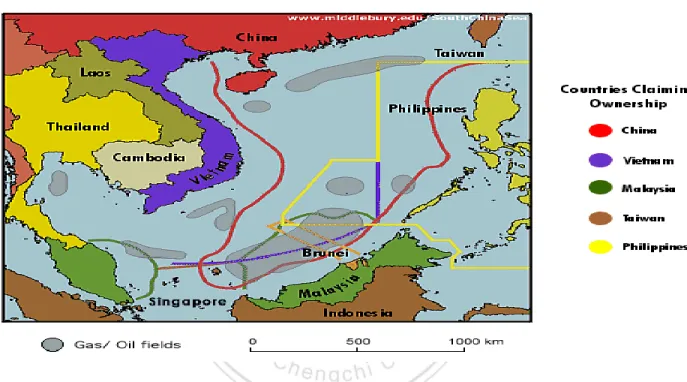
(29) Malacca Strait. About 2.300 ships transit the Sunda Strait annually and the total annual tonnage carried through the Sunda Strait is 111 million metric tones36.. It is certainly possible to denote the economic importance of the Southeast Asian sea lanes of communication to both established and emerging Asian states. Being conscious of this strategic and economic variable is fundamental to a thorough understanding of the importance of the South China Sea maritime disputes and their effects on the regional and global economies. Even though these sensitivities were felt in all states claimants, it is also of great importance to those non-state territorial claimants. Thus, the involvement of United States and, to a lesser extent, Japan is understandable. With these concepts in mind, the next section will analyse the impacts of other fundamental aspects of maritime sovereignty in the South China Sea: the United Nations Conference of the Law of the Sea (UNCLOS).. 1.3 - The UNCLOS III and the impacts on the Southeast Asia After World War II, there was an increasing demand for “territorialization” of the specifics areas of the seas and continental shelf37 around the globe38. Consequently, with. 36. Supra Note 29.. 37. The Article76 of UNCLOS define continental shelf as: “the continental shelf of a coastal State comprises. the seabed and subsoil of the submarine areas that extend beyond its territorial sea throughout the natural prolongation of its land territory to the outer edge of the continental margin, or to a distance of 200 nautical miles from the baselines from which the breadth of the territorial sea is measured where the outer edge of the continental margin does not extend up to that distance”. United Nations Convention on the Law of the Sea (UNCLOS) - Part VI.. 29.
(30) the increase of demands for maritime areas, there also grew the possibilities for conflicts. In this context was established the first United Nations Conference of the Law of the Sea as established in Geneva in 1958. The UNCLOS III in 1973 was a consequence of these conferences; though, the previous conferences did not find any consensus among the members of the United Nations39. Between a series of regulations approved by UNCLOS III the most important were those regarding navigational rights, territorial sea limits, economic jurisdiction, legal status of resources on the seabed beyond the limits of national jurisdiction, passage of ships through narrow straits, conservation and management of living marine resources, protection of the marine environment, a marine research regime and a binding procedure for settlement of disputes between states40. In addition, the resolutions related to internal waters, territorial waters, archipelagic waters, contiguous zone, exclusive economic zone (EEZ), and Continental shelf had a fulminate impact on the coastal countries, namely in the Southeast Asia region. The reason of this impact in the SEA relies on the complex regionalization conditions vis-à-vis its geographical positions. All Pacific States situated in Southeast Asia are grouped around the South China Sea and its bays41 in a relatively circular pattern making. 38. Essentially the first wave were composed by the Latin American countries such as Mexico (1945),. Panama (1946), Chile (1947), Peru (1947), Nicaragua (1948), and Costa Rica (1948). See Hanns J. Buchholz, Law of the Sea Zones in the Pacific Ocean (Singapore: Institute of Southeast Asian Studies, 1987), 5. 39. Ibid. 38.. 40. ibid.. 41. The Gulf of Thailand and Gulf of Tonking.. 30.
(31) that all territorial claims have a common centre42. In conjunction with the legal disputes triggered by UNCLOS‟s resolutions, there are a number of historic claims that gain more complexities due to the large number of islands and reefs43.. 1.4 - The claimants and demands. Competing territorial claims over the South China Sea and consequently its resources for various areas and almost all countries demand partial or total sovereign under that area. For the purposes of this thesis already mentioned, the research will concentrate the analysis just on the China, Philippines, Malaysia and Vietnam propositions44.. 42. The UNCLOS the article 123 defined the duties and rights for these kinds of coastal states. Essentially. they urge to cooperation in all issues regarding to the maritime and sovereignty rights as well scientific cooperation aspects as well. “Cooperation of States bordering enclosed or semi-enclosed seas States bordering an enclosed or semi-enclosed sea should cooperate with each other in the exercise of their rights and in the performance of their duties under this Convention. To this end they shall endeavour, directly or through an appropriate regional organization:(a) to coordinate the management, conservation, exploration and exploitation of the living resources of the sea;(b) to coordinate the implementation of their rights and duties with respect to the protection and preservation of the marine environment;(c) to coordinate their scientific research policies and undertake where appropriate joint programmes of scientific research in the area;(d) to invite, as appropriate, other interested States or international organizations to cooperate with them in furtherance of the provisions of this article”. See United Nations Convention on the Law of the Sea (UNCLOS) Part IX. Enclosed or Semi-Enclosed Areas: http://www.un.org/Depts/los/convention_agreements/texts/unclos/part9.htm 43. Gendreau, supra note 19 at page 23.. 44. The complete list of countries that demand some measure sovereignty or interests on the South China. Sea are Brunei, Cambodia, China, Indonesia, Malaysia, The Philippines and Taiwan.. 31.
(32) In general sense the claims can be separated into two basic categories: historical and legal basis45. China and Vietnam relies its claims under the historical aspects while Philippines using a mix of historical and legal and Malaysia essentially legal. Basically, there is an overlapping claim in the South China Sea. Figure 1 – Maritime Claims. Source: The South China Sea Virtual Library. Available: http://www.southchinasea.org/maps_images.html Access: August, 06 2010. A) Brunei‟s claims Brunei Darussalam only has one claim in the South China Sea, the Louise Reef. The sultanate use legal basis derivate from its interpretations about the UNCLOS III. 45. Ralf Emmers, “Maritime Disputes in the South China Sea: Strategic and Diplomatic Status Quo” in. Maritime Security in Southeast Asia ed. Kwa Chong Guan and John K. Skogan (New York: Routledge Press, 2007).. 32.
(33) regarding to continental shelf provisions. The Louise Reef is part of the seabed and technically a legal extension of a continental shelf. The question about the Brunei‟s claims is whether the continental shelf can be considered as a natural prolongation seaward from the territory of Brunei. B) China‟s claims The PRC perspectives the South China Sea as an exclusive Chinese sea and claims almost the entire territory. The PRC refers to the Spratly Islands as the Nansha islands, claiming all of the islands and most of the South China Sea for historical reasons. China also claims the Paracel Islands (referred to as the Xisha Islands), and includes them as part of its Hainan Island province. Chinese claims are based on a number of historical events, including the naval expeditions to the Spratly Islands by the Han Dynasty in 110 AD and the Ming Dynasty from 1403-1433 AD. In the 19th and early 20th century, China asserted claims to the Spratly and Paracel islands. According to specialists, notable problems of authenticity and accuracy exist despite all descriptions implied by China in reference to the Spratly islands.. Officially, the Chinese claims were defined during the Nationalist rule (KMT) in 1947 by Chiang Kai-shek46. Later Premier Zhou En-Lai formalized the claims in 195147.. 46. It is important to highlight that at that time the Chinese Nationalist government’s assertiveness. pertaining to the South China Sea was in response to French actions in the area. With fear of Japanese expansion in the region, France claimed the Spratly Islands for itself and occupied some of the islands. Later, in 1938, the French forces also occupied the Paracel Islands. At the time, China was immersed in its civil war and could not to respond to these occupations. Following the end of the World War II, the Nationalist government of Chiang Kai-shek sent naval expeditions in to both areas to establish sovereignty. 33.
(34) However, from legal point-of-view, that the mere discovery of some territory is not sufficient enough to promote the discoverer rights of ownership to the territory 48 . According with Emmers, Beijing has not provided a legal explanation for its territorial claims. In May 1996, the PRC applied the archipelagic principle when drawing maritime baselines in the Paracel islands, although the Philippines and Indonesia are the only archipelagic states in the region49.. During World War II, the islands were claimed by the Japanese. After years of clashes and rhetorical challenges, in 1992, Chinese law restated its claims in the region50. China has occupied 8 of those islands to enforce its claims. In 1974, China seized the Paracel Islands from Vietnam. Moreover, Beijing since 1988 has deployed around 260 marines in garrisons on seven islets in Spratly area51. Additionally, Beijing alto have using legal. markers and established a permanent presence in the region. In 1947, Chiang Kai-shek’s government published a map showing the region with a U-shaped dotted line incorporating virtually all of the South China Sea into Chinese territory, citing historical arguments this action. With the victory of the Communists and the consequent establishment of the nationalist government in Taiwan, the same map and claims were adopted by both countries. Thus, the PRC essentially inherited the claims made by the Kuomintang, which in turn, became the Taiwan’s maritime claims as well. See Timo Kivimaki, War or Peace in the South China Sea (Denmark: NIAS Press, 2002), 9-11. 47 48. Supra Note 19 at page 23. Christopher C. Joyner, “The Spratly Dispute in the South China Sea: Problems, Policies, and Prospects. for Diplomatic Accommodation” in Cooperative Monitoring in the South China Sea, ed. John C. Baker and David G. Wiencek (London: Praeger Publishers,2002), 48-56. 49. Emmers, supra note 45.. 50. Peoples Republic of China, Law of the People's Republic of China on the Territorial Sea and the. Contiguous Zone. Adopted at the 24th Meeting of the Standing Committee of the Seventh National People's Congress on February 25, 1992 51. Emmers, supra note 45 at 28-32.. 34.
(35) elements to justify its claims utilizing the economic exclusive zone rights and continental shelf principles established in the Law of Sea (LOF) of United Nations. The scope of Chinese claims in the South China Sea, make the implementation of CBMs and diplomatic negotiations highly difficult and extremely dependent of Beijing‟s interests52. C ) Vietnam‟s claims. Until reunification, Vietnam had recognized Chinese sovereignty over Paracels and Spratlys. Since 1975, Vietnam has claimed both groups based on historical claims of discovery and occupation. Basically, the Vietnamese claims are based on history and the continental shelf principle. Vietnam claims the entire Spratly Islands (Truong Sa in Vietnamese) as an offshore district of the province of Khanh Hoa. Vietnamese claims also cover an extensive area of the South China Sea; however they are not clearly defined. In addition, Vietnam claims the Paracel Islands (the Hoang Sa in Vietnamese), although they were seized by the Chinese in 1974. Hanoi has followed the Chinese example of using archaeological evidence to bolster sovereignty claims. In the 1930's, France claimed the Spratly and Paracel Islands on behalf of its then-colony Vietnam. Vietnam has since occupied 27 of the Spratly Islands to enforce its claims. In 1977 Vietnam also established a 200-nautical mile EEZ.53 D) Malaysia‟s claims. 52 53. Ibid. 51. Monique Chemillier Gendreau, Sovereignty over the Paracel and Spratly Islands (London; Kluwer Law. Press international, 2000), 19.. 35.
(36) Malaysia extended its continental shelf in 1979 and included features of the Spratly in its territory. Since then, it has occupied 6 islands to be considered within its continental shelf54. Its Spratly claim‟s are based upon the continental shelf principle, and have clearly defined coordinates. Malaysia has tried to build up one atoll by bringing soil from the mainland and has built a hotel. E) Philippines‟s claims. Among the ASEAN members, The Philippines claims are the largest in the Spratly Islands – a region the Philippines refer to as Kalayaan. Its claims have clearly defined coordinates, based both upon the proximity principle as well as on the explorations of a Philippine explorer in 1956. In 1971, the Philippines officially claimed 8 islands, partly on the basis of this exploration, arguing that the islands: 1) were not part of the Spratly Islands; and 2) had not belonged to anyone and were open to being claimed. In 1972, they were designated as part of Palawan Province, and have been occupied. Later, in 1978 a presidential decree finally declared Kalayaan as part of the national territory55. F) Taiwan‟s claims. Various authors assert that the Taiwanese argument for its legal basis to claim sovereignty over the Spratly and Paracel Islands are the same as that of China. The maps which have been published by both PRC and Taiwan demonstrate a common border 54. Ibid.53.. 55. Christopher C. Joyner, “The Spratly Dispute in the South China Sea: Problems, Policies, and Prospects. for Diplomatic Accommodation” in Cooperative Monitoring in the South China Sea, ed. John C. Baker and David G. Wiencek (London: Praeger Publishers,2002) ,19.. 36.
(37) which runs to the south, past the western coast of the Philippines and up to the coast of Sarawak (Malaysia). The map also claims Zengmu Reef, which lies 130 kilometers off Sarawak, as “being Chinese territory”56. Though the maps published in Taiwan and China show identical information, the Taiwanese map includes what is referred to as the “nine-dotted line” to distinguish it from the “U-shaped Line” printed on maps published by the PRC. Map 1 – Nine- dotted line (Taiwan). Map 2 – U-Shaped Line (China). Source: South China Sea Virtual Library – Maps: Available: http://community.middlebury.edu/~scs/maps_images.html. 56. Access. September, 07 2010.. Hanns J. Buchholz, Law of the Sea Zones in the Pacific Ocean (Singapore: Institute of Southeast Asian. Studies, 1987), 43. See also Junwu Pan, Toward a New Framework for Peaceful Settlement of China’s Territorial and Boundary Disputes (Netherlands: Martinus Nihoff Publishers,2009), 171.. 37.
(38) In addition, both countries support their claims historical arguments57. These similarities lead different specialist to consider the Taiwanese and Chinese claims as identical and “therefore understood as one58”. However, in contrast to the Chinese claim, Taipei‟s claims also are further supported by its persistent occupation of Itu Aba island. 59. . Taiwan. was the first claimant to establish a presence on the Spratly islands, on the largest island in the region Itu Aba (Taiping Dao). From the legal standpoint, the Taiwanese claims are rather paradoxical. Taiwan has had a continuous presence in the area for more than four decades without facing any strong resistance or objection from the other claimants. Taiwan‟s essential claim to sovereignty is by arguing that is has provided continuous peace to the tumultuous region. On the other hand, Taiwan‟s arguments to claim sovereignty suffers from the same deficiencies as China, “as that discovery of, and consistent contact with, scattered islet formations in ocean space are insufficient cause to establish legal title of sovereignty60”.. 57. Ibid.56.. 58. Ralf Emmers, Geopolitics and Maritime Territorial Disputes in East Asia (New York: Routledge Press,. 2010), 66. See also John C. Baker and David G. Wiencek, Cooperative Monitoring in the South China Sea (London: Praeger Publishers, 2002), 55. 59. Yann-huei Song, “United States and Territorial Disputes in the South China Sea: A Study of Ocean Law. and Politics.” Maryland Series in Contemporary Studies N.1 (2002): 75. 60. Supra Note 54.. 38.
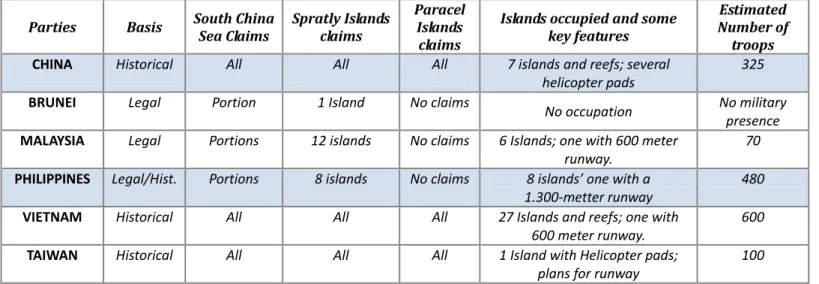
(39) Table 1 – Summary of Territorial, claims basis and occupation in South China Sea Parties. Basis. South China Sea Claims. Spratly Islands claims. CHINA. Historical. All. All. Paracel Islands claims All. BRUNEI. Legal. Portion. 1 Island. No claims. MALAYSIA. Legal. Portions. 12 islands. No claims. PHILIPPINES. Legal/Hist.. Portions. 8 islands. No claims. VIETNAM. Historical. All. All. All. TAIWAN. Historical. All. All. All. Islands occupied and some key features 7 islands and reefs; several helicopter pads No occupation 6 Islands; one with 600 meter runway. 8 islands’ one with a 1.300-metter runway 27 Islands and reefs; one with 600 meter runway. 1 Island with Helicopter pads; plans for runway. Estimated Number of troops 325 No military presence 70 480 600 100. Source: Adapted from John C. Baker and David G. Wiencek Cooperative Monitoring in the South China Sea: Satellite Imagery, Confidence-Building Measures, and the Spratly Islands Disputes. (London: Prager Publishers, 2002) and other variety of sources.. However, the contradiction behind o this trend is characterized by the pattern between Beijing and the withal disputants countries in the economic aspects. The economic relations between the disputants skyrocketed since the re-establishing of diplomatic ties in 1992. As ASEAN members, Malaysia, Philippines and Vietnam have had a completely new experience in terms of economic exchange with Beijing from the historical perspective the same can be said about the pattern of relationship between Taiwan and China. The immediate outcomes of these movements can be verified in the level of trade exchanges between Chinese and Southeast Asia countries since the complete reestablishment of diplomatic ties in 1992. Even the economic exchange was not able to meliorate the historical mistrust between the actors, principally regarding about the Beijing ambiguous behavior. The trade between China and ASEAN countries, which therefore includes all South China Sea. 39.
(40) disputant states, expanded at an annual growth rate of about 15% since 1995, and it jumped by 31.7% in 2002 to US$ 54.77 billion. According to the Institute of Asia-Pacific Studies (CASS) utilizing China‟s statistical data, China‟s trade with ASEAN increased rapidly over the period of 1990 to 200761. Though from a low baseline of 7 billion US$ in 1990, the trade volume exceeded 100 billion U.S. $ as a mark in 2004, and amounted to 202.6 billion US$ in 2007 as a new record, reaching the goal of 200 billion US$ that was planned for the year 2010 three years in advance62. This economic flow leads the both sides to an intensification process of trade integration that resulted in the Free Trade Area. During the China-ASEAN Comprehensive Economic Cooperation at the Sixth China-ASEAN Summit held in Cambodia, The PRC formalized an agreement on trading in Goods in the Framework Agreement and on Economic Cooperation with ASEAN in November 2004 63 . The scheduled stipulation was not until January, 2010. Due to the different economic profiles among the ASEAN members, the agreement was divided in two stages. Finally, the Chinese Ministry of Commerce reinforced the aspects related to size and potential market consumer that ACFTA would create and its “amazing picture for our. 61. Zhao Jianglin, “Recent Development of China-ASEAN Trade and Economic Relations: From Regional. Perspective”.. Institute. of. Asia-Pacific. Studies,. CASS,. Available:. http://iaps.cass.cn/english/Articles/showcontent.asp?id=1131 62 63. Ibid. 61. Tang Yohong and Wang Weiwei, “An Analysis of Trade Potential between China and ASEAN within. China-ASEAN FTA”, University of International Business and Economics [2005]. Available: http://faculty.washington.edu/karyiu/confer/beijing06/papers/tang.pdf access: March, 19, 2010.. 40.
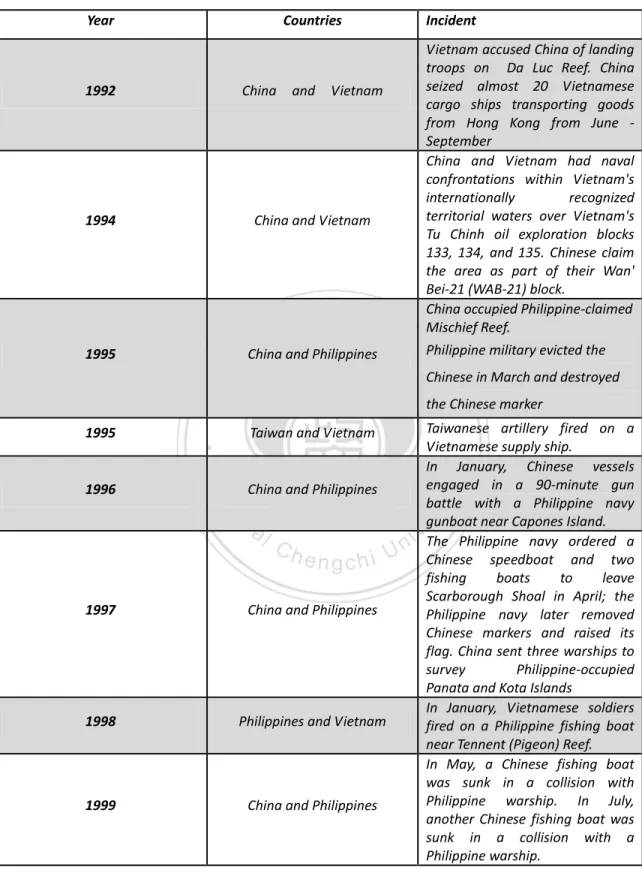
(41) future co-operation” when it is fully established64. However, since 1992, the recent the clashes and quarrels in the South China Sea multiplied simultaneously with the trade exchange. At the same time that economic relations enhanced with enthusiasm, the security questions rose and resulted in contentions that many times put Southeast Asia on alert (source). Between 1992 and 2002, sixteen disagreements occurred between claimant countries, its majority involving the People‟s Republic of China. The significance and intensity of these conflicts led a series of diplomatic efforts to avoid or even prevent the escalade of tension in the region. Despite nationalistic and intense domestic pressure, there was a consensus in Southeast Asia and China that an eventual generalized conflict could put their economies on their knees, which, given the current flow, would be a complete disaster for all. 65. . Among these efforts, The ASEAN Declaration on the South. China Sea in 1992 and The Declaration on the Conduct of Parties in the South China adopted in 2002 are emblematic. 1.5 The United States interests Recently at the Asian Regional Security Meeting, U.S. Secretary of State Hillary Rodham Clinton, broke one of the most consistent US foreign policy principles towards 64. The first step to implement the ACFTA was given in January, 2010 that included the five original. members: Indonesia, Malaysia, Philippines, Singapore and Thailand. The withal countries of Laos, Cambodia, and Myanmar (Burma) would have to comply until 2015. The dimensions of the new agreement are impressive. The ACFTA between China and ASEAN created an economic giant with 1.7 billion consumers, with a regional Gross Domestic Product (GDP) of about US$2 trillion and total trade estimated at US$1.23 trillion. This became the biggest FTA in the world in terms of population size. See Raul L. Cordenillo, “The Economic Benefits to ASEAN of the ASEAN-China Free Trade Area – ACFTA”. ASEAN Available: http://www.aseansec.org/17310.htm. Access: March, 19, 2010 65. Joyner, supra note 48 at page 35.. 41.
(42) Southeast Asia; the non-involvement in the South China Sea maritime disputes. Secretary Clinton stressed that though the United States remains neutral with regards to the dispute itself, the preservation of free shipping in the area is part of US National interests and that the U.S. would be willing to facilitate multilateral talks on the issue 66.. Clinton‟s. assertiveness is in complete contrast to the United States‟ usual approach to the South China Sea issue. In a 1996 statement related to US presence and interests, it was made very clear that the US is commitment to non-involvement in the territorial disputes in the South China Sea: “The United States takes no position on the legal merits of the competing claims to sovereignty over various islands, reefs, atolls and cays in the South China Sea. The United States would, however, view with serious concern any maritime claim, or restriction on maritime activity in the South China Sea that was not consistent with international law, including the 1982 United Nations Convention on the Law of the Sea.67”. The US interests in the South China Sea obey a series of national and global variables. Ultimately, the amalgamation of these multiple interests is characterized in the concept of freedom of navigation; initiated in 18th century but particularly intensified since World War II. During the war, the US made certain to eliminate the Japanese SLOC‟s in the South China Sea that linked all Southeast Asia to China and Japan. Since then, the navigational freedom in the region has been permanent and definite part of US. 66. Mark Lander, “Offering to Aid Talks, U.S. Challenges China on Disputed Islands”. The New York Times.. Available: http://www.nytimes.com/2010/07/24/world/asia/24diplo.html . Access: August, 02 2010. 67. Song, supra note 26 at page 26.. 42.
(43) strategic interests68.However, Chinese official stance that the status of the South China Sea is one of China‟s “core interests,” puts in peril this freedom of navigation that has guided US actions in the region. This concept of free access in any maritime domain was reinforced several times by various US officials. For example, in 2001 the US Department of Defense released a report stating the key elements where the US armed forces should undertake all efforts to protect, among them the access to key strategic-areas is emphasized69: Ensuring US security and freedom of action, including: -. US sovereignty, territorial integrity, and freedom;. -. Safety of US citizens at home and abroad;. -. Protection of critical US infrastructure;. Honoring international commitments, including: -. Security and well-being of all allies and friends;. -. Precluding hostile domination of critical areas, particularly Europe, Northeast Asia, the East Asian littoral, the Middle East and Southeast Asia;. -. Peace and stability in the Western Hemisphere;. Contributing to Economic well-being, including: 68. Vitality and productivity of the global economy. Zhang Mingliang and Yang Fang, “South China Sea: Reconciling Chinese-US Interests”. RSIS. Commentaries. July, 22 (2010). Available: http://www.rsis.edu.sg/publications/Perspective/RSIS0802010.pdf. Access: August, 05 2010. 69. US Department of Defense - Quadrennial Defense Review Report, September, 30 2001. Available:. http://www.defense.gov/pubs/pdfs/qdr2001.pdf . Access: August, 05 2010. See Also Buchholz, supra note at 34.. 43.
(44) -. Security of international sea, air, space, and information lines of communication;. Access to key markets and strategic resources According to Song, the Asia-Pacific region and SCS area are inextricably linked with the US national interests listed above. In fact, the region encompasses some these US priorities as: trade, oil business, security interests, security and strategy and freedom of navigation70. With regard to freedom of navigation it is clear that a conflict could result in serious restrictions. Therefore, when the US claimed its intention to take a more assertive role in solving the SCS disputes, it was in fact defending its immediate economic and strategic interests. In her speech at the ASEAN Regional Forum in Hanoi 2010, Secretary of State Hilary Rodham Clinton again highlighted the issue of freedom of navigation as crucial for the US‟ interests in the region: “…The United States, like every nation, has a national interest in freedom of navigation, open access. to Asia‟s maritime commons, and respect for international law in the South China Sea. We share these interests not only with ASEAN members or ASEAN Regional Forum participants, but with other maritime nations and the broader international community.71”. Therefore for United States, the issue of freedom of navigation as a national interest necessitates the maintenance of peace in the region. The questions of freedom of navigation and. 70. Supra Note 31 and 32 at 28.. 71. US Department of State: Comments by Secretary Clinton in Hanoi, Vietnam. Discusses US-Vietnam. relations, ASEAN Forum and North Korea. Available: http://www.america.gov/st/texttrans-english/2010/July/20100723164658su0.4912989.html Access: August, 25 2010.. 44.
數據

+2
相關文件
Honolulu: University of Hawaii Press, 1986),討論中國佛教諸宗的禪學貢 獻。一九八七年,這位學者還編成一部會議論文集《頓與漸:中國思想裡的覺悟之路》 (Sudden and
• What if the quark bilinear is slightly away from the light cone (space-like) in the proton
Southeast Asia: In Search of an ASEAN Community: Insight from the Former ASEAN Secretary-General. Singapore:
Southeast Asia: In Search of an ASEAN Community: Insight from the Former ASEAN Secretary-General. Singh, Daljit, Tin Maung Maung
資料來源:‘ASEAN: A Community Stalled?’ in Jim Rolfe, ed., The Asia-Pacific: A Region in Transition (Honolulu: Asia-Pacific Centre for Security Studies, 2004),
閱讀劇本 了解劇情 文學賞析 音樂欣賞 創作背景、 配器法等 不同版本 深入探討 與原著的 關係 作出評論.
文學賞析能力:形式、節奏的感 悟、從詩歌與政治的關係了解詩 歌的怨刺作用,探討深層的主題
學校選用「對學校的態度」量表,以了解學生對 學校的觀感及學生朋輩之間的關係,探討學生的 發展及成長需要。學校再於 下學年
