科技部補助專題研究計畫成果報告
期末報告
雙軌溝通說服模式的腦神經研究觀點:功能性核磁共振影像在
推敲可能性模式與系統簡則思考模式的應用 (II)(第2年)
計 畫 類 別 : 個別型計畫 計 畫 編 號 : MOST 102-2420-H-004-007-MY2 執 行 期 間 : 103年01月01日至104年10月31日 執 行 單 位 : 國立政治大學企業管理學系 計 畫 主 持 人 : 別蓮蒂 計畫參與人員: 博士班研究生-兼任助理人員:楊偉顥 博士班研究生-兼任助理人員:成力庚 博士班研究生-兼任助理人員:許維欽 博士後研究:陳玉珊 報 告 附 件 : 出席國際會議研究心得報告及發表論文 處 理 方 式 : 1.公開資訊:本計畫可公開查詢 2.「本研究」是否已有嚴重損及公共利益之發現:否 3.「本報告」是否建議提供政府單位施政參考:否中 華 民 國 104 年 10 月 30 日
中 文 摘 要 : 資訊處理一直是消費者行為研究中的重要議題,現今研究人員可以 掌握影響溝通的資訊類型、個體因素與環境因素,但更想瞭解的是 當消費者的態度或行為受某項行銷刺激影響時,是透過何種心理機 制。然這卻是傳統實驗法或問卷調查法難以解答的部分。拜資訊科 技所賜,原本為醫療目的的功能性核磁共振造影 (fMRI),已成為當 今研究消費者腦神經科學的一大利器。藉由fMRI可以協助研究者掌 握消費者大腦的活動,以佐證過去的研究結果。
探討消費者資訊處理與說服模型的理論中以Petty and Cacioppo於 1981年所提出推敲可能性模型,以及Chaiken於1980年提出之簡則式 與系統式資訊處理模型最為著名且被廣為消費者行為研究者採用。 這兩大資訊處理模式的概念均強調雙路徑的處理資訊過程,以及消 費者採用的資訊處理路徑會受到涉入程度的影響。本研究的目的即 是透過傳統實驗法及fMRI技術,確認兩模型共通的影響因素:涉入 程度與資訊強度,並進一步確知當消費者接受不同實驗因素刺激時 ,其腦部活動的運作如過去資訊說服研究所論述的,會採取不同的 「路徑 (區域)」處理資訊,據以顯示雙路徑的處理資訊過程的具體 存在,以及影響因素的效果。 本研究計畫為兩年期共四個研究,包括兩個傳統實驗,以及兩個 fMRI實驗。研究結果基本上支持雙軌資訊處理過程的論述,高涉入 者對廣告資料的反應和態度的確與低涉入者不同。傳統實驗1a和 1b發現強訴求、簡則訴求與弱訴求會引發不同的廣告和產品態度 ,且高涉入者會明顯偏好強訴求,以及與產品特質相符合的代言人 ;但低涉入者則不受這些因素影響。 兩個fMRI實驗2和3則分別測試廣告訴求、代言人及涉入程度的效果 。從參與者腦部活動可發現,高涉入者的深度腦部活動在Middle Temporal Gyrus最為突出,此區掌管瞭解文字意涵及認知處理,證 明高涉入者確實有比較高度的思考與邏輯推論。此外,強訴求比弱 訴求更可以讓參與實驗者的Anterior Cingulate Cortex特別活躍 ,此區與獎酬和決策有關。不過強訴求與簡則訴求、簡則訴求與弱 訴求之間的腦部活動則無明顯差異。 本研究不僅直接支持過去文獻中雙路徑處理資訊過程的論述,也清 楚呈現出資訊處理的心理機制和腦部活動,為經典的推敲可能性模 型及簡則式與系統式資訊處理模型提供更明確的證明。 中 文 關 鍵 詞 : 推敲可能性模式、簡則與系統式處理、功能性核磁共振造影、消費 者腦神經科學
英 文 摘 要 : Information process has always been an important issue in the field of consumer research. What marketing researchers now truly want to know is the mechanism when a consumer’s attitude or behavior is changed by a marketing stimulus. However, the mechanism is difficult to be detected by
traditional experiments or survey methods. The purposes of this study were to first identify the presence of dual processes, and then investigate the shared determinants of information process via traditional and fMRI experiments. The fMRI technology can bridge the gap and visually reveal the process (i.e. area) in consumer’s brain when they
receive certain type of information according to ELM or HSM.
Among all the information process models, Elaboration Likelihood Model (ELM, Petty and Cacioppo, 1981) and
Heuristic and Systematic Model (HSM, Chaiken, 1980) are the most popular and well applied ones in consumer research. They both emphasize the dual-process of information and the importance of involvement.
The results of this research generally supported the dual processes that high-involved consumers processed the
advertisement information differed from low-involved ones. The traditional experiment of Study 1a showed that strong, weak, and heuristic appeals created different attitudes toward the ad and product. Also, high-involved consumers could distinguish strong from heuristic and weak arguments, but low-involved ones couldn’t. The findings of Study 2 indicated that high-involved consumers would consider whether the spokesperson was qualified for endorsing the particular product or not; whereas low-involved ones would not.
Study 2 and 3 employed fMRI to test the effects of
advertisement arguments, spokespersons, and involvement. The results indicated that high-involved consumers
processed information logically and thoroughly, which was revealed in their brain activity of Middle Temporal Gyrus. This area is related to word meanings and cognition; thus the result directly supported the strong elaboration and systematic processes.
The fMRI experiments also found that the argument itself can trigger different levels of information process. The Anterior Cingulate Cortex, which is related to reward anticipation and decision-making, was more activated when consumers processed strong arguments than weak ones. 英 文 關 鍵 詞 : Elaboration Likelihood Model, Heuristic and Systematic
Model, Functional Magnetic Resonance Imaging, Consumer Neuroscience
0
科技部補助專題研究計畫成果報告
(期末報告)
雙軌溝通說服模式的腦神經研究觀點:功能性核磁共振影
像在推敲可能性模式與系統簡則思考模式的應用 (II)
計畫類別:個別型計畫
計畫編號:MOST 102-2420-H-004-007-MY2
執行期間: 102 年 1 月 1 日至 104 年 10 月 31 日
執行機構及系所:國立政治大學企業管理學系
計畫主持人:別蓮蒂
計畫參與人員:陳玉珊、成力庚、楊偉顥、許維欽
本計畫除繳交成果報告外,另含下列出國報告,共 1 份:
出席國際學術會議心得報告
期末報告處理方式:
1. 公開方式:
非列管計畫亦不具下列情形,立即公開查詢
2.「本研究」是否已有嚴重損及公共利益之發現:
否
□是
3.「本報告」是否建議提供政府單位施政參考
否
□是, (請列舉
提供之單位;本部不經審議,依勾選逕予轉送)
中華民國 104 年 10 月 20 日
1
Content
Introduction ... 2
Theoretical Background ... 3
Information Processing Models ... 3
Elaboration Likelihood Model ... 4
Heuristic and Systematic Model... 6
ELM versus HSM ... 8
The Viewpoint of Consumers Neuroscience on Dual Process ... 9
Development of Consumer Neuroscience ... 9
Brand Preferences ... 10
Advertising ... 10
Choice Behavior and Purchase Decisions... 10
Functional Magnetic Resonance Imaging (fMRI) ... 11
Hypothesis of Advertising Arguments in Brain ... 12
Hypothesis of ELM in Brain ... 13
Hypothesis of HSM in Brain... 14
Study 1. Dual Processes in ELM and HSM ... 16
Study 1a ... 16
Participants and Produce ... 16
Results and Discusses ... 16
Study 1b ... 16
Pretest ... 16
Participants and Produce ... 17
Results and Discusses ... 17
Study 2. Neuro-Activation during Messages Process ... 18
Participants ... 18
Materials ... 18
Procedures ... 19
Results ... 21
Discussion ... 24
Study 3. Neuro-Activation during Messages Process under High and Low Involvement .... 25
Participants ... 25 Materials ... 25 Procedures ... 26 Results ... 27 Discussion ... 31 General Conclusion ... 32 Reference ... 34
2
The Neuroscience Viewpoint on Comparing Elaboration Likelihood
Model and Heuristic and Systematic Mode
Introduction
Among all the persuasion and information process models, Elaboration Likelihood Model (ELM, Petty & Cacioppo, 1981) and Heuristic and Systematic Model (HSM, Chaiken, 1980) are the most popular ones and have been applied in various domains. These two models both emphasize the dual process of information, but with some subtle differences. For example, in a high involvement condition, consumers prefer strong argument without spokesperson than weak argument with spokesperson, which is named central route in ELM or systematic thinking in HSM. Conversely, in a low involvement condition, consumers prefer weak argument with spokesperson than strong argument without spokesperson, called peripheral route in ELM or heuristic thinking in HSM. It seems that ELM and HSM are equivalent; however, subtle differences exist between ELM and HSM, but have not been fully illustrated in previous dual process research.
Many researchers have indicated the two information processing paths in traditional experiments by revealing the different attitudinal or behavioral results of information processing. However, to date there has been relatively little research directly support the two path theory while the importance of discovering psychological mechanism have seen valued more than before. The current study aims to bridge the gap.
Due to the development of technology, functional magnetic resonance imaging (fMRI) which originally served for the medical purpose only, is now applied on social science and become an important tool of studying consumer neuroscience in the past ten years. With the assist of fMRI, researchers now can directly view the thinking process in consumers’ brain to capture the mechanism in the black box. Thus, the current study tries to address the difference between ELM and HSM via traditional experiments and fMRI explores consumers’ reactions and brain activities while they engage in elaborative versus peripheral route or in systematic versus heuristic processing.
3
Hopefully, further understanding of ELM and HSM could contribute to the area of persuasion and marketing communication.
Theoretical Background
For the above purposes, this study first reviewed these two information processing models: Elaboration Likelihood Model (ELM) and Heuristic and Systematic Model (HSM). The theoretical backgrounds were reviewed first and the results of applied research in the field of consumer behavior were then compared. Finally, the development of consumer neuroscience and the applications of fMRI in consumer behavior were introduced.
Information Processing Models
The development of information processing model can be traced to Greenwald’s cognitive response theory (1968). It assumed that people would carefully inspect and consider any information or issues they received. Namely, persuasion happens only when people deliberately process the message content (Wright, 1980). However, several studies suggested that people don’t pay attention on what they are not interested in (Miller, Maruyuma, Beaber, & Valone, 1976). Not everyone wants to put a lot of cognitive resources to process information, like cognitive misers or economy-minded (Burnkrant, 1976; Chaiken 1980, 1987; Fiske & Taylor, 1991; McGuire, 1969).
In fact, according to parsimony principle of information processing, consumers only dealt with a few important information (Haines, 1974). Consequently, Chaiken (1980) proposed heuristic and systematic information processing model. At the same period, Petty and Cacioppo (1983) also proposed elaboration likelihood model. The development time and concept of these two models are quite similar, but the essence and theoretical implication are not completely identical. The following paragraphs will briefly introduce ELM model and HSM model, and then illustrate the application of the two models. Finally, the similarities and differences between the two information processing models are compared to infer the possible area of brain activity illustrated in fMRI.
4
Elaboration Likelihood Model
Elaboration Likelihood Model (Petty & Cacioppo, 1981) provided a comprehensive view of attitude change routes. Two distinct thinking routes, central and peripheral routes, were suggested in ELM. In the central route, attitude change is based on a person's diligent consideration of information so that the property and quality of the argument is the key component. In contrast, attitude change occurs via the peripheral route when an individual does not considered the pros and cons of the issue, but makes a simple inference about the merits of the advocated position based on various simple cues in the persuasion context.
An individual taking central or peripheral persuade path is determined by the elaboration likelihood. Petty and Cacioppo (1986a, 1986b) proposed that motivation and ability are the antecedents of elaboration likelihood. When consumers’ motivation and ability of processing information are strong, they examine message contents carefully and through the central path to accept (or reject) the information. On the contrary, when consumers are lack of motivation or ability to process information, they prefer to form their judgments by using some peripheral clues or some simple principles (Petty & Cacioppo, 1986a, 1986b; Petty, Cacioppo, & Goldman, 1981; Petty, Unnava, & Strathman, 1991; Petty & Wegener, 1999). If the formation or change in attitude is coming from the central path, the effect is durable and predictable for behavior. But, if the formation or change in attitude is coming from the peripheral path, the effect is relatively short and unpredictable for behavior (Petty, Cacioppo, & Schumann, 1983; Petty & Cacioppo, 1986a, 1986b; Petty, Unnava, & Strathman, 1991; Petty & Wegener, 1999).
Involvement is a critical determinant for using either central or peripheral route to process persuasion messages. In Petty et al. (1983), involvement was defined as personal relevance. They manipulated high-involvement by advertising the product to be soon available in the local area. Also, after viewing a variety of advertisements, participants would be rewarded by one product from the experimental product category as a gift. The low-involved participants were made to believe that the advertised product would not be available in their local market in the near future,
5
and they could bring back one unrelated product after viewing the ads.
One of the important capability factors influencing the information processing is repetitive message (Cox & Cox, 1988; Cacioppo & Petty, 1989). In addition, distraction (Petty, Wells, & Brocks, 1976), time pressure (Kruglanski & Freund, 1983) and other factors would reduce people’s ability to process the message sincerely, and increase the contribution of peripheral path. Other than these contextual factors, personal factors also affect the ability, for example, respondents’ knowledge about the message and cognitive efforts to consider message. Respondents would rely on simple cues to judge the message if they don’t have adequate knowledge (Wood & Kallgren, 1988).
There are two important assumptions in ELM, tradeoff hypothesis and multiple roles hypothesis. Tradeoff hypothesis assumes that the influence of central route and peripheral route in judgment are tradeoff. That is, when the effect of central route in judgment increased, the effect of peripheral route would reduce. According to ELM, two kinds of information processing paths may operate simultaneously in people's minds, but the final judgment would be majorly influenced by one of the two routes (Petty, Cacioppo, Kasmer, & Haugtvedt, 1987).
Multiple roles hypothesis refers that any single factor may affect consumer attitudes in different routes (Petty & Cacioppo, 1986a, 1986b). For example, the effect of a beautiful vacation spot picture would change according to respondent’s elaboration likelihood. When likelihood of elaboration is low, the respondent takes peripheral route, and the beautiful picture plays the role of peripheral cue. However, when respondent’s likelihood of elaboration is high, the central route is taken, and the respondent considers the beautiful picture as a strong product argument.
According to multiple roles hypothesis of ELM, any factors (such as physical attractiveness, mood) may affect the judgment, no matter a respondent’s processing motivation is high or low. However, the interpretation and influence of various factors is not on the same path. The influence of various factors can be summarized into three forms: (1) Under high information processing motivation, respondents consider the physical attractiveness of a model as a quality argument for
6
the cosmetics, therefore, they would take the central route processing information; (2) Under high information processing motivation, physical attractiveness may also mislead respondents’ judgment and interpretation; (3) Under low information processing motivation, respondents do not consider an attractive model as an argument, but just a simple peripheral clue for judgment.
Heuristic and Systematic Model
Heuristic and Systematic Model (Chaiken, 1980) proposed that high-involvement leads message recipients to employ a systematic information processing strategy in which message-based cognitions mediate the persuasion result; whereas low-involvement leads recipients to use a heuristic processing strategy in which simple decision rules mediate the persuasion. Besides, people were more persistent with the opinion through being content-mediated than through being source-mediated. With systematic processing, quality of message contents is critical for persuasion (Chaiken, 1980, 1987; Chaiken et al., 1989); whereas, with heuristic processing, cues availability, accessibility, and relevancy are keys for attitude change.
The motivation of information processing is an important factor to influence which processing path a recipient would take. Chaiken (1989) proposed “sufficiency principle” to explain information processing motivation. The main argument of sufficiency principle is derived that, people hope to spend minimum efforts to process information, but they want to reach maximum confidence and accuracy of decision-making. Sufficiency threshold means the correct confidence level which people desire to reach before making decisions. Actual confidence refers the decision-making confidence level which people really have in subjective or objective conditions. The difference between the sufficiency threshold and actual confidence is the source of motivation to process information. People will continue to invest efforts until the actual confidence level achieves the sufficiency threshold. Namely, people will try to narrow the gap between actual confidence level and sufficiency threshold (Eagly & Chaiken, 1993).
7
than heuristic information processing does. Therefore, when the gap between actual and sufficient confidence is greater, people prefer to use systematic information processing more. On the contrary, when the gap between actual and sufficient confidence is small, people tend to use heuristic information processing (Eagly & Chaiken, 1993). Furthermore, the high degree of accuracy motivation would raise the sufficiency threshold. Namely, the higher accuracy motivation is, the greater gap between actual and sufficient confidence. Consequently, when people are highly motivated by making accurate decision, they prefer to process the information systematically; whereas when people have low accuracy motivation, they tend to process the information heuristically (Eagly & Chaiken, 1993).
Several HSM studies have noted that, systematic and heuristic information processing paths are not mutually exclusive; these two paths may exist separately or simultaneously and influence each other (Bohner et al 2002; Chaiken & Maheswaran, 1994; Chaiken et al 1989; Eagly & Chaiken, 1993; Maheswaran & Chaiken, 1991). The co-occur condition of systematic and heuristic information processing can be divided into three types (Bohner et al, 1995; Zuckerman & Chaiken, 1998). First, additivity hypothesis refers systematic and heuristic paths process independently, and heuristic processing can reinforce the effect of systematic processing, when the judgment of those two processing paths are consistent (Chaiken et al, 1989; Maheswaran & Chaiken, 1991).
The second type is attenuation hypothesis, which systematic and heuristic information processing paths are interacting when the judgment of these two processing paths are inconsistent or contradictory. Furthermore, if people are highly motivated to process the information, systematic processing would predominate and dilute the effect of heuristic processing, because the judgment based on systematic processing is more reliable than heuristic processing (Bohner, Frank, & Erb, 1998; Chaiken & Maheswaran, 1994; Chaiken et al. 1989; Eagly & Chaiken, 1993; Maheswaran & Chaiken, 1991).
Third, bias hypothesis indicates that heuristic processing can bias systematic processing. Because the heuristic cue in the message can evoke people establishing initial expectation to the
8
direction and strength of message. Then, this initial expectation may bias people's perception of message content and response even when they have strong processing motivation and enough cognitive resource, which is similar to assimilation effect.
ELM versus HSM
Both ELM and HSM proposed dual processing route in persuasion. The processing routes, central or peripheral route in ELM and systematic or heuristic processing in HSM, are determined by how motivated and able people are to assess and elaborate upon the central merits of a person, issue, or target. Central route and systematic processing refer to those based on relatively extensive and effortful information processing activity. In contrast, attitude changes by peripheral route can be based on various attitude change processes that typically require less cognitive efforts. Heuristic processing entails that activation and application of judgmental rules or heuristic that presumed to be learned and stored in memory. Similar to peripheral route processing, attitudes formed on the basis of heuristic processing reflect easily processed cues.
Considering the impact of involvement, high-involved people seek for object related information in relation to knowledge that they have already processed, and then they try to arrive at a reasoned attitude toward the message or object. However, low-involved people are less likely to process object related information, but rely more on surrounding cues. Thus, high-involved people are expected to have better attitudes toward the advertised products with strong appeals than weak (based on ELM) and heuristic ones (based on HSM). Hypothesis 1a is designed to reveal this effect of involvement on information process, as well as indirectly support the fact of dual processes of ELM and HSM.
H1a: High-involved people would have better attitudes toward the advertised product with strong appeals than weak and heuristic ones.
Furthermore, because high involved people tend to think thoroughly, they may also notice the surrounding or peripheral cues, but they should carefully evaluate the relationship between the
9
surrounding cues and focal object. If the surrounding cues fit with the focal object or information, the attitudes of high involved people will be further enhanced. Thus, it is expected that high-involved people would take the spokesperson’s characteristics and expertise into consideration to examine if the spokesperson fits the product, but low-involved people would not. The following hypothesis is proposed:
H1b: High-involved people would have better attitudes toward the product which is endorsed by the spokesperson whose expertise or characteristics fit the product than low-involved people’s attitudes.
In addition, we expect that neuroscience could further shed the light on this issue. By comparing brain activities when people response to such advertisement message, the critical factor may be discovered.
The Viewpoint of Consumers Neuroscience on Dual Process
Development of Consumer Neuroscience
In recent years, consumer behavior researchers have begun to notice the application of scientific methods of brain studies. When consumers receive marketing stimuli (eg, advertisements) and make a decision, what researchers are really interested in is the psychological mechanisms of information. In tradition research methods, researchers can only observe consumers’ behavior and indirectly inference consumers’ psychological mechanisms by developing hypothetical constructs via causal experiments. Some researchers proposed that we could direct observe an individual's brain activity by using neuroscience tools, and verify those hypothetical psychological mechanisms (Ambler et al, 2000, 2004; Shiv & Fedorikhin, 1999; Shiv et al, 2005). Over the past few years, consumer brain research have investigated on several important issues, includes branding, advertising and consumer decision-making (Ambler & Burne, 1999; Deppe et al, 2005a, 2005b; McClure et al.. , 2004; Paulus & Frank, 2003; Zaltman, 2000). These relevant researches are described as the following.
10
Brand Preferences
The impact of brand association and brand preference on brand selection and consumption experience is an importance topic in consumer behavior research. Past studies confirmed that affective process was a fundamental factor to successful brand (eg, Deppe et al 2005a, 2005b; McClure et al 2004; Plassmann et al 2007). Deppe et al. (2005a) found that brand preference (or brand equity) had a nonlinear influence on decision making through observing brain activity. Yoon et al. (2006) revealed that the activation zone of brain was different when participants processed people information or brand information. It implies, although scholars suggested that brands have personality as human being (Aaker, 1997), but brand personality and human personality are different according to the phenomenon of brain activity.
Advertising
Previous advertising research indicated that emotional memories played an important role in processing advertisement (eg, Ambler et al, 2000; Delgado et al, 2001; Klucharev et al, 2008). People’s emotions are highly associated with complex brain function, but some specific emotions, such as grief and anger, are not very clear associated with certain brain regions (Ochsner and Gross, 2005). Ambler et al. (2000) found that emotional advertising would activate memory and reward regions in brain. Kenning et al. (2007) indicated an attractive advertising would induce the activation of some brain regions, such as fusiform face area (FFA), high order visual cortices, posterior cingulate cortex, nucleus accumbens and MPFC.
Choice Behavior and Purchase Decisions
Many studies indicated that prefrontal cortex control impulse purchase behavior and emotional behavior. Consequently, strengthening or restraining prefrontal cortex would affect people’s impulse purchases behavior, for example, music may reduce cognitive control (Ambler et al., 2004; Ochsner and Gross, 2005; Paulus and Frank, 2003; Ridderinkhof et al., 2004). Plassmann et al. (2007) found that, loyal customers’ anterior cingulated cortex (ACC) is especially activated
11
compared with non-loyal customers when they make a purchasing decisions in a department store.
Stoll, Baecke, and Kenning (2008) proposed that attractive packaging would induce people’s precuneus area and other rewards area. On the contrary, unattractive packaging would activate people’s frontal lobe and insula cortex; those areas deal with unpleasant picture.
Functional Magnetic Resonance Imaging (fMRI)
Functional magnetic resonance imaging, or fMRI, is a technique for measuring brain activity. It works by detecting the changes in blood oxygenation and flow that occur in response to neural activity when a brain area is more active it consumes more oxygen and to meet this increased demand blood flow increases to the active area. The technique of fMRI can be used to produce activation maps showing which parts of the brain are involved in a particular mental process.
The prototypical fMRI experimental design is a "boxcar" design in which two conditions are alternated over the course of a scan in a single subject. This is a categorical, blocked, subtractive design. The inferential framework of "cognitive subtraction" allows one to attribute differences in neural activity between the two conditions to the cognitive process of interest, which has been putatively isolated by subtraction. Although the application of cognitive subtraction to imaging was a major innovation when originally introduced by Posner and colleagues, subtraction was originally conceived by Donders (1868) for studying the chronometric substrates of cognitive processes. Cognitive subtraction relies upon two assumptions: pure insertion and linearity.
fMRI statistical analysis step is to obtain the relationship between time and the brain signal changes from assuming the experimental stimulates. Then using statistical thresholds to distinguish between activation and non-activation of regions of the brain in the experimental manipulation; then followed by the activation of the brain structure of the region with high-resolution anatomical images show its activation position. Therefore, the first step for personal analysis is called the first-level individual analysis, then all individual analysis results can then be used for group analysis (second-level group analysis), using a general linear model (GLM ) to carry out statistical analysis.
12
Hypothesis of Advertising Arguments in Brain
The prefrontal cortex in brain is known to support higher executive cognitive functions. Brain-imaging findings indicated that anterior prefrontal cortex (AFC) and medial prefrontal cortex (MPFC) activates during people thinking and planning (Coricelli & Nagel, 2009; Leshikar & Duarte, 2011). Thus, it is expected that AFC and MPFC activate stronger when consumers receive strong than weak advertisement appeals. The following hypothesis is then derived:
H2: Consumers’ MPFC and AFC activate stronger when they receive strong than weak advertisement arguments.
Furthermore, because advertisement with spokesperson could enrich the advertisement messages more than without spokesperson, the aforementioned hypothesis regarding the effect between strong and weak argument may be stronger when advertisement with spokesperson compared to without spokesperson. Hence, the following hypothesis is proposed:
H3: The difference of brain activations (MPFC & AFC) between strong and weak argument is stronger when the advertisement has a spokesperson than no spokesperson’s endorsement.
According to HSM discussion, when consumers receive advertising messages with a heuristic cue (such as: country of origin, high market share, etc.), people would use the heuristic cue and past experience to make a quick judgment (such as: Germany electronic products are very durable). Goldberg et al. (2006) have found that the superior frontal gyrus (SFG) is related to self-concept and self-awareness. SFG activation is then expected when consumers process advertisement message from past individual experience heuristically. Therefore hypothesized:
H4: Consumers’ SFG activate more when they receive heuristic messages than when they receive strong argument.
13
Hypothesis of ELM in Brain
According to ELM literature, Petty and Cacioppo (1981) considered people with high motivation or strong ability was more likely to analysis message carefully. Petty, Cacioppo, and Schumann (1983) also confirmed that people tended to be involved in importance and personal relevant issues. Besides, people form their attitudes, which are durable and consistent with behavior when they are highly motivated to process information via the central path. However, Petty, Cacioppo, and Schumann (1983) verified their hypothesis by manipulating involvement, argument quality, and spokesperson indirectly.
Based on ELM, high involved people take the central path, and they simultaneously process stimulus-based information and memory-based information. Correspondingly, some functions of people’s brain are activated, such as cognition, thinking, memories and experience extract. Medial Prefrontal Cortex (MPFC) handles people’s thinking and self-inference (Coricelli & Nagel, 2009; Leshikar & Duarte, 2011). Dorsolateral Prefrontal Cortex (DLPFC) handles extracting human’s experience (Murray & Ranganath, 2007).
H5: When consumers make a judgment about an advertisement with strong arguments, high-involved consumers’ MPFC and DLPFC are activated more than low-involved ones.
By contrast, low-involved people form the attitude based mainly on peripheral cues, such as emotional reactions for spokesperson’s attractiveness (Petty et al., 1993). Consequently, the brain area Amygdala which manages and coordinates the emotion related memory and reactions is predicted to activate while low-involved people processing peripheral advertisement information. There are two routes of responding to emotional stimuli related to Amygdala. The one is the reflex route by Cerbral Cortex which responses to danger and threats through Thalamus. The other the Nucleus Accumbens (NAcc) in Amygdala which deals with positive moods and reward systems
14
(e.g., O’Doherty, Deichmeann, Critchely, & Dolan, 2002; Knutson, Adams, Fong, & Hommer, 2001). In the commercial settings as reviewing advertisements in the current study, consumers with low involvement would process the advertisements via Nucleus Accumbens (NAcc) rather than Cerebral Cortex which responses to emergency. Consequently, the following H6 is proposed: H6: When consumers make a judgment about an advertisement with attractive spokesperson,
low-involved consumers’ Nucleus Accumbens are activated more than high-involved ones.
Hypothesis of HSM in Brain
According to HSM, the choice of systematic or heuristic processing path depends on people’s capabilities and motivation (Eagly & Chaiken, 1993). When people eager to get proper and sufficient information, they have a strong motivation to process information, and then tend to systematically process and analyze the information. Systematic process noted in HSM entails an analytic and comprehensive dealing with the judgment relevant information and responses to the actual content of the information. Given its nature, systematic processing requires both high-level cognitive processing. Hence, high-involved people who systematically process the advertisements with considerable cognitive resource would have higher activity level in the brain areas which response to high-level intelligence. The activation in anterior prefrontal cortex (AFC) and Medial Prefrontal Cortex (MPFC) which deals with deliberate thinking, analyzing, planning, and self-inference (Coricelli & Nagel, 2009; Leshikar & Duarte, 2011) is expected among high-involved people. This prediction is already noted in H5 and the same as the prediction for the central route in ELM.
Moreover, the systematic process should be compared with the heuristic process in HSM. Consequently, this study further suggested that, when high-involved consumers receive strong arguments, their brain areas related to thinking and analyzing, like MPFC are activated more than low involved consumers in the process of heuristic cues.
15
H7a: High involved consumers’ MPFC is more activated when they take systematic process on strong arguments of a product in advertisement than the baseline.
H7b: High involved consumers’ MPFC is more activated when they take systematic process on strong arguments of a product in advertisement than low involved ones who take heuristic process on the advertisement.
Conversely, HSM proposed that a low involved consumer tends to take heuristic process to evaluate product quality. The consumer would focus on some product features that are not directly related to the quality, but simply makes a judgment via past experiences, stereotypes, or halo effects. When people take the heuristic process, they need existing knowledge structure learned and stored in memory for the advertising product to help them making quick decision. Consequently, low-involved people would use the rule of thumb in heuristic process to form product attitude while viewing the advertisements. The brain areas which response to retrieve and dealing memory are expected to activate during heuristic processing. DLPFC is the area expected to take this responsibility (Murray & Ranganath, 2007). Despite the advertisement appeals are strength, weak, or heuristic, it was expected that DLPFC would be active when low-involved people process information heuristically.
H8a: Low involved consumers’ DLPFC is more activated when they take heuristic process on heuristic arguments of a product in advertisement than the baseline.
H8b: Low involved consumers’ DLPFC is more activated when they take heuristic process on heuristic arguments of a product in advertisement than high involved ones who take systematic process on the advertisement.
Although either systematic or heuristic processing mode may occur alone, HSM delineates specific and predictable ways in which systematic and heuristic processes may co-occur and addible.
16
Study 1. Dual Processes in ELM and HSM
Study 1a
Participants and Produce
Three hundred and ninety-four participants (146 males and 248 females with averaged 20.09 years old) were recruited in this 2 (involvement: high vs. low) × 3 (appeal: strong, weak, and heuristic) between-subject design study. The product involvement was manipulated as personal relevancy that the advertised product will be lunched on campus and the participants would have a chance to win the product as the lottery prize. Participants reviewed an advertisement of Vitamin B with strong, weak, or heuristic appeals. Five attitudinal items to ad and product were evaluated. These five items were averaged to be a single attitude score.
Results and Discusses
As expected, the interaction effect of involvement and appeal was significant. High-involved participants carried better attitudes toward the product with strong advertisement appeals (M = 3.53) than weak (M = 3.30; t(130) = 1.96, p < .05) and heuristic ones (M = 3.27; t(127) = 2.05, p < .05).
However, no difference was found among low-involved participants, F(2, 196) = 2.93. The findings
supported H1a that high- and low-involved people processed strong, weak, and heuristic advertisement appeals differently. The result further supported that strong, weak, and heuristic appeals can be used as an independent variable in the following studies.
Study 1b
Pretest
With a pretest of 49 undergraduate students, two celebrities who were singer (Show Lo) and travel show compere (Janet Hsieh) with similar degrees of attractiveness and awareness were selected to endorse for two products: styling mousse and luggage. Participants agreed that Show Low could endorse mousse properly due to his dressing style; and, Janet Hsieh would be proper for luggage
17
because of her traveling expertise.
Participants and Produce
One hundred and forty one participants (59 males and 82 females with averaged 22.40 years old) were recruited for Study 1. They were divided into high- and low-involvement conditions by involvement scores of Zaichkowsky’s (1994) PII of each tested product. Participants with PII scores of top and bottom one third were categorized into high- and low-involved groups, respectively. Finally, 46 low-involved and 49 high-involved participants were valid to examine the effects for luggage; whereas, 49 low-involved and 48 high-involved participants were selected into styling mousse. Participants reviewed the luggage and styling mousse advertisements endorsed by either Janet or Show. In addition, a bottled water ad without an endorser was reviewed. Four items regarding attitudes toward the ad and product for each product were evaluated. These four attitude items toward each focal product were averaged and standardized independently in order to compare the effects across products.
Results and Discusses
As expected, high-involved participants had better attitude for the luggage endorsed by Janet who is known by her traveling expertise than the attitude for Show endorsed luggage (M z-score =
0.59 vs. 0.15; t (47) = 1.69, p < .05, one-tail). This difference did not be found among the
participants who were low-involved in luggage (M z-score = -0.38 vs. -0.46; t (44) = 0.27). The same
pattern was found in attitude for styling mousse. High-involved participants had better attitude for the styling mousse endorsed by Show who is characterized by his various styling than the attitude for Janet endorsed styling mousse (M z-score = 0.68 vs. -0.17; t (46) = 2.00, p < .01). By contrast, the
celebrity’s characteristics did not exert the effect on the attitude among low-involved people (M
z-score = -0.10 vs. -0.38; t (47) = 1.04). The findings indicated that high- and low-involved people
processed the celebrity’s characteristics and expertise differently. High-involved people would consider whether the celebrity was qualified for endorsing the particular product or not; whereas,
18
low-involved people would not. H1b had been supported. Next, in Study 2, the spokespersons were selected for proper product endorsement in advance to further support for discrimination of central versus peripheral route and systematic versus heuristic processing.
Study 2. Neuro-Activation during Messages Process
In Study 2, an fMRI experiment was designed to explore the active broad Brodmann area when consumers received and processed ad information. A 2 (with[117]/without[117] spokesperson) * 3 (strong[52]/weak[52]/heuristic[13] argument) within-subjects design was employed for the fMRI experiment.
Participants
Thirty-two participants were recruited from the National Chengchi University in Taipei. Two participants were excluded because of the image interference due to participants’ dental mouthpiece. Finally, 30 participants (mean age 20.9; 15 male and 15 female) who had normal or corrected-to-normal visual acuity and no known neurological condition, were included in analyses. After being informed about potential risks, participants provided an informed written consent before participation. The experimental standards were approved by the local ethics committee of National Taiwan University in Taipei.
Materials
The stimuli through E-prime in the fMRI study were 234 ads, including 52 products (in 13 categories) and 52 celebrities selected by the research team. The products and celebrities were first chosen based on the database of Eastern Integrated Consumer Profile, and then tested on a sample of 26 college students. The stimuli were divided into two groups. One group had 117 advertising stimuli including 52 strong arguments, 52 weak arguments, and 13 heuristic arguments with spokesperson. The other group had 117 advertising stimuli including 52 strong arguments, 52 weak arguments, and 13 heuristic arguments but without spokesperson.
19
Procedures
fMRI experiment. The participant’s head was fixed with foam pads during the fMRI scan to
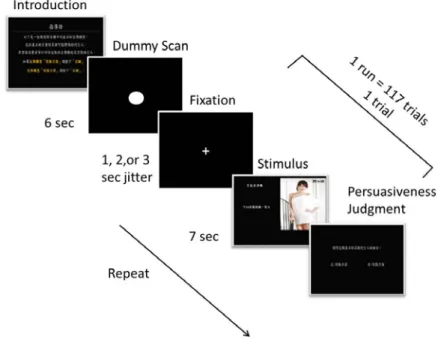
minimize head motions. All participants reported no difficulty in viewing stimuli or hearing instructions. Participants who required vision correction used either MRI-compatible contact lenses or MRI-compatible plastic goggles. The experiment was performed in two runs. First run contained 117 advertising stimuli with spokesperson and the other run contained 117 advertising stimuli without spokesperson. During each run, participants were first presented with the instruction and a dummy scan by self-paced, and the 117 trials were presented. Within one trial, a stimulus was presented for 7 seconds following a fixation period with randomly jittered inter-trial intervals of 1, 2, or 3 seconds. Participants were asked to judge whether the advertising concept was persuasiveness or not persuasiveness. (see Fig. 1).
Fig. 1. Study 2: fMRI procedures of experimental design. The experiment was performed in two runs, and 117 trials were presented in each run.
The response time was unlimited until the participant responded the question. The stimuli of the 3 type argument (strong[52]/weak[52]/heuristic[13] argument) of persuasiveness judgment were also randomly distributed in each run. There was a 1-min break between the two runs, and each
20
run took approximately 21 minutes. The total duration of the experiment for each participant was approximately 44 minutes. Participants then completed a post-scan 3-point rating of the persuasiveness judgment on each argument with product, in order to for this research to retrieve the brain–behavior relationship later. Finally, participants were requested to choose dislike and unknown spokesperson from the 52 spokespersons.
Data collection. Scans were performed in a 3-tesla Siemens Megnetom Skyra Siemens MRI
scanner using a 32-channel head coil. Visual stimuli were presented to the participants on a Hitachi CP-SX635 Projector. BOLD echoplanar images (EPIs) were collected using T2*-weighted gradient-echo echoplanar imaging sequences (voxel size, 4*4*3𝑚𝑚𝑚𝑚3 ). Each volume contained 34 transversal slices of 3 mm slice thickness that were oriented parallel to the anterior and posterior commissure (AC–PC) line covering the entire brain (TR=2000 ms, TE=24 ms, flip angle=90°, FOV=256 mm, 64*64 matrix, in plane-resolution=4.0*4.0 mm2
). High-resolution T1-weighted structural images were also acquired using the 3D MPRAGE pulse sequence: TR=1560 ms, TE=3.30 ms, flip angle=15.0°, 256*256 voxel matrix, FOV=256 mm, 192 contiguous axial slices, thickness=1.0 mm, and in-plane resolution: 1.0*1.0 mm2. This study included two runs, and the first two TRs in each functional run were discarded to avoid T1 equilibrium effects.
fMRI data preparation and analysis. Prior to statistical analysis, all images were
reconstructed, aligned, and corrected (in the x and y dimension) for movement artifacts (Woods, Mazziotta, and Cherry 1993). A two-dimensional Gaussian filter (approximately 3 mm at half-height) was applied to enhance signal-to-noise characteristics for each voxel. Signal changes during brain activity were identified using a “block design” that compared average signal amplitude acquired during the activity epochs with average signals acquired during baseline epochs according to a general linear model. An “active” voxel was defined as one in which the average magnetic resonance signal acquired during the stimulation periods was significantly different from the average baseline levels, p < .005, corrected for multiple comparisons based on empirically validated false-positive rates obtained using both resting brain and copper sulfate phantoms (Hirsch et al.
21
2000). This particular analysis procedure was developed to map sensory/motor, language, and visual-sensitive areas for neurosurgical planning using fMRI, and has been validated by conventional mapping techniques such as direct cortical stimulation, somatosensory evoked potentials, and surgical outcome studies.
An active area was defined for each participant as a cluster of at least 5 contiguous voxels each with a false-positive rate, p < .005. To preserve the highest spatial resolution for each participant, an idiopathic strategy was applied for the first stage of data analysis where each participant was processed separately. A modified “forward transform” method was employed to assign labels to the active individual brain areas for each subject where the brain topology was employed as an index to labels of the Human Brain Atlas (Lancaster et al. 2000). Accordingly, the stages of assignment included identification of the brain slice passing through the AC/PC line and location of respective commissures of the axial view; assignment of an atlas plate to each brain slice; location of the vertical AC/PC plane on all T2*-weighted images of brain slices; location of the central sulcus and confirmation of those landmarks on all T1-weighted images of brain slices; assignment of the anatomical labels, Brodmann’s areas, and atlas sectors for each active cluster; and determination of each active cluster volume on the basis of voxel count.
Results
Manipulation checks. The spokespersons were checked by participants’ post-test behavioral
responses to whether they have seen the spokespersons or not. Generally, participants recognized the 52 spokespersons. Moreover, three type arguments (strong/weak/heuristic argument) also were checked by participants’ post-test response. Participants’ persuasiveness judgments for the three type arguments are consistent with the design.
Strong versus weak argument contrast. The hypothesis about the contrast of strong versus
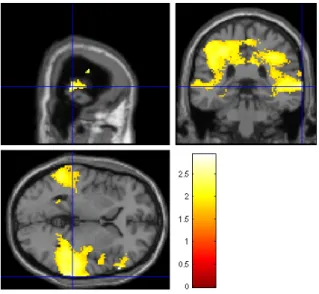
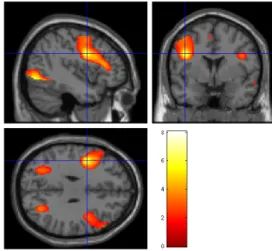
weak argument suggested a stronger activation in MPFC and AFC. However, the result did not support hypothesis 2. Instead, the experimental results showed that BA32 (R, Anterior Cingulate)
22
was activated. The anterior cingulate cortex (ACC) is the frontal part of the cingulate, and it consists of BA 24, 32, and 33 (Foxall, 2015). Anterior cingulate cortex (ACC) is involved in rational cognitive functions, such as reward anticipation, decision-making, empathy, impulse control, and emotion (Foxall 2015).
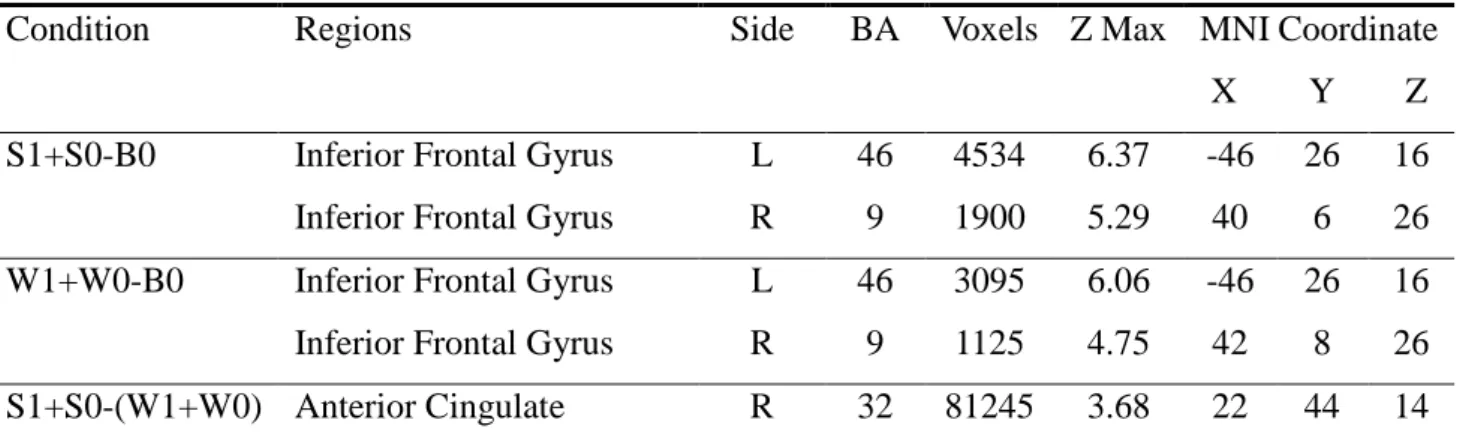
Table 1. Activated Regions in the Strong versus Weak Argument Contrast
Condition Regions Side BA Voxels Z Max MNI Coordinate
X Y Z S1+S0-B0 Inferior Frontal Gyrus L 46 4534 6.37 -46 26 16 Inferior Frontal Gyrus R 9 1900 5.29 40 6 26 W1+W0-B0 Inferior Frontal Gyrus L 46 3095 6.06 -46 26 16 Inferior Frontal Gyrus R 9 1125 4.75 42 8 26 S1+S0-(W1+W0) Anterior Cingulate R 32 81245 3.68 22 44 14 Note 1: S = Strong argument, W = Weak argument, 1 = with spokesperson, and 0 = without
spokesperson.
Note 2: BA = Brodmann’s area; Voxels = number of voxels in cluster, only clusters with an extent threshold of p < .05, corrected for whole brain and cluster 10 or greater are presented; threshold of p < .05, FWE corrected.
23
W1+W0-B0: BA46 (L, IFG) W1+W0-B0: BA9 (R, IFG)
S1+S0-(W1+W0): BA32 (R, Anterior Cingulate)
With versus without spokesperson contrast between strong and weak argument. The
present study assumed that the different brain activations between strong and weak argument was stronger in middle frontal gyrus when the advertisement had a spokesperson than no spokesperson’s endorsement. However, the experimental results showed that no activation difference in brain. Table 2. Activated Regions in the Spokesperson Contrast between Strong and Weak Argument
Condition Regions Side BA Voxels Z
Max
MNI Coordinate X Y Z
S1-W1 Middle Frontal Gyrus L 9 44419 4.49 -34 32 34
S0-W0 Middle Frontal Gyrus R 10 40012 3.44 38 46 18
S1+S0-(W1+W0) No Activation Area
Note: BA = Brodmann’s area; Voxels = number of voxels in cluster, only clusters with an extent threshold of p < .05, corrected for whole brain and cluster 10 or greater are presented; threshold of p < .05, FWE corrected.
24
S1-W1 BA9(L, Middle Frontal Gyrus) S0-W0 BA10(L, Middle Frontal Gyrus)
Heuristic versus strong argument contrast. The comparison of brain area activation
between heuristic versus strong argument could reveal the perceptual difference between these two types of argument. The contrast indicated no activation difference in brain while participants responded to heuristic than strong argument (i.e., H1 vs. S1, H0 vs. S0, and H1+H0 vs. S1+S0). Thus, hypothesis 4 was not supported.
Discussion
The first fMRI experiment tested participants' brain activations after receiving strong or weak arguments. The most significant result was that participants exposed to the strong arguments had relatively higher activation in Anterior Cingulate (ACC). ACC is the frontal part of the cingulate, which is involved in rational cognitive functions, such as reward anticipation, decision-making, empathy, impulse control, and emotion (Foxall 2015). The result revealed that strong argument did bring in more rational cognitive processes than weak argument. In addition, the stronger activation between strong and weak arguments was not influenced by the present of spokesperson or not. However, the brain activity difference was not significantly different between strong and heuristic argument.
The next fMRI experiment will incorporate the involvement level into the study design as most ELM and HSM studies emphasized.
25
Study 3. Neuro-Activation during Messages Process under High and Low
Involvement
Study 3 employed an fMRI experiment to explore activities of Brodmann area when consumer received and processed ad information under different levels of involvement. A 2 (with[117]/without[117] spokesperson) * 3 (strong[52]/weak[52]/heuristic[13] argument) * 2 (High/Low involvement) within design experiment was planned. The major difference between Study 2 and 3 was that Study 3 carried one extra variable: involvement.
Participants
Thirty-three neurologically healthy, National Chengchi University students participated in this study. One participant fell asleep and one participant did not complete the fMRI scan. Eventually, 31 participants (13 males and 18 females) aged 20–23 (20.4 years) were included in this study. All participants were Mandarin speakers, had normal or corrected-to-normal vision, and had no history of previous neurological or neuropsychological disorders. The study design passed the evaluation by the Research Ethics Committee of the National Taiwan University; furthermore, a written informed consent was signed by each participant, with approximately US $17 as the incentive.
Materials
The stimulus set contained 234 designed advertisements through E-prime in the fMRI study. There are 52 products (in 13 categories) and 52 celebrities in this study. These products and celebrities are selected by researchers were used in current study. The selecting process was similar to Study 2 and the major parts of the stimuli were the same as what was used in Study 2. High involvement group had 118 advertising stimuli, including 52 strong arguments, 52 weak arguments, and 14 heuristic arguments, half with and half without spokesperson. Low involvement group had 116 advertising stimuli including 52 strong arguments, 52 weak arguments, and 12 heuristic arguments, half with and half without spokesperson.
26
Procedures
fMRI experiment. The participant’s head was fixed with foam pads during the fMRI scan to
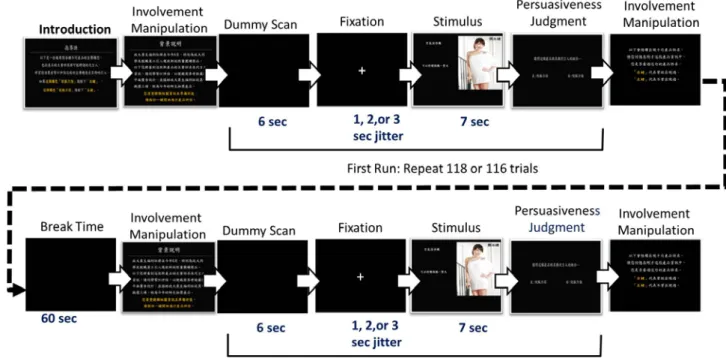
minimize head motions. All participants reported no difficulty in viewing stimuli or hearing instructions. Participants who required vision correction used either MRI-compatible contact lenses or MRI-compatible plastic goggles. The experiment was performed in two runs, high involvement or low involvement, and two run were presented in a random order. Three types of arguments (i.e., strong, weak, and heuristic) of were also randomly distributed within high or low involvement run. During each run, participants were first presented with the instruction and a dummy scan by self-paced, and the 118 trials (or 116 trials) were presented. Within one trial, a stimulus was presented for 7 seconds following a fixation period with randomly jittered inter-trial intervals of 1, 2, or 3 seconds. Participants were asked to judge whether the advertising concept was persuasiveness or not persuasiveness (see Fig. 2).
Fig. 2. Study 3: fMRI procedures of experimental design. The experiment was performed in two runs
27
one minute break between the two runs, and each run took approximately 20 to 25 minutes. The total duration of the experiment for each participant was approximately 45 to 55 minutes. After the fMRI session, participants had to complete a rating on the persuasiveness judgment of each argument with product and the recognition of spokesperson, which were the same as what was in Study 2. In addition, 20 fake arguments and 8 unused celebrities, which were not presented during the fMRI session, were added into the questionnaire. Participants were asked to distinguish those they didn’t see in the fMRI session.
Data collection, preparation, and analysis. All the fMRI data collecting and preparing
process was the same as the Study 2.
Results
Manipulation checks. The spokespersons were checked by participants’ post-test behavioral
responses to whether they have seen the spokespersons or not in the fMRI. Participants’ correct rate was generally above 75%. Moreover, three type arguments (i.e., strong/weak/heuristic argument) were also examined by participants’ post-test response. Participants’ persuasiveness judgment for the three type arguments were the same as original design. However, one participant’s correct rate for recognition was below 70%, and was excluded for the following analysis.
High versus low involvement contrast with strong arguments. This study proposed that
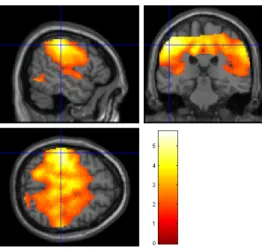
when consumers make a judgment about an advertisement with strong arguments, high-involved consumers’ MPFC and DLPFC were activated more than low-involved ones. The findings indicated that the activation level of BA22 (R, Middle Temporal Gyrus) was higher when high-involved people process the strong advertisement arguments than those of low-involved people (see Table 3). Though hypothesis 5 was not supported and the expected AFC and MPFC activation was not found, the activation of middle temporal gyrus (MTG) was supported to take the role of accessing word meaning while reading (Acheson and Hagoort, 2013). The higher
28
activation of MTG among high- than low-involved people supported that high-involved people process the meaning of strong advertisement appeals more than low-involved people.
Table 3. Activated Regions in the High versus Low Involvement Contrast with Strong Arguments
Condition Regions Side BA Voxels Z
Max
MNI Coordinate X Y Z HS1+HS0-(LS1+LS0) Middle Temporal Gyrus R 22 18678 2.72 72 -34 2 Note: BA = Brodmann’s area; Voxels = number of voxels in cluster, only clusters with an extent
threshold of p < .05, corrected for whole brain and cluster 10 or greater are presented; threshold of p < .05, FWE corrected.
Low versus high involvement contrast with spokesperson. Hypothesis 6 assumed that
low-involved consumers’ NAcc would activate stronger than high-involved consumers did when they made a judgment about an advertisement with attractive spokesperson. However, the fMRI experiment found no brain area was activated differently. The result suggested that the brain area of high and low involved participants reacted similarly while facing attractive spokesperson.
High involvement with strong argument versus baseline contrast. This study assumed that
29
product in advertisement than the baseline. The contrast indicated the activation level of BA9 (L, Inferior Frontal Gyrus) was higher when high-involved people process the strong advertisement arguments than baseline. BA9 (R, Inferior Frontal Gyrus) is part of the medial prefrontal Cortex (MPFC), and so Hypothesis 7a is supported.
Table 4. Activated Regions in the Contrast of High Involvement with Strong Argument versus Baseline
Condition Regions Side BA Voxels Z
Max
MNI Coordinate X Y Z HS1+HS0-B0 Inferior Frontal Gyrus L 9 3353 4.85 -42 2 30 Note: BA = Brodmann’s area; Voxels = number of voxels in cluster, only clusters with an extent
threshold of p < .05, corrected for whole brain and cluster 10 or greater are presented; threshold of p < .05, FWE corrected.
High versus low involvement contrast with strong arguments. This study proposed that
high-involved consumers activated their medial prefrontal cortex (MPFC) stronger when they received strong arguments of a product in advertisement than low-involved consumers who heuristically processed all kinds of advertisement appeals (H7b). Different from the expectation, the result indicated that BA2 (L, Postcentral Gyrus) was activated comparing high and low involvement with strong versus heuristic argument, respectively (Table 5). Postcentral Gyrus is considered part of the somatic sensory system and responsible for the sense of touch (Blakemore, S.J. et al. 2005).
30
Table 5. Activated Regions in the Contrast of High Involvement with Strong Argument versus Low Involvement with Heuristic Argument
Condition Regions Side BA Voxels Z
Max
MNI Coordinate X Y Z (HS1+HS0)-(LH1+LH0) Postcentral Gyrus L 2 43687 4.66 -52 -28 46 Note: BA = Brodmann’s area; Voxels = number of voxels in cluster, only clusters with an extent
threshold of p < .05, corrected for whole brain and cluster 10 or greater are presented; threshold of p < .05, FWE corrected.
Low involvement with heuristic argument versus baseline contrast. This study proposed
that low involved consumers’ DLPFC is activated stronger when they received heuristic arguments of a product in advertisement than the baseline. The contrast indicated the activation level of BA18 (L, Middle Occipital Gyrus) and BA18 (R, Middle Occipital Gyrus) was higher when low-involved participants processed the heuristic advertisement arguments than the baseline. Middle Occipital Gyrus is part of the occipital cortex in the human brain, and it is visual association area and responsible for the interpretation of images (Mangun et al. 1998). Thus, hypothesis 8a was not supported, but the result showed that even low-involved participants with heuristic argument still tried to process the ad image received.
Table 6. Activated Regions in the Contrast of Low Involvement with Heuristic Argument versus Baseline
31
Condition Regions Side BA Voxels Z
Max
MNI Coordinate X Y Z LH1+LH0-B0 Middle Occipital Gyrus L 18 2657 5.84 -22 -96 2
Middle Occipital Gyrus R 18 1491 5.30 26 -88 -2 Note: BA = Brodmann’s area; Voxels = number of voxels in cluster, only clusters with an extent
threshold of p < .05, corrected for whole brain and cluster 10 or greater are presented; threshold of p < .05, FWE corrected.
BA18 (L, Middle Occipital Gyrus) BA18 (R, Middle Occipital Gyrus)
Low versus high involvement contrast with strong arguments. Low-involved consumers
were expected to reveal a stronger activation in their dorsolateral prefrontal cortex (DLPFC) than high-involved ones when they received heuristic arguments of a product in advertisement (H8b). However, the result did not show any significant activation or support to this hypothesis.
Discussion
Hypothesis of high involvement in brain. Study 3 had manipulated the involvement level of
participants, which was one more variable beyond what were in Study 2. Generally, the results provided evidence that consumers thought deeply or used more cognitive resources when they were highly involved with the advertisement than when they were not. Comparing the brain activities of high versus low involvement situations, the activation of MTG revealed more brain process on word meaning while reading (Acheson and Hagoort, 2013). High involved consumers took
32
systematic process on strong arguments of a product in advertisement, thus their MPFC was more activated than the baseline. It means that when high involved consumers received strong arguments of a product in advertisement, they used more cognitive resource and processed carefully. However, no evidence showed that compared to low involved ones, high involved consumers would activate their MPFC more when they received strong arguments in advertisement. Therefore, it could be concluded that although low-involved consumers heuristically processed all kinds of advertisement appeals, their MPFC were still activated as strong as high involved ones.
Hypothesis of low involvement in brain. In addition, this study tried to identify how the
brain process of low involved consumers would be different from the high involved ones. The results revealed no difference between the involvement levels. However, the interesting result appeared in the comparison of low involvement and the baseline. The contrast results indicated the activation level of left and right Middle Occipital Gyrus in the brain of low-involved consumers when they processed the heuristic advertisement arguments than the baseline. Middle Occipital Gyrus is related to visual association and interpretation of images (Mangun et al. 1998), which indicated the possibility that low involved consumers with heuristic argument basically processed the ad image.
General Conclusion
This study built up all propositions based on the similarities and differences between two important dual processing models of information (i.e., ELM and HSM) and employed both traditional experiments and the state of the art technology fMRI to illustrate the comparison. The results generally support the dual processes that high involved consumers processed the advertisement information differed from low involved ones.
As supported in the traditional experiments, high involved consumers pay more attentions on if the adverting appeal is strong and reasonable; also they form better attitudes toward the ad and
33
product if the spokesperson fit the product than the low involved ones. Obviously, high involved consumers process information logically and thoroughly. This deep process of high involved consumers is also revealed in their brain activity of during of the process. The activation of Middle Temporal Gyrus is related to word meanings and cognition; thus the result directly supports the strong elaboration and systematic process.
The current studies also found that the argument itself can trigger different levels of information process. First, high- and low-involved people process strong, weak, and heuristic advertisement appeals differently, which is supported in Study 1a. High-involved consumers can distinguish the difference between arguments, and react better toward strong argument; however, low-involved consumers form similar attitudes to these arguments. Furthermore, Anterior Cingulate Cortex which is related to rational cognitive functions, such as reward anticipation and decision-making, is more activated when consumers process strong arguments than weak ones. However, the differences between strong versus heuristic and heuristic versus weak arguments are not clear enough.
This study not only supports the dual information processes, but also clearly reveals the psychological mechanism in the processing. The results enrich the knowledge of ELM and HSM by showing the major brain topographies of information process in different levels of involvements and arguments. We are hopeful that future research may focus on the direct links and explanation of the relationship between brain activation and the type of information processing.
34
Reference
Aaker, J. L. (1997). Dimensions of brand personality. Journal of Marketing Research, 34 (Aug.):347-356.
Aaker, J. L. and Mabeswaran, D. (1997). The effect of cultural orientation on persuasion. Journal of Consumer Research, 24, 315-328.
Acheson, D. J. and Hagoort, P. (2013). Stimulating the brain's language network: syntactic ambiguity resolution after TMS to the inferior frontal gyrus and middle temporal gyrus. Journal of Cognitive Neuroscience, 25 (10), 1664-1677.
Ambler, T. and Burne, T. (1999) The impact of affect on memory of advertising. Journal of Advertising Research, 39 (2), 25-34.
Ambler, T., Brautigam, S., Stins, J., Rose, S., and Swithenby, S. (2004). Salience and choice: Neural correlates of shopping decisions. Psychology Marketing, 21 (4), 247-261.
Ambler, T., Ioannides, A., and Rose, S. (2000). Brands on the brain: Neuroimages of advertising. Business Strategy Review, 11 (3), 17-30.
Blakemore S. J., Bristow, D., Bird, G., Frith, C., Ward, J. (2005). Somatosensory activations during the observation of touch and a case of vision-touch synesthesia. Brain, 128, 1571–1583.
Bohner, Gerd, Frank, Elisabeth, and Erb, Hans-Peter (1998). Heuristic processing of distinctiveness information in minority and majority influence. European Journal of Social Psychology, 28 (5), 855-860.
Bohner, Gerd, Markus Ruder, and Erb, Hans-Peter (2002). When expertise backfires: Contrast and assimilation effect in persuasion. Journal of Social Psychology, 41, 495-519.
Bohner, Gerd, Moskowitz, Gordon B., and Chaiken, Shelly (1995). The interplay of heuristic and systematic processing of social information. European Review of Social Psychology, 6,