
台北市與上海市國中生英語學習動機比較 - 政大學術集成
111
0
0
全文
(2) Thesis Topic A Comparison of English Learning Motivations of Junior High School Students in Taipei and in Shanghai. 研究生: 劉孟珠 指導教授 : 陳陸輝博士. Advisor: Dr. Lu-huei Chen. 政 治 大. 學. ‧ 國. 立. Student: Mengchu Liu. A Thesis. ‧. Submitted to International Master’s Program in Asia-Pacific Studies. y. sit. Nat. National Chengchi University. er. io. In partial fulfillment of the Requirement. n. For theadegree of Master in China v Studies. i l C n U hengchi. July 2010.
(3) Abstract This study tried to investigate the different motivation in English learning and the elements that influence the student's motivation between the junior high school students in Shanghai and Taipei.. This study is. conducted through social observation and qualitative research approaches. The scope of this study focuses on the investigation in Taipei and Shanghai. The subjects of this research will be the junior high school students in Taipei and the junior high school students in Shanghai, and the graduated or elder students, and the students' teachers and parents as well.. 政 治 大. After the research, there are some findings. The overpopulated pressure. 立. lead students in China must study harder to enter top prestigious. ‧ 國. 學. universities. The interviewers in this study revealed that Taiwanese students do not totally study due to external stress and English learning is. ‧. based on interests. Parents in Taiwan hope their kids not only learn. sit. y. Nat. English for good grades but also develop their interests in English learning. In Shanghai, parents urge their children to study all the time.. er. io. n. Parents concern the aschool grades very much. In Taipei, teachers are. l. iv. n in Shanghai are more C h Differently, U willing to be students’ friends. teachers. engchi. authoritative than in Taipei.. Teachers emphasize the accuracy on. English learning. China’s accession to WTO affects the model of English learning. Globalization accelerates the trend to learn English.. These. years China runs some world-class convention and exhibition which attract more international business and tourists and encourage Chinese to learn English. In the process in this study, we found the English learning motivation of students in Shanghai is stronger than Taiwan's students.. i.
(4) TABLE OF CONTENTS 1. Introduction...................................................................................................................... 1 1.1 Motivation................................................................................................................ 1 1.2 Purpose .................................................................................................................... 2 2. Literature Review and Research Method ...................................................................... 4 2.1 Previous Studies ...................................................................................................... 4 2.2 Theoretical basis for the Research ........................................................................11 2.3 Vroom's Expectancy Theory of Motivation...........................................................11 2.4 Hypothesis ............................................................................................................. 14 2.5 Research Method................................................................................................... 15. 治 政 大 2.7 Instrument ............................................................................................................. 16 立 2.8 Subjects.................................................................................................................. 16. 2.6 Scope of Research ................................................................................................. 16. ‧ 國. 學. 2.9 Research Design.................................................................................................... 17 2.10 Procedure............................................................................................................. 17. ‧. 3. The English Learning History and Development in Taiwan and in China............... 19 3.1 Why learn English................................................................................................. 19. y. Nat. sit. 3.2 The English learning history and development in Taiwan.................................. 23. er. io. 3.3 The English learning history and development in China.................................... 27. al. n. iv n C 4.1 The factors and resultsh of English learning e n g c h i U motivations in Taipei ..................... 30 4.2 Brief conclusion of English learning motivations in Taipei ............................... 60. 4. The factors and results of English learning motivations in Taipei ............................ 30. 5. The factors and results of English learning motivations in shanghai ....................... 64 5.1 The factors and results of English learning motivations in Shanghai ............... 64 5.2 The brief conclusion of English learning motivations in Shanghai................... 85 6. Conclusion ...................................................................................................................... 88 Reference............................................................................................................................. 98 Appendix........................................................................................................................... 104. ii.
(5) 1. Introduction. With the economy of China improving, people of China begins to heed the importance of English language. passion.. Chinese people are now learning English with unprecedented. During this recent period of high economic growth in China, a large of. number of Taiwan businessmen have been doing business in the Mainland China and many of whom brought their entire family to live and be educated in China.. Many. of these Taiwanese businessmen have brought back information in connection with their educational experience in the Mainland China.. We now have means to learn. more about China's educational system including English language education and learning.. 政 治 大. 立. 1.1 Motivation. ‧ 國. 學. Few years ago, one of my students (junior high school) migrated to Dalian, China and. ‧. studied there because her father was transferred to work there.. Like most of the. children of Taiwanese employees stationed in the Mainland China, she came back to. sit. I was impressed at level of English taught in China which is much. io. higher than that in Taiwan.. n. al. er. text books.. She came to see me and showed me her English. y. Nat. Taiwan during summer vacations.. The thought that came to my mind was that although. Ch. i Un. v. China is big and powerful with a nationalistic attitude, it still has the ambition and. engchi. drive to become more competitive by making their population proficient in foreign languages.. I was intrigued by the Chinese students' motivation to learn English.. Another reason to arouse my interest in this subject is a certain teacher in China that I heard about.. The teacher, Li Yang, is a passionate and enthusiastic English teacher. who taught countless Chinese people his "crazy English" and earned a very high reputation.. Yang is very good at motivating people's desire to learn.. Yang. motivates people's desire, their ambitions and even their love for their country. Yang's motivational teaching in English was at the peak during the time when China held the Beijing Olympic Game.. In 2008, China held the Beijing Olympic Game which caused an English learning 1.
(6) “fever”.. People learn English like crazy, from kids, students in every rank of schools,. young people and even grandfathers and grandmothers tried to learn English.. Chao. Chi-Cheng1, a committee member of the Chinese Peoples' Political Consultative Conference, in an English speech competition said that, Chinese people learned English for learning new technology few decades ago; but now, Chinese people learn English for introducing China to the world and for presenting the Chinese culture, which I doubt very seriously is the sole or even the strongest motivation behind this phenomenon.. Regardless, the motivations behind learning English appear to be very. different in China and Taiwan, at least on the surface.. Some of the Taiwanese businessmen's children who migrated to China with their parents and went to local schools or international schools cannot catch up with the. 政 治 大. local students' English level and were asked to move to a lower grade.. 立. Chinese high. school students construct their future career plan with determination and Taiwan should be aware of the crisis in their competitiveness and. ‧ 國. 學. hard-working.. should take a look at what is behind Chinese students' strong motivation and ambition. ‧. in learning English.. Nat. sit. y. While I was doing my studying, I noticed that there are many researches made in. io. er. connection with college students' English learning motivation but very few in connection with the motive of high school students.. al. It is meaningful to do this. n. v research in order to achieve better C h comprehension Uonnthei advantage and disadvantage e n gin cChina h i and Taiwan. The results from this English teaching and learning methods research could also be beneficial in forming relevant educational policies.. 1.2 Purpose This study is trying to investigate the difference in English learning motivation levels between the junior high school students in Shanghai and Taipei, the two largest cities in China and Taiwan respectively.. This paper will also identify. the elements that influence the student's motivation levels in learning English in 1. Sun, Lu (2009). Chao Chicheng looked back to see the history of “English fever” in China. Retrieved April 13, 2009 from http://cppcc.people.com.cn/BIG5/35377/9117490.html 2.
(7) these two cities.. Taiwan and China have the same Chinese language and the same culture, but they have developed separately in the last 60 years.. The Culture of Revolution. in China, especially, has introduced vastly different concepts of value and behavior model to Chinese people.. Taiwan, on the other hand, is an island. once colonized by Japan and its people was forced to learn Japanese.. After. Chinese nationalist came to Taiwan at the end of the Chinese civil war in 1949, Taiwanese people were forced to speak Chinese Mandarin in stead of Taiwanese. While the communist China was in a period of self imposed isolation, Taiwan was flourishing in international trade and Taiwanese people spontaneous learn English in order to pursuit higher academic achievement and international business achievement.. 政 治 大. Taiwan is a relatively small economy and well. 立. understood the importance of international trade and its people are aware of the. ‧ 國. It was only about twenty years ago. 學. advantage of knowing different languages.. that China started to attach importance to English learning2.. ‧. n. er. io. sit. y. Nat. al. 2. Ch. engchi. i Un. v. Wang, Shaomin (2005). A review of researches on English Learning Motivation in China over the past 20 years. Journal of TV University. Retrieved 2005 from http://www1.open.edu.cn/elt/11/4.htm. 3.
(8) 2. Literature Review and Research Method. 2.1 Previous Studies Some theorists traced back the concept of motivation to Plato and Aristotle (Pintrich, P. & Schunk, D., 1996)3, who discuss the concept of "willingness".. Various theories. of psychology lead to different definitions of motivation and classification schemes. In Gareth R. Jones and Jennifer M. George's book4, motivation is explained as "psychological forces that determine the direction of a person's behavior in an organization, a person's level of effort and a person's level of persistence". He 政 治 大 devised a simple model that demonstrates the process of motivation: Needs - drives 立 behavior - goals - reduction or release of tension.. According to Joe Kelly's book5, motivation is deeply affected by the needs.. ‧ 國. 學. In the field of educational psychology, the motivational construct was examined in Intrinsic motivation is from. ‧. terms of intrinsic and extrinsic6 motives of the learners.. y. Nat. internal rewards to a task or activity itself; people do certain activities for their own. sit. self-perceived needs and goals and pleasure. 7 Intrinsic motivation researchers. er. io. believed that humans were inherently prone to pursue opportunities to develop their. al. n. iv n C increased competence. Extrinsic comes from external reward such as h emotivation ngchi U money, outside reinforcement and even certain types of positive feedback.8 Behaviors. feelings of competence, possibly obtaining pleasure from the experience of the. that react to avoid punishment were also extrinsically motivated.. Intrinsically. motivated students determine to do much better in classroom activities, because they. 3. 4. 5 6. 7. 8. Pintrich, P. & Schunk, D.(1996). Motivation in Education: Theory, Research & Applications, Ch. 3. Englewood Cliffs, NJ: Prentice-Hall. Jones, Gareth R. and Jennifer M. George (2008). Contemporary Management. Irwin Professional Publish. Consador, Kat (2009). What Is the Definition of Employee Motivation? Retrieved September 11, 2009 from http://www.ehow.com/about_5387352_definition-employee-motivation.html Kelly, Joe (1980). How Managers Manage. N.J: Prentice-Hall, Englewood Cliffs. Sansone, Carol & Harackiewicz, Judith M. edited (2000) Intrinsic and Extrinsic Motivation: The search for optimal motivation and performance. San Diego: Academic Press, P.444~P.452 Deci, E. L., & Ryan, R. M. (1985). Intrinsic motivation and sef-determinaton in human behaviour. New York: Pienum. Deci, E. (1972). Intrinsic Motivation, Extrinsic Reinforcement, and Inequity. Journal of Personality and Social Psychology 22 (1): P.113~P.120 4.
(9) are willing and eager to learn new material automatically.. Their learning experience. is more meaningful, and they go deeper into the subject to fully understand it. Diversely, extrinsically motivated students may perform the same tasks for chasing certain temptation like grades, compliments.. In the field of second/foreign language learning, Canadian social psychologists Robert Gardner9 and Wallace Lambert10, accentuated motivational issues and claimed that motivation played a determining role in successful language acquisition11. They found that two orthogonal factors were equally related to second-language achievement, one an intellectual or aptitude factor, and the other a motivational factor, which was characterized by a strong drive to learn the language, favorable attitudes towards the language group, and an expressed desire to learn more about the language. 政 治 大. group and meet more of its members (referred to as an integrative orientation).12. 立. Their social-educational model of integrative and instrumental motivation had been. ‧ 國. his doctorial thesis. 13. 學. the leading model for decades, which represents reasons for studying languages.. In. in 1960, Robert Gardner postulated that the distinction between. ‧. integrative and instrumental orientations implies an attitudinal as well as a motivation difference between two types of language students.. “Those students who are. Nat. That is, the linguistic responses. io. er. they are trying to learn are not rewarding to them”14.. sit. y. instrumentally oriented may be handicapped by the fact that the linguistic responses. are not really meaningful for instrumentally oriented students, while integrative. n. al. Ch. i Un. v. oriented students, on the other hand, enjoy the foreign speech sounds, grammatical. engchi. rules, etc., because they are willing to behave as valued members of a certain language group.. He conducted a research on English speaking high school students learning. French in Montreal in Canada to examine the factors of Second-Language Achievement, Integrative-Motivational, Home Background, General Associational Fluency or Meaningfulness, General Ethnocentrism, Home Discipline-Anomic 9. Gardner, R. & W. Lambert (1959), Motivation variables in second language acquisition. Canadian Journal of Psychology, 13:P.266~P.272 10 Lambert, Wallace E. (1972) Language, Psychology and Culture. California: Stanford University Press, P.9~P.31 11 Edwards, John (1985). Language, Society and Identity. Oxford: Basil Blackwell Ltd. P.146~P.158 12 Gardner, Robert C. (1960a). Motivation variables in second language acquisition .Doctorial thesis, McGill University. 13 Gardner, Robert C. (1960b). Motivation variables in second language acquisition .Doctorial thesis, McGill University. From http://publish.uwo.ca/~gardner/docs/phd.pdf 14 Gardner, Robert C. (1960c). Motivation variables in second language acquisition .Doctorial thesis, McGill University. From http://publish.uwo.ca/~gardner/docs/phd.pdf P.16 5.
(10) Orientation, Parental Supports of the Integrative Orientation.. It was found that the. integrative-oriented students liked their French-Canadian acquaintances significantly more than those who were instrumentally oriented.. In the 1970s, the psychologist Abraham Maslow suggested that people are motivated by a hierarchy of needs15.. According to Abraham Maslow's Hierarchy of Needs. Theory, people are motivated by needs that remain unsatisfied, and that certain lower factors must be satisfied in order for higher needs.. Maslow recognized the general. categories of needs (the physiological need, the safety need, the belonging and love need, the esteem need, the need for self-actualization) which have to be fulfilled in order to prevent illness.. These needs were referred to as “deficiency needs”.. When. people are motivated to fulfill these needs, people progress toward growth and, eventually, self-actualization.. 立. 政 治 大. ‧ 國. 學. Due to the very few researches on comparison of English learning motivations of junior high school students in China and in Taiwan, this paper is trying to cite the. sides.. ‧. point of view from the researches from both sides to present the situation of both. sit. y. Nat. io. er. Liao (2007) in Taiwan did the study “A Study of Taiwanese Junior High School Students' EFL Learning Motivation and Learning Strategies”.16. al. In Liao’s study, a. n. i v from ten different classes motivational questionnaire was and 315 students n C developed hengchi U in a junior high school located in Miaoli County in central Taiwan were interviewed.. The participants in Liao’s study reported several orientations including, integrative orientation, instrumental orientation and intrinsic orientation.. Liao’s study reflected that the participants’ motivation was integrative orientated. Based on Gardner’s proposition17, the integrative orientated factor refers to a desire to. 15. Maslow, Abraham H. (1954). Motivation and Personality. New York: Harper & Row, P.35~P.58 Liao, Yen-fen (2007). A Study of Taiwanese Junior High School Students’ EFL Learning Motivation and Learning Strategies, Unpublished Master Thesis, National Changhua Normal University. 17 Gardner, R. C. & Lysynchuk, L. M.(1990). The role of aptitude, attitudes, motivation and language use on second-language acquisition and retention. Canadian Journal of Behavioural Science, 22, P.254~P.270 16. 6.
(11) interact with English-speaking groups and an interest in foreign culture, the language and the people.. The students in Liao’s study showed a high affinity to English. language, customs and cultures and the special and interesting stories of the foreign culture but not necessarily actually integrate into foreign countries.. The participants. revealed that they hope to talk to the foreign tourists in fluent English and even to make friends with them.. The two motivational orientations Expectancy & Satisfaction and Utilitarian Purposes in Liao’s study generally reflected the learners’ pragmatic reasons for learning English. The construct of expectancy was referred to perceived likelihood of success and the concept of satisfaction which was related to the outcome of learning, including the combination of extrinsic rewards and intrinsic rewards.. And the utilitarian purposes 治 政language was a大beneficial tool for finishing the fact was regarded that the target individuals’ assignments.立The target language, English, was viewed as a useful tool. ‧ 國. The participants showed their learning. 學. when the learners sing or see a movie.. English for pragmatic reasons, for example, to get a good job, to pass exams, and to Moreover, the learners thought that it is necessary to. ‧. use computers and Internet.. have excellent English proficiency in Taiwan.. sit. y. Nat. io. The junior high school students in Liao’s study hoped to be better than. al. n. motivation.. er. In addition, there was a noted overlap of instrumental orientation and intrinsic. Ch. i v have been taught that Students n U. others by obtaining good English language skills.. engchi. good English proficiency can lead to a higher social status and a better future.. In the. study, it showed that a large number of participants had great confidence levels during language acquisition.. The participants also declared that they enjoyed learning. English because they were interested in learning something new.. Moreover, the construct of intrinsic motivation could be described using Weiner’s (1979, 1986)18 attribution concepts: people actively process information from their. 18. Weiner, B. (1979). A theory of motivation for some classroom experiences. Journal of Educational Psychology, 71(1), P.3~P.25 Weiner, B. (1986). An Attributional Theory of Emotion and Motivation, New York: Springer-Verlag. 7.
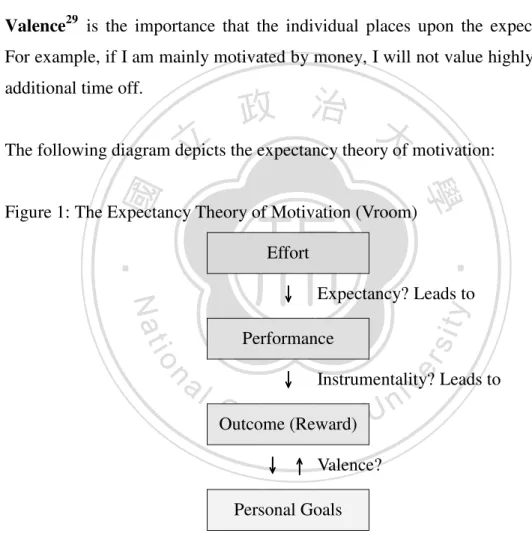
(12) past experiences or contexts in an attempt to understand and rationalize the occurrences of their success and failure in achievement contexts.. By this concept we. can see, even 18% of the learners in Liao’s study gave up learning English; it still can be attributed as the intrinsic orientated motivation.. Another relative research in Taiwan “A Study of the Relationships among Learning Motivation, Learning Satisfaction, and Learning Achievement of Junior High School Students---Example in Yunlin County”19 was written by the graduate student Chiu-li Chen in 2005.. The study involved 762 students as samples from public junior high. schools and from private junior high schools in Yunlin County in central Taiwan. One of the purposes in Chen’s study was to investigate students’ English learning motivation and tried to discuss the differences among learning motivation.. The 治 政held higher endorsement findings of the study are: students with the intrinsic goal 大 orientation; the personal立 factors affecting their English learning motivation were. ‧ 國. 學. school types, gender, learning style after class and the earlier learning, the better motivation orientation.. Students learn English for intrinsic orientated reasons like. ‧. curiosity, self-challenge, interest and positive attitude on learning.. It was. inconsistent with Huang (2004)20 who conducted a research on elementary school. Nat. It was presumed that. sit. y. students that revealed more extrinsic motivation orientated.. io. students.. er. junior high school students were more mature and deliberate than elementary school The outer rewards like prize or compliment from parents and teachers. al. n. v assent and discern they ni C hJunior high schoolU students i future. e n g cforhtheir have to study hard and be self -responsible were not the main enticement.. From the theses above, we can presume that the English learning motivation of junior high school students in Taiwan are not only more intrinsic orientated but also more integrated orientated.. Of course junior high school students in Taiwan also learn. English for pragmatic reasons and have the extrinsic motivation element for they have. 19. 20. Chen, Chiu-li (2005). A Study of the Relationships among Learning Motivation, Learning Satisfaction, and Learning Achievement of Junior High School Students---Example in Yunlin County. Unpublished master thesis. National Yunlin University of Science & Technology. Huang, Yuwen (2004). The research on senior grades teachers’ teaching attitude, the interaction between students and teachers, and the motivation of learning in elementary. Unpublished master thesis. Department of Education & Graduate Institute of Elementary and Secondary Education, National Chiayi University. 8.
(13) to be estimated by the important entrance examination to go to their ideal senior high schools.. But the studies also revealed that junior high school students in Taiwan. learn English for interest and for the reason to use this language to hook themselves to the world, to the level of self-esteem and self-actualization by Maslow’s concepts. But the studies above were investigated in the central Taiwan and were some of the present cases in Taiwan.. Thus, this study is trying to investigate the present situation. in Taipei and trying to find out the differences from Shanghai.. On the other hand, some studies in Mainland China discussed the present situation of Chinese high school students’ English learning motivation.. In 2005, Fan Mingshu in. Liaoning Normal University conducted a thesis on the topic of “An Investigation of English learning motivation of Second year of Middle school students”21.. There 治 were 70 eighth grade students in政 this study and two 大questionnaires were used. The finding indicated that the立 school children had no particular contact with foreigners and. ‧ 國. subject and students had to force to accept it.. 學. no particular interest in it and nor do their job prospects on it.. English was just a. Most schools accidentally encouraged. ‧. extrinsic orientated motivation with the teacher-directed classroom, grades and test This led the students to work to please teachers or authorities. Nat. It was meaningful for the middle. sit. rather than to develop themselves on interest.. y. and competitiveness.. school students to get high grades to please teachers and parents and to go to brand. er. io. grades was stronger than a l The termination on getting igood v using the language to fulfill their n C hlives. U engchi. n. name senior high schools.. Another study was conducted by Wen (2005).22 In this study it presented the current situation that students often complained that their classes were boring, their teachers were boring and their text books were boring.. After each examination, students’. names were listed in order based on their scores by their teachers and this let students got a lot of pressure.. For teachers, students’ scores were very important for their. promotion.. Almost all teachers participated in this study thought students learn English for the 21. 22. Fan, Mingshu (2005). An Investigation of English Learning Motivation of Second Year of Middle School Students. Unpublished master thesis. Liaoning Normal University. Wen, Aiying (2005). Effect of Students’ Motivation on English Learning in Junior Middle Schools. Unpublished master thesis. Jiangxi Normal University. 9.
(14) purposes to pass the exam and go to good universities and to get good jobs.. In China,. English is just one of the compulsory subjects; students’ aim of learning English is only to pass the examination and the subject English is one of the determined elements to go to good universities. frequently by teachers.. And cram methods of teaching were used. Wen’s research found that students spent much time on. memorizing vocabularies, grammar structures and mechanical drills which were no help on students’ English proficiency.. The teaching approach was not. communicative approach so the students lacked of interactive activities. learning materials might lack of readability, suitability and exploitability.. The. Quite a. number of studies showed that the motivation for most Chinese learners was instrumental orientated.. The research revealed that students from countryside or. non-key high schools were less motivated to learn English and their learning. 政 治 大. outcomes are generally low (Meng, 199123; Zhao and Campbell 199524; Pride and Liu 1998 25 ).. 立. Students from key high schools had stronger motivation on learning. ‧ 國. 學. English than the students from non-key schools for the factors that key high school students had much stronger determination to learn English and believed English was. ‧. important and valuable for their future and got higher scores on it as well.. The. author argued that English has become the international language and students. Nat. With. sit. y. achieve on it can hook the global village and make their dreams come true.. io. er. China’s joining in WTO, China’s development in economy, the Olympic Game in China in 2008, Chinese students learn English not only for passing the exam but also. n. al. Ch. tried to identify themselves with English.. engchi. i Un. v. From the theses above, we can assume that the English learning motivation in middle school students in China are more instrumental orientated.. Students focus their aim. on getting high scores but not on the reason of usefulness.. Teachers and parents. forced students to learn English to get better grades and enter key high schools and brand name universities.. It is guarantee to get a good job and improve the life. quality by way of getting good grades and getting top brand name university certificate.. But the situation might change gradually through China’s rapid. 23. Meng, Qingqing (1991). Letter to the Editor. China Daily, June 10 1991, P.6 Zao, Young and Campbell K.P. (1995). English in China, World Englishes, Vol.14, No. 3, P377~390 25 Pride, J. B., & Liu, R-S. (1988). Some Aspects of the Spread of English since 1949. International of Journal of the Sociology of Language, P. 41~70, 74 24. 10.
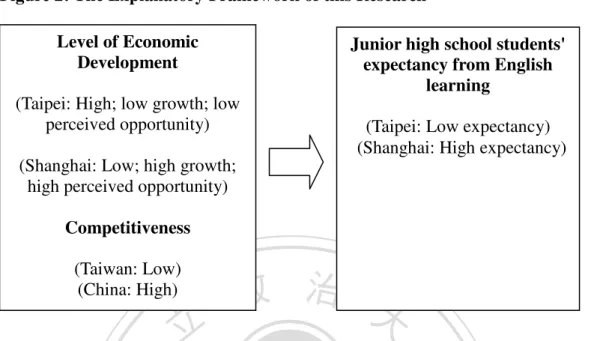
(15) economic development and hook itself internationally by the joining in WTO current years.. These researches above were conducted on the situation in Jiangxi province and Liaoning province, but in this paper we would like to get more information about the English learning motivation of junior high school students in Shanghai, the most prosperous city in China.. It is meaningful to continue digging into the context in this. paper.. 2.2 Theoretical basis for the Research. 政 治 大. This study is trying to examine how needs or personal goals affect on the motivation of the students in learning English through psychological theories and compare. 立. Taiwan's and China's high school students' motivation in learning English.. ‧ 國. 學. In this thesis, I will apply Vroom's expectancy theory of motivation, definitions of. ‧. motivation and needs as provided by Jones, George and Kelly, Gardner, Maslow and empirical data obtained from field research to identify the different needs of the junior. y. Nat. sit. high school students in Taipei and Shanghai and analyze the needs' impact on their. n. al. er. io. English learning motivations and achievements.. 2.3 Vroom's Expectancy C Theory Un h of Motivation. engchi. iv. Unlike Maslow concentrated on the relationship between internal needs and the resulting effort expended to fulfill them, Vroom separated effort (which arises from motivation), performance, and outcomes to introduce his concept of expectancy theory.. Expectancy theory is about the mental processes with reference to choice, or. choosing.. Vroom hypothesizes that effort, performance and motivation must be. linked in order to motivate a person.. Vroom proposes three variables to account for. this, which he called Valence, Expectancy and Instrumentality.26. 26. Vroom, Victor H & Kenneth R. MacCrimmon (1968), “Toward a Stochastic Model of Managerial Careers,” Administrative Science Quarterly 13, June 1968, (1): 26-46 11.
(16) Expectancy27 refers to the strength of an individual’s preference for receiving a reward.. If expectancy is higher, the individual will put higher efforts to achieve the. desired outcome. performance, i.e.. It is the belief that increased effort will lead to increased If I study harder then my grades will get better.. Instrumentality28 is the belief that if you perform well that a valued outcome will be received, i.e. if I learn English well, I can benefit something in it for me.. It refers to. the degree to which a first level outcome will lead to the second level outcome. Valence29 is the importance that the individual places upon the expected outcome. For example, if I am mainly motivated by money, I will not value highly the offers of additional time off.. 立. 政 治 大. The following diagram depicts the expectancy theory of motivation:. ‧ 國. 學. Figure 1: The Expectancy Theory of Motivation (Vroom). Expectancy? Leads to. Performance. n. al. Ch. ↓. er. io. sit. y. Nat. ↓. ‧. Effort. v. Instrumentality? Leads to. engchi. Outcome (Reward). i Un. ↓ ↑ Valence? Personal Goals. 27. 28. 29. Vroom, Victor H. (1964). Work and Motivation. John Wiley & Sons, Inc. Third Printing, April, 1967. P. 8~28 Theories of Motivation: Vroom’s Valence-Expectancy Theory from:http://www.mbaknol.com/management-concepts/theories-of-motivation-vroom%E2%80%99s -valence-expectancy-theory/ Expectancy Theory of Motivation from http://www.arrod.co.uk/archive/concept_vroom.php 12.
(17) There is a simple formula which expresses the strength of motivation:. M=E*V. E is expectancy, V is valance, and M is motivation.. It explains that the more the. expectancy and the valance, the more the motivation.. For example, the strength of. the benefit of English learning will strengthen junior high school students’ motivation in learning English. Porter, Lyman W. and Edward E. Lawler30, III(1968)enriched this pattern as four variables items: effort, performance, reward and satisfaction to explain the motivation of individual process.. 政 治 大 They demonstrate the importance. And in 1973, they made a second amendment of the new. theoretical model, by adding a “learning” factor.. 立. of learning and that the expectations of effort obtains performance and performance They also. stressed the impact of situational changes in incentives are features.. The most. ‧ 國. 學. obtains outcome were likely caused by the influence of past experiences.. The extrinsic rewards satisfy the low-level needs in. Nat. y. motivation and reward.. ‧. important feature of expectancy theory is to emphasize the relationship between. al. er. The intrinsic rewards satisfy the higher demand levels in. io. security and so on.. sit. Maslow's hierarchy of needs including food, clothes, salary, status, promotion,. n. Maslow's hierarchy of needs including the meaning of existence and the ability of self-affirmation and so on.. Ch. engchi. i Un. v. This study tries to apply Vroom's Expectancy Theory of Motivation to examine the English learning motivation in high school students between China and Taiwan through the questionnaires basic on Gardner’s definition on motivation. This study tries to interview the students in Taipei and in Shanghai to examine what kinds of personal goals are they expectant for, whether English learning is the most important reward for the students, how they performance in studying English and what effort they will make if they choose to performance well in English learning. 30. Porter, Lyman W. and Edward E. Lawler, III. (1968), Managerial Attitudes and Performance,. Homewood, IL: Richard D. Irwin, Inc.. 13.
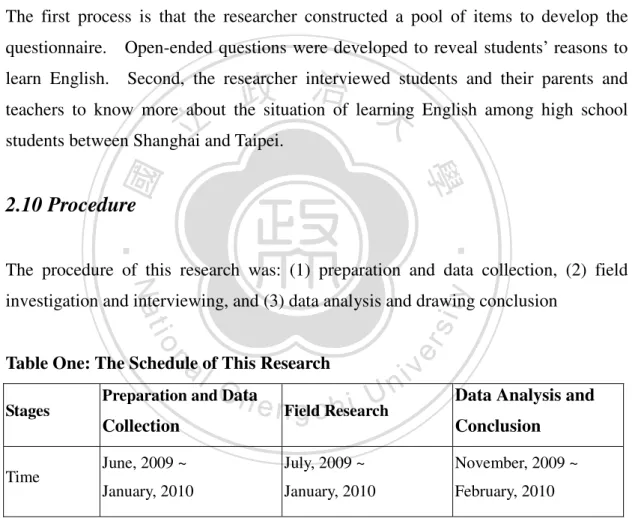
(18) 2.4 Hypothesis This study hypothesizes that high school students in Shanghai have a stronger English learning motivation than their counterparts in Taipei, due to the different environments those students are exposed to, as explained by Victor Vroom's expectancy theory of motivation.. Taipei, as compared to Shanghai, has achieved relatively higher level of economic development where its GDP per capita is much higher than Shanghai31, its educational system encourages creativity and endorses Harvard Professor Howard Gardner's theory of multiple intelligences, and therefore, people’s focus is placed on individual. 治 Most junior high school students 政 in Taipei attended senior high school and most are大 not exposed to financial pressure 立 are available to most senior high school; students could during this time. Colleges development and achievement of individual goals.. ‧ 國. supplement learning.. Many multimedia educational tools are available to. 學. attend college easily.. While Shanghai on the other hand has a lower GDP per capita,. ‧. Most of the students’ goal in life is to focus on placing on ability to get into excellent key high schools and prestigious top universities and find better paying jobs to make. y. Nat. er. io. al. sit. them stand out in a large population in China.. n. On the other hand, from Vroom’s Expectancy Theory of Motivation, Shanghai. Ch. i Un. v. students' relative higher motivation in learning English language can be explained that. engchi. China’s rapid economic growth leads high perceived opportunity itself and finally causes Shanghai’s junior high school students have high expectancy for their future. But Taipei’s level of development is higher and the time of the development is earlier, compared to Shanghai, and the low growth and low perceived opportunity causes its. 31. According to IMF, the GDP per capita in Taiwan in 2009 was around US$16392; and according to the Taiwan Economic Research Institute, a research report released in March 2009, it estimated the GDP per capita of Taipei was US$48,400 Li, Judy (2009). Taipei City Has Second-Highest Per Capita GDP in Asia: TIER. Taiwan Economic News. Retrieved March 19, 2009 from http://www.cens.com.tw/cens/html/en/news/news_inner_26710.html According to IMF, the GDP per capita in China was US$3678. According to Shanghai Statistic Bureau in 2008, it was the first year that Shanghai’s GDP per capita was over US$10000.. 14.
(19) junior high school students have lower expectancy. innovative and creative society.. But Taiwan develops itself as an. My hypothesis can be illustrated as follows:. Figure 2: The Explanatory Framework of this Research Level of Economic Development. Junior high school students' expectancy from English learning. (Taipei: High; low growth; low perceived opportunity). (Taipei: Low expectancy) (Shanghai: High expectancy). (Shanghai: Low; high growth; high perceived opportunity) Competitiveness (Taiwan: Low) (China: High). 立. 政 治 大. ‧ 國. 學. Taipei, as compared to Shanghai, has achieved relatively higher level of development, but this also suggests that the growth rate is lower and perceived opportunities are In a higher growth economy, Shanghai students are more likely to observe. ‧. fewer.. the success of others and the rapid increase in demand for people’s proficient in. Nat. y. Their experience in this kind of environment will likely result in higher. sit. English.. io. er. expectancy in Shanghai students from English language learning and hence a higher motivation as based on Vroom's expectancy theory of motivation.. n. al. 2.5 Research Method. Ch. engchi. i Un. v. This study is conducted through social observation, qualitative research and qualitative approaches.. The qualitative research will be conducted through the. collection and review of second-hand academic journals, book sand so on.. It will be. also managed through in-depth interviews with junior high school students, the graduated junior high school students, their teachers and their parents in Shanghai and Taipei.. The interviews with the junior high school students are intended to. determine the elements of both intrinsic motivation and extrinsic motivation of the students.. The interviews with students' teachers and parents are intended to prove. that the extrinsic motivation of the students will influence their future career plan. 15.
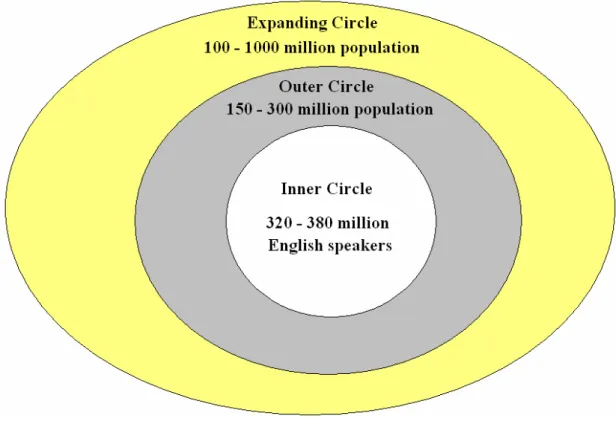
(20) 2.6 Scope of Research This study will focus on the investigation in Taipei and Shanghai since these two cities are the largest and the most prosperous cities in Taiwan and China.. 2.7 Instrument For the instrument of this research, the use of observation approach will be adopted. The qualitative research will be conducted through the collection and review of second-hand academic journals, books, resources from Internet and newspapers and in-depth interview with semi-conducted questionnaire to collect qualitative data.. 2.8 Subjects. 立. 政 治 大. ‧ 國. 學. The subjects of this research will be the junior high school students in Taipei and the junior high school students in Shanghai, and the graduated or elder students, and the. ‧. students' teachers and parents as well.. Teachers will be involved in this research. y. and understood the students' learning process.. Teachers make long term. sit. Nat. because they have been with the students in the campus for an extended period of time. al. iv n C and sometimes h e n g they c h iplayU the decisive roles. n. psychology.. er. io. observations in educational circumstance and are more familiar with educational As for parents, they are the secondary main roles who participate in. their children's learning future career.. in children’s. The parents know well about their children and even affect their children's learning and career planning.. The graduated or elder students have just experienced the. learning period of junior high school, and when they look back at their experience, they are often more clear about the learning process than the students who are still in it.. They are also more eloquent in delivering their thinking and experience regarding. the subject.. The popularities or the public opinions or editorials will be accepted for. gathering the views in the society generally.. 16.
(21) 2.9 Research Design The aim of this study is trying to identify the different motivations in English learning between Taiwan's and China's junior high school students and try to figure out whether the English learning motivation in junior high school students in Shanghai is stronger than in Taipei.. This paper tries to apply Vroom's expectancy theory of. motivation to examine the phenomenon and the differences between the two groups of students mentioned above.. The first process is that the researcher constructed a pool of items to develop the questionnaire.. Open-ended questions were developed to reveal students’ reasons to. learn English.. Second, the researcher interviewed students and their parents and. 政 治 大. teachers to know more about the situation of learning English among high school. 立. students between Shanghai and Taipei.. ‧ 國. 學. 2.10 Procedure. ‧. The procedure of this research was: (1) preparation and data collection, (2) field. y. Nat. n. al. Table One: The Schedule of This Research Stages. Time. er. io. sit. investigation and interviewing, and (3) data analysis and drawing conclusion. i n Preparation andC Data U h e nField hi g cResearch. v. Collection. Data Analysis and Conclusion. June, 2009 ~. July, 2009 ~. November, 2009 ~. January, 2010. January, 2010. February, 2010. In the period of preparation and data collection, I adopted data and resources about the issue and relative literature from books, journals and from Internet.. In the period of. field research, I went to Shanghai in person during July and August in 2009.. I. interviewed some domestic junior high school students and their English teachers through Taiwanese business people in Shanghai for the reason that I didn’t know any local Chinese people.. I interviewed some local students through Taiwanese students. who join the local schools and international schools. 17. In order to get more.
(22) information about the local education situation, I also interviewed some Taiwanese mothers whose children joined the local schools or international schools.. In fact,. Taiwanese parents send their kids to local schools which they chose as very good schools.. And my interviewers are students who have strong willing to enter. key-high schools and have good academic performance.. So my interviewers on both. Taipei and Shanghai in this study are students who wish to enter high schools.. Not. only Taiwanese mothers in Shanghai but also the local teachers, students, principals and parents in Shanghai helped me a lot to do this research.. After back to Taiwan, I. continued to interview the students, teachers and parents in Taipei to do more research. The third period of this research was to collect all data and analyze the data and try to find the clue and make a conclusion and implication.. 立. 政 治 大. ‧. ‧ 國. 學. n. er. io. sit. y. Nat. al. Ch. engchi. 18. i Un. v.
(23) 3. The English Learning History and Development in Taiwan and in China. 3.1 Why learn English Because of the proliferation of globalization, the transportation vehicle progresses, along with the rise of Internet, people get closer and communicate one another more often.. English becomes the global humanity's common language for communication. after World War II32.. 政 治 大. With the growth of the British Empire since eighteen centry, English began to spread. 立. and reach to truly global by the late nineteenth century.33 Indian linguistic Braj. ‧ 國. 學. Kachru34 (1985) has proposed a widely-used concentric model of English which can be categorized by three circles: the Inner-, the Outer-, and the Expanding-circle In the Inner-circle countries, English is the main language (e.g., the. U.S.A., Canada, Britain, and Australia).. ‧. countries.. In the Outer circle, English has spread as a. sit. y. Nat. result of colonization and has been used there mainly for administrative purposes.. io. er. As the Expanding circle, it encompasses all countries in which English is being taught as a foreign or additional language (e.g., Taiwan, China and other Asian countries.. n. al. Ch. i Un. v. Now the population of the Outer circle and Expanding circle are bigger than the Inner circle and it is still increasing.. engchi. The concept of “English is a world language” has. been shaped.. A world authority English linguist, David Crystal, brought up his idea about the phenomenon of English as a global language. According to Crystal35 in 1997, there were over 320-380 million speakers of English as first language, 150-300 million population speak English as a second language.. The number of people learning. English as a foreign language is 100 million to 1000 million and is still increasing 32 33 34. 35. Wikipedia, English Language from http://en.wikipedia.org/wiki/English_language EHistLing. Lecture 7: World-Wide English. from http://www.ehistling-pub.meotod.de/01_lec06.php Kachru, B. (1985). Standards, codification, and sociolinguistic realism: The English language in the Outer circle. In R. Quirk & H. Widdowson (Eds.). English in the world, teaching and learning the languages and literatures. Cambridge: Cambridge University Press, P.11~30 Cristal, D. (1997). English as a global language. Cambridge: Cambridge University press. 19.
(24) rapidly.. The famous British linguist David Graddol36 (1997) forecasts the future. language environment must be multilingual communication since the frequent international communication and trade, the rise of the BRICs, the technology and the corpulence of people.. People who only use a language will probably meet the. difficult on work, trade, research or politics.. But “the global popularity in English is. in no immediate danger and it pre-eminent position as a world language will not be changed in some world regions and domains use as the economic demographic and political shape of the world is transformed.”37 He also analyzed that the relationship between English and globalization was a complex one: economic globalization encouraged the spread of English but the spread of English also encouraged globalization.. 政 治 大. Figure 3: Kachru (1985) The Three Concentric Circles of the English-Speaking World. 立. with estimates of speaker numbers in millions according to Crystal in 1997. ‧. ‧ 國. 學. n. er. io. sit. y. Nat. al. Ch. engchi. i Un. v. In 2006, David Graddol38 forecasts that a massive increase in the number of people 36 37 38. Graddol, David (1997a). The Future of English? The British Council 1997. 2000. P.2 , P.10~11 Graddol, David (1997b). The Future of English? The British Council 1997. 2000. P.2 Graddol, David. (2006). English Next. London: British Council. Available for free from the website of the British Council. Retrieved March 16th, 2008, from http://www.britishcouncil.org/learning-research-english-next.pdf P.14~15, P19, P41~49 20.
(25) learning English has already begun, and is likely to reach a peak of around 2 billion in the next 10-15 years.. Over the next decade there will be a complex and changing. mix of learner ages and levels of proficiency. and many needs.. The situation will be one of many ages. He argued the rise of Chinese and Spanish will appear the. importance of bilingual.. Multilingualism will be normality and affect the economy,. education and national policy making. language as well.. It is necessary to learn English and native. With the prosperity of innovation and information technology,. English will be the international tool of communication. 39. English language will. continue to grow in popularity and influence in the future.. There are many reasons that people learn English:. 治 政 大 involves deeply in various (1) Participate in international official language: English 立 domains like international politics, the communication media, the economics and ‧ 國. 學. trade activity, the sightseeing trip, international education.. Observing the situation,. almost important international organization like OECD, WTO, APEC, EU and. ‧. important international active like Olympic Games, the world expo, as well as many kinds of international conferences, English occupies the official language the first. y. Nat. English is also prominent in international politics, business, technology,. n. al. er. io. media, medicine, education, tourism, culture and so on.. sit. place.. Ch. i Un. v. (2) Get information from Internet: most government official websites, most. engchi. international organization's websites and international displays use English as official language.. The different cultures exchange and fuse unprecedentedly.. The. boundaries between countries become vague because of using the common language English.. The global various corners' news, the different groups’ advocation and their. positions transmit to the world by the international language - English.. English. dominates computers and the Internet. Those who want to use computers or the Internet must learn English first.. 39. Modiano M. (1999). International English in the global village. English Today 58, vol.15, No.2. UK:Cambridge University Press. Crystal D. (1999). The Future of English? English today 58, Vol.15, No.2. UK: Cambridge University Press.. 21.
(26) (3) Get access to knowledge: most books, press, reports and the most important theses in the world are written in English or translated in English.. People who want to. access to the important knowledge from all over the world must have the ability to use English or at least they meet the problems of translation.. Most of the information on. the Internet are written in English or translated in English.. (4) Communicate with people: nowadays most people use English in conferences, travel, and education, etc.. Global migration is higher than ever before.. People. migrate at liberty and will surprisingly find that they can easily communicate with people everywhere in English.. With convenience of transportation and information,. lots of people travel on business or on vacation. growing.. The proportion of global tourism is. The employees from all over the world in transnational firms or global. 政 治 大. firms communicate mutually without any barriers for the reason they use the common. 立. world language -English.. The spread of transnational goods also spread the. ‧ 國. 學. language and culture.. their lives on work, social lives, and leisure.. Learning to speak English well may be. y. The employees in many international enterprises. sit. Nat. the best thing to improve our life.. ‧. (5) Push individual career forward: with the ability to use English, people may enrich. io. employees discuss their work without language barrier.. n. al. Ch. engchi. Then different nationalities. er. and joint ventures communicate each other in English.. i Un. v. (6) Share the different cultures and the circular of entertainment. cultures and media contribute the spread of English.. American popular. People can easily receive the. popular entertainment and news from MTV channel, CNN, even the cartoon network or Disney channel.. In order to participate in the globalization opportunity and the challenges, many governments around the world stipulate English as one of the official languages in their countries or adopt English as very important foreign languages. longer becomes a legacy of certain countries.. English no. The skills of using international. languages become a part of international competitiveness.. Because of the trend of globalization, whoever owns the ability of English proficiency 22.
(27) owns the competitiveness.. The trend of globalization leads the cities like Soul,. Hong Kong, Singapore, and Taipei to international stages.. Thus, many countries. around the world try their best to promote their people with English. English native speakers will face more competition since more bilingual elites owns the abilities of languages and profession. leading the world. competition.. The western will no more occupy the superiority of. Not only the enterprise but the schools face the unprecedented. Many countries’ governments manage various policies and plans to. promote their people’s English ability and to improve their people’s international perspective.. In Taiwan, the Research, Development and Evaluation Commission,. Excusive Yuan manages a plan in September 23, 2008 which is under the proposal of the twelve “i Taiwan” (I love Taiwan) to improve citizen’s English proficiency.. The. government advocates that English proficiency is the key competitiveness in the future.. 政 治 大. The Excusive Yuan set goals to carry out from 2010 to 2012 in order to. 立. improve people’s English proficiency and build a circumstance which can attract. ‧ 國. depends on export.. Taiwan is an economy which highly. 學. international professional expertise to Taiwan.. It goes without saying that language is important in trade,. ‧. especially English.. y. Nat. sit. Though some schools of scholars bring up their critical respective on language. er. io. hegemony40, culture hegemony41 and infiltration of capitalism, we can not deny. al. n. iv n C people the conveniences when h they e ntravel h i Uthe world and communicate with g caround. English provide people a channel to learn new knowledge and news and provide. people internationally.. 3.2 The English learning history and development in Taiwan. Look back Taiwan’s history in learning English; it almost has been over 120 years. 40. Phillipson, R. (1992) Linguistic Imperialism. New York: Oxford University Press. Phillipson, R. (2001). English or ‘no’ to English in Scandinavia? English Today 66, vol.17, No.2. UK: Cambridge University Press. 41 Wu, Shueichi (2008). From the Deconstruction of Taiwan’s English Worship to the Construction of Critical Pedagogy of English Teaching Model. Unpublished doctorial thesis. The Department of Education, National Taiwan Normal University. 23.
(28) Before the Opium War in Qing dynasty, public school education in Taiwan was laggard.. In 1886, the governor of Taiwan Liu Minchuan (劉銘傳)opened a school. and hired foreign teachers to teach English, French, and geography to children in Taipei.. The school education was indefinite and in a chaos during the colonial period by Japan and the period Taiwan returned to the ROC government. colonized Taiwan, Taiwanese were forced to learn Japanese.. After Japanese. After the defeat of. Japan in 1945, Taiwan was returned to the government of R.O.C. and practiced The Courses Standards of High School42 in 1948 and stipulated to teach English 20 hours per week in junior high school.. The Course Standards revised its regulations many. 政 治 大 support association and立 Taiwan government held an “English training center” to times in later years.. In the corresponding period of time in 1951, an American. develop some English expertise in Taiwan University.. After 1965, the American. ‧ 國. 學. support association decreased the money supply, so the “English training center” was taken over by Taiwan University.. It was the period that people considered the elites. ‧. in the society must know how to speak English.. sit. y. Nat. al. er. io. In 1968, Taiwan government carried out the nine-year compulsory education and The. v. n. Course Standards stipulated junior high school students had to study English and the. Ch. teaching hours were 12-18 per week. per week.. i Un. In 1972, the English teaching hours were 8-12. engchi. In 1983, The Course Standards was revised again and the English. teaching hours were shrunken to 12-14 per week.. In 1985, The Course Standards. was revised again with very fine regulations and contents; and the English teaching hours were 3 required hours and 2 selected hours.. In 1998, the Ministry of. Education transformed The Course Standards to The Course Outline and integrated the nine-year compulsory education courses systematically.. In 1997, the government. had an experiment to teach English from the third grade in Taipei and from the fifth grade in Kaohsuing.. The Ministry of Education regulated to teach English from the. fifth grade in all cities of Taiwan in 2001 and then extend downward from the third 42. Source from: The Department of High Education of Taiwan Ministry of Education coded. (1983). Junior High School Curriculum Standards, Appendix: Junior High School Curriculum Standard Revision Processes. Taipei: Cheng Chung Bookstore. 24.
(29) grade in 2005.. Since 1970s until now, Communicative Language Teaching. Approach has been the mainstream English language teaching approach around the world and in Taiwan.. It was at the corresponding period that many Asian countries started to teach English in elementary schools. grade in 1997.. For example, Korea started to teach English from the third. Thailand started their English teaching from the first grade in 1996.. In Japan, schools don’t have formal English curriculum in elementary school, but schools can schedule the extra curriculum to learn English from the third grade. 2004, 54% public schools and most private schools have English courses.. In. 43. 政 治 大. There is a historical development that caused Taiwan’s English education to pay more. 立. attention on colloquial English than academic English.. Education in Taiwan has. ‧ 國. 學. long been blind by worship of diploma and the impact of academic advancement. Examination led teaching and learning competitive pressures in.. The political. ‧. liberation after 1987 aroused the demand of reform from all ranks in the society.. Under the concept of happy learning, the course And then, Taiwan adopted. er. io. contents are simplified and teaching hours are reduced.. sit. Nat. breaking the worship of diploma.. y. The demand of education reform was on reducing students’ learning pressure and. al. nine-year integrated curriculum and endorsed the concept of Gardner’s multiple. n. iv n integrated curriculum no more emphasizes CNine-year hengchi U the results and scores of children, but want the child to have “life skills”. On this intelligences. 44. in education.. premise, English learning contents must be daily use and colloquial English, not only concern with English grammar and translation.. But the private institutes always go head and lead Taiwan the trend of English teaching.. In the late 1970, many English learning institutions or so called cram. schools in Taipei teaching extra English speaking courses and the trend gradually spread to all parts of Taiwan.. 43. 44. It was estimated at least 70% of the 6th grade students. Chou, Chongtien (2004). The differences of English teaching in Asia. Retrieved June 1, 2004 from http://www.cet-taiwan.com/ET/07_ET_show.asp?serno=119 Gardner, H. (1993), Multiple Intelligences: The Theory in Practice. New York: Basic Books. 25.
(30) had already learned English over 1 year before they went to the formal English learning in junior high school. elementary.. Parents claimed to advance the English learning from. The passion of learning English is not only from parents, from the. private enterprises in international trade, technology and academic exchange but also the promotion from government 45 .. The Ministry of Education promote the. “Connecting Classrooms” plan which promotes the interactive learning through the Internet to exchange information of schools among countries, so that teachers and students from different countries can learn together like in the same classroom.. 立. 政 治 大. ‧. ‧ 國. 學. n. er. io. sit. y. Nat. al. 45. Ch. engchi. i Un. v. For example: 2010~2015 The White Book of Internationalization Education in Taipei City. 26.
(31) 3.3 The English learning history and development in China. In 1861, the Qing dynasty was shocked by the western countries’ ascendant military weapons and became aware of the lack of diplomatic expertise.. They opened a. school in Beijing (京師同文館: Jin Shi Tong Wen Guan) to cultivate diplomatic expertise.. That was the first public school which taught English as a school course.. Some churches also taught English. teach English.. In 1923, the Ministry of Education stipulated English as a required. course in schools. selected course.. After 1911, the government allowed schools to. But in 1937, during Chinese fought with Japan, English became a After the Chinese Communists took over the regime in 1949, the. government stipulated students had to take either English or Russian as foreign. From 1949 to the 政 治 大 middle 1960s, the relationship between China and Russia was intimate; Russian once 立 languages in both junior high schools and senior high schools.. was the first foreign language.. After the period of The Great Leap political. ‧ 國. 學. movement in 1958, the foreign languages courses almost were cancelled.. During the. Culture Revolution in 1966, the foreign language courses almost stopped.. It was. ‧. until the end of the Culture Revolution in 1978, the foreign language courses revived Subsequent to the end of Cold War, English is substitute for Russian.. After. sit. y. Nat. again.. the reform and open period, most junior high schools took English as the first foreign. io. After 1981, the government had formal context. er. language and as a required subject.. al. n. v practiced the nine-year ni CIn h1986, the ChineseUgovernment obligation education and started toelay n gstress c honi English. The Chinese government books for students to study.. emphasized that English as a communication tool and pay attention on the four skills of English.. In 2001, China decided to make English compulsory in elementary. schools from grade three.. In practice, rural areas may not meet that target.. Currently, in the coastal regions cities like Guangzou, Beijing and Shanghai, students even learn English from grade one.. Today, many parents send their children to. whole English language kindergartens in order to start learning English earlier. Course Standard divides the learning standard as nine levels.. The. Students must reach. the first level when they finish the fourth grade and the second level when students graduate from elementary schools.. Students have to reach the fifth level when they. graduate from junior high school and the eighth level when students graduate from senior high schools.. The foreign language high schools students must reach the 27.
(32) ninth level.46 the peak.. Around the period of Beijing Olympic Game, the English tide reached. Before that, many Taiwanese cram schools (in Mandarin: Bu Shi Ban) see. the English learning fever in China and head west without hesitation. When motioned about today's education system and education strategy, we can not ignore the man - Deng Xiaoping.. In order to catch up with advanced countries after. the Cultural Revolution, Deng Xiaoping first grasped the most important two areas of science and education.. He cried out: “Be sure to create an air in the party: to respect. knowledge, respect the talents.47” He especially paid attention to basic education. He said: “People are not able to be trained in one or two days.. University students. are from high schools, high school students are from elementary schools, therefore, we must pay attention to primary and secondary education.” He instructed that China. 政 治 大 All ranks of key schools accept the most excellent students in certain areas. 立. have to set up key elementary schools, key high schools and key universities at the time.. That is why there are key schools in every category of education in China today.. ‧ 國. 學. It was the recovery period of education from 1977 to 1984.. In 1978, the resumption of. ‧. China restored a unified college entrance examination.. In November in 1977,. large-scale sending students abroad, sending students to the United States for the first. y. Nat. io. expanded since then till today.. sit. 1981 China allowed students to study abroad at their own expenses, this wave The trend of studying abroad arouses more people. al. er. time.. iv n C back to China and are regarded h and respected as knowledge-rich “returnees.” engchi U the passion of English learning is exaggerated.. Thus,. From 1985 to 1989, it was a period of comprehensive education reform.. China. n. effort to move forward learning English.. After decades later, these people come. practiced nine years of compulsory education system in 1986.. China adjusted the. structure of secondary education and vigorously developed vocational and technical. 46. 47. Chou, Chungtien (2005). The English teaching in China. Retrieved March 1, 2005 from http://www.cet-taiwan.com/ET/07_ET_show.asp?serno=117 www.ce.cn (2007) Deng Xiaoping’s speech about reviving the entrance examination of university in 1977. Retrieved August 23, 2007 from C:\Documents and Settings\Joy\My Documents\1977 ( ).htm. 年鄧. 小平關於恢復高考的講話和批示 選載. 28.
(33) education.. The political turmoil that occurred in 1989 interrupted the process of. education reform slowed the development of education in the doldrums48. After the mid 90s, education has led down a described as the "education industry" of the special development path.. As the severe shortage of funds for education, China’s. government was keen to expand the use of market mechanisms, school-profit income-generating activities through education.. In 2001, China promulgated the. “Basic Education Reform and Development of the State Council on the decision” and implemented weak schools and new public schools could mutate to private schools. In this period, China implemented the “985 project” to build world-class universities; privatized the compulsory education system to private property, run "Famous School Runs Private" and the high tuition fees policy.. Through the “Education Industry”. 政 治 大 education under the government’s serious shortage of educational inputs. 立. strategy, it was indeed effective in expanding the education scale, increased access to. the reasons why today there are various choices in China.. Students try their best to. 學. ‧ 國. Those are. enter the universities of “985 project” and its next “211 project”.. Without any doubt,. students have to study English very hard if they want to enter such prestigious top. ‧. schools.. From the second half of 2003, the Ministry of Education high-profile. y. Nat. criticized the ideas of “educational industry” and educational equity has become the. er. io. sit. fundamental values of public education till now.. al. iv n C Australia soon in China, h e npropaganda gchi U n. China's reform and opening up let English-speaking universities, Britain, Canada, New Zealand and. exhibition were held in China.. and major educational. This evoked China's younger generation to make a. determined effort to learn English.. It was the surging tide of globalization when the. occasion of Deng's reform and opening up in 80’s.. The international society. immediately was aware of the changes in China, and many English learning institutions developed their enterprises in China since then.. Now its domestic. English learning institutes like New Oriental Institute and Universal IELTS also develop prosperously.. 48. Source: Blue Book of Development and Reform 1978~2008. Chapter 24. Retrieved Octor 8, 2008 from: C:\Documents and Settings\Joy\My Documents\ .htm. 發展和改革的進程. 29. 改革開放以來教育.
(34) 4. The factors and results of English learning motivations in Taipei. Chapter 4 and Chapter 5 will present some factors and results which affect the English learning motivations of junior high school students in Shanghai and Taipei, and will have brief conclusions.. These chapters will conclude five main factors and then. subdivide into many detail factors to make an interview questionnaire with twenty questions to explore the factors and results which affect the English learning motivations of junior high school students in Shanghai and Taipei.. The factors are:. (1) Personal factors: interest, personal experience, future career, (2) Family factors:. 政 治 大. parents, siblings and other family members, (3) Schools factors: classmates, teachers, and schools, (4) Learning materials and tools (5) Social factors: social points of view.. 立. Of all, the personal factors are the most important factors which can explain students’. ‧ 國. 學. intrinsic motivations.. and learning models between Taipei and Shanghai.. ‧. And these chapters also try to investigate the different English learning motivations Further more, it tries to apply. Nat. The. sit. y. Vroom’s value-expectancy Theory to examine the hypothesis of this study.. al. er. io. comparison of English learning motivations on both sides and the result of the. n. application of the theories will be explained in the conclusion chapter.. Ch. hi. e. i Un. v. n g c learning motivations in Taipei 4.1 The factors and results of English In this section we will present the factors and results of English learning in Taipei and figure out the motivation of English learning in Taipei.. We use the same. questionnaire to make a comparison to figure out the differences between both sides.. 4.1.1 Personal factors: interest, personal experience, future career. Personal learning motivation is the key point to show personal determination on learning and it is individual’s intrinsic motivation in the field of educational. 30.
(35) psychology.. Students in Taipei regard English as first important world language and. it is necessary to master it.. Due to the policy of simplifying junior high school. course and the policy to stress applying English in daily life, students in Taipei think English is the easiest, functional and vivid learning in school.. Many parents think. the textbooks are very easy and they send their kids to cram schools for the reasons to reinforce the curriculum performance and to develop kids’ ability of using English. Parents hope their kids not only learn English for good grades but also develop their interests in English learning.. Parents think English is a key to access the. international and enrich people’s lives.. They hope their kids learn English happily. and learn more in order to speak English spontaneously. tool of communication. learning English.. They regard English as a. But we can not say most of students are so interested in. There is still a portion of students meet frustration on learning. 政 治 大. English and they lost their intrinsic motivation on it.. 立. ‧ 國. 學. Mother Li feels that her daughter has great interest in English pronunciation. She said:. ‧. io. al. n. happily.” (Case F). y. She often imitates new words or sentences. er. of English is very pleasant.. She thinks the pronunciation. sit. Nat. “My daughter is very interested in English.. Ch. engchi. i Un. v. “My daughter reads English magazine voluntarily. interesting and vivid.. She feels very happy.. Its contents are. Sometimes when she reads. the interesting content, she can't help giggling. She studies her English textbooks well, too.. The motive of reading English from interest certainly. can strengthen the ability of using English gradually.” (Case E). A junior high school student felt embarrassed and said:. “I think pronunciation of English is quite pleasant.. Although my English. grades are not good, they’re about 70s, I think I feel a great interest in English.” (Case K). 31.
(36) English teacher in Taipei, Ms. Shiu, expressed the present situation from her observation and she induced that students have learned English since they were in the kindergartens so they get used to English pronunciation and like it.. Many students. have interests in English and they don’t study English just for passing the high school entrance examination.. Students learn some talents or interests with foreign teachers. both for learning English and for fun.. “In my experience, many students learn English since they were in grade one or younger. pronunciation.. They get used to this language gradually and like the They spontaneously learn English not only because their. parents ask them to attend English speaking cram schools but also they. 政 治 大. think it is interesting to use this language and communicate with people.” (Case A). 立 ‧ 國. 學. “In my classes I met students who have passed the GEPT49 middle level, but they still enjoy English classes in school. They don’t think to learn They really think it is cool to. ‧. English is just to pass entrance examination. use this language.” (Case A). sit. y. Nat. io. instrument with foreign teachers.. n. al. Ch. er. “For few years, parents send children to learn hockey, soccer or play music They learn to speak English by way of. i Un. v. playing and developing their interests and professional specialties.” (Case A). engchi. “Some of junior high school use multi-media to learn English.. For. example, some schools ask their students to read extra supplementary materials like English magazines to improve their English.. It is very. ordinary to ask students to read magazine and have extra English competition.” (Case A). 49. General English Proficiency Test: The Ministry of Education of Taiwan commissioned the Language Training & Testing Center (LTTC) to develop a fair and reliable English test, called the General English Proficiency Test (GEPT), for all English learners at all levels of proficiency. The LTTC GEPT is administered at five levels, Elementary, Intermediate, High-Intermediate, Advanced, and Superior, and includes listening, reading, writing, and speaking components. Retrieved from: http://www.lttc.ntu.edu.tw/E_LTTC/E_GEPT.htm 32.
數據
Outline
Introduction
Previous Studies
Vroom's Expectancy Theory of Motivation
Why learn English
The English learning history and development in Taiwan
The English learning history and development in China
Brief conclusion of English learning motivations in Taipei
The factors and results of English learning motivations in Shanghai
The brief conclusion of English learning motivations in Shanghai
Conclusion
相關文件
The purpose of the study aims at discussing the important factors of affecting junior high school students in aboriginal areas in terms of learning mathematics.. The research
This purpose of study was to realize, as well as the factors of influence of information technology integrated in teaching by junior high school special education teachers in
This study was conducted to understand the latest situation between perception of principal‘s leading role and school effectiveness in junior high schools, and
It aims to understand the authentic English learning adjustment of junior high school students in remote area and to compare the difference between the family background and
This study is aimed to investigate the current status and correlative between job characteristics and job satisfaction for employees in the Irrigation Associations, by
The purpose of this study was to investigate the current situation of multicultural literacy and intercultural sensitivity of junior high school teachers in Taichung
The main purpose of this study is to explore the work enthusiasm of the Primary School Teachers, the attitude of the enthusiasm and the effect of the enthusiasm.. In this
The participants of this case study are two eighth graders in junior high school. The math game is designed to assist in teaching volume four, chap- ter one of grade eight
