Do Education:當代教育創新與實踐
Do Education:Innovation and Practice of Contemporary Education
編者序 I
編 者 序
參、檢視學生在自學中心自主學習之個案研究 ... 45
作者:李筱倩 摘要 ... 45
Introduction ... 47
Teacher Guidance of Student Learning at the SAC ... 50
Methods ... 53
Findings ... 56
Discussions and Conclusion... 65
目次 V 伍、英語教學創新課程教育活動之研究 ... 101 作者:樓玟麟 摘要 ... 101 Introduction ... 102 Literature Review ... 103 Methodology ... 110 Findings ... 118 Discussions... 126
Curriculum Integration and Instruction Influencing Learning ... 126
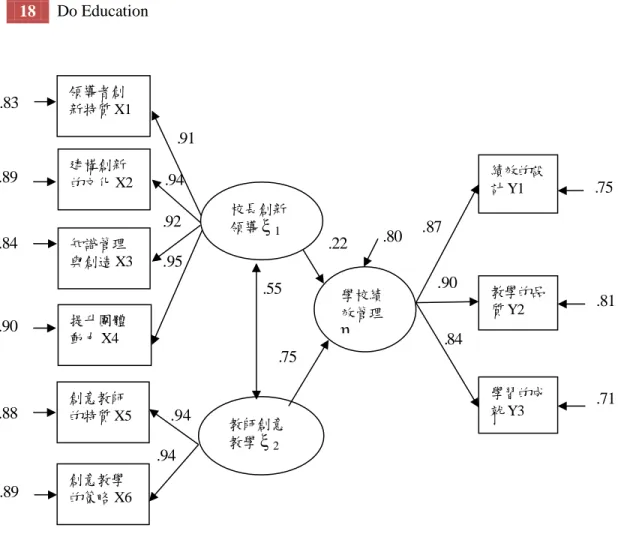
創新領導、創意教學與績效管理關係之研究 17
皆符合大於 .50 的適配度指標。綜上所述,本研究理論模式在適配度考驗堪稱 良好。
創新領導、創意教學與績效管理關係之研究 23
參考文獻
江明曄(2006)。中等以下學校校長創造性領導、學校創造性組織氣氛與教師 創意教學關係之研究(未出版之博士論文)。國立臺中教育大學,臺中市。 吳明隆(2009)。結構方程模式:AMOS 的操作與應用(第二版)。臺北市: 五南。 倪靜貴(2007)。高級中學校長創新領導表現指標建構之研究(未出版之博士 論文)。國立臺灣師範大學,臺北市。 張偉豪(2011)。SEM 論文寫作不求人。高雄市:三星統計。Adair, J. (2007). Leadership for innovation: How to organize team creativity and
harvest Ideas. London: Kogan Page.
Armstrong, M. (2006). Performance management: Key strategies and practical
guidelines (3rd ed..). London: Kogan Page.
Beghetto, R. A.,& Kaufman, J. C. (2011). Teaching for creativity with disciplined improvisation. In R. K. Sawyer (Ed.), Structure and improvisation in creative
teaching (pp. 94-109). Cambridge: Cambridge University Press.
Brewer, D. (1993). Principals and student outcomes: Evidence from U.S. high schools. Economic of Education Review, 12(4), 281-292.
Briscoe, B. R.,& Claus, L. M. (2008). Employee performance management: Policies and practices in multinational enterprises. In A. Varma, P. S. Budhwar,& A. Denisi (Eds.), Performance management systems: A global
perspective (pp. 25-39). London: Routledge.
Caney, S. (1995). Steven Caney's invention book. New York: Workman Publishing. Chinn, P.L. (2008) Peace and power: Creative leadership for building community
Cokins, G. (2009). Performance management: Integrating strategy exection,
methodologies, risk, and analytics.Hoboken, NJ: Wiley.
Craft, A. (2002). Creativity and early years education: A lifewide foundation. New York: Continuum.
Craft, A. (2005). Creativity in schools: Tensions and dilemmas.London: Routledge. Cramond, B. (2005). Fostering creativity in gifted students. Waco, TX: Prufrock
Press.
Dean, J. (1999). Improving the primary school, London: Routledge.
Downing, J. P. (1997). Creative teaching: Ideas to boost student interest. Englewood, CO: Teacher Ideas Press.
Duffy, B. (2006). Supporting creativity and imagination in the early years (2nded.). Maidenhead: Open University Press.
Fryer, M. (1996). Creative teaching and learning. London: Paul Chapman.
Hanushek, E. (1992). The trade-off between child quantity and quality.Journal of
Political Economy, 100(1), 84-117.
Hartle, F., Everall, K.,& Baker, C. (2001). Getting the best out of performance
management in your school. London: Kogan Page.
Haynes, G., Wragg, T., Wragg C.,& Chamberlin, R. (2003). Performance management for teachers: Head teachers’ perspectives. School Leadership and
Management,23(1), 75-89.
Jeffrey, B.,& Craft, A. (2004). Teaching creatively and teaching for creativity: Distinctions and relationships. Educational Studies, 30(1), 77–87.
Kythreotis, A., Pashiardis, P.,& Kyriakides, L. (2010). The influence of school leadership styles and culture on students’ achievement in Cyprus primary schools. Journal of Educational Administration, 48(2), 218-240.
創新領導、創意教學與績效管理關係之研究 25
&C. Day (Eds.), Successful principal leadership in times of change: An
International Perspective (pp. 189-203). New York, NY: Springer.
Looney, J. (2011). Developing high-quality teachers: Teacher evaluation for improvement. European Journal of Education,46(4), 440-455.
Marks, H. M.,& Printy, S. M. (2003). Principal leadership and school performance: Integrating transformational and instructional leadership. Educational
Administration Quarterly 39(3), 370-397.
Moreland, J. (2009). Investigating secondary school leaders’ perceptions of performance management. Educational Management Administration and
Leadership, 37(6), 735-765.
Murlis, H. (1992). Performance-related pay in the context of performance management. In H. Tomlinson, (Ed.), Performance related pay in education (pp. 55-67). London: Routledge.
Printy, S. (2010). Principals' influence on instructional quality: Insights from US schools. School Leadership and Management, 30(2), 111-126.
Renzulli, J. S.,&De Wet, C. F. (2010). developing creative productivity in young people through the pursuit of ideal acts of learning . In R. A. Beghetto and J. C. Kaufman (Eds.), Nurturing creativity in the classroom (pp. 24-72). Cambridge; New York: Cambridge University Press.
Ritchhart, R. (1994). Teaching with the heart. In K. Jennings (Ed.), One teacher in
ten: Gay and lesbian educators tell their stories (pp. 50-53). Boston: Alyson
Publications.
Sawyer, R. K. (2011). What makes good teachers great? The artful balance of structure and improvisation. In R. K. Sawyer (Ed.), Structure and
improvisation in creative teaching (PP. 1-24). Cambridge: Cambridge
University Press.
Simpon, C., Qureshi, A.,& Sagoo, P. (2012). Small actions - big change: Co-producing creative approaches in school and out. In H. Manchester (Ed.),
Creative approaches to improving participation: Giving learners a say (pp.
59-75). London: Routledge.
Sloane, P. (2007). The innovative leader: How to inspire your team and drive
creativity. London: Kogan Page.
Starko, A. J. (2010). Creativity in the classroom: Schools of curious delight (4th ed.). New York, NY: Routledge.
Stein, M. R.,& Nelson, B. S. (2003). Leadership content knowledge.Educational
evaluation and policy analysis, 25(4), 423-448.
Storey, A. (2002). Performance management in schools: Could the balanced scorecard help? School Leadership & Management, 22(3), 321-338.
壹、前言
學校分散式領導:概念發展與證據成效 29
學校分散式領導:概念發展與證據成效 31
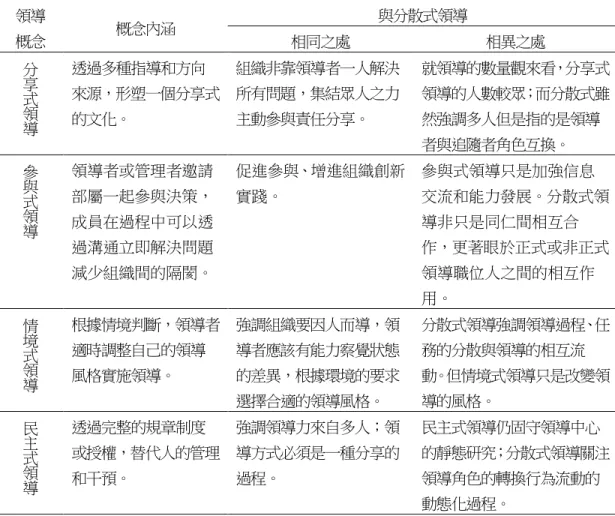
(democratic leadership)、轉型領導(transformational leadership )、團隊領導(team leadership)、授權(delegation)、集體決定(collective decision making)、同僚模式(collegial model)、領導密度(leadership density)、領替代理論(substitutes for leadership theory)、 分享式領導(shared leadership)、共同領導、建構式領導、永續領導、合作式領導、 教師領導等有相似或重疊之處(蔣園園,2008;賴志峰,2009a;Brooks, Gaetane, Normore, & Hodgins, 2007;Harris, 2008;Spillane, 2005)。茲列舉整理如表 1。
學校分散式領導:概念發展與證據成效 35
學校分散式領導:概念發展與證據成效 37
三、有利於學習表現表現的提升
張奕華(2009)。分散式領導、教師學術樂觀與學生學習成就關係之研究。 行政院國家科學委員會專題研究計畫(編號 NSC98-2410-H004-011)。 臺北市,國立政治大學教育學系。 張奕華、顏弘欽(2012)。學校分散式領導構面之探析:領導者、追隨者與 情境三元互動之檢證。教育實踐與研究,25(2),225-254。 黃宗顯(2008)。學校領導:新理論與實踐。臺北市:五南。 鄭伯壎、謝佩鴛、周麗芳(2002)。校長領導作風、上下關係品質及教師角色 外行為:轉型式與家長式領導的效果。本土心理學研究,17,105-161。 謝文全(2004)。教育行政學。臺北市:高等教育。 謝傳崇、王瓊滿(2011)。國民小學校長分佈式領導、教師組織公民行為對學 生學習表現影響之研究。新竹教育大學教育學報,28(1),35-66。 謝傳崇、李尚儒(2011)。校長分佈式領導對學生學習表現影響之研究-以學 校知識創造為中介變項。教育理論與實踐學刊,23(1),149-181。 蔡進雄(2004)。領導新典範:後英雄式領導的意涵及其對學校行政領導的啟 示。教育政策論壇,7(1),111-130。 蔡進雄(2005)超越轉型領導:國民中小學校長新轉型領導影響教師組織承諾 之研究。國民教育研究集刊,13,37-63。 賴志峰(2008)。分佈式領導理論之探究-學校領導者、追隨者和情境的交互 作用。國民教育研究學報,20,87-113。 賴志峰(2009a)。學校領導新議題研究。臺北市:高等教育。 賴志峰(2009b)。中小學分佈式領導風格量表之檢證。初等教育學刊,34, 25-52。 蔣園園(2008)。分布式領導概念辯析及對學校組織改善的作用。教育科學, 24(6),11-15。
Bennett, N., Harvey, J. A., Wise, C., & Woods, P. (2003). Distributed leadership Retrieved, August 30, 2011. From
學校分散式領導:概念發展與證據成效 41
Bolden, R. (2008). Distributed leadership. In J . Martarano & J . Gosling(Eds.), Leadership: The key concepts . London: Routledge.
Brooks, J. S., Gaetane, J. M., Normore, A. N., & Hodgins, D.W. (2007). Distributed leadership for social justice: Exploring how influence and equity are stretched over an urban high school. Journal of School Leadership, 17, 378-408. Brooks, J. S., Jean-Marie, G., Normore, A. H., & Hodgins, D. W. (2007).
Distributed leadership for social justice: Exploring how influence and equity are stretched over an urban high school. Journal of SchoolLeadership, 17(4), 378-408.
Chang, I. (2011). A study of the relationships among distributed leadership, teacher academic optimism and student achievement in Taiwanese elementary schools.
School Leadership & Management, 31(5), 1-25.
Fernet, C. (2011). Development and validation of the work role motivation scale for school principals (WRMS-SP). Educational Administration Quarterly,
47(2), 307-331.
Firestone, W. A., & Martinez, M. C. (2007). Districts, teacher leaders, and distributed leadership: Changing instructional practice. Leadership andPolicy
in Schools, 6(1), 3-35.
Gordon, Z. V. (2008). The effect of distributed leadership on student achievement. Unpublished doctoral dissertation, Central Connecticut State University, New Britain, CT.
Gronn, P. (2003). Leadership: Who needs it? School Leadership and Management,
Harris, A. (2008). Distributed leadership: According to the evidence. Journal of
Educational Administration, 46(2), 172-188.
Harris, A., Leithwood, K., Day, D., Sammons, P., & Hopkins, D. (2007).Distributed leadership and organizational change: Reviewing the evidence. Journal of Educational Change, 8(4), 337-347.
HayGroup. (2004). The five pillars of distributed leadership in school. Nottingham, UK: National College for School Leadership.
Hoy, W. K., & Miskel, C. G. (2001). Educational administration: Theory, research
and practice(6th ed.). Boston: McGraw-Hill.
Hulpia, H., Devos, G., & Rossel, Y. (2009). The relationship between the perception of distributed leadership in secondary schools and teachers’ and teacher leaders’ job satisfaction and organizational commitment. School
Effectiveness and School Improvement, 20(3), 291-317.
Jameson, J. (2006). Leadership in post compulsory education. London: David Fulton.
Mayrowetz, D. (2008). Making sense of distributed leadership: Exploring the multiple usages of the concept in the field. Educational Administration
Quarterly, 44(3), 424-435.
Mascall, B., Leithwood, K., Straus, T., & Sacks, R. (2008). The relationship between distributed leadership and teachers’ academic optimism. Journal of
Educational Administration, 46(2), 214-228.
Nguni, S., Sleegers, P., & Denessen, E. (2006). Transformationaland transactional
leadership effects on teachers' job satisfaction, organizational commitment,
學校分散式領導:概念發展與證據成效 43
Pearce, C. J., & Conger, C. (2003). Shared leadership: Reframing the hows
andwhys of leadership. Thousand Oaks, CA: Sage.
Pedersen, J., Yager, S., & Yager, R. (2010). Distributed leadership influence on
professional development initiatives: Conversations with eight teachers.
Academic Leadership Online Journal, 8(3).
Ritchie, R., & Woods, P. A. (2007). Degrees of distribution: Towards an understanding ofvariations in the nature of distributed leadership in schools.
Journal of School Leadership and Management, 27(4), 363-381.
Rosenbach, W. E., & Taylor, R. L. (Eds.). (2006). Contemporary issues in
leadership (6th ed.). Boulder, CO: Westview.
Saadi, A. M., Hussain, A., Bhutta, R. N., Perveen, N., Kazmi, U. K., & Ahmad, N. (2009). Democratic and distributed leadership for school improvement: Case studies from Pakistan. The International Journal of Learning, 16(2), 521-532. Spillane, J. P. (2005). Distributed leadership. The Educational Forum, 69(2),
143-150.
Spillane, J. P. (2006). Distributed leadership. San Francisco: Jossey-Bass.
Spillane, J. P., Camburn, E. M., & Pareja, A. (2007). Taking a distributed perspective to the school principal’s work day. Leadership andPolicy in
Schools, 6(1), 103-25.
Spillane, J. P., Halvorson, R., & Diamond, J. (2004). Theory of leadership practice: A distributed perspective. Journal of Curriculum Studies, 36(1), 3-34.
Spillane, J. P., & Healey, K. (2010). Conceptualizing school leadership and management from a distributed perspective. The Elementary School Journal,
Thornberry, N. (2006). A view about vision. In W. E. Rosenbach & R. L. Taylor(Eds.), Contemporary issues in leadership (pp.31-43). Boulder, CO:Westview.
Van Ameijde, J. D. J., Nelson, P. C., Billsberry, J., & Van Meurs, N. (2008). Distributed leadership in project teams. In K. T. James & Collins, J. (Eds.),Leadership perspectives: Knowledge into action (pp. 223-237). New York:Palgrave Macmillan.
檢視學生在自學中心自主學習之個案研究 47
Introduction
Self-access (language learning) centers (which are usually abbreviated as SAC) where students have access to resources and work independently of a teacher have been established during the past few decades as a beneficial approach in EFL (English as a Foreign Language) pedagogy. Built on the theory of learner autonomy and self-directed learning (Benson, 2001; Dickinson, 1987; Little, 1991), SACs are believed by many scholars to be advantageous in supporting English courses through their remedial programs or extensive practices in reading, writing, listening and speaking, in fostering autonomy and self-directive study strategies among students, and in providing multiple technologies as learning resources to motivate and enhance English learning (Cotterall & Reinders, 2001; Klassen, Detaramani, Lui, Patri, & Wu, 1998; Shen, 2008; Stepp-Greany, 2002).
important of all, the center started a cycle of “project”, whose on-going aims were to discuss ways to enhance participation, to design action, to promote activities, and to plan further projects to enhance more involvement. As a result, the declining participation was eventually reversed.
Another successful example is the English Resource Center in Saitama University in Japan (reported by Hughes, Krug, & Vye, 2011). This center provided an English learning environment available to the university-wide community. Different from the activities they usually did in a formal classroom, students visiting the center were encouraged to take charge of their own learning. Native language was strictly prohibited inside the center. When students gathered together with peers, they had to use English to communicate. The role of the advisors in the center were to facilitate English communication and rapport between the students, and they soon stepped back and let learners autonomously develop and manage their interaction. In the report by Hughes, Krug, & Vye (2011), they indicated deepened social interaction in the center as well as the development and expansion of an out-of-class second language learning community. They noticed that peer students gave each other more advises on language learning and they observed further social activities in English outside the center.
檢視學生在自學中心自主學習之個案研究 49
been conducted to examine actual student learning activities at the SAC; pedagogical suggestions made from empirical studies for fostering student English learning at the SAC are also limited. Since certain conditions, such as learning strategies, motivation, attitudes (Dickinson, 1987), academic confidence (Thanasoulas, 2010) and national cultural background (Palfreyman, 2003; Scharle & Szabo, 2000), forecast learner autonomy, not every student using the SAC is well-prepared to become a self-directed and autonomous learner. In addition, the previous studies done by scholars generally recommend a certain degree of teacher involvement in student learning at the SAC, such as offering an orientation program to familiarize students with the resources at the SAC (Chao, 2003, in Chinese), providing onsite assistance like counseling services (Cheng & Lee, 2009), supervising the student learning process (Wang, 2010), and building the links between class activities and student learning at the SAC (Liou, 1995, in Chinese; Wallis, 2005). Therefore, it is important to find out what students do during their visits at the SAC and what support or guidance teachers can offer to facilitate autonomous English learning at the SAC. Research conducted to investigate these areas should help English educators to modify curricula when student independent and productive learning at the SAC is desired.
A case study was conducted at a technological junior college in southern Taiwan (school name abbreviated as NKMU) during the first semester of 2011, with 49 fourth-year junior-college students voluntarily participating in the study. The study aimed to answer the following questions:
What are students’ perceptions of learning at the SAC?
Do students’ perceptions change after the implementation of the self reporting task?
Answers to these questions and pedagogical suggestions thus made should help teachers of English learners better understand their students’ learning at the SAC and therefore create curricula more helpful in promoting their students’ autonomous English learning there.
Teacher Guidance of Student Learning at the SAC
The theory of learner autonomy advocates the learner’s ability to take charge of his/her own learning, and the learner’s responsibility for decision making in learning is stressed (Holec, 1981; Little, 1991; Scharle & Szabo, 2000). However, this does not mean that teachers have no play in students' learning at the SAC. The teacher’s role concerning the degree of their control on student learning varies based on the different types of SACs (Healey, 1993; Shen, 2008). In some programs, teachers may only serve as a counselor or facilitator giving feedback to students’ learning results, with students being encouraged to fully structure their own learning. In other programs, teachers create a fixed learning content and sequence, while students control the rate at which they proceed. Wherever the SAC type falls on the spectrum, previous studies have suggested teacher involvement to be essential.
檢視學生在自學中心自主學習之個案研究 51
preparation on the teacher’s part as well as on the learner’s” (p.2). He maintains that students have to make psychological preparation and methodological preparation in order to self instruct. Scharle & Szabo (2000) also suggest three stages in developing learner responsibility, including raising awareness, practicing the skills introduced at the previous stage, and transferring roles (p. 9).
“Consistent control” on the teacher’s part is deemed essential, as Scharle & Szabo (2000) state, “It is very important to clearly establish expectations towards the learner, the limits of acceptable behaviour and the consequences of failing to meet expectations” (p. 8).
One recent case study done by Wang (2010) describes the situation where students were unprepared for independently constructing their own learning at the SAC. Wang (2010) investigated 103 students’ perceptions and practice of the SAC at her university. The study results showed that students held a positive attitude toward the university’s requirement of asking them to spend a total of 15 hours per semester at the SAC. However, as the students chose their preferred programs to learn English at their own pace (p. 159), the top three activities students often performed were (1) surfing the Internet for assignments, (2) using facebook, youtube, or BBS, and (3) sending and receiving emails (p. 164)--most of which did not necessarily relate to autonomous English learning activities. Also, 67% of the users of the SAC indicated that they never used the learning resources there, probably because they were not provided with information about the resources. Therefore, in her conclusion, Wang suggested that “students need to be prepared for their roles as active learners,” and accordingly instructor involvement and engagement is crucial (p. 171).
檢視學生在自學中心自主學習之個案研究 53
embodied in a system to help them keep learning [my translation]” (Chao, 2005, p. 16). However, this does not suggest that individual students in Taiwan have no potential to develop into autonomous learners at the SAC. Teacher guidance points out a practical solution. Little (1994, as cited in Littlewood, 1999) suggests that “learner autonomy is the product of interdependence rather than independence” (p. 75). Ryan (1991, as cited in Littlewood, 1999:p. 75) also concludes that an ideal environment for facilitating autonomy includes:
concrete support through the provision of help and resources;
personal concerns and involvement from significant others;
opportunities for making choices;
freedom from a sense of being controlled by external agents.
As teachers can appropriately act as a “significant other” and an “external agent,” and since successful cases of linking student learning practices at the SAC and classroom activities have been reported by language teachers in countries other than Taiwan (for example, Klassen et al., 1998, and Thompson & Atkinson, 2010), it stands to reason to integrate a teacher-guided learning model into student use of the SAC. Thus, this study is conducted to examine students’ independent English learning at the SAC while a teacher guidance tool, the self-report form, is used and its effect on student learning is investigated.
Methods
Participants & Context
NKMU (a technological university located in southern Taiwan) were recruited to participate in the study. However, as the study lasted approximately a whole semester (14 weeks) and not every student could meet the task requirement by submitting a self-report form weekly since their participation was voluntary, in the end only 36 students participated throughout the whole project. Among the 36 students (seven females and twenty-nine males), 15 were Shipping Technology majors and 21 were Marine Engineering majors.
檢視學生在自學中心自主學習之個案研究 55
Data Collection and Analysis
The 36 students participating in the study were invited to record on a weekly basis (for 14 weeks) their activities at the SAC. The self-report form (Appendix A) required the students to give information such as when they visited the SAC, what activities they did there, and how long they stayed at the SAC per visit. The weekly self-report forms were collected and recorded every week. The school-recorded SAC visit reports done by the SAC supervisor were also collected to triangulate the data. A descriptive analysis was adopted to examine both students’ self-reports and the school’s report and the results helped answer the first research question, “What do the students’ self-reports and survey answers suggest about their English learning at the SAC?” A limitation of data collection occurred as the students might not always precisely record the amount of time they spent on each individual activity at the SAC. Therefore, certain deviations were expected. To help solve the problem, those students giving vague records of their activities had been automatically excluded from the list of participants and therefore in the end only 36 students remained participating.
survey answers and helped answer the first research question. Also a paired samples t-test was used to see if there were any significant differences between students’ pre- and post-project survey answers. Understandings thus gained helped answer the second research question, “What are students’ perceptions of learning at the SAC?” and the third question, “Do students’ perceptions change after the implementation of the self reporting task?”
Findings
As is stated above, various sources of data were collected and analyzed. Findings obtained from data analysis revealed the following information:
What do the students’ self-reports and survey answers suggest
about their English learning at the SAC?
檢視學生在自學中心自主學習之個案研究 57
although the school record showed that one student might spend a total of 23.8 hours at the SAC, only 53% of the amount of time he/she spent there was used to learn English. A close examination of all the entries in students’ self reports also suggested that when the students stayed at the SAC, they did not necessarily study English. They sometimes studied for their other subjects. Or sometimes they chatted with their friends (in person or by text messaging), dozed off, or simply spent their time idly without doing anything in particular.
Table 1
Students’ top five activities at the SAC
The activities I was engaged at the SAC
Rank Pre-Survey (%) Post-Survey (%) 1 Preparing for the in-class
quizzes
63.9 Studying English textbook 50
2 Reading English novels 44.4 Preparing for the in-class quizzes
50
3 Studying English textbook 41.7 Reading English novels 41 4 Other activities 36.1 Preparing for the nationwide
English competence test
38.9
5 Preparing for the nationwide English competence test
30.6 Reading English magazines 13.2
檢視學生在自學中心自主學習之個案研究 59
Table 2
Average hours students spent per week at the SAC
The amount of time per week I spent at the SAC
Rank Pre-Survey (hr.) (%) Post-Survey (hr.) (%) 1 4-6 27.8 1-3 55.6 2 1-3 27.8 4-6 27.8 3 Less than 1 22.2 5-7 8.3 4 5-7 11.1 Less than 1 8.3 5 8-10 5.6 More than 10 0 6 More than 10 2.8 8-10 0
What are students’ perceptions of learning at the SAC?
The answers given in the post-project survey provided understanding about students’ perceptions of learning at the SAC during this semester (see Table3).
Table 3
Students’ perceptions of learning at the SAC
Item(Agree % VS. Disagree%) TA(%) A(%) N(%) DA(%) TD(%)
1. I enjoy learning at the SAC. (36% VS. 39%)
17 19 25 39 0
2. I think the requirement of
spending 30 hours at the SAC each semester is appropriate.(41% VS. 28%)
19 22 31 25 3
3. I think it is appropriate for the school to grade the amount of time we spend at the SAC.
(25% VS. 50%)
11 14 25 31 19
4. I am willing to spend extra hours learning at the SAC.
(42% VS. 28%)
11 31 31 14 14
Table 3
Students’ perceptions of learning at the SAC
Item(Agree % VS. Disagree%) TA(%) A(%) N(%) DA(%) TD(%)
5. I think learning at the SAC helps to raise my English proficiency level.(39% VS. 34%)
11 28 28 28 6
6. I feel bored at the SAC because I have nothing to do there.
(17% VS. 56%)
0 17 28 31 25
7. I think the learning resources at the SAC are sufficient.
(25% VS. 28%)
3 22 47 22 6
8. I can concentrate on my study at the SAC.(30% VS. 42%)
11 19 28 42 0
9. I feel that I am more motivated to learn English because of the establishment of the SAC.
(47% VS. 22%)
14 33 31 19 3
10. I think I have made the best use of my time spent at the
SAC.(16% VS. 42%)
8 8 42 36 6
TA= Totally Agree, A=Agree, N=Neutral, DA=Disagree, TD= Totally Disagree
檢視學生在自學中心自主學習之個案研究 61
resourceful SAC. This could be further supported by the fact that 56% of the students did not feel they were bored at the SAC and 42% of the students did not think they had made the best use of the time they spent at the SAC. In other words, if the SAC is set up to more properly meet students’ needs and expectations, it is very likely that more students will enjoy learning at the SAC.
On the other hand, the students particularly disliked that they were demanded to study at the SAC as part of the course requirements (25% found it appropriate while 50% found it not). Interestingly, the students did not seem to mind how long they were required to learn at the SAC: 41% of the students found the amount of 30 hours appropriate (while 28% did not think so) and 42% of the students were willing to spend extra hours there (while 28% were not). This might again suggest that the students did not reject the idea of learning at the SAC; however, they disliked being required to do so.
Table 4
Students’ top three reasons of going to the SAC
The reason why I went to the SAC…
Rank Pre-Survey (%) Post-Survey (%) 1 Required by the school 91.7 Required by the school 83.8 2 Required by the school 83.8 Required by the school 72.2 3 Preparing for tests 47.2 Doing homework 61.6
Do students’ perceptions change after the implementation of the
self reporting task?
檢視學生在自學中心自主學習之個案研究 63
Table 5
The results of the paired samples t-test
Item N Mean S.D. t p 1. I enjoy learning at the SAC. 36 0.028 1.028 0.162 0.872 2. I think the requirement of spending
30 hours at the SAC each semester is appropriate.
36 0.250 0.770 -1.948 0.059
3. I think it is appropriate for the school to grade the amount of time we spend at the SAC
36 0.000 1.373 0.000 1.000
4. I am willing to spend extra hours learning at the SAC.
36 0.222 0.959 -1.390 0.173
5. I think learning at the SAC helps to raise my English proficiency level.
36 0.222 1.290 -1.034 0.308
6. I feel bored at the SAC because I have nothing to do there.
36 0.389 1.248 -1.869 0.070
7. I think the learning resources at the SAC are sufficient.
36 0.000 0.956 0.000 1.000
8. I can concentrate on my study at the SAC.
36 0.583 0.937 -3.734 0.001**
9. I feel that I am more motivated to learn English because of the establishment of the SAC.
36 0.306 0.889 -2.063 0.047*
10. I think I have made the best use of my time spent at the SAC.
367 0.333 1.309 -1.528 0.136
* = p<0.05 ** = p<0.01
approaching (November and the next March), many of the students used their time at the SAC studying for the test. Therefore, it could be that the preparation for the test motivated the students and helped them focus when learning at the SAC.
The extra five questions students answered in the post-project survey gave more information of students’ perceptions of the self-reporting task (see Table 6):
Table 6
Students’ perceptions of the self-reporting task
Item(Agree % VS. Disagree %) TA(%) A(%) N(%) DA(%) TD(%) 14. The self-reporting task motivates
me to learn at the SAC.(33% VS. 39%)
15 18 29 27 12
15. Because I need to turn in the weekly reports to the teacher, I make more plans about my learning at the SAC. (30% VS. 39%)
12 18 32 27 12
16. When filling in the self-report forms, I earnestly reflect on how much I have learned at the SAC.(24% VS. 41%)
3 21 35 32 9
17. It is a meaningless task to turn in the weekly self-report
forms.(24% VS. 27%)
6 18 50 15 12
18. The weekly self-reports have no effect on me.(12% VS. 42%)
0 12 47 27 15
檢視學生在自學中心自主學習之個案研究 65
found that the task led them to make more study plans at the SAC. However, to some degree (although not tremendously), the task still impacted the students, as 42% of the students disagreed that the task had no effect on them and 47% remained undecided. In addition, half of the students chose a neutral answer when they were asked if the task was meaningless to them. This indicated that somewhat the students recognized the effect or value of the self-reporting task. However, what was troublesome was that only 24% of the students stated that they earnestly reflected on how much they had learned at the SAC. This might suggest that the students dutifully recorded what they did at the SAC, which helped arouse their attention to the benefits or values of learning at the SAC, yet not to such a strong degree to facilitate them to make the most of the time they spent there. As a result, their English proficiency, as the students perceived (Table 3), did not progress as a result of their learning at the SAC.
Discussions and Conclusion
independently read English novels. However, although students seemed to be more motivated in learning at the SAC, they did not seriously modify their study plans so that they could make the best use of the SAC, which mostly could be explained by the fact that students’ visits at the SAC were mandatory rather than voluntary.
Pedagogical suggestions based on the findings are thus made. To begin, students’ visits to the SAC should be encouraged rather than compulsory. When students felt that they had to stay at the SAC for a certain amount of time (in this case, 30 hours) to meet the school’s course requirement, they seemed to idle around or do things unrelated to English learning just to fulfill their time requirement (as is also observed by Wang, 2010, see earlier section). Therefore, raising students’ interest and willingness to autonomously learn at the SAC should be the primary goal for teachers of English using this facility. This can be done through building a SAC full of interesting English learning resources that are of practical use to students. LaClare (2011) pointed out the importance of enhancing learner identification.He emphasized that at the early stage of the construction of a SAC, it would be essential to create opportunities for input from potential users. Therefore, inviting students to provide suggestions on what learning materials and resources they would like to use in the SAC should be a good start.
檢視學生在自學中心自主學習之個案研究 67
more interactive and practical English learning activities should be arranged. Students visiting the SAC should be encouraged to use English to communicate with one another. This way, English will become a practical communicative tool rather than a boring subject when students come to the SAC. More importantly, students’ visits to the SAC should not be mandatory. Instead, they should be encouraged and when students express the needs of learning certain English skills (in this case, for example, students studied to enhance their reading comprehension and listening skills to pass the TOEIC exam), related learning resources should be provided. Once students view their visits to the SAC as an enjoyable English learning experience and consider it helpful to their personal life and future career, they will become more willing to spend time studying English there. Eventually, there will stand a great possibility that students become autonomous English learners in the future.
time spent at the SAC in fulfilling their assignments. In this study, as English novel reading was encouraged in class hours, very often the students reported that they brought the novels to read at the SAC. Therefore, when English courses are created to require more independent learning, students’ use of the SAC should become more substantial.
檢視學生在自學中心自主學習之個案研究 69
can do to help their students become more autonomous learners at the SAC. Hopefully more sophisticated discussions and further investigation will be facilitated in the future so that our students can be guided to evolve into more autonomous learners.
Acknowledgements
This author would like to thank National Kaohsiung Marine University for financially supporting the research conducted in the school year 2011. The anonymous reviewers' helpful comments on an earlier draft of this article are also appreciated. The author would like to thank the participating students for their continuous help with the weekly report forms.
References
Benson, P. (2001) Teaching and researching autonomy in language learning. Harlow: Longman.
Chao, C.-c. (2003). Constructing a language learning environment for the new entury: The theoretical framework underlying the foreign language self-learning center at Soochow University. Soochow Journal of Foreign
Languages and Cultures, 18, 1-16.
Cheng, W.-w. & Lee, M.-l. (2009, May). Students perspectives toward the management of a self-access learning center. Proceedings of the 26th
Conference of English Teaching and Learning in the R.O.C. (pp. 271-277).
Cotterall, S. & Reinders, H. (2001). Fortress or bridge? Learners’ perceptions and practice in self access language learning. Tesolanz, 8, 23-38.
Dickinson, L. (1987). Self-instruction in language learning. Cambridge: Cambridge University Press.
Healey, D. (1993). Learner choices in self-directed second language learning. Ann Arbor, MI: UMI Dissertation Services.
Ho, J., & Crookall, D. (1995). Breaking with Chinese cultural traditions: Learner autonomy in English language teaching. System, 23(2), 235-243.
Holec, H. (1981). Autonomy and foreign language learning. Oxford: Pergamon. Hughes, L.S., Krug, N.P., & Vye, S. (2011). Growth of an out-of-class learning
community through autonomous socialization at a self-access centre. Studies
in Self-Access Learning Journal, 2(4), 281-291. Retrieved from
https://docs.google.com/file/d/0B1kU_KPg-p3-ZWY0YTZmOWMtN2ZmNS 00NzQ3LWE2ZWMtZTVjMzFmMjE0ZWRm/edit?pli=1
Klassen, J., Detaramani, C., Lui, E. Patri, M. & Wu, J. (1998). Does self-access language learning at the tertiary level really work? Asian Journal of English
Language Teaching, 8, 55-80. Retrieved from
http://www.cuhk.edu.hk/ajelt/vol8/art4.htm
LaClare, E. (2011). Enhancing user identification with the independent learning centre at Sung Bin Home for Girls. Studies in Self-Access Learning Journal,
2(4), 304-308. Retrieved from
檢視學生在自學中心自主學習之個案研究 71
Lee, C.-m. (2005). A study on the possibility of setting up a self-access resource center at the Airline Service Management Department of the Kaohsiung Hospitality College. Journal of Kaohsiung Hospitality College, 7, 169-179. Lee, M.-l, Good, R.L, & Chen, R-s. (2006). Fostering learner autonomy through a
multimedia English learning center. Journal of Applied Foreign Languages, 6, 105-127.
Li, C.-l. (2008). The effects of English self-language activities on university
students’ English learning. (Unpublished Master’ Thesis). Chung Yuan
Christian University.
Liou, H.-c. (1995, March). Learner autonomy and self-assessment in foreign language education: Merits and limitations. Paper presented at International
Conference on Educational Reform: Its Theory and Practice. National Taiwan
Normal University, Taipei.
Little, D. (1991). Learner autonomy 1: Definitions, issues and problems. Dublin: Authentik.
Littlewood, W. (1999). Defining and developing autonomy in East Asian contexts.
Applied Linguistics, 20(1), 71-94.
Oxford, R. L. (1990). Language learning strategies: What every teacher should
know. Boston: Heinle & Heinle.
Palfreyman, D. (2003). Introduction: Culture and learner autonomy. In D. Palfreyman & R.C. Smith (Eds.), Learner autonomy across cultures:
Language education perspectives (pp. 1-19). New York, NY: Palgrave
Scharle, A. & Szabo, A. (2000). Learner autonomy: A guide to developing learner
responsibility. Cambridge, UK: Cambridge University Press.
Shen, L.-b. (2008). A study of college students’ use of the self-access language center. Chia-Nan Annual Bulletin, 34, 397-408.
Stepp-Greany, J. (2002). Student perceptions on language learning in a technological environment: Implications for the new millennium. Language,
Learning & Technology, 6(1), 165-180. Retrieved from
http://llt.msu.edu/vol6num1/pdf/steppgreany.pdf
Thanasoulas , D. (2010). What is learner autonomy and how can it be fostered? The
Internet TESL Journal, 6(11), Retrieved from
http://iteslj.org/Articles/Thanasoulas-Autonomy.html
Thompson, G., & Atkinson, L. (2010). Integrating self-access into the curriculum: Our experience. Studies in Self-Access Learning Journal, 1(1), 47-58.
Wallis, R. (2005). Independent learning: What do students at our center do and
why do they do it? Supporting Independent English Language Learning in the
21st Century: Proceedings of the Independent Learning Association Conference Inaugural.
Wang, L-w. (2010). English majors’ perceptions and practice of self-access learning at the self-access English learning center (SAC) of Chungyu Institute of Technology. Journal of Chungyu,16(2), 157-176.
檢視學生在自學中心自主學習之個案研究 73
Appendices
Appendix A. Student Self-Report Form
Appendix B. Survey Questions
1. I enjoy learning at the SAC.
□ Totally Agree □ Agree □ Neutral □ Disagree □ Totally Disagree
2. I think the requirement of spending 30 hours at the SAC each semester is appropriate.
□ Totally Agree □ Agree □ Neutral □ Disagree □ Totally Disagree
3. I think it is appropriate for the school to grade the amount of time we spend at the SAC.
□ Totally Agree □ Agree □ Neutral □ Disagree □ Totally Disagree 4. I am willing to spend extra hours learning at the SAC.
□ Totally Agree □ Agree □ Neutral □ Disagree □ Totally Disagree 5. I think learning at the SAC helps to raise my English proficiency level.
□ Totally Agree □ Agree □ Neutral □ Disagree □ Totally Disagree 6. I feel bored at the SAC because I have nothing to do there.
□ Totally Agree □ Agree □ Neutral □ Disagree □ Totally Disagree 7. I think the learning resources at the SAC are sufficient.
□ Totally Agree □ Agree □ Neutral □ Disagree □ Totally Disagree 8. I can concentrate on my study at the SAC.
□ Totally Agree □ Agree □ Neutral □ Disagree □ Totally Disagree
9. I feel that I am more motivated to learn English because of the establishment of the SAC.
□ Totally Agree □ Agree □ Neutral □ Disagree □ Totally Disagree 10. I think I have made the best use of my time spent at the SAC.
□ Totally Agree □ Agree □ Neutral □ Disagree □ Totally Disagree 11. On average every week I spend ____ learning at the SAC.
More than 10 hours 8-10 hours
5-7 hours 4-6 hours 1-3 hours Below 1 hour
12. The reason(s) why I use the SAC is/are _______ (multiple choices). It is required by the school.
檢視學生在自學中心自主學習之個案研究 75
13. The activity/activities I do most at the SAC is/are _____ (multiple choices). Watching English videos
Reading English magazines Doing online practice tests Reading English novels Studying English textbooks Preparing for class quizzes Studying for TOEIC or GEPT tests Reading other English readings Other
(Note: The extra five questions in the post-survey are presented below.)
14. The self-reporting task motivates me to learn at the SAC.
□ Totally Agree □ Agree □ Neutral □ Disagree □ Totally Disagree
15. Because I need to turn in the weekly reports to the teacher, I make more plans about my learning at the SAC.
□ Totally Agree □ Agree □ Neutral □ Disagree □ Totally Disagree
16. When filling in the self-report forms, I earnestly reflect on how much I have learned at the SAC.
□ Totally Agree □ Agree □ Neutral □ Disagree □ Totally Disagree 17. It is a meaningless task to turn in the weekly self-report forms.
□ Totally Agree □ Agree □ Neutral □ Disagree □ Totally Disagree 18. The weekly self-reports have no effect on me.
A Case Study of Examining Student Autonomous
Learning at the Self-Access Language Learning
Center
Hsiao-chien Lee*
Abstract
Built on the theory of learner autonomy and self-directed learning, self-access (language learning) centers (usually abbreviated as SAC), where students have access to resources and work independently of a teacher, are believed to benefit students in their English learning.Successful cases of SAC where students visit regularly and frequently have been reported in some Asian countries. In Taiwan, many higher education institutions also have established an SAC to promote students’ English proficiency and learning autonomy. However, comparatively few studies have been conducted to examine actual learning activities at the SAC; pedagogical suggestions made from empirical studies for fostering students’ English learning at an SAC are also limited. This study was conducted at a technological junior college in southern Taiwan during the first semester of 2011. Thirty-six fourth-year junior college students voluntarily participated in the study, self-reporting weekly (for 14 weeks) their activities at the SAC and filling out pre- and post-study surveys. The school recorded SAC visit report was also collected to triangulate the data. The findings suggest that the students utilized the SAC as a study-room for completing schoolwork instead of an English learning resource. However, the weekly self-reporting task did motivate the
*
檢視學生在自學中心自主學習之個案研究 77
students to take learning at the SAC more seriously. In addition, as English novel reading was encouraged during English class hours, the students tended to use their time at the SAC to independently read English novels. Pedagogical suggestions based on the findings include that students’ visits to the SAC should be encouraged rather than mandatory and that more teacher support is essential in order to ensure student activities at the SAC are related to English learning. In the end, it is concluded that once students view their visits at the SAC as an enjoyable English learning experience, they will be willing to spend more time studying English there and eventually evolve into autonomous English learners.
後現代主義對幼兒敘說能力的影響
徐永康*
摘要
從 啟 蒙 時 期 理 性 主 義 為 本 的 影 響 下 , 書 籍 的 敘 事 以 線 性 結 構 ( line
面臨後現代作品不斷出現的潮流,本研究建議教師的閱讀教學策略必須調
整出具有以下的幾項特性:(1)從個別閱讀到建立以探索團體為主的閱讀模式。
(2)從完全確定到容忍不確定性。(3)從接受核心價值到對核心價值的反省。
(4)從單一解釋到多重可能性解讀。
觀的方式描述,如先前提及的 Kant 主張。因此,在真實世界裡,我們更要去 注意或是察覺彼此的差異、多樣與特別的意義,若是追溯 Lyotard 對大敘說的 不信任,可從 Wittgenstein 的語言遊戲(language-game)說起,若要找出一個 語詞的定義,特別是認為語詞的意義來自於外在物質的直接指稱,其實是相當 困難的。Wittgenstein 的語言遊戲的描述,例如小說中的語言通常比起自然語 言簡單些;兒童學習語言也從簡單地開始、特定的區域或文化有自己的語言遊 戲、而所有的自然語言似乎都是語言遊戲的家族(family),特別是維根斯坦 的家族概念,是取自於家族相似性的概念(family-resemblance),簡單地說, 屬於一個家族的成員,並不一定彼此都很相像,而是在家族之間的成員之間, 總是可以找到一個和其他成員長相相似之人。李歐塔的後現代,運用了維根斯 坦的家族相似概念,打破對於大敘說的迷戀,轉而走向小敘說的主張。 除了 Lyotard 對於大敘說的質疑之外,在 1990 年後,有關人類行為的研 究指出,指導人類行為的,並不完全是理性思維,甚至有些人認為指導人類行 為的是以感受為主2,相對於完全理性的想法則被認為是不切實際的,因此, 後現代主義的思想是要對「現代主義」提出的普遍理性的概念提出質疑。(Carr, 1998;莊明貞,2002;蘇永明,2004;楊洲松,2005)3包含有以下三項,這 也是現代主義與後現代主義的爭論點: (1) 後現代質疑理性的優先性。這是相對於人類情感對行為的影響。對 於有些行為失控的人,他們犯罪並不是出於無知,而是情緒無法控制,這時的 情感反應影響行為,從理性出發的道德知識並不真實指導道德行為,相反地是 道德感受或道德想像所產生的情感促使我們想要有道德行為的傾向(Noddings, 2002:153)4,現代主義強調個人理性,後現代主義強調情感也很重要。 2 若丁思(NelNoddings)借用哲學家休模的主張認為指導我們行為的心理因素是情感與慾望 而不是理性,她藉著休模說的人的理性是情感的奴隸來說明理性不具有行為指導的優先性。 3 Carr, W. 1998.
後現代的幼兒教育 83 (2) 後現代質疑理性的普遍性。這是相對於人類生活情境差異對行為的 影響。抽象的理性基礎的認知能力,忽略了人特有的個別經驗。從啟蒙時期發 展的理性思維,給了錯誤的信念。這錯誤的信念相信只要是真理就讓我們更自 由,如果我們告訴其他人事實的真相,如果他們都是理性的人,他們也應該同 意我們的結論。事實上並非如此,若是要接受事實,除了理性能力之外,還有 更重要的是個人的內在經驗,如果事實不在內在經驗時,這些事實自動被過濾 掉。因此,除了理性之外,我們還需要考慮到個人不同的經驗(Lakoff, 2004: 16-18)。5現代主義不在乎經驗,後現代主義強調身體經驗的重要。 (3) 後現代質疑理性的必然性,後現代主義反對啟蒙時期時區分了「知 覺主體」和「客觀可被知覺的世界」。後現代主義者認為我們對世界的知識, 涉及到我們和世界之間的關係,這關係本身存在著先前的預設,也就是一種想 像基模6,認知者透過自身的概念框架來建立主體與客體之間的關係,如果這 說法成立的話,我們的知識也就沒有所謂完全客觀或者是超驗(transcendental) 的知識,所有的知識都跟自身的概念框架有關係。理性的認知作用並不全然與 經驗無關(Johnson, 1987:17)。 在後現代主義中認為理性並不如同過去啟蒙時期的看法,理性思想上有其 侷限性。後現代主義的思想確實影響到許多的生活層面,例如在大眾傳播上, 設計給幼兒閱讀的圖畫書,開始帶有後現代的風格,如兒童文學專家 Lewis (2001:87-101)認為目前帶有後現代風格的圖畫書創作者,可能受以下幾項 性質的影響7: (1) 不確定性(indeterminacy):對於真實世界的不確定性。例如在物 理學中對量子的測量,難以確定量子的精確位置;在科學哲學中,孔恩的「科
5 請參閱 George Lakoff 的 Don’t Think of an Elephant. 第 16-19 頁。
後現代的幼兒教育 85 (5) 混雜文體(hybridization):為了要打破過去單一意義的呈現,過去 的文體多數以單一的文體進行,如果是童詩,整本書都是以詩的寫作進行,若 是以小說的方式,從頭到尾都是小說體,但是後現代強調對過去限制的改變, 混合許多的文類,改變過去一致性的文體,讓讀者除了有耳目一新的感受外, 還希望藉著這樣的編輯模式,消除不必要的分類。
後現代的幼兒教育 87 的努力,發現上頁和下頁的關聯性,並且希望找出上頁中還沒有解決的問題, 是否在新的一頁中有更新或更多的線索。整個故事在翻頁的過程中串聯成整個 故事。若是與本文內容無關的事件,不必要在這故事中出現。 3.以線性的方式來敘事:故事有開始、過程與結束,完整而封閉。 就以目前幼稚園或托兒所的教師在說故事的活動上,絕大多數是以現代主 義的作品為主,這類作品在結構上以線性的發展為主,有開始、有過程、有結 束。在圖畫書開展時,很快地就會吸引幼兒的注意,立即讓主角遇到一個極為 困難的問題,並在一些巧智的計謀下,順利解決問題,最後有個完美的結束。 這樣的故事設計,較少有值得思索或是爭議的空間。在閱讀這類作品時,可以 看出文本中的情節、人物、背景設定以及風格的運用,通常以比較容易理解為 主,不會出現跟文本內容無關的條件,這預設了閱讀文本的過程中,盡量及早 讓幼兒有獨立閱讀的能力;在線性結構下,只有一條發展的途徑,不會有另一 條線索出現。事實上,這些文本內容並不真正地反應幼兒生活的情況,生活事 件的解讀有許多的可能,生活問題的解決,會因環境與時間而有不同的解決方 式,同時也讓讀者以被動的方式接受了整個文本內容。
二、後現代圖畫書的敘說特性
後現代圖畫書表現出與線性結構的故事有很大的差異,就以安東尼布朗的 「公園裡的聲音」(Voices in the Park)來說,這故事內容採用以下的方式呈現:後現代的幼兒教育 99 對文本有能力作多重可能性解讀。如果我們期望幼兒有更好的閱讀能力,必須 要有機會接觸到後現代圖畫書的作品,而不是一味的只有線性結構的、完整而 封閉的書籍。
誌謝
感謝臺北市立教育大學幼教系九二級進修部全體同學、新北市樹林國小附 設幼兒園、新北市板橋區大觀幼兒園、北市大屯國小附設幼稚園、新北市樹林 區牧人幼兒園協助收集資料。參考文獻
莊明貞(2002)。後現代課程研究及其本土實踐的可能性。 教育研究。 楊洲松 (2005)。後 現代 思潮對教育哲學的衝擊。教育 資料與研究雙 月 刊,66,77-90。 蘇永明(2004)。後現代與教育。臺北:師大書苑。Browne, A. (1998). Voices in the Parks., New York: DK publishing Inc. Carr, W. (1998).Confronting the Postmodernist Challenge. In P. Hirst and P.
White(Eds.), The philosophy of education :critical writings
(pp.433-441).New York:Routledge.
Johnson, M. (1987). The body in the Mind: The Bodily Basis of Meaning,
Imagination, and Reason. Chicago: University of Chicago Press.
Pubs.
Lewis, D. (2001). Reading Contemporary Picturebooks. New York: Routedge.
Lyotard, J-F. (1984).The postmodern Condition: A Report of Knowledge. New York: University of Minnesota.
Nikolajeva, M (2008). Play and Playfulness in Postmodern Picturebooks in L. Sipe& S. Pantaleo(Ed.), Postmodern Picturebooks. New York: Routledge.
Introduction
Recently, an increase in multicultural issues has been of concern in Taiwan. Many scholars have advocated the urgent necessity of enacting multicultural education programs not only for the students’ needs but also for the teachers’ intercultural competence. Tang(2010) stated three reasons that multicultural education in Taiwan is essential. Two of these three reasons, Tang emphasized, are the native people and ethnic immigrants. He asserted that multicultural education in teacher education program is crucial. It must be a core, not an elective course.
Historically, the indigenous in Taiwan are disadvantaged as a result of the economy, culture, and education. They have been ignored by the government and intellectuals. Under the premise that the indigenous have been forgotten, Tang, (2010) argued that it is time for them to have equal rights, a place in the economy, education, and opportunities to live in the mainstream and participate in the Taiwanese democratic process. Thus, multicultural awareness is crucial.
英語教學創新課程教育活動之研究 103
In view of growing concern about the multicultural issue in Taiwan, I created and led a curriculum for multicultural learning and instruction in an English language class. The course was designed for students to developknowledge, attitudes, and multicultural perspectives and awareness, positively contributing to their multicultural understanding and leadership in diverse environments. Through an elaborated curriculum action involving project-based (PBP) pedagogy, the purpose of the study was to examine (a) how and why this innovative curriculum and instruction worked out, (b) how students grew and changed after participating in this multicultural learning and practice, and (c) how they improved their English language abilities.
Literature Review
This study was guided by the conceptual framework described in the literature review section. The topics covered include the introduction of curriculum, thinking-centered curriculum design, 3S learning, and its application to the multicultural learning and English teaching contexts.
What is curriculum? The word curriculum derives from the Latin, meaning “to run the course [or] “the running of the course.” Cicero extended this meaning to “the course my mind runs on.” In Webster’s New International Dictionary (2nd
ed.)
curriculum is defined as a course, especially a specified fixed course of study, as in
planning. Null (2011) claimed that “curriculum is the heart of education” (p.1), noting that curriculum is about what should be taught and is a combination of thoughts, action, and purpose. Eisner (1994) stated that curriculum can be “conceived of as a series of planned events that are intended to have educational consequences for one or more students” (p. 31). It is carefully deliberated and strategically planned, carefully monitored, and adjusted. All materials must directly connect to professional development in order to form a holistic and progressive picture, require students to use higher-order thinking and problem-solving skills, and meet their various learning needs (March& Peters,2008).
Graves (2000) stated that a course designer should conceptualize the course content before teaching. He clarified conceptualizing content as a continuous process in which language teachers make choices about the territory of language learning and think about who their students are, why they are teaching a particular course, what their students need, and how the course benefits them. It is an array of actions emanating from curriculum wisdom and the judgment of language teachers. Thus, designing a course involving multicultural learning as a content-based subject-matter course with English learning needs to be seriously undertaken.