數位國家治理(2):
國情追蹤與方法整合
國 家 發 展 委 員 會 編 印
中華民國 104 年 2 月
數位國家治理(2):
國情追蹤與方法整合
受委託單位:電子治理研究中心 研究主持人:朱斌妤
協同主持人:黃東益、洪永泰、李仲彬、曾憲立 研 究 顧 問:陳俊明
研 究 助 理:柯政豪、趙婙君、李宜臻、陳思妤
國 家 發 展 委 員 會 編 印
中華民國 104 年 2 月
目次
目 次 ... I 表 次 ... III 圖 次 ... IX 提 要 ... XI Abstract ... XXI
第 一 章 緒論 ... 1
第一 節 研究背 景 與問題 ... 1
第二 節 研究目 的 ... 4
第三 節 研究方 法 ... 6
第 二 章 文獻分析 ... 9
第一 節 電子治 理 與公共 價 值 ... 9
第二 節 主觀性 指 標調查 方 法 ... 23
第三 節 世界網 路 計畫(WIP)與電子治理公共價值 ... 30
第 三 章 電子治理公共價值架構之跨國檢視 ─美國、英國、新加坡 47 第一 節 電子治 理 現況與 發 展趨勢 ... 47
第二 節 以電子 治 理公共 價 值架構 為 基礎的政 策比較 ... 59
第 四 章 研究設計 ... 81
第一 節 主觀調 查 問卷修 正 與設計 ... 83
第二 節 問卷調 查 與入選 機 率 調 整法 ... 93
第三 節 巨量資 料 調查 ... 96
第四 節 調查法 ... 102
第 五 章 巨量資料分析 ... 115
第一 節 觀察期 間 分析結 果 ... 115
第二 節 傳統調 查 法在示 範 區議題 的 調查結果 ... 119
第三 節 調查結 果 受「事 件 」影響 的 程度 ... 144
第 六 章 電子治理公共價值的國情分析:2013 至 2014 ... 153
第一 節 操作性 價 值 ... 153
第二 節 政治性 價 值 ... 160
第三 節 社會性 價 值 ... 174
第 七 章 數位國情主觀指標調查方法的比較分析 ... 213
第一 節 各調查 方 法受訪 者 的基本 資 料比較 ... 213
第二 節 對解釋 母 體之接 觸 程度比 較 ... 229
第三 節 問卷題 組 信度與 效 度比較 ... 251
第四 節 電話調 查 與入選 機 率調整 法 ... 255
第五 節 調查成 本 與執行 效 率分析 ... 262
第 八 章 結論 ... 265
第一 節 研究發 現 ... 266
第二 節 研究限 制 與後續 研 究建議 ... 273
第三 節 政策建 議 ... 275
參 考 文獻 ... 285
附 錄 ... 295
附錄 一、 各價值面向之衡量題目一覽 ... 295
附錄 二、 本研究問卷 ... 301
附錄 三、 信任面向因素分析分析結果 ... 315
表次
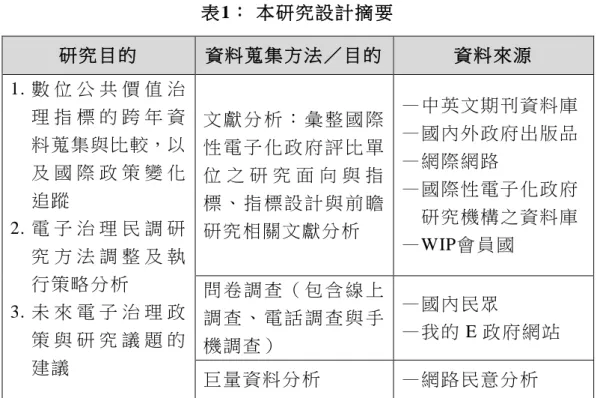
表 1: 本研究設計摘要 ... 7
表 2: 電子治理公共價值架構指標定義 ... 17
表 3: 電子治理公共價值架構操作化指 標的主/客觀類型與 來源 21 表 4: 多元研究方法各面向之比較 ... 25
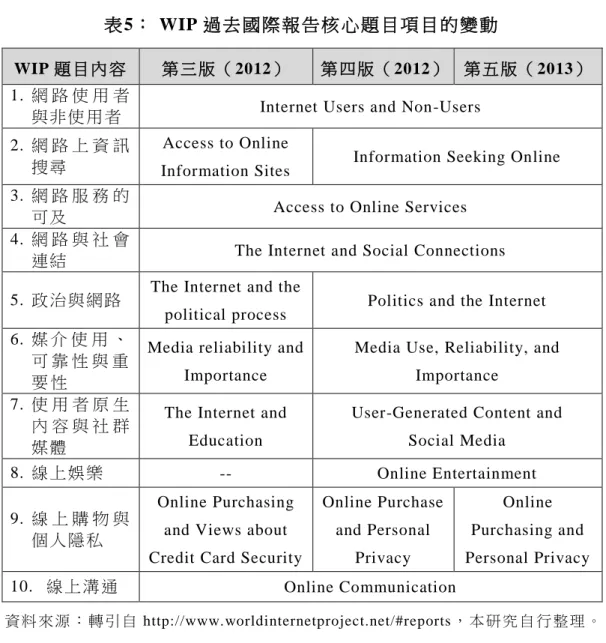
表 5: WIP 過去國 際報告核心題目項目 的變動 ... 37
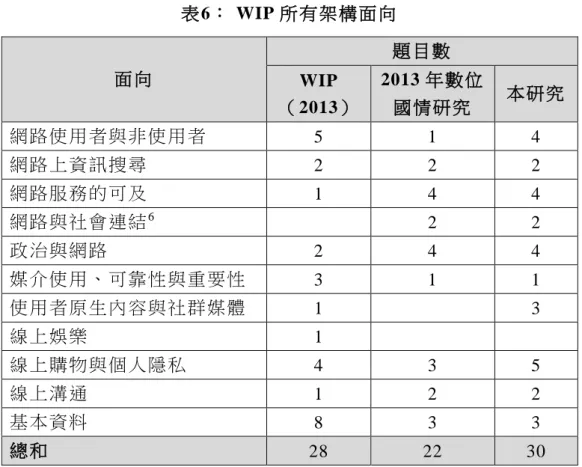
表 6: WIP 所有架 構面向 ... 40
表 7: 操作性價值之跨國比較 ... 63
表 8: 政治性價值之跨國比較 ... 72
表 9: 社會性價值之跨國比較 ... 79
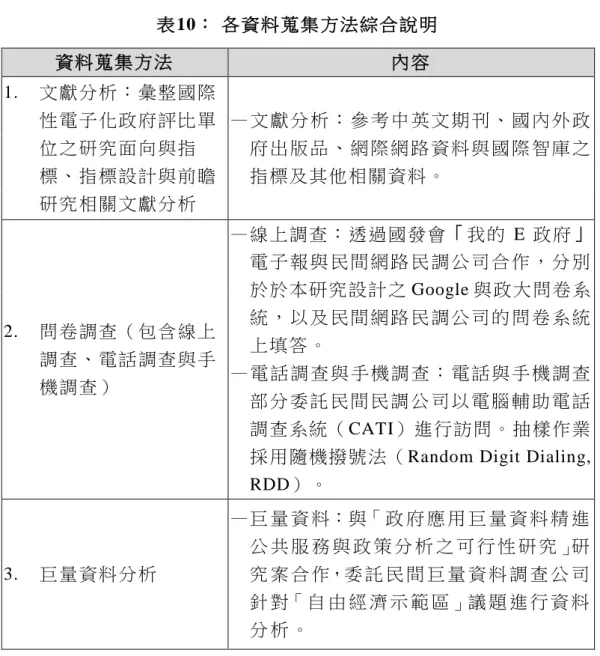
表 10: 各資料蒐集方法綜合說明 ... 82
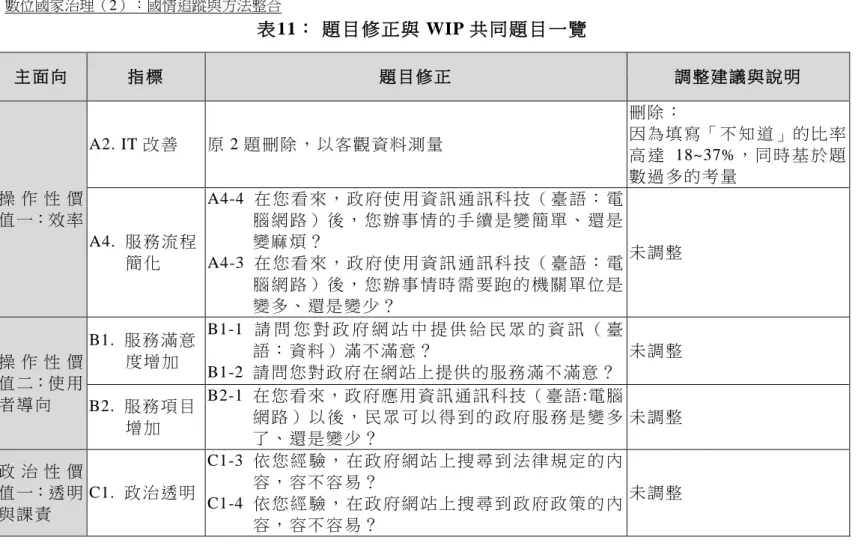
表 11: 題目修正與 WIP 共同題目一覽 ... 84
表 12: 各調查方法的題目內容 ... 91
表 13: 示範區題目類型與詢問方式 ... 92
表 14: 關鍵字一覽 表 ... 98
表 15: 問卷調查法與巨量分析的比較 ... 101
表 16: 不同調查方法之樣本回收數 ... 103
表 17: 訪問成功樣本之代表性檢定 —性 別 ... 104
表 18: 訪問成功樣本之代表性檢定 —年 齡 ... 105
表 19: 訪問成功樣本之代表性檢定 —教 育程度 ... 105
表 20: 訪問成功樣本之代表性檢定 —居 住地區 ... 106
表 21: 聲量計算範例 ... 116
表 22: 各頻道來源分布一覽表 ... 117
表 23: 不同事件前後之 樣本數回收情形 ... 119
表 24: 示範區政策聽聞程度比較 ... 120
表 25: 示範區政策的支持程度 ... 121
表 26: 政策說明後與是否支持該政策 ... 123
表 27: 網路上討論示範區議題的經驗 ... 124
表 28: 政策說明工具 [懶人包]的清楚程 度 ... 125
表 29: 不同年齡受訪者對於示範區的支 持與認知 ... 128
表 30: 經貿議題支持度 ... 131
表 31: 物流議題支持度 ... 133
表 32: 農業議題支持度 ... 135
表 33: 醫療議題支持度 ... 137
表 34: 教育議題支持度 ... 139
表 35: 金融議題支持度 ... 141
表 36: 服務議題支持度 ... 143
表 37: 服務流程簡化 1-電子治理對民眾洽公手續簡化的影 響 ... 154
表 38: 服務流程簡化 2-電子治理對民眾洽公需接觸單位數 影響 156 表 39: 服務滿意度增加 1-民眾對政府網站提供資訊的滿意 度 ... 157
表 40: 服務滿意度增加 2-民眾對政府網站上提供的服務滿 意度 158 表 41: 服務項目增加 1-民眾可以得到的政府服務量改變的 狀況 159 表 42: 政治透明 1-從政府網站找到法 律規定相關資訊的容 易度 161 表 43: 政治透明 1-從政府網站搜尋到 法律規定相關資訊的 容易度 ... 162
表 44: 政治透明 2-從政府網站找到與 政策相關資訊的容易 度 ... 163 表 45: 政治透明 2-從政府網站搜尋到 與政策相關資訊的容 易度 164 表 46: 行政透明 1-從網路上查到政府 線上服務的流程的容 易度 165
表 47: 行政透明 2-從網路上查到政府 線上服務處理進度的 容易度 ... 166 表 48: 行政課責 1-容不容易找到業務 承辦人來處理問題 ... 167 表 49: 公共事務參與的網路行為 1-透過社群網站傳遞公共 議題 168 表 50: 公共事務參與的網路行為 2-參加網路舉辦、號召現 場活動
... 169 表 51: 公共事務參與的網路行為 3-網路討論區提出公共問 題看法
... 170 表 52: 電子化政府服務使用意願 1-透過政府網站做「線上 申請」
... 171 表 53: 電子化政府服 務使用意願 2-未來是否願意使用政府設 立網站 ... 172 表 54: 網路中的政治效能感 1 ... 173 表 55: 網路中的政治效 能感 2 ... 174 表 56: 政治信任 1-同不同意「政府所 做的事大多數是正確 的」 175 表 57: 政治信任 2-政府決定政策時會 不會優先考慮「民眾 的 福 利 」
... 177 表 58: 政治信任 3-相不相信政府首長 在電視或報紙上所說 的話 178 表 59: 網路信任 1-網路上的朋友能不 能信任 ... 179 表 60: 網路信任 2-網路上的資訊是能 不能相信 ... 180 表 61: 網路信任 3-擔不擔心政府監看 您在網路上的行為 ... 181 表 62: 網路信任 4- 擔不擔心政府之外的 民間企業公司監看您 的行為
... 182 表 63: 對電子化政府的信任 1-政府網站上提供的資訊可不 可靠 183 表 64: 對電子化政府 的信任 2-相不相信政府透過網路能處理 好事情
... 184 表 65: 教育學習 1-利用網路來查證資 料的頻率 ... 186
表 66: 教育學習 2-利用網路上課或接 受工作訓練的頻率 ... 187
表 67: 經濟發展 1-在網路上查詢商品 資訊的頻率 ... 188
表 68: 經濟發展 2-透過網路買東西的 頻率 ... 189
表 69: 經濟發展 3-透過網路拍賣東西 的頻率 ... 191
表 70: 經濟發展 4-用網路訂車票、旅 館或機票的頻率 ... 192
表 71: 經濟發展 5-用網路來繳帳單的 頻率 ... 193
表 72: 經濟發展 6-使用網路銀行處理 金融帳戶的頻率 ... 194
表 73: 就業機會 1-透過網路找尋工作 資訊或投遞履歷的頻 率 ... 195
表 74: 休閒娛樂 1-利用網路搜尋藝文 資訊或活動的頻率 ... 196
表 75: 休閒娛樂 2-觀賞網路上影音資 料、從事線上遊戲的 頻率 197 表 76: 休閒娛樂 3-在網路上瀏覽旅遊 資訊的頻率 ... 198
表 77: 人際關係 1-在社群網站上張貼 訊息的頻率 ... 199
表 78: 人際關係 2-在網路上張貼個人 作品的頻率 ... 200
表 79: 人際關係 3-在網路上轉貼或分 享連結、作品的頻率 ... 201
表 80: 人際關係 4-使用線上通訊軟體 和別人聯絡的頻率 ... 202
表 81: 人際關係 5-使用「網路」打電 話的頻率 ... 203
表 82: 人際關係 6-使用「臉書( Facebook)」的頻率 ... 204
表 83: 人際關係 7-上網後和家人聊天 、吃飯、在一起時間 的變化 ... 205
表 84: 人際關係 8-上網後和朋友聊天 、吃飯、在一起時間 的變化 ... 207
表 85: 健康 1-透過網路搜尋和身體健 康有關資訊的頻率 ... 208
表 86: 生活滿意度 1-透過網路搜尋居 家附近生活資訊的頻 率 ... 209
表 87: 生活滿意度 2-有網路後生活後 的快樂程度變化 ... 211
表 88: 不同調查方法比較-整體受訪者 性別 ... 214
表 89: 不同方法間個人基本資料比較 — 整體受訪者年齡 ... 215
表 90: 不同方法間個人基本資料比較 — 整體受訪者教育程度 ... 216
表 91: 不同方法間個人基本資料比較 — 整體受訪者居住地區 ... 217
表 92: 不同調查方法比較-網路使用程 度 ... 218
表 93: 不同調查方法比較-網路使用者 性別 ... 219
表 94: 不同調查方法比較-網路使用者 年齡 ... 220
表 95: 不同調查方法比較-網路使用者 教育程度 ... 221
表 96: 不同調查方法比較-網路使用者 居住地區 ... 222
表 97: 不同調查方法比較-政府網站使 用程度 ... 223
表 98: 不同調查方法比較-政府網站使 用程度性別 ... 224
表 99: 不同調查方法比較-政府網站使 用程度年齡 ... 225
表 100:不同年齡受訪者對於政府電子化 服務的使用程度與意 願 .. 226
表 101:不同調查方法比較-政府網站使 用程度教育程度 ... 228
表 102:不同調查方法比較-政府網站使 用程度居住地區 ... 229
表 103:不同調查方法比較 —自然人憑證 持有 ... 231
表 104:不同調查方法比較 —自然人憑證 持有性別 ... 232
表 105:不同調查方法比較 —自然人憑證 持有年齡 ... 233
表 106:不同調查方法比較 —自然人憑證 持有教育程度 ... 234
表 107:不同調查方法比較 —自然人憑證 持有居住地區 ... 235
表 108:各調查次母群分類方法 ... 237
表 109:電話調查與手機調查訪問失敗原 因 ... 239
表 110:不同方法間母體涵蓋 —性別 ... 240
表 111:不同方法間 母體涵蓋—年齡 ... 242
表 112:不同方法間母體涵蓋 —教育程度 資料來源 ... 245
表 113:不同方法間母體涵蓋 —居住地區 ... 248
表 114:不同調查中「信任」面向的 Cronbach's α 值 ... 252
表 115:不同調查管道主要萃取成份 ... 254
表 116:次樣本分組 的修正係數(fc) ... 256
表 117:修正前後教育程度之比較 ... 257
表 118:修正前後上網頻率之比較 ... 258
表 119:修正前後政府網站使用頻率 ... 259
表 120:修正前後政府信任題 1 之比較 ... 260
表 121:修正前後政府信任題 2 之比較 ... 260
表 122:修正前後政府信任題 3 之比較 ... 261
表 123:不同調查管道的成本與效率分析 ... 263
圖次
圖 1: 電子治理公共價值架構圖 ... 2
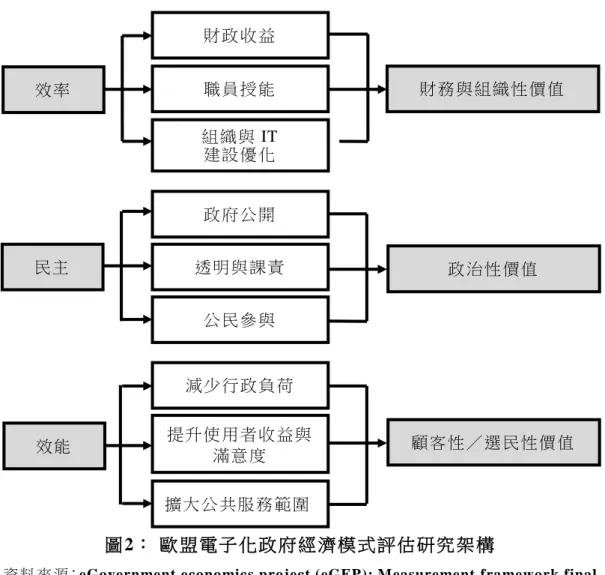
圖 2: 歐盟電子化政府經濟模式評估研 究架構 ... 11
圖 3: 世界網路計畫的成員 ... 34
圖 4: WIP 與電子 治理公共價值架構的 連結 ... 39
圖 5: 不同 WIP 會 員國網路使用者比率 ... 42
圖 6: 同 WIP 會員 國網路使用者性別比 率 ... 43
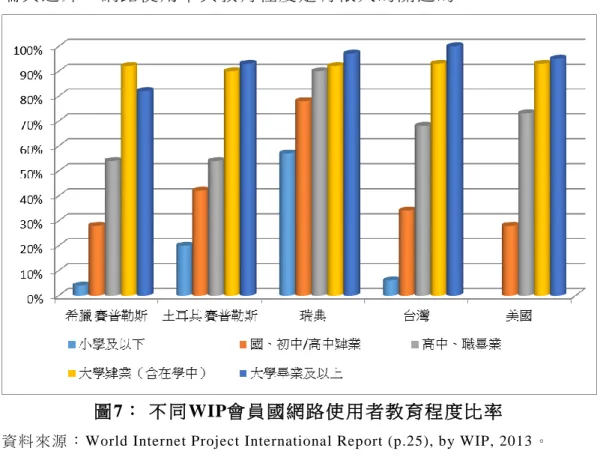
圖 7: 不同 WIP 會 員國網路使用者教育 程度比率 ... 44
圖 8: 不同 WIP 會 員國網路使用者年齡 比率 ... 45
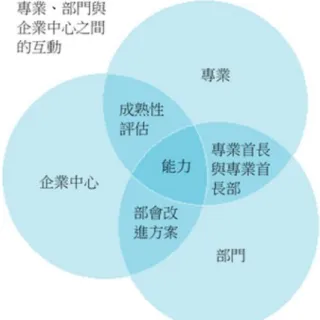
圖 9: 2014 年能力 計畫:公務員核心能 力 ... 54
圖 10: eGov2015 願 景與策略 ... 56
圖 11: 新加坡 Data Catalogue ... 67
圖 12: 新加坡 eCitizen ideas!網站 ... 68
圖 13: 本研究調查時間軸 ... 97
圖 14: 刊登於「生活情報區」之截圖 ... 109
圖 15: 政府入口網第 303 期電子報截圖 ... 110
圖 16: 政府入口網第 306 期電子報截圖 ... 111
圖 17: 2014 年數位 國情調查中獎公告 ... 112
圖 18: 情緒走勢圖 ... 118
圖 19: 電話調查受訪者正面表態 所受到 外部事件的影響 ... 145
圖 20: 手機調查受訪者正面表態所受到 外部事件的影響 ... 146
圖 21: 政府網站會員調查受訪者正面表 態所受到外部事件的 影響 ... 147
圖 22: 網路調查(波仕特)受訪者正面 表態所受到外部事件 的影響
... 148
圖 23: 事件前各調查受訪者正面表態 ... 149
圖 24: 事件後各調查受訪者正面表態 ... 150
圖 25: 事件前後各調查受訪者正面表態 ... 151
圖 26: 理論母體與調查母體比較 ... 238
圖 27: 不同調查執行特性比較 ... 264
提要
關 鍵 字:電子 治理、 公共價值、網 路輿情 、調查方法、 巨量資 料、前 瞻研 究
一、研究緣起與目的
聯合 國從 2003年開始 持續建構與 修正的 電 子發展階段 論、電 子 化 政 府 準備 度(E-Government Readiness)指標,已經成為各國用來了解 本 身 電子 化政 府相 較於 國際 之 優 劣的重 要 指標;世界經濟論 壇(World Economic Forum)每 年針 對 世界 各 大經濟 體 之資訊 通訊科技發 展與整 備度的調查, 也成為 評斷國家競爭 力的重 要依據,進而 影響國 家資訊 產 業 的發展。 然而, 目前各 國際電 子化指 標,大多以整 體層次 觀察資 訊技術與操作 面向的 發 展,忽略了 個體層 面(例如使用 者個人 )的主 觀性分析。為 了和國 際電子治理趨 勢接軌 並發展我國電 子治理 衡量架 構,國家發展委員會委託臺灣電子治理研究中心( Taiwan E-governance Research Center) 的 陳 俊 明 等 ( 2014) 團 隊 完 成 「 數 位 國 家 治 理 : 國 情分析架構與 方法」 研究,該團隊 依照文 獻與層級分析 法建構 第一階 段 的 電子 治理 公共 價值 架構,涵蓋 操作性、政治 性 與社會性 三 大價值,
其下包含效率、使用者導向、透明 與課責、公民參與、資 訊 近 用 公 平 、 信任、自我發 展、生 活品質與環境 永續等 九面向,同時 完成了 第 一年 的 主觀評量資 料蒐集 。透過該架構 所涵蓋 的次面向及指 標測量 ,可供 進一步建構出 電子治 理的國情指數 ,最後 成為我國未來 數位發 展策略 以 及 電子 治理 方面 政策 所需 的 重 要參據 。
然而 , 電子 治理公共 價值架構 須 藉由長期 性追蹤,並 持續修正 其 內容,才能提 升其信 度與效度。同 時,隨 著資訊科技的 發達、 網路與 行 動 載具 的普 及以 及 Web 2.0等相關社群網路的盛行,民意表達及公民 參 與 方 式有 了 相 當 大 的 改 變 ,網 路 輿 情 與 巨 量 資料 ( Big Data) 的 蒐
集及分析方法 逐漸盛 行,數位國情 調查 需 要精進與整合 相關方 法,並 找 出 最佳 的調 查策 略
本研究延續 陳俊明 等 (2014)成果,以同 一架構審視 我國數 位 國 家發展面向、 電子治 理的相關動態 ,以及 數位國家治理 發展所 追求的 最終公共價值 的實踐 程度,同時因 應與時 俱進的科技發 展以及 調查方 式 ,本研究的 研究程 序包括:檢視 電子治 理公共價值架 構以及 相關國 際組織及先進 國家政 府數位相關指 標發展 文獻、以不同 調查方 法蒐集 主觀性資料、 進行跨 年資料分析、 比較不 同調查方法結 果、呈 現數位 國 情 狀態 ,最 後提 出電 子治 理 政 策未來 發 展與研究 議題的 建議 。
二、研究方法及流程
本 研究共分 三 個階 段, 內 含 的研究 方 法與程 序概 述如下:
(一 ) 數 位公 共價值 治 理指標 跨 年資料 蒐集與比較,以及國際政 策變 化追蹤:檢討前一年度所建構完成的電子治理公共價值架構,
並 針對 相關 國際 組織 及 先 進國家 政府(例如美 國、英國、新加 坡 )數 位 政 策 發展 進 行 文獻的 檢視。此外,參考不同調查的分 析 結果 以及 世界 網路 計 畫 (World Internet Project, WIP)問卷 題 目進 行本 研究 主觀 指 標 問卷題 目修正,透 過不同 調查方法
(包括電話調查、手機調查、網路樣本調查、及最新的巨量資 料),進行主觀資料 蒐 集 。
(二 ) 電 子 治 理議題 調 查方法 執 行策略 分析:除針對 前一階段完 成蒐 集 的調 查資 料進 行跨 年 資 料分析,同時 比較來 自不同調查 方法 的資料,參考既有研 究成果及各國作法,研提各資料蒐集方式 的組合建議,以增加往後調查研究的母體涵蓋率和測量的信 度 與 效度 。
(三 ) 未 來電 子治 理政 策與 研 究 議題的 建議:研究團 隊綜整前述 成果,
針 對未 來政 府的 電子 治 理 政策、數位國 情調查 策略與方法 及後 續 值得 探討 的議 題研 提 建 議。
三、研究成果
(一 ) 數 位國 情問 卷修 正
1、 本研究 延 續陳俊 明 等 (2014) 的 電子治 理公共價值 架構與 操 作化題 目 , 並 參考 先 前 的調查 結 果 調 整問卷 內容, 最後 的修 正包括 :(1)加入財務與科技風險相關題目,例如「認為網 路上的 資 訊有多 少 是可以 相 信的」、「擔不擔 心政府 監看您在 網路上 的 一舉一 動 」;(2)受訪者回答「 不知道」比率較高的 題目, 移 除其題 項 或改寫 文 字敘述;(3)新增「是否擁有自 然人憑 證 」題目 , 確認不 同 調查方法 所接觸 受訪者分布 與 母 體分布差異;以及( 4)設計自由經濟貿易示範區題組,做為 巨量資 料 與主觀 問 卷調查 資 料蒐集方 法之比 較。
2、 本研究 修 正後的 主 觀調查 問 卷共涵蓋 操作性 、 政 治性 與 社 會 性三 大 價值 ,效 率 、 使用者 導 向、透 明與課責、 公民參 與、
信任、 自 我發展 、 生 活 品質等 七 大面向 ,十九項指 標。手 機 調查因 為 方法的 特 殊性質 和 研究經費 上的限 制,僅納入 五項 主觀指 標 ,電話 調 查 及 兩個網 路 調查管 道,則皆包 含所有 的 主觀指 標 題目( 完 整問卷 題 目共計 66 題)。
(二 ) 依 照 電 子治理 公 共價值 架 構,進 行 美 國、英 國、新 加 坡 三 國 電 子 治理 政策 比較 分析:本研究持續綜合 整理國 外電子治理 發展 趨勢相關文獻、各項 國際間電子化政府評比指標,針對美國、
英國、新加坡等電子 治理國際評比績優的國家,對 應電子 治理 與 操作性、政治性與 社會性 三 大 公共價值,進行 這 三個 國家 電 子 治理 政策 的 比 較 分 析。
1、 在 操 作 性 價 值 下:(1)美國、英國和新加坡皆設置資訊平台,
作為政 府 資料整 合 的窗口 ;(2)美國與英國皆規劃官方的數 位政府 策 略,新 加 坡政府 則 按照國家 的政策 方向持續邁 進,
打造完 善 的電子 化 環境。
2、 在 政 治 性 價 值 下:(1)以資料透明與課責制度的建立為主流,
美國、 英 國與新 加 坡政府 均 以資料開 放為基 礎,推動重 要計 畫;(2)關於公民參與的實踐,美國與新加坡兩國有較明顯 的發展;(3)美國、英國皆著重改善服務提供措施,以提高 資訊近 用 的公平 性 。
3、 在社會 性 價值下 :(1)為加強民眾對電子化政府的信任,美 國與英 國 分別規 劃 政策與 指 南來規範 政府施 政;(2)英國特 別著重 公 務 員數位 能 力的培 養 與精進, 新加 坡以雲端運 算的 方式帶 動 自我發 展 ;(3)美國著重運用行動裝置取得資訊,
新加坡 則 提供多 元 服務, 藉 此改善生 活水準 ;(4)針對資通 科技設 備 的能源 有 效性, 新 加坡將其 列為發 展電子化政 策的 重要里 程 碑。
(三 ) 數 位國 情調 查結 果
1、 操 作 性 價 值 — 受 訪 者 對 於 操 作 性 價 值 所 涵 蓋 的 面 向 大多 持 肯 定態度,如電子化政府提高效率、簡化流程、滿意政府網站提 供的資訊與網站服務的滿意度、及政府因為網際網路增加服務 項目等,惟民眾對於政府提供資訊之滿意度則相較去年下降 。 2、 政治性 價 值 — 在「 透 明 與課責 」 面向中 ,包括資訊 取得容 易
度、線 上 業務處 理 進度、 以 及可否找 到業務 負責人等項 目皆 有待改 進 ;關於 「 公民參 與 」面向, 網路公 共參與行為 仍不 足,電 子 化政府 服 務使用 意 願也 微幅 降低。
3、 社會性 價 值 — 在「 信 任 」面 向 中,政 治 信 任 與 網 路 信 任 低 落 , 但民眾 對 於電子 化 政府的 信 任程度相 對較高 ;關於「自 我發 展」和 「 生活品 質 」之面 向 ,回答從 未使用 的受訪者比 例皆 微幅下降;「經濟發展」面向相關題目中,以透過網路查詢商 品資訊 的 比例最 多 ;有關 「 生活品質 」之題 目中,以觀 賞網 路上的 影 音資料 、 或從事 線 上遊戲的 使用頻 率最高;最 後,
網路對 家 庭相處 時 間的負 面 影響較大 ,但整 體而言,網 路對 於民眾 快 樂程度 的 提升, 其 正面多於 負面。
(四 ) 巨 量資 料分 析方 法
1、 本研究 分 析自 2014 年 7 月 8 日 到 8 月 11 日間,網路 上有關 自由經 濟 示範區 的 討論文 章 ,並設計 與自由 經濟示範區 有關 的「事件」(即 7 月 21 日國發會主委的網路說明會),透 過內 容觀察 法 和自動 語 意技術 , 觀察網路 民意在 事件前後的 變動 情形。
2、 依照網 路 頻道的 來 源以及 語 意情緒分 析結果 發現,正面 情緒 多來自 新 聞轉錄 , 例如部 落 格與電視 台的新 聞轉貼;負 面情 緒則以 網 友討論 居 多,例如 PTT 八卦版與政黑板;部分無法 判定情 緒 、或者 無 情緒字 眼 ,則散見 於社群 網站中的新 聞發 布管道 , 例如論 壇 與時事 專區 。 而整個 觀察期間, 網友的 負 面態度 均 高於正 面 態度。
3、 公共政 策 網路說 明 會「事 件 」對政策 行銷的 正面效果有 限,
網路說 明 會並未 提 升民眾 對 自由經濟 示範區 政策的了解 與支 持程度 , 反而產 生 明顯的 負 面影響。
4、 巨量資 料 在輿情 觀 測上的 應 用,以本 研究來 說,容易受 到其 他網路 事 件影響 。 因此, 應 用巨量資 料進行 輿情監測時 ,本 研究認 為 透過長 時 間觀察 , 較能避免 單一事 件影響。
(五 ) 多 元調 查方 法的 比較 分 析 結果
1、 手機調 查 與電話 調 查的合 併 ,對於母 體涵蓋 率的 幫助有 限:
本研究 結 果顯示 , 合併之 後 的新樣本 群與臺 灣的母體分 布仍 然有相 當 差異。
2、 除 手 機 調 查 之 外,女 性 相 對 於 男 性,較 易 接 受 各 式 調 查 訪 問 。
3、 電 話 調 查 和 網 路 調 查 相 比,前 者 的 管 道 更 容 易 接 觸 到 青 少 年 ( 1 5 ~ 1 9 歲 ) 族 群 : 雖 然 青 少 年 經 常 使 用 網 路 , 但 若 希 望 透 過 網 路 民 調 方 式 來 了 解 青 少 年 的 意 見,反 而 並 不 容 易 。
4、 電話調 查 較不會 受 到「事 件 」的影響 : 關於 網路說明會 ,各 調查法 「 事件前 、 後」調 查 結果中, 電話調 查的差異最 小,
而手機 調 查與網 路 調查都 在 「事件」 發生後 產生了波動 。 5、 網路 調 查成 功接 觸 對 象多為 中 壯年, 不易吸引年 齡低、 年齡
高者填 答 問卷: 未來 如 何提升 青 少年和 高齡人口的 成功接 觸 與受訪 機 會,將 是 網路調 查 必須面對 的重要 課題。
6、 不同方 法 所接觸 到 的樣本 , 地區分布 上的差 異較小 : 往後 所 調查的 主 題若僅 受 到地區 變 數影響, 可考慮 透過網路調 查來 取代電 話 調查, 以 便減低 調 查成本。
7、 若單從 成 本的角 度 來看, 網 路調查具 有相當 大優勢 : 倘若 不 考慮代 表 性、母 體 涵蓋率 等 情形,網 路調查 公司所提供 的調 查,不 僅 節省人 力 、經費 , 又能承載 大量題 目。
8、 網路調 查 容易高 估 電子化 政 府使用者 : 電話 調查所接觸 到的 網路使 用 者,及 網 路調查 所 接觸到的 網路使 用者, 二者 在 網 路上的 行 為有所 不 同,網 路 調查有高 估網路 使用者態度 之可 能性。
9、 網路樣 本 對公共 政 策議題 的 知曉度最 高: 以 自由經濟示 範區 議題為 例 ,在比 較 不同方 法 所接觸到 的樣本 後,發現網 路民 眾對於 政 策的瞭 解 程度、 支 持程度皆 較高。 研究以 電話 調查 資料為基礎,經入選機率調整法( Propensity Score Adjustment)
調整網路樣本,完成網路調查人口變項以及回應結果之校正,
結果顯 示 ,以入 選 機率調 整 法修正網 路問卷 調查結果的 方式 確實有 效 可行, 但 由於入 選 機率調整 法是將 網路問卷向 可信 賴的電 話 調查結 果 作校正 , 因此需要 可信賴 的調查與母 體資 料作為 校 正的參 考 。
四、後續研究與政策建議
根據本研究 之發現, 針對往後數 位國情的 相關策略, 提出下列 研 究建議:
(一 ) 持 續修 正電 子治 理公 共 價 值架構 與指標:每 二 至 三 年,依 據 國 際 發展 和國 內資 料蒐 集 狀 況,仿 照 UN、WIP 之架構修正過程,
透 過專 家會 議方 式來 進 行 電子治 理公共價值 架構修 正工作,且 資 料蒐 集方 式應 隨著 科 技 發展、民眾 意見 表達行為 的改變、以 及 民意 調查 方法 與時 俱 進 。
(二 ) 建 立與 開放 公共 價值 數 位 國情追 蹤資料庫系 統:除整合現 有國 際評比資料庫、各類 電子治理使用者主觀調查資料、以及各項 客 觀指 標調 查數 據外,呼應 國 際政府 資料 開放趨勢,使 資料庫 系 統具 備資 料分 析、 比 較 與分享 等重要功能 。
(三 ) 強 化手 機調 查運 用在 主 觀 性評估 研究中的份 量:針對不使 用有 線 電話 及 網際 網路 的 受訪 者,可 透過手 機 調查核心題目,來補 充 電話 調查 之不 足。另外,在 題 目數量較 多的調 查中,對於交 互 使用 手機 與網 路的 受 訪 者,建立適 當的 訪問機制,同 時運用 兩 種方 法進 行調 查。
(四 ) 單 位巨 量資 料 盤 點 與開放 方 式研提:政 府資料 可能有豐富 的文 字 內容、非 結構化、非 正式公 民 對話 等等 特性,如果能利用內 容與文字分析,或者語意及影響分析,將有助政府轉型、並改 善 政府 透明 程度 、促 進 參 與及平 等之目標。
(五 ) 加 強 國 際 合 作,強 化 國 際 評 比 表 現:本 研 究 連 結 國 際 評 比 指 標 與 電子 治理 公共 價值,未來 可經由特定變 數或資料的統一,進 行 跨國 性實 證資 料的 比 較 分析,並 藉 2016 年我國舉辦 WIP 年 會 ,強 化國 際評 比表 現 與 國際交 流。
基於數位國 情主觀指 標調查成果 與研究團 隊的實務經 驗,本研 究 認為應持續優 化電子 治理計畫,透 過提升 行政管理效率 與彈性 ,藉此 縮短政策制定 與執行 的過程,並配 合中長 期的修法,來 推動我 國 未來 數 位 發展 。以 下本 研究 研擬 短 期 、中長 期 政策建 議:
(一 ) 短期立即 可 行之政 策 建議
1、 操作 性 價值 部分 — 強 化 原有電 子 化政府 服務項目範 圍、品質、
及簡化 流 程外, 應 盡速掌 握 民眾對於 政府所 提供資訊滿 意度 下降之成因,據此改善資訊品質、資訊內容與民眾需求落差、
及資訊 取 得容易 性 等。
2、 政治 性 價值 部分 — 持 續 強化資 料 開放之 範圍,在資 料取得 的 容易度 上 ,如版 面 的設計 、 資訊所置 放的層 次、以及法 令或 政策資 料 的可近 性 。另外 , 建議運用 行動裝 置和社群媒 體,
提供民 眾 線上參 與 或審議 之 管道,且 由政府 進行具體回 應,
以增加 網 路政治 效 能感及 政 府網站的 使用意 願。
3、 社會 性 價值 部分 — 提 高 民眾對 於 政府的 信任,需要 長時間 的 努力, 應 不斷增 進 政府的 透 明度、資 訊的精 確度、以及 網路 申辦的 效 率,將 相 關指標 列 入政府服 務品質 獎評比項目 ,並 由資訊 主 管機關 定 期評比 各 機關網站 ,提供 機關改進基 礎。
4、 輿情蒐 集 與分析 策 略 —(1)公 共 政 策 網 路 說 明 會 的 效 果 非 常 有限, 建 議 重 新思 考 其 舉辦的 模 式,避 免因說明不 清楚反 而 產生明 顯 的負面 影 響;(2)網路調查有其偏頗,雖可藉由入 選機率 調 整法校 正 調查結 果 ,由於入 選機率 調整法需要 可信 賴的調 查 與母體 資 料作為 校 正的參考 ,母體 推估方式可 參考 美國疾 病 控制與 預 防中心 (Centers for Disease Control and Prevention)以及 美 國 當前人 口 調查( Current Population Survey, CPS)面對 面 訪談 調查 方 式進行 推估,網路 調查可 作 為輿情 蒐 集的補 充 方法, 建 議仍以傳 統調查 方式為主。
(二 ) 中 長程 建議
1、 操作 性 價值 部分 — 需 更 積極展 開 政府資 訊公開,強 化對政 府 資訊透 明 與行政 課 責,隨 著 資 訊 通訊科 技 程 度提升,資 訊公 開的制 度 應當日 趨 健全, 以 促進我國 推行民 主政治,以 及落 實電子 治 理之透 明 與課責 兩項 公 共價值 。
2、 政治 性 價值 部分 — 透 過 多元化 社 會網絡 平台,提升 公民參 與 程度, 我 國政府 目 前積極 推 動 Web 2.0 相關服務,然而,社 會網絡 平 台或管 道 仍掛在 政 府單位網 站之下 ,且面向較 為單 一,可 參 考新加 坡 政府成 立 專屬計畫 網站並 經營社群網 絡。
3、 社會 性 價值 部分 —( 1)在 電 子 治 理 體 系 觀 點 下,整 合 各 類 生 活品質 安 全管制 系 統與提 升 效率,電 子治理 應該以落實 民眾 的生活 品 質 價 值為 優 先 。除近 來 國內所 爆發的食品 安全議 題 外,並 應 透過電 子 發票推 動 強化政府 在各面 向稽 核功效 。同 時,經 濟 部、財 政 部等跨 部 會單位的 政策方 案必須與立 法單 位之腳 步 調和, 藉 此持續 深 化跨域服 務管理 機制;(2)持續 關注網 路 成癮問 題 ,部分 受 訪者表示 「因為 網路而變得 不快 樂」,政府除了探究原因,可參考他國作法,與民間組織合作 舉辦戒 除 網路成 癮 之課程 或 營隊。
4、 輿情蒐 集 與分析 策 略 —( 1)利 用 政 府 現 有 資 料,分 析 正 確 的 母體分布,實務上,全國人口統計資料尚存在「逕為遷出(逕 遷戶所 )」的問題,此落差將造成調查結果之偏誤,未來應由 相關部 會 通力 合作 , 確 認目前 實 際在臺 灣生活的人 數,及 其 相關基 本 資料比 例,作 為電話 調 查或手 機調查加權 之依據;(2)
輿情蒐 集 應採多 元 調查方 法 ,本研究 之電話 調查以及手 機調 查的受 訪 者中, 各 有七成 以 及八成的 比例使 用網路,其 中每 天使用 的 重度使 用 者所占 比 例最高, 且網路 問卷在本 研究 各 調查管 道 中的信 度 最佳, 加 上其速度 快、成 本適中,未 來值 得發展 網 路調查 , 唯網路 對 母體的涵 蓋率 建 議應 參考美 國疾 病 控 制 與 預 防 中 心 ( Centers for Disease Control and Prevention, CDC)以 及 CPS 調 查方式找 到可信 的母體分布 , 並定期 公 布, 再以 入 選 機率調 整 法調整 網路調查結 果;(3)
為 不 同 議 題 建 構 專 屬 的 網 路 調 查 公 民 群 ( panel), 未 來 建 議 招募長 時 間與政 府 機關配 合 的網路公 民顧問 調查群,並 且設 計定期 的 替換與 評 估機制 , 往後則對 應議題 特性,由網 路調 查公民群當中,依照基本資料分層抽樣出代表性的樣本;( 4)
短時間 改 變看巨 量 資料、 深 度效果看 問卷調 查,根據本 研究 的比較 發 現,巨 量 資料的 分 析確實能 在短時 間內看出網 民態 度的「改變」,建議未來透過巨量資料分析,在第一時間了解 議題及 事 件影響 力 ,然而 若 考慮民意 的品質 與代表性, 仍以 問卷調查為重;(5)在特定議題上,可用網路調查取代電話 調查, 例 如在本 研 究所選 定 的 自 由經濟 示範 區議題中, 傳統 電話型 態 與網路 調 查結果 非 常相近, 因此, 關於往後的 調查 策略, 得 考量公 共 政策議 題 的關注族 群、知 識來源、及 討論 場域等 因 素選擇 適 合的調 查 方法。
5、 建立國 際 評比中 心 、發展 協 同與夥伴 關係, 以推廣我國 電子 治理體 系 —目 前臺 灣 電 子治理 研 究中 心已為 日本早稻田 大學 電子化 政 府研究 所 ( Waseda University Institute of
e-Government)的 國際 團 隊 成員之 一,將有機 會透過 影響世 界網路 計 畫之網 路 發展調 查 指標,令 臺灣與 國際場域接 軌,
未來政 府 可朝建 立 電子治 理 國際評比 中心的 目標邁進, 進而 發揚我 國 所建置 的 電子治 理 公共價值 體系。
Abstract
Key Words: Digital Governance, Public Value of E-Governance, Multi-Method Research, Big Data, Prospective Study
1、 Background and Motive
International organizations, such as United Nations (UN), International Telecommunication Union (ITU), and World Economic Forum (WEF), have invested significant efforts in the development of frameworks and indices for the assessment of e-government performances around the world. Since 2003, the UN has continued to build upon and rectify the paradigms and theories on the stages of e-government evolution and e-government readiness indices. The studies by WEF on the development of information and communications technologies (ICTs) and the readiness of major economies , has also become recognized as an essential component in the evaluation of a nation’s competitive capacity.
Nevertheless, current international e -government indices are primarily focused on observing the dimensi ons of technical and operational developments from a holistic perspective. This has left the subjective analysis of individual dimensions (individual users) in neglect. In order to integrate with current trends of international and Taiwanese e-governance and to develop Taiwan’s e-governance measurement framework, the National Development Council (NDC) has delegated the Taiwan E-governance Research Center (TEG) to conduct extensive research projects on the subject area. The first phase of the project was completed in the Chen et al. (2014) “Public Value and Electronic Governance: Analytical and Methodological Reflections”
research project. This project developed the first stage of the public value based e-governance framework based upon past literature and da ta collected using an Analytical Hierarchy Process (AHP) model, and completed the first annual collection of subjective evaluative data. The public value based e-governance framework covers three major values:
political, social and operational. These value s are in turn, further divided into nine dimensions: efficiency, user -oriented service, transparency and accountability, citizen participation, accessibility equity, trust, self-development, quality of life, and environmental sustainability. Measurement of sub-dimensions and indicators of the public value based e-governance framework would allow for the further development of national digital status indices, and serve as important references for Taiwan’s approaches in digital developments and e-governance related policies in the future.
However, the public value based e-governance framework requires a longitudinal study, containing multiple years of survey data, coupled with constant revisions, in order to enhance its reliability and validity.
In addition, the development of ICTs and web technologies, along with the widespread use of portable and mobile internet devices , and the prevalence of Web 2.0 social media platforms, are gradually changing the way in which public opinion is expressed and civic particip ation is conducted. Techniques for the collection and analysis of internet public opinion and Big Data are also becoming increasingly popular, thus, researches intended on measuring the national digital status should explore appropriate strategies to incorporate and integrate these new developments and approaches.
This research builds upon the results of Chen et al. (2014), utilizing the public value based e-governance framework in the examination of the dynamics of Taiwan’s national digital development dimensions and e-governance related subjects. This research hopes to internalize new
developments, in areas of technology and methodology, in the understanding of the extent of implementation of public values pursued by the development of e-governance. At the same time, this research aims to integrate different data collection practices and conduct methodological comparisons. Research procedures used in this research includes the following: examination of the developed public value based e-governance framework and the development of related international digital indices through literature, the use of multiple survey methods in the collection of subjective data, the analysis of multi -year data, and the comparison of the results from multiple survey methods. This research hopes to provide, a comprehensive picture of Taiwan’s national digital status, and recommendations for future e -governance policy developments and research directions.
2、 Methods and Procedures
This research is divided into three stages. The research methods and procedures employed for each stage are outlined below:
(1) The collection and comparison of multi -year data on e-governance public value indicators, and the tracking of international e-governance policy changes: Review of the public value based e-governance framework developed by Chen et al. (2014), and the examination of literature on the development of digital indices by international organizations and foreign nations . The results of various researches are referenced, and questions derived from the World Internet Project (WIP) are used to revise and strengthen the subjective indicator questionnaire used by Chen et al. (2014).
Multiple different survey methods, including telephone surveys, cell phone surveys, internet surveys, and big data methods, are also used to gather subjective data.
(2) The analysis of e-governance research methods and implementation strategies: Multi-year data analysis along with the comparison of data from different survey methods, based upon the data collected during the previous stage. Past research findings and methods employed by international studies are also referenced. Suggestions are then made on how best to coordinate the different survey methods. It is hoped that these recommendations would boost the coverage, reliability and validity of future studies.
(3) Recommendations for research directions and policies on e-governance: A compilation of the results presented in the first two sections, followed by recommendations for, e -governance policies, strategies for the investigation of national digital status and issues that are worth researching.
3、 Preliminary Results
(1) Revision of the national digital status questionnaire
i. This research adopts the public value based e-governance framework developed by Chen et al. (2014) and the framework’s accompanying survey items. Survey results from Chen et al.
(2014) are analyzed and survey items are then adjusted according to the results. Revisions include: (1) The inclusion of questions on financial and technological risks, these include “How much of the information on the Internet overall is generally reliable?” and
“Are you worried about the government checking what you do online?” (2) Questions with high amounts of “don’t know”
responses are either reworded or removed. (3) A new item, “Do you possess a Citizen Digital Certificate?” is added in order to verify the difference between the distribution of the respondents from different survey methods and the distribution of the actual
population. (4) The addition of items pertaining to Taiwan Free Economic Pilot Zones (FEPZ), in order to compare the subjective data gathered from different surveys with the data obtained through big data methods.
ii. The revised subjective survey questionnaire includes political, social and operational values. These values are then divided to into seven dimensions: efficiency, user-oriented service, transparency and accountability, citizen participation, trust, self-development, quality of life. These values are in turn, operationalized into nineteen indicators. Due to budget and methodological constrains, the cellphone survey only contained items for five different indicators. The telephone and the two different internet surveys contained all of the indicators and had a total of sixty-six questions.
(2) A comparison of e-governance policies of the United States of America, United Kingdom and Singapore is made with the public value based e-governance framework: Continued integration of the literature on international e-governance development trends and international e-government assessment indicators. A comparative analysis on e-governance policies are conducted on the United States, United Kingdom and Singapore, as these three nations all score favorably in international assessments. The analyses are conducted with regard to the three major public values, i.e., the operational, political, and social values .
i. In terms of operational values: (1) All three nations have implemented information platforms to serve as portals for the integration of government data. (2) Both, the United States and the United Kingdom, have formulated official e -government policies, while Singapore continues to build a comprehensive
e-environment in the direction specified in its national policies.
ii. In terms of political values: (1) Data transparency and the creation of accountability measures seems to be the main focus for all three nations. United States, United Kingdom and Singapore have all made open data as the basis for the implementation of major policies. (2) Both the United States and Singapore have made significant gains in the implementation of civic participation measures. (3) The United States and United Kingdom have placed a lot of emphasis on the elevation of service provision, in order to increase the equity of data usage.
iii. In terms of social values: (1) In order to strengthen citizen trust in e-government, both the United States and the United Kingdom have formulated policies and guides to standardize government administrative procedures. (2) The United Kingdom has placed particular emphasis on improving the ICT skills of civil servants, while Singapore is utilizing cloud co mputing methods to drive self-development. (3) The United States is heavily focused on providing access to information for portable devices, while Singapore is focused on providing multiple services in order to enhance the standard of living. (4) Singapore has made ICT energy efficiency as a major milestone for its e -government policy.
(3) Results of the national digital status surveys
i. Operational values: The questionnaire items which operationalize the operational dimensions mostly yield positive responses from respondents. These include e-government efficiency, process reengineering, satisfaction toward the data and service provided by government websites and the increase of services brought by the use of the internet by the government. Of
these items only satisfaction toward information provided by the government is lower than data from Chen et al. (2014).
ii. Political values: The questionnaire items measuring the transparency and accountability dimension, which includes information accessibility, speed of onlin e services and the ease with which the person in charge can be contacted, all show much room for improvement. The online civic participation measuring the civic participation dimension reveals that citizen participation is still not high enough. Willingnes s to use e-government services also slightly decrease compared with the results from Chen et al. (2014).
iii. Social values: The questionnaire items in the trust dimensions reveal that citizen trust in the government and the internet are both very low. However, citizen trust in e-government is much higher. The percentage of respondents who have never utilized an e-service is slightly lower for the self-development and quality of life dimensions. Of all items measuring the economic development index, the item for buying things online scores the highest. Between items measuring the quality of life index, the items for viewing videos online and for gaming online score the highest. The negative effects of the internet on family relations are also significant, but overall, the effect of the internet on citizen happiness is positive.
(4) Big data results
i. This research employs content analysis and automated text analysis techniques to analyze the attitude of web forum discussions on Taiwan Free Economic Pilot Zones during t he period of 2014/07/08 to 2014/08/11. Changes in internet public opinion before and after the event are observed.
ii. Analyses based on the source of online information and attitudinal semantics, reveal that most positive attitudes are derived from news media channels; these include reposts of TV news and blogs. Most negative attitudes are from discussions by netizens on PTT. Most data from news broadcast channels of social media websites, such as forums and boards for posting current affairs, show no clear attitude.
iii. Online public policy seminars, awareness or explanatory campaigns have limited positive impact on policy marketing. The policy publicity event used in the analysis do not significantly raise citizen awareness and support for the Taiwan Free Economic Pilot Zones, in fact the event actually lower public support for the policy.
iv. The application of big data methods to the observation of internet public opinions can easily be affected by events which are not accounted for in the original research. Thus the research team believes that any use of big data methods to monitor internet public opinion requires a long period of observations, this would prevent the effect of single events.
(5) Multi-research method analyses and comparisons
i. The combining of cellphone and telephone surveys has limited impact on improving the data to more accurately reflect the actual distribution of the respondent population. The results reveal that the combined results are still unable to reconcile the respondent sample with the distribution of the Taiwanese populace.
ii. Apart from the cellphone survey, the telephone and internet surveys all have higher female valid samples. This could mean
that women, in general, are more willing to answer surveys conducted by any method.
iii. Our telephone survey has more respondents in the 15~19 age range than the internet surveys. This reveals that despite the high frequency of internet use among younger citizens, public opinion methods of survey would have more success in reaching these younger citizens through telephone surveys.
iv. Our results show that telephone surveys are less affected by events. The policy publicity event used in this research’s analysis shows that respondent opinions toward policy change the least for the telephone survey. However, int ernet and cellphone surveys all have considerable opinion changes after the event.
v. Most respondents of the internet surveys are in middle age group, the internet survey seems to have difficulty inducing younger and older respondents to respond to questionnaires. The ability to successfully obtain younger and older respondents is an area in which internet surveys should strive towards.
vi. The distribution of respondents by geographical area is not significantly different among the various survey methods. Thus, for surveys in which the variable in question is solely affected by geographical distribution, cheaper internet surveys could be use d to replace the telephone survey.
vii. In terms of cost, internet surveys have a huge advantage over the other survey methods. If sample representation and coverage isn’t extremely important, internet surveys are the best choice, as they do not require as much man power, money, and is better able to deal with larger numbers of respondents.
viii. Internet surveys over represent the percentage of respondents who have used e-government services. The behaviors of the internet users from telephone and internet surveys a re significantly different. Results of the Taiwan Free Economic Pilot Zones items reveal that respondents of the internet surveys are more knowledgeable and supportive of government policies.
ix. The use of the Propensity Score Adjustment (PSA) method is a potentially viable method of fine-tuning the respondent distribution of internet surveys. This research successfully utilizes PSA in the adjustment of internet survey data with the data from the telephone survey serving as the basis for the adjustment.
4、 Future Research Directions and Policy Recommendations
The following research and policy recommendations are suggested in light of the discoveries made in this research.
(1) Continued adjustment of the public value based e-governance framework and its indices: The framework should be revised by specialist meetings and conducted according to the data collected from international developments and the data collected in Taiwan , every two to three years. The revision processes should be similar to the adjustment processes adopted in UN and WIP projects. The methods for data collection should be changed to keep pace with the development of technology, the way in which public opinion is expressed, and the development of public opinion surveys.
(2) Creating and opening up to the public, a public value based national digital status tracking database system: The database should integrate current international assessment databases, subjective e-government user data, and objective indicators. The database should also include data analysis, comparison and
sharing functions, in accordance with the open data trends in the international community.
(3) The increase of the use of cellphone surveys for subjective assessment researches: Cellphone surveys should be used to contact respondents who lack a land line (telephone) and do not use the internet. This would complement the telephone survey. In surveys with a high number of survey items, a method should be developed to combine both the cellphone and internet surveys when they are used together.
(4) Strengthen international cooperation and enhance international assessments: This research has linked international assessment indicators with e-governance public values. It is hoped that the next step would be the conducting of a cross -national empirical research based on the public value based e-governance framework.
In addition, the WIP annual conference will be hosted in Taiwan in 2016. TEG should utilize this opportunity to strengthen our exchanges and cooperation with the international community.
The continued enhancement of e-government programs coupled with the elevation of administrative management efficiency and flexibility could lessen the time needed for policy creation and implementation. This advantage could then be used along with the policy recommendations, stated below, to further develop Taiwan’s e-government. Short-term and medium/long-term policy recommendations are as follows:
(1) Short-term policy recommendations
i. Operational values: enhance the coverage and quality of current e-government services, while also simplifying its process. The reason for a decline in satisfaction toward government provided services should also be quickly noted. The data could then be
used to improve information quality, information contents, and the accessibility of the service.
ii. Political values: continued improvement in the area of open data , in terms of the ease of obtaining data. These include webpage design, the level in which the data is presented, and the accessibility of data on laws and policies. It is r ecommended that mobile devices and social media platforms be utilized. This would provide online civic participation and deliberation channels. If this were implemented alongside concrete and regular government responses, online political efficacy and the usage of government websites would be increased.
iii. Social values: the elevation of citizen trust in government is a process which requires a lengthy amount of time. Government transparency, information accuracy, efficiency of online services should be continuously improved. Certain indicators should be included in government service quality assessment rewards, while information management agencies should conduct regular assessments of the websites of different agencies and offer advices for improvements.
iv. Public opinion data collection and analysis strategy: (1) Public policy online awareness campaigns are limited in their effectiveness. It is recommended that the methods for conducting these campaigns are revised, in order to minimize the negative effects of not clarifying the policy enough. (2) Due to biases inherent in internet surveys, even with the help of PSA, it is recommended that more traditional survey methods be used as the main data gathering method, with the internet survey utilized as a supplement.
(2) Medium/long-term policy recommendations
i. Operational values: a more active push toward open data. The strengthening of government data transparency and administrative accountability. The development of ICT would allow for a more robust open data structu re and the push for a more accountably democratic system.
ii. Political values: the elevation of civic participation through the use of a diverse social media platform. Although the Taiwanese government has been pursuing the development of Web 2.0 services, government social media platforms and channels are still based upon government websites , lacking diversity. It is recommended that the current development by the Singaporean government be emulated, through the creation of specifically designed webpages and social media administrators.
iii. Social values: (1) Quality of life and safety management systems should be prioritized and integrated to increase efficiency. This should be done under the e-governance structures. Electronic invoice and digital receipts should be utilized to enhance government investigations and prevent future disasters such as those in the food industry. Cross-agency departments should keep pace with legislative departments in order to further the management mechanisms of cross-agency services. (2) More attention should be paid to citizens suffering from internet addictions. The government should analyze the methods used by other nations and host workshops and camps to help citizens with such needs.
iv. Public opinion data collection and analysis st rategy: (1) Current survey methods are reliant upon the population census for citizenry distribution data. Nevertheless, there are a significant
number of Taiwanese citizens who are living, studying or working abroad. These absent citizens would distort th e actual population interviewed by the various survey methods. It is recommended that different agencies cooperate with each other to confirm the current true distribution of the Taiwanese population so that the weighing of telephone and cellphone surveys could be more accurate. (2) Multi-research methods should be adopted. Internet surveys had the highest reliability, the lowest cost and the fastest implementation rate. (3) Panels should be maintained for the analysis of different policy issues.
It is recommended that netizens be recruited as long term policy advisers. However, procedures for the assessment and rotation of panel respondents should be in place to ensure that the most meaningfully representative sample per issue can be selected for analysis. (4) According to the results of this study, big data methods can allow for an immediate view of the change in netizen attitudes. Nevertheless, for a more complete and representative depiction of public opinion, survey methods are still recommended. (5) The survey of certain issues could be done with the internet survey alone. For example, in this research the results of the telephone survey and the internet survey were very similar concerning the Taiwan Free Economic Pilot Zones items. When deciding which method to use for future research, the target group of interest, the source of knowledge and the place where the discussion is taking place, should all be taken into consideration.
v. The creation of an international assessment center in order to develop cooperative and partnership relations. This would help promote the e-governance system of Taiwan. Currently the Taiwan research team is already a member of the Waseda
University Institute of e-Government research team. These partnerships are vital in connecting Taiwan with the international community and would help promote the public value framework of Taiwan in the global community.
第一章 緒論
本研 究「數位國家治理(2):國情追蹤與 方法整合」主要目的為 呈現我國數位 國情的 現況與發展, 同時經 由不同調查方 法的比 較,研 擬因應科技發 展趨勢 ,測量數位國 情的適 當策略。本章 包含三 部分,
分 別 是研 究背 景與 問題 、研 究 目 的以及 研 究方法, 以下將 依序說明 。
第一節 研究背景與問題
自 聯合國於 2003年開始建構與持 續修正 電 子發展階段 論以及 電 子 化政府準備度 指標起 ,數位國家治 理指標 已經成為各國 用來比 較本身 與其他國家電 子化政 府優劣的重要 依據。 迄今,學術界 與實務 界已經 投入龐大的資 源進行 數位國家發展 以及政 府電子治理等 相關研 究。研 究的焦點從電 子治理 整體發展階段 論的概 念論述、與政 府行政 理論之 間 的連結修正 、到針 對特定資訊系 統之設 計與評估。近 來愈發 強調數 位 化 國 家 建 立 過 程 應 該 回 應 政 府 治 理 上 的 重 要 公 共 價 值 ( public value),例 如,Friedland與 Gross(2010)主 張 電 子 治 理 的 價 值 目 標 包 括:( 1)操作性價值(operational values):包含效率、效能等。(2)
政 治性 價 值( political values):包含 透 明度、參 與和公 平等 。( 3)
社 會性 價值(social values):包含生活品質、意識形態等。類似的觀 點,可 見之於 歐 盟執委 會(European Commission, 2006)等 國 際 評 比 。
因 應 將 公 共 價 值 結 合 進 數 位 治 理 發 展 評 估 過 程 的 重 要 性 與 必 要 性 , 臺 灣 電 子 治 理 研 究 中 心 ( Taiwan E-governance Research Center, TEG) 委 託 陳 俊 明 等 完 成 研 究 報 告 ─ 「 數 位 國 家 治 理 : 國 情 分 析 架 構 與方法」(陳 俊明等 , 2014),陳俊 明等 依照文獻與層 級分析 法建構 第 一 階段 的電 子治 理公 共價 值 架 構( 請 參 見圖1),該架構涵蓋 操作性、
政 治 性、與社 會性 三 大價值,其下 包含效 率、使用者導 向、透 明 與課 責、公民參與 、資訊 近用公平、信 任、自 我發展、生活 品質與 環境永 續九 個 面向, 該研究 主張透過這個 架構所 涵蓋的次面向 及指標 測量,
可供進一步建 構出電 子治理的國情 指數, 最後成為我國 未來數 位發展 策略以及電子 治理方 面政策所需的 重要參 據。本研究是 上述研 究的延 續,一方面希 望以該 研究的架構為 基礎, 持續追蹤我國 數位國 情 的發 展 , 另一 方面 也探 討數 位國 情 衡 量時所 遭 遇的方法 選擇困 境 。
圖 1: 電子治理公共價值架 構圖
資 料 來 源 : 陳 俊 明 等 ( 2014) 。 數 位 國 家 治 理 : 國 情 分 析 架 構 與 方 法 。 臺 北 市 : 國 家 發 展 委 員 會 。
特 別需要說 明的是, 這個架構中 的不同指 標,適用不 同的測量 方 法,有些適合 透過使 用者的主觀性 態度認 知進行衡量( 也就是 透過問 卷直接請使用 者填答 ),有些則僅 能透過 專家學者評估 或是利 用客觀 性的政府統計 數據, 類似目前大多 數國際 組織所用的方 式,因 此要最 終完成數位國 情指標 呈現,必須要 有整合 性的方法加以 配合。 陳俊明 等(2014)的研究因 資源的限制, 在完成 架構建立之後 ,針對 架構中 主觀性的態度 認知指 標進行測量, 完成數 位國情調查架 構中主 觀性指 標的衡量,並 藉由多 種調查方法( 包括 面 對面訪談 、手 機、電 話、以 及網路調查) 的同時 使用,進行調 查方法 的比較。然而 架構並 非一成 不變,仍須以 多年期 的調查資料, 審視 架 構完整性與可 行性, 並兼顧 客觀性指標的 蒐集 工 作,因此,陳 俊明等 建議以下 七 個 接續性 工作,
才能最終完成電子治理公共價值架構 建立與國情追蹤:(1)公共價值
權 重 與主 客觀 資料 的系 統性 整 合;(2)電子治理公共價值架構與指標 修正規劃;( 3)建立與開放公共價值數位國情追蹤資料庫系統;( 4)
跨國實證研究,強化國際評比表現;( 5)深化公共價值數位國情體系;
(6)強化手 機調查 運用在主觀性 評估研 究中的份量; ( 7)在電子治 理議題上,持 續比較 分析各主觀指 標調查 方法。本研究 主要建 立在前 一 年 度 研 究 成 果 的 基 礎 之 上 , 將 研 究 的 核 心 主 題 置 於 上 述 七 個 議 題 中 ,強調 數位國 情 主觀指 標 追蹤與 調 查方 法比較的 部 分。
更具體的說 ,數位國 情中主觀性 指標,因 為必須透過 使用者問 卷 的方式來進行 ,但所 用的調查方法 差異相 當可能影響研 究的結 果,必 需注意資料收 集方式 的多樣性,例 如電話 調查所接觸到 的「網 路使用 族群」和手機 調查、 網路問卷所接 觸到的 「網路使用族 群」可 能是不 一樣的一群人 。因此 ,當數位國情 必須仰 賴民眾(使用 者)的 態度與 認知來評斷時 ,透過 什麼方法才能 呈現真 實的國情,變 成是數 位國情 分析前所必須 釐清的 重要問題。總 之,資 訊科技的發達 、網路 與行動 載 具 的普 及以 及Web 2.0等相關社群網路的盛行,民意表達及公 民參與 方 式 有 了 相 當 大 的 改 變 , 國 內 外 對 於 電 話 的 涵 蓋 率 的 改 變 已 有 討 論
(AAPOR, 2008; 2010;吳齊殷,2003),這些發展改變了民意蒐集的 方 式 。 同時 , 因 應 新 興 技 術 的崛 起 , 例 如 巨 量 資料 ( Big Data) 的 蒐 集 及 分 析 方 法 逐 漸 盛 行 , 數 位 國 情 調 查 更 需 要 將 相 關 方 法 精 進 與 整 合 , 並找 出適 當的 策略 。
循此邏輯, 本研究 延 續陳俊明等 ( 2014)成果,以同 一架構 審 視 我國數位國家 發展面 向、電子治理 的相關 動態,乃至於 數位國 家治理 發展所追求的 最終公 共價值的實踐 程度; 同時因科技發 展以及 調查方 式與時俱進, 應有不 同資料蒐集方 式加入 ,本研究也將 進行調 查 方法 的檢討。具體 而言, 所涉及的研究 程序與 方法包括:對 現有完 成之電 子治理公共價 值架構 、相關國際組 織及先 進國家政府數 位相關 指標發 展文獻的再檢 視、採 納不同調查方 法(電 話調查 、 手機 調查 、 網 路調 查、以 及最新 的巨量 資 料 分 析)持續蒐集資料,除進行跨年資料分析 , 也 比 較與 整合 來自 不同 方法 的 資 料,以 提 供數位國 情全貌 。